WBBSE Class 7 Science Solutions Chapter 1.2 Light

Detailed explanations in West Bengal Board Class 7 Science Book Solutions Chapter 1.2 Light offer valuable context and analysis.

WBBSE Class 7 Science Chapter 1.2 Question Answer – Light

(Page no. 16)

1. Fill in the blanks in the following table. Put a [✓] mark in the appropriate place.
Answer:
WBBSE Class 7 Science Solutions Chapter 1.2 Light 1

Class 7 Science Chapter 1.2 Question Answer West Bengal Board –Light

Multiple Choice Questions & Answers : (1 mark for each question)

Question 1.
A luminous object-
i) umbrella
ii) brick
iii) star
iv) wood
Answer:
iii) star

Question 2.
A non-luminous object-
i) sun
ii) firefly
iii) burning candle
iv) stone
Answer:
iv) stone

WBBSE Class 7 Science Solutions Chapter 1.2 Light

Question 3.
A transparent object-
i) air
ii) wood
iii) iron
iv) wall
Answer:
i) air

Question 4.
An opaque object-
i) air
ii) wood
iii) water
iv) transparent glass
Answer:
ii) wood

Question 5.
A translucent object–
i) air
ii) water
iii) glass
iv) oil paper
Answer:
iv) oil paper

Question 6.
Light can propagate-
i) without medium
ii) with medium
iii) both are true
iv) both are false
Answer:
i) without medium

Question 7.
Ultra violet rays of sun-
i) can cause skin cancer
ii) is harmful to the DNA molecules
iii) can cause harm lens of eye.
iv) all are true
Answer:
iv) all are true

WBBSE Class 7 Science Solutions Chapter 1.2 Light

Question 8.
Number of colours present in sunlight are-
i) five
ii) three
iii) seven
iv) six
Answer:
iii) seven

Question 9.
Flowering is possible in wheat if daylight length-
i) exceeds 12 hours
ii) less than 12 hours
iii) exceeds 8 hours
iv) less than 8 hours
Answer:
i) exceeds 12 hours

Question 10.
Fireflies produce light in their own body-
i) to search food
ii) to communicate between themselves
iii) to attack others
Answer:
ii) to communicate between themselves

Question 11.
When reflection occures from uneven surfaces, it is called-
i) regular reflection
ii) diffuse reflection
iii) none of the two
Answer:
ii) diffuse reflection

Question 12.
In letter M Lateral inversion-
i) will not occur
ii) will occur
iii) may occur, may not occur
Answer:
i) will not occur

Fill in the blanks : (1 mark for each question)

1. The reflection from any smooth surface is ______ reflection of light.
Answer:
regular

WBBSE Class 7 Science Solutions Chapter 1.2 Light

2. Tracing paper is an example of ______ object.
Answer:
translucent

3. Objects on the other side of ______ objects can not be seen at all.
Answer:
opaque

4. A ______ camera is a simple camera without a lens but with a tiny aperture.
Answer:
pinhole

5. The sunlight is a mixture of rays of different ______ .
Answer:
colours

6. In a plane mirror if the angle of reflection is 60° then the angle of deviation would be ______ .
Answer:
60°

7. In nature a ______ is formed due to dispersion of sunlight.
Answer:
rainbow

8. Movement of migratory birds from colder regions to warmer regions depends on the intensity of ______.
Answer:
sunlight

9. The ray that represents the light reflected by the surface is known as ______ .
Answer:
incident ray

10. The angle between the normal and incident ray is known as ______ .
Answer:
angle of incidence

11. In a pinhole camera the smaller the hole, the finer is the optical ______ .
Answer:
impression

WBBSE Class 7 Science Solutions Chapter 1.2 Light

12. When the source of light is ______ both penumbra and umbra are formed.
Answer:
large

State whether True or False : (1 mark for each question)

1. Firefly can emit light, so it is called source of light.
2. When the size of the light source is very small, we call it a point source.
3. When the source of light is large, only the umbra is formed.
4. The ray of light that bounces back from the mirror is called the index ray.
5. The angle between the normal and incident ray is known as angle of incidence
6. The angle of incidence and the angle of reflection are equal:
7. When reflection occurs from uneven surfaces, it is called regular reflection.
8. Rainbow is formed due to dispersion of sunlight.
9. The sunlight is a mixture of eight rays of different colours.
10. Sir Issac Newton discovered dispersion in 1866.
11. The process of seperation of different colours of light from a polychromatic light is called dispersion.
12. Sunlight is a polychromatic light.
13. Layer of Ozone gas prevents ultraviolet rays.
14. X-ray is one type of invisible light which can not pass through our skin and flesh.
Answer:
1. true
2. true
3. false
4. false
5. true
6. true
7. false
8. true
9. false
10. false
11. true
12. true
13. true
14. false

a. Match the column A with column B.

Column A Column B
a) Ultraviolet light very harmful i) under our skin
b) Fingerlings of Salmon fishes ii) is known as spectrum
c) Movements of migratory birds iii) straight line
d) Plants can not prepare food iv) is regular reflection of light
e) We have melanin v) the umbra is formed
f) The band of seven colours vi) depends on the intensity of sunlight
g) The reflection from smooth surface vii) to the DNA molecules
h) Light moves along a viii) without any medium
i) When we use a point source ix) without sunlight
j) Light can propagate x) die if they receive less light

Answer:
a) Ultraviolet light very harmful.to the DNA molecules.
b) Fingerlings of Salmon fishes die if they receive less light.
c) Movements of migratory birds depends on the intensity of sunlight.
d) Plants can not prepare food without sunlight.
e) We have melanin under our skin,
f) The band of seven colours is known as spectrum.
g) The reflection from smooth surface is regular reflection of light.
h) Light moves along a straight line.
i) When we use a point source the umbra is formed.
j) Light can propagate without any medium.

WBBSE Class 7 Science Solutions Chapter 1.2 Light

Very Short Questions & Answers : (1 mark for each question)

Question 1.
How many kinds of reflection are there?
Answer:
According to the nature of reflector reflection of light are of two types – a) regular reflection and b) diffuse reflection.

Question 2.
What kind of reflection helps us to see objects?
Answer:
Diffuse reflection helps us to see objects.

Question 3.
Which reflection creates image?
Answer:
Regular reflection creates image.

WBBSE Class 7 Science Solutions Chapter 1.2 Light

Question 4.
What type of image is formed in a plane mirror?
Answer:
Virtual image is formed in a plane mirror.

Question 5.
State an example of internal full reflection in nature.
Answer:
Mirage is an example of internal full reflection.

Question 6.
Is mirage a real image or virtual image?
Answer:
Mirage is a virtual image.

Question 7.
Which image cannot be formed on a screen?
Answer:
Virtual image cannot be fromed on a screen.

Question 8.
What type of reflection occurs in opaque glass?
Answer:
Diffuse reflection occurs in a opaque glass.

Question 9.
Which of these letters would have lateral inversion – D, T, A, P, B, C, N, W.
Answer:
D, P, B, C and N – these letters would have lateral inversion.

Question 10.
Give a natural example of internal full reflection.
Answer:
Air bubble in water dazzles – this is an example of internal full reflection.

WBBSE Class 7 Science Solutions Chapter 1.2 Light

Question 11.
How a ray of light changes its path when it travels from denser medium to rarer medium?
Answer:
A ray of light travelling from a denser medium to a rarer medium bends away from the normal. The angle of refraction is more than the angle of incidence.

Question 12.
Give an example of natural dispersion of light.
Answer:
A rainbow is an example of natural dispersion of light.

Question 13.
What is pure dispersion?
Answer:
In a dispersion where every colour is clearly and distinctly visible, it is called pure dispersion.

Question 14.
Give two uses of magnifying glass.
Answer:
Magnifying glass is used to read small letters in a book. It is used by watchmakers and repairers to see the minute parts of the watches.

Question 15.
At what distance an object should be placed from a convex lens to form image? What kind of image would be formed diminished or enlarged image?
Answer:
If an object is placed nearer than the length of focus of a convex lens then the object would have enlarged virtual image.

WBBSE Class 7 Science Solutions Chapter 1.2 Light

Question 16.
Is the velocity of red light and blue light same in glass? If not which one is faster?
Answer:
In glass the velocity of red and blue light are not same. In glass the velocity of red light is the greatest.

Question 17.
How we can distinguish between planet and a star?
Answer:
The heavenly bodies whose light seems to be constant are planets, and those whose lights seems to twinkle are stars.

Question 18.
What is the velocity of light in vaccum?
Answer:
The velocity of light in vaccum is = 3 × 10⁸ m/sec.

Question 19.
What is the velocity of light in water?
Answer:
The velocity of light in water is = 2.25 × 10⁸ m/sec.

Question 20.
What is complementary colour?
Answer:
If the two colours mixed create white colour then they are called complementary colours. As example – yellow and blue are complementary colours.

Question 21.
In which medium water or glass, velocity of light is greater?
Answer:
Light travels faster in rarer medium than in denser medium. So light travels faster in water than in glass.

Question 22.
What type of wave is light?
Answer:
Light is a form of electromagnetic wave that needs no medium to travel.

WBBSE Class 7 Science Solutions Chapter 1.2 Light

Question 23.
What is the similarity between reflection and internal full reflection?
Answer:
The similarity is both of them follow rules.

Question 24.
At which position of an object convex lens forms real image?
Answer:
From convex lens if an object is placed at the length same or greater to its focus length then the object will form real image.

Question 25.
What is reflection?
Answer:
When light falls on a mirror, it comes back, this incident is caled reflection.

Question 26.
What is ‘point of incidence’.
Answer:
The point at which the ray of light touches the mirror is known as ‘point of incidence’.

Question 27.
What is reflector?
Answer:
The line which represents the position of the mirror is known as ‘reflector’.

Question 28.
What is normal?
Answer:
The line drawn perpendicular to the reflector at the point of incidence is called the normal.

WBBSE Class 7 Science Solutions Chapter 1.2 Light

Question 29.
What is angle of incidence?
Answer:
The angle between the normal and incident ray is known as angle of incidence.

Question 30.
What is angle of reflection?
Answer:
The angle between the normal and the reflected ray is known as angle of reflection.

Question 31.
Write the names of few flowers that bloom during summer days.
Answer:
Sunflower, Balsam, Tulip.

Question 32.
Write the names of few flowers that bloom during winter days.
Answer:
Marrigold, Dahlia, Rose.

Question 33.
Write the names of two plants whose process of flowering – requires day-length more than 12 hours.
Answer:
Wheat. Radish.

WBBSE Class 7 Science Solutions Chapter 1.2 Light

Question 34.
Write the names of two plants whose process of flowering requires day length less than 12 hours.
Answer:
Sunflower, Tomato.

Short Questions & Answers : (2 marks for each question)

Question 1.
What is luminous object? Give example.
Answer:
The object which smits light from its own source internally is called luminous object. Sun. stars. glowworm etc. are luminus objects.

Question 2.
What is non-luminous object?
Answer:
The objects which emit light from other source externally or through reflection of the luminous body is called non-luminous object. Bricks. wood, stone etc. are non-luminous object

Question 3.
What is extended luminous source?
Answer:
When the size of a luminous source is larger than the ‘point source’, the source is known as extended luminous source, like – Sun, torch, electric bulb etc.

Question 4.
What is point source?
Answer:
When the size of the light source is very small, we call it point source, like – light passing through a pinhole in black cardboard.

WBBSE Class 7 Science Solutions Chapter 1.2 Light

Question 5.
What is transparent medium?
Answer:
The medium through which light can pass easily is called transparent medium. Air, transparent glass. water etc. are known as ‘transparent objects”.

Question 6.
What is ‘Incident Ra’ and what is ‘Reflected Ray’?
Answer:
The ray of the light approaching the mirror is known as ‘Indcident Ray’.
The ray of light that leaves the mirror is called ‘Reflected Ray’.

Question 7.
What is opaque medium?
Answer:
The objects or medium through which light cannot pass at all are called opaque medium. Objects like wood, wall, iron etc. are known as opaque objects as light cannot pass through them.

Question 8.
What is Translucent media?
Answer:
Through some objects light couldn’t pass well. it passes in a mild and faded way, those sorts of objects or media are called translucent objects or translucent media. Ground glass. fog. tracing paper etc are translucent media.

Question 9.
Write down a property of light.
Answer:
Light moves along a straight line. This is one of the properties of light.

WBBSE Class 7 Science Solutions Chapter 1.2 Light

Question 10.
What is light ray?
Answer:
The imaginary rectilinear path with an arrow representing a path of light is known as light ray. Light ray does not exist in reality.

Question 11.
What is Beam of light? How many types are they?
Answer:
A collection of light rays is called as beam of light. Beam of light are of three types –
a. Parallel beam of light.
b. Divergent beam of light.
c. Convergent beam of light.

Question 12.
When umbra and penumbra is formed?
Answer:
When the source of light is large, then both the penumbra and umbra are formed, but when we use a point source only the umbra is formed. The darker portion of a shadow is umbra and the partially dark portion is penumbra.

Question 13.
State the laws of reflection.
Answer:
a) The angle of incidence and the angle of reflection are equal.
b) Incident ray, reflected ray and the normal on the reflector at the point of incidence must lie on the same plane.

WBBSE Class 7 Science Solutions Chapter 1.2 Light

Question 14.
What is Regular reflection?
Answer:
When reflection occurs on the polished surface it is called Regular reflection. The reflection from any smooth surface is regular reflection of light. The reflection on a plane mirror or curved mirror is an example of Regular reflection.

WBBSE Class 7 Science Solutions Chapter 1.2 Light 2

Question 15.
What is the surface of the separation of the two media?
Answer:
When two liquids of different density is mixed, then the surface of contact of the two liquidshaving different density, is called surface of separation of the two media.

Question 16.
What is the refraction of light?
Answer:
When light ray pases from one medium to another medium, it changes its path from the surface of separation of two media. This phenomenon of light is called refraction of light.

Question 17.
Which letter from A to Z suffer lateral inversion?
Answer:
The letters which suffer lateral inversion are – B, C, D, E, F, G, J, K, L, N, P, Q, R, S, Y and Z.

Question 18.
Why is word ‘AMBULANCE’ written in a reverse way on the car?
Answer:
The letters on the front of an ambulance are written laterally inverted like. The driver of the vehicle moving on road ahead of the ambulance reads these words laterally inverted as AMBULANCE in his rear view mirror and so he gives side to pass the ambulance first.

WBBSE Class 7 Science Solutions Chapter 1.2 Light

Question 19.
What is compound light?
Answer:
The Sunlight is actually a compound of number of rays of different colours. This type of light is called compound light.

Question 20.
What is ‘Spectra’? What is ‘dispersion’?
Answer:
When the Sunlight passes through a prism, the lights of different colours are separated from each other. We distinguish the light in seven colours. This band of seven colours is known as ‘Spectra’. The process of separation of different colours of light from a compound light is called as “dispersion”.

Question 21.
Who discovered ‘dispersion’? What are seven colours in Sunlight?
Answer:
The famous scientist Sir Issac Newton discovered ‘dispersion’ in 1666. The seven colours in sunlight are 1. Violet
2. Indigo
3. Blue
4. Green
5. Yellow
6. Orange
7. Red

Question 22.
How the living world is saved from the ultra-violet ray of Sun?
Answer:
in the atmosphere high above the Earth, there is a layer of Ozone gas. This is known as Ozonosphere. This layer absorbs Ultra-violet rays otherwise the living world would have been in great danger.

Long Questions & Answers : (3 marks for each question)

Question 1.
What is Deffuse reflection?
Answer:
When reflection occurs in uncven surfaces. then it is called diffuse reflection of light. In diffuse reflection, when a parallel beam of light falls on a rough surface. they donot remain parallel after reflection. The diffused rays, after reflection goes in different directions. For example, the reflection on the wall, trees, soil, screen of the cinema hall etc.

Question 2.
What is a pinhole camera and how does it work?
Answer:
A pinhole camera is a simple camera without a lens but with a tiny apperature. A pinhole camera – effectively a light-proof box with a small hole in one side. Light frpom a scene passes through the aperture and projects an inverted image on the opposite side of the box, which is known as the camera obscure effect.

Question 3.
Why the ozone layer is being progressively destroyed? State its ill-effect.
Answer:
Various human activities produce such gaseous compound that reach the ozone layer and destroy ozone molecules and prevent their formation. As a result of this. the ozone layer is being progressivly destroyed. Progressive destruction of the Ozone layer leads to the rise in the number of skin cancer patients all over the world day by day.

WBBSE Class 7 Science Solutions Chapter 1.2 Light

Question 4.
Write a short note on X-ray.
Answer:
X-ray is one type of an invisible light. It can pass through our skin and flesh, but it cannot pass through the bones. So we can have a photograph of the damaged portion of the bone. But prolonged use of X-ray can also cause cancer. For that reason, a baby in the womb must not be exposed to X-ray.

Question 5.
Why cannot a plant survive in dark conditions?
Answer:
It is not possible for plants to prepare food with sunlight. The green parts of plants absorb solar energy and convert it into energy of food. Different parts of plant body are able to respond to external stimuli by utilising the energy derived from food. That is why, plants cannot survive when placed in dark conditions.

Question 6.
What is Rainbow? How is it formed?
Answer:
The Rainbow is formed in nature by the process of natural dispersion of sunlight. Rainbow is generally seen in the afternoon or evening sky after a shower. There are some floating water droplets in the sky. The sunrays while passing through them undergoes dispersion and finally it produce rainbow.

Question 7.
Name one harmful invisible light. Explain how this light is harmful.
Answer:
One harmful invisible light is Ultra-Violet light. It is extremely harmful to cells of living organism. It can cause harm to lens of eye and also to the photosensitive cells in the inner layer of eyeball (ratina). Besides, the ultra-violet ray of sun can cause skin canser.

Question 8.
Distinguish between reflection of light and refraction of light.
Answer:
When light rays move from one medium to another medium. a part of the light after undergoing reflection on the surface goes back to the former medium. This phenomenon is known as reflection of light. The remaining part of the light rays enter into the second medium and changes its path. Then each ray of light moves along a different straight line. This phenomenon is called refraction of light.

WBBSE Class 7 Science Solutions Chapter 1.2 Light

Question 9.
When a pencil or stick is placed in a glass of water, it appears to be bent, why?
Answer:
This is due to refraction of light in passing from water to air. The rays of light coming from tip of pencil or stick inside water, bend away from the normal at the surface of separation of the two media. So the immersed part of the pencil or stick appears to be bent on the surface of water.

Question 10.
When water is filled in a bucket and seen from above the base of the bucket seems to have risen, why this happen?
Answer:
This happens due to refraction of light. When the light ray from the base of the bucket after passing through water (the denser medium) enters into air (the rarer medium), at that time it deviates from the normal at the surface of separation. When it reaches our eye we can see the image of the base at a height above its original position.

Question 11.
Now try to find the examples of following influences in different animals –
a. Movement of animals under the influence of light.
Answer:
Locust stop their movement when sun remains covered by dark cloud.

b. Laying of eggs of animals under the influence of light.
Answer:
Salman fishes lay eggs in sufficient light as the Fingerlings of Salman fishes die if they receive less light.

c. Changing of colour of eye under the influence of light.
Answer:
The eyes of dog, cat. tiger glow at night in darkness.

d. Changing of colour of skin under the influence of light.
Answer:
If some cave-dwelling animals are brought into sunlight, coloured pigments start to be synthesized in their skin.
WBBSE Class 7 Science Solutions Chapter 1.1 Heat

Detailed explanations in West Bengal Board Class 7 Science Book Solutions Chapter 1.1 Heat offer valuable context and analysis.

WBBSE Class 7 Science Chapter 1.1 Question Answer – Heat

(Page no. 2)

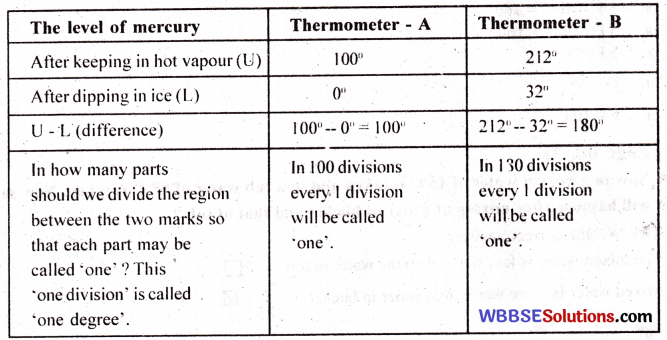
Both of the thermometers are of same type. Bulbs of both the thermometers are – immersed into the same liquid as shown in the figures 1 and 2.

a Do you think that the height of the mercury columns in the two thermometers in figure 1 have been shown correctly? Justify your answer.
Answer:
Yes, because the height of the mercury columns in the both the thermometers are same.

WBBSE Class 7 Science Solutions Chapter 1.1 Heat

Do you think that the heights of the mercury columns in the two thermometers in figure 2 have been shown correctly ? Give reason for your answer.
Answer:
No, thermometers are different and ‘B’ thermometers are different. This is impossible because they immersed in same liquid.

Write the numbers chosen by you in the exact portions given below. (Page – 4)

WBBSE Class 7 Science Solutions Chapter 1.1 Heat 1

(Page no. 5)
Fill in the following table by taking date from Table -1 and Table -2.

WBBSE Class 7 Science Solutions Chapter 1.1 Heat 2

(Page no. 6)

Now say how many divisions are there from θ° to C and 32° to F.
Answer:
50 and 90 divisions respectively.

WBBSE Class 7 Science Solutions Chapter 1.1 Heat

Now calculate 40°C in terms of degree Fahrenheit.
Answer:
WBBSE Class 7 Science Solutions Chapter 1.1 Heat 3

(Page no. 7)

Now in a bucket water of 15°C is taken and in a tub water of 9°C is taken. Now say, what will happen after mixing of water of bucket and that of tub?
Tick ‘✓’ the correct answer.
The mixed water is less warm than the water in tub [ ]
Mixed water is more warm than water in bucket. [✓]

(Page no. 8)

Fill in the following blanks
Answer:
The rise in temperature of the water in the first container = 50°C.
The rise in temperature of the water in the second container = 75°C.

Water in which container has observed more heat to obtain the temperatures stated above?
Answer:
The second container.
Now the two containers with water at 50°C and 75°C are kept at room temperature (25°C).
After sometime water of the two containers will separately reach room temperature. The irst container with decrease by (50-25)°C = 25°C and the second container will decrease by (75-25)°C = 50°C.

WBBSE Class 7 Science Solutions Chapter 1.1 Heat

water of which container will lose more quantity of heat?
Answer:
The second container.

(Page no. 9)

In which case will water absorb more heat in going from a temperature of 25°C to 50°C ? Will it be the case of one glass of water or twenty glasses of water ?
Answer:
Twenty glass of water.

Fill in the table given below :- (Page no. 10)

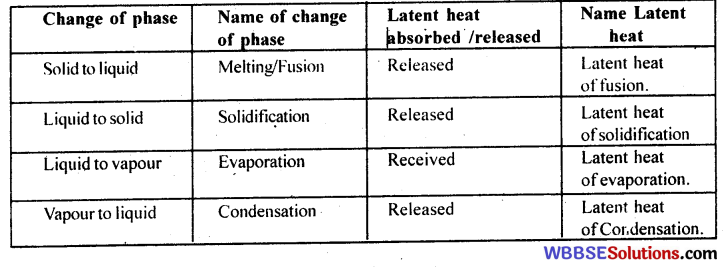
WBBSE Class 7 Science Solutions Chapter 1.1 Heat 4

Now fill up the following table : (Page no. 12)

WBBSE Class 7 Science Solutions Chapter 1.1 Heat 5

Now see whether you can explain the incidents given below. (Page no.13)

Why there is a cool sensation after bathing ?
Answer:
When we bath. some water evaporates taking the latent heat from our body. So our body loses some amount of heat. The temperature of our body becomes less than adjacent surrounding. So we feel a cool sensation after bathing.

Why the floor becomes cool when it is mopped with water?
Answer:
When floor of a room is mopped with water, the water evaporates taking the latent heat from the floor and also from the adjacent surroundings. So the floor loses heat and becomes cool.

WBBSE Class 7 Science Solutions Chapter 1.1 Heat

During summer if all the doors and windows are kept open and wet curtains are hung, the room remains moderately cool. Explain.
Answer:
During summer if all the doors and windows are kept open and wet curtains are hung. the water from the curtain evaporates slowly. In this process the required latent heat is taken by water from room. so the room become cool.

Influence of heat and temperature on living being.
Answer:
Influence of heat and temperature is observed on the variation of stucture, nature and lifestyle of living being. Animals of winter zone are more hairy than the animals of summer zone. In a hot day more sweating from the human body and panting of dog is observed. All of them keep the body cool. Again to keep the body warm there is dense fur on the body of Polar Bear. The penguins hug each other for the same reason. Plats are dried up in very hot condition. Again cameleon. cold blooded animals like snake enjoy the heat of the sun or heat of the sand. These phenomena occur as a result of the influence of heat.

Let’s see, what people do when the temperaturerises. (Page no. 14)
Word troves : breathing. food intake, perspiration, work.

1. They raise perspiration rate. 2. Breathing rate is increased. 3. The diameter of Blood vessel is increased. 4. Amount of food intake is decreased. 5. Aversion to work and lethergy are seen.

What happens in the body of human beings when temperature of the body is decreased? Write that with the help of following word trove.
Word troves : trembling, food intake, sweating, hairs.
1. Trembling occurs. 2. The rate of food intake decreases. 3. Excessive sweating increases. 4. The hairs stand on end.

Discuss yourselves about phenomena where influence of heat is observed on living organisms of atmosphere and write in the space given below.
Generally white flowers blessom in the night in less temperature, the flowers with coloured petals bloom in daytime, sunflower blossoms when sun’s ray fall on it, during winter season merrigold blooms only in cold temperature.

Class 7 Science Chapter 1.1 Question Answer West Bengal Board –Heat

Multiple Choice Questions & Answers : (1 mark for each question)

Question 1.
Celsius scale is divided into-
i) 80 parts
ii) 180 parts
iii) 100 parts
iv) 120 parts
Answer:
iii) 100 parts

WBBSE Class 7 Science Solutions Chapter 1.1 Heat

Question 2.
Freezing point of Fahrenheit scale is –
i) 32° F
ii) 0°F
iii) 180° F
iv) 80°F
Answer:
i) 32° F

Question 3.
To make thermometer quickly effective-
i) Shape of the bulb should be large
ii) Shape of the bulb should be small
iii) Bulb should be made round in shape
Answer:
ii) Shape of the bulb should be small

Question 4.
1 Calorie =
i) 4.18400 joules
ii) 1.18400 joules
iii) 2.18400 joules
iv) 3.18400 joules
Answer:
i) 4.18400 joules

Question 5.
The amount of heat required to change the temperature of unit mass of the substance by one unit is called-
i) latent heat
ii) heat
iii) specific heat capacity
Answer:
iii) specific heat capacity

Question 6.
Temperature of substance A is 100°F and temperature of substance B is 100° C. Then say which of the following is correct.
i) B substance has more heat
ii) A substance has more heat
iii) Two substance has same heat
Answer:
i) B substance has more heat

WBBSE Class 7 Science Solutions Chapter 1.1 Heat

Question 7.
Which of the following substances have highest specific heat capacity-
i) Alcohot
ii) Kerosene
iii) Water
Answer:
iii) Water

Question 8.
The instrument by which heat absorbd or heat released is measured is called-
i) Barometer
ii) Thermometer
iii) Caloriemeter
Answer:
iii) Caloriemeter

Question 9.
Heat is a from of-
i) substance
ii) energy
iii) absorber
Answer:
ii) energy

Question 10.
The amount of heat energy required to raise the temperature of 1 ~g of water by 1°C is called-
i) 1 J
ii) 1 K cal
iii) 1 Calorie
Answer:
iii) I Calorie

Question 11.
Water stored in earthen pots gets cooled due to-
i) evaporation
ii) boiling
iii) freezing
Answer:
i) evaporation

Question 12.
If in two same type of kettle equal quantity of water and milk are boiled by same time keeping side by side the-
i) Water and milk would began to boil at the same time
ii) Milk will boil quicker than water
iii) Water will boil faster than milk
Answer:
ii) Milk will boil quicker than water

WBBSE Class 7 Science Solutions Chapter 1.1 Heat

Question 13.
Change of vapour to liquid is called-
i) melting
ii) evaporation
iii) boiling
iv) condensation
Answer:
iv) condensation

Question 14.
In SI system specific heat capacity of water is-
i) 4.2 Joule
ii) 4200 J/Kg
iii) 42 J/Kg
Answer:
ii) 4200 J/Kg

Question 15.
Change of solid to liquid is called-
i) melting
ii) evaporation
iii) melting
iv) cordensation
Answer:
i) nelting

Fill in the blanks : (1 mark for each question)

1. All the substances do _____ a definite melting point.
Answer:
not have

2. When pressure is increased, melting point of ______ decrease.
Answer:
ice.

WBBSE Class 7 Science Solutions Chapter 1.1 Heat

3. In a definite pressure pure crystal shaped substances have _______ melting and freering point.
Answer:
same.

4. When moulded iron is solidified its shape ______.
Answer:
increase.

5. Wax has _______ definite melting point.
Answer:
no.

6. Ether is a _____ liquid.
Answer:
volatile

7. If heat is the reason then temperature is its _____.
Answer:
result.

8. 0°C = – °F
Answer:
32°.

9. Clinical thermometer should not be immersed in ______ water.
Answer:
Boiling.

WBBSE Class 7 Science Solutions Chapter 1.1 Heat

10. Heat is a form of ______.
Answer:
energy.

11. The degree of hotness or coldness of a body is called _______.
Answer:
temperature.

12. When two bodies of different temperatures are kept in contact, the hot body loses heat and the cold body gains lieat, till their temperatures are ______.
Answer:
same

13. The boiling process takes place ove ______ liquid.
Answer:
entire.

14. In CGS system the unit of heat is ______ .
Answer:
calories

15. Heat always flows from ______ temperature to ______ temperature.
Answer:
higher, lower.

WBBSE Class 7 Science Solutions Chapter 1.1 Heat

16. Heat is a _______ quantity.
Answer:
scaler.

17. Normal temperature of a human body is 98.4°F. In celcius scale it is _______.
Answer:
36.89°C.

18. Hahrenheit is divided into _______ equal parts.
Answer:
180°

19. _____ is responsible for the change of state of a substance.
Answer:
latent heat.

20. ____ has a very high latent heat of vaporisation.
Answer:
water.

State whether True or False : (1 mark for each question)

1. The floor becomes cold after mopping it with water.
2. Spirit evaporates very slowly.
3. Change from liquid to solid is calied solidification.
4. The unit used in SI system to measure heat is calorie.
5. The change of phase of a substance from solid to liquid is called melting.
6. If water is kept in an earthen pitcher, it becomes cool.
7. The leaves of babul and radhachura ere open at night.
8. When temperature of human body decreases trembling occures.
9. When body temperature rises in people breathin, rate is increased.
10. Plants are dried up in very cold condition.
Answer:
1. true
2. false
3. true
4. false
5. true
6. true
7. false
8. true
9. true
10. false

WBBSE Class 7 Science Solutions Chapter 1.1 Heat

Match the following: (1 mark for each question)

a) Match the column A with column B.

Column A Column B
a) Liquid to solid– i) after bathing
b) Vapour to liquid– ii) snake
c) Cold-blooded animal– iii) volatile substance
d) Spirit is a iv) open in daylight
e) Cool sensation is felt v) solidification
f) 0° C to 100°C– vi) are hairy
g) Latent heat is required for vii) condensation
h) Animals of of cold region viii) Celsius scale
i) The leaves of some trees ix) evaporation

Answer:
a) I.iquid to solid — solidification.
b) Vapour to liquid — condensation.
c) Cold-blooded animal — snake
d) Spirit is a volatile substance.
e) Cool sensation is felt after bathing.
f) 0° C to 100° C – Celsius scale.
g) Latent heat is required for evaporation.
h) Animals of cold region are hairy.
i) The leaves of some trees open in daylight.

Very Short Questions & Answers : (1 mark for each question)

Question 1.
What is the SI unit of temperature?
Answer:
The SI unit of temperature is Kelvin (K).

WBBSE Class 7 Science Solutions Chapter 1.1 Heat

Question 2.
Which liquid has the highest specific heat capacity?
Answer:
Water has the highest specific heat capacity.

Question 3.
What are the limitations of Celsius scale?
Answer:
In Celsius scale lower limit is 0°C and upper limit is 100°C.

Question 4.
How many divisions are there between upper and lower limit of Fahrenheit scale?
Answer:
In Fahrenheit scale there are divisions Upper limit – lower limit = 212°F-32°F=

Question 5.
Is heat vector quantity?
Answer:
No, heat is scaler quantity.

Question 6.
0°C or 0° F which one is lesser?
Answer:
between 0°C and 0°F, 0°F is lesser.

Question 7.
In CGS system what is the unit of temperature?
Answer:
In CGS system the unit of temperature is degree celsius.

Question 8.
What is the heat r.easering property of mercury thermometer?
Answer:
The measuring property of thermometer is its expansion due to heat.

WBBSE Class 7 Science Solutions Chapter 1.1 Heat

Question 9.
1 Calorie = how many Joule?
Answer:
1 Calorie =4.2 Joule.

Question 10.
What do you mean by primary difference of a thermometer?
Answer:
The difference between the upper limitation and lower limitation of a thermoneter is called the primary difference of a thermometer.

Question 11.
What is the amount of heat given out by a body?
Answer:
Heat given out by a body = mass of the body × specific heat capacity of the body × fall in temperature of the body.

Question 12.
What is the amount of heat absorbed by a body ?
Answer:
Heat absorbed by a body = mass of the body × specific heat capacity of the body × rise in Temperature of the body.

Question 13.
How could you find out specific heat capacity of a substance?
Answer:
WBBSE Class 7 Science Solutions Chapter 1.1 Heat 6

Question 14.
What is the unit of specific heat capacity in CGS system?
Answer:
In CGS system the unit of specific heat capacity is Calorie / gran / °C.

Question 15.
What is melting?
Answer:
Change of a substance from solid to liquid state is called melting.

WBBSE Class 7 Science Solutions Chapter 1.1 Heat

Question 16.
What is solidification?
Answer:
Change of a substance from liquid to solid state is called solidification.

Question 17.
What is evaporation?
Answer:
Change of a substance from liquid to vapour state is called evaporation.

Question 18.
What is condensation?
Answer:
Change of a substance from vapour to liquid state is called condensation.

Question 19.
What is latent heat of a substance?
Answer:
Latent heat of a substance is defined as the amount of heat required to change the state of the substance without any change in temperature.

Question 20.
What is latent heat of fusion?
Answer:
The latent heat of fusion is the amount of heat required to change a substance from the solid state to its liquid state at its melting point without any change in temperature.

Question 21.
What is the latent heat of the fusion of ice?
Answer:
The latent heat of the fusion of ice is 80 calorie / gram.

WBBSE Class 7 Science Solutions Chapter 1.1 Heat

Question 22.
Name a volatile substance.
Answer:
Sprit or ether is a volatile substance.

Question 23.
What is vaporization?
Answer:
Vaporization is a transitional phase of a compound or an element and it occurs during the boilling or sublimation process.

Question 24.
What is evaporation?
Answer:
Evoporation is nothing but a type of vaporization which mostly occurs at temperatures below the boiling point.

Question 25.
What is necessary for vaporization?
Answer:
Latent heat is necessary for vaporization.

Question 26.
What a dog do to keep its body cool?
Answer:
A dog projects its tongue out and pants to keep its body cool.

Question 27.
What is the unit of measuring heat in SI system?
Answer:
In SI system heat is measured in joule.

Question 28.
Name another unit other than joule which is used to measure heat.
Answer:
Other than joule heat is measured in calorie.

WBBSE Class 7 Science Solutions Chapter 1.1 Heat

Question 29.
What is used to measure fever?
Answer:
Clinical thermometer is used to measure fever.

Question 30.
What is used inside thermometer?
Answer:
Mercury is used inside the thermometer.

Question 31.
In what degree celsius water converts into ice?
Answer:
In 0° celsius water converts into ice.

Short Questions & Answers : (2 marks for each question)

Question 1.
What is heat? Write down its units.
Answer:
Heat is a form of energy which causes a sensation of hotness and coldness and which can be transferred from a hotter body to a cooler body.
Units of heat are – In CGS system it is calorie and in SI system it is joule. I Calorie = 4.2 joule.

Question 2.
What is temperature? Write down its units.
Answer:
Temperature is the degree of hotness or coldness of a body. Temperture is a relative measure, or indication of hotness or coldness.
Units of temperature are – In CGS system it is degree celsius (0°C) and in SI system it is Kelvin (K).

Question 3.
What is thermometer? What is mercury thermometer?
Answer:
Thermometer is an instrument which measures the temperature of a substance perfectly. A thermometer in which mercury is used for measuring temperature is called mercury thermometer.

WBBSE Class 7 Science Solutions Chapter 1.1 Heat

Question 4.
What is Celsius scale?
Answer:
The thermometer scale which was invented by the Swidish as tranomer Anders Celsius is named after him. He devised the inverted form of this scale – ice point 0°n and steam point 100°. The scale is divided into 100 parts. Every part is called 1°C.

Question 5.
What is Fahrenheit scale?
Answer:
Fahrenheit scale is a temperature scale in which the temperature of boiling water is taken as 212 degrees and the temperature of melting ice is taken as 32 degrees. It was invented by Gabriel Fahrenheit a German physicist. The scale is diveded into 180 parts and each part is taken as 1°F.

Question 6.
What do you mean by 1 calorie of heat? Is it a vector quantity?
Answer:
The amount of heat energy required to raise the temperature of 1 gram of pure water by 1°C is called 1 caloric. Heat is has only magnitude but no direction so it is a scalar quantity. It is not vector quantity.

Question 7.
What is specific latent heat ?
Answer:
Specific latent heat of a substance is defined as the amount of heat required to change the state of unit mass of the substance without any change in temperature.

WBBSE Class 7 Science Solutions Chapter 1.1 Heat

Question 8.
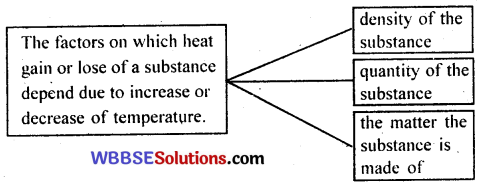
Name three factors that determine the quantity of heat absorbed by a body.
Answer:
The quantity of heat gained by a body depends on the following three factors.
a) Mass of the substance
b) Nature of the substance
c) Rise in temperature of the substance.

Question 9.
What is the principal of calorimetry ?
Answer:
The principal of calorimetry states that if two bodies at different temparatures are placed in contact with each other, the hot body will lose heat till they reach a common temperature.

Question 10.
At what temperature the reading of Fahrenheit will be twice than Celsius scale?
Answer:
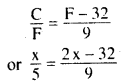
Taking C = x and F = 2x.

WBBSE Class 7 Science Solutions Chapter 1.1 Heat 7
or, 9 x = 10x – 160 or, 9x – 10 x =-160
or, – x = – 160 or x = 160
∴ Required temperatures are 160°C or 320°F

Long Questions & Answers : (3 marks for each question)

Question 1.
What are the fixed points of a thermometer? What do you mean by lower fixed point and upper fixed point of a thermometer?
Answer:
Two definite temperatures are taken as upper and lower limits to make a scale of a thermometer. There two definite limits are called fixed points of a thermometer.

Lower fixed point – In a definite temperature and in a definite atınospheric pressure when ice changes into water. then this temperature is called lower fixed point.

Upper fixed point – In a definite temperature and in a definite atmospherie pressure when water begings to boil and change into vapour, then this temperature is called upper fixed point.

WBBSE Class 7 Science Solutions Chapter 1.1 Heat

Question 2.
What is relation between Celsius scale and Fahrenheit scale ?
Answer:
100 division in Celsius scale is equal to 180 division in Fahrenheit scale.
Then 1 division in Celsius scale = \(\frac{180}{100}\) division in Fahrenheit scale.
C division in Celsius scale =\(\frac{180}{100}\) divisions in Fahrenheit scale.
Then we can write \(\frac{180}{100}\) = F-32 or \(\frac{9}{5}\)=F-32 or c=(F-32)

Again \(\frac{9C}{5}\) = F-32
then \(\frac{C}{5}\) = \(\frac{F-32}{9}\)
C =\(\frac{5}{9}\)(F-32)

Question 3.
State the difference between Heat and Temperature.
Answer:

Heat Temperature
1. Heat is a form of energy. 1. Temperature is the degree of hotness or coldness of a body.
2. Heat is the reason of temperarure. 2. Temperature is the result of heat.
3. Units of heat in CGS system is calorie and in SI system is Joule 3. Units of temperature in CGS system is degree celsius and in SI system is Kelvin.
4. Heat is measured by an instrument called calorimeter. 4. Temperature is measured by thermometer.

Question 4.
Explain why water in an earthen pitcher remains cool.
Answer:
Water in earthen pitcher remains cool. Water in earthen pitcher remains cool. In fact, numerous capillary holes are there, in the wall of earthen pitcher. Through the holes a little amount of water comes out from the pitcher. Then envaporation takes place. The process needs latent heat. Then the water on the wall absorbs requirite latent heat the pitcher and water in it. As a result the pitcher and water in side it loses that heat and become cool.

Question 5.
Why cooling sensation is felt when ether or sprit is poured on hand?
Answer:
In fact, spirit or ether is a volatile compound (this type of substance evaporates very quickly). Latent heat is required for evaporation. The spirit or ether absorbs latent heat fron the surrounding also and from the hand. Therefore, the particular position of hand loses heat, that is why, when spirit or ether is poured on hand, cooling sensation is felt at that spot.

WBBSE Class 7 Science Solutions Chapter 1.1 Heat

Question 6.
State the difference between evaporation and boiling.
Answer:

Evaporation Boiling
1. Evaporation taks place at all temperatures. 1. Boiling takes place at the boiling point of the liquid.
2. Evaporation is a slow and slient process. 2. Boiling is a fast and violent process.
3. Evaporation takes place only at the surface of the liquid. 3. Boiling takes place over the entire mass of the liquid.
4. Evaporation causes cooling. 4. Boiling does not cause cooling.

Question 7.
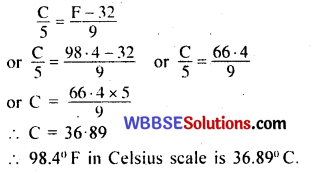
Normal temperature of a body in clinical thermometer is 98.4°F, how much it will be in Celsius scale ?
Answer:
We know that
WBBSE Class 7 Science Solutions Chapter 1.1 Heat 8

Question 8.
How much heat 50 gm of water at 25°C will take to reach boiling point ?
Answer:
Mass of water =50 gm
Intial temperature =25°C
Final temperature =100°C
Specific heat of water =1 Cal/g /°C
Heat gained = 50 × 1 × (100-25) Cal =3750 Cal.
∴ Required heat = 3750 Calorie.

West Bengal Board Class 8 Science Book Solution in English WBBSE

WBBSE Class 8 Science Question Answer West Bengal Board

WBBSE Class 8 Science Book Solutions West Bengal Board in English Medium

WBBSE Class 8 Science Book Solutions West Bengal Board in Hindi Medium

WBBSE Class 8 Solutions

West Bengal Board Class 7 Science Book Solution in English WBBSE

WBBSE Class 7 Science Question Answer West Bengal Board

WBBSE Class 7 Science Book Solutions West Bengal Board in English Medium

WBBSE Class 7 Science Book Solutions West Bengal Board in Hindi Medium

WBBSE Class 7 Solutions

WBBSE Class 7 History Solutions Chapter 6 Towns, Traders and Trade

Detailed explanations in West Bengal Board Class 7 History Book Solutions Chapter 6 Towns, Traders and Trade offer valuable context and analysis.

WBBSE Class 7 History Chapter 6 Question Answer – Towns, Traders and Trade

1. Find the odd one out :

a) Shajahananad, Tughlaqabad, Qila Rai Pithora, Daulatabad.
Answer: Qila Rai Pithora

b) Tanka, Mohar, cotton, silver.
Answer: Cotton.

WBBSE Class 7 History Solutions Chapter 6 Towns, Traders and Trade

c) Indigo, Peeper, Banjara, Multani
Answer: Banjara.

d) Karavanian, Kasba, Banjara, Multani. is
Answer: Kasba

e) Pandua, Burhampur, Chittagong, Gaur. is
Answer: Burhampur.

2. Match the column A with B

A B
Siri
Danes
Saraf
Hauz
Chirag-I Delhi
Inhabitants of Denmark
Sheikh Nasiruddin
Alauddin Khalji
Exchange of coins
Preservation of water.

Answer:

A B
Siri
Danes
Saraf
Hauz
Chirag-I-Delhi
Alauddin Khalji
Inhabitants of Denmark
Exchange of coins
Preservation of water.
Sheikh Nasiruddin

3. Answer in brief : ( 30 to 35 words) :

a) How would cities develop in the medieval India?
Answer:
There were a number of cities in India during the age of the Sultanate as well as the Mughals. They were often centres for business and finance. Cities were also established for political and administrative reasons. Cities around temples and mosques was important religious cities. Most of the cities had flourished during the 13th to 19th century AD.

WBBSE Class 7 History Solutions Chapter 6 Towns, Traders and Trade

b) Why did old Delhi of the Sultanate gradually decline?
Answer:
The city of old Delhi changed to a great extent in the second half of the 14 century. The city was not built in the stony regions of Araballi but the city Ferozabad was buit around Feroz Shah Kotla. This city was along the banks of the Yamuna River. Thus water supply enabled easy transportation of goods. The old city of the Sultanate was gradually reduced to ruins.

c) Describe the kuthis of the European Companies.
Answer:
The European merchants used to make houses according to the requirments in the Kothis. The Kothis were fortified with arms and ammunitions. They had their residences as well as godowns there. It was in this way the Gujrat, North and South coromondal became the main centres of the Europeans.

WBBSE Class 7 History Solutions Chapter 6 Towns, Traders and Trade

d) How did the Mughal rulers encoruage trade?
Answer:
The Mughal rulers encouraged the merchants in trade. They announced tax relief on goods, gave Permision for establishement of Kothis. Many of the Mughal aristocrats were engaged in trade themselves. The emperor, members of the nobility and the aristrocrats were engaged in trade themselves.

They used to employ craftsmen in their ‘Karkhans’ or factories to make luxury items for themselves. But trade was not the intention in such cases. Thus when Europe moved forward through trade, agriculture was the base for Indian economy.

5. Answer the following questions in 100 to 120 words :

a) Why did Delhi develop into an important city in the 13th century?
Answer:
The development and flourishment that took place in Delhi during the middle ages can be divided into two stages. One was in the 10th to 14th century and the other in the 17th century. Delhi during Qutubuddin Aibak’s time centred around the city Quila Rai-Pithore. This was the first Delhi of the Sultanate or Qutab Delhi.

Later during the rule of Giyasuddin Balaban a township named Ghiaspur was established beside the River Yamaun. Balban’s grandson Kaikobad built the Quilaghari Place near the Yamuna river. Jalaluddin Khalji’s Shaher-1-Nau or New city was centered around this palace. People belonging to the class of Amirs and Sardars settled in the place with them came Singers and musicians.

A strong fort city was built in Siri with the view to protect the citizens during the reign of Sultan Allauddin Khalji. Sultan Giyasuddin Tughlaq wanted a place to reside with his followers. So he established Tughlaqabad a bit away from this Purana shahar.

This was never the capital or the centre for business. In his time an attempt was made to build a wall around Qutab Delhi, Siri and his very own ‘Jahanpanah’ in order to form a greater city. This work however could not be completed. Despite all this the Delhi of times of the Sultanate never lost his importance.

WBBSE Class 7 History Solutions Chapter 6 Towns, Traders and Trade

b) Describe the urban life of Shahjahanabad.
Answer:
The Population of Shahjahanabad was of a cosmopolitan nature. People belonging to various classes resided in different types of houses. The nobility and high officials lived in beautiful houses with gardens, the rich merchants lived in houses decorated with terracotta tiles and stones, the ordinary Shopkeepers would live above or behind their shops.

The huge sprawling houses were known as ‘havelis’. The ordinary houses were known as ‘makam’ or ‘Kothi’. Very small rooms were known as ‘Kothri’. There were also bunglows. Many thatched huts built around big houses. These served as quarters for ordinary soldiers, servents, skilled laboures and the like.

Sometimes, the huts caught fire, as a result of which the people and the cattle boat their lives. But there was no such differences in the settlements. High officials like Amirs and the Poor craftmen would live in the same ‘mohalla’ side by side. There were two highways in Shahjahanabad. The high ways were known as ‘bazar’ because they lived up with shops.

c) Why did trade flourish during the Delhi Sultanate?
Answer:
Business had spread during the time of the Sultanate. There were several reasons for this. In the 13th -14th century the Sultans built some new cities and townships. Sometimes the houses in the old cities were rebuilt. The writings of that time give descriptions of how the cities were formed. The nobility, aristocrats, soliders and common people started living in these cities.

Thus the cites soon became over populated. A lot of raw materials and labourers were needed to build the palaces, mosques, markets, pubs, bath, water supply system etc. These labourers belonged to different caste and creed. Some were Indian, some came from other countries, Many labourers were Prisoners of wars and slaves.

The import-export business had developed with a view supplying the people with their daily needs and raw building materials. The Sultans maintained a large army. In Sultan Alauddin Khalji’s time tax was imposed on the farmers to acquire money to maintain the army. The famers were compelled to sell their crop to the merchants. The luxury items used by the nobility Provided scope for business.

d) What was the nature of inland trade in medieval India?
Answer:
There were two kinds of business in the country.
i) Business between the villages and the cities and towns.
ii) Business between two cities. The goods that would be sent from the villages to the highly populated cities would generally be less priced and would come in large numbers. Crops, Edible oil, Ghee, Salt would come in large quantities to be sold in the cities.

From one city to another would come luxury items created for the rich and the aristocrats. The craftsmen belonged to different communities. Good wine, fine muslin cloth would be imported from various places.

Cotton and silk from Bangladesh, Coromondal and Gujrat were much in demand. It was the first time in this age that the spinning wheel was used to make cloth. Other handicrafts such as that of leather, wood, metal, carpets were used as commodities and were also traded during this time. It was in this age that paper was first made in India. It so happened that the sweet sellers started selling sweets in paper packets.

WBBSE Class 7 History Solutions Chapter 6 Towns, Traders and Trade

The system of communication improved a lot during this time. Inns were built at the roadside: where travellers and merchants could keep their luggage and take rest. Tax collection and business: became easier due to the introduction of Tanka (Silver coins) and jital (Gold coins.)

e) What idea do you gain about the foreign trade from the import-export chart given?
Answer :
There were many foreign traders from different countries came to India for trading purpose.Firstly, India imported from the East and South East Asia Spices, Tin, copper. India imported silver and gold from Europe.

On the other hand European countries imported Silver from America. India supplied cotton textile and opium to East and South East Asia. Europe imported black Peeper, Indigo, Saltpetre, cotton Textile, silk and silk Fabric from India. This is the trading picture of the middle age.

Class 7 History Chapter 6 Question Answer West Bengal Board – Towns, Traders and Trade

Multiple Choice Questions & Answers : (1 mark for each question)

Question 1.
Quila Rai Pathora was established by …………….
i) Alauddin Khalji
ii) Froz Shah Tughlaq
iii) Prithviraj
iv) Humayun
Answer:
iii) Prithviraj

Question 2.
Jahanpanah was established by …………….
i) Muhammad bin Tughlaq
ii) Ghiyasuddin Tughlaq
iii) Feroj Shah Tyghlaq
iv) Aluddin Khalji
Answer:
ii) Ghiyasuddin Tughlaq

WBBSE Class 7 History Solutions Chapter 6 Towns, Traders and Trade

Question 3.
The term Kotla means …………….
i) market
ii) city
iii) hospital
iv) fort
Answer:
iv) fort

Question 4.
The main problem of Delhi was …………….
i) scarcity of water
ii) scarcity of space
iii) skilled labourers
iv) craftsmen
Answer:
i) scarcity of water

Question 5.
Hauz-i Shamsi was constructed by …………….
i) Giyasuddin Balban
ii) Alauddin khalji
iii) Illtutmish
iv) Ghiyasuddin Tughlaq
Answer:
iii) Illtutmish

Question 6.
In the 350 years of Sutanaterule, the rulers had transferred their administrative centre ……………..
i) ten times
ii) eleven times
iii) seven times
iv) eight times
Answer:
ii) eleven times

Question 7.
The fort of Attock was in …………….
i) Rajputna
ii) Deccan
iii) Delhi
iv) north-west
Answer:
iv) north-west

Question 8.
Shahjahanabad was built in the year …………….
i) 1648
ii) 1639
iii) 1635
iv) 1645
Answer:
ii) 1639

Question 9.
In Shahjahanabad beautiful and huge mansions were known as …………….
i) haveli
ii) makan
iii) kothi
iv) kothri
Answer:
i) haveli

Question 10.
In Sultanate era sweetmeat sellers of Delhi were selling sweets wrapped in ……………..
i) leaf
ii) jute bag
iii) paper
iv) cloth
Answer:
iii) paper

Question 11.
A kind of paper known as Hundi was introduced by the …………….
i) Saraf
ii) dalal
iii) merchants
iv) traders
Answer:
i) Saraf

Question 12.
Indian spices specially peeper, were much in demand in …………….
i) Africa
ii) America
iii) Europe
iv) Asia
Answer:
iii) Europe

WBBSE Class 7 History Solutions Chapter 6 Towns, Traders and Trade

Question 13.
The English merchants first established trade centres in …………….
i) Bengal
ii) Surat
iii) Goa
iv) Masulipattam
Answer:
iv) Masulipattam

Question 14.
Thomas Roe established trade Kothis in …………….
i) Patna
ii) Agra
iii) Burhanpur
iv) all are correct
Answer:
iv) all are correct

Question 15.
European ships were larger and more suited to naval warfare than …………….
i) Africa
ii) India
iii) America
iv) mansadar
Answer:
ii) India

Fill in the blanks : ( 1 mark for each question)

1. The word nagar originated from …………….
Answer:
Sanskrit

2. Fatehpur Sikhri was built by Mughal emperor …………….
Answer:
Akbar

3. During the time of Qutbuddin Aibak, Delhi grew around …………….
Answer:
Quila Rai Pithora

WBBSE Class 7 History Solutions Chapter 6 Towns, Traders and Trade

4. The Mongals had destroyed the city of Bagdad, which was a big center of the civilization.
Answer:
Muslim

5. An important source of water in Delhi was the hauz or is …………….
Answer:
talao

6. From Agra served as the capital of the Mughal empire.
Answer:
1596

7. During the reign of Alauddin Khilji revenue was collected in cash from the …………….
Answer:
peasantry

8. Delhi Sultans introduced two types of coins, Tanka and …………….
Answer:
Jital

9. …………….. acted as a link between the buyers and sellers.
Answer:
Dalals

10. A kind of paper known as Hundi was introduced by the is …………….
Answer:
Saraf

WBBSE Class 7 History Solutions Chapter 6 Towns, Traders and Trade

11. Cities like Varanasi, Rajmahal, Hooghly, Dhaka were all connected by …………….
Answer:
waterways

12. The European merchants were not interested in trading only, they also wanted control over the …………….
Answer:
sea routes

13. The Dutch settled in Surat in the west and in the Deccan.
Answer:
Masulipattam

14. The European merchants worked in India with the help of …………….
Answer:
middlemen

WBBSE Class 7 History Solutions Chapter 6 Towns, Traders and Trade

15. Gujarat, North and South Coromondel became the main trading centers for the …………….
Answer:
Europeans

State whether True or False: (1 mark for each question)

1. Communication system improved significantly in sultanate era.
Answer:
true

2. Business spread during the time of Delhi Sultanate.
Answer:
true

3. At Shahjahanabad had four main highways.
Answer:
false

4. In 1505 during the time of Sikandar Lodi the city of Agra started to ruin.
Answer:
false

5. All the dynasties of the Sultanate made Delhi the centre of their authority.
Answer:
true

WBBSE Class 7 History Solutions Chapter 6 Towns, Traders and Trade

6. Later Hauz-i Alai came to be known as Hauz-i Khas.
Answer:
true

7. The main problem of Delhi was scarcity of labour.
Answer:
false

8. The Subarbs were not enclosed by walls like the main cities.
Answer:
true

9. Siri was established by Muhammad bin Tughiaq.
Answer:
false

10. In the medieval age the growth and development of Delhi had two phases.
Answer:
true

11. The word Magar originated from Sanskrit.
Answer:
false

12. Shahjahanabad was established in 1540.
Answer:
false

13. During the reign of Alauddin Khilji a strong fort was built at Siri.
Answer:
true

14. An important source of water in Delhi was the Hauz or talao.
Answer:
true

WBBSE Class 7 History Solutions Chapter 6 Towns, Traders and Trade

15. From 1596 Agra served as the capital of the Mughal empire.
Answer:
true

Match the column A with column B.

Column A Column B
a) Jahan Ara Begam was i) two main highways
b) Beautiful and huge mansions were ii) for the travellers
c) Sliahjahanabad had iii) Emperor Jahangir
d) Roadside inns were built iv) Duke of Albuquerque came to India
e) Saraf couls assess v) wanted control over the sea routes
1) After Vasco da Gama vi) by Feroz Shah Tughiaq
g) European merchants vii) Saha Jahan’s daughter
h) Thomas Roe came to the court of viii) known as Haveli
i) Firojabad was established ix) the purity of metals

Answer:
a) Jahan Ara Begam was Saha Jahan’s daughter.
b) Beautiful and huge mansions were known as Haveli.
c) Shahjahanabad had two main highways.
d) Roadside inns were built for the travellers.
e) Saraf could assess the purity of metals.
f) After Vasco da Gama Duke of Albuquerque came to India.
g) European merchants wanted control over the sea routes.
h) Thomas Roe came to the court of Emperor Jahangir.
i) Firojabad was established by Feroz Shah Tughlaq.

WBBSE Class 7 History Solutions Chapter 6 Towns, Traders and Trade

Answer in brief (within 30 – 50 words) : (Full mark-3)

Question 1.
Name some towns developed between the 13th and 18th century.
Answer:
Delhi had become important in Indian politics and economy since early times. Apart from Delhi there were other important cities also. Pandua, Gauda, Nabadwip and Chittagong in bengal, Lahore in Punjab, Agra in north India, Fatehpur Sikri built by Nughal emperor Akbar, Burhanpur, Golconda and Bijapur in the Deccan and Ahmedabad, Surat etc.

Question 2.
Why was Delhi attractive to the rulers and merchants.
Answer:
Delhi is geographically located at the confluence of the Aravalli range and riverine plains of the Yamuna. It was convenient to build well protected forts here because of the slope of the land and the availability of building material from the Aravallis. Again the river Yamuna was the main waterway and the natural frontier to the east. Hence from time immemorial rulers and merchants were attracted to this region.

Question 3.
What is Kutub Delhi?
Answer:
The Sultanate was established Muhammed Ghori, the Sommander-in-Chief of Qutbuddin Aibak. During the time of Qutbuddin Aibak, Delhi grew around Quila Rai Pithora, the town of the Rajput rulers. This was the first Delhi or Qutb Delhi during the time of the Sultanate.

Question 4.
Following the description of Isami, write about the process of building the city of Delhi.
Answer:
Isami was a historian. According to his description, as the insects gather around the flame of a lamp, so too the aristocrats, artists and artisans practising different arts, physicians, jewel traders, sages and saints from Arabia, China, Central Asia and Byzantine began to settle in the city of Iltutmish.

Question 5.
Who destroyed the city of Baghdad and was its result?
Answer:
The Mongals destroyed the city of Bagdad. It was a big centre of Muslim civilisation. This helped Delhi to develop. It became the seat of the Sufi saints and was popularly referred to as Hazarat-i delhi. The famous Sufi Saint Nizamuddin Aulia lived here during this time.

Question 4.
What was the incident that made Ghiyasuddin popular?
Answer:
Sultan Ghiyasuddin, when leaving for Bengal to fight a war, ordered that Nizamuddin should leave the city before he returned. Nizamuddin’s disciples was worried about his security. Then he simply told them, “Delhi is still far away.” Ghyasuddin was killed during his return in an accident. This incident made Nizamuddin popular among the people.

Question 7.
Mention the cosmopolitan character of Delhi.
Answer:
Delhi was not dominated by any caste or religion. Generally skilled labourers or craftsmen belonging to the same profession lived in a particular area. The cities however were not very well planned. There was not enough scope for the people to settle according to their caste or creed.

WBBSE Class 7 History Solutions Chapter 6 Towns, Traders and Trade

Question 8.
What was the main problem of Delhi?
Answer:
The main problem of Delhi was scarcity of water. It was not possible to provide adequate water for the entire population. The Sultan dug a few ‘hauz’ or tanks but this did not solve the problem. Therefore the city started moving towards the Yamuna. The water problem became acute when the river started changing its course frequently.

Question 9.
What was the sources of water in Delhi?
Answer:
An important source of water in Delhi was the hauz or talao. Digging of water bodies and their renovation was a symbol of good administration. Sultan Iltutmish is credited with building the hauz-i shamsi or hauz-i sultani. Alauddin Khalji had constructed an even bigger four-cornered reservoir. Ghiyasuddin Tughlaq built another reservoir in the newly constructed Tughlaqabad.

Question 10.
Write about the importance of Delhi.
Answer:
The importance of Delhi never waned even though it came under the rule of various dynasties. The capital was changed several times during the mughal rule. This was not the case during the Sultanate. All the dynasties of the Sutanate made Delhi the center of their authoriry.

Question 11.
What is the story behind Chandni Chawk?
Answer:
There was a big bazar from Lal Qila to Jahanara Begum Chowk. Shah Jahan’s daughter, Jahan Ara Begam, built a garden to the north of this market and a bath to the sonth. It is said the Chawk would glitter on moonlight night nights and so it was named Chandni Chowk. Yet others claim that the glitter of coins of gold and silver in the chowk caused it to be named so.

Question 12.
Who were engaged in business?
Answer:
The Carvanians and Banjaras would bring food grains. Shahs or Multani merchants adept in long distance trade. They were also money lenders. Multani traders were mainly Hindu, although there were some Muslims as well. Other than these merchants there were several small traders. Some Sufi saints too were engaged in business.

Question 13.
What was Hundi?
Answer:
A kind of paper known as Hundi was introduced by the saraf. It came to be used in the times of Turks. The merchants could buy a hundi from a saraf and take it to different places and exchange it for money. This enabled merchants to carry money from one place to another.

WBBSE Class 7 History Solutions Chapter 6 Towns, Traders and Trade

Question 14.
Write about the sea trade in the medieval period.
Answer:
In the mediaval period many merchants from different countries joined the sea trade. Gujarati, Tamil, Telegu, Oriya and Bengali, Malabarase merchants had earned a name for themselves in the trading world. These merchants were from Hindu, Muslim and Jain communities. They traded with the Arab, Persian and South East Asian merchants. Some of the big Indian merchants had their own ships. The rest used to send goods on the ships of others.

Question 15.
When was the East India Company established?
Answer:
In A.D. 1600 The English East India Company was established in London. In 1602 Dutch East India Company was established in Amsterdam. In 1664 the French East India Company was established in Paris.

Question 16.
Give a short description of activities of English merchants.
Answer:
The English merchants first established trade centres in Muculipattam and then in Surat. Thomas Roe, the emmissary of King James I of England, came to the court of Emperor Jahingir. He established trase kothis in Agra, Patna and Burhanpur. Emperor Shah Jahan forced the Portugueseto leave Hooghly for engaging in slave trade. There after the Dutch, English, and French traded freely in India.

Answer in detail (within 100 – 120 words) : (Full mark-5)

Question 1.
Mention the cosmopolitan character of Shahjahanabad.
Answer:
Shahjahanabad had a cosmopolitan population. People of various classes lived in different types of houses. The princes and the Amirs lived in beautiful mansions. The rich merchants lived in brick and stone houses decorated with tiles. Common traders lived above their shops or behind them. The most beautiful and huge mansons were known as Haveli.

Houses inferior to the havelis were called makan and kothi. Apart from these there were bungalows. Many thatched huts existed beside the big houses. In these huts the ordingary soldiers, servants, artisans usually lived. High officials and poor artisans lived side by side.

Question 2.
Write a short note on treders and trading from 13th to 18th century.
Answer:
In India several merchant guilds traded in various parts of the country. In those days there were neither air routes nor rail routes. Road ways and waterways were the only means of communication. many of these routes were inaaccessible. Danger loomed at every step of the journey.

Yet the traders moved from one part of the country to another carrying their commodities for trading on animal backsor on sailing boats or ships. Not only the Indian trader but foreign merchants also came to do business. Many markets, mandis, hamlets, small and big towns grew up on the banks of rivers and sea-coast beacause of trade and commerce.

WBBSE Class 7 History Solutions Chapter 6 Towns, Traders and Trade

Question 3.
What were the causes for spreading business during the time of Delhi Sultanate?
Answer:
Business spread during the time of the Delli Sultanate. There were several reasons for this. In the 13th-14th century the Sultans of Delhi founded some new towns and rebuilt houses in the old cities. The Sultans and their nobilitiy, soldiers and the common people started to live in these cities. So the cities became populous.

A lot of raw material and labour was required to construct palaces, mosques, markets, pubs, baths etc. The labourers belonged to different caste and creed. Some were Indians and others came from abroad. Many labourers were enslaved prisoners of war. Import and export developed in course of supplying the people with daily necessities and building materials.

Question 4.
Write about the influx of foreign traders to India.
Answer:
The Portuguese were the pioneers who showed interest in coming to Indiaby sea. Their main interest was to capture the spice trade in India and South East Asia. Indian spices, specially pepper, were much in demand in Europe. The Portuguese wanted to make a good profit by buying the spices from Indian markets and sell them in Europe.

With this objective Vasco da Gama, the emissary of the king of Portugal, came to India. He reached calicut in Malabar in the south, in 1498. After Vasco da Gama, the Portuguese naval commander,Duke of Albuquerque, came to India. He wanted to end Arab domination in the arabian sea trade. The Portuguese secured influence over Goa.

The European merchants were not interested in trading alone. they also wanted control over the sea routes. Their ships were advanced and carried weapons. They became powerful in the Arabian Sea and indian Ocean.

WBBSE Class 7 History Solutions Chapter 6 Towns, Traders and Trade 1

Additional Questions and answers

Question 1.
Write the name of the capital of Chola dynasty.
Answer:
Thenjavur was the capital of Chia dynasty.

Question 2.
What is the name of the river that flowed near Thanjavur?
Answer:
Kaveri river flowed near Thanjavur.

WBBSE Class 7 History Solutions Chapter 6 Towns, Traders and Trade

Question 3.
Who built Rajarajeshvara temple?
Answer:
King Rajaraja Chola built Rajarajeshvara temple.

Question 4.
What were the market activities in towns?
Answer:
The towns were bustling with markets selling food grains, spices, cloth, jewllery etc.

Question 5.
How did water get supplied in towns?
Answer:
From wells and tanks water was supplied in towns.

Question 6.
What is meant by ‘pattern of urbanization’?
Answer:
Pattern of urbanization means the process by which cities are developed.

Question 7.
What was the capital of Chauhan reign?
Answer:
Ajmer was the capital of Chauhan reign.

Question 8.
Name the places which were famous for producing cloth.
Answer:
Thanjavur and Uraiyur were famous for producing cloth.

Question 9.
Which kind of cotton was used by the king?
Answer:
Fine cotton was used by the kings.

Question 10.
What did Gujarati traders use to sell?
Answer:
Gujarati traders sold textiles and spices.

Question 11.
Which spices were grown in the tropical climates?
Answer:
Pipper, cinamon, nutmeg, ginger etc. grown in tropical climate.

Question 12.
Who was Khwaja Muinuddin Chisti?
Answer:
Khwaja Muinuddin Chisti was a famous Sufi Saint.

WBBSE Class 7 History Solutions Chapter 6 Towns, Traders and Trade

Question 13.
Why were craftsman of Bidar so famous?
Answer:
The craftsmen of Bidar were famous for their inlay work in copper and silver.

Question 14.
When did Hampi fall into ruin?
Answer:
In 1565 the defeat of Vijayanagara by Deccan sultan is the cause of ruin of Hampi.

Question 15.
Which city was called the gate to Mecca?
Answer:
Surat was called gateway to Mecca.

Question 16.
Who had banking houses at Surat?
Answer:
The Kathiward sets ha huge banking houses at Surat.

Question 17.
When did Surat begin to decline?
Answer:
Towards the end of the 17th century Surat began to decline.

Multiple Choice Questions and Answers

Question 1.
An important trade center of western India was ………………..
i) Madurai
ii) Hampi
iii) Masulipattam
iv) Surat
Answer:
iv) Surat

Question 2.
Musalipattanam was famous for ……………….
i) temples
ii) horse trade
iii) trading port
iv) crafts production
Answer:
trading port

Question 3.
Hampi was the capital of which empire ……………….
i) Vijayanagara
ii) Mewar
iii) Mughal
iv) none of these
Answer:
Vijayanagara

WBBSE Class 7 History Solutions Chapter 6 Towns, Traders and Trade

Question 4.
Which of the following was not traders ……………….
i) Gujrat Baniyans
ii) The Mandari oswal
iii) Nenadesi
iv) The Banjaras
Answer: Nenadesi

Question 5.
A pilgrim centre was ……………….
i) Surat
ii) Puskar
iii) Bombay
iv) Bijapur
Answer:
ii) Puskar

Question 6.
Which of the following was an example of temple town ……………
i) Berar
ii) Ajmer
iii) Golconda
iv) Tanjavur
Answer:
iv) Tanjavur

Question 7.
The people from distant place visited Surat because it was ……………
i) a beautiful place
ii) the gateway of west Asia
iii) famous town
iv) pilgrim centre
Answer:
ii) the gateway of west Asia

Question 8.
The Rajrajeshvara temple is situated in ……………
i) Thanjavur
ii) Bijapur
iii) Ajmer
iv) Vijayanagara
Answer:
i) Thanjavur

WBBSE Class 7 History Solutions Chapter 6 Towns, Traders and Trade

Question 9.
What type of towns existed in medieval period …………..
i) administrative
ii) port
iii) temple
iv) all of these
Answer:
iv) all of these

WBBSE Class 7 History Solutions Chapter 7 Lifestyle and Culture: Sultanate & Mughal Era

Detailed explanations in West Bengal Board Class 7 History Book Solutions Chapter 7 Lifestyle and Culture: Sultanate & Mughal Era offer valuable context and analysis.

WBBSE Class 7 History Chapter 7 Question Answer – Lifestyle and Culture: Sultanate & Mughal Era

1. Fill in the blanks.

a. In the Sultanate and Mughal Period the houses houses of the common people were made of ______ (tiles and bricks/ cement and sand/ marble).
Answer:
tiles and brick

b. The couplets of Kabir are known as ______ (bhajan/katha katha/doha)
Answer:
doha

c. The sufis considered their Gurus as ______ (pir/muri/Be-shara)
Answer:
Pir.

WBBSE Class 7 History Solutions Chapter 7 Lifestyle and Culture: Sultanate & Mughal Era

d. ______ (kolkata/ Nabadwip/Murshidabad) was known as the main centre of the Chitanya movement.
Answer:
Nabadwip.

e. ______ (Nanak/Kabir/ Meera Bai) was the devotee of Lord krishna or Giridhari.
Answer:
Meera Bai.

f. The main feature of Din-i-ilahi was that the relation between the Mughal Emperor and the nobility was of ______.
Answer:
teacher-disciple.

g. The craftsmanship of setting gems on marble with intricate design is called ______(Chahar bag/ Pietra dura/ Terracota)
Answer:
Petra dura.

h. ______(Hanja Nama/ Tuti Nama/ Raja Nama) is the name of the Persian translation of Mahabharata.
Answer:
Rajam Nama.

i. (Daswant/ Mir Sayyid Ali/ Abdus Samad) ______ was known as ‘Sheerin Columa.’
Answer:
Abdus Samad.

j. Jaunpuri Raga was created by ______ (Baiju Baora/ Hussain Shah Sarki/ Ibrahim Shah Sarki).
Answer:
Hussain Shah Sarki,

k. The author of the ‘Sri Krishna Vijay Kavya is ______ (Kashiram Das/ Krittibas Ojha/ Maladhar Basu)
Answer:
Maladhar Basu.

WBBSE Class 7 History Solutions Chapter 7 Lifestyle and Culture: Sultanate & Mughal Era

l. ‘Persioan wheel’ was used for _____ (water lifting / ot bombard with a canon/ Gardening).
Answer:
Water lifting.

2. What are the matching explanation of the Statements given below:

a. Statement: The industries were established along the river basin.
Explanation 1 : No tax wes imposed for industries established beside rivers.
Explanation 2 : In the past all people lived beside rivers.
Explanation 3 : It was easier to import raw materials and export of produced materials.
Answer:
ExP-3 : It was easier to import raw materials and export of produced materials.

b. Statement : Chaitanya adopted Bengali as the means of spreading Bhakti.
Explanation 1: He only knew Bengali.
Explanation 2: In those days the language of the common people of Bengal was Bengali.
Exmplantion 3 : All books on Bhakti were written in Bengali.
Answer:
Exp-2 : In those days the language of the common people of Bengal was Bengali.

WBBSE Class 7 History Solutions Chapter 7 Lifestyle and Culture: Sultanate & Mughal Era

c. Statement: Chisti Sufis did not join in politics.
Explanation-1: They belived worshiping God was not possible involvement in politics.
Explanation-2: They did not understand politics
Explanation-3: They were humannists.
Answer:
Exp-3: They were humanists.

d. Statement : Akbar introduced Din-i-ilahi.
Explanation-1: He was a follower of Buddhism.
Explanation-2 : He wanted to build a group of followers.
Explanation-3: He gave up warfare.
Answer:
Exp-2: He wanted to build a group of followers.

e. Statement: The Mughal emperors were interested in building forts.
Explanation-1: Building cost of forts was less.
Explanation- 2 : Building forts was easier than palaces.
Explanation-3 : Building forts would make the empire secure.
Answer:
Exp-2 : Building forts was easier than palaces.

f. Statement: During the reign of Jahangir European painting influenced Mughal Painting.
Explanation-1 : In that period European paintings started arriving at the Mughal Court.
Explanation-2 : In that period the Mughal Painters were European.
Explanation-3 : In that period Indian artists had learnt Painting from Europe.
Answer:
Exp-1 : In that period European paintings started arriving at the Mughal Court.

g. Statement : In the medieval age Radha and Krishna were at the centre of Manipuri dance. .
Explanation-1 : The god and goddess of Indian dance were Krishna and Radha.
Explanation-2 : Vaishnava cult spread to Manipur in that period.
Explanation 3 : Chaitanya belonged to Manipur.
Answer:
Exp-2: Vaishnava cult spread to Manipur in that period.

WBBSE Class 7 History Solutions Chapter 7 Lifestyle and Culture: Sultanate & Mughal Era

h. Statement : In ancient india People used to write on Palm leaves.
Explanation-1 : In that Period Use of paper was not known.
Explanation-2: in that period cost of paper was high.
Explanation-3 : In that Period Indians had not invented ink to be used on paper.
Answer:
Exp-1: In that Period Use of paper was not known.

3. Answer the following questions in brief (in 30-50 words)

Question a.
Which fruits, vegetables and crops were produced in large scale in the sultanate and the Mughal Period?
Answer:
Mango, grapes, dates, rose-apple, banana, jackfruit, coconut etc. were the furits.
The main vegetables were-Brinjal, differen types of bitter-gourd. radish, potato, chilies, ginger etc.
The main crinere-wheat, rice, Barley, different types of Pulses etc.

Question b.
Who wer Bhakti Saints of Medieval India?
Answer:
Namdev, Janaesvar, Tukaram, Ramananda, Kabir, Nanak, Chitanyadev, Meera Bai, etc. were the famous Bhakti Saints of Medieval India.

Question c.
What is Silsila? What do you know about the life style of the Chisti Sufis?
Answer:
Silsila means order or group. There were two types of silsila or group in the sufismChistis and Suhrawardis. The life style of the Chisti Sufis were simple. They did not judge the people in the yardsticks of religion, wealh and Power. Chisti Sufis remained aloof from politics and the royal courts. They believed that any kind of involvement in state affairs, worship of god becomes impossible.

Question d.
How was the oath taking ceremony of Din-i-ilahi?
Answer:
Those who accepted Din-i-ilahi, took oath in this ceremony to sacrifice (Kurban) their life(Jaan), Property (Meal), religion (Din) and dignity (Namus). They had to bow feet at Badshah, as the disciples (murids) bowed to their sufi gurus (Peer). After the completion of this ceremony. Badshah presented them new turban, a medal of Sun and a Photo of Badshah to attach to the front of the turban.

WBBSE Class 7 History Solutions Chapter 7 Lifestyle and Culture: Sultanate & Mughal Era

Question e.
What are the special architectural characteristics of the Alai Dar waza?
Answer:
Alai Darwaza was built in the reign of Sultan Alauddin Khalji. It is an extra ordinary example of Indo-Islamic architectural art. This ‘Darwaza’ was built of red sandstone, supposing that this ‘Darwaza’ was a reflection of Alauddin’s power as Sultan. Not the message of Allah but the praises of Sultan were engraved on this Darwaza. It was an exception in this period. This was also in the Qutb complex. It became an example of the sultanate architecture.

Question f.
What is ment by ‘calligraphy’ and ‘Minitaure’?
Answer:
Art of handwriting was practiced in the Sultanate and Mughal period. In English it is called calligraphy. Then there was no printing press. Hand written books were the samples of art.
Each and every page of Tutinama, Razamnama (Persion translation at Mahabharata) etc. was decorated with fine handwriting and pictures. These pictures of small shape and size are called ‘miniature.’

Question g.
What is ‘Shivayana’? What aspect of the life style of Bengal Pesants is learnt from it?
Answer:
Literature centring with Lord shiva was written in Sultanate and Mughal period. Such writing are called ‘Shivayana’. Sivayana Poems were composed on the legends of Shiva and the household tales of Shiva and Durga. Poor Shiva-Durga were reflected in these writings. Here Shiva tries to earn by cultivation. In these writings poor peasant familes, was supposed to have been converted into Shiva and Durga family.

Question h.
Where was paper invented? Write what you know about the use of paper in medieval India.
Answer:
Paper was invented in China in the the first century AD. In thenth century Mongols of central Asia brought the paper making technology from China. Whin a short time use of paper spread in India. As a result reading and writing became easier. In the fourteenth century, it was said that paper became as cheap in India that sweet-meat seller used it as packet. It is also to be noted that at first European missionaries founded printing press in India. It took some more time to use this technology on commercial basis.

4. Answer in details : (in 100 to 120 words)

Question a.
Write about the lifestyle of the Common people in medieval India.
Answer:
Most of the people lived in the villages. The main function of agriculture was to meet the local demands. The basis of the society was a joint family. The position of women in the society and family was lower than the male mamber of the same. But men and women of a poor family worked jointly in their household work, as well as in their firms. Very basic elements were required for settlements of poor people. A well, ditch or a pond were sufficient enough for the villagers to make a habitation of their own. Trunks of trees, bunches of straw were their only nccessities to make a hut. There they found their space some how. After the payment of taxes and other government duties some share of crops was in hand of the peasants.

This was the only resource of their daily wages. The peasant families tailed day and night for some particular reasons. Very little is known about the daily life of the peasants. Festivals on some occasions were a bit exception in their monotonous life. Wrestling was a popular game at that time. Archery, javelin throwing and swimming were also popular. Rulers of Delhi and the regional states were changed in different times. But the life of the common people in sultanate and the Mughal period remained unchanged. Hard labour and Poverty these were the only thing in the life of Poor peasants artisans and labours in that period of India.

WBBSE Class 7 History Solutions Chapter 7 Lifestyle and Culture: Sultanate & Mughal Era

Question b.
Hoe were the people of different relegions united by Kabir’s Bhakti ideology?
Answer:
Kabir one of the Popular Bhakti Saints at 14th-15th century AD. was brought up in a Muslim Jola (weaver) family in Benaras. Some think that Kabir was one of the disciples of Ramananda. Along with monotheism of Islam, Vaisnaba, Natha-yogi and Tantrik beliefs were converged in the religions thought of Kabir. To him, all the religions were the same. All the gods were the same. In the opinion of Kabir, Rama, Hari, Gobind, Allah, Sain, Sahib were the different names of the same god. His philosophy helped very much to sattle the disunity and contradiction among the Hindus and muslims in the then society. Kabir believed that man would get his god in his mind through devotion. For this, there is no need to go to temple or Mosque. So, to him, idol worshipping, bathing in the Ganges or to observe Namaz are of no value. In the social life of that Period Kabir’s thought was most important. He was the person the show manship of religious rituals.

Question c.
Analyse the effect of the Vaishnava movement in Bengal.
Answer:
In the 16th century AD, Propagation and diffusion of the Bhakti movement in Bengal became Powerful by the efforts or Sri Chitanya and his companions. In Bengal, particulary in Rada Bengal, vaishnava religion was prevalent previously. Sri Chitanya combined that vaishavite tradition with the sprit of Bhakti Geet. As a protest against the discrimination of caste and creed and class, the vaishnava Bhakti spread like a movement. Nabadwip was the main centre of this religious movement. At that time, Non-Brahmins formed the majority of the population of the city.

The condition was the same in the villages. Long before the birth of Chaitanaya, administrative changes took place in Bengal as a result of Turkish invasion. In Hussain Shai rule the influence of the Brahmanas declined and that of the Kayasthas increased. Besides, there was also torture of rulers and officials. Common Poor People could not find any relief from this torture in traditional Islam giving up Hinduism. Besides, different types of religion and belief were Prevalent in the society.

There was also some attraction to Tantric practices. worship of their folk deities, such as Manasa, Chandi and Dharma, was in practice. But, it was not so easy to propagate Bhaktism in that atmosphere of Nabadwip. Brahmana Bhattacharays were dead against the vaishnavas. They looked down upon Bhaktism and Vaisnavism. Sri Chitanya and his followers emphasized on only one social Principle. This principle is known as Bhakti. Bhakti is spontaneous, it needs no prepatation. Sri Chitanya emphasized upon plain living and simple behaviour. There was no room for pomps, Vaishnava Bhakti became Popular for the liberal outlook of Chaitanya.

WBBSE Class 7 History Solutions Chapter 7 Lifestyle and Culture: Sultanate & Mughal Era

Question d.
Write a short note on Akbar’s Din-i-ilahi.
Answer:
In 1570 AD Akbar gradually stopped to affer ‘Namaz’ and other Islamic rituals publicly. Insted of it he began to observe some rituals as he liked. Once he discussed with Ulema on Islam in Fatehpur Sikri. Afterwards he called gurus of other religions and used to discuss with them on several topics on religion. At last on the basis at above discussons, he introduced a new ideology called Din-i-ilahi.

Once it was thought that Din-i-ilahi was a new religion introduced by Akbar. But he never gave up Islam. He choose the most reasonable opinion among the different interpretations at Islam. On the basis of disussion with gurus of different religons he choose some characteristics. He introduced it among his coutries. But now theory is changed. It is thought that, Din-i-ilahi was in fact a propagated ideal among some of his most loyal nobles. Akbar himself selected them. They took oath of loyalty to Badshah through some rituals. This is Din-i-ilahi. Thus Akhar organised a group of loyal followers around him. Each of them had his own religion. Din-i-ilahi was not a seperate religion.

Question e.
Discuss gardening and fort building during the reign of Mughal emperors.
Answer:
In the seventeenth century, art of garden making spread extensively in the hands of the Mughals. Grafting of plants was in use from the ancient period, it developed during this period. Some European technology came through Portuguese in this field. As a result, quality of fruits developed to some extent.

Spread of Mughal arhitecture started from Akbar’s reign. Akbar expanded the Mughal rule and the construction work side-by-side. Akbar was interested in building fort cities and palaces. For this the empire became protected, architecture also developed with it. Agra fort is its example. Forts of Ajmer, Lahore, Kashmir, Allahabad etc. were also built in Akbar’s reign. Akbar built Buland Darwaza to comemorate his viectory over Gujrat.

WBBSE Class 7 History Solutions Chapter 7 Lifestyle and Culture Sultanate & Mughal Era 1

Question f.
What were the main features of different architectural phases in Medieval Bengal.
Answer:
Musilm rule spread in Bengal in the thirteenth century. The main thechniqe of building the original structure was according to Islamic style. Again in the sphere of artwork use of raw materials at folk styles of Bengal are seen. Use of bricks in building construction is a characteristic of the architectural style at Bengal.

Houses and most of the temples were built in sloped style. Reason behind this was there would be no water logging during excessive rain. This very style was cailed ‘bangla’. It is an example of naming a sytle after its location. The main structure of many temples were built in this style. When such two similar structures stood side-by-side, it was called ‘jod-Bangla’. Style of chal or chala (sloped roof) based temple building is also seen in Bengal. The temples were called Ek-Chala (one slope). Do chala (two slops) or sometime At-chala (eight slopes) just after the numbers of ‘chalas’ or slopes used. Sometimes arches and domes were also built on such roof according to Islamic style. Temples with more than one pinnacles on rectangular platform were built in that period. Thse were called ‘Ratna’. Temples with five pinnacles were called ‘Pancharatna.’ Terracotta (use of burnt bricks) work was done on the walls of most at the temples. In 1442-1539 AD the Indo-Islamic architecural art flourished in Bengal.

WBBSE Class 7 History Solutions Chapter 7 Lifestyle and Culture: Sultanate & Mughal Era

Question g.
What was the role of the Mughal emperors in the development of Mughal painting?
Answer:
Painting of portraits started in Akbar’s time. During Jahangir’s reign Portrait painting flourished. From that time European painting style influnceed Mughal Painting. Impact of realism and naturalism became Prominent. Nature, plants and animals came to the surface as object of painting. In Jahangir’s time the artists began to put their own signatures on the paintings. Form this it could be known what picutre is whose. Many of the noble bodies were enthusiastic about painting. Ladies of andar mahal were rarely painted by outsider articles. Mughal ladies like Nadira Banu, Sahifa Banu used to draw picture.

Sahajahan was also enthusiastic in Painting. Use of perspective (understanding of distance) was started in this period. Ornamentation of ‘Padshahanama’ is a famous work of this time. As art pieces, these paintings have become the materials of contemporary history. After shahjahan no development of painting is seen. During Aurangzeb’s time, works of court articles were hampered.

Question h.
Discuss how did the use and popularity of Persian language increase in medieval India.
Answer:
Persian language and literature gained huge popularity in medieval India. In India persian literature started with the Sultanate rule.

Persian was perhaps introduced in India with the advent of Turks in the tenth century AD. Persian was in use as offical language in central Asia and Iran. Long before it, Persian was also used there in literature. From this it would not be wrong to conclude that Turks knew Persiarr language. Perhaps, for this reason Turks gave importance to Persian in India.

Qutubuddin Aibak and Iltutmish were Patrons of Persion language and literature. The Khaljis, too, contributed much to the development of Persian language and literature. In this period Lahore came one of the main centres of Persian study. Persian was the most chosen language for history writing in this period, and Amir Khasru’s writing were most popular among Persian literatures and Philosophers.

Usefulness and Popularity of the Persian language in the Mughal Period : Emperor Babur was a scholar both in Turkish and Persian. During the reign of Akbar Persion language and literature started to develop gradually like Akbar emperor Jahangir was also alover of Persian language. But this tradition declined in Aurangzeb’s reign. It is belived that Aurangzeb was not kind enough towards the poets and litterateures coming from Persian. But he knew persian very well. Not only Muslims, the Hindus also used this language very well.

WBBSE Class 7 History Solutions Chapter 7 Lifestyle and Culture: Sultanate & Mughal Era

Question i.
What wr the changes took place in the military and agrisultural technology in the Sultanate and the Mughal age?
Answer:
Major changes took place in the filed of military technology. In the first half of the fourteenth century fire arms came to India through the hands of the Mughals. After sometime use of gun powder and morters were introduced in some regions in India. In the second half of the fifteenth century technology of guns reached India from China and Mameluk-ruled Egypt. In the earlier years of sixteenth century Portuguese spread their technology in South India.

During this time Mughals also started large scale use of guns and canons. Along with cavalry infantry and war elephants, canon-operators and gun-carrying soldiers began to take their place in the army of the kings and Badshahs. In the field at agriculture, there was the highest development in irrigation system. In South India vijaynagar rules and in North India Feroz Shah Tughlaq and in later period Mughal rulers developed irrigation system.

Class 7 History Chapter 7 Question Answer West Bengal Board – Lifestyle and Culture: Sultanate & Mughal Era

Multiple Choice Questions & Answers : (1 mark for each question)

Question 1.
In Sultanate and Mughal period sraft centerswere seen only in
i) a area
ii) some areas
iii) all areas
iv) nowhere
Answer:
ii) some areas

Question 2.
In the Gangetic plains, among the crops high demand was-
i) coconut
ii) banana
iii) grapes
iv) mangoe
it Answer:
iv) mango

Question 3.
During the reign of Jahangir, a Dutch merchant wrote that the poor hardly knewthe taste of –
i) meat
ii) fish
iii) sugar
iv) ghee
Answer:
i) meat

WBBSE Class 7 History Solutions Chapter 7 Lifestyle and Culture: Sultanate & Mughal Era

Question 4.
A popular sport in Sultanate and Mughal periodwas-
i) football
ii) cricket
iii) wrestling
iv) juggling
Answer:
iii) wrestling

Question 5.
Gurur mamak was the-
i) last Guru
ii) second Guru
iii) third guru
iv) first Guru
Answer:
iv) first Guru

Question 6.
meera Bai was born in a Kshatriya family in –
i) Gujrat
ii) Rajasthan
iii) varanasi
iv) Punjab
Answer:
ii) Rajasthan

Question 7.
Kavir was brought up in a Muslim-
i) farmer
ii) cobbler
iii) weaver
iv) carpenter
Answer:
iii) weaver

WBBSE Class 7 History Solutions Chapter 7 Lifestyle and Culture: Sultanate & Mughal Era

Question 8.
The number of dohas inciuded in Guru grantha sahib-
i) more than five hundred
ii) less than five hundred
iii) six hundred
iv) four hundreci
Answer:
i) more than five hundred

Question 9.
By the people in those days Kabir was regarded as the emblem of
i) peace
ii) truth
iii) peace and equality
iv) equality
Answer:
iii) peace and equality

Question 10.
The Chisti Sufis never judged a person on the basis of-
i) religion
ii) wealth
iii) power
iv) religion, wealth, power
Answer:
iv) religion, wealth, power

Question 11.
The Bhakti saints and the Sufis influenced-
i) economy
ii) culture
iii) politics
iv) trade
Answer:
ii) culture

Question 12.
It was not easy to preach Bhakti in the social environment of –
i) Nabadwip
ii) Murshidabad
iii) Nadia
iv) Pandua
Answer:
i) Nabadwip

WBBSE Class 7 History Solutions Chapter 7 Lifestyle and Culture: Sultanate & Mughal Era

Question 13.
All the Mughal emperors were very appreciative of –
i) sports
ii) wrestling
iii) architecture
iv) gardening
Answer:
iii) architecture

Question 14.
The best example of Mughal architecture is the –
i) Agra fort
ii) Jama Masjid
iii) Red fprt
iv) Taj Mahal
Answer:
iv) Taj Mahal

Question 15.
The designing of the book Hamzanama started during the reign of –
i) Humayun
ii) Akbar
iii) Babar
iv) Jahanjir
Answer:
i) Humayun

Fill in the blanks : (1 mark for each question)

1. Apart from architecture, Shah Jahan was also interested in ________.
Answer:
painting

2. Drawing an exact replica of an object is called a ________.
Answer:
Tasveer

WBBSE Class 7 History Solutions Chapter 7 Lifestyle and Culture: Sultanate & Mughal Era

3. Raja Man Singh Tomar of Gowalior was a great connoisseur of ________.
Answer:
music

4. Indian classical dance is basically of ________.
Answer:
six types

5. Firoj Shah Tughlaq built an observatory on a high minarate in is ________.
Answer:
Delhi

6. The t chnology of producing silk from silk worms came from ________.
Answer:
China

7. Persian wheel did not become popular among Indian peasants for its ________.
Answer:
high price

8. The whole life of Daswant was immersed in ________.
Answer:
art

9. During the time of Akbar instances can be found about the art of book ________.
Answer:
designing

10. Bara Sona Masjid built in 1526 is the biggest mosque in ________.
Answer:
Gauda

11. Sri Chaitanya organised two types of kirtan-nama kirtan and ________.
Answer:
nagar kirtan

12. Nabadwip was the center of _________ movement.
Answer:
Bhakti

WBBSE Class 7 History Solutions Chapter 7 Lifestyle and Culture: Sultanate & Mughal Era

13. Sufism originated in ________.
Answer:
central Asia

14. Religion was an integral part of life in medieval ________.
Answer:
India

15. After paying the revenue and vlearing other loans, the peasant still had ________ in hand.
Answer:
something

State whether True or False: (1 mark for each question)

1. In Sultanate and Mughal period majority of the people lived in village.
Answer:
true

2. In Sultanate and Mughal period sugar and perfume manufacturing was famous.
Answer:
true

3. The method of using tiles and bricks for making houses was unknown in Bengal and other areas.
Answer:
false

4. Then society was based on the single family basis.
Answer:
false

WBBSE Class 7 History Solutions Chapter 7 Lifestyle and Culture: Sultanate & Mughal Era

5. Wrestling was a popular sport in those days.
Answer:
true

6. very basic elements were required for settlement of poor people.
Answer:
true

7. Meera Bai was born in a Brahmin family.
H. Answer:
false

8. According to Kavir idol worship, bathing in the Ganges or offering namaz had no value.
मे Answer:
true

9. A Langar Khana was introduced by Kabir.
Answer:
false

10. Meera bai said that her Lord is none other than Giridhari Gopa!a.
Answer:
true

11. Under the Hussain Sahis the influence of the Brahmins increased.
Answer:
false

12. The Chisti Sufis used to stay connected with politics.
Answer:
false

13. One does not know whether Chaitanyaactually looked like the picture of today.
Answer:
true

14. Nagar Kirtan were sung in a ceremonial procession and covering the entire city.
Answer:
true

WBBSE Class 7 History Solutions Chapter 7 Lifestyle and Culture: Sultanate & Mughal Era

15. Thomas Roe was the first British ambassador to the mughal court.
Answer:
true

Match the column A with column B.

Column A Column B
a) All Mughal emperors i) best example of Mughal architecture
b) The autobiography of Jahanjir ii) in the 13th century
c) The Tajmahal is the iii) took an interest in painting
d) In the forts and palaces of Bidar iv) on Geddess Chandi
e) Muslim rule spread in bengal v) Tuzuk-i Jahangir
f) Many Badsahi ladies vi) is of six types
g) Indian classical dance vii) were appreciative of architecture
h) Chandi Mangal was written viii) the concept of Bhakti
i) Sri Chaitanya tried to spread ix) Iranian style wall paintings can be seen

Answer:
a) All Mughal emperors were appreciative of architecture.
b) The autobiography of Jahanjir Tuzuk-i Jahangir.
c) The Tajmahal is the best example of Mughal architecture.
d) In the forts and palaces of Bidar Iranian style wall paintings can be seen.
e) Muslim rule spread in bengal in the 13 th century.
f) Many Badsahi ladies took an interest in painting.
g) Indian classical dance is of six types.
h) Chandi Mangal was written on Geddess Chandi.
i) Sri Chaitanya tried to spread the concept of Bhakti.

Answer in brief (within 30 – 50 words) : (Full mark-3)

Question 1.
How Sri Chaitanya protested against Hindu and Muslim rulers?
Answer:
Sri Chaitanya and his follower Nityananda opposed the oppression of the two influencial brothers in Nabadwip, Jagai and Madhai. he also protested against the orthodox Brahmins. In a debate he defeated the Kazi, who opposed Kirtan. In short Sri Chaitanya and his followers organised protests against the oppression of Hindu and Muslim.

Question 2.
What is the evidence of Arab style of architecture in India before Sultanate?
Answer:
There is svidence of Arab style of architecture in India much earlier than the 13th century. Ruins of mosques are found in Gujrat built before the Sultanate. These indicate that the Islamic school of architecturewas introduced in India prior to the Sultanate period. The main feature of this architecture were the arch and the dome.

Question 3.
In Akbar’s reign what was epitomized in Fatehpur Sikri?
Answer:
The main architectural monuments during Akbar’s reign were the palace, mosque, mahal, and durbar (royal court) at Fatehpur Sikri. ‘Fetch’ means victory. As a victorious emperor he did not demolish anything; instead the liberal and artistic minded Akbar built Fatehpur Sikri. Various kinds of architectural styles of India had merged at Fatehpur Sikri. Akbar wae the emperor of sntire India and not a particular community, religion or region.

WBBSE Class 7 History Solutions Chapter 7 Lifestyle and Culture: Sultanate & Mughal Era

Question 4.
What was ‘chala’ and ‘ratna’?
Answer:
The style of having thatched roof (chala) on temples were seen in Bengal. The temple was called Ek chala (single thatched roof), Do chala (double thatched), or At chala depending upon the number of chalas or slopes on the roof. Temples built on a rectangular base with more than one spire were found in Bengal. These spires were called ‘ratna’. A temple with one spire was ‘Ak ratna mandir’. If temples had five spires were called ‘Pancha ratna mandir’.

Question 5.
What were the characteristics of the paintings of Rajasthan and Pahari regions?
Answer:
Various styles of painting are seen in Rajasthan and hilly or Pahari regions. In these paintings there has been amalgamation of the Mughal style and the regional styles. These paintings have their own value with respect to the subject of the painting and the use of colours.

Question 6.
Write about the role of Mughal emperors in music.
Answer:
Akbar was the most famousconnoisseur of music among the Mughal emperors. Scholars as well as musicians ossupied his royal court.Abul Fazal mentioned thirty six singers in his account. tansen was the most famous among them. Music was also in practice duringthe reign of Shah Jahan. Aurangzeb was extremly enthusiastic in the first ten years of his reign. But later he stopped patronizing music officialy.

Question 7.
Write a short note on Manipuri dance.
Answer:
Manipuri dance is one type of the Indian classical dance. In the 18th century the Bhakti cult had an impact on manipuri culture. As a result, their traditional dance style mingled with the spirit of Bhakti. The tradition of Manipuri Raslila flourished under Maharaja Bhagyachandra of Manipur. He also designed kumil dress for the dance.

Question 8.
Write a short note on Amir Khasru.
Answer:
Amir Khasru was born in 1252 at Patiali in Uttar Pradesh. Amir Khasru was most popular among persian literateures and philosophers. Throughout his life he kept on experimenting with different genres of Parsian poetry. He was an inventor of a new style of Persian literature called Sabak-i Hind.

WBBSE Class 7 History Solutions Chapter 7 Lifestyle and Culture: Sultanate & Mughal Era

Question 9.
Write about the development of Persian language during the Mughal emperors.
Answer:
During the reign of Akbar, Persian language and literature started to develop. Among the historical writings in peasian Akbarnama and Ain-i Akbari of Abul Fazl were significant. Jahqangir was also a great lover of the Persian language. During his reign Talib Amuli was a famous poet in India. The tradition continued in the reign of Shah Jahan. The tradition of translating in Persian gradually declined in the reign of Aurangzeb.

Question 10.
What is Mangal Kavya?
Answer:
Worshipping deities like Chandi, Manasa, and Dharma was traditional. During the worship, glories of gods and goddesses were sung. These songs had underlying stories. Some works of literature were writtin on those stories, They were called Mangal Kavya. Mangal means benediction. The message of the poem was by worshipping the daity on whom the poetry was composed would ensure the well being of devotee.

Question 11.
Write about the role of Akbar in spreading science.
Answer:
The Mughal emperor Akbar was very keen to spread science. In his royal court importance was given to mathematics, astronomy and geography. Abul Fazel, the historian of Akbar’s court, had written that although Akbar was not educated yet he took keen interest in science and technology. In fact he even used to do some handwork.

Additional Questions and answers

Question 1.
What is miniature?
Answer:
Miniature is small sized paintings generally fone in water colour on cloth or paper.

Question 2.
What distinguishes Kangra paintings from other paintings?
Answer:
Soft colours including cool blue and green and lyrical treatment of thems distinguishes Kangra painting from other paintings.

WBBSE Class 7 History Solutions Chapter 7 Lifestyle and Culture: Sultanate & Mughal Era

Question 3.
Who were the Naths?
Answer:
The Naths were the ascetics who engaged in yogic practices.

Question 4.
Why were temples built in Bengal?
Answer:
Temples were built in bengal to increase in religious faith. Powerful people wanted to demonstrate their power. Support of brahmins to to get idols placed in temples from hut. New economic opportunities to people also helped in temple setting up.

Question 5.
Who was Anantavarman?
Answer:
Anantavarman was one of themost important rulers ofthe ganga dynasty in the 12th century.

Question 6.
Define the term Katak?
Answer:
The term kathak is derived from katha, a word used in Sanskrit and other languages for the story.

WBBSE Class 7 History Solutions Chapter 7 Lifestyle and Culture Sultanate & Mughal Era 2

Question 7.
Where did Kathak developed?
Answer:
Kathak developed in the courts of Rajasthan and Lucknow.

Question 8.
Under whose patronage did katak grow into a major art form?
Answer:
Kathak grew into a major art form under the patronage of Wajid Ali Shah. He was the last Nawab of Awadh.

WBBSE Class 7 History Solutions Chapter 7 Lifestyle and Culture: Sultanate & Mughal Era

Question 9.
What are the chief food items of the bengalis?
Answer:
Rice and fish are chief food items of the bengalis.

Question 10.
Mention all the six dance forms thet are recognised as classical.
Answer:

  1. Kathak
  2. Bharatnatyam
  3. kathakali
  4. Odissi
  5. Kuchipudi
  6. Manipuri.

Question 11.
How did miniature painting develop under the Mughal patronage?
Answer:
The sarliest miniatures were on palm leaves or wood. The Mughal smperors especially Akbar, Jahangir and Shah jahan patronised highlt skilled painters. These painters illustrated manuscripts containing historical accounts and poetry. .

Question 12.
Who were the Pirs? What was their position in society?
Answer:
Pirs were spiritual leaders having spiritual powers. They also functioned as teachers and adjudicators. The cult of Pirs became very popular and their shrines can be found everywhere in Bengal.

WBBSE Class 7 History Solutions Chapter 7 Lifestyle and Culture: Sultanate & Mughal Era

Question 13.
Why was the second category of the early Bengali literature not written?
Answer:
The second category of the early Bengali literature was circulated orally. therefore it was not written down.

WBBSE Class 7 History Solutions Chapter 5 The Mughal Empire

Detailed explanations in West Bengal Board Class 7 History Book Solutions Chapter 5 The Mughal Empire.

WBBSE Class 7 History Chapter 5 Question Answer – The Mughal Empire

1. Fill in the blanks : (Full mark – 1)

a) At the battle of Gharghra Babur’s main opponent was ———–
(Rana Sangha / Ibrahim Lodi / Nusrat Khan).
Answer:
Rana Sangha.

b) The battle of Bilgram took place in ———– (1539 /1540 /1541)
Answer:
1540

c) During the reign of Jahangir the Sikh Guru ——–  (Jay Singh/ Arjun/ Himu) was executed.
Answer:
Arjun.

WBBSE Class 7 History Solutions Chapter 5 The Mughal Empire

d) The Rajput leaders who did not join the Mughals was Rana ——– (Pratap Singh / Man Singh / Jaswant Singh).
Answer:
Pratap Singh.

e) The prime minister of Ahmadnagar was ——– (Todarmal /Malik Amber / Bairam Khan).
Answer:
Malik Ambar.

2. Match the statement with the following explanation. Which one do you think is correct :

a) Statement: Mughals were proud of their Timuride heritage.
Exp. 1: Timur established Mughal rule in India.
Exp. 2: Timur once attacked Northern India and occupied Delhi.
Exp. 3: Timur was a Safavid ruler.
Answer:
Timur established Mughal rule in India.

b) Statement: Once Humayun had to leave India.
Exp. 1: He was defeated by his brothers.
Exp. 2: He was defeated by Sher Khan.
Exp. 3: He was defeated by Rana Sangha.
Answer:
He was defeated by Sher Khan.

c) Statement: Mahesh Das came to be known as Birbal.
Exp. 1: He was very strong.
Exp. 2: He was very intelligent.
Exp. 3: He was valiant against the Mughals.
Answer:
He was very intelligent.

WBBSE Class 7 History Solutions Chapter 5 The Mughal Empire

d) Statement: The maritime commerce of Bengal developed during the reign of Aurangzeb.
Exp. 1: He defeated the Portuguese Pirates.
Exp. 2: He defeated Shivaji.
Exp. 3: He exempted of Tax on Bengal trade.
Answer:
He defeated the Portuguese Pirates.

e) Statement: The system of assessing the land during the reign of Akbar was called ‘zabat’.
Exp. 1: ‘zabat’ means the fixation of the market price of the crops.
Exp. 2: ‘zabat’ means only the emperor can collect tax.
Exp. 3: ‘zabat’ means the calculation of land revenue.
Answer:
‘zabat’ means the calculation of land revenue.

WBBSE Class 7 History Solutions Chapter 5 The Mughal Empire

3. Answer the following questions briefly (in 30 to 50 words) :

a. Why did the Mughal rulers call themselves Badshah?
Answer:
In the case of a sovereign ruler the Mughals used the title of Padshah or ‘Badshah’. The Sultans of Delhi used the title‘Sultan’, The Mughals used the title Sultan in the case of a Prince. For example, the other name of Jhangir was Salim. But when he became a prince he was called Sultan Salim. Using the title‘Badshah’the Mughals tried to make the people realise, their ruling power is not defendant on any others’ recommendation.

b. Why did Humayun lose to the Afghans?
Answer:
The Mughal rulers’ connection with the aristrocrats was one of the salient features of Mughal rule. But during the reign of Humayun (1530-40, 1555-56 AD), this connection became weak to some extent. While in distress, his brothers too did not come to help him.

Humayun did not accept the Timurid Policy of disbursing the areas among his heirs. Babur too left Humayun as his heir. The ruling power of the empire was kept in his won hand by Humayun. Rest of the regions were given to his brothers.

As they did not get the direct responsibility they did not feel any urge to protect the empire. So at last the Mughal troops, though united could not come out as the victor, and Humayun defeated by the Sher Khan, the Afghan leader twice. Slier Khan was the most important political enemy of Humayun.

WBBSE Class 7 History Solutions Chapter 5 The Mughal Empire

c. Why did the conflict among the Mughal nobility increase?
Answer:
At the time of Jahangir, there was a dirty race started among the aristrocrats of the Mughal court. In the strifes of the Mughal court, Empress N urjahan, Prince Khurram (later Badshah Shahjahan), the member of Nurjahan’s family and others played an important role.

During the reign of Aurangzeb the conflict increased among the aristocrats regarding the grant of Mansabs. The link which connected the Mughals with the different groups of aristrocarts was disrupted in many cases. They tried to utilise the Mughal empire to protect their own interest.

d. What was Sul-i-kul?
Answer:
The administrative ideal of Akbar was a synthesis of the Timurid, Persian and the Indian monarchy. According to this ideal, Badshah will rule according to the desire of God and he will maintain a fatherly relation with his subjects. In short, he is not an warfare.

The royal power of the Badshah is entirely his own. He will not show any partiality to any person and political groups, in particular. Tolerance to all and peace for all is called, in short, Sul-hi-kul. On the basis of this ideal, Akbar introduced a newtheory entirely of his won. which is called Din-i-Ilahi.

WBBSE Class 7 History Solutions Chapter 5 The Mughal Empire

e. Give an account of the ‘Suba’ administration of the Mughals.
Answer:
The reign of the first Mughal emperor Babur was almost spent with warfare. He could not devote his attention to the art of administration properly. In between the administrative organisation of the Afghan ruler, Sher-shah was very much planned, which was largely followed by Akbar in a later period.

Akbar divided his empire in several provinces which were called ‘Suba’. The ‘Subas’ were again subdivided into ‘Sarkars’ and the ‘Sarkars’ were divided into ’parganas’.

4. Answer the following questions in detail (in 100 to 120 words) :

a. Compare the first battle of Panipath, the battle of Khanua and the battle of Gharghara.
If the Mughals were not victorious in the first battle of Panipath who would h?ve ruled in Northern India?
Answer:
The first battle of Panipath took place between Babur and Ibrahim Lodi in 1526 A.D. The number of Babur’s soldier was lesser than that of the Lodis, but Babur was an efficient warrior. In the battle field, Ibrahim Lodi was killed and the Mughal rule was established in Delhi and Agra.

The battle of Khanua took place in 1527 AD between Babur and Rajputs, led by Rana of Mewar Sangram Singh (Rana Sanga). Before the war Babur made the Mughal warriors realise that this battle is a religions battle of the Mughals. In fact he tried to unite them all. But some of the Muslim rulers tried to drive out Babur from Northern India. So it was not a religious war infact. Babur won the battle.

Battle of Gharghara took place in 1529 AD between Babur and Afghans. Though Babur won the battle he could not establish permanent dominance over Bihar. If the Mughal could not won the battle of Panipath the Rajput would ascended the throne.

WBBSE Class 7 History Solutions Chapter 5 The Mughal Empire

b. What was the philanthropic aspects of Sher-Shah’s administrative system?
Answer:
Sher Shah introduced some reforms in the administrative and revenue system.

i. Each cultivator received from the state a ‘Patta’. The name of the farmer, his right to the land, the amount of the revenue to remit, etc. were clearly specified in the Patta. In exchange the farmar had to sign a kabuliyat indicating his consent to pay the revenue dues to the state.

ii. To improve the communication system Sher Shah developed the roadways. He reconstructed the trunk road extending from Sonar Gaon to Peswar on the North-West frontier. It was called Sarak-I-Azam. Later this road came to be known as famous Grand-Trunk Road. Besides this he built a road extending from Agra to Jodhpur and Chitor. Another road was built connecting Lahor with Multan.

iii. For the convenience of the traders and travellers a number of ‘Sarais’ were along the roads.

iv. Sher Shah improved the Postal communication system by introducing news service on the horse back. To maintain his control over the army Sher Shah introduced the system of‘Dagh’ and ‘Huliya5.

c. What were the similarities and dissimilarities in the Rajput Policies of the Mughal rulers?
Answer:
It was well understood by the Mughal Badshah Humayun that to grab the Power of Hindustan, it is necessary to maintain a good relation with the Rajputs. Because the Rajputs were the only zamindars of a vast area of Northern India. Later Badshah Akbar borrowed this idea and incorporated the Rajputs in the Mughal ‘Mansabdari’ system with the help of war and peace.

Some of the Rajput daughters were wedded with the Mughal Princes. Akbar maintained the rights of his wives to perform their own religious rituals. The Hindus were exempted from paying Pilgrim tax and the Jiziya. He banned the system of conversion, in the case of prisoners of war.

Thus Akbar made the non-Muslim subjects of his empire happy. As a result of Akbar’s liberal attitude the valiant Rajputs joined havels with the Mughals, they performed with repute beyond the limits of the Mughal empire. In the 17th century AD Jahangir and Shah-Jahan followed the Rajput policy of Akbar.

During the reign of Aurangzeb the largest number of the Rajputs came under the Mansabdari system of the Mughals. But in the other hand, after about one hundred years of the withdrawal of Jiziya, Aurangzeb reimposed the same. So it is clear that the Rajput policy of the Mughals from Akbar to Aurangzeb was similar and dissimilar in parts.

WBBSE Class 7 History Solutions Chapter 5 The Mughal Empire

d. What was the impact of the Deccan ulcer on the Mughal rule?
Answer:
During the rule of Aurangzeb, in the seventeenth century AD. the Marathas increased their power to a large extent. It was Aurangzeb’s conviction that if he can conquer the southern kingdom, a large amount of revenue could be collected from there. At the same time it would be easier for him to subdue the Marathas. During the reign of Akbar the Mughals occupied Bijapur and Golconda.

The extent of the Mughal empire was not so large as it was now. But the plan of the emperor did not come out successful. In stead, the Mughal had to fight a long bloody war incurring a huge loss of the royal exchequer. The wound of the Deccan war was not healed up any more. The Mughals had to accept the Maratha leader Shibaji an independent king. Aurangzeb had to fight this war for long 25 years and he had to breath his last in that very Deccan.

e. Was there any definite policy of succession among the Mughal emperors? How did the policy of succession influence their administration?
Answer:
Babur had dynastic and heredetary relations with the families of military aristocrats. The Mughal rulers’ connection with the aristrocrats was one of the salient features of Mughal rule. During the reign of Humayun this connection became weak to some extent, while in distress, his brothers too did not come to his help.

But Humayun did not accept the Timurid Policy of disbursing the areas among his heirs. Babur too left Humayun as his heir. The ruling power of the empire was kept in his own hand by Humayun. Rest of the regions were given to his brothers. As they did not get the direct responsibility they didn’t feel any urge to protect the empire. So at last the Mughal troops, though united could not come out as the victor.

Class 7 History Chapter 5 Question Answer West Bengal Board – The Mughal Empire

Multiple Choice Questions & Answers : (1 mark for each question)

Question 1.
Timurlane invaded Northern India in ……………
i) 1395
ii) 1398
iii) 1390
iv) 1392
Answer:
ii) 1398

WBBSE Class 7 History Solutions Chapter 5 The Mughal Empire

Question 2.
The Uzbeks were a Turkish speaking race of …………….
i) middle Asia
ii) western Asia
iii) central Asia
iv) southern Asia
Answer:
iii) central Asia

Question 3.
When Babur was in Kabul, he adopted the title …………….
i) Badshah
ii) Padshah
iii) Padishah
Answer:
i) Badshah

Question 4.
Sher Shah constructed Sarak-i-Azam …………….
i) from Lahore to Multan
ii) from Agra to Jodhpur
iii) from Jodhpur to Chitore
iv) from Sonargaon to Peshawar
Answer:
iv) from Sonargaon to Peshawar

WBBSE Class 7 History Solutions Chapter 5 The Mughal Empire

Question 5.
To keep control over the army Sher shah continued …………….
i) Dag
ii) Hulia
iii) Dag and Hulia
iv) Patta
Answer:
iii) Dag and Hulia

Question 6.
In the battle of Haldighat Akbar defeated _________
i) Pratap Singh
ii) Uday Singh
iii) Man Singh
Answer:
i) Pratap Singh

Question 7.
During the reign of Akbar Birbal became _________
i) prime minister
ii) one of the gems of Navaratna
iii) all are false
iv) all are true
Answer:
iv) all are true

Question 8.
Abul Fazl was a famous historian during the time of _________
i) Babur
ii) Akbar
iii) Jahangir
iv) Shah Jahan
Answer:
ii) Akbar

WBBSE Class 7 History Solutions Chapter 5 The Mughal Empire

Question 9.
Aurangzeb reimposed jizya in _________
i) 1689
ii) 1670
iii) 1679
iv) 1672
Answer:
iii) 1679

Question 10.
Akbar made the non-Muslim people
i) happy
ii) unhappy
iii) angry
Answer:
i) happy

Question 11.
In Khsandesh Asirgarh was an important—
i) market
ii) village
iii) military camp
iv) fort
Answer:
iv) fort

Question 12.
Aurangzeb thought that the conquest of Decan states would fetch more _________
i) slaves
ii) friends
iii) revenue
iv) wealth
Answer:
iii) revenue

WBBSE Class 7 History Solutions Chapter 5 The Mughal Empire

Question 13.
In Deccan Aurangzeb fought for _________
i) twenty years
ii) twenty five years
iii) fifteen years
iv) thirty years
Answer:
ii) twenty five years

Question 14.
Akbar divided his provinces into _________
i) parganas
ii) sarkars
iii) Suba
iv) districts
Answer:
ii) sarkars

Question 15.
Zabat means _________
i) calculatin
ii) collection
iii) tax
iv) mansadar
Answer:
i) calculatin

Fill in the blanks : (1 mark for each question)

1. Mughals regarded themself as ……………….
Answer:
Timuride

2. The Mughals used the term Padshah or Badshah for the ………………. ruler.
Answer:
sovereign

3. Pad means lord and shah means ruler or ……………….
Answer:
monarch

4. The Mughal empire in was not based on ………………. alone.
Answer:
warfare

WBBSE Class 7 History Solutions Chapter 5 The Mughal Empire

5. Some Muslim rulers from northern India joined the ………………. to drive away Babur.
Answer:
Rajputs

6. Humayun broke the ………………. tradition of distributing the empire among the heirs.
Answer:
Timuride

7. Sher Shah developed the roadways to improve ……………….
Answer:
communication

8. When Akbar became the ruler he was barely ……………….
Answer:
thirteen

9. Birbal secured a in court of Akbar by his ……………….
Answer:
wit

10. Akbar recognised the right of his wives to perform their individual……………….
Answer:
rituals

11. During the reign of emperor Auranzeb, the largest number of Rajputs came within the Mughal: ………………. system.
Answer:
mansabdari

12. Marwar has come from the word ……………….
Answer:
maruwar

WBBSE Class 7 History Solutions Chapter 5 The Mughal Empire

13. The Daccan states lost faith in the ……………….
Answer:
Mughals

14. Babur could hardly devote his time to ……………….
Answer:
governance

15. Akbar introduced the ……………….. system in 1580
Answer:
dahsala

If State whether True or False: (1 mark for each question)

1. During the reign of Jahangir, the Mughals established their control over Mewar.
Answer:
true

2. Aurangzeb defeated his other brothers and became the emperor.
Answer:
true

3. At the time of Akbar’s death a small part of India came under Mughal rule.
Answer:
false

4. Akbar established his reign by conquests alone.
Answer:
false

5. Pratap Singh refused to surrender to the Mughals.
Answer:
true

6. The fort of Chitor was very important to the Rajputs on security aspect.
Answer:
true

7. Birbal was endowed with the title ‘Samrat’.
Answer:
false

8. In 1556, with the help of Bairam Khan, Akbar defeated the Afgans.
Answer:
true

9. Sher Shah stopped the Dag and Hulia system.
Answer:
false

10. Humafun was the favourite son of Babur.
Answer:
true

11. Padshah is a Urdu word.
Answer:
false

12. The Mughals ruled India from the 16th ventury to the middle of 18th century.
Answer:
false

WBBSE Class 7 History Solutions Chapter 5 The Mughal Empire

13. The first Mughal emperor in India was Zahiruddin Muhammad babur.
Answer:
true

14. The battle of Khanua was not a religious conflict.
Answer:
true

15. Babur was defeated by the Rajputs.
Answer:
true

Match the column A with column B.

Column A Column B
a) The other name of Sangram Singh is
b) The Mughals used the term
c) The Mughals were proud to be
d) Humayun was
e) Sher Shah developed
f) Akbar defeated Rana Pratap Singh
g) Birbal was very
h) For liberal policy of Akbar the Rajputs
i) Jahangir realised the importance of
i) the postal system
ii) the son of Babur
iii) Rana Sanga
iv) in the battle of Haldighat
v) padshah for the sovereign ruler
vi)  joined hands with the Mughals
vii) Maratha power
viii) descendants of Timurlane
ix) intelligent

Answer:
a) The other name of Sangram Singh is Rana Sanga.
b) The Mughals used the term padshah for the sovereign ruler.
c) The Mughals were proud to be descendants of Timurlane.
d) Humayun was the son of Babur.
e) Sher Shah developed the postal system.
f) Akbar defeated Rana Pratap Singh in the battle of Haldighat.
g) Birbal was very intelligent.
h) For liberal policy of Akbar the Rajputs joined hands with the Mughals.
i) Jahangir realised the importance of Maratha power.

Answer in brief (within 30 – 50 words) : (Full mark-3)

Question 1.
Why does the Mughals regarded themselves as Tinuride?
Answer:
The Mughals were the descendants of the Mongal chief Chenghis Khars on one side and the Turkish despot Timurlane on the other side. The Mughals were proud to be descendants of Timuride. They regarded themselves as Timuride.

Question 2.
Mention the areas where Timur established his empire.
Answer:
In the 14th century, taking the advantage of the fall of Mongal dynasty, Taimur conquered some regions of central Asia and established his empire. These regions belong to Khorasan, Iran, Iraq, and some areas in Turkey.

WBBSE Class 7 History Solutions Chapter 5 The Mughal Empire

Question 3.
Who was Badshah or Padshah?
Answer:
The Mughals used the term Badshah for the sovereign ruler. This word means very powerful. By using the title Badshah the Mughals indicated that their reign did not depend on the recognition of any one of else. When Babul was in kabul, he adopted the title Padshah.

Question 4.
What was the strategy of Babur in the battle of Panipat and Khanua?
Answer:
Babur followed dual attack of the artillery on one hand and the swift moving mounted archers on the other hand. The cavalry attacked the enemy from the two sides and also from behind while the artillery shelled from the front. This dual aggression made the opponents perplexed.

Question 5.
Was the battle of Khanua a religious conflict ?
Answer:
Before the war Babur convinced the Mughal soldiers that it was a fight for their religion. They were crusaders or Ghazi. Babur tried to unite his soldiers. Some Muslim rulers from northern India joined the Rajputs to drive away Babur. So the battle was not a religious conflict.

Question 6.
Write about the political conflict between Mughal and Afgan.
Answer:
The two main opponents of Mughals, the Rajputs and the Afgans, had enimity among themselves. Of them the Afgans of Bihar led by Sher Khan was the most important political rival of Humayun. On two consecutive occasions Humayun had lost to Sher Khan. After losing the battle of Chausa and Bilgram Humayun had to flee from the country.

Question 7.
Mention the roads constructed by Sher Shah.
Answer:
Sher Shah constructed a road from Sonargaon in Bengal to Peshawar in the North West frontier. The road was called Sarak-i-Azam. This road was later known as Grand Trunk Road. Another road was constructed from Agra to Jodhpur and also to Chitor. Another road from Lahore to Multan was also constructed.

WBBSE Class 7 History Solutions Chapter 5 The Mughal Empire

Question 8.
Who was Bairam Khan?
Answer:
When Akbar became the ruler he was thirteen. Bairam Khan was his guardian. He assisted Babur. With the help of Bairam khan Akbar defeated the Afgans in the second battle of Panipat.

Question 9.
Who was Rana Pratap Singh?
Answer:
Rana Pratap Singh was the son of Rana Uday Singh. Rana Pratap Singh refused to surrender to the Mughals. In 1576 Akbar defeated Rana Pratap Singh in the battle of Haldighat. Even after his defeat Rana Pratap Singh continued to oppose the Mughals.

Question 10.
Who was Birbal?
Answer:
Among the nine celebraties in the court of Akbar Birbal was one of them. His name was Mahesh Das. He was born in a Brahmin family of Madhya Pradesh. He secured a position in the court of Akbar by his wit. He was endowded with the title ‘Raja’. During the reign of Akbar he became Wazir-i Azam or the Prime Minister.

Question 11.
How did Akbar establish his reign?
Answer:
Akbar established his reign not by conquests only. He wanted to place the local rulers in important positions of his court. He did not want to present himself to the local people as a despotic invader. After conquering Northern India the Mughals moved over the Decan.

Question 12.
Who was Baro-Bhuyans?
Answer:
During the reign of Jahangir, the local Hindu Zamindars and the Afgans revolted against the Mughals time and again. The confederation of these rebels was called Baro- Bhuyans. Among them Pratapaditya, Chand Ray, Kedar Ray, Isha Khan etc. deserve nention. Jahangir tried to win over the landlords.

Question 13.
Mention the revolts against Shah Jahan?
Answer:
At the begining of Shah Jahan’s rule Khan Jahan revolted in the Decan. But he was defeated by the Mughals. Military expeditions were sent to. supress revolts in Bundelkhand and in Ahmednagar. During his time the Mughals lost control over Kandahar.

Question 14.
What was the problems during the reign of Aurangzeb?
Answer:
The conflict among the nobility over obtaining Mansabs. The Jat peasants in Mathura and the Satnami peasants in Haryana revolted against the Mughals. Regional powers like the Sikhs and the Marathas also opposed the Mughal rule. Conflict with the Rajputs and the continuous fights in the Deccan created more problems.

Question 15.
Which policy of Akbar was followed by Jahangir and Shah Jahan?
Answer:
During the reign of Jahangir, the Mughals established their control over Mewar. Amar Singh, the son of Rana Pratap Singh, was awarded a high Mansab. During the reign of Shah Jahan, the Rajput chieftains went to fight ever, in distant central Asia. They continued to be awarded high positions.

WBBSE Class 7 History Solutions Chapter 5 The Mughal Empire

Question 16.
Mention the relation between Aurangzeb and Rajputs.
Answer:
During the reign of Aurangzeb the largest number of Rajputs came within the Mughal Mansabdari system. Raja Jaisingh, the king of Amber, was one of the most loyal nobels of Aurangzeb. Rana Jaswant Singh the Rathor chieftain of Mewar was an advisory of the Emperor. But latter he received handsome mansab from the emperor.

Answer in detail (within 100- 120 words) : (Full mark-5)

Question 1.
Write what you know about Mansabdari and Jagirdari.
Answer:
The Mansabdars were paid in two ways in cash or in assignments of revenue. The assignments of revenue is called Jagir. The person who held the Jagir was called Jagirdar. The system was called Jagirdari system. One part of the collected revenue was used by the Jagirdars for their livelihood and for maintaining their cavalry. Jagir did not mean land.

Jagirdars were assigned Jagirs to collect revenue from cultivated lands, port areas, markets etc. The Mansabdars were appointed by the Emperor himself. Their promotion also depended upon him. Jagirs were transferred from time to time. The Mansabdari and the Jagirdari system were not hereditary.

Question 2.
What is Sulh-i Kui and Din-i Ilahi ?
Answer:
The basic administrative policy of the Mughal empire was to include all different factions in order to make an Indian empire. It can be said that Akbar’s administrative policy was almost a synthesis of Timuride, Persian and Indian kingship.

According to this principle, the emperor would rule by devine right and would love his subjects as his children. In other words, his right to rule was not granted by any other ruler. The right to rule was his own. He would have no partiality for peace with all was known as Sulh-i kul. On the basis of this principle Akbar introduced a new personal way of thought called Din-i Ilahi.

Answer in brief (within 30 – 50 words) : (Full mark-3)

Question 1.
Why does the Mughals regarded themselves as Tinuride?
Answer:
The Mughals were the descendants of the Mongal chief Chenghis Khars on one side and the Turkish despot Timurlane on the other side. The Mughals were proud to be descendants of Timuride. They regarded themselves as Timuride.

Question 2.
Mention the areas where Timur established his empire.
Answer:
In the 14th century, taking the advantage of the fall of Mongal dynasty, Taimur conquered some regions of central Asia and established his empire. These regions belong to Khorasan, Iran, Iraq, and some areas in Turkey.

Question 3.
Who was Badshah or Padshah?
Answer:
The Mughals used the term Badshah for the sovereign ruler. This word means very powerful. By using the title Badshah the Mughals indicated that their reign did not depend on the recognition of anyone of else. When Babul was in kabul, he adopted the title Padshah.

WBBSE Class 7 History Solutions Chapter 5 The Mughal Empire

Question 4.
What was the strategy of Babur in the battle of Panipat and Khanua?
Answer:
Babur followed dual attack of the artillery on one hand and the swift moving mounted archers on the other hand. The cavalry attacked the enemy from the two sides and also from behind while the artillery shelled from the front. This dual aggression made the opponents perplexed.

Question 5.
Was the battle of Khanua a religious conflict ?
Answer:
Before the war Babur convinced the Mughal soldiers that it was a fight for their religion. They were crusaders or Ghazi. Babur tried to unite his soldiers. Some Muslim rulers from northern India joined the Rajputs to drive away Babur. So the battle was not a religious conflict.

Question 6.
Write about the political conflict between Mughal and Afgan.
Answer:
The two main opponents of Mughals, the Rajputs and the Afgans, had enimity among themselves. Of them the Afgans of Bihar led by Sher Khan was the most important political rival of Humayun. On two consecutive occasions Humayun had lost to Sher Khan. After losing the battle of Chausa and Bilgram Humayun had to flee from the country.

Question 7.
Mention the roads constructed by Sher Shah.
Answer:
Sher Shah constructed a road from Sonargaon in Bengal to Peshawar in the North West frontier. The road was called Sarak-i-Azam. This road was later known as Grand Trunk Road. Another road was constructed from Agra to Jodhpur and also to Chitor. Another road from Lahore to Multan was also constructed.

Question 8.
Who was Bairam Khan?
Answer:
When Akbar became the ruler he was thirteen. Bairam Khan was his guardian. He assisted Babur. With the help of Bairam khan Akbar defeated the Afgans in the second battle of Panipat.

Additional Questions and answers

Question 1.
Who were the Mughals?
Answer:
Mughals were the descendants of two of great rulers. From their maternal side Genghis khan ruler was their ancestor. On the father’s side Timurlane, ruler of modern Turkey was their ancestor.

Question 2.
Why was it extremely to rule over the vast territories of Indian subcontinent?
Answer:
It extremely to rule over the vast territories of Indian subcontinent because of the diversity of people and culture in the middle ages.

Question 3.
Why were the Mughals proud of their Turide ancestory?
Answer:
The Mughals did not like to be known as Mughsls. Ghengis Khan’s memory was associated with massacre of people and invasional instinct. It was also linked with Uzbegs, their Mongal competitors.

Question 4.
Who founded the Mughal rule and how?
Answer:
Babur was the first Mughal emperor in India. At the age of 12 he was forced to leave his ancestral home Farghana due to Uzbeg’s attacks. In 1526 he defeated Ibrahim Lodi at the battle of Panipat and captured Delhi and agra. In 1527 he defeated Rana Sanga khanua. In 1628 he defeated Rajputs at Chanderi and strengthened his control over Delhi and Agra.

Question 5.
At which age did Akbar became emperor?
Answer:
At the age of 13 Akbar became emperor.

Question 6.
who were the mothers of Jahangir and Shah Jahan?
Answer:
Mother of Jahangir,was a Kachhwaha princes. She was a daughter of Rajput, ruler of Amber.
Mother of Shah Jahan was a Rahor princes, daughter of a Rajput, the ruler of Marwar.

Question 7.
How did the Mansabdars get their salaries?
Answer:
Most of the mansabdars did not actually reside in or administer their jagirs. They only rights to the revenue of their assignments which was collected for them by their servants. Mansabdars themselves served in somsother parts of the country.

WBBSE Class 7 History Solutions Chapter 5 The Mughal Empire

Question 8.
Who were Zamindars? What were their duties?
Answer:
The mainsource of income of the Mughal emperors was tax on on the produce of the peasantry. In most olaces, peasants paid taxes through the rural elites. The rural slites were the headman or the local chieftan. The Mughals used the term ‘zamindar’ to describe all intermediaries, whether they were local hesdmen of villages or powerful chieftains

Question 9.
What wae the idea of Sulh-i-kul according to Jahangir?
Answer:
According to Jahangir Sulh-i-kul was a concept of divine compassion following principle of ‘Universal peace.’

Question 10.
Mention the year in which Mughal empire was established in India.
Answer:
In 1526 Mughal empire was established in India.

Question 11.
Who defeated Humayun at Chausa and Kanauj battle?
Answer:
Sherkhan defeated Humayun at Chausa and Kanauj battle.

Question 12.
Who was Akbar‘s father?
Answer:
Akbar’s father was Humayun.

Question 13.
When did Jahangir became emperor of Mughal?
Answer:
Jahangir became emperor of Mughal after death of his father Akbar in 1695.

Question 14.
What is recognized as a great success of Jahangir?
Answer:
The sisodiya ruler of Mewar, Amar Singh accepted Mughal service which was a great success of Jahangir.

Question 15.
Who was Dara Sukoh?
Answer:
Dara Sukoh was son of Shah Jahan.

Question 16.
Name the emperor who spent his last days in jail.
Answer:
Shah Jahan spent his last days in the jail.

Question 17.
Who killed his three brothers?
Answer:
Aurangzeb killed his three brothers.

Question 18.
Who was the first emperor of Mughal in India?
Answer:
Babur was the first Mughal emperor in India.

WBBSE Class 7 History Solutions Chapter 5 The Mughal Empire

Question 19.
When was the first war of Panipat fought?
Answer:
In 1526
WBBSE Class 7 History Solutions Chapter Chapter 5 The Mughal Empire 1
Question 20.
When Babur defeated Rana Sanga?
Answer:
In 1527 Babur defeated Rana Sanga, Rajput ruler and allies.

Question 21.
Write the names of all Mughal emperors.
Answer:
Babur, Humayun. Akbar, Jahangir, Shah jahan, Aurangzeb were the Mughal emperors.

Question 22.
What was the main source of income for the Mughals?
Answer:
The main source of income was tax on the produce of the peasantry.

Question 23.
Give the name of provinces where zabat was not possible to implement.
Answer:
Zabat was not possible to implement in Gujrat and Bengal.

Question 24.
Who was Diwan in Mughal administrative system?
Answer:
Financial officer of each province was called Diwan.

Question 25.
Who procided support to subadar?
Answer:
The subadar was supported by military paymacter (bakshi), the minister in charge of religious and charitable patronage (sadar), military commanders (faujdars), the town police commandar (kot.wai).

Question 26.
Write a short note on ‘sulh-i-kul’.
Answer:
Sulh-i-kul means universal peace. Akbar established sulh-i-kul. It did not allowed discrimination between people of different religions in his realm. It was focused on a system of ethics, honesty, justice, peace that was universally applicable.

WBBSE Class 7 History Solutions Chapter 5 The Mughal Empire

Question 27.
Describe the steps taken by Todar Mai for lands and taxes.
Answer:
Todar Mai carried out a survey of crop yields, price and areas cultivated for a ten years period. On the basis of this data tax was fixed in each crop in cash. Each province was divided into revenue circles with its own schedule of revenue rates of individual crops. This revenue system was called ‘Zabat’.
WBBSE Class 7 History Solutions Chapter Chapter 5 The Mughal Empire 2

Question 28.
Write a short note on ‘Akbar Naina’.
Answer:
Abui Fazl wrote a history of Akbars reign, titled ‘Akbar Nama’. The first volume dealt with Akbar’s ancestors. The second volume recorded the events of Akbar’s reign. The third volume deals with Akbar’s administration, household, army, revenue system and geography of his empire.

Question 29.
Describe the reign of Shah Jahan.
Answer:

  • The Afgan noble Khan Jahan Lodi rebelled against Mughalas and was defeated.
  • Campaigns were launched against Ahmadnagar; the Bundelas were defeated and Orcnha seized.
  • The campaign to seize Balkh from the Uzbegs was unsuccessful. Qandahar was lost to the Safavids.
  • In 1657-58 there was a conflict over succession amonst Shah Jahan’s sons.
  • Aurangzeb was victorious and his three brothers were killed.
  • Shah Jahan was imprisoned for the reel of his life in Agra.

Question 30.
How did the nobles of Akbar weaken the empire?
Answer:
Akbar’s nobles commanded large armies. They had access to large amount of revenue. Till they were loyal, the emperor functioned efficiently. At the snd of the 17th century many nobles had build independent networks of their own. Their loyalties to the emperor were weakened to their own self interest.

Question 31.
Who was benefited in Mansabdari system?
Answer:
The Mughal emperors and their mansabdars spent a great deal of income on salaries and goods. This expenditure benefited the artisans and peasants who supplied them with goods and produce. But the scale of revenue collection left very little for investment in the hands of the primary producers, peasants and artisans. They lived from hand to mouth. The wealthier peasantry and artiasanal groups, merchants and bankers profited in this type of economy.

WBBSE Class 7 History Solutions Chapter 5 The Mughal Empire

Multiple Choice Questions and Answers

Question 1.
Genghis Khan was a ruler of thie tribe__________
i) Huns
ii) Turkish
iii) Mongols
iv) none of these
Answer:
Mongols

Question 2.
Which Mughal emperor was defeated by Sher Shah__________
i) Babur
ii) Akbar
iii) Jahangir
iv) Humayun
Answer:
iv) Humayun

Question 3.
Which is the ruling period of Jahangir__________
i) 1605-1627
ii) 1530-1556
iii) 1556-1605
iv)1526-1530
Answer:
1605-1627

Question 4.
Which Sikh Guru’s Martyrdom took place __________
i) Guru Tegh Bahadur Singh
ii) Guru Arjun Singh
iii) Guru Gobimd Singh
iv) Guru Nanak Singh
Answer:
Guru Arjun Singh

Question 5.
Rathor Rajput was related to __________
i) Mewar
ii) Marwar
iii) Ranthambor
iv) Amber
Answer:
ii) Marwar

WBBSE Class 7 History Solutions Chapter 5 The Mughal Empire

Question 6.
The salary of the Mansabdars was called ____________
i) Jat
ii) Mansab
iii) Jagi
iv) Jabat
Answer:
iii) Jagi

WBBSE Class 7 History Solutions Chapter 8 The Crisis of the Mughal Empire

Detailed explanations in West Bengal Board Class 7 History Book Solutions Chapter 8 The Crisis of the Mughal Empire offer valuable context and analysis.

WBBSE Class 7 History Chapter 8 Question Answer – The Crisis of the Mughal Empire

1. Find out the odd one and underline :

a. Pune, Konkan, Agra, Bijapur.
Answer:
Agra

b. Banda Bahadur, Afjal khan, Shaista khan, Muazzam.
Answer:
Banda Bahadur

c. Astapradhan, Bargi, Mawle, Khalsa.
Answer:
Khalsa

WBBSE Class 7 History Solutions Chapter 8 The Crisis of the Mughal Empire

d. Ramdas, Teg Bahdur, Jai Singha, Hargobinda.
Answer:
Jai Singha

e. Kesh(hair), Kripan(dagger), Kalam(pen), Kanga(comb).
Answer:
Kalam(pen)

2. March the column ‘A’ with column ‘B’.

Group-A Group-B
Raigad Narnaul
Hindupadapadashahi Shivaji
Golconda North-West frontier
Satnami Bajirao-I
Pathan Tribe Deccan

Answer:

Group-A Group-B
Raigad Shivaji
Hindupadapadashahi Bajirao-I
Golconda Deccan
Satnami Narnaul
Pathan Tribe North-West frontier

3. Answer the following questions in brief : (30-50 words)

a) What were the economic and political changes occured during Aurangazeb’s reign?
Answer:
The Mughal Empire during Aurangazeb’s reign was vast and trouble broke out between the nobility over the control at the Mansabs. During this time the Marathas emerged as a regional power. They refused to acknowledge Mughal supremacy. Relations with the Sikhs were also bitter. The notion at Mughal supremacy received a bloody blow with the emergence of these regional powers.

b. When and with whom was the Treaty at Purandar signed? What was its outcome?
Answer:
The Treaty of Purandar was signed betwen Shivaji and Aurangzeb, the Mughal Emperor.
As per this Treaty, Shivaji was forced to surrender as many as 23 forts in favour of the Mughals. The forts were the only pivot (main pillar) of security in those times. Here after, shivaji’s visit to the Mughal court was reciprocated with affront. He was imprison in the Agra fort. Hidden in a fruit basket Shivaji managed to escape. When he reached the Daccan, there began a conflict with the Mughals once again.

WBBSE Class 7 History Solutions Chapter 8 The Crisis of the Mughal Empire

c. Why did the Jats have a conflict with the Mughals?
Answer:
The jats of Delhi-Agra region were mainly peasants. Many of them were landlords too. They often entered into conflicts on the issue of revenue collection during the reigns of Jahangir and Shahjahan. During Aurangzeb’s time, they put up an organ ised rebellion under the supervision of local landlord. The Jats voiced their claim for a seperate homeland. On the one hand the resistance by the Jats against the Mughals was a peasant movement and on the other, the jats were getting integrated under the identity at a different clan.

d. What was the reason behind the conflict between Shivaji and the Mughals?
Answer:
During Aurangzeb’s reign the Mughal Empire was vast and trouble broke out between the nobility over the control at the Mansabs. During this time the Marathas emerged as a regional power under the leadership at Shivaji. They refused to acknowledge Mughal supremacy, they dreant of an independent state. The Marathas were a marital tage. The dwelt in the areas adjoin Pune and the Konkan coast. Many of them were nobles at the courts at Bijapur and Golconda. Yet they did not lave a dream of separate kingdom of their own. In the 17th century, the Maratha ruler Shivaji unfied the Marathas under his fold. The rise of the Marathas under the leadership of Shivaji was a significant protest movement against a central Administration at Mughals.

e. What advantages did the Mughals enjoy due to their victory at Bijapur and Golkonda?
Answer:
vast area of the Deccan came under the Mughal rule after Aurangazeb’s victory in Bijapur and Golkonda. Aurangzeb kept the fertile lands of the area as his ‘khas land’ or ‘Khalisa’. Those were not leased as ‘Jaigirs’. The revenues derived from the ‘khas land’ were directly deposited to the central Treasury. In fact, there was no scarcity of land, but fertile land, which could be leased as jagir was less in number.

4. Answer the questions in detail (100-120 words)

a. How did the Sikhs organise themselves against the Mughals?
Answer:
There was certain conflict between the Sikhs and the Mughals during the reign of Jahanagir and Shahjahan. That was mainly political in nature. The Shikhs were loyal to their ‘Gurus’.

This was the reason behind some occasional conflicts between the Sikhs and the Mughals, Arjundev, who was the son of Ramadas, the fourth Guru of the Sikhs, became the Guru of the Sikhs in the last quarter at the 16 th century AD. This time onwards came the hereditary policy of Guru Arjun, carried two swords at a time what he meant was that he had his command not only over religion but also on politics. So the rise of the Sikhs became almost synonymous with the rise of an independent power. For the Mughal regime, it was hard to put up with. The ninth Sikh Guru, Tegbahadur opposed the religious policy of Aurangzeb. However, it was the same religion, which acted as the deterrent to Mughal-Sikh conflict. A word was in circulation that Tegbahadur opposed the Mughal rule in Punjab with the support of a pathan. This incident triggered the exodus of the Sikhs under the aegis of their Tenth Sikh Guru Govinda singh to the mountaneous regions at Punjub, where they all got united.

WBBSE Class 7 History Solutions Chapter 8 The Crisis of the Mughal Empire

b. Why did the agrarian crisis break out during the last phase of the Mughal age? What was the outcome of this crisis?
Answer:
Agrarian crisis was at per with the crisis at Jaigirdari and Mansabdari systems. However those who directly depended on agriculture for their livelihood grew large in numbar. In the Deccan, the Mughal Mansabdars took help at the Maratha sardars for collecting taxes during the time of warfare. This indicates that the Mughal command became considerably weak over those areas. Again there was a hike in the Price of merchandise during the 17th century AD.

As a result of this increase price hike the Aristocrats, wanted to improve the share of their income from the land. They began to mount pressure upon the Zamindars and the peasants. The peasants also chose to organise a rebellion. On several occassions, they received the patronage of the Zamindars too. It so happened sometimes that the peasants secretly deserted the villages to dodge the taxes. The cultivation remained suspended for the time being. Even taxes could not be collected when here was no farming. So, those Mansabdars, who were depended with the jagirs in these lands, could not take due care of the horseriders.

c. Why did the last phase of the Mughal era run into a crisis of the Jagirdari and Mansabdari system? What was its impact upon the Mughal empire?
Answer:
Right from the time of Shahjahan, the Mansabdari and Jaigirdari systems ran into a crisis. On many occasions the mansabdars were not allowed their dues according to their worthiness for the post. In many cases, the revenues could not be duly collected on account at the peasant rebellions. This apart, the corruption was beyond any control. Deprived at their dues, it was difficult for the Mansabdars to look after all such horseriders with whom their duty rested. In fact, the gap between the theory and the practice widened ever and ever. Aurongzeb’s reign saw a move complicated form of this problem.

During the last phase of the 17th century the Mansabdars entered into an unholy fight and conspiracy in the hope of a profitable jagir. In the Darwari pilitics there ensued a conflict among the Irani, Turani, Maratha and other Rajputs groups. No single Mughal ruler could be held responsible for the Mansabdari and Jaigirdari crisis. In fact various other pre-existing problems snowalled into such huge mess.

WBBSE Class 7 History Solutions Chapter 8 The Crisis of the Mughal Empire

d. What is your view about the overall condition of Mughal empire during Aurangeb’s rule?
Answer:
The Mughal Empire during Auarangzeb’s reign was vast and trouble broke out between the nobility over the control at the Mansab’s. During this time the Marathas emerged as a regional power. They refused to acknowledge Mughal supremacy. Relations with the Sikhs were also bitter. The notion of Mughal supremacy received a bloody blow with the emergence of these regional powers. Those resistance against the Mughals took different shapes in different places. Where the Marathas dreamt of an independent state, the Jat and Satnami revolts brought forward the defects at the Mughal agricultural system.

Class 7 History Chapter 8 Question Answer West Bengal Board – The Crisis of the Mughal Empire

Multiple Choice Questions & Answers : (1 mark for each question)

Question 1.
During the reign of Aurangzeb the Marathas emerged as-
i) central power
ii) regional power
iii) foreign power
Answer:
ii) regional power

Question 2.
Shivaji was greatly influenced by his-
i) father
ii) mother
iii) teacher
iv) mother and teacher
Answer:
iv) mother and teacher

WBBSE Class 7 History Solutions Chapter 8 The Crisis of the Mughal Empire

Question 3.
Shivaji killed Afzal Khan with –
i) a sword
ii) a knife
iii) bagh nakh
iv) an arrow
Answer:
iii) bagh nakh

Question 4.
Shivaj’s coronation was held in 1674 at-
i) Raigad
ii) Pune
iii) Konkan
iv) Bijapur
Answer:
i) Raigad

Question 5.
Shivaji had-
i) ten ministers
ii) twelve ministers
iii) six ministers
iv) eight ministers
Answer:
iv) eight ministers

Question 6.
The ninth Sikh Guru was –
i) Ramdas
ii) Arjundev
ii) Hargobind
iv) Tegh bahadur
Answer:
iv) Tegh bahadur

Question 7.
Khalsa was started by-
i) Tegh Bahadur
ii) Ramdas
iii) Govind Singh
iv) Hargobind
Answer:
iii) Govind Singh

Question 8.
The Jats of Delhi-Agra region weremainly-
i) soldiers
ii) peasants
iii) labours
iv) zamindars
Answer:
ii) peasants

Fill in the blanks : (1 mark for each question)

1. The Mughal rulers failed to increase the fertility of the soil using new ____.
Answer:
technology

2. After the death of Guru Govinda Singh his disciple ____ continued the fight.
Answer:
Banda bahadur

3. The Jats wanted to establish a seperate ________.
Answer:
state

WBBSE Class 7 History Solutions Chapter 8 The Crisis of the Mughal Empire

4. Sometimes the peasantry used to quit their native village to avoid paying ________.
Answer:
revenue

5. In many cases the Mansabdars were deprived of their alloted ________.
Answer:
salary

6. Guru Govinda Singh could not succeed against the ________.
Answer:
Marathas

7. The Sikhs were loyal to their _______.
Answer:
Gurus

8. Forty years after the death of Shivaji political power passed in to the hands of the __________.
Answer:
Peshwa

State whether True or False : (1 mark for each question)

1. Some regional powers challenged the Mughals.
Answer:
true

2. The Marathas were skilled in warfare.
Answer:
true

3. Shivaji’s father Shahaji Bhosle was the Jagirdar of the sultan of Golkonda .
Answer:
false

4. Peswa Bajirao I wanted to unite other kingsagainst the Mughal on the basis of independence.
Answer:
false

WBBSE Class 7 History Solutions Chapter 8 The Crisis of the Mughal Empire

5. Shivaji introduced well organized sovereign rule.
Answer:
true

6. The ninth Sikh Guru Tegh Bahadur opposed the religioug policy of Aurangzeb.
Answer:
true

7. A group of traders took up arms against the Mughal empire at Narnaul.
Answer:
false

8. Along with the crisis in Jagardari and Mansabdari systems, there was also the agrarian crisis.
Answer:
true

9. Guru Govind Singh succeed against the Mughals.
Answer:
false

WBBSE Class 7 History Solutions Chapter 8 The Crisis of the Mughal Empire

10. The Marathas used to call their state Swarajya.
Answer:
true

Match the column A with column B.

Column A Column B
a) Guru Arjundev i) Shivaji
b) eight ministers ii) Hindupad-Padshahi
c) Shahaji Bhosle iii) wooden comb
d) Raigad iv) skilled in warfare
e) Peswa Bajirao I v) Guru Haragobind
f) Kangha vi) kachha
g) cotton undergarment vii) Afzal Khan
h) Marathas viii) Ashta Pradhan
i) Shivaji killed ix) Shivaji’s coronation

Answer:

Column A Column B
a) Guru Arjundev i) Guru Haragobind
b) eight ministers ii) Ashta Pradhan
c) Shahaji Bhosle iii) Shivaji
d) Raigad iv) Shivaji’s coronation
e) Peswa Bajirao I v) Hindupad-Padshahi
f) Kangha vi) wooden comb
g) cotton undergarment vii) kachha
h) Marathas viii) skilled in warfare
i) Shivaji killed ix) Afzal Khan

Answer in brief (within 30-50 words) : (Full mark-3)

Question 1.
Write about the rise of the Marathas under Shivaji.
Answer:
Shivaji introduced a well organized sovereign rule. His coronation wes held in 1674. His eight ministers were known as Ashta Prodhan. The prime minister was called Peshwa. The marathas used to call their state Swarjya. They invaded the neighbouring Mughal areas and extortedtax from the people. Patriotism arose among the marathas under the astute leadership of Shivaji.

WBBSE Class 7 History Solutions Chapter 8 The Crisis of the Mughal Empire

Question 2.
What is Khalsa?
Answer:
In 1699 Guru govinda Singhstarted an organisation called ‘Khalsa’. The main purpose of Khalsa was to provide security to the Sikhs. Military training was part of the daily life of the Sikhs. The Sikhs who were the followers of Khalsa adopted the surname Singh.

WBBSE Class 7 History Solutions Chapter 8 The Crisis of the Mughal Empire 1

Question 3.
Write a short note on the revolt of Jats.
Answer:
The Jats of the Delhi-Agra region were mainly peasants. many of them were Zamindars. During the reign of Mughal emperor Jahangir and Shah jahan, the Jats had conflict with the Mughalsabout revenue sollection. during Aurangzeb’s reign the Jats rose in a unified rebilion under the leadership of a local zamindar. The Jats wanted to establish a seperate state.

Answer in details : (in 100 to 120 words)

Question 1.
Write about the relation between Shivaji and the Mughals.
Answer:
The Marathas, skilled in warfare, lived in Pune and the Konkan region. Many of them were high officials in the court of Bijapur and Golkunda and Bijapur. But they had no state of their own. Shavaji united them. Taking advantage of the illness of Sultan, Shivaji won over many zamindars of Bijapur. The Sultan Afzil khan to suppress him. Afzal even tried to kill him. But the alert Shivaji killed Afzal with a weapon called bagh naka. It wes not possible for Aurangzeb to accept his rise of power. Meanwhile, Shivaji attacked Surat and plundered the port city twice. It wes Jaisingh who compelled Shivaji to sign the treaty of Porbundar in 1665 .

Shivaji was forced to surrender 23 forts to the Mughals. When Shivaji reached the Mughal court at Agra, he was imprisoned in the Agra fort. But Shivaji was able to escape. On reaching the Deccan, his strife against the Mughals resumed. The rise of Marathas under Shivaji was a huge challenge to central autority. Shivaji introduced a well organized sovereign rule.

WBBSE Class 7 History Solutions Chapter 8 The Crisis of the Mughal Empire

Question 2.
Write about the conflict of the Sikhs with Mughals.
Answer:
During the reign of Emperor Jahangir and Shsh Jahan the Mughals had engaged in conflict with Sikhs. This conflict was pursly political. The Sikhs were loyal to their Gurus. This had often led the Sikhs to occassional strife with the Mughals. Towards the end of 16th century Arjundev, the son of Guru Ramdas, became the Guru of the Sikh community. Since then the system of selecting the Sikh Gurus became hereditary. Guru hargobind, the son of Guru Arjundev, used to carry two șwords simultaneouly. He indicated theat he had command not only over rsligion but also ocer politics.

The Mughals could not accept the rise of Sikh power. The ninth Sikh Guru Tegh Bahadur opposed the religious policy of Aurangzeb. The Sikh conflict with Aurangzeb was mainly on political grounds. Mughals imprisoned Tegbahadur and killed him. After the death of Guru Govind singh, his disciple Banda Bahadur continued the fight. Guru Govinda Singh could not succeed against the mughals. But the Mughal control over the North West became weak.

WBBSE Class 7 History Solutions Chapter 8 The Crisis of the Mughal Empire 2

Additional Questions and answers

Question 1.
Why did the Marathas want to expand beyond the Deccan?
Answer:
The Marathas wanted to clip away the authority of the Mughal empire. To possess the right to collect shauth and sardeshmukhi in the entire region. Maratha king to be recognised as the overlord the entire Daccan.

Question 2.
What was the effect of Aurangzeb’s long war in the Deccan?
Answer:
The military and financial resources of his empire got depleted.

WBBSE Class 7 History Solutions Chapter 8 The Crisis of the Mughal Empire

Question 3.
Which parts of India were associated with peasant and Zamindari rebillions?
Answer:
Northern and western parts of India.

Question 4.
Who was Shivaji?
Answer:
Shivaji was the founder of the Maratha kingdom.

Question 5.
How were peasant-pastoralists important for Shivaji?
Answer:
Peasant-pastoralists provided the back’one of the Maratha army. Shivaji used these forces to challenge the Mughals.

Question 6.
What was Chauth?
Answer:
20% of land revenue claimed by Zamindars was known as Chauth.

Question 7.
What was Sardeshmukhi?
Answer:
10% of the land revenue paid to the head revenue sollectorin the Deccan was known as Sardeshnukhi.

Question 8.
How did the later Mughal emperors lose their control over their nobles?
Answer:
The efficiency of the administration broke down under the later Mughal emperors. It became increasingly difficult for them to keep acheck on the powerfl nobles appointed as as governors even controlled the offices of revenue. They gain political, economic and military powers ocer vast regions.

Question 9.
Under whose leadership the Jats became powerful?
Answer:
The Jats became powerful under the leadership of Churaman.

WBBSE Class 7 History Solutions Chapter 8 The Crisis of the Mughal Empire

Question 10.
Describe the impact of nadir Shah’s invasion up[on Delhi.
Answer:
Nadir Shah was the ruler of Iran.He plundersd the city of Delhi in 1739 . He took away immense amounts of wealth. as a result the Mughal treasery became vacant. Delhi turned into a deserted place. Delhi was very rich but became poor after Nadir Shah looted it.

WBBSE Class 7 History Solutions Chapter 9 India Today: Government, Democracy and Self Governance

Detailed explanations in West Bengal Board Class 7 History Book Solutions Chapter 9 India Today: Government, Democracy and Self Governance offer valuable context and analysis.

WBBSE Class 7 History Chapter 9 Question Answer – India Today: Government, Democracy and Self Governance

1. Fill in the blarks.

a. (Bangladesh/Japan/France/Great Britain) ______ has king and queen even today.
Answer:
Great Britain

b. The system of selecting of rulers among themselves is known as________ (Democracy $i$ Monarchy/Federal).
Answer:
Democracy.

c. The longest constitution is the world is of _______ (India/Japan/England)
Answer:
India.

WBBSE Class 7 History Solutions Chapter 9 India Today: Government, Democracy and Self Governance

d. The system of governancein which the people aregoverned by themselves is known as ________ (constitution/sabha and sanity/self-governance)
Answer:
Self-governance.

e. A cluster of villages makes a _____ (block/district/municipality)
Answer:
Block.

2. Match column ‘A’ with Column ‘B’

Column ‘A’ Column ‘B’
Sarkar Greece
Dr. B.R.Ambedkar Self-government
Federation Indian constitution
Athens Farsi
Assembly of district India

Answer:

Column ‘A’ Column ‘B’
Sarkar Farsi
Dr. B.R.Ambedkar Indian constitution
Federation India
Athens Greece
Assembly of district Self-government

3. Answer in brief (in about 30-50 words)

a. What characteristics do you notice in the administrative system of India?
Answer:
The Indian constitutionclearly states the powers of the union and the state governments. The system of governance which recognizes the power of both central and the state governments is called a federal system of governance. .

b. What are Federal system and and sonstitution?
Answer:
Constitution explicity refers to the Power of the Central Govt and the State Govt. The administration that accepts the power of both the Central Govt and the State Govt is called Federal Government. On the other it is Federal for having the co-existence of both the central govt and the state government. Every courstry has its own system of rules and regulations. These ‘rules and regulations’ is together called ‘the constitution’.

WBBSE Class 7 History Solutions Chapter 9 India Today: Government, Democracy and Self Governance

c. What are the functions of the Government?
Answer:
The functions of the Government ranging from Govern the administration, taking initiative for people’s development, collecting taxes, keeping up the freedom of country to working for peace and development of its nation.

d. What do you mean by ‘Self-Governance’?
Answer:
The people of India not only elect ruler but they also do Participate in the system of ruling themselves. Direct participation to the system of ruling is called ‘Self Government’. ‘Self’ means ‘own’ and ‘Possessed’means ‘Under.’ People here are under the control of themselves. That very kind of administration is called ‘self-Government’.

e. What is election commonly known as?
At what interval is election held in India?
What is the relation between election of the Government and Democracy?
Answer:
The general term for ‘election’ is called ‘voting’. The citizen of the country elect their Government through ‘voting’.
In India election is held every after five years.
The selection of ruler among the people themselves is called ‘Democracy’. It is democracy where people do set up their code of administration. Thus people elect the representative to govern their country through ‘voting’. Here lies the relation between the election and democracy.

4. Answer in details (100-120 words) :

a. Why is India called democratic and federal? What is the role of the constitution in the adminisration of the country?
Answer:
India is a vast country this country has only one central Govt. Again each of the states has its own Government who are called the State Govt. Both the Central and the State Govt. are selected by the people. The kind of adminstration that accepts both the power of Central and the State Govt. is called system of Federal Govt. In that sense India is democratic. For people do elect ruler themselves. On the other, it is Federal for the administration of India consists of both the

Central and the State Govt. Therefore India is called democratic and federal.
To every country has its own code of administration. This code is called ‘the constitution’. The word ‘Bidham’ means ‘rule’. India has a constitution written format that’s the largest in the world. This constitution allows the people of country to select their supreme ruler India has two kinds of Government. The central and the state. The constitution of India holds the function of both the Govt. This constitation plays a vital role in governing a country.

b. What are the branches of the government? What are the functions of those branches? Why is the Judiciary kept seperate?
Answer:
The Govt. has the divisions. The department of law, the department of administration and the department of Judiciary. The dept. of law enacts laws to govern the country. The dept of administration functions in governing the country following that laws. The dept. of Judiciary keeps vigid on governance of the country as per constitution and reservation of right to justice of the people.

Almost all the countries segregate the dept. of Judiciary from two other constitute (law and administration). Therefore the right to justice is reserved through this system. In a word it is called ‘the theory of individualisation of power. The wond ‘Individualisation’ means ‘to segregate’. The theory is adopted to reserve the ‘right to democracy’. The philosopher of France Montensku first invented this theory.

WBBSE Class 7 History Solutions Chapter 9 India Today: Government, Democracy and Self Governance

c. What are the functions of Municipalities and gram Panchayats?
Answer:
‘Municipality’ exists in small cities and towns. Service to the people/inhabitants of the town, development and administration incroporated the duties of municipality. Supply of drinking water, construction of roads, checking pollution all these are performed by municipality. The municipality takes initiative in spreading education and developing health care by building schools and hospitals.

As of municipality in the town, village-Panchayat does exist in villages. All round development of village is sole aim to Panchayat. The duties of Panchayat involving supply of drinking water, cleanliness of village, construction of roads and the likes. Besides Panchayat is the functionery for building schools, health centre, afforestation.

Be of municipality or Panchayat, people do elect their representative every after five years. Again in both sphere people themselves do take part in ruling administration and other activities.

d. Write a note on system of ‘Self-Government’ in West Bengal.
Answer:
Where people are under the control of themselves is called the ‘system of selfGovernment’. This system has a couple of aspects in West Bengal. Municipality for towns and cities and Panchayat for villages. There is Municipality in small towns and cities. The word ‘পৌর’ comes from ‘পুর’, In Sanskrit it means town. The members of the municipality are selected by the dwellers of that town aged 18 years or above. The members are called the “representative of civic

body. ‘ One of them is elected to be the Chief of municipality servive to the people of the town or city, Public health, development administration-all belong to the function of municipality.

As of municipality in the town, there are village Panchayat in the villages. The people of village select the members of vilage-Panchayat through ‘election’. One of them becames the chief of Panchayat. All round development of a village is the sole function of Panchayat. Supply of drinking water cleanliness to the village, construction of roads involiny the functions of Panchayat.

In ‘block’ there are ‘associations of panchayat’. Many a village makes a block. A district is formed with many a block. There is a ‘district ouncil’ in the district. As of Village, ‘association of Panchayat’ and ‘district council’ are responsible to conduct the system of ‘self-government’ of block and district.
‘Municipality and Panchayat’-in each system people elect their members through ‘election’ every after five years. Again in both system people participate in ruling the administration and other activities.

WBBSE Class 7 History Solutions Chapter 9 India Today: Government, Democracy and Self Governance

e. Can we know about the democratic system in ancient India or elsewhere? What do you think about the democracy?
Answer:
Once upon a time in India the subjects of Bengal selected Gopal to be their king. That was the beginning of Pal Dynasty’. It was two thousand five years back from now, the people of Athens selected ruler among themselves.

The people of Greece would draw out some symbols on a broken pitcher and drop it into a new pitcher. Who ever received the lions share of a broken pitcher would become the ruler.

Class 7 History Chapter 9 Question Answer West Bengal Board – India Today: Government, Democracy and Self Governance

Answer in brief (within 30 – 50 words) : (Full mark-3)

Question 1.
What is the theory of ‘individualisation of power?’
Answer:
Almost all the countries segregate the dept of Judiciary from two other constitute (law and administration). Therefore the right to justice is reserved through it. In a word it is called ‘the theory of ‘individualisation of power.’ ‘Individualisation’ means ‘to segregate’. This theory is adopted to reserve ‘right to democracy’. Philosopher Montensku of France first invented this theory.

Question 2.
What is meant by ‘Municipality’?
Answer:
‘Muniçipality’ exists in small cities and towns. The word ‘পৌর’ comes from ‘পুর’, In sanskrit it means ‘town’. the members of the municipality are selected by the dwellers of that city aged 18 years or above.

Question 3.
What is democracy?
Answer:
‘Democracy’ is not a new conception. It was 2500 years back from today, the people of Athens of Greece selected their rulers they liked among themselves. It is heard that people would draw out some symbols on a broken pitcher and dropped it into a new one. Whoever received the lion’s share of a brother pitcher would be selected ruler.

WBBSE Class 7 History Solutions Chapter 9 India Today: Government, Democracy and Self Governance

Question 4.
What’s the function of village Panchayat?
Answer:
Village-Panchayat do exist in villages like the municipalities in cities or towns. The members of Panchayat are elected through election procedure by the villagers. Out of the elected members are becomes the chief of Panchayat. The sole aim of Panchayat evolves all round development of a village. Supply of drinking water, cleanliness, construction of roads and the likes as the duties of Panchayat. Besides Panchayat is the functionary for building schools. health centre, afforestation.

Question 5.
Comment on ‘Indian Constitution’.
Answer:
‘Constitution’ was drafted after a 3 years of discussion and controversy. The consitution was adopted on 26th Nov, 1949. on 26th Junuary, 1950 the constitution was made effective. ‘Repulic Day’ is observed on 26th January.

Question 6.
What’s your view on ‘kind of administration’ of modern India?
Answer:
The modern India proceeds with a reforming administration governed by a Central Government. Again each of the states has its own Government, that means here exists a Federal administration.

Question 7.
Define ‘Federation’ and ‘Constitution’.
Answer:
The administration that accepts the power of both the central and the state Govt. is called ‘Federal Government. To every country has its own system of these ‘rules and regulation’ are called ‘The constitution’ the word ‘Bidhan’ means ‘rules’.

Question 8.
What are the functions of a municipality?
Answer:
The functions of municiality incomposses service to me people of the towr or cities, public health, development and administration and the likes. Supply of drinking water, construction of roads, checking pollution, all are performed by municipality. The municipality takes inititive in spreading education and developing health care by building schools and hospital.

Question 9.
Discuss on the division of the Government.
Answer:
To conduct the functions of the Govt. it has been into three set-up. The dept. of law, where laws are enacted to govern the country. The dept. of administration who rule the country abiding by laws. The dept of judiciary keep vigil on governance of the country as per constitution and reservation of right to justice of the people. To take action against law-breakers is another function of the dept of judiciary.

WBBSE Class 7 History Solutions Chapter 9 India Today: Government, Democracy and Self Governance

Question 10.
How is the constitution of India?
Answer:
India has a constitution in a written format. It is the biggest ever in the world. unlike constitution of other countries it consists of many clause and sub-clauses. Dr. B. R. Ambedkar is the chief maker of this constitution. The constitution acknowledges the right to people in selecting the Supreme ruler of the country. The ‘election’ is generally called ‘conduction of vote’. participating in ‘vote’ the people of the country do elect the government for the next five years.

Additional Questions and answers

Short answer type Questions and Answers

Question 1.
What is meant by ‘constitution’? what does it contain?
Answer:
A constitution is a document which contains details of how to govern a country. Constitution is a framework within which a government has to function. It defines the power of different organs of the government and also enumerates the righte and duties of citizens.

Question 2.
Mention the preamble of the Indian constitution.
Answer:
WE, THE PEOPLE OF INDIA, Having solemnly resolved to constitute India into a SOVEREIGN SOCIALIST SECULAR DEMOCRATIC REPUBLIC AND TO SECURE TO ALL ITS CITIZENS :
JUSTICE, social, economic and political;
LIBERTY of thought expression, belief, faith and worship; and to promote among them allFRATERNITY assuring the dignity of the individual and the unity and integrity of the Nation; IN OUR CONSTITUENT ASSEMBLY THIS TWENTY-SIXTH day of November 1949, do HEREBY ADOPT, ENACT AND GIVE TO OURSELVES THIS CONSTITUTION.

Question 3.
Name the body that framed the constitution. Who was its chairman?
Answer:
The constitution of India was framed by the Constituent Assembly. Dr. Rajendra Prasad was its chairman.

WBBSE Class 7 History Solutions Chapter 9 India Today: Government, Democracy and Self Governance

Question 4.
What is democracy and republic?
Answer: Democravy: Democracy is defined as a ‘Government of the people, by the people and for the people.’
Republic: Republis is a state where the head of the state is an elected person. He is elected for a definite period.

Question 5.
What is a preamble?
Answer:
The preamble is a kind of introductory statement which somes before the constitution. It is not law. But it explains the main spirit of the Indian constitution.

Question 6.
When did the constitution of India come into forve?
Answer:
26 January, 1950.

WBBSE Class 7 Geography Solutions Chapter 11 Continent of Europe

Detailed explanations in West Bengal Board Class 7 Geography Book Solutions Chapter 11 Continent of Europe offer valuable context and analysis.

WBBSE Class 7 Geography Chapter 11 Question Answer – Continent of Europe

Write down after thinking (Page no. 125)

What this called that central place from where a large number of mountains are extended.
Answer:
The central place from where a large number of mountains are extended is called a knot. Write correct information on the basis of Drainage Map.

WBBSE Class 7 Geography Solutions Chapter 11 Continent of Europe 1

In your opinion the general slope of Europe is in which direction and why?
Answer:
The general slope of Europe is from south to north as threre are lofty mountains region to the south and the altitude of the mountain region gradually reduces towards the north.

WBBSE Class 7 Geography Solutions Chapter 11 Continent of Europe

In your opinion in which climatic region of Europe is the density of population maximum and in which climatic region is it the lowest and why?
Answer:
The density of population in Europe is maximim in temperate climatic region and lowest in mountain climatic region.

Class 7 Geography Chapter 11 Question Answer West Bengal Board – Continent of Europe

Multiple Choice Questions & Answers : (1 mark for each question)

Question 1.
The sixth largest continent of the world is-
i) Asia
ii) Europe
iii) Africa
iv) North America
Answer:
ii) Europe

Question 2.
To the west of Europe lies-
i) Pacific Ocean
ii) Medterranean Sea
iii) Indian Ocean
iv) Atlantic Ocean
Answer:
iv) Atlantic Ocean

Question 3.
To the east of Europe lies-
i) Alps mountain
ii) Himalaya mountain
iii) Ural mountain
iv) Scandenavian mountain
Answer:
iii) Ural mountain

WBBSE Class 7 Geography Solutions Chapter 11 Continent of Europe

Question 4.
The country which is called as ‘country of lakes’-
i) Finland
ii) Belgium
iii) Denmark
iv) France
Answer:
i) Finland

Question 5.
The longest river Europe is-
i) Rhine
ii) Rhone
iii) Volga
iv) Danube
Answer:
iii) Volga

Question 6.
A tributary of river Rhine-
i) Arju
ii) Sava
iii) Rhuda
iv) Rhur
Answer:
iv) Rhur

Question 7.
The major mineral of the Rhur industrial region is –
i) petroleum
ii) coal
iii) iron ore
iv) lead
Answer:
ii) coal

WBBSE Class 7 Geography Solutions Chapter 11 Continent of Europe

Question 8.
An iron and steel industrial centre is-
i) Dortmund
ii) Achen
iii) Deutchburg
iv) Botrop
Answer:
i) Dortmund

Question 9.
Main river of the Ruhr industrial region is-
i) Danube
ii) Elbe
iii) Rhone
iv) Rhine
Answer:
iv) Rhine

Question 10.
Continental climate is found in-
i) Western Europe
ii) Mediterranean coast
iii) central and eastern Europe
iv) North-West Europe
Answer:
iii) central and eastern Europe

Question 11.
The average altitude of Ruhr region is –
i) 140 m
ii) 240 m
iii) 150 m
iv) 180 m
Answer:
ii) 240 m

Question 12.
Chatham is famous for-
i) ship repairing
ii) engineering
iii) printing and publishing
iv) dairy product
Answer:
i) ship repairing

WBBSE Class 7 Geography Solutions Chapter 11 Continent of Europe

Question 13.
Dertford is famous for-
i) chemical industry
ii) automobile manufacturing
ii) paper industry
iv) dairy product
Answer:
iii) paper industry

Question 14.
Capital city of Netherlands-
i) Rotterdam
ii) Amsterdam
iii) Harlen
iv) Groningen
Answer:
ii) Amsterdam

Question 15.
Reclamation of Polderlands sterted in in the Netherlandsin the-
i) fourteenth century
ii) tenth century
iii) nineth century
iv) eleventh century
Answer:
iv) eleventh century

Fill in the blanks : (1 mark for each question)

1. The grass land of Europe of the temperate region is called as _____.
Answer:
Steppe.

2. The longest river of the France is _____.
Answer:
Seine.

WBBSE Class 7 Geography Solutions Chapter 11 Continent of Europe

3. The climate that found in Europe is _____.

4. The highest peak of Caucasus mountain is the _____.
Answer:
Elburz.

5. The largest lake of Europe is the _____.
Answer:
Ladoga.

6. The number of countries in the continent of Europe _____.
Answer:
54.

7. The highest peak of Alps is _____.
Answer:
Mont. Blanc.

8. _____ is the main river of the Rhur industrial area.
Answer:
Rhine.

9. The river Rhine enters in the Rhur industrial region near _____city.
Answer:
Cologne.

10. The climate of Rhur industrial region is cool _____type.
Answer:
temperate.

WBBSE Class 7 Geography Solutions Chapter 11 Continent of Europe

11. This region is formed by the alluvial deposition of _____and _____.
Answer:
glacier, river.

12. The _____ farming method is being adopted for agrriculture.
Answer:
mixed.

13. London is called one of the largest _____ port.
Answer:
exporting.

14 London port is situtated at the _____ of the river Thames.
Answer:
estuary.

15. The climate of London is _____.
Answer:
humid

16. An automobile industrial centre of London basin is _____.
Answer:
Oxford.

WBBSE Class 7 Geography Solutions Chapter 11 Continent of Europe

17. Lands reclaimed from the sea are called _____.
uns :
Polderlands.

18. The largest Polderland in Netherlands is _____.
Answer:
Zuider zee.

19. To make the polderland salt free _____ is cultivated.
Answer:
hay, clover.

20. At _____ there is a huge reserve of natural gas.
Answer:
Groningen.

21. Amsterdam is well known for cutting and polishing of _____.
Answer:
diamond.

22. _____ canals are used for transportation.
Answer:
circular.

State whether True or False : ( 1 mark for each question)

1. Europe is the fifth largest continent in the world.
Answer:
False

2. To the east of Europe lies the continent of Asia.
Answer:
True

3. A great deal of physical diversity exists in Europe.
Answer:
True

4. Elburge is the highest peak of Europe.
Answer:
True.

WBBSE Class 7 Geography Solutions Chapter 11 Continent of Europe

5. There are forty five thousand lakes in Finland.
Answer:
False.

6. The longest river of Europe is Rhone.
Answer:
False.

7. Oka, Kama are the tributaries of volga.
Answer:
True.

8. Length of river Danube is 3530 km.
Answer:
False.

9. In sub-polar climate region land remains covered with ice for 6-8 months.
Answer:
True.

WBBSE Class 7 Geography Solutions Chapter 11 Continent of Europe

10. Continental climate in the central and eastern Europe.
Answer:
True.

11. Chernozem soil is found in the north of Ruhr Industrial area.
Answer:
False.

12. Coal is the main mineral Of Ruhr Industrial Region.
Answer:
True.

13. Heathrow is the main airport if London basin.
Answer:
True.

14. Lichester is famous for printing and publishing.
Answer:
False.

WBBSE Class 7 Geography Solutions Chapter 11 Continent of Europe

15. The transport system and industries are well developed in the polderland.
Answer:
True.

Match the column A with column B.

Column A Column B
a) Polderland is situated in i) international airport
b) There are three thousand ii) in the north of Ruhr
c) London is an iii) of Poland
d) Shape of London Basin iv) the Caucasus
e) Essen is famous for v) is like a clay saucer
f) Hamburgh port is located vi) cold temperate zone
g) The length of river Danube vii) polders in Netherlands
h) Vistula is the longest river viii) is 2850 km
i) Elburz is the highest peak of ix) is cool temperate in nature
j) The climate of Ruhr region x) cement industry

Answer:
a) Polderland is situated in cold temperate zone.
b) There are three thousand polders in Netherlands.
c) London is an international airport.
d) Shape of London Basin is like a clay saucer.
e) Essen is famous for cement industry.
f) Hamburgh port is located in the north of Ruhr.
g) The length of river Danube is 2850 km
h) Vistula is the longest river of Poland.
i) Elburz is the highest peak of the Caucasus.
j) The climate of Ruhr region is cool temperate in nature.

Very Short Questions & Answers : (1 mark for each question)

Question 1.
What is the highest peak of Europe?
Answer:
The highest peak of Europe is Elburz.

Question 2.
What is Polderland?
Answer:
The lowland of Netherland that is reclaimed from the sea is called Polderland.

WBBSE Class 7 Geography Solutions Chapter 11 Continent of Europe

Question 3.
What is the longest river of Poland?
Answer:
The longest river of Poland is Vistula.

Question 4.
What is the best international river of Europs?
Answer:
The best international river of Europe is Danube.

Question 5.
In which climate rainfall ocean in winter in Europe?
Answer:
Rainfall occurs in winter in Meditarranean sea climate.

Question 6.
Which country is called as the ‘land of fishermen’?
Answer:
Norway is called as the ‘land of fishermen’.

WBBSE Class 7 Geography Solutions Chapter 11 Continent of Europe

Question 7.
What is the mouth of the river Volga?
Answer:
The mouth of the river Volga is Caspian sea.

Question 8.
What is called as the light house of Meditarranean sea.
Answer:
The lipare volcano is called as the ‘light-house of Meditarranean sea’.

Question 9.
What is the major industry of Rhur industrial region?
Answer:
Iron and steel industry is the major industry of Rhur industrial region.

Question 10.
Where the wine industry is famous?
Answer:
Wine industry is famous in the city of Esen.

WBBSE Class 7 Geography Solutions Chapter 11 Continent of Europe

Question 11.
Where the glass industry is founded in Rhur industrial region?
Answer:
In the city of Geilsenkersen the glass industry is founded.

Question 12.
On the bank of which river the city of London located?
Answer:
On the bank of river Thames the city of London is located.

Question 13.
Of which state the city of London is the capital?
Answer:
The city of London is the capital of United Kingdom.

Question 14.
Which highland is situated to the north of London basin?
Answer:
The Chiltam highland is to the north of London basin.

Question 15.
What is the area of the London basin?
Answer:
The area of the London basin is 7,760 sq . km.

Question 16.
What is the shape of London basin?
Answer:
The shape of the London basin is like a clay saucer.

WBBSE Class 7 Geography Solutions Chapter 11 Continent of Europe

Question 17.
What is the major river of London?
Answer:
Thames is the major river of London.

Question 18.
What is the major Air-port of London?
Answer:
Heathrow is the major airport of London.

Question 19.
What is known as the port by which goods can be exported and imported?
Answer:
Retrading Port.

Question 20.
Name a ship repairing centre of London basin.
Answer:
Chathum is a ship repairing centre of London basin.

Question 21.
What is the area of London basin?
Answer:
The area of london Basin is 7,760 sq . km.

WBBSE Class 7 Geography Solutions Chapter 11 Continent of Europe

Question 22.
Write the boundary of London basin.
Answer:
Chiltam highland to the north, North Downs highlands in the south, Reading city at the west and North sea at the west and North sea at the east.

Question 23.
Name the tributaries of the river Thames.
Answer:
The tribiutaries of river Thames are Lee. Roading, Way, Male etc.

Question 24.
Why is the agriculture not developed in London basin?
Answer:
For clusteried settlement, industrialization and urbanization

Question 25.
How is the climate of London basin?
Answer:
As the London basin lies near the sea and for the influence of Westerlies rainfall occurs all the year round and the climate is wet and humid.

Question 26.
What is the cause of economic development of London Basin?
Answer:
The cause of economic development of London Basin is rapid industrialization.

Question 27.
Where are Engineering industry and information technology setup?
Answer:
The engineering industry – Gilford, Information Technology-Reading.

WBBSE Class 7 Geography Solutions Chapter 11 Continent of Europe

Question 28.
What is the meaning of Polderland?
Answer:
Low plainland, rescued from the sea.

Question 29.
How many polderlands are there in Netherlands?
Answer:
There are three thousand polders in Netherlands.

Question 30.
What are hay and clover?
Answer:
Hay and clover are one type of grass.

WBBSE Class 7 Geography Solutions Chapter 11 Continent of Europe

Question 31.
What is the major river of Netherlands?
Answer:
the river Rhine.

Question 32.
What is Green house?
Answer:
Cultivation of vegetables in glass house.

Question 33.
What is the capital of Netherlands?
Answer:
The capital of Netherland is Amsterdam.

Question 34.
Which resource is lacked in Netherlands?
Answer:
Minerals are lacked in Netherlands.

Question 35.
Which flowers are cultivated in Netherlands?
Answer:
Tulip, Cosmos, Gladinli are cultivated in Netherlands.

WBBSE Class 7 Geography Solutions Chapter 11 Continent of Europe

Question 36.
For what purpose the Polderland is formed?
Answer:
For the purpose of settlement.

Question 37.
In which continent Netherlands is situated?
Answer:
Netherland is situated in Europe.

Question 38.
What type of soil Netherlands has?
Answer:
The soil of Netherlands is alluvial and fertile.

Question 39.
What are the crops of Netherlands?
Answer:
The crops cultivated in Netherlands is wheat, oat, potato, beet, flex, vegetables etc.

Question 40.
What is the major industry of Netherland?
Answer:
Cutting and polishing diamond is the main industry of Netherlands.

WBBSE Class 7 Geography Solutions Chapter 11 Continent of Europe

Question 41.
Name some polderland of Netherlands.
Answer:
Zuider zee, Iceland, Zuidplus, Aana Paolana, Zeepe, Prínce Alexander etc.

Short Questions & Answers : (2 markśs for each question)

Question 1.
State the boundary of the continent of Europe.
Answer:
To the east of Europe thereare the continent of Asia and the Caspian sea, to the west there are Atlantic ocean and Bay of Biscay, Arctic ocean. White sea and Baltic sea lie in the north and in the south lie Strait of Gibraltor, Meditarranean sea and Black sea.

Question 2.
What is called as ‘country of lakes’ and why?
Answer:
Finland is known as ‘cuuntry of lakes’. It is because there are more than 35 thousand lakes in Finland.

Question 3.
Name the rivers originated from the Alps mountain.
Answer:
The rivers originated from the Alps mountain are Seine, Rhine, Elbe, Vistuta, Rhone, Po, Danube etc.

WBBSE Class 7 Geography Solutions Chapter 11 Continent of Europe

Question 4.
State about the minerals of Rhur industrial region.
Answer:
The major mineral of this region is coal. High grade coal like Bituminus and Anthrasite are found here. The layer of coal in this region is thick. A little bit mineral oil is also found here.

Question 5.
How is the transport system of Rhur industrial region?
Answer:
This region is connected by railways, roadways, and waterways. The rivers are connected through canals. The rivers remain navigable through out the year. The port Hamburgh, lies to the north, is helpful for the industrial development of the region.

Question 6.
How is the climate of London basin.
Answer:
As the London basin lies near the sea and for the influence of Westerlies rainfall occurs all the year round and the climate is wet and humid. Cloudy sky along with drizzle is common in London basin and the temperature in winter is 3°-5° C.

Question 7.
Write about the agriculture of the London basin.
Answer:
For unfavourable climate agriculture has not been developed in London basin but the method of mixed farming has been adopted by using highly developed machinery. Plenty of vegetables potatoes, maize, oat and fruits are grown here.

Question 8.
Describe the course of the river Thames.
Answer:
The major river of London basin is Thames. The source of the river is Cottsolds mountain and pases through the Gorring gap lies in between Chiltarn mountain and White Horse. Then it flows towards the east and falls in North sea.

WBBSE Class 7 Geography Solutions Chapter 11 Continent of Europe

Question 9.
What is Truck-Forming?
Answer:
To fulfil the demand of large number of population fruit and vegetables are produced in small farm and transported by means of truck. This is called Truck farming.

Question 10.
Describe the climate of London basin.
Answer:
London basin is locatea in the British typed climatic region. The temperature in summer remains almopst 180-200 C and in winter 30-50 C. The average rainfall is 60-75 cm. Generally the weather is cloudy along with drizzling.

Question 11.
Write about the natural vegetation of London basin.
Answer:
For clusteried settlement vegetation could not grows in London basin. In high altitude Pine, Oak, Birch, Aash, Beach are found. But this forest will be soon abolished due to urbanization.

Question 12.
Write about the industry of London basin.
Answer:
London basinis located by the side of Thames river: Many industrials have been flourished at the both river bank. The city Reading is famous for biscuit and information technology. For air craft and its machinaries the cities Reading Hamil, Hampsted are famous. Lichestar and Esex are known for Dairy product and Flower. Chathum is famous for ship repairing, Watchford is for printing factory.

Question 13.
Name the cities and trade centre of London basin.
Answer:
London is the major city, port and trade centre of this region. Not only the people’s of London but also the people of entire country are connected with London. Heathrow is the international airport of the city of London. London is the main trade centre of silk, tea, rubber, in the world. London is one of the Retrading port in the world. Besides, Reading, Luton, Chestar, Rochester Gilford are the famous cities and trade centres of London basin.

WBBSE Class 7 Geography Solutions Chapter 11 Continent of Europe

Question 14.
How is the entire poldarland divided into? What are they?
Answer:
According to use polderland is divided into three parts – north and north-east, Nurd Holland and dortrichot at due west and central part and zuid Holland in the south.

Question 15.
Describe the climate of Polderland.
Answer:
Polderland is situated in torried zone. The average temperature is 16^{\circ C and 3^{\circ C in winter. Due to influence of westerlies the rainfall occurs through out the year. The average annual rainfall is 70 cm.

WBBSE Class 7 Geography Solutions Chapter 11 Continent of Europe 2

Question 16.
Describe the vegetation and agriculture of Polderlands.
Answer:
Due to lacking of land the vegetation do not grow. According to climate Oak, Birch have grown. Wheat, Oat, Potato, Barley, Mustard and flowers like Tulip, Cosmos, Gladinli are grown here. Tulip of Netherland is world famous.

WBBSE Class 7 Geography Solutions Chapter 11 Continent of Europe

Question 17.
Name the industrial centre and cities of Polderlands.
Answer:
The major industries of Polderland are textile industry, leather industry, Electronic industry, Iron and Steel industry, Ship industry, Diamond cutting industry are world famous. The valuable cities are Amsterdam, the capital city, trade centre, Ana point, Roterdam, Groninjen, Harlem, Leden, Isumuidam, The Heg etc.’

Long Questions & Answers : (3 marks for each question)

Question 1.
What do you know about the rivers of Europe?
Answer:
i) The rivers generated from Alps – The rivers that are generated from Alps are Seine, Rhine, Elbe, Vistula etc. The seine is originated from Alps and falls English channel. The tributories are Dais and Marne. The Elbe and Rhine generated from Alps, fall in the Nortrh sea. The tributaries of Elbe are Haven and Arju, Rhur and Nipa are the tributaries of Rhine. The river Vistula is also generated from Alps mountain and falls in Baltic sea. The tributaries are Rhuda, Needa and Chiagu.

The rivers generated from Alps, flow towards the south are Rhone, Po and Danube. Rhone falls to the gulf of lions. The main tributary of the Rhone is Seine. The river Po falls in the Adriatic sea. The tributary of this river is Tisino. The mouth of the river Danube is Black sea. The main tributaries of Danube is Brava and Sava. It is the greatest international river.

ii) The rivers generated from Voldai mountain – The major river is Volga. It is the longest river of Europe. The other important rivers are Don, Nieper and a Neister. The source of the three rivers are Voldai mountain and mouth is the Black sea. West Dayina and Nieman flow to the south ward and fall in Baltic sea. North Dayina and Oneaa flow to the northward and fall in North sea.

WBBSE Class 7 Geography Solutions Chapter 11 Continent of Europe

Question 2.
Mention the climate of Europe.
Answer:
The climate of Europe is temperate. It varries from place to place. According to changing in temperature and rainfall the climate of Europe can be divided into some types.
i. Tundra climate – Tundra vegetation :- The north Europe, comprising Norway, Sweeden, Finland and north Russia, enjoy better cold throughout the year. The land remains snow covered for 9-10 months in the year. Only 2-3 months in summer the land remains ice free. So small flower plants are grown then.

ii. Sub polalr climate sub polar vegetation – This type climte is the feature of some part of Sweden, Finland, Norway and Russia. No remarkable plants or trees grow as the land remains snow covered for 6-8 months. Some coniferous trees like Lirch, Fir, Birch, Alder grow here. The temperature remains 10° C here in summer and form -25° to -35° in winter.

iii. West European climate – temperate Deciduous Forest – This type of climate is found in North-west Europe comprising United Kingdom, Western France, Western part of Germany, Holland, Denmark, Belgium. With the soft wood the deciduous forest is also grown here. Oak, Mapple, Alder, Willow are the main trees of the forest. The temperature in summer is 15-20° C and in winter it is 5° C. The rain fall is 100-150 cm.

iv. Mediterranean climate – Mediterranean forest – This type of climate is found in southern Europe comprising the states of Italy, Spain, France, Greece etc. The trees likde olive, fig, cork, oak etc. are grown in this forest. Orange and grapes are found plentyful here.

v. Continental climate :- Steppi grassland – Continental climate is observed in Russia and Ukraine. As the rainfall is scanty the grassland is formed. Willow, Mapple, Plum trees are grown here. The temperature in summer is 20°-22° C and in winter remains below the ice point.

Question 3.
State the factors of development of Europe.
Answer:

  1. The location at the centre in the northern hemisphere makes easy to communicate with all continents.
  2. For the location of water bodies in three sides, the climate is moderate.
  3. The warm gulf stream make the ports of the north-west ice free.
  4. Abundent growth of coniferous forest makes the soft wood available which is responsible for the growth of paper and lumbering industry.
  5. The plentyful minerals, hydel power, atomic power developed communication system helped Europe to be flourished in industry.
  6. Commercial fishing, developed agriculture mixed farming, cattle rearing is the major occupation of Europe.
    mperature in summer is 20°-22° C and in winter remains below the ice point.

WBBSE Class 7 Geography Solutions Chapter 11 Continent of Europe

Question 4.
What are the causes of industrial development of Ruhr region?
Answer:

  1. High grade coal: There is never lack of raw meterials and coal for abandance of high grade coal.
  2. Well developed transportation system – for highly developed roadways, railways and waterways the industry has been flourished here.
  3. The plentiful iron ore : – Iron ore is not found in the Ruhr industrial region but the neighbouring areas produces plentiful iron ore, Lorren lies in the frontier of Luxemburgh in France is famous for iron ore.
  4. Densely populated region – As the region is densely populated the labour is easily available and the labours are skilled by nature.
  5. Sufficient capital and developed technology – In case of technology the state Germany is the best in Europe. It is one of the richest country of the world. So the capital and developed technology is plentiful which are needed for the development of industry.

Question 5.
Which industry is developed in which places in Ruhr industrial region?
Answer:
i) Iron and steel industry – The iron and steel industry has been setup at Duisbergh, Mulhyne. Esen, Dortmund, Boklum, Geilsenkersen Ham, Hatingen. For the development of iron and steel industry Esen is known as the queen of Ruhr industrial region.
ii) Engineering industry – The name of the industrial centres of Engineering industry are Dortmund, Boklum, Esen, Duisbergh, Geilsenkersen, Hatn, Hagen, Gladbach. Rail Engine automobile, Machineries are produced here.
iii) Chemical industry – Duisbergh, Hetm, Batrop, Reckling, Hegdgen, Gladbach are famous for chemical industry.
iv) Textile indusrty – Textile industry are flourished in Esen, Mochen, Gladbach, Achen, Dentchburg, Botrop etc. Gladbach is known as the Manchester of Germany.
v) Cement Industry – Cement industry is setup at Esen and Geilsenkersen.
vi) Other industries – a) Electrical industry is developed in Achen, Bokhum, Dortmund. b) Geilsenkersen is famous for glass industry. c) Food processing industry has been setup at Dusseldorf and Deutchburg. d) Dortmund is famous for wine factory.

WBBSE Class 7 Geography Solutions Chapter 11 Continent of Europe

Question 6.
Evaluate the city of London as a port.
Answer:
London is a great and important port of United Kingdom. London port stretches along the both side of the Thames river 88 km. inward frin the sea. Road ways railways are stretched from the city to all direction. One third of total import and one forth of total export of England are done through this port. London port is located in such a place that the trade with India, south-east Asia,Australia, west Asia, north and south America is done through this port. This port is known as the international market of many goods. For these purposes the port of London imports many goods from east and west at fair prices and exports those to the different countries of the world. So it is called Retrading port.

Question 7.
Write about the relief and the rivers of Ruhr industrial region.
Answer:
The relief of the Ruhr industrial region is almost plain and a little bit rugged in nature. Having formed by the alluvial deposition of glaciers and rivers the region consists of small hillocks. The average height of the icgion is almost 240 m. The major river of this region is Rhine. This river enters the Ruhr industrial region near the city of colon and flows along the western boundary. The tributaries of this river are Ruhr, Lipa, Emsur and Upar. The fertile soil is found at the bank of this river and Chernozem soil is found in the south and Podzol soil in the north.

Question 8.
How is the climate and vegetation of Ruhr industrial region?
Answer:
The climate of Ruhr industrial region is cool temperate by nature. The temperature in summer is moderate and winter is cool. The temperature in summer remains 150-200 C and in winter 20-50 C. The average rainfall is 50-70 cm. Teh rainfall occurs for the influence of westerlies. Snow fall occurs in winter. Presently, the forest cover has been reduced here for agriculture, industry and settlement. To prevent the industrial pollution some measure has been taken for increasing forests. Pine, Birch, Oak, Fir trees are found in this forests.

Additional Questions and answers

Question 1.
Write about physical environment of London Baein.
Answer:
The London Basin is situated in the lowlying plainland bordered by two mountains called Chiltern and North Downs, laid out on both sides of the river Thames which flows through the south-east of United Kingdom. The capital city of United Kingdom, London, is situated in this basin shaped region, so it is named London Basin.

The river Thames almost bisects the London Basin as it flows from the west to east. No highlands are found near the mouth of Thames or to the east of the London Basin. But at the source of Thames, mainly in the north, west and south, there are three highlands called Chiltern, White Horse and North Downs. In the past, the central part of these highlands subsided to form this low land. Thereafter, deposition of alluvium by Thames and its tributaries gave the London Basin its present shape.

WBBSE Class 7 Geography Solutions Chapter 11 Continent of Europe

Question 2.
How a Polderland comes into being?
Answer:
Marshy land or parts of shallow seas are first enclosed with concrete dams on all sides. Inside the dams, there are rings of canals to drain the water. After that, musky water is pumped into the enclosure. As the sediment settles down, the water is pumped out. Thereafter, the alluvium dries up and then the land is left for a few days to become salt free. After that, the land is used to cultivate different kinds of grasses (Hey, clover etc.) for fodder and also for livestock rearing with a view to make this land cultivable in future. When the land finally becomes favourable for cultivation different crops and flowers such as sugar, beet, oat, sunflower. tulip etc. are cultivated.

Question 3.
How a Polderland comes into being?
Answer:
Polderland is actually low land reclaimed from under the sea. Polderland is formed in the deltaic interfluves of Issel, Mass and Rhine rivers. The whole Polderland is classified into three parts. Those are-Groningen, Freezeland and Ovarisel in the north and north-east, Nurd Holland and Dortrechot in the west and central parts and Zuid Holland in the south. Some parts of this region is located at least 10 feet below the sea level. If stagnation of rain water occurs, it is pumped out to the draining canals. Most of the places here are covered with marine clays.

The Rhine and its tributaries such as Lake, Val, Mas etc. flow through this region. Alluvial soil is found along the banks of these rivers, Polderland is located in the cold temperate zone. But the warm North Atlantic drift has a moderating influence on the climate. Winters are hence not so cold and summers are not too hot. The westerlies bring rainfall throughout the year. But the amount of rainfall is meagre. Average annual rainfall is 70 cm. Here trees like Oak, Birch and grasslands are very common.