WBBSE Class 9 Physical Science Notes Chapter 4 Matter: Atomic Structure, Physical and Chemical Properties of Matter

Comprehensive WBBSE Class 9 Physical Science Notes Chapter 4 Matter: Atomic Structure, Physical and Chemical Properties of Matter can help students make connections between concepts.

Matter: Atomic Structure, Physical and Chemical Properties of Matter Class 9 WBBSE Notes

Indian Philosopher Kanad named the basic smallest particles of matter as Kana.

Greek Philosopher Demokritos called the smallest particle as Adornos’ meaning indivisible.

John Dalton developed the idea of ultimate unit of matter which is known as atom.

WBBSE Class 9 Physical Science Notes Chapter 4 Matter: Atomic Structure, Physical and Chemical Properties of Matter

Cathode Rays : It consists of negatively charged material particles called electrons. Cathode rays are produced from cathode surface when a gas at low pressure is subjected to electric discharge.

Electrons : Fundamental sub-atomic particles carrying negative charge (1.602 × 10⁻¹⁹ coulombs) and having mass 91 × 10-31 kg, discovered by J. J. Thomson.

Proton : A sub-atomic positively charged particle, having charge 1.602 × 10⁻¹⁹ coulombs and mass 1.67 × 10⁻²⁷ kg. Mass of a proton is nearly 1837 times higher than the mass of an electron.

Alpha particle : He2+ ions or helium nuclei.

Rutherford’s Experiment : Led to the discovery of nucleus. Radius of nucleus (~ 10-15 m) is very small as compared with radius of an atom (~ 100-10m).

WBBSE Class 9 Physical Science Notes Chapter 4 Matter: Atomic Structure, Physical and Chemical Properties of Matter

Neutrons : Sub-atomic neutral particles having mass 1.675 x 10⁻²⁷ kg, discovered by James Chadwick.

Nucleons : The constituent particles of the nucleus i.e., protons and neutrons together are called nucleons.

The mass of an electron is \(\frac{1}{1837}\) times the mass of a proton.

The mass of an electron is \(\frac{1}{1839}\)  times the mass of a neutron.

Rutherford’s model of the atom proposed that a very tiny nucleus is present inside the atom and electrons revolve round this nucleus. The stability of the atom could not be explained by this model.

Neils Bohr proposed that electrons revolve round the nucleus in a limited number of orbits, called permissible orbits. The orbits are also called energy level.

Energy levels are designated by letters K, L, M, N, O, P, Q.

Elements with their outermost shell completely filled are chemically inert.

The outermost shell of an atom is called valence shell and the electrons present in the valence shell are called valence electrons.

WBBSE Class 9 Physical Science Notes Chapter 4 Matter: Atomic Structure, Physical and Chemical Properties of Matter

The maximum number of electrons that can be accommodated in a shell is given by 2n2, where
n = shell number.

Atomic number (Z)= Number of protons
= Number of electrons
– Mass number (A) = Number of protons + Number of neutrons

Isotopes : Atoms of same element having same atomic number but different mass number.

Isobars : Atoms of different elements having same mass number but different atomic number.

Isotones: Atoms of different elements having same neutron number but different atomic and mass number.

Nuclear force : In the nucleus, continuous transformation of the closely packed neutrons and protons take place i.e. protons transform into neutrons and vice versa. As a result of this transformation a strong attractive force acts within the nucleus. This force is known as nuclear force.

Ion : A charged atom or radical is called an ion.

Cation : Positively charged atom or radical is called a cation.

Anion : Negatively charged atom or radical is called an anion.

Frequency (v) of the radiation emitted when an electron jumps from an orbit having energy E1 to an orbit having energy E1 is given as \(v=\frac{E_2-E_1}{h}\)

WBBSE Class 9 Physical Science Notes Chapter 4 Matter: Atomic Structure, Physical and Chemical Properties of Matter

Electronic arrangement of elements:

WBBSE Class 9 Physical Science Notes Chapter 4 Matter Atomic Structure, Physical and Chemical Properties of Matter 1
Each element has its own characteristic emission spectrum.

Series of lines in the line spectrum of hydrogen atom :

WBBSE Class 9 Physical Science Notes Chapter 4 Matter Atomic Structure, Physical and Chemical Properties of Matter 2

Orbital: Region of space around the nucleus where probability of finding an electron is maximum.

Quantum Mechanics: It is a theoretical science that takes into account the dual nature of electron.

Degenerate orbitals: The orbitals having equal energy.

Ground state: The lowest energy state of an atom.

Excited state: An atom is said to be in excited state if some lower energy orbital is vacant and the electron is present in higher energy orbital.

WBBSE Class 9 Physical Science Notes Chapter 4 Matter: Atomic Structure, Physical and Chemical Properties of Matter

Electronic configuration : Distribution of electrons among various orbitals in an atom.

Quantum numbers : A set of four number used to specify energy, size, shape, orientation of the electron orbital and spin of the electron.

Principal Quantum number (n) : Tells us about energy of the electron and size of the orbital.

Azimuthai Quantum number (1): Tells us about the shape of the orbital and orbital angular momentum.

Magnetic Quantum number (m): Tells us about orientations of the electron cloud in a sub-shell.

Spin Quantum number (s) : Tells us about spin of the electron.

WBBSE Class 9 Physical Science Notes Chapter 4 Matter: Atomic Structure, Physical and Chemical Properties of Matter

s-orbitais are spherically symmetrical.

Shape of s-orbitais:
WBBSE Class 9 Physical Science Notes Chapter 4 Matter Atomic Structure, Physical and Chemical Properties of Matter 3
p-orbitals are dumb-bell shaped:
WBBSE Class 9 Physical Science Notes Chapter 4 Matter Atomic Structure, Physical and Chemical Properties of Matter 4

The five d-orbitais are : dxy dyz dxz dx2 – y2 and dz2

WBBSE Class 9 Physical Science Notes Chapter 4 Matter Atomic Structure, Physical and Chemical Properties of Matter 5

Angular momentum \(m v r=\frac{n h}{2 \pi}\)
[m mass of the electron, u = velocity of the electron, r = radius of the orbit,
h = Planck’s constant, n = Principal Quantum number]

de-Brogue equation:
\(\lambda=\frac{h}{m v}\) A = [λ = wavelength, m = mass of the electron, υ = velocity of the electron, h = Planck’s constant]

Heisenberg’s uncertainty principle:
\(\Delta x \cdot \Delta p \geq \frac{h}{4 \pi}\)
[Δx = uncertainty in position,
Δp = uncertainty in momentum
h = Plancks constant]

Schrodinger’s wave equation:
WBBSE Class 9 Physical Science Notes Chapter 4 Matter Atomic Structure, Physical and Chemical Properties of Matter 6

[m = mass of an electron, V potential energy, E = total energy, Ψ = wave function of electron (eigen function

Aufbau Prinuiple : The orbitais are filled in the order of increasing energy,starting with the orbital of lowest energy.

Pauli’s Exclusion Principle: No two electrons in an atom can have same set of ail the four quantum numbers.

WBBSE Class 9 Physical Science Notes Chapter 4 Matter: Atomic Structure, Physical and Chemical Properties of Matter

Hund’s Rule of Maximum Spin Multiplicity: The pairing of electrons in orbitais of a particular sub-shell cannot take place until all the orbitais of the sub-shell are singly occupied.

Nuclear isomer : Atoms (nuclides) which have the same atomic number and mass number but have different radioactive properties are called nuclear isomers.
Example:
WBBSE Class 9 Physical Science Notes Chapter 4 Matter Atomic Structure, Physical and Chemical Properties of Matter 7

Isodiapher : Atoms in which the difference between the number of neutrons and the number of protons is saine are termed as isodiapher.

Example:
WBBSE Class 9 Physical Science Notes Chapter 4 Matter Atomic Structure, Physical and Chemical Properties of Matter 8

Isoster: Molecules or ions with same number of atoms and also the same number of electrons are said to form isosteric group or more simply isosters.
Example : in N2O and CO2, number of atoms 3 and numbers of electrons = 20. So, these are isosters.

Gay Lussac’. Law : Under the same conditions of temperature and pressure, when two or more gases combine together. they do so in simple ratio by volumes, and the volumes of the products if gaseous also bear a simple ratio to the volume of the reacting gases.

Berzelius hypothesis: Under the same conditions of temperature and pressure, equal volume of all gases contain the same number of atoms.

Avogadros hypothesis : Under the same conditions of temperature and pressure equal volume of all gases (both elementary and compound) contain equal number of molecules.

Molecule : The smallest particle of an element or compound which can exist in the free state is known as molecule.

Elementary molecule : The molecule which is formed by one or more atoms of an element is known as elementary molecule. Example : Hydrogen (H2), Oxygen (O2) etc.

Compound molecule : The molecule which is formed by atoms of more than one element is known as compound molecule. Example: Water (H2O), Carbon dioxide (CO2) etc.

WBBSE Class 9 Physical Science Notes Chapter 4 Matter: Atomic Structure, Physical and Chemical Properties of Matter

Vapour density: Vapour density of a gas is the ratio of the weight of a certain volume of the gas to the weight of same volume of hydrogen under similar conditions of temperature and pressure.

Molecular mass =
WBBSE Class 9 Physical Science Notes Chapter 4 Matter Atomic Structure, Physical and Chemical Properties of Matter 9

Atomic mass = \(\frac{\text { mass of } 1 \text { atom of an element }}{\frac{1}{12} \times \text { mass of } 1 \text { carbon }\left({ }^{12} \mathrm{C}\right) \text { atom }}\)

Gram atomic mass : When the atomic mass of an element is expressed in gram then the amount of element in gram is known as gram atomic mass of the element.

Gram molecular mass : When the molecular mass of an element or compound is expressed in gram then that amount of element or the compound in gram is known as gram molecular mass of the element or the compound.

Molar volume : The volume of a gaseous substance (element or compound) under a fixed temperature and pressure is known as molar volume of the gas.

Avogadro’s number: One gram-molecule of any element or compound containing equal number of molecules (NA 6.022 × 10²³) is known as Avogadro’s number.

R. A. Millikan determined the value of Avogadro’s number by ‘oil drop experiment’ in 1913.

Modern definition of Avogadro’s number : The number of atoms present in exactly 12g of carbon (12C) is designated as Avogadro’s number.

Avogadro’s constant : ‘Avogadro’s number/mole’ is called Avogadro’s constant
i.e. 6.022 × 10²³ Avogadro’s number has no unit. But Avogadro’s constant has the unit mol’. It is a universal constant.

Atomicity : It is the number of atoms by which an elementary molecule is composed of.

WBBSE Class 9 Physical Science Notes Chapter 4 Matter: Atomic Structure, Physical and Chemical Properties of Matter

Atomic mass unit (amu) : It is an unit used for measusing the atomic mass of an atom.
1 amu = 16606 ×10-24g

Average atomic mass
\(\frac{\sum \text { natural abundance of isotope }(\%) \times \text { its atomic mass }}{100}\)

Mole (SI System) : A mole is the amount of a substance which contains as many entities (atoms, molecules, ion or any other particle) as there are atoms in exactly 0012 kg (or 12g) of carbon-12 isotope.

Solution : A solution (or true solution) is a uniformly homogeneous mixture of two or more substances whose relative proportions may be varied upto a certain limit.

Solute : The substances which are present in smaller quantities and gets dissolved are called solutes.

Solvent : The medium in which the solutes are uniformly dispersed through dissolution is known as the solvent.  solute + solvent = solution

Homogeneous mixture : A homogeneous mixture is one in which the constituent substances are so intimately mixed that even a very close examination cannot distinguish any surface of separation between them.

Heterogeneous mixture : A heterogenous mixture on the other hand is one in which the particles of the constituent substances of a mixture are distinctly distinguishable.

Some useful solvents : Water is a versatile liquid solvent of organic and inorganic substances, carbon disuiphide is the solvent of sulphur, oxalic acid is the solvent of rust, benzene is the solvent of rubber etc.

WBBSE Class 9 Physical Science Notes Chapter 4 Matter: Atomic Structure, Physical and Chemical Properties of Matter

Types of solution:

(a) Solution of solid in solids : Solution of one metal in another gives the alloys like brass, bronze etc.

(b) Solution of liquids in solids : Mercury (liquid metal) can remain dissolved in solid metal like gold, silver, sodium etc. to form amalgams.

(c) Solution of gases in solids : Hydrogen gets dissolved in spongy palladium and in some similar metals. This phenomenon is called occlusion.

(d) Solution of solids less in liquids : Aqueous solution of common salt (NaCl), sugar, copper sulphate are examples.

(e) Solution of liquids in liquids : A mixture of water and alcohol, a mixture of benzene and xylene are examples.

(f) Solution of gases in liquids: Ordinary water contains air dissolved in it. Soda water contains carbon dioxide under pressure. Dissolved oxygen in water allows aquatic life to survive.

(g) Solution of solids in gases : e.g. smoke, where solvent is air and solute is carbon and dust particles dissolved in air.

(h) Solution of liquids in gases: e.g. fog.

(j) Solution of gases in gases : e.g. air, mainly a mixture of nitrogen and oxygen.

Classification based on concentration:

  • saturated solution
  • unsaturated solution
  • supersaturated solution

Suspension : The particle in suspension state is 10-4cm in diameter.

True solution : The particle in true solution is 10-8 cm in diameter.

Sol : It is a colloidal solution in which a solid is dispersed in a liquid (e.g.paints).

Emulsion : It is a colloidal solution in which a liquid is dispersed in another liquid (e.g. milk).

Gel : It is a colloidal solution in which a liquid is dispersed in a solid (e.g.fruit jellies, cheese etc.)

Aerosol : It is a colloidal solution in which a solid or a liquid is dispersed in a gas (e.g. fog. smoke, clouds etc.)

Lyophilic colloids : These are the substances which pass readily into the colloidal state whenever mixed with a suitable solvent (e.g. protein, starch etc.)

Lyophobic colloids : These are the substances which do not yield colloidal solutions on mere shaking with a liquid (e.g. gold, silver. Fe(OH)4, As).

Positive sols : These are the sols which carry positive charge on the dispersed phase particles. (e.g. sols of Fe(OH), Al(OH)3 etc.)

WBBSE Class 9 Physical Science Notes Chapter 4 Matter: Atomic Structure, Physical and Chemical Properties of Matter

Negative sols : These are the sols which carry negative charge on their particles (e.g. sols of Cu, Ag, Au, As2S3 etc.)

Multi-molecular colloids :These are the colloids in which the individual particles consist of aggregates of atoms of small molecules having molecular sizeless than 10-7cm in diameter. (e.g. sols. of gold atoms, platinum sol.)

Macro-molecular colloids : These are the colloids in which the size of the particles of the dispersed phase are of the order of colloidal dimensions (e.g. sol of starch, cellulose)

Peptisation : It is the process of converting precipitates into colloidal state by adding small amount of a suitable electrolyte.

Dialysis : It is the process of separating substances in colloidal state from those present in ionic states with the help of a semipermeable membrane

Tyndal I effect : It is the process of scattering of light from the surface of colloidal particles and in this process a beam of light passed through a colloidalsolution becomes visible as a bright streak.

Brownian motion : This is ceaaeless erratic irregular and random motion of colloidal particles suspended in a dispersion medium.

Elcctrophoresis : It is the movement of charged colloidal particles, under the influence of an electric field, towards the oppositely charged electrodes.

Coagulation : It is the phenomenon of change of colloidal state to suspended state. It can be brought about by adding an electrolyte to a colloidal solution.

Hardy schuize rule : It states that greater the valency of the coagulating ion added, the greater is its power to coagulate.

Gold number : ¡t is the weight in milligrams of a protective colloid which prevents the coagulation of 10 mL of a gven gold sol on adding 1 mL of 10% solution of sodium chloride.

Smaller the value of gold number, of a lyophilic colloid, the greater is its protective power.

Colloids in everyday life :
(i) Foods, medicines and pharmaceutical preparation.
(ii) Soaps, synthetic detergents,
(iii) Paints, varnishes, enamels, resins, gums, glues, rubber.
(iv) Industrial processes such as tanning, dyeing, rubber plating and removal of smoke from air are based on the colloidal nature of particles.

Suspended particulate matter (SPM) : Many partículate matter, such as fine particles of dust, sand, coal dust, pollen grains, cement dust, metal dust, fly-ash etc. remain suspended in normal air; these are termed as pollutants which cause air pollution.

Solubility : Solubility of a given solute in a solvent is defined as the weight in grams of the solute dissolved in 100 grams of the solvent so as to saturate the solution at a given temperature.

Solubility is just a number, it has no unit,

Effect of temperature and pressure on soluhility of gas in liquid:
(a) Effect of tempe rature : The solubility of gases in liquids decreases with the increase of temperature and at lower temperature, solubility increases.

(b) Effect of pressure : At a definite temperature the solubility of a gas in a particular solvent is proportional to the pressure applied on the gas. This is known as Henry’s law.

WBBSE Class 9 Physical Science Notes Chapter 4 Matter: Atomic Structure, Physical and Chemical Properties of Matter

Effect of temperature Of solubility of solid in liquid :

  • The solubility of KNO3 in water, increases tremendously with the increase of temperature.
  • In case of NaCl, the increase of solubility in water is much less, almost same.
  • The solubility of CaSO4in water decreases with the increase of temperature.
  • The solubility of Glauber’s salt (Na2SO4.104O) in water first increases upto a certain temperature (324°C) and then sharply decreases with temperature.

WBBSE Class 9 Physical Science Notes Chapter 4 Matter Atomic Structure, Physical and Chemical Properties of Matter 10

Solubility curve :

Crystals : Crystals are homogeneous solid particles (big or small) with definite geometric shape, and are bounded by plane surfaces which meet at sharp edges.

Crystallisation : Crystallisation is a process by which crystals of a substance are obtained from its solution.

Water of crystallisation : When crystal is formed from the aqueous solution of it then one or more fixed number of water molecules associated with each molecules of that substance by chemical bonding are called water of crystallisation.

Hydrated crystals: Crystals having the water molecules associated with them are called hydrated crystals.

Example:
MgSO4. 7H2O (Epsome salt)
FeSO4. 7H2O (Green vitriol)
CuSO4. 5H2O(Blue vitriol)
H2C2O4. 2H<2O (Oxalic acid)

Efflorescent substance and Efflorescence: Certain hydrated crystals when exposed to air at ordinary temperature lose their water of crystallisation partially or fully and are transformed into amorphous varieties. Such a substance is called efflorescent substance and the phenomenon is known as efflorescence.

Example:
WBBSE Class 9 Physical Science Notes Chapter 4 Matter Atomic Structure, Physical and Chemical Properties of Matter 11

Cause of efflorescence: Efflorescence is happened only when the vapour pressure within the hydrated crystal at ordinary temperature is greater than the vapour pressure of the atmosphere.

WBBSE Class 9 Physical Science Notes Chapter 4 Matter: Atomic Structure, Physical and Chemical Properties of Matter

Deliquescent substance and Deliquescence: Certain water soluble substances when exposed to the atmosphere at ordinary temperature absorb water vapour from the air and are soluble in it to make saturated solution, such substances are called deliquescent substances and the phenomenon is known as deliquescence.

Example:
(i) MgCl2 (Magnesium chloride)
(ii) CaCl2(Calcium chloride)
(iii) FeCl3 (Ferric chloride)
(iv) NaOH (Caustic soda)
N.B. : Edible Salt (NaCl) becomes moist in the rainy season due to the presence of deliquescent MgCl2. 6H2O as impurity in it.

Cause of deliquescence: Deliquescence occurs when the vapour pressure of water in the delequescent substance is less than the vapour pressure of the atirosphere of ordinary temperature.

Hygroscopic substances: There are certain substances which when exposed to air absorb moisture from air but are not dissolved in the absorbed water. These substances are called hygroscopic substances. Example: Conc. HSO4, CaO etc.

Drying agent: There are certain substances which absorb water or water vapour molecule from other compounds without forming any chemical bond. These substances are called drying agent.
Example: Anhydrous CaCl2, Anhydrous MgSO4, Conc. HSO4 etc.

The concentration of a solution can be expressed in several different ways:
(a)Percentage by weight (% w/w): It is the amount of solute in grams present in 100 grams of the solution.

(b) Weightivolume percentage (% w/V): It is the amount of solute in grams present in 100 mL of the solution.

(c) Volume/volume percentage (% V/V): It is the volume in mL of the solute present in 100 mL of the solution.

(d) Strength: It is the number of grams of the solute dissolved per litre of the solution.

(e) Normality (N): It is the number of gram equivalent of solute dissolved per litre of a solution.

WBBSE Class 9 Physical Science Notes Chapter 4 Matter: Atomic Structure, Physical and Chemical Properties of Matter

(f) Molarity (M): It is the number of moles of solute dissolved per litre of the solution.

(g) Molality (m): It is the number of moles of solute dissloved in 1000 gram of the solvent.

(h) Formality (F): Formality of a solution is the number of gram formula weight of the ionic solute (e.g. NaCl) dissolved per litre of the solution.

(j) Parts per million (ppm) : It is defined as the number of parts of a component per million parts of the solution.

Vapour pressure of liquid : The pressure developed above the liquid at a given temperature at the equilibrium point.

Lowering of vapour pressure : It is the difference in the vapour pressure of the pure solvent and that of the solution.

Raoult’s Law : The vapour pressure of a solution is equal to the product of the mole fraction of the solvent and its vapour pressure in pure state.

Ideal solution: The solution which obey Raoult’s law at all concentration and follow the conditions
\(\Delta \mathrm{H}_{\text {mix }}=0 ; \Delta \mathrm{V}_{\text {mix }}=0 \)

Non-ideal solution : The solution which show positive or negative deviations from Raoults law.

Azeotrope : The mixture of liquids which boils at constant temperature like pure liquid and has same composition of components in liquid as well as vapour phase.

Colligative properties : The properties of the solution which are independent of nature of solute but depend upon the concentration of solute particles.

Osmosis : The passage of solvent from pure solvent or solution of low concentration to the solution of higher concentration through the semi permeable membrane.

Isotonic solutions : The solutions of same molar concentration and same osmotic pressure at given temperature.

Acids:
(j) Arrhenius concept : A substance which furnishes H ions in aqueous solution.
WBBSE Class 9 Physical Science Notes Chapter 4 Matter Atomic Structure, Physical and Chemical Properties of Matter 12

(ii) Bronsted concept : A substance which is proton donor.

(iii) Lewis concept : A substance which is acceptor of electron pair.

WBBSE Class 9 Physical Science Notes Chapter 4 Matter: Atomic Structure, Physical and Chemical Properties of Matter

Types of acids : According to their structure:

(i) Hydracids : Those acids which have hydrogen atoms and other non-metal or radicals but no oxygen atom are called hydracids. Example : Hydrochloric acid (HCl), Hydrocyanic acid (HCN).

(ii) Oxyacids : Those acids which have one or more oxygen atoms with hydrogen and other non-metal atoms are called oxyacids. Example : Nitric acid (HNO3), Sulphuric acid (H2SO4).

Types of oxyacids:
(a) Ous-acids : Those oxiacids which have lesser number of oxygen atom and the valency of the main element naming the acid is less are called otis-acids.

Example: HNO2 (Nitrous acid)
[valency of N = 3]
H2SO3 (Sulphurous acid)
[valency of S = 4]

(b) Ic-acids : Those oxyacids which have greater number of oxygen atom and the valency of the main element naming the acid is high. are called ic-acids.

Example: HNO3 (Nitric acid)
[valency of N= 5]
H2SO4 (Sulphuric acid)
[valency of S = 6]

(c) Hypoacids : Those acids which have less oxygen atom than ous-acids are called hypoacids.
Example : HOCl (Hypochiorous acid)

WBBSE Class 9 Physical Science Notes Chapter 4 Matter: Atomic Structure, Physical and Chemical Properties of Matter

(d) Per-acids : Those acids which have greater number of oxygen atoms than ic-acids are called per-acids. Example : HClO4 Perchloric acid)

Basicity of acid : The number of H ions produced in aqueous solution of a molecule of acid, is called basicity of acid.

Types of acids according to basicity of acid:

(a) Monobasic acids : Those acids which ionise in aqueous solution to produce one He ion are called monobasic acids. Example : HCl, HNO3, HBr etc.

(b) Diba sic acids : Those acids which ionise in aqueous solution to produce inherit; two He ions are called dihasic acids. Example : H2SO4, H2CO3, H2SO3 etc.

(c) Tribasic acids : Those acids which ionise in aqueous solution to produce three He ions are called trihasic acids. Example : H3PO4

• Types of acids according to their ionisation :

Strong acids : The acids which ionise mostly in aqueous solution and small number of molecules exist in molecular state, are called strong acids.
Example : HCl, HNO3, H2SO4 etc.

Weak acids : The acids whose most of the molecules exist in molecular state and ionise a little number of molecules, are called weak acids.
Example : CH3COOH, H2CO3, H2S etc.

Types of acids according to their source :
Mineral acids : The acids which are produced from minerals are called mineral acids.

Example :
(i) Hydrochloric acid (HCl)
[Prepared from NaCl]

WBBSE Class 9 Physical Science Notes Chapter 4 Matter: Atomic Structure, Physical and Chemical Properties of Matter

(ii) Nitric acid (HNO3)
[Prepared from KNO3]

Organic acids : The acids containing carbon atom and prepared from animals or plants are known as organic acids.
Example :
(i) Formic acid (HCOOH) [Source : Ant]
(ii) Lactic acid [CH3CH(OH)COOH] [Source : milk]

Properties of acids :
(i) An acid produces H  ion in aqueous solution.
(ii) Acids are generally soluble in water and the solution is acidic or sour in taste.
(iii) The aqueous solution of acids turns blue litmus into red, orange coloured methyl orange into pinkish red. On the other hand, phenol phthalein remains colourless in aqueous solution of an acid.
(iv) Electropositive metals like Zn, Mg, Fe (which belong above hydrogen in electrochemical series) react with dilute acid to produce hydrogen.
Example :
Zn + H2SO4 = ZnSO4 + H2
2Al + 6HCl – 2AlCl3 + 3H2

Acids form salt and water reacting with metallic oxides and hydroxides.
Example :
2NaOH + H2SO4 = Ha2SO4 + 2H2O
CaO + 2HCl = CaCl2 + H2O

Acids form carbon dioxide reacting with metallic carbonate and bicarbonate.
Example :
Na2CO3 + 2HCl = 2NaCl + CO2 + H2O
NaHCO3 + HCl = NaCl + CO2 + H2O

Fuming nitric acid : It is a product produced by dissolving excess amount of nitrogen dioxide in nitric acid.

Acid rain : Dissolved NO2 and SO2 of atmosphere produce nitric acid (HNO3) and sulphuric acid
(H2SO4)which come down along with rain. This phenomenon is known as acid rain.

Stone cancer : Corrosion of marble or stone due to acid rain is called stone cancer.

Aqua regia : It is a mixture of 3 volumes concentrated hydrochloric acid and 1 volume concentrated nitric acid which can dissolve metals like gold and silver.

WBBSE Class 9 Physical Science Notes Chapter 4 Matter: Atomic Structure, Physical and Chemical Properties of Matter

Royal water : Aqua regia is called royal water.

Fuming sulphuric acid : Fuming sulphuric acid or oleum (H2S2O7) is obtained when sulphur trioxide is passed over 98% Sulphuric acid.

Muriatic acid : Hydrochloric acid.

Aqua fortis : Nitric acid.

King of chemicals : Sulphuric acid.

Laughing gas : Nitrous oxide (N2O).

Preparation of hydrogen chloride in laboratory :
WBBSE Class 9 Physical Science Notes Chapter 4 Matter Atomic Structure, Physical and Chemical Properties of Matter 13

Preparation of nitric acid in laboratory :
WBBSE Class 9 Physical Science Notes Chapter 4 Matter Atomic Structure, Physical and Chemical Properties of Matter 14

Manufacture of sulphuric acid by contact process :
WBBSE Class 9 Physical Science Notes Chapter 4 Matter Atomic Structure, Physical and Chemical Properties of Matter 15

Identification of acids :

(a) Identification of Hydrochloric acid :
WBBSE Class 9 Physical Science Notes Chapter 4 Matter Atomic Structure, Physical and Chemical Properties of Matter 16

(b) Identification of Sulphuric acid :
WBBSE Class 9 Physical Science Notes Chapter 4 Matter Atomic Structure, Physical and Chemical Properties of Matter 17

(c) Identification of Nitric acid (Ring test) :
WBBSE Class 9 Physical Science Notes Chapter 4 Matter Atomic Structure, Physical and Chemical Properties of Matter 18

Formation of Hydrogen from nitric acid : Magnesium liberates hydrogen from cold and very dilute nitric acid.
Mg + 2HNO3 = Mg(NO3)2+ H2

Passive iron : Cold and concentrated nitric acid or fuming nitric acid when comes in contact with iron produces passive iron. Passive iron is chemically inactive.

WBBSE Class 9 Physical Science Notes Chapter 4 Matter: Atomic Structure, Physical and Chemical Properties of Matter

Uses of hydrochloric acid :

  • It is used in dyeing and calicoprinting.
  • It is used as a cleaning agent in galvanising and tin plating.
  • It is used in the manufacture of glucose, glue and many useful metallic chlorides.

Uses of nitric acid :

  • It is used in the production of explosives such as dynamite, gun cotton, nitro-glycerine, trinitro toluene (TNT).
  • It is used to prepare rayon, artificial silk and dyes.

Uses of sulphuric acid :

  • It is used for the preparation of different chemical compounds like HCl, HNO3, ether, alcohol etc.
  • It is used as an important raw material for dyes, medicine, plastic etc.
  • Oxides : Binary compound of oxygen with any element (metallic and non-metallic) are called oxides.

Types of Oxides :

(a) Acidic oxide : An acidic oxide is an oxide which reacts with a base to form salt and water.

  • Non-metallic oxide : CO2, SO2, P2O5, SiO2
  • Metallic oxide : CrO3 (Chromium trioxide), Mn2O7 (Manganese heptoxide) etc.

WBBSE Class 9 Physical Science Notes Chapter 4 Matter: Atomic Structure, Physical and Chemical Properties of Matter

(b) Basic oxide: A basic oxide is an oxide which reacts with an acid to form salt and water. These are generally the oxides of metals.
Example :
CaO (Calcium oxide)
MgO (Magnesium oxide)
FeO, CuO etc.

(c) Neutral oxide : The oxides which neither react with acid nor with base are called neutral oxide.
Example : CO (Carbon monoxide)
H2O (Water), N2O (Nitrous oxide)
NO (Nitric oxide)

(d) Amphoteric oxide : The oxides which react with both acids and bases to produce salt and water are called amphoteric oxide.
Example :
Al2O3 (Aluminium oxide)
ZnO (Zinc oxide)
SnO (Stanous oxide)
PbO (Lead monoxide) etc.

Peroxide : The oxides which react with cold and dilute mineral acid to produce hydrogen peroxide and have peroxylinkage (— O — O —) are called peroxide.
Example :
Na2O2 (Sodium peroxide)
BaO2 (Barium peroxide)

Mixed oxide : An oxide which is formed by oxides of more than one oxide of a metal having variable valency is called mixed oxide.
Example :
Fe3O4 [FeO + Fe2O3] ; Mn3O4 [2MnO + MnO];
Pb3O4 [PbO2 + 2PbO] etc.

Poly-oxide : The oxides which have oxygen atoms more than an ordinary oxide and also do not react with acid to produce hydrogen peroxide are called poly-oxides.
Example :
Mn2O7 (Manganese heptoxide)
PbO2 (Lead dioxide)

Sub-oxide : An oxide which has less oxygen atoms rather than required for oxidation state of the element is called sub-oxide. Example : Carbon sub-oxide (C3O2)

WBBSE Class 9 Physical Science Notes Chapter 4 Matter: Atomic Structure, Physical and Chemical Properties of Matter

Super-oxide : Metals like Na, Li, Ca form super-oxide and have negative ion (O-O) in it.
Example : LiO2, KO2 etc.

Alkali: Those metallic oxides and hydroxides react with acids to produce salts and water are known as alkali. Example : CaO, Na2O, NaOH, Al(OH)a etc.

Base (According to Arrhenius concept): The metallic oxides or hydroxides after dissolving in water produce negatively charged hydroxyl ions are known as base.
WBBSE Class 9 Physical Science Notes Chapter 4 Matter Atomic Structure, Physical and Chemical Properties of Matter 19

Properties of bases :

  • The aqueous solution of bases turn red litmus into blue, orange coloured methyl orange into yellow.
  • Bases produce salts and water when react with acids.
  • Concentrated solutions of some strong bases are slippery to touch.
  • The aqueous solution of bases can conduct electricity.
  • Strong bases when heated with electro-positive elements (like Al, Zn etc.) produce hydrogen.

Example : 2NaOH + Al + 2H2O = 2NaAlO2 + 3H2
Strong bases absorb carbon dioxide from atmosphere to form carbonate salt and water.
Example : 2NaOH + CO2 = Na2CO3 + H2O

Difference between alkali and bases : The oxides and hydroxides of metal and metal like radicals are called alkalis. But those alkalis which dissolve in water to form OH are called bases.

Example :
WBBSE Class 9 Physical Science Notes Chapter 4 Matter Atomic Structure, Physical and Chemical Properties of Matter 20

  • Acidity of bases : The number of OH ions produced in aqueous solution of one molecule of bases are called the acidity of bases.

Types of bases according to acidity of bases :

(a) Monoacidic bases : The bases which produce one OK ion in aqueous solution from one molecule are called monoacidic bases.
Example:
WBBSE Class 9 Physical Science Notes Chapter 4 Matter Atomic Structure, Physical and Chemical Properties of Matter 21

(b) Diacidic bases : The bases which produce two OH” ion in aqueous solution from one molecule are called diacidic bases.
Example :
WBBSE Class 9 Physical Science Notes Chapter 4 Matter Atomic Structure, Physical and Chemical Properties of Matter 22

Types of bases according to their ionisation :

Strong bases : The bases which ionise mostly in aqueous solution and small number of molelcules exist in molecular state are called strong bases.
Example : NaOH, KOH, Ca(OH)2 etc.

Weak bases : The bases whose most of the molecules exist in molecular state and ionise a little number of molecules are called weak bases.
Example : NH4OH, Cu(OH)2 etc.

WBBSE Class 9 Physical Science Notes Chapter 4 Matter: Atomic Structure, Physical and Chemical Properties of Matter

Types of bases according to their source :

Mineral bases : The bases which are produced from minerals are called mineral bases.
Example : NaOH, KOH etc.

Organic bases : The bases cortaining nitrogen atom and whose sources are animals and plants are called Organic bases.
Example:
WBBSE Class 9 Physical Science Notes Chapter 4 Matter Atomic Structure, Physical and Chemical Properties of Matter 23

Salts : The replaceable hydrogen atoms in an acid when replaced by metal or basic radical partially or fully then the compound so produced is called salt.

Definition of salts according to Arrhenius concept: The compound formed by cation other than hydrogen ion (H)+ and anion other than hydroxyl ion (OH~) is known as salt.

Types of salt :

  • Normal salts : Normal salts are formed by the complete replacement of the hydrogen atoms in an acid by metals or basic redicals.

Example :
(i) NaCl [Sodium chloride] [NaOH + HCl = NaCl + H2O]
(ii) Na2SO4 [Sodium Sulphate] [2NaOH + H2SO4 = NA,SO4 + H2O]

Acid salt: An acid salt is one which is formed only by partial replacement of hydrogen atom in a molecule of an acid (di-basic, tri-basic) by metal or basic radical.
Example :
NaHSO4 (Sodium bisulphate)
NaHCO3 (Sodium bicarbonate)
Na2HPO4 (Di-sodium hydrogen phosphate)

Basic Salt: When the hydroxyl (OH) or, oxide (O) radicals are partially neutralised by acid then basic salts are produced.
Example :
(i) Pb(OH)Cl [Basic lead chloride]
(ii) Pb(OH)NO3 [Basic lead nitrate]

Double salts : When two normal salts are mixed with each other with their molecular weight ratio to form a solution and cooled the solution to make a combined crystal which is stable in solid state but ionises into different constituent ions in solution are called double salts.
Example :
K2SO4 Al2(SO4)3 . 24H2O
(NH4)2SO4FeSO4 . 6H2O

WBBSE Class 9 Physical Science Notes Chapter 4 Matter: Atomic Structure, Physical and Chemical Properties of Matter

Complex salts : When the solution of two mixed salts is concentrated and cooled then a crystal of new salt is produced. The constituent salts lose their identity in new salt. In aqueous solution they produce new complex ions. This type of salts are called complex salts.
Example : K4[Fe(CN)6] ; [Cu(NH3)] SO4

Neutralisation : The reaction in which equivalent amount of an acid reacts with equivalent amount of a base and thus the properties of acid and bases are completely lost forming salt and water, is called neutralisation reaction.
Example :
WBBSE Class 9 Physical Science Notes Chapter 4 Matter Atomic Structure, Physical and Chemical Properties of Matter 25

Titration : The process by which bases are neutralised with the help of acids or vice-versa is called titration.

Indicators : The chemicals which are able to determine the end point of neutralisation reaction by changing their colours are called indicators.

Indicators used in neutralisation reaction :

Name of the indicators and their actual colour In acid solution In alkali solution In neutral solution
1. Litmus (violet) red blue violet
2. Phenolphthalein colourless pink colourless
3. Methyl-orange (orange) red yellow orange

Choice of indicators :
(a) Strong acid and weak base — Methyl orange
(b) Weak acid and strong base — Phenolphthalein
(c) Strong acid and strong base — Any indicator
(d) Weak acid and weak base — No such indicator.

Vanishing colour : Vanishing colour is a coloured solution which becomes colourless on exposure to air after a lapse of time.
Example :
The aqueous solution of ammonium hydroxide (NH4OH) mixed with phenolphthalein turns pink colour. Now if this solution is allowed to spray on cloth, at once a pink colour is developed upon cloth. But since ammonia in NH4OH is highly volatile, after lapse of time NH3 disappears from the cloth and the solution becomes neutral. As a result pink colour of phenolphthalein vanishes.

Vanishing colour cannot be prepared with dilute NaOH solution, due to the fact that NaOH does not evaporate.

WBBSE Class 9 Physical Science Notes Chapter 4 Matter: Atomic Structure, Physical and Chemical Properties of Matter

pH : The symbol pH is derived from ‘Poteuz,’ the Danish word for power, pH refers to potency of hydronium ion.  pH = -log [H] = – log[OH]

pH range :

  • The pH of acidic solution is less than 7. [pH < 7, the solution will be acidic]
  • The pH of basic solution is greater than 7. [ pH > 7, the solution will be basic]
  • The pH of neutral solution is 7. [pH = 7, the solution will be neutral] So, the range of pH is from 0 to 14.

WBBSE Class 9 Physical Science Notes Chapter 4 Matter Atomic Structure, Physical and Chemical Properties of Matter 26
Colour changes for universal indicator at different pH values.

  • The approximate pH of a solution can be determined with the help of pH papers.
  • pH -papers have different colours in solutions of different pH.
    A pH paper can determine pH of a solution with an accuracy of about 0 -5.

pH-metres : For accurate measurement of pH (upto accuracy 0.001 units), pH metres are used.

WBBSE Class 9 Physical Science Notes Chapter 4 Matter: Atomic Structure, Physical and Chemical Properties of Matter

Universal indicator : A mixture of organic dyes which gives different colours with solutions of different

pH values is called a universal indicator.

Name of the Fluid pH
1. 0 1(M) NaOH solution 13
2. Milk of magnesia 10
 3. Egg white, sea water 7-8
4. Human blood  7-4
5. Tears 7-4
6. Milk 6-8
7. Human Saliva 64
8. Tomato juice 4-2
9. Soft drinks and Vinegar 30
10. Lemon juice 2-2
 11. Gastric juice 1.2
12. 1(M) HCl solution 0

Importance of pH :

Field Utility
1. Biotechnology Biochemical and organic reactions at controlled pH value give best results.
2. Agriculture Some crops such as citrus fruits grow better in alkaline soils. Sugarcane grows better in neutral soil, whereas rice grow better in slightly acidic soil. The pH of soil is tested before growing particular crop.
3. Medicine Determination of pH value of blood and urine helps to diagnose certain disease.
4. Cosmetics Soaps, shampoos, face creams are prepared for the consumers having different pH value of skin secretions.
5. Milk plants pH of milk is rigorously controlled at pH 6 8 as otherwise it turns sour.
6. Breweries Controlling pH value of wine to obtain a desired flavour.

Antacids : Medicines which can remove the excess acid from the stomach and raise the pH to appropriate level are called antacids.

Types of antacids:

Cimetidine (Tegamet): It binds to the receptors that trigger the release of hydrochloric acid into the stomach. This results in release of lesser amount of acid.
WBBSE Class 9 Physical Science Notes Chapter 4 Matter Atomic Structure, Physical and Chemical Properties of Matter 27
Cimetidine remained the largest selling drug in the world for a long time.

(ii) Ranitidine (Zantac): After cimetidine, ranitidine (Zantac) was introduced for treatment of hyperacidity.
WBBSE Class 9 Physical Science Notes Chapter 4 Matter Atomic Structure, Physical and Chemical Properties of Matter 28

Separation of mixtures:

Fractional distillation : The process by which two or more miscible liquids are separated by distillation using the difference in their boiling point is called fractional distillation.

When the boiling points of two or more miscible liquids differ by about 15°C — 20°C these are separated by simple fraction distillation.

WBBSE Class 9 Physical Science Notes Chapter 4 Matter: Atomic Structure, Physical and Chemical Properties of Matter

fractionating column : If the boiling points of two liquids are very close i.e. difference is small in that case a fractionating column is used to separate the liquid mixtures.

Separation of immiscible liquids using separating funnel : Immiscible liquids are easily separated by using a separating funnel. Each liquid forms its own liquid layer due to difference in density.

Chromatography : It is a method by which mixture of different substances are separated. In this method due to difference in adsorption of different substances in solid phase (adsorbent) and difference in migration of the substances in the mobile phase (liquid or gas), various substances are separated.

Paper Chromatography : It is a very easy technique to separate the various organic dyes present in the writing ink or printing ink.

Advantages of chromatography :

  • A small amount of the compound present in the mixture can be separated.
  • The properties of the individuals present in the mixture do not alter.
  • It is a very easier method to separate the different components present in the mixture.

Sublimation : There are some solids which on heating directly transform into vapour phase without transforming through the intermediate liquid state. This phenomenon is called sublimation.
Example : NH4Cl (ammonium chloride) and SiO2 (sand) are separated by this method.

Natural water : Natural water, except rain water, is generally impure and contains dissolved metals, apart from other impurities.

Sources of natural water :

  • Rain water
  • River water
  • Spring and well-water
  • Mineral water
  • Sea water

Soft water : Water in which lather is easily formed with soap is called soft water.

Hard water : The class of water that does not easily form lather with soap, is called hard water.

Hardness of water : The property of natural water which does not allow it to form lather is known as hardness of water.

Cause of hardness of water : The hardness of water is caused by the presence of bicarbonate, chloride and sulphate of calcium, magnesium and iron in water.

WBBSE Class 9 Physical Science Notes Chapter 4 Matter: Atomic Structure, Physical and Chemical Properties of Matter

Types of hardness :

  • Temporary hardness : It is due to the presence of soluble bicarbonate of calcium, magnesium and iron in water.
  • Permanent hardness : This is caused by the presence of chloride and sulphate of calcium, magnesium and iron in water.

Removal of temporary hardness :
WBBSE Class 9 Physical Science Notes Chapter 4 Matter Atomic Structure, Physical and Chemical Properties of Matter 29

Removal of permanent hardness :
Lime-soda process :
CaSO4 + Na2CO3 = CaCO3↓ + Na2SO4
CaCl2 + Na2CO3 = CaCO3↓ + 2NaCl

Permutit process :
2Na (Permutit) + Ca(HCO3)2 = Ca(Permutit)2 ↓+ 2NaHCO3

[Zeolite, a natural mineral is a giant molecule of sodium aluminium silicate (NaAlSO4 3H2O). Artificially prepared mineral called permutit is used to remove permanent hardness]

Calgon process :
WBBSE Class 9 Physical Science Notes Chapter 4 Matter Atomic Structure, Physical and Chemical Properties of Matter 30

Ion exchange resin process :
WBBSE Class 9 Physical Science Notes Chapter 4 Matter Atomic Structure, Physical and Chemical Properties of Matter 32
De-ionised water : Very soft and pure water which is obtained by treating hard water through the ion-exchange process, is free from all types of ions i.e., cations and anions. Such type of water is known as de-ionised water.

Water is an universal and versatile solvent :

  • Water is a polar compound. Most of the ionic compounds are soluble in polar solution and thus water is, therefore, a good ionising solvent for acids, bases and salts.
  • Water is an amphiprotic solvent i.e. it can act both as an acid (a proton donar) and a base (a proton acceptor) in the reaction.
  • Many covalent compounds like sugar, urea, alcohol, organic acid, organic bases are soluble in water through hydrogen bonding. Hence, we may conclude that water is an universal as well as versatile solvent.

Water pollution : Some soluble and insoluble matters in water which produce some harmful effect to men and aquatic animals are known as water pollution.

Pollution due to natural source :

Pollution due to arsenic : Ground water is sometime contaminated with arsenic acid and arsenius acid as a deprotonated form. Consumption of these arsenic contaminated water for a long period can cause dangerous poisonous effects in the form of black spots on palms and feet and skin become rough. This is known as black foot disease. From scientific researches it can be assumed that arsenic poison may be a cause of skin cancer.

Pollution due to fluoride : Sea-water, river-water contain fluoride from natural source. Excess fluoride in water is responsible for fluorosis disease which is a cause of dental decay and bone decay.

Pollution due to artificial or human activity : Fertilizers, insectisides, pestisides, are regularly used for increasing the production of food grains. These substances when washed with water are mixed in ponds, river etc. As a result of this, water is polluted.

Removal of arsenic from water :

  • Arsenic is removed from water if water is allowed to pass through a bag made of cloth containing alumina or ferric hydroxide replacing the candle used in the filter. Arsenic or arsenius ions are absorbed in the alumina bed or ferric hydroxide bed and thus are removed.
  • Take 20 litre of water, \(\frac{1}{4}\)th amount of tea spoon of bleaching powder and the same amount of ferrous sulphate in a bucket. After stirring well, arsenic will be removed.

WBBSE Class 9 Physical Science Notes Chapter 5 Work, Power and Energy

Comprehensive WBBSE Class 9 Physical Science Notes Chapter 5 Work, Power and Energy can help students make connections between concepts.

Work, Power and Energy Class 9 WBBSE Notes

The temperature of the deeper layers of the water in the pond remains nearly at 4°C and falls gradually to 0°C upwards till the layer of ice is reached. The marine life in water is thus saved.

WBBSE Class 9 Physical Science Notes Chapter 5 Work, Power and Energy 1

Work = Force x displacement of the point of application in the direction of the force

WF x d (W Work done;
F Force acting on body
d = displacement of the body from the point of application of the force)

WBBSE Class 9 Physical Science Notes Chapter 5 Work, Power and Energy

Sometimes the direction of force is placed as an angle to the horizontal vector will be taken suppose F is acting as θ angle with horizontal plane. So, the horizontal vector Fcosθ.
∴ work done,
W = Fcosθ.d = Fdcosθ ………………………… (i)

Note :
(i) If θ = 0°, cosθ = 1, then W = Fd
(ii) If θ = 90°, cosθ 1, then W = 0
(iii) If θ = 180°, cosθ = -1, then I W = – Fd

Work done by the force : If the displacement of the point of application of the force takes place in the direction of the force then the force is said to have done the work.

Example : If a body is dropped vertically, the gravitational force attracts it downward. The displacement of the body takes place in the direction of gravitational force. Here, work is done by the gravitational force.

Work done against the force: When the displacement of the point of application of the force takes place in the direction opposite to the applied force, then work is said to be done against the force.
Example: If a body is lifted vertically upward, displacement of the body is in the direction opposite to the gravitational force and work is done against the gravitational force.

No work force : When a force acts perpendicularly to the direction of displacement of the particle, then the force does not do any work and is known as no work force.

WBBSE Class 9 Physical Science Notes Chapter 5 Work, Power and Energy

Example : If a man moves along a horizontal place road with a suitcase in his hand, force of gravity does no work on the suitcase. Because in this case weight of suitcase and its displacement are at right angles to each other.

Unit of work:
Absolute unit :
(i) CGS : erg
1 erg 1 dyne x 1cm

(ii) SI : Joule
1 Joule = 1 Newton x 1 meter
= 105 dyne × 10
2 cm
= 107 dyne × cm
∴ Joule = 107erg

Gavitational unit of work :
(i) CGS : g-cm
1g-cm = 1 g-wt × 1 cm
= 981 dyne × 1 cm
1 g-cm = 981 erg

(ii) SI : kg-m
1kg-m = 1 kg-wt x 1m
= 9.8 Newton x 1m
1 kg-m = 9.8 Joule

Practical unit of work : Joule
1 Joule 10 erg

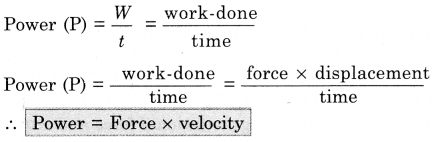
Power : Rate of work done by an agent is called its power, i.e. work done in unit time is known as power. If any work W done by applying ‘p’ force in ‘p’ time then
WBBSE Class 9 Physical Science Notes Chapter 5 Work, Power and Energy 3
N.B : Some work done is less time by an agent means it has greater power. Power does not depend on the total amount of work done but on the time required to do the work. Power is a scalar quantity.

WBBSE Class 9 Physical Science Notes Chapter 5 Work, Power and Energy

Unit of power:

Absolute unit:

  • CGS : erg s-1
  • SI: Watt or Js-1

Gravitational unit:

  • CGS : g-cms-1
  • SI: kg-ms-1

Practical unit : The practical unit of power in both CGS and SI units is Watt.

Watt : The power of doing 1 erg of work in 1 second is known as 1 watt.

1 Watt 1 Joule second-1  = 10-7erg s-1
1 Kilowatt 10 watt
1 Megawatt 10watt
Horsepower: In FPS system, practical unit of power.

Definition of Horse Power (hp) : The power to work at the rate of 550ft-lb per second is called 1 horse power 1 horse power = 746 Watt

WBBSE Class 9 Physical Science Notes Chapter 5 Work, Power and Energy

Energy : The capacity of an object to do work is called the energy of the object.

N.B. Since by energy we mean some amount of work, so we express energy in the unit of work.

Energy is a scalar quantity.

Types of energy :
(1) Potential energy : The energy of an object because of its position or shape is called its potential energy. Examples of potential energy :

  • When a weight is raised through a certain height, work is done against gravity, which is retained in the body in this new position as potential energy and is now capable of doing some work if allowed to fall down to its former position.
  • When a spring wound, stretched or compressed it gains potential energy, as it is now capable to do work while it comes back to its normal shape.

(2) Kinetic energy : It is the energy acquired by a body by virtue of its motion.
Examples of Kinetic energy :

  • Kinetic energy of a bullet fired from a gun helps it to pierce a target.
  • Kinetic energy of blowing air and running water are used to run a windmill and a water mill respectively.

Kinetic energy of a hammer is used in driving a nail into a block of wood.
Calculation of kinetic energy: If a body of mass m be moving with velocity v, then it can be shown that,
i.e. Kinetic energy = 1/2 x mass x (velocity)2
∴ Kinetic energy = 1/2 mv2

Mechanical energy: The sum of the kinetic energy and the potential energy of an object is called its mechanical energy.

Law of conservation of energy: Energy cannot be created or destroyed. Only one form of energy is transformed to other type of energy. The total amount of energy is constant in the universe.

Examples of conservation of energy :

(i) Snow deposited at high altitudes melts and the water so formed flows down to the seas. In the process, the potential energy of the water is converted into kinetic energy. We convert this kinetic energy of water to electrical energy in hydroelectric power plants.

(ii) The food we eat comes from plants and animals that eat plants or plant products. When we eat food, several chemical processes take place, and energy in the form needed by the body is produced from the energy contained in the food. When we walk, run, exercise, this energy is used to provide kinetic energy.

WBBSE Class 9 Physical Science Notes Chapter 5 Work, Power and Energy

m Conservation of energy in a freely falling body : Suppose a ball of mass ‘m’ is kept at rest at a point A, which is at a height ‘h’ above the ground. We take the potential energy at the ground to be zero. The potential energy of the ball at A’ is then,
UA = mgh

WBBSE Class 9 Physical Science Notes Chapter 5 Work, Power and Energy 4

The ball is at rest at A, so its kinetic energy here is
KA= o
The total energy is, UA + KA = mgh (1)

The ball is now allowed to fall. The only force on it during the fall is gravity (free fall), and hence, its acceleration is a = g downwards. Consider any point B in its path.

WBBSE Class 9 Physical Science Notes Chapter 5 Work, Power and Energy

Suppose its distance from A is x. The height of the point B from the ground is (h – x). When the ball reaches point B, its potential energy is,
UA = mg (h- x).
The velocity of the ball at point B is given by
v2 = u2 + 2gx = 2gx.
The kinetic energy of the ball at point ‘B’ is :
KB – \(\frac{1}{2}\) mv2 = \(\frac{1}{2}\) m(2gx) = mgx
The total energy at point B is
UB + KB = mg(h-x) + mgx = mgh …………..(2)
Comparing (1) and (2), we see that
UA + KA = UB + KB
The point B was chosen to be any point in the path of the ball. The total energy here turned out to be equal to the initial energy. Thus, the energy at all points during the fall is the same, that is, remains conserved as the ball falls.

WBBSE Class 9 Physical Science Notes Chapter 5 Work, Power and Energy

The potential energy is gradually converted into kinetic energy.
This result is also true if a ball is thrown upwards or at some angle with the vertical. During the upward movement of a ball, its kinetic energy gets gradually converted to potential energy.

WBBSE Class 10 Physical Science Solutions Chapter 1 Concerns About Our Environment

Detailed explanations in West Bengal Board Class 10 Physical Science Book Solutions Chapter 1 Concerns About Our Environment offer valuable context and analysis.

WBBSE Class 10 Physical Science Chapter 1 Question Answer – Concerns About Our Environment

Very Short Answer Type Questions :

Question 1.
In which of the atmospheric layers does the increase in altitude result in increase in temperature?
Answer:
Stratosphere and Thermosphere.

Question 2.
Which one is more harmful to the human body – CO or CO2 ?
Answer:
CO is more harmful to the human body.

Question 3.
In which of the layers of atmosphere does temperature decrease with increase in altitude?
Answer:
Troposphere and Mesosphere.

WBBSE Class 10 Physical Science Solutions Chapter 1 Concerns About Our Environment

Question 4.
Mention the range of temperature of the atmosphere ?
Answer:
The range of temperature of the atmosphere is from -92° C to + 1200° C.

Question 5.
What is the main source of carbon monoxide in the atmosphere ?
Answer:
Coal, Petrol and incomplete combustion of other fossil fuels.

Question 6.
Which of the atmospheric layers contains maximum ozone gas?
Answer:
Stratosphere.

Question 7.
Name some gases which are responsible for green house effect.
Answer:
Carbon dioxide (CO2), Methane (CH4), Water vapour (H2O), Chlorofluoro carbon (CFC), Nitrous Oxide (N2O).

Question 8.
Name the sources of dissolved oxygen in water ?
Answer:
The sources of Oxygen in water are the atmospheric oxygen or the photosynthesis carried out by the plants in water during daylight.

Question 9.
Name of the main compounds causing damage to the ozone layer?
Answer:
Nitric oxide (NO) and Freons.

Question 10.
What compound is formed when CO gas combines with blood ?
Answer:
Carboxy haemoglobin.

WBBSE Class 10 Physical Science Solutions Chapter 1 Concerns About Our Environment

Question 11.
Which disease is caused due to the formation of hole in the ozone layer and why ?
Answer:
Ultraviolet rays coming from the sun reach the earth passing through the ozone hole cause skin cancer.

Question 12.
Name some methods of waste managment ?
Answer:
B urning and incineration, recycling process, sewage treatment and dumping method.

Question 13.
Name some methods used in green chemistry ?
Answer:
The use of sunlight, micro-waves, sound waves and the use of enzymes.

Question 14.
What is COD?
Answer:
COD means chemical Oxygen Demand.

Question 15.
Name some methods used in green chemistry.
Answer:
The use of sunlight, microwaves, sound waves and the use of enzymes.

Question 16.
Name two sinks of carbondioxide.
Answer:
Ocean which dissolves it and plants which use it for photosynthesis.

Question 17.
What type of pollution effects the sea birds ?
Answer:
Oil pollution.

Question 18.
What are the main sources of thermal pollution ?
Answer:
Nuclear plants and Thermal power plants.

Question 19.
What is siltation ?
Answer:
The mixing of soil or rock particles into water is known as siltation.

WBBSE Class 10 Physical Science Solutions Chapter 1 Concerns About Our Environment

Question 20.
Which gas was responsible for so many deaths in Bhupal tragedy?
Answer:
The gas methyl isocyanate (MIC) was responcihle to many deaths in Bhupal.

Question 21.
What type of aromatic compounds are present as particulates in the air?
Answer:
Polycyclic aromatic hydrocarbons (PAH).

Question 22.
What are silicosis and asbestosis ?
Answer:
Lung disease caused by the particulates of silica is called silicosis and that caused by particulates as asbestos is called asbestosis.

Question 23.
What class of people are generally susceptible to attack of black lung and white lung diseases.
Answer:
Generally workers of coal mines and those of cotton mills become victims of black lung and white lung diseases respectively.

Question 24.
What is PCB ?
Answer:
PCB is polychlorinated biphenyl. It is a highly toxic compound.

Question 25.
Why does the population of fish get hindered in thermally polluted water ?
Answer:
Thermal pollution increases the temperature which in turn decreases the DO level of the water. Thus it affects the fishes badly and their growth gets retarded.

WBBSE Class 10 Physical Science Solutions Chapter 1 Concerns About Our Environment

Question 26.
What is chlorosis ?
Answer:
The presence of SOx in the atmosphere as pollutant slows down the production of chlorophyll in the leaves of the plants and the green colour disappears. The phenomenon is called chlorosis.

Question 27.
Why high and low tides occur in sea ?
Answer:
Due to the gravitational pull of sun and moon on the spinning earth, the level of water in the sea rises and falls, these are referred to as the “high tide’ and ‘low tide’.

Question 28.
Thal energy is converted to what form of energy for use ?
Answer:
Electrical energy.

Question 29.
Where in the world geothermal energy is used to generate electricity ?
Answer:
Due to geological changes, some molten hot rocks are formed in the deeper region’s of the earth’s crust and are pushed upward and traped in some regions. In some places heat comes from the fission of radioactive material naturally present in the rocks.

Question 30.
Name a petro-crops.
Answer:
At present Euphorbias plants contain latex of high carbon content, thermal cracking of this latex produce bio-petrol or diesel. These plants are called petro-crops.

Question 31.
What is the name of anaerobic bacteria used for the fermentation of blomass ?
Answer:
Methanogenic bacteria.

Short Answer Type Questions :

Question 1.
What are combustible and non-combustible materials ?
Answer:
Combustible materials : Materials that can be burnt are combustible materials. Non-combustible materials : Materials that cannot be burnt are noncombustible materials.

WBBSE Class 10 Physical Science Solutions Chapter 1 Concerns About Our Environment

Question 2.
What are the types of sources of energy?
Answer:
Types of sources of energy: There are two types of sources of energy. These are : (i) Renewable sources of energy. (ii) Non-renewable sources of energy.

Question 3.
What is nuclear fission?
Answer:
Nuclear fission : It is a process in which a heavier nucleus splits into lighter nuclei with release of huge amounts of energy.

Question 4.
What is a petroleum? What is natural gas?
Answer:
(i) Petroleum: An oil derived from rocks. A complex mixture of hydrocarbons. (ii) Natural gas : Natural gas is a fossil fuel that is found on the top of petroleum under the earth.

Question 5.
What is destructive distillation.
Answer:
Destructive distillation : It is a process of burning wood in limited supply of oxygen.

Question 6.
What is hydroelectric power plant ?
Answer:
Hydroelectric power plant : In this power plant energy of flowing water is utilized to produce electricity on a large scale.

Question 7.
What is wind mill?
Answer:
Wind mill : It is a device that converts wind energy to mechanical or electrical energy.

WBBSE Class 10 Physical Science Solutions Chapter 1 Concerns About Our Environment

Question 8.
What is a solar cell?
Answer:
Solar Cell : It is a device that directly converts solar energy into electrical energy.

Question 9.
What is good source of energy ?
Answer:
Good source of energy : A good source of energy should be renewable and environment friendly.

Question 10.
What are the disadvantages of fossil fuels ?
Answer:
Disadvantages of fossil fuels: Following are the disadvantages of fossil fuels: (i) These are non-renewable (ii) The produce air pollutants on burning.

Question 11.
What is geothermal energy?
Answer:
Geothermal energy : The energy which can be hamessed from the heat of inside of the earth is called geothermal energy.

Question 12.
If you could use any source of energy for heating your food, which one would you use and why?
Answer:
We use LPG (liquefied Petroleum Gas) for heating our food; because it is easily available in our kitchen, gives on smoke on burning and takes less time to do the job.

Question 13.
Name two energy sources that you would consider to be renewable. Give reasons for your choice.
Answer:
Solar energy and wind energy are examples of renewable energy sources because they get quickly replenished.

Question 14.
Give the names of two energy sources that you would consider to be exhaustible. Give reasons for your choice.
Answer:
Coal and petroleum are exhaustible energy sources because their stock is going to be finished in the near future and it takes millions of years for their formation.

WBBSE Class 10 Physical Science Solutions Chapter 1 Concerns About Our Environment

Question 15.
Fish do not grow as well in warm water as in cold water-explain why.
Answer:
Explanation: The solubility gas in water depends on the temperature. Consequently the amount of soluble oxygen in warm water becomes less than that of cold water. As oxygen is very essential for the respiration and growth of fish in water, so the growth of fish becomes less in warm water.

Question 16.
What is chlorosis ?
Answer:
Chlorosis: The process of sulpherdioxide gas in the atmosphere retards the production of chlorophyll in the leaves of the plants. In consequence of which the green colour of leaves is lost. This phenomenon of disappearance of green colour of leaves is known as chlorosis.

Question 17.
What is siltation ?
Answer:
Siltation: In this process of mixing of soil particles with water. The soil particles present in water procedure turbidity. Due to the turbidity of water, the free movements of the equatic organisms is hindered and as a result their growth and productivity also get reduced.

Question 18.
In which season the depletion of ozone layer on Antarctica take place and when is it filled up again ?
Answer:
During the spring time in Antarctica i.e. in the months of September and October, the depletion of ozone layer of the stratosphere takes place. But after the spring in the months of November and December the produced ozone hole is filled up.

Question 19.
What is meant by inversion temperature in different regions of atmosphere?
Answer:
Inversion temperature: As we proceed from one region of atmosphere to the next higher region, the trend of temperature changes either from increase to decrease or from decreaseto increese. This trend of either increase or decrease is called inversion temperature.

WBBSE Class 10 Physical Science Solutions Chapter 1 Concerns About Our Environment

Question 20.
How does carbon monoxide molecule link to haemoglobin molecule?
Answer:
Explanation: In haemoglobin molecule Fe(II) atom is linked to five groups by coordinate bonds and the sixth site remains free. In normal condition aerial oxygen O2 links to Fe (II) of this vacant coordination site. Now carbon monoxide (CO) being a stronger legand than oxygen molecule in case of the presence of both CO and O2, CO occupies the vacant coordiriction site in haemoglobin instead of oxygen.

Broad Answer Type Questions

Question 1.
What is a good fuel ?
Answer:
Good fuel: A good fuel should have many desirable characteristics. Some of these are as follows:

  1. It should produce a high amount of energy for each unit of mass or volume.
  2. It should be easily available and should be easy to transport.
  3. It should be economical.

Question 2.
Why are we looking for alternate source of energy ?
Answer:
Because of growing population, the energy demand is rising. Fossil fuels are going to be exhausted in the near future and burning them is causing air pollution. Hence we need to find an alternate source of energy which renewable and environment-friendly.

Question 3.
How has traditional use of wind and water energy been modified for our convenience?
Answer:
Before the beginning of the Industrial revolution, wind and water energy were used for serving many purposes but the ways of their use were not efficient. For example windmills were used to power smaller mills like flour mills or saw mills. The flow of water was used for transporting wooden logs. Now-adays, both wind energy and water energy are being widely used to produce electricity, which means a better and more efficient use of these forms of energy.

Question 4.
What kind of mirror, concave or convex or plain would be best suited for use in a solar cooker? Why ?
Answer:
Explantation : A concave mirror is best suited for use in a solar cooker. The reason for this is the ability of a concave mirror to converge the solar energy at a point. This enables the concave mirror to produce a larger amount of heat compared to other types of mirror.

Question 5.
What are the limitations of the energy that can be obtained from the oceans?
Answer:
Limitations of energy which can be obtained from the oceans :
These forms of energy can be used only in coastal areas, which would leave a vast portion of the human habitation. The technologies for using these energies are still at experimental stage and hence are very costly and less efficient.

WBBSE Class 10 Physical Science Solutions Chapter 1 Concerns About Our Environment

Question 6.
What are the advantages of nuclear energy ?
Answer:
Advantages of nuclear energy are as follows: A small amount of radioactive material can generate a huge amount energy. It does not produce air pollution. A nuclear power plant is more efficient than other power plants.

Question 7.
Can any source of energy be pollution-free? Why and why not ?
Answer:
Many sources of energy can be pollution-free when burning of biomass is not involved in production of energy, then there is no chance of pollution. For example, wind energy, hydel energy, solar energy etc. are pollution-free.

Question 8.
Hydrogen has been used as a rocket fuel would you consider it a cleaner fuel than CNG ? Why and why not?
Answer:
Hydrogen is a much cleaner energy source than CNG. CNG is derived from biomass and hence burning the CNG causes air pollution, although on a much smaller scale than coal and petroleum. Use of hydrogen as energy source does not polluting gases.

Brain Storming Questions :
Very Short Answer Type Questions :

Question 1.
In which layer of atmosphere least temperature is found?
Answer:
Mesopause, the upper part of mesosphere, is the coldest region having an average temperature around -85° C.

WBBSE Class 10 Physical Science Solutions Chapter 1 Concerns About Our Environment

Question 2.
Why ionosphere is so called ?
Answer:
Ionosphere has ions and electrons produced due to different types of ionization reactions occuring there in presence of high energy solar uv radiation. For this reason it is called so.

Question 3.
What is a ‘moisture trap’ and why is it called so ?
Answer:
Tropopause is called ‘moisture trap’. Most of water vapour of stratosphere enters through the tropopause by virtue of its low temperature leaving stratosphere dry. For this reason tropopause is called so.

Question 4.
What is an ozone hole?
Answer:
Ozone hole is a region of expectionally depleted ozone in the stratosphere of the ozone layer in high altitudes i.e., the Antartic, chiefly in winter, attributed to chemical action of CFCs and other atmospheric pollutants resulting in an increase in ultraviolet rays at ground level which gives rise to an increased rink of skin cancer.

Question 5.
What do you mean by ODS ?
Answer:
The chemical substances which catalyse and accelerate the depletion of ozone are called ozone-depleting substances (ODS).
Example :
Chlorofluorocarbons (CFCs), Halons etc.

WBBSE Class 10 Physical Science Solutions Chapter 1 Concerns About Our Environment

Question 6.
What is Dobson unit (DU) ?
Answer:
The Dobson unit (DU) is a unit of measurement of the columner density of a trace gas in the earth’s atmosphere.

Question 7.
Global warming is a consequence of which phenomenon ?
Answer:
Global warming is a direct consequence of greenhouse effect.

Question 8.
Name one compound which has approximately 20 times more green house effect than carbondloxide.
Answer:
Methane (CH4) has approximately 20 times more green house effect than CO2.

Question 9.
What is a greenhouse ?
Answer:
Greenhouse is a glass house used for raising plants, vegetables, fruits and flowers within it in cold temperature regions where growing of crops in the open field is not possible due to low temperature or cold.

Question 10.
Is the greenhouse effect applicable for earth only ?
Answer:
No, in the solar system, the atmospheres of Venus, Mars and Titan also contain gases that cause a greenhouse effect.

Question 11.
Name any two radiations emitted by the sun that are not visible to the human eye.
Answer:
Infrared radiation and ultraviolet radiation are not visible to the human eye.

WBBSE Class 10 Physical Science Solutions Chapter 1 Concerns About Our Environment

Question 12.
Which one is the principle greenhouse gas ?
Answer:
When ranked by their direct contribution to the greenhouse effect, apart from water vapour, Carbon dioxide stands as the principal greenhouse gas.

Question 13.
Name a non-renewable source of energy other than fossil fuels.
Answer:
Nuclear energy is another category of non-renewable source of energy other than fossil fuels.

Question 14.
What is the empirical formula of methane hydrate?
Answer:
The empirical formula of methane hydrate is (CH4)4 .(H2 O)23.

Question 15.
Which process is the basis for the formation of biomass ?
Answer:
Photosynthesis is the basic process for the formation of biomass.

Question 16.
Name the country which generates maximum electricity using wind energy ?
Answer:
Germany produces maximum electricity using wind energy.

Question 17.
What should be the maximum wind speed to operate wind turbine?
Answer:
The maximum wind speed shall be 15 Km hr-1.

WBBSE Class 10 Physical Science Solutions Chapter 1 Concerns About Our Environment

Question 18.
How much power does a single photo voltaic cell produce ?
Answer:
The power output of a single solar photo voltaic cell varies between 1.0 to 1.5 w.

Question 19.
Name two semi conducting materials which are used to make solar cells.
Answer:
Solar cells are made of Silican (Si) and Gallium (Ga).

Question 20.
Between Petrol and Kerosene, which has a higher calortic value?
Answer:
Petrol (50 Kj g-1) has a higher calorific value than Kereosene (48 Kj g-1).

Question 21.
Name two devices in which solar energy is harnessed directly.
Answer:
Solar energy is harnessed directly in solar cookers and solar water heaters.

Numerical Problems :

Working fomula :

Calorific value of fuel :
Amount of heat energy liberated on burning of a fuel = (mass of fuel) × (Calorific value of fuel)

Solar constant :
Heat energy produced by incident solar radiation =(Solar constant) × (Area) × (time)
Where solar constant =1.4 kjm-2 s-1 = 14 kwm-2

WBBSE Class 10 Physical Science Solutions Chapter 1 Concerns About Our Environment

Examples 1: Calculate the energy released by a piece of wood of mass 10 kg when it is completely burnt. (The calorific value of wood is 17 Kjg-1)
Answer :
Amount of heat energy liberated on burning a fuel (piece of wood)
= (mass of fuel) × (Calorific value of fuel)
= 17 × 10000 kj
[Mass of fuel, m = 10 kg
= 170000 kj
= 10000 g
Calorific value of fuel = 17 Kjg-1 ]

Example 2 : The calorific value of a gas is 40 Kjg-1. If a furnace contains 40 g gas in 40 second, calculate the power of the furnace.
Answer :
Gas consumed by the furnace is 40 second = 40 g
∴ Energy consumed by the furnace is 40 second
= 40 × 40 kj=1600 kj
∴ Power of the furnace = \(\frac{Energy}{ Time}\) = \(\frac{40 \times 40}{40}\) kjs-1
= 40 kw

WBBSE Class 9 Physical Science Notes Chapter 2 Force and Motion

Comprehensive WBBSE Class 9 Physical Science Notes Chapter 2 Force and Motion can help students make connections between concepts.

Force and Motion Class 9 WBBSE Notes

Rest : If a body does not change its position with respect to time, the body is said to be at rest and that body is called static body.

Motion : If a body changes its position with respect to time, the body is said to be in motion and that body is called kinetic body.

Rest and motion is always a relative term : An object in one situation may be at rest, while in another situation the same object may appear to be in motion.

For example, a man sitting in a running train finds a man standing on the platform or in a field or a tree or a building all moving backwards, i.e. in motion. But actually, to the man on the field, the tree, the building etc. appear to be stationary, while the man in the train is moving forward.

Classification of motion :

WBBSE Class 9 Physical Science Notes Chapter 2 Force and Motion 1

Linear motion : If any particle moves along any line, then the motion of that particle is called linear motion.

Straight linear motion : If any particle moves along any straight line and any particle of the body travels the same distance at same speed, then the motion is called straight linear motion.

Curve linear motion : If any particle does not move in a definite direction but moves in curvilinear way and changes its direction in that way, then the motion is called curve linear motion.

Circular motion : If any particle moves around the particular point or axis, then this motion is called circular motion.
Example: The motion of electric fan.

Mixed motion : If any motion is a combined form of linear motion and circular motion, then that motion is called mixed motion.

Example: The moving wheel car. Here the circular motion of wheel produces linear motion.
Concept of a particle: A particle is a geometrical mass point or a material body of neglígible dimensions.

Reference body : For determining whether a body is at rest or in motion we must compare the motion of the body with some other body, called the reference body.

Reference frame : To locate the position of body with respect to the reference body, a system of co-ordinates fixed to the reference body is constructed. This is called reference frame.

WBBSE Class 9 Physical Science Notes Chapter 2 Force and Motion

Types of reference frames :

Inertial frame of reference : A frame of reference which is either at rest or moving with uniform velocity is called an inertial frame of reference.
In this frame of reference, Newton’s first law of motion is valid.

Example :

  • A frame of reference remaining fixed with respect to stars is an inertial frame of reference.
  • A space ship moving in space without spinning and with its engine shut off is an inertial frame of reference.
  • A train moving on a horizontal track with constant velocity is an inertial frame of reference.

Non-inertial frame of reference : A frame of reference which is accelerated is called non-inertial frame of reference.
In this frame of reference, Newton’s first law of motion is not valid.
Example : A ball is lying on the floor of a stationary bus. When the bus is accelerated or retarded, the ball starts moving. The bus is said to an example of non-inertial or accelerated frame of reference.

Motions in one, two or three dimensions :

One dimensional motion : If the motion of a particle be along a straight line, the motion is one dimensional.
Example :

  • A train moving along a straight track.
  • A body falling freely under gravity.

Two dimensional motion : If the motion of a particle be in a plane, i.e. when two of the three co-ordinates are required to specify the position of the particle in motion, the motion is called two dimensional.

Example :

  • The earth revolving round the sun.
  • An insect crawling on the floor.

WBBSE Class 9 Physical Science Notes Chapter 2 Force and Motion

Three dimensional motion : If the motion of a particle be in a space, i.e. when all the three co-ordinates are required to specify the position of the particle in motion, the motion is called three dimensional.

Example :

  • A flying bird
  • A flying aeroplane
  • A flying kite

Position of a particle moving along a straight line : The position of a particle moving along a straight line is described by a quantity x. The numerical value of x, together with the unit, gives the distance of the particle from the origin, and the sign of x denotes whether the particle is in the positive direction or in the negative direction.

WBBSE Class 9 Physical Science Notes Chapter 2 Force and Motion 14

Fig. Positions of a moving particle on a straight line path
To describe the position of the particle at a given time, we have to specify :

  • its distance from the origin
  • whether it is in the positive direction or in the negative direction as seen from the origin.

Distance traversed : The length of the actual path traversed by a particle during motion in a given interval of time is called distance traversed by the particle.

WBBSE Class 9 Physical Science Notes Chapter 2 Force and Motion 15

Suppose a man goes from P to Q, a distance of 4 m. Then he moves a distance QR of length 3 m at right angle to PQ.

Thus starting from P, he reaches finally at R travelling a total distance PQ + QR = (4 + 3) m = 7 m.
Unit (SI) of distance traversed : meter (m).
Distance traversed : Scalar quantity

Displacement : The displacement of a moving particle in a given interval of time is the shortest distance between the two positions of the moving particle in a particular direction and is given by the vector drawn from the initial position of the particle to its final position.

Units of displacement :

  • CGS : cm
  • SI : m

WBBSE Class 9 Physical Science Notes Chapter 2 Force and Motion

Dimensions of displacement : [M0 L1 T0]

The characteristics of displacement are :

  1. Displacement has the unit of length.
  2. The displacement may be positive, negative or zero.
  3. The magnitude of the displacement of a moving particle between two points gives the shortest distance between them.
  4. The displacement of a moving particle between two points does not give us any idea about the path followed by the moving particle.
  5. The displacement of a moving particle between two points has a unique value.
  6. The actual distance travelled by the moving particle may be greater than or equal to the magnitude of the displacement.
  7. The displacement remains unaltered, even if the origin of the co-ordinate axis be shifted.
  8. As a particle cannot be at two different positions at the same time, so the displacement is a single valued function of time.
  9. The displacement changes if its direction be changed.

Diffference between displacement and distance

Displacement Distance
i. The distance moved by a particle in any particular direction is called the displacement of the particle. i. Total path covered by a particle in a straight or curved path is called distance traversed by the particle.
ii. It is a vector quantity. ii. It is a scalar quantity.

Speed : Rate of change of position of a body with respect to time is known as its speed.
It is measured by the distance covered by body in unit time.

WBBSE Class 9 Physical Science Notes Chapter 2 Force and Motion 2

Characteristics of speed :

  1. Speed does not give any idea about the direction of motion.
  2. Speed can be positive, but never negative or zero.
  3. Speed is a scalar quantity.

WBBSE Class 9 Physical Science Notes Chapter 2 Force and Motion

Units of speed :

  • CGS: cmsM1
  • SI: ms-1

The dimensions of speed are : M0 L1 T-1]

Types of Speed :

Uniform speed : The speed of a body is said to be uniform, if it covers equal distance in equal intervals of time, however small these intervals may be.

Non-uniform speed or variable speed : If an object does not cover equal distances in equal time-intervals, its speed is called non-uniform or variable speed.

Average speed: When a body is moving with variable speed, the constant speed with which the body covers the same distance in a given time as it does while moving with variable speed during the given time, is called the average speed.

WBBSE Class 9 Physical Science Notes Chapter 2 Force and Motion 3

If a body moves distances S1, S2, S3, …. etc. in times t1, t2, t3 …. etc. respectively, then

WBBSE Class 9 Physical Science Notes Chapter 2 Force and Motion 4

Instantaneous speed: The instantaneous speed at a point is defined as the limit of the average speed over a path length that tends to become zero but always includes that point.
Thus, if the moving particle covers a path △S in time interval △t, then

Whenever we mention about the speed of a particle, it always means the instantaneous speed, if not mentioned otherwise. In case of uniform motion of a particle, the instantaneous speed is equal to the uniform speed.

WBBSE Class 9 Physical Science Notes Chapter 2 Force and Motion

Typical speeds of some objects :

Average speed of a tortoise 05 km/h
Average walking speed of man 6 km/h
Maximum speed of a bee 16 km/h
Maximum speed of a cheetah 96 km/h
Maximum speed of a falcon 152 km/h
Maximum speed of a typical fast train 225 km/h
Wind speed in a light breeze 32 km/h
Wind speed in a hurricane 320 km/h
The speed of the earth moving round the sun 1.072 × 10⁵ km/h

If not mentioned otherwise, the term velocity means instantaneous velocity.

Difference between speed and velocity :

Speed Velocity
i. Speed is the time rate of change of position of a body in any direction. i. Velocity of a body is the time rate of change of its displacement.
ii. Speed is a scalar quantity, i.e. it has only magnitude but no definite direction. ii. Velocity is a vector quantity, i.e. it has both magnitude and also a particular direction.
iii. Instantaneous speed is the magnitude of instantaneous velocity. iii. With a proper direction attached to the instantaneous speed, instantaneous velocity is obtained.
iv. A body moving with uniform speed may not have uniform velocity. iv. A body moving with uniform velocity always possesses uniform speed.
v. Speed can be positive but never negative or zero. v. Velocity can be positive, negative or zero.

Acceleration : The rate of increase of velocity of a body with respect to time is called its acceleration.

WBBSE Class 9 Physical Science Notes Chapter 2 Force and Motion 6

Characteristics of velocity :

  1. When the velocity increases, the acceleration is called positive and when it decreases, it is called negative or retardation or deceleration.
  2. Acceleration has both magnitude and direction, so it is a vector quantity.

Units of acceleration :

  • CGS: cms2
  • SI: ms2

Dimensions of acceleration : [M0 L1 T2]

Types of acceleration :

Uniform acceleration : The acceleration of a moving body is said to be uniform if its velocity changes be equal amounts in equal intervals of time, however small the intervals may be.

Non-uniform or variable acceleration : The acceleration of a moving body is said to be variable, if it does not have equal changes in velocity in equal intervals of time, however small these intervals may be.

Average acceleration : When a body is moving with variable acceleration, then the average acceleration of the body is defined as the ratio of the total change in velocity of the body to the total time taken.

Instantaneous acceleration : The instantaneous acceleration of a particle at a point at a certain instant of time is the limit of the average acceleration over a displacement that tends to be zero, but always includes the given point.

Thus, if the moving particle undergoes a change of velocity of \(\overrightarrow{\Delta \mathrm{V}}\) in time interval Δt, then

WBBSE Class 9 Physical Science Notes Chapter 2 Force and Motion 7

If not mentioned otherwise, the term acceleration means instantaneous acceleration.
Retardation : The rate of decrease of velocity of a body with respect to time is called retardation.

Characteristics of retardation :

  1. Retardation is opposite to the acceleration and thus it is considered as negative acceleration.
  2. Retardation has both magnitude and direction, and hence it is vector quantity.

Units of retardation :

  • CGS : cms2
  • SI: ms2

Dimensions of retardation : [M0L1T2]

Types of retardation :

  1. Uniform retardation : The retardation of a moving body is said to be uniform if its velocity changes by equal amounts in equal intervals of time, however small the intervals may be.
  2. Non-uniform retardation: The retardation of a moving body is said to be variable, if it does not have equal changes in velocity in equal intervals of time.
  3. Instantaneous retardation : The instantaneous retardation of a particle at a point at a certain instant of time is the limit of average retardation over a displacement that tends to be zero but always includes the given point.

Graphical Representation of Motion : A graph is a very powerful method of representing information.

To describe the motion of an object, we can use line graphs. In this case, line graphs show dependence of one such as distance or velocity, on another quantity, such as time.

WBBSE Class 9 Physical Science Notes Chapter 2 Force and Motion

Plotting a graph : A graph is plotted to display the relation between two quantities. Generally, one of the two quantities changes independently and the other quantity depends on it.

Choosing the axes: Draw two perpendicular lines, crossing each other at a point. Each line represents one of the two quantities to be plotted. Generally, a horizontal line from left to right is drawn to represent the independent quantity, and a perpendicular line is drawn to represent the dependent quantity. These lines are called the x-axis and the y-axis, or the horizontal axis and the vertical axis respectively.

Choosing the scale : The size of the paper on which a graph is drawn is limited. On the available length of the axes, values are marked at equal distances. This is done in such a way that all the values of the quantity represented on the axis can be accommodated in the available length.

Plotting the points : Each set of values of the two quantities is represented by a point on the graph.

Joining the points: Once all the points corresponding to the available sets of values of the quantities are plotted, they are joined by a smooth curve to get the graph.

Velocity-time graph : Velocity-time graphs under different conditions are shown in the Fig. 1 to Fig. 4. In Fig. 1, velocity-time graph for a particle moving with uniform velocity is shown.

WBBSE Class 9 Physical Science Notes Chapter 2 Force and Motion 8

As the velocity V is uniform, so the plot of the velocity against time would be a straight line parallel to the time axis. The distance moved in time t is equal to v t, which is seen from the graph as the area of the rectangle OABC. Thus the distance travelled by a particle in uniform motion is given by the area under the velocity-time graph.

In Fig. 2, velocity-time graph for a particle moving in straight line with uniform acceleration and starting with initial velocity u = 0 is shown. Same motion starting with initial velocity u is shown in Fig.3. In both the cases velocity-time curves are straight line. In each case the constant slope of the straight line gives the uniform acceleration.

In Fig. 4, velocity-time graph for a particle moving with uniform retardation in a straight line is shown. The curve is again a straight line but the slope is negative. In all the cases, the distance moved by the particle is given by the area under the velocity-time graph.

WBBSE Class 9 Physical Science Notes Chapter 2 Force and Motion

Position-time graph :

WBBSE Class 9 Physical Science Notes Chapter 2 Force and Motion 9

In Fig. 5 position-time graph of a particle moving with uniform velocity is shown. It is a straight line and the slope of the curve gives the uniform velocity of the particle.

In Fig. 6. position-time graph for a particle moving with uniform acceleration in a straight line is given. The graph is parabolic in nature. Here the slope of the curve gives the average velocity over certain interval of time.
Equations for motion with uniform acceleration: Consider a particle
moving with acceleration ‘a’ along a straight line, starting with initial velocity ‘u’ attains a velocity ‘V’ in interval of time ‘t’ and traverses a distance ‘S’ in this interval.

In Fig. 7, the velocity-time graph for the motion is shown. Here OD = u and AC = v and OA = t.
From the graph we have

WBBSE Class 9 Physical Science Notes Chapter 2 Force and Motion 10

AC = AB+BC
or, v = u + a t

Again the distance ‘S’ covered by the particle in the time interval ‘t’ is given by the area of the trapezium OACD.

or, s = area of the trapezium OACD
= area of the rectangle OABD + area of the △BCD
= OA.AB + \(\frac{1}{2}\) BD.DC
= ut + \(\frac{1}{2}\) t . at
∴ s = ut + \(\frac{1}{2}\) at2
Again, s = area of the trapezium OACD
= \(\frac{1}{2}\)( Sum of parallel sides ) × perpendicular distance between them
= \(\frac{1}{2}\)(OD + AC) × BD
= \(\frac{1}{2}\)(u + v) × t = \(\frac{1}{2}\)(u + v) a /a
or, 2 as = (u + v) at = (u + v)(u – v) [∵ at = v-u]
∴ 2 as = v2-u2
Or, v2 = u2+2 a s

WBBSE Class 9 Physical Science Notes Chapter 2 Force and Motion

Newton’s first law of motion :

Every material body continues in its state of rest or of uniform motion in a straight line if and only if it is not compelled by any external force to change that state.

Newton’s first law of motion consists of three parts :

  • A body at rest continues to be at rest until some external force acts on it.
  • A body in uniform motion in a straight line continues to move uniform unless it is compelled to change that state by the application of some external force.
  • A body cannot change its direction of motion without the application of an external force. The body continues to move along the same straight line.

Newton’s first law of motion gives two things :

  • Concepts of inertia of a body
  • Definition of force

Definition of force : Force is that which changes or tends to change the state of rest or of uniform motion of a body along a straight line.

Inertia of the body : The inability of a body to change by itself its state of rest or of uniform motion along a straight line is called inertia of the body.

Types of inertia of a body :

  • Inertia of rest
  • Inertia of motion

Inertia of rest : Inertia of rest of a body is its inability to change its state of rest by itself.
Example : When a bus starts suddenly from rest, the passengers sitting inside tend to fall backwards. This is because the lower parts of their bodies start moving with the bus being in contact with it, but upper parts of their bodies try to remain at rest due to inertia of rest and fall back.

A coin placed on a piece of cardboard covering a hollow glass tumbler, falls into it when the cardboard is suddenly struck from side by fingers. The cardboard slips off but the coin tends to the remain in place due to inertia of rest and falls into the tumbler due to gravity when the support is removed.

Inertia of motion : Inertia of motion of a body is in inability to change by itself its state of uniform motion in a straight line.

Example :
An electric fan revolves a few rounds even after the switch is put off. It is due to inertia of motion.

When a running bus stops suddenly, passengers sitting inside tend to fall forward. This is because the lower parts of their bodies come to rest as soon as the bus stops, but the upper parts of their bodies try to remain in motion due to inertia of motion and fall forward.

WBBSE Class 9 Physical Science Notes Chapter 2 Force and Motion

Newton’s second law of Motion :

The rate of change of momentum of a body is proportional to the impressed force and takes place in the direction in which the force acts.

Newton’s second law of motion gives two things :

  • Concept of inertial mass [Inertial mass of a body is the force required to produce unit acceleration in the body.]
  • Magnitude and direction of the force.

Linear momentum : It is the property of a body possessed by virtue of its mass and velocity and its magnitude is given by the product of its mass and velocity.

p = m v (p = Linear momentum,
m = mass of the body,
v = velocity of the body)

Units of momentum :

  • CGS : g.cm s-1
  • SI: kg.ms-1

Momentum has both magnitude and direction and so it is a vector quantity.
Measurement of force : Suppose a body of mass m moves uniformly in a certain direction with the velocity u and after t time, due to application an of external force p in the same direction, its final velocity becomes v and acceleration of the body will be f.
Initial momentum of the body = mu.
After time t, final momentum of the body = mv.

WBBSE Class 9 Physical Science Notes Chapter 2 Force and Motion 11

So, the change of momentum after time t = (mv-mu).
Rate of change of momentum

WBBSE Class 9 Physical Science Notes Chapter 2 Force and Motion 12

Now, according to Newton’s second law of motion, rate of change of momentum

WBBSE Class 9 Physical Science Notes Chapter 2 Force and Motion 13

Now, according to Newton’s second law of motion, rate of change of momentum is directly proportional to the applied external force.

∴ p α m f
or, p = k m f

[k is a constant of proportionality]
If we now choose the unit of the force in such a way that unit force is that force which when acting on a body of a unit mass produces unit acceleration on it, then we have p = 1, m = 1, f = 1, i.e. k = 1

∴ p = m f or Force = mass × acceleration

WBBSE Class 9 Physical Science Notes Chapter 2 Force and Motion

Dimensions of force :
F = [M’ L’ T2]
The force is a vector quantity.

Types of units of force :

  • Absolute units
  • Gravitational units

Absolute units : These units are called absolute as their values are independent of the place where the measurements are made.

CGS unit Dyne: It is the force which when acting on a body of mass one gram produces in it an acceleration of one centimetre per second every second.
(b) SI unit : Newton: It is a force which when acting on a body of mass one kilogram produces in it an acceleration of one metre per second every second.

Relation between dyne and Newton :

1 Newton = 1 kg × 1 ms2
= 1000 g × 100 cms2
= 105 g.cms2
∴ 1 Newton = 105 dyne

WBBSE Class 9 Physical Science Notes Chapter 2 Force and Motion

Gravitational units of force : The unit of force expressed in terms of gravity is known as gravitational unit.

CGS system : gram-weight (g-wt) : The force with which the earth attracts a body of mass one gram towards its centre is called one gram-weight.

SI system : kilogram-weight (kg-wt) : The force with which the earth attracts a body of mass one kilogram towards its centre is called one kilogramweight.
1 g – wt = 981 dyne
1 kg – wt = 9.81 Newton

Impulse : The total effect of a force is called impulse and is measured by the product of the force and the time for which the force acts on the body.

Impulsive force : Impulsive force is a force of very large magnitude but of extremely short duration, which acting on a body produces a finite change of its momentum, displacement of the body during the action of the force being negligible.

The effect of the force is measured by its impulse.
Example of impulsive force : A player lowers his hands while catching a cricket ball. In doing so he increases the time of catch to reduce the momentum of the ball to zero. We know,
Impulse = force × time = change in linear momentum

So, to produce a particular change in linear momentum, if one takes longer time, then the force required would be less. Thus in catching a cricket ball, the player increases the time of catch by lowering his hands and thereby decreases the force and smaller reaction on the hands.
Newton’s third law of motion : To every action there is an equal and opposite reaction.

WBBSE Class 9 Physical Science Notes Chapter 2 Force and Motion

Newton’s third law of motion gives :

  1. From Newton’s third law we find that forces always occur in pairs, i.e. a single isolated force is not possible.
  2. Action and reaction [Action means the force exerted by a body on another body and reaction means the force exerted by the second body on the first] can never cancel each other, as they occur on different bodies.
  3. Each force produces its own effect.
  4. Newton’s third law is applicable to bodies both at rest or in motion.
  5. The action and reaction forces may appear due to actual contact of the two bodies or even from a distance.
  6. Newton’s third law is applicable to all types of forces e.g., gravitational, electric or magnetic etc.

Examples of action and reaction forces : If action and reaction act on the same system of particles, the action and reaction forces balance each other. So there is no displacement of the system of particle.

A chair cannot be raised sitting on it. Because in this case, action and reaction act on the same system.
Firing from a gun : When a gun is fired, the shot moves forward (action) and the gun recoils back (reaction).

Newton’s second law is the real law of motion : Both Newton’s first and third laws of motion are found to be followed from Newton’s second law of motion. So Newton’s second law can be said to be the real law of motion.

The principle of conservation of linear momentum : In an isolated system of bodies, i.e. when no external force acts on the system, the vector sum of the linear momenta of all the bodies of the system is conserved and is not affected due to their mutual action and reaction.

Characteristics of the principle of conservation of linear momentum :

  1. The principle of conservation of linear momentum is universal, i.e. it is applicable to both the microscopic and macroscopic system.
  2. The principle of conservation of linear momentum is independent of the frame of reference.
  3. The principle of conservation of linear momentum is more fundamental than Newton’s laws of motion from which it is derived.

WBBSE Class 9 Physical Science Notes Chapter 2 Force and Motion

Application of the principle of conservation of linear momentum :

A man jumps to the shore from a boat: When a man jumps to the shore from a boat, the boat is pushed away from the shore. This is because the momentum of the boat is equal and opposite to that of the man in accordance with the principle of conservation of linear momentum.

When a gas is released from a gas-filled balloon, it moves in direction opposite to that of the gas. Here also following the principle of conservation of momentum, the momentum with which the gas is coming out would impart an equal and opposite momentum to the balloon and hence the balloon would move in the opposite direction.

Motion of a rocket is based on the principle of conservation of momentum. When the fuel is burnt inside a rocket the gas produced comes out through a nozzle at the bottom of the rocket at high speed. To equalise this momentum of the issuing gas, the rocket moves upward.

WBBSE Class 9 Physical Science Notes Chapter 3 Matter: Structure and Properties

Comprehensive WBBSE Class 9 Physical Science Notes Chapter 3 Matter: Structure and Properties can help students make connections between concepts.

Matter: Structure and Properties Class 9 WBBSE Notes

Fluid : The word fluid comes from a Latin word ‘fluere’ meaning to flow.

Hydrostatics : The branch of Physics which deals with fluid at rest is called hydrostatics.

Hydrodynamics: The branch which deals with fluid in motion is called hydrodynamics.

Density : The density of a substance is its mass per unit volume.

Specific gravity : Specific gravity of a substance is the ratio of the density of a substance to the density of water at 4°C.

Relative density : The specific gravity being ratio of two densities, it is also called relative density.
In C.G.S. system, the density of a substance is numerically equal to its specific gravity.

Hydrostatic pressure : The normal force exerted by the fluid at rest per unit area of the surface in contact with it is called the pressure of fluid or hydrostatic pressure.

Mathematical expression of pressure : If F be the normal force acting on the very small area A of the surface in contact due to the fluid, then the pressure ‘ p ‘ is given by,

p = \(\frac{F}{A}\) t or F = p × A
Thrust : The total normal force exerted by a fluid at rest on a surface in contact with it is thrust.

WBBSE Class 9 Physical Science Notes Chapter 3 Matter: Structure and Properties

Unit of pressure :

  • CGS : dyne cm-2
  • SI : Nm-2 or pascal (Pa)

Dimension of pressure : [ML-1T-2]
Pressure is a scalar quantity as pressure at any point inside a fluid is same in all directions.

Unit of Thrust :

  • CGS : dyne
  • SI : newton (N)

Pressure at a point in a liquid : Consider a liquid of density ‘d’ contained in a vessel in equilibrium of rest. We are to find the pressure at a point ‘O’ at a depth ‘h’ below the liquid surface. Consider a cylindrical vertical column of liquid of height ‘h’, the area of cross-section of the cylinder being ‘A’. Area ‘A’ is around the point ‘O’.
So, volume of liquid column = hA
mass of the liquid column = h Ad
Weight of the liquid column = h Adg
∴ Force exerted by the liquid column on area A = hAdg
∴ Pressure ‘P’ on A = \(\frac{hAdg}{A}\)
∴ P = hdg

WBBSE Class 9 Physical Science Notes Chapter 3 Matter Structure and Properties 1

Important points regarding liquid pressure :

  1. The liquid at rest exerts equal pressure at a point inside the liquid in all directions.
  2. The liquid at rest exerts equal pressure at all points at the same horizontal level in the liquid.
  3. The liquid pressure is independent of shape of the liquid surface or the area of the liquid surface, but depends upon the height of liquid column.
  4. Total pressure at a depth ‘h’ below the liquid surface is equal to (p + hdg), where ‘p’ is the atmospheric pressure and ‘d’ is the density of the liquid.
  5. Average pressure on the side walls of a containers having liquid of density ‘d’ upto a height ‘h’ is \(\frac{1}{2}\) hdg.
  6. The liquid pressure is a scalar quantity.
  7. The thrust exerted by a liquid on the walls of vessel in contact with the liquid acts normally to the surface of the vessel.
  8. The free surface of a liquid at rest is horizontal.
  9. The liquid always finds its own level.
  10. The gauge pressure at a point in a liquid is the difference of total pressure at that point and atmospheric pressure.

WBBSE Class 9 Physical Science Notes Chapter 3 Matter: Structure and Properties

Pascal’s Law : The pressure applied at any place to an enclosed fluid at rest is transmitted with undiminished magnitude to every portion of the fluid and acts normally to the surface in contact with the fluid.

Archimedes’ principle : Archimedes’ principle states that a body immersed wholly or partly in a fluid at rest, appears to lose a part of its weight, which is equal to the weight of the fluid displaced.

Buoyancy : The upward thrust which any fluid exerts upon a body partly or wholly submerged in it is called its Buoyancy.

Conditions for Archimedes’ principle and buoyancy :

As Archimedes’ principle involves the weight of a body, so the principle does not hold good when the body is in weightless condition like the state of free fall of the body in an artificial satellite moving in a circular orbit.

The buoyancy does not depend on the depth of the liquid to which the body is immersed or on the shape, mass or material of the body. It depends only on the immersed volume of the body and the density of the displaced liquid at a particular place.

Conditions for floatation of a body :

  1. When the weight of the body(w) is greater than the weight of the liquid displaced (w), then the body sinks, i.e. w>w.
  2. When the weight of the body (w) is equal to the weight of the liquid displaced (w), then the body floats completely immersed anywhere within the liquid, i.e. w = w’.
  3. When the weight of the body is less than the weight of the liquid displaced, then the body floats partly immersed on the surface of the liquid. i.e. w < w

Atmospheric pressure : The weight of a column of air of unit crosssection and which extends from the point under consideration to the top of the atmosphere is called atmospheric pressure.

Standard or Normal temperature and pressure : The standard or normal atmospheric pressure is defined as the pressure exerted by a column of mercury 76 cm high at 0°C at 45° latitude and mean sea-level.

Siphon : A siphon is a simple device for transferring liquid from one vessel to the other without disturbing the whole volume of the liquid or pouring it.

WBBSE Class 9 Physical Science Notes Chapter 3 Matter Structure and Properties 2

Arrangement of siphon : It consists of a bent tube with one of the arms BD longer than the other AC. The tube is first filled with the liquid to be transferred. The two ends of the tube are then closed with fingers and the shorter limb is placed in the vessel to be emptied below the level of the liquid and two ends are opened. The liquid begins to flow.

WBBSE Class 9 Physical Science Notes Chapter 3 Matter: Structure and Properties

Working principle of siphon :

Let ‘p’ be the atmospheric pressure, ‘ d ‘ the density of the liquid and h1 and h2 be the vertical heights of A and B above the liquid surfaces.
The pressure P1 at A = P-h1 dg and the pressure P2 at B = P-h2 dg.
Now as h2>h1, so P1>P2,
i.e. Pressure at A > Pressure at B.
Hence the liquid at A is pushed to B. As the liquid moves from A to B the vacancy so produced is filled up by atmospheric pressure forcing more liquid into the tube from the vessel. From the point ‘B’ liquid comes out of longer tube due to gravity and a continuous flow through the siphon takes place.

Conditions for working of a siphon are :

  1. At first the whole tube must be filled with liquid.
  2. The end of the longer tube must be below the level of the liquid in the other vessel.
  3. The height h1 must be less than the height of the corresponding liquid barometer, otherwise the atmospheric pressure will not be able to raise the liquid to the top of the tube.
  4. The siphon will not work in vacuum due to the absence of atmospheric pressure.

Example : 1. We cannot siphon out water from a boat floating on a river to the river. Because the boat is floating in the river and water leaks into the boat from the river, so level of water inside the boat would be same as that of the river outside.

2. There being no atmosphere in the moon, atmospheric pressure is absent there. So normally siphon does not work on the moon. But in the case of pure liquid, the siphon action may be possible even in the moon due to cohesive force of the liquid.

Surface Tension : Surface tension is the property of a liquid by virtue of which the free surface of liquid at rest tends to have minimum area and so it behaves as if covered with a stretched membrane.

Measurement of surface tension : Surface tension is measured as the force acting on unit length of an imaginary line drawn tangentially anywhere on the free surface of the liquid at rest. It acts at right angles to both sides of the line and tangentially to the liquid surface.

WBBSE Class 9 Physical Science Notes Chapter 3 Matter: Structure and Properties

Mathematical expression of surface tension :

If ‘F’ be the total force acting on an imaginary line of length l, drawn tangentially on the liquid surface at rest, the force of surface tension ” T ” is given by:
T = \(\frac{F}{l}\)

Units of surface tension :

  • CGS : dyne cm-1
  • SI : Nm-1

Dimensional formula of surface tension : [MT-2]
Surface tension is a scalar quantity as it has no specific direction.

Examples of surface tension :

Raindrops attain spherical shape to acquire minimum area (as we know for a given volume of sphere has minimum surface area) due to surface tension, so that it has minimum surface energy.

An iron needle sinks in water but a greased iron needle placed gently on the water surface at rest is found to float on it. A slight depression on the surface of water can be seen just below the needle, showing that the water surface behaves like a stretched membrane.

A wire ring is dipped in soap solution to form a soap film on it and a loop of cotton thread is gently placed on it. The loop takes an irregular shape. Now on pricking the soap film in the middle position of the loop with a sharp needle, the loop would be found to attain circular shape. It is because the remaining soap film tries to have minimum surface area due to surface tension and for a given perimeter, the area of the circle is maximum.

A little kerosene oil dropped on water is found to spread over the water surface. This is because the surface tension of oil is much less than that of water and so the greater tension of the water stretches the oil in all directions.

Surface energy : It is the amount of work done against the force of surface tension, in forming the liquid surface of a given area at a constant temperature.

Excess of pressure inside a soap bubble or liquid bubble : A soap bubble or a liquid bubble has a very thin film having two surfaces and has air both inside and outside the bubble. So, in this case, excess of pressure ‘ P ‘ inside the bubble is given by :

P = \(\frac{4T}{R}\)

Excess of pressure inside an air bubble in a liquid :
An air bubble inside a liquid has only one surface and so excess of pressure ‘P’ inside it is given by,

P = \(\frac{2 T}{R}\)

If the air bubble is formed at a depth ‘h’ below the free surface of a liquid of density ‘dhr’, then excess of pressure inside the bubble is given by :

P = \(\frac{2T}{R}\) + hdg

Angle of contact: The angle which is tangent to the liquid surface at the point of contact, makes with the solid surface inside the liquid is called angle of contact.

WBBSE Class 9 Physical Science Notes Chapter 3 Matter: Structure and Properties

The value of angle of contact :

  1. the value depends on the nature of the liquid and the solid in contact.
  2. depends on the medium above the free surface of the liquid.
  3. is independent of the inclination of the solid with liquid surface.
  4. is fixed for a given pair of solid and liquid and surrounding medium.

Variation of surface tension :

The presence of impurities in the liquid surface or dissolved in it, considerably affect force of surface tension and depends on the degree of contamination.

The surface tension of a liquid decreases with rise of temperature. The surface tension of a liquid becomes zero at boiling point of the liquid and it vanishes at critical temperature.

Applications of surface tension :

  1. Surface tension of soap solution is low, and thus it is used for washing. Hot soap solution is still better as surface tension decreases with rise in temperature.
  2. Surface tension of lubricating oils and paints are kept low, so that they can spread easily.
  3. Antiseptics have very low surface tensions so that they can spread quickly.
  4. Oil spreads over the surface of water because the surface tension of oil is less than that of water.
  5. Rough sea can be calmed by pouring oil on sea-water.
  6. In soldering, flux is added to reduce the surface tension of molten tin, so that it can spread.

Viscosity : Viscosity is the property of a fluid by virtue of which an internal frictional force comes into play when the fluid is in motion and opposes the relative motion of its different layers.

Co-efficient of viscosity (η) : Co-efficient of a liquid is the tangential force required to maintain a unit velocity gradient between two layers of unit area.

WBBSE Class 9 Physical Science Notes Chapter 3 Matter: Structure and Properties

Dimensional formula of :
η = ML-1 T-1

Unit of co-efficient of viscosity :

  • CGS : Poise
  • SI : Pascal-second (PaS) or decapoise

1 decapoise = 1 NSm-2

Decapoise : If 1 newton tangential force is required to maintain a velocity gradient of 1 ms-1 m between two layers each of area 1 m2 is called 1 decapoise.

Poise : If 1 dyne tangential force is required to maintain a velocity gradient of 1 cms-1 / cm between two layers each of area 1 cm2 is called 1 poise.
1 decapoise =10 poise

Terminal velocity : It is the constant maximum velocity acquired by a body while falling through a viscous fluid.

The expression of terminal velocity :

v = \(\frac{2 r^2\left(d-d^{\prime}\right) g}{9 \eta}\)

[ Consider a small sphere of radius r and density d falling under gravity in a viscous fluid of density d and coefficient of viscosity η and terminal velocity is r]

Terminal velocity depends upon :

  1. The terminal velocity of a sphere varies directly as the square of the radius of it.
  2. The terminal velocity of a sphere is inversely proportional to the co-efficient of viscosity.
  3. If the density of the material of the sphere be less than the density of the fluid, then the sphere would move upwards to attain terminal velocity.

Variation of viscosity :

  1. The viscosity of a liquid decreases with increase in temperature.
  2. The viscosity of all gases increases with increase in temperature.
  3. With increase in pressure, the viscosity of liquids increases, but viscosity of water decreases.
  4. With increase in pressure, the viscosity of gases remains unchanged.

Streamline Flow : The streamline or orderly flow of a fluid is that flow in which every particle of the fluid follows exactly the path of its preceding particle and has the same velocity in magnitude and direction as that of its preceding particle while crossing that point.

Laminar Flow : If fluid flowing over a horizontal surface with a steady flow, moves in the form of layers of different velocities which do not mix with each other, then the flow of liquid is called laminar flow.

Turbulent Flow : When a fluid moves with a velocity greater than its critical velocity the motion of the particles of fluid becomes disorderly or irregular and such a flow is called turbulent flow.

Critical velocity : The critical velocity is that velocity of liquid flow, upto which its flow is streamlined and above which its flow becomes turbulent.

Reynold’s number (R): It is the ratio of the inertial force per unit area to viscous force per unit area for a flowing fluid.

WBBSE Class 9 Physical Science Notes Chapter 3 Matter: Structure and Properties

Significance of Reynold’s number (R) :

  1. R < 2000, the flow of a liquid is streamline or laminar.
  2. R > 3000, the flow of a liquid is turbulent.
  3. 2000 < R < 3000, the flow is streamline or turbulent.

Energy of a liquid in motion : A liquid in motion possesses three types of energy. These are :

Pressure energy : The energy possessed by a liquid by virtue of its pressure and is measured by the work done in pushing the liquid in the vessel against the pressure without imparting any velocity to it is called the pressure energy of the liquid.

Potential energy : The energy possessed by a liquid by virtue of its height or position above the surface of the earth or any reference level taken as zero level is called the potential energy of the liquid.

Kinetic energy : The energy possessed by a liquid by virtue of its motion or velocity is called the kinetic energy of the liquid.

Bernoulli’s Principle (1738) : For the streamline flow of an ideal fluid (non-viscous and incompressible) the sum of the pressure energy, kinetic energy and potential energy per unit mass is always constant.

Mathematical form of bernoulli’s principle :

For streamline flow of an ideal fluid of density d and passing through any cross-section at a height h with a velocity ‘v’ at pressure p we have
\(\frac{p}{d}\) = Pressure energy per unit mass
gh = Potential energy per unit mass
\(\frac{1}{2}\) vhr2 = Kinetic energy per unit mass
According to Bernoulli’s theorem,
\(\frac{p}{d}\) + gh + \(\frac{1}{2}\)v2 = const.
or, \(\frac{p}{dg}\) + h + \(\frac{v^2}{2 g}\) = const.
or, p + hdg + \(\frac{1}{2}\)dv2 = const.

For the streamline flow of an ideal fluid, the sum of pressure energy per unit volume, potential energy per unit volume and kinetic energy per unit volume is always constant at all cross-sections of the liquid.

Applications of bernoulli’s theorem :

Atomiser or sprayer : It is Based on Bernoulli’s principle. It is used for spraying liquid like perfumes over the body etc.

Blowing off the roofs during storm : During storms or cyclones, sometimes roofs of a hut are found to blow off without causing any damage to the side walls of the house.

Motion of two parallel boats : The boats sailing in the same direction parallel to each other, small distance apart are found to come closer to each other.

Lift on an aeroplane wings: The shape of an aeroplane wings i.e. aerofoil is made in such a way that its upper surface is curved more than its lower surface.

Spinning of a ball (Magnus effect) : A Cricket ball is thrown straight without any spin. The streamlines of air passing are seen evenly passing above and below the ball and the ball continues to move along the original straight direction. But if the ball is released with a spin, the streamlines of air in the same direction as the direction of spinning of the ball, while these are oppositely directed.

WBBSE Class 9 Physical Science Notes Chapter 3 Matter: Structure and Properties

Limitations of bernoulli’s theorem :

  • It is assumed that velocity of every particle of liquid passing through any particular cross-section of the tube is uniform.
  • But acutally, praticles of liquid in the central layer have maximum velocity and those closer to the tubewell have minimum velocity.
  • Thus, mean velocity of the particles should be taken.
  • The liquid in motion experiences a viscous drag, which should be considered.
  • It is assumed here that there is no loss of energy, when the liquid is in motion. But there is always some loss of
  • energy as some kinetic energy is lost as heat.
  • When the liquid is flowing on a curved path, the energy due to centrifugal force should be considered.

Elasticity : Elasticity is the property by which a body is able to resist deformation, either in shape or in volume or both, and recovers its original configuration when the deforming force is removed.

Types of bodies according to elastic property :

Perfectly rigid body : A body is said to be perfectly rigid, when no relative displacement between its parts occurs under the action of a deforming force, however large it may be.

Perfectly elastic body : A body is said to be perfectly elastic, when it regains its original configuration immediately and completely after the removal of the deforming force, however large it may be.

Perfectly inelastic body : A body is said to be perfectly inelastic or plastic, when it does not regain its original configuration at all on the removal of deforming force, however small it may be.

Partly elastic body : A body is said to be partly elastic when after the removal of the deforming force, it regains only partly its original configuration.

Elastic Limit : Elastic limit is the upper limit of deforming force upto which the body regains its original shape or size completely on removal of deforming force and beyond which on increasing the deforming force, the body loses, its property of elasticity and gets permanently deformed.

Stress : Whenever a deforming force is applied to a body, internal force of reaction comes into play, which tends to resist the deforming force and maintains the original configuration of the body.
This reaction force developed per unit area of the body is called stress.

Types of Stress :

  • Normal stress
  • Tangential stress.

Normal stress : When the deforming force acts normally over an area of a body, then the internal restoring force set up per unit area of cross-section is called normal stress.

Types of normal stress :

Tensile stress : If there be increase in length or extension of a body in the direction of the applied force, the stress developed is called tensile stress.

Compression stress : If there be decrease in length or compression of a body due to applied force, the stress developed is called compression stress.

Tangential stress : When the deforming force acts tangentially to the surface of a body to produce a change in the shape of the body, then the stress developed in the body is called tangential stress.

Strain : When a deforming force is applied on a body, there is a change in the configuration of the body and the body is said to be strained.

Measurement of strain : The fractional change in the length, volume or shape of a body relative to that in its original configuration is a measure of the strain.

Types of strain :

  1. Longitudinal strain : If the deforming force produces a change in length alone, the strain produced in the body is called longitudinal strain.
  2. Volumetric strain : If the deforming force produces a change in volume only, the strain produced in the body is called volumetric strain.
  3. Shearing strain : If the deforming force produces a change in the shape of the body alone without changing its volume, the strain produced is called shearing strain.

Hooke’s Law : The deformation of an elastic body is directly proportional to the applied force within elastic limit.

Generalised Hooke’s Law : (Modified Hooke’s Law by Scientist Thomas young)
Within elastic limit, stress is proportional to strain.
∴ stress ∝ strain
or, \(\frac{t { stress }}{t { strain }}\) = Constant
This proportionality constant is known as coefficient of elasticity or modulus of elasticity of a body which is independent of magnitude of stress and strain but depends upon the nature of material of the body and the way in which the body is deformed.

WBBSE Class 9 Physical Science Notes Chapter 3 Matter: Structure and Properties

Types of modulus of elasticity :

  • Young’s modulus of elasticity : It is the ratio of the longitudinal stress to the longitudinal strain within the elastic limit.
  • Bulk Modulus of Elasticity : Bulk modulus of elasticity is the volume stress (normal stress) to the volume strain within elastic limit.
  • Modulus of rigidity : Modulus of rigidity or shear modulus of a material is the ratio of the shearing stress to the shearing strain within the elastic limit.

Poisson’s Ratio: The ratio of the lateral strain to longitudinal strain of the material of a wire or bar under tension is called its Poisson’s ratio.

Elastic property of Material : A stressstrain curve for a wire of elastic material shown in fig. 3.3. From the figure it is found that OA portion of the curve is a straight line, i.e., stress is linearly related to strain. Hence, the material obey’s Hooke’s law. This is the region of perfect elasticity and ‘A’ represents the elastic limit of the material.

WBBSE Class 9 Physical Science Notes Chapter 3 Matter Structure and Properties 3

When the stress on the wire is increased beyond ‘A’ i.e., of elastic limit. Hooke’s law is no longer capable of explaining the elastic behaviour. On removal of stress the wire does not regain its original length completely and the wire is said to have acquired permanent set. The wire behaves like a plastic body.

If the process of stretching continued further, a stage is reached when the wire is found to undergo a relatively large strain with almost no increase of stress. This occurs at point ‘B’ called yield point. Beyond this point, metals are called ductile.

Further increase in stress ultimately results in the breaking of the wire and corresponding point ‘C’ on the curve is called breaking point. Breaking stress is the maximum stress that can be applied to a material before it ruptures. If a solid breaks soon after crossing the elastic limit, it is called brittle.

WBBSE Class 9 Hindi व्याकरण समास

Students should regularly practice West Bengal Board Class 9 Hindi Book Solutions and व्याकरण समास to reinforce their learning.

WBBSE Class 9 Hindi व्याकरण समास

लघु उत्तरीय प्रश्नोत्तर :-

प्रश्न 1.
समास किसे कहते हैं ?
उत्तरः
समास शब्द का अर्थ है-संक्षिप्त करने की रचना-विधि या छोटा करने का ढंग। अपनी बात को कम से कम शब्दों में कहना मानव का स्वभाव है। इसीलिए वह अनेक बार भाषा के एक से अधिक शब्दों को मिलाकर एक शब्द बना देता है। एक से अधिक शब्दों को मिलाने की यह विधि ही समास कहलाती है।
अथवा
परस्पर संबंध रखने वाले दो या दो से अधिक शब्दों के मेल को समास कहते हैं।
अथवा
समास वह शब्द रचना है जिसमें अर्थ की दृष्टि से परस्पर स्वतंत्र संबंध रखने वाले दो या दो से अधिक शब्द मिलकर किसी अन्य स्वतंत्र शब्द की रचना करते हैं।
जैसे – रसो
ई + घर = रसोईघर : पीत + अम्बर = पीताम्बर।

प्रश्न 2.
समास-विग्रह किसे कहते हैं ?
उत्तरः
दो या दो से अधिक शब्दों के मेल से नये शब्द बनाने की क्रिया को समास कहते हैं। इस विधि से बने शब्दों को समस्त-पद कहते हैं। जब समस्त-पदों को पृथक-पृथक किया जाता है तो उसे समास-विप्रह कहते हैं।
अथवा
जब समस्त-पद के सभी पद अलग-अलग किए जाते हैं, तब उस प्रकिया को ‘समास विप्रह’ कहते हैं जैसे ‘मातापिता’ समस्त पद का विग्रह होगा माता और पिता।

WBBSE Class 9 Hindi व्याकरण समास

प्रश्न 3.
‘पूर्वपद’, ‘उत्तरपद’ तथा ‘समस्त-पद’ से आप क्या समझते हैं ?
उत्तरः
समास रचना में दो शब्द (पद) होते हैं। पहला पद ‘पूर्वपद’ कहा जाता है और दूसरा पद ‘उत्तरपद’ तथा इन दोनों के समास से बना नया शब्द समस्त-पद’ कहलाता है। समास रचना के क्रम में का विभक्ति लोप हो जाता हैं। जैसे-

WBBSE Class 9 Hindi व्याकरण समास 1

प्रश्न 4.
हिन्दी में समास प्रक्रिया के अंतर्गत कितने प्रकार से शब्दों की रचना हो सकती है ?
उत्तरः
हिन्दी में समास प्रक्रिया के अंतर्गत तीन प्रकार से शब्दों की रचना हो सकती है-

  • तत्सम + तत्सम शब्दों के समास से, जैसे – राजा + पुत्र = राजपुत्र
  • तद्भव + तद्भव शब्दों के समास से, जैसे – बैल + गाड़ी = बैलगाड़ी
  • विदेशी + विदेशी शब्दों के समास से, जैसे – जेब + खर्च = जेबखर्च

प्रश्न 5.
संकर समास किसे कहते हैं ? सोदाहरण लिखें।
उत्तरः
हिन्दी में ऐसे समास भी मिलते है जो दो भिन्न भाषाओं के मेल से बने हैं। इन्हें ही संकर समास कहते हैं। जैसे –

  • योजना कमीशन (तत्सम् + विदेशी)
  • डाकखाना (तद्भव + विदेशी)
  • पॉकेटमार (विदेशी + तद्भव)

प्रश्न 6.
समास की विशेषताओं को लिखें।
उत्तरः
समास की निम्नलिखित विशेषताएँ है –

  •  समास में दो या दो से अधिक पदों का एक पद के रूप में संक्षेपीकरण अथवा योग होता है।
  • समास में दो या अधिक पदों के बीच के विभक्ति चिह्न, प्रत्यय आदि का लोप हो जाता है।
  • समास की प्रक्रिया में पदों के बीच संधि की स्थिति पैदा हो जाने पर संधि अवश्य हो जाती है। इस नियम का पालन हिन्दी की बजाय संस्कृत में अति आवश्यक है।

WBBSE Class 9 Hindi व्याकरण समास

प्रश्न 7.
सन्धि और समास में अंतर स्पष्ट करें।
उत्तरः
सन्धि और समास में निम्नांकित अंतर हैं :-
सन्धि में अक्षरों का और समास में पदों (शब्दों) का मेल होता है –
सन्धि
विद्यालय = विद्या + आलय
नयन = ने + अन्

समास
विद्या का आलय
माता-पिता=माता और पिता

समास में सन्धि के नियमों का पालन आवश्यक है, पर सन्धि में समास का नियम पालन आवश्यक नहीं है। यह ऊपर के उदाहरणों से स्पष्ट हो गया है।
समास और सन्धि दोनों में पदों को तोड़ते हैं। समास में पदों को तोड़ने की क्रिया ‘विग्रह’ कहलाती हैं और सन्धि में इसे ‘विच्छेद’ कहते हैं।
समास में जोड़ (+) चिन्ह की कोई आवश्यकता नहीं होती, पर सन्धि में (+) चिह्न आवश्यक है।
समास में शब्द का यथार्थ रूप सामान्यत: बना रहता है, किन्तु सन्धि में कभी एक अक्षर और कभी दोनों में परिवर्तन होता है। कभी-कभी दोनों के बदले तीसरा अक्षर आ जाता है। जैसे-
समास
गृह-प्रवेश = गृह में प्रवेश
भाई-बहन = भाई और बहन
गंगाजल = गंगा का जल
नीलगाय = नीली है जो गाय

प्रश्न 8.
समास के कितने भेद हैं ?
प्रश्न 8.
समास के कितने भेद हैं ?
उत्तरः
हिन्दी में समास के निम्नलिखित छ: भेद है :-

  • तत्पुरुष
  • कर्मधारय
  • द्विगु
  • द्वन्द्ध
  • बहुवीहि और
  • अव्ययी भाव।

कुछ वैयाकरण नज्’ नामक सातवाँ भेद भी मानते हैं।

WBBSE Class 9 Hindi व्याकरण समास

प्रश्न 9.
तत्पुरुष समास किसे कहते हैं ? उदाहरण सहित लिखें।
उत्तरः
तत्पुरुष समास – जिस समास में दूसरा पद प्रधान हो तथा पहले पद की विभक्ति आदि का लोप हो, उसे तत्पुरुष समास कहते हैं। जैसे –

राजपुत्र = राजा का पुत्र। पाठशाला = पाठ के लिए शाला आदि।
ऊपर के उदाहरणों में ‘का’, के लिए’ का लोप है।

प्रश्न 10.
तत्पुरुष समास के भेदों को सोदाहरण लिखें :-
उत्तरः
तत्पुरुष समास के छ: भेद हैं – (क) कर्म तत्पुरुष, (ख) करण तत्पुरुष, (ग) सम्प्रदान तत्पुरुष, (घ) अपादान तत्पुरुष, (ङ) सम्बन्ध तत्पुरुष, (च) अधिकरण तत्पुरुष।
(क) कर्म तत्पुरुष :- इसमें कर्म का चिह्न को’ समास होने पर लुप्त हो जाता है। जैसे – गिरहकट = गिरह को काटने वाला; जलज = जल को देने वाला।
(ख) करण तत्पुरुष :- इसमें करण का ‘से’ या द्वारा’ चिह्न लुप्त रहता है। जैसे-शोकाकुल = शोक से आकुल; तुलसीकृत = तुलसी द्वारा कृत (बनाई गई)।
(ग) सम्प्रदान तत्पुरुष :- इसमें सम्प्रदान का चिह्न को’ या ‘के लिए’ हट जाता है। जैसे-देश-प्रेम = देश के लिए प्रेम; मार्गव्यय = मार्ग के लिए व्यय।
(घ) अपादान तत्पुरुष :- इसमें अपादान का चिह्न ‘से’ हट जाता है। जैसे-पदच्युत = पद से च्युत, धर्मविमुख = धर्म से विमुख।
(ङ) सम्बन्ध तत्पुरुष :- इसमें सम्बन्ध के चिह्न ‘का’, के, की’ हट जाते हैं। जैसे-यंगाजल = गंगा का जल; राजपुत्र = राजा का पुत्र।
(च) अधिकरण तत्पुरुष :- इसमें अधिकरण का चिह्न ‘में’, पर’ लुप्त रहता है। जैसे-वनवास = वन में वास; प्रेममग्न = प्रेम में मग्न।

प्रश्न 11.
निम्नलिखित पर संक्षिप्त टिप्पणी लिखें :-
कर्मधारय समास, द्विगु समास, द्वन्न्व समास।
उत्तरः
कर्मधारय समास :- जिस सामासिक पद में विशेषण और विशेष्य (संज्ञा), विशेषण तथा उपमान और उपमेय का मेल होता है, उसे कर्मधारय समास कहते हैं। जैसे-पीताम्बर = पीत अम्बर; नीलगाय = नीली गाय।
लाल-पीला (दोनों विशेषण); चन्द्रमुख = चन्द्र की तरह मुख (उपमान-उपमेय का मेल)।
द्विगु समास :- जिस सामासिक पद (शब्द) का पहला पद संख्यावाचक विशेषण हो, उसे द्विगु समास कहते हैं। जैसेत्रिभुवन = तीनों भुवनों का समाहार; चौराहा = चार राहों का समाहार।
द्वन्द्ध समास :- जिस सामासिक पद (शब्द) के दोनों या सभी पद प्रधान हों, उसे द्वन्द्व समास कहते हैं। जैसेमाँ-बाप = माँ और बाप; दालभात = दाल और भात (इसमें और, एवं, या हट जाते हैं)।

प्रश्न 12.
द्वन्द्व समास के कितने भेद हैं ? परिभाषा व उदाहरण भी लिखें।
उत्तरः
द्वन्द्ध समास के तोन भेद हैं – (क) इतरेतर द्वृन्द्ध (ख) वैकल्पिक द्वन्द्व और (ग) समाहार द्वन्द्व।
(क) इतरेतर द्वन्द्व :- जिस दून्द्व समास में ‘और का लोप होता है, उसे इतरेतर दून्द्ध समास कहते हैं। जैसे-सीताराम = सीता और राम; राजा-रानी = राजा और रानी।
(ख) वैकल्पिक द्वन्द्ध :- जिस द्वन्द्ध समास में विरोधी शब्दों का मेल हो और उन शब्दों के बीच का विकल्पसूचक समुच्चयबोधक व’ या ‘अथवा’ का लोप हो उसे वैकल्पिक द्वन्द्ध कहते हैं। जैसे – मान-अपमान = मान व अपमान; पाप-पुण्य = पाप अथवा पुण्य।
(ग) समाहार द्वन्द्ध : जिस द्वन्द्ध समास में विरोधी शब्दों के पदों के अलावा उसी तरह का दूसरा अर्थ व्यंजित हो, उसे समाहार द्वन्द्ध समास कहते हैं। जैसे-चोर-डाकू; भूल-चूक; हाथ-पाँव आदि।

WBBSE Class 9 Hindi व्याकरण समास

प्रश्न 13.
बहुव्रीहि समास की परिभाषा व उदाहरण लिखें।
उत्तरः
बहुव्रीहि समास :- जिस सामासिक पद (शब्द) का कोई भी पद प्रधान न हो, बल्कि समस्त पद अपना विशेष अर्थ व्यक्त करे, वहाँ बहुवीहि समास होता है। जैसे-नीलकंठ = नीला है कंठ जिसका (शिवजी); लम्बोदर = लम्बा है उदर जिसका (गणेश जी)।

प्रश्न 14.
बहुव्रीहि समास के कितने भेद हैं ? परिभाषा व उदाहरण लिखें।
उत्तरः
बहुव्रीहि समास के चार निम्नलिखित भेद माने जाते हैं –
(क) समानाधिकरण बहुव्वोहि, (ख) व्यधिकरण बहुवीहि, (ग) तुल्ययोग या सहबहुवीहिहि तथा (घ) व्यतिहार बहुवीहि।
(क) समानाधिकरण बहुवीहि समास :- जिस बहुव्रीहि समास का समस्त पद कर्तांकारक की विभक्ति का हो और विग्रह करने पर कर्म से लेकर अधिकरण कारक तक किसी का भी कारक चिह्न (विभक्ति) उसमें लगा हो और उसका विशेष अर्थ व्यंजित हो, तो उसे समानाधिकरण बहुव्रीहि समास कहते हैं। जैसे-दशानन = दस हैं आनन जिसके = सम्बन्ध तत्पुरुष। जितेन्द्रिय = इन्द्रियाँ जीती गई हैं जिसके द्वारा (से )= करण तत्पुरुष।
(ख) व्यधिकरण बहुव्रीहि समास :-जिस बहुव्वीहि समास के विग्रह करने पर पहले पद में कर्त्ताकारक और दूसरे पद में सम्बन्ध या अधिकरण का चिह्न लगता है, उसे अधिकरण बहुव्रीह समास कहते हैं। जैसे-चक्रपाणि = चक्र हैं पाणि में जिसके। चन्द्रचूड़ = चन्द्र है चूड़ पर जिसके
(ग) तुल्ययोग या सहबहुव्रीहि समास :- जिस बहुव्रीहि समास का पहला पद सह (साथ) हो, उसे तुल्ययोग या सहबहुवीहि समास कहते हैं। जैसे-सतेज = तेज के साथ जो हो। सकुशल = कुशल के साथ जो हो।
(घ) व्यतिहार बहुव्रीहि समास :- जिस बहुवीहि समास से घात-प्रतिघात का भाव प्रकट होता है, उसे व्यतिहार बहुवीहि समास कहते हैं। जैसे- बाताबाती = बात-बात में लड़ाई का बोध होता है। लातालाती = लात-लात से लड़ाई का बोध होता है।

प्रश्न 15.
व्यतिहार बहुव्रीहि के कितने भेद माने जाते हैं ? परिभाषा व उदाहरण भी लिखें।
उत्तरः
व्यतिहार बहुव्रीहि के निम्नलिखित भेद माने जाते हैं –
(क) करण बहुवीहि,
(ख) सम्प्रदान बहुव्रीहि
(ग) अपादान बहुवीहि
(घ) सम्बन्ध बहुव्वीहि और
(ङ) अधिकरण बहुवीहि।
विशेष :- इस समास के भेद में कर्ता, कर्म और सम्बोधन को छोड़कर (कारकों के चिह्न – ने, को, हे, अरे) शेष जिस कारक का चिह्न (विभक्ति) लगता है, उसी के अनुसार इसका नाम होता है। जैसे-
(क) करण बहुव्वीहि समास :- कृतकार्य = किया गया है काम जिससे (जिसके द्वारा), वही।
(ख) सम्प्रदान बहुव्रीहि समास :- दिया गया है धन जिसको, वह।
(ग) अपादान बहुव्राहि समास :- निर्मल = निर्गत है मल जिससे, वह।
(घ) सम्बन्ध बहुव्रीहि समास :- चतुर्भुज = चार हैं भुजाएँ जिसकी, वह।
(ङ) अधिकरण बहुव्रीहि समास :- प्रफुल्लकुसुम = फूले हैं कुसुम जिसमें, वह।

WBBSE Class 9 Hindi व्याकरण समास

प्रश्न 16.
निम्नलिखित पर टिप्पणी लिखें :- अव्ययीभाव समास।
उत्तरः
अव्ययीभाव समास :- जिस सामासिक पद (शब्द) का पहला या दोनों शब्द अव्यय हों, उसे अव्ययीभाव समास कहते हैं। इसमें पहला पद प्रधान होता है और समस्त पद क्रिया-विशेषण के रूप में प्रयोग में आता है।
विशेष-द्रष्टव्य :- संज्ञा की आवृत्ति (द्विरुक्ति) से भी अव्ययीभाव समास बनते हैं। जैसे-
(क) घर-घर, कदम-कदम, दर-दर आदि।
(ख) क्रिया-विशेषण की द्विरुक्ति से भी अव्ययीभाव समास बनते हैं।
जैसे – धीरे – धीरे, पहले -पहले आदि।
(ग) अव्ययीभाव में कभी-कभी पहला पद अव्यय नहीं रहता, पर वह क्रिया-विशेषण रूप में काम करता है। जैसे – मन ही मन; डगर-डगर आदि।
(घ) कुछ अव्ययीभाव समास के पूर्वपद विकृत होकर आते हैं। जैसे-हाथों-हाथ, बीचो-बीच आदि।

प्रश्न 17.
कर्मधारय समास तथा बहुव्रीहि समास में अंतर स्पष्ट करें।
उत्तरः
कर्मधारय समास और बहुव्रीहि समास में अन्तर :-
कर्मधारय समास में पहला पद विशेषण और दूसरा पद विशेष्य (संज्ञा) के रूप में आता है, किन्तु बहुव्वीहि समास में सभी पद किसी दूसरे पद का विशेषण होता है। जैसे-
कर्मधारय समास
बहुव्रीहि समास
पीताम्बर = पीला वस्त्र
पीला वस्त्र हो जिसका, वह (कृष्ण)
ऊपर के उदाहरणों में कर्मधारय में विशेषण-विशेष्य का मेल दिखाया गया है और बहुवीहि में एक विशेष अर्थ का बोध होता है।

प्रश्न 18.
तत्पुरुष समास और कर्मधारय समास में अंतर स्पष्ट करें।
उत्तरः
तत्पुरुष समास और कर्मधारय समास में अन्तर :-
तत्पुरुष समास में अलग-अलग विभक्तियाँ लगते हैं और कर्मधारय समास में खण्ड करते समय केवल एक ही विर्भिक्ति लगाई जाती है।
जैसे –
तत्पुरुष समास-
राजपुत्र = राजा का पुत्र
माखनचोर = माखन का चोर

कर्मधारय समास-
चन्द्रमुख = चन्द्र जैसा मुख
नीलकमल = नीला कमल

WBBSE Class 9 Hindi व्याकरण समास

प्रश्न 19.
तत्पुरुष तथा बहुव्रीहि समास में अन्तर को सोदाहरण बताएँ।
उत्तरः
तत्पुरुष और बहुव्रीहि समास में अन्तर :- तत्पुरुष और बहुव्वीहि में यह भेद है कि तत्पुरुष में प्रथम पद द्वितीय पद का विशेषण होता है, जबकि बहुव्रीहि में प्रथम और द्वितीय दोनों पद मिलकर अपने से अलग किसी तीसरे के विशेक्ण होते हैं। जैसे-पीत + अम्बर = पीताम्बर (पीला कपड़ा) कर्मधारय तत्पुरुष है, तो पीत है अम्बर जिसका वह-पीताम्बर (विष्णु) बहुव्रीहि। इस प्रकार यह विग्रह के अन्तर से ही समझा जा सकता है कि कौन तत्पुरुष है और कौन बहुवीहि। विग्रह के अन्तर होने से समास का और उसके साथ ही अर्थ का भी अन्तर हो जाता है। पीताम्बर’ का तत्रुरुष में विग्रह करने पर पीला कपड़ा’ और बहुव्रीहि में विग्रह करने पर ‘विष्यु’ अर्थ होता है।

प्रश्न 20.
बहुव्रीहि तथा द्विगु समास के अंतर को उदाहरण के साथ दिखलाएँ।
उत्तरः
बहुवीहि और द्विगु समास में अन्तर –
जहाँ पहला पद संख्यावाचक होता है और दूसरा पद ‘विशेष्य’ की विशेषता ‘संख्या में’ बताता है वहाँ “द्विगु’ समास होता है।
जहाँ समस्त पद किसी तीसरे की ओर संकेत करता है वहाँ बहुव्रीहि समास होता है।
उदाहरण :
(i) चतुरानन = चार आननों का समाहार (द्विगु)
चतुरानन = चार आनन हों जिसके – बहा (बहुव्रीहि)
(ii) त्रिलोचन = तीन लोचनों का समाहार (द्विगु)
त्रिलोचन = तीन लोचन हैं जिसके = शिव (बहुव्रीहि)

प्रश्न 21.
बहुव्रीहि समास की विशेषताओं को लिखें।
उत्तरः
बहुवीहि समास की निम्नलिखित विशेषताएँ हैं-

  • यह दो या दो से अधिक पदों का समास होता है।
  • इसका विम्रह शब्दात्मक या पदात्मक न होकर वाक्यात्मक होता है।
  • इसमें अधिकतर पूर्वपद कर्ता कारक का होता है या विशेषण।
  • इस समास से बने पद विशेषण होते हैं। अतः, उनका लिंग विशेष्य के अनुसार होता है।

प्रश्न 22.
टिप्पणी लिखें – नअ समास।
उत्तरः
“नअ समास ” तत्पुरुष का एक भेद है जिसमें पूर्व पद “अभाव” अथवा “निषेध” का अर्थ व्यक्क करता है। अभाव एवं निषेध को व्यक्त करने वाले उपसर्ग हिन्दी में ‘अ’ तथा ‘अन’ है। इनके उदाहरण हैं-अधर्म (न धर्म), अन्याय (न न्याय), असमर्थ (नहीं समर्थ), अनिष्ट (न् इष्ट), अनचाहा (न चाहा), अनधिकार (न अधिकार), अपूर्ण (न पूर्ण), अनकहा (न कहा) आदि।
विशेष : (क) उर्दू में “ना” तथा “गैर” से बननेवाले शब्द, जिनका हिन्दी में प्रयोग होता है, नज् समास में ही माने जाएंगे। यथा – नालायक (नहीं लायक), नाबालिग (नहीं बालिग), नापसन्द (नहीं पसन्द), गैर हाजिर (नहीं हाजिर), गैरवाजिब (नहीं वाजिब) आदि।
(ख) हिन्दी में निषेध का अर्थ व्यक्त करने वाले ‘न’ अव्यय से बननेवाले शब्द नज्’ समास के अन्तर्गत आते हैं, जैसे – नास्तिक (न आस्तिक), नगण्य (नहीं गण्य), नक्षत्र (नहीं क्षत्र) आदि।

WBBSE Class 9 Hindi व्याकरण समास

प्रश्न 1.
समास के समस्त भेदों के अनुसार समासों की सूची प्रस्तुत करें तथा उनका विग्रह भी करें।
उत्तरः
समास-सूची (तत्पुरुष समास) :-
द्वितीय तत्पुरुष (कर्म-तत्पुरुष) :-

समस्त पद – विग्रह

गिरिधर – गिरि (को) धारण करनेवाला।
जलधर – जल (को) धारण करनेवाला।
हलधर – हल (को) धारण करनेवाला।
भूधर – भू (को) धारण करनेवाला।
वंशीधर – वंशी (को) धारण करनेवाला।
विषधर – विष (को) धारण करनेवाला।
मनोहर – मन (को) हरनेवाला।
स्वर्गप्राप्त – स्वर्ग (को) प्राप्त करनेवाला।
मोक्षप्राप्त – मोक्ष (को) प्राप्त करनेवाला।
यशप्राप्त – यश (को) प्राप्त करनेवाला।
सुख्याप्त – सुख (को) प्राप्त करनेवाला।
पॉकेटमार – पॉकेट (को) मारनेवाला।
चिड़ीमार – चिड़ियों (को) मारनेवाला।
कठखोदवा – काठ (को) खोदनेवाला।
कठफोड़वा – काठ (को) फोड़नेवाला।
दु:खापन्न – दु:ख को आपन्न (प्राप्त)।
संकटापन्न – संकट को आपन्न।
स्थानापन्न – स्थान को आपन्न।
अग्निभक्षी – अग्नि (को) भक्षण करनेवाला।
सर्वभक्षी – सर्व या सब (को) भक्षण करनेवाला।
गगनचुम्बी – गगन (को) चूमनेवाला।
गृहागत – गृह को आगत।

तृतीया तत्पुरुष (करण-तत्पुरुष) :-

समस्त पद – विग्रह

देहघोर – देह से चोर
मुंहवोर – मुँह से चोर
कामचोर – काम से चोर
प्रेमसिक्त – प्रेम से सिक्त
जलसिक्त – जल से सिक्त
अकालपीड़ित – अकाल से पीड़ित
रोगपीड़ित – रोग से पीड़ित
धर्मान्ध – धर्म से अंधा
जन्मान्ध – जन्म से अंधा
मदान्ध – मद से अंधा
शोकार्त्त – शोक से आर्त्त
दुखार्त्त – दुःख से आर्त्त
आतपजीवी – आतप से जीनेवाला
श्रमजीवी – श्रम से जीनेवाला
शोकमस्त – शोक से प्रस्त
रोगग्रस्त – रोग से मसस्त
करुणापूर्ण – करुणा से पूर्ण
कष्टसाध्य – कष्ट से साध्य
रसभरा – रस से भरा
मदमाता – मद से माता
जलावृत्त – जल से आवृत्त
मेघाच्छन्न – मेघ से आव्छन्न
तुलसीकृत – तुलसी द्वारा कृत
नियमबद्ध – नियम से आबद्ध
मुँहमाँगा – मुँह से माँगा
पददालित – पद से दलित
दु:ख-संतप्त – दु:ख से संतप्त
फलावेष्टित – फल से आवेष्टित
शोकाकुल – शोक से आकुल
रोगमुक्त – रोग से मुक्त

WBBSE Class 9 Hindi व्याकरण समास

चतुर्थी तत्पुरुष (संप्रदान-तत्पुरुष) :-

समस्त पद – विग्रह
शिवालय – शिव के लिए आलय
न्यायालय – न्याय के लिए आलय
गोशाला – गाय के लिए शाला
धर्मशाला – धर्म के लिए शाला
रसोईघर – रसोई के लिए घर
स्नानघर – स्नान के लिए घर
देशभक्ति – देश के लिए भक्ति
भक्ति – गुरु के लिए भक्ति
त्रशोक – पुत्र के लिए शोक
पितुशोक – पितृ (लिता) के लिए शोक
हुदक्षिणा – गुरु के लिए दक्षिणा
शिवार्पण – शिव के लिए अर्पण
देवबलि – देव के लिए बलि
सभाभवन – सभा के लिए भवन
फलाकांक्षी – फल के लिए आकांक्षी
लोकहितकारी – लोक के लिए हितकारी
मार्गव्यय – मार्ग के लिए व्यय
मालगोदाम – माल के लिए गोदाम
राहखर्च – राह के लिए खर्च
डाकमहसूल – डाक के लिए महसूल
विधानसभा – विधान के लिए सभा

पंचमी तत्पुरुष (अपादान-तत्पुरुष) :-

समस्त पद – विग्रह

शक्तिहीन – शक्ति से हीन
अन्नहीन – अन्न से हीन
दयाहीन – दया से हीन
क्रियाहीन – क्रिया से हीन
बलहीन – बल से हीन
नेत्रहीन – नेत्र से हीन
जातिभ्रष्ट – जाति से भ्रष्ट
पथभ्रष्ट – पथ से भ्रष्ट
स्थानभ्रष्ट – स्थान से भ्रष्ट
पदभष्ट – पद से भ्रष्ट
ॠणमुक्क – ॠण से मुक्त
पापमुक्त – पाप से मुक्त
व्ययमुक्त – व्यय से मुक्त
बंधनमुक्त – बंधन से मुक्त
मरणमुक्त – मरण से मुत्ता
धनहीन – धन से हीन
पदच्युत – पद से च्युत
धर्मव्य्यत – धर्म से च्युत
स्थानच्युत – स्थान से च्युत
वनरहित – वन से रहित
लक्षणरहित – लक्षण से रहित
धनरहित – धन से रहित
मायारिक्त – माया से रिक्त
ईश्वरविमुख – ईश्वर से विमुख
जलरिक्त – जल से रिक्क
प्रेमरिक्त – प्रेम से रिक्त
धर्मविमुख – धर्म से विमुख
मरणोत्तर – मरण से उत्तर
जजात – जल से जात
ज्ञर – लोक से उत्तर

WBBSE Class 9 Hindi व्याकरण समास

षष्ठी तत्पुरुष (संबंध-तत्पुरुष) :-

समस्त पद – विग्रह
अन्नदान – अन्न का दान
कन्यादान – कन्या का दान
श्रमदान – क्रम का दान
भूदान – भू का दान
विद्यालय – विद्या का आलय
देवालय – देव का आलय
देशसेवा – देश की सेवा
बालुकाराशि – बालुका की राशि
राजकन्या राजा की कन्या
राजमहल – राजा का महल
राजगृह – राजा का गृह
राजभवन – राजा का भवन
औषधालय – औषध का आलय
न्यायालय – न्याय का आलय
हिमालय – हिम का आलय
पुस्तकालय – पुस्तक का आलय
मदिरालय – मदिरा का आलय
सेनानायक- सेना का नायक
जननायक – जनों का नायक
गुरुसेवा – गुरु की सेवा
वीरकन्या – वीर की कन्या
कृष्णोषासक – कृष्ण का उपासक
त्रिपुरारि – त्रिपुर का अरि
शकारि – शक का अरि
दनुजारि – दनुजों का अरि
शांतिदूत – शांति का दूत
राजदूत – राजा का दूत
आनन्दमठ – आनन्द का मठ
आनन्दाश्रम – आनन्द का आश्रम
अमृतपात्र – अमृत का पात्र
रामायण – राम का अयन
उल्कापात – उल्का का पात
राजपुत्र – राजा का पुत्र
राजदरबार – राजा का दरबार
सभापति – सभा का पति
राष्ट्रपति – राष्ट्र का पति
सेनाध्यक्ष – सेना का अध्यक्ष
सभाध्यक्ष – सभा का अध्यक्ष
विद्यार्थी – विद्या का अर्थी
शिक्षार्थी – शिक्षा का अर्थी
प्रेमोपासक – प्रेम का उपासक
गंगाजल – गंगा का जल
गणेश – गण का ईश
चन्द्रोदय – चन्द्र का उदय
देशभक्त – देश का भक्त
चरित्रचित्रण – चरित्र का चिन्रण
अमरस – आम का रस
विद्यासागर – विद्या का सागर
मामोद्धार – प्राम का उद्धार
सभाभवन – सभा का भवन
विद्याभ्यास – विद्या का अभ्यास
रत्नागार – रत्नों का आगार

WBBSE Class 9 Hindi व्याकरण समास

सप्तमी तत्पुरुष (अधिकरण-तत्पुरुष) :-

समस्त पद – विग्रह

कविश्रेष्ठ – कवियों में श्रेष्ठ
मुनिश्रेष्ठ – मुनियों में श्रेष्ठ
कुलश्रेष्ठ – कुल में श्रेष्ठ
यतिश्रेष्ठ – यतियों में श्रेष्ठ
नरोत्तम – नरों में उत्तम
पुरुषोत्तम – पुरुषो मे उत्तम
सर्वोत्तम – सर्व में उत्तम
आनन्दमग्न – आनन्द में मग्न
ध्यानमग्न – ध्यान में मग्न
प्रेममग्न – प्रेम में मग्न
प्रेमासक्त – प्रेम में आसक्त
फलासक्त – फल में आसक्त
नराधम – नरों में अधम
क्षत्रियाधम – क्षत्रियों में अधम
पुरुषससिंह – पुरुषों में सिंह
कार्यकुशल – कार्य में कुशल
म्रामवास – ग्राम में वास
गृहपववेश – गृह में प्रवेश
शास्भ्भवीण – शास्त्रों में प्रवीण
रणशूर – रण में शूर
शरणागत – शरण में आगत
दानवीर – दान में वीर
धर्मवीर – धर्म में वीर
रणवीर – रण में वीर
हरफ.नमौला – हर फन में मौल
घुड़सवार – घोड़े पर सवार
आपबीती – आप पर बीती
आत्मनिर्भर – आत्म पर निर्भर

WBBSE Class 9 Hindi व्याकरण समास

कर्मधारय समास :

 विशेषणवाचक :-

समस्त पद विग्रह
पीताम्बर – पीत अम्बर
महाकाव्य – महान् काव्य
महात्मा – महान् आत्मा
महावीर – महान् वीर
महापुरुष – महान् पुरुष
सद्भावना – सत् भावना
सज्जन – सत् जन
नवयुवक – नवयुवक
श्वेताम्बर – श्वेत अम्बर
कापुरुष – कुत्सित पुरुष
कदन्न – कुत्सित अन्न
छुटभैये – छोटे भैये
नीलकमल – नीला कमल
नीलोत्पल – नील उत्पल
परमेश्वर – परम ईश्वर
वीरबाला – वीर बाला

उपमावाचक :-

समस्त पद – विग्रह
चरणकमल – कमले समान चरण
नेत्रकमल – कमल के समान नेत्र
करकमल – कमल के समान कर
मुखकमल – कमल के समान मुख
कमलनयन – कमल के समान नयन
कुसुमकोमल – कुसुम के समान कोमल
किसलय कोमल – किसलय के समान कोमल
शोकसागर – शोकरूपी सागर
ज्ञानसागर – ज्ञानरूपी सागर
संसारसागर – संसाररूपी सागर
विरहसागर – सागर के समान विरह
घनश्याम – घन के समान श्याम
मेघ कुन्तल – मेघ के समान कुन्तल
शैलोन्नत – शैल के समान उन्नत
विद्युन्चंचला – विद्युत्-जैसी चंचला
विद्युतवेग – विद्युत के सामन वेग
ज्ञानालोक – ज्ञानरूपी आलोक
शोकानल – शोकरूपी अनल
भक्ति सुधा – भक्तिरूपी सुधा
प्राणधान – प्राणरूपी धन
कीर्तिलता – कीर्तिरूपी लता
मुखचन्द्र – चन्द्र के समान मुख
मुखारविन्द – अरविन्द के समान मुख
प्राणप्रिय – प्राण के समान प्रिय
लौह पुरुष – लौह के समान पुरुष
मृगनैनी – मृग के नयन के समान नयनवाली
शशिमुख – शशि के समान मुख

WBBSE Class 9 Hindi व्याकरण समास

नज् (नकारात्मक) :-

समस्त पद – विग्रह

अकर्म – नकर्म
अगोचर – न गोचर
अचल – न चल
अचेतन – न चेतन
अदृश्य – न दृश्य
अधर्म – न धर्म
अछूत – न छूत
अजात – न जात
अज्ञात – न ज्ञात
अतृप्त – न तृप्त
अपढ़ – न पढ़
अपार – न पार
अधीर – न धीर
अनादि – न आदि
अन्मचार – न आधार
अनिष्ट – न इष्ट
अनिच्छुक – न इच्छुक
अमंगल – न मंगल
अव्यय – न व्यय
असभ्य – न सभ्य
असार – न सार
अहित – न हित

द्विगु समास :

समस्त पद – विग्रह

दोपहर – दो पहरों का समाहार
दुअन्नी – दो आनों का समाहार
काल – तीन कालों का समाहार
नित्र – तीन नत्रों का समाहार
कला – तीन फलों का समाहार
लोक – तीन लोकों का समाहार
भुवन – तीन भुवनों का समाहार
गन – तीन गुणों का समाहार
पाद – तीन पादों का समाहार
शूल – तीन शूलों का समाहार
देव – तीन देवों का समाहार
तिकोना – तीन कोनों का समाहा
तिमाही – तीन माहों का समाहा
चवन्नी – चार आनों का समाहार
चौमासा – चार मासों का समाहार
चतुर्वेद – चार वंदों का समाहार
पसेरी – पाँच सेरों का समाहार
पंचवटी – पाँच वटों का समाहार
सप्तशती – सात सौ (श्लोक) का समाहार
पंचपात्र – पाँच पात्रों का समाहार
पंचमुख – पाँच मुखों का समाहार
षड्रस – छ: रसों का समाहार
सतसई – सात सौ (दोहा) का समाहार
अठकोना – आठ कोनों का समाहार
अष्टाध्यायी – आठ अध्यायों का समाहार
चौराहा – चार राहों का समाहार

WBBSE Class 9 Hindi व्याकरण समास

बहुव्रीहि समास :

समस्त पद – विग्रह

चतुरानन – चार हैं आनन जिसके
पंचानन – पाँच हैं आनन जिसके
दशानन – दश हैं आनन जिसके
बडानन – बट् हैं आनन जिसके
सहस्साक्ष – सहस्त हैं अक्ष जिसे
सहस्तानन – सहस्स हैं आनन जिसके
दिगम्बर – दिक् है अम्बर जिसका
दशमुख – दश (दस) हैं मुख जिसे
निर्धन – नहीं है धन जिसको
शांतिप्रिय – शांति है प्रिय जिसे
बोदोर – लम्बा है उदर जिसका
हिरण्यगर्भ – हिरण गर्भ है जिसका
नीलाम्बर – नीला है अम्बर जिसका
पीताम्बर – पीत है अम्बर जिसका
चतुर्भुज – चार हैं भुजाएँ जिसका
जितेन्द्रिय – जीती है इन्द्रियाँ जिसने
नेकनाम – नेक है नाम जिसका
वजदेह – वज है देह जिसकी
वजायुध – वज्ज है आयुध जिसका
मरीचिमाली – मरीचि है माला जिसकी
मिठबोला – मीठी है बोली जिसकी
शूलपाणि – शूल है पाणि में जिसके
वीणापाणि – वीणा है पाणि में जिसके
हभान – चन्द्र है भाल पर जिसके

WBBSE Class 9 Hindi व्याकरण समास

अव्ययीभाव :

समस्त पद – विग्रह

प्रत्यक्ष – अक्षि के प्रति (आगे)
समक्ष – अक्षि के सामने
परोक्ष – अक्षि के परे
बेरहम – बिना रहम के
बेकाम – बिना काम का
बेलाग – बिना लाग के
बेफायदा – बिना फायदे का
बेखटके – बिना खटके का
प्रत्यंग – हर अंग
प्रतिमास – हर मास
प्रत्येक – हर एक
भरसक – सक (शक्ति) भर
यथार्थ – अर्थ के अनुसार
शक्ति – शक्ति के अनुसार
रपेट – पेट भरकर
यथासंभव – जितना संभव हो
यथाशीघ्र – जितना शीघ्र हो
अनजाने – बिना जाने हुए
निर्भय – बिना भय का
निधड़क – बिना धड़क के
निर्विकार – बिना विकार के
निर्विवाद – बिना विवाद के
प्रत्युपकार – उपकार के प्रति
आपादमस्तक – पाद से मस्तक तक
उपकूल – कूल के समीप
बख़बी – खूबी के साथ
अकारण – बिना कारण के
अभूतपूर्व – जो पूर्व (पहले) नही भूत (हुआ) है।

WBBSE Class 9 Hindi व्याकरण समास

द्वंद्व समास :

समस्त पद – विग्रह

राधाकृष्ण – राधा और कृष्ण
सीताराम – सीता और राम
गौरीशंकर – गौरी और शंकर
शिवपार्वती -शिव और पार्वती
देवासुर – देव और असुर
भाई-बहन – भाई और बहन
माँ-बाप – माँ और बाप
राजा-रानी – राजा और रानी
हरिशंकर – हरि और शंकर
हाथी-घोड़ा – हाथी और घोड़ा
गाय-बैल – गाय और बैल
अन्न-जल – अन्न और जल
लोटा-डोरी – लोटा और डोरी
नाक-कान – नाक और कान
भात-दाल – भात और दाल
एड़ी-चोटी – एडी़ और चोटी
आग-पानी – आग और पानी
आगा-पीछा – आगा और पीछा
फल-फूल – फल और फूल
भला-बुरा – भला और बुरा
शीतोष्ग – शीत और उष्ण
लेन-देन – लेना और देना

WBBSE Class 9 Hindi व्याकरण समास

दीर्घ उत्तरीय प्रश्नोत्तर :

प्रश्न 1.
प्रयोग की दृष्टि से समास के कितने भेद हैं ? प्रत्येक की परिभाषा व उदाहरणालिखें।
उत्तरः
प्रयोग की दृष्टि से समास के तीन भेद किए जा सकते हैं :

  • संयोगमूलक समास
  • आश्रयमूलक समास
  • वर्णनमूलक समास

संयोगमूलक समास :- संयोगमूलक समास को द्वनन्दू समास अथवा संज्ञा-समास कहते हैं। इस प्रकार के समास में दोनों पद संज्ञा होते हैं। दूसरे शब्दों में, इसमें दो संज्ञाओं का संयोग होता है। जैसे -माँ-बाप, भाई-बहन, माँ-बेटी, सास-पतोहू, दिन-रात, बेटा-बेटी, माता-पिता, दही-बड़ा, दूध-दही, थाना-पुलिस, सूर्य-चन्द्र इत्यादि। इसमें सभी पद प्रधान होते है। किन्तु, जहाँ योजक चिह्न (-) नहीं लगता, वहाँ तत्पुरुष समास होता है। तत्पुरुष में भी दो संज्ञाओं का संयोग होता है। जैसे – पाठशाला, गंगाजल, राजपुत, पर्णकुटीर इत्यादि।

आश्रयमूलक समास :- यह विशेषण प्राय: कर्मधारय समास होता है। इस समास में प्रथम पद विशेषण होता है, किन्तु द्वितीय पद का अर्थ बलवान होता है। कर्मधारय का अर्थ है कर्म अथवा वृत्ति धारण करनेवाला। यह विशेषणविशेष्य, विशेष्य-विशेषण, विशेष्य पदों द्वारा सम्पन्न होता है। जैसे –
(क) जहाँ पूर्वपद विशेषण हो; यथा-कच्चाकेला, शीशमहल, महारानी।
(ख) जहाँ उत्तरपद विशेषण हो; यथा-घनश्याम।
(ग) जहाँ दोनों पद विशेषण हो, यथा-लाल-पीला, खट्टा-मीठा।
(घ) जहाँ दोनों पद विशेष्य हों, यथा-मौलवीसाहब, राजबहादुर।
वर्णनमूलक समास :- इसके अन्तर्गत बहुवीहि और अव्ययीभाव समास का निर्माण होता है। इस समास (अव्ययीभाव) में प्रथम पद साधारणत: अव्यय होता है और दूसरा पद संज्ञा। जैसे-यथार्ति, यथासाध्य, प्रतिमास, यथासम्भव, घड़ी-घड़ी, प्रत्येक, भरपेट, यथाशीघ्र इत्यादि।

WBBSE Class 9 Hindi व्याकरण समास

प्रश्न 2.
दून्द्ध समास के कितने भेद हैं ? परिभाषा व उदाहरण सहित वर्णन करें।
उत्तरः
द्वन्द्व समास के तीन भेद हैं –

  • इतरेतर द्वन्द्ध
  • समाहार द्वन्द्ध और
  • वैकल्पिक द्वृन्द्ध।

इतरेतर द्वन्द्ध :- यह द्वन्द्, जिसमें ‘और से सभी पद जुड़े हुए हों और पृथक अस्तित्व रखते हों, इतरेतर द्वनन्द कहलाता है। इस समास से बने पद हमेशा बहुवचन मे प्रयुक्त होते हैं, क्योंकि ये दो या दो से अधिक पदों के मेल से बने होते हैं।
जैसे – राम और कृष्ण = राम-कृष्ण, भरत और शतुछ्न = भरत-शत्रुछ्न, ॠषि और मुनि = कषि-मुनि, गाय और बैल = गाय-बैल, भाई और बहन = भाई-बहन आदि।

समाहार दून्द् :- ‘समाहार का अर्थ है समष्टि या समूह। जब दृन्द्व समास के दोनों पद ‘और समुच्चयबोधक से जुड़े होने पर भी पृथक्-पृथक् अस्तित्व न रखे, बल्कि समूह का बोध कराये, तब वह समाहार दून्दू कहलाता है। समाहार द्वनन्द्व में दोनों पदों के अतिरिक्त अन्य पद भी छिपे रहते हैं और अपने अर्थ का बोध अप्रत्यक्ष रूप से कराते हैं। जैसे-आहारनिद्रा = आहार और निद्रा (केवल आहार और निद्रा ही नहीं, बल्कि इसी तरह की और बातें भी); दालरोटी = दाल और रोटी (अर्थात्, भोजन के सभी मुख्य पदार्थ); हाथपाँव = हाथ और पाँव (अर्थात्, हाथ और पाँव तथा शरीर के दूसरे अंग भी)।

कभी-कभी विपरीत अर्थवाले या सदा विरोध रखनेवाले पदों का भी योग हो जाता है। जैसे-ऊँच-नीच, लेन-देन, आगा-पीछा, चूहा-बिल्ली, शीतोष्ण इत्यादि।

जब दो विशेषण-पदों का संज्ञा के अर्थ में समास हो, तो समाहार द्वन्द होता है। जैसे-लँगड़ा-लूला, भूखा-प्यासा, अंधा-बहरा इत्यादि। उदाहरण लँगड़े-लूले यह काम नहीं कर सकते ; भूखे-प्यासे को निराश नहीं करना चाहिए, इस गाँव में बहुत से अंधे बहरे हैं।

द्रष्टव्य :- यहाँ यह ध्यान रखना चाहिए कि जब दोनों पद विशेषण हों और विशेषण के ही अर्थ में आये हों तब वहाँ द्वान्द्व समास नहीं होता, वहाँ कर्मधारय समास हो जाता है। जैसे-लँगड़ा-लूला आदमी यह काम नहीं कर सकता; भूखा-प्यासा लड़का सो गया; इस गाँव में बहुत से लोग अंधे-बहरे हैं-इन प्रयोगों में लाँगड़ा-लूला, , भूखा-प्यासा और ‘अंधा-बहरा’ द्वन्द् समास नहीं है।

वैकल्पिक द्वन्न्व :- जिस द्वन्द्ध समास मे दो पदों के बीच ‘या, ‘अथवा’ आदि विकल्पसूचक अव्यय छिपे हों, उसे वैकल्पिक द्वन्द्व कहते हैं। इस समास में बहुधा दो विपरीतार्थक शब्दों का योग रहता है। जैसे-पाप-पुण्य, धर्माधर्म, भला-बुरा, थोड़ा-बहुत इत्यादि। यहाँ पाप-पुण्य’ का अर्थ ‘पाप’ और ‘पुण्य’ भी प्रसंगानुसार हो सकता है।

WBBSE Class 9 Hindi व्याकरण अव्यय

Students should regularly practice West Bengal Board Class 9 Hindi Book Solutions and व्याकरण अव्यय to reinforce their learning.

WBBSE Class 9 Hindi व्याकरण अव्यय

लघु उत्तरीय प्रश्नोत्तर :-

प्रश्न 1.
अविकारी या अव्यय शब्द से आप क्या समझते हैं ?
उत्तरः
अविकारी या अव्यय शब्द :- अविकारी या अव्यय शब्द वे हैं जिनमें कोई विकार या परिवर्तन नहीं होता है । इनमें लिंग, वचन, कारक तथा काल के कारण कोई परिवर्तन नहीं होता। जैसे-हाथी जल्दी-जल्दी चलता है। वह कदापि नहीं आएगा। इसमें ‘जल्दी-जल्दी’ और कदापि’ दोनों अविकारी शब्द हैं।

प्रश्न 2.
अविकारी शब्द कितने प्रकार के होते हैं ?
उत्तरः
संज्ञा, सर्वनाम, विशेषण, क्रिया एवं क्रिया-विशेषण के अतिरिक्त भी हिन्दी में विशाल शब्द राशि है, जिनका प्रयोग वाक्यों के अन्वय में अनिवार्य रूप से घटित होता रहता है । यही नहीं, उनमें ऐसे भी शब्द सम्मिलित हैं जो वाक्य को विचित्र स्कूर्ति प्रदान करते है, वाक्यों को चमत्कारपूर्ण बनाकर भावों में मनोहारिता भरते हैं। इसके अन्तर्गत तीन प्रकार के शब्द आते हैं –

  • अव्यय रूप संयोजक, आवेगसूचक एवं आलंकारिक शब्दावली
  • वाक्य में अन्वय सूचक शब्दावली
  • सापेक्ष शब्द युग्म

WBBSE Class 9 Hindi व्याकरण अव्यय

प्रश्न 3.
अव्यय रूप संयोजक, आवेगसूचक तथा आलंकारिक शब्दावली से आप क्या समझते हैं ?
उत्तरः
अव्यय रूप संयोजक, आवेग सूचक एवं आलंकारिक शब्दावली :- ये सब शब्द वाक्य में शब्द एवं वाक्य-समूह के संयोजन में, मन के आवेग के अनुरूप उच्चारण में एवं वाक्य के अलंकरण (सुंदरता बढ़ाने में) में अद्दुत रूप से उत्कर्ष लाते हैं। इनमें प्रथम अव्यय रूप संयोजक है जिसमें निम्नलिखित प्रकार के शब्द सन्निविष्ट हैं –

  • संयोजक
  • वियोजक
  • संकोचक
  • हेतुबोधक
  • सिद्धान्तमूलक
  • क्रिया-विशेषक तथा
  • व्यतिरेकात्मक।

प्रश्न 4.
संयोजक शब्द का परिचय दें ।
उत्तरः
संयोजक शब्द :- ये एकाधिक शब्दों, वाक्यांशों अथवा वाक्यों का संयोजन करके उन्हें वृहत्तम करते हैं। इनमें प्रमुख हैं – और, तथा, एवं आदि ।

  • इंग्लैण्ड तथा अमेरिका आतंकवाद का अन्त चाहते हैं।
  • पाकिस्तान आतंकवाद विरोधी अभियान का खुले जगत् में समर्थन करता है साथ ही अपनी सीमा में विभिन्न आतंकवादी संगठनों को प्रशिक्षण भी दिलवाता है ।
  • आतंकवाद में जन्मा और आतंकवाद में फला-फूला समुदाय कभी किसी दशा में आतंकरहित नहीं रह सकता।
  • आतंकवाद का अन्त होगा एवं बहुत शीघ्र ही होगा ।
  • आतंकवादी दूसरों को आतंकित करते हैं उसी तरह स्वयं भी अपने में ही आतंकित रहते हैं।

प्रश्न 5.
वियोजक शब्द क्या है ? सोदाहरण समझाएँ ।
उत्तरः
वियोजक शब्द :- ये एकाधिक शब्दों, वाक्यांशों अथवा वाक्यों में विकल्प बताकर उन्हें एक-दूसरे से पृथक् करते हैं । इनमें प्रमुख है – या, वा, अथवा ।

  • तुम अपने देश की संप्रभुता की रक्षा करो या अपनी सीमा के अन्तर-बाहर जी-हजूरी करो।
  • मनुष्यों जैसा आचरण अथवा पशुओं जैसी आचरण अपनाने में आज का मनुष्य स्वतंत्र है।
  • तुम्हारी मौत का रास्ता तुम चुनो या तुम्हारी मौत ही चुने ।
  • विकास वा विनाश अवश्यम्भावी है।

प्रश्न 6.
संकोचक शब्द के क्या कार्य हैं ?
उत्तरः
संकोचक शब्द :- ये एकाधिक शब्दों, वाक्यों या वाक्यांशों में से उत्तर द्वारा पूर्व के अर्थ को सीमित या संकोचित करते हैं । इनमें प्रमुख हैं – किन्तु, परन्तु, लेकिन, मगर आदि ।

  • इंग्लैण्ड और अमेरिका अब आतंकवाद का अन्त चाह रहे हैं, किन्तु अब भी वे दूसरों को माध्यम बनाकर ही अपना उल्लू सीधा करने के फेर में हैं ।
  • सरकारी अनुमान के अनुसार इस वर्ष गेहूँ की उपज कम होगी, परन्तु सरकार आयात करने के पक्ष में नहीं है।
  • जाओ मगर आओ भी ।
  • हम देश की सेवा के लिए उद्यत हैं, लेकिन परिस्थितियों से अवरुद्ध होने के लिए बाध्य हैं।

WBBSE Class 9 Hindi व्याकरण अव्यय

प्रश्न 7.
हेतुबोधक शब्द की उपयोगिता क्या है ?
उत्तरः
हेतुबोधक शब्द :- ये एक शब्द, वाक्यांश या वाक्य द्वारा दूसरे शब्द, वाक्यांश या वाक्य की कारणता बताते हैं । इनमें कारण, क्योंकि, चूँकि, ताकि, कि इत्यादि प्रमुख हैं ।

  • इस बयान पर हस्ताक्षर करता हूँ, ताकि आपको समय पर काम आए ।
  • मैं समय से आया, कारण आप समय से चूकते नहीं ।
  • चोरी की क्योंकि भूखा था’ को भारतीय दण्ड संहिता कम देखती है ।
  • डरा कि मरा ।
  • चूँकि यह आपका मामला था, मुझसे ना करते ना बना ।

प्रश्न 8.
सिद्धांतमूलक शब्द क्या हैं ?
उत्तरः
सिब्धान्तमूलक :- ये दो शब्दों, वाक्यांशों या वाक्यों में से एक में दूसरे की फल निष्पन्नता या परिणामधर्मिता दिखाते हैं । इनमें प्रमुख हैं – अतएव, फलतः, परिणामस्वरूप, इसलिए, अत: इत्यादि ।

  • पिता हो फलत: तुम इस देय के भागी हो ।
  • कई बार असफल हुए हो, अतएव अब अवसर से वंचित हो ।
  • तुम्हारा बार-बार गिरना, अतः तुम्हारा चरम शिखर पर पहुँचना स्वयंसिद्ध है ।
  • तुमने शातिर : अपराधी को धर दबोचने में जान की बाजी लगाकर पुलिस की मदद की है, इसलिए तुम्हारे जालिम को दबाने में ही नहीं, तुम्हारे हर सही काम मेंसाथ देने के लिए थाने में रिकार्ड है।
  • इस लड़के ने अबतक अथक परिश्रम किया था, परिणामस्वरूप आज आई० ए० एस० अधिकारी है।

प्रश्न 9.
क्रिया-विशेषण शब्द क्या प्रकट करते हैं ? प्रमुख शब्दों को उदाहरण सहित समझाएँ।
उत्तरः
क्रियाविशेषण शब्द :- ये एकाधिक शब्दों, वाक्यांशों या वाक्यों को जोड़ते हुए एक मे प्रयुक्त क्रिया की विशेषता भी प्रकट करते हैं । इनमें प्रमुख हैं-संयोगतः, निसर्गतः, दिष्ट्या, दैवात्, भाग्येन इत्यादि ।

  • मुम्बई में घनघोर वृष्टि से तबाही थी, संयोगतः वहाँ समुद्र जल में आग भी लग गई ।
  • मैं सीतान्वेषण में सफलता से निराश हो रहा था, दिष्ट्या ही तुमसे परिचय हुआ।
  • वसन्त में आमों की वृक्षों में मजरियाँ लगती हैं, निसर्गत: कोयलों की तान गूँजने लगती है ।
  • मुझे अपनी संस्था के लिए स्नातकोत्तर उपाधिधारिणी अंग्रेजी अध्यापिका की आवश्यकता थी, भाग्येन अपनी पौत्री सदृश तू अपने घर की जैसी ही निकली ।
  • भरत उधेड़बुन में ही थे कि दैवात् हनुमान् हाथ जोड़े प्रसन्न मुद्रा में सामने खड़े दिखाई दिये।

WBBSE Class 9 Hindi व्याकरण अव्यय

प्रश्न 10.
व्यतिरेकात्मक शब्द को सोदाहरण समझाएँ :-
उत्तरः
व्यतिरेकात्मक शब्द :-वियोजक शब्दों से मिलते-जुलते फिर भी उनसे भिन्न ये व्यतिरेकात्मक शब्द दो शब्दों, वाक्यांशों या वाक्यों में अन्यथा परिणाम की घोषणा करते हैं । इनमें प्रमुख हैं – अन्यथा, नहीं तो, फिर तो, तब तो इत्यादि ।

  • प्रत्याशियों को समस्त बाध्यताओं को अंगीकार करना होगा, अन्यथा रिक्तिपूर्ति परीक्षा में सम्मिलित होने से वंचित होना होगा ।
  • तुम प्रशिक्षित नहीं, तब तो तुमसे अधिक योग्यतावाले ही इस पद के योग्य ठहरे ।
  • निर्धारित आयु सीमा के नीचे हो, फिर तो कुछ दिन प्रतीक्षा के बाद प्रयास करना ।
  • कम्प्यूटर, कामर्स और अंग्रेजी का ज्ञान प्राप्त करो, नहीं तो आज किसी प्राइवेट फर्म में काम न मिलेगा ।
  • पन्द्रह जुलाई तक सारा सरकारी बकाया चुका दो अन्यथा जेल में बन्द कर दिया जाएगा।

प्रश्न 11.
आवेग सूचक शब्द क्या हैं ?
उत्तरः
आवेग सूचक शब्द :- इस प्रकार के शब्दों द्वारा मन के हर्ष, विस्मय, विषाद, घुणा, कामना आदि आकस्मिक भाव प्रकट किये जाते हैं।

  • कामना :- काश! आज सरदार वल्लभ भाई पटेल होते !
  • घृणा :- धिक्कार! आडवानी जी, आपसे ऐसी आशा न थी ।
  • विषाद :- हाय ! श्यामा प्रसाद मुखर्जी को खोकर देश आज हताश है ।
  • हर्ष :- सच ! मनमोहनजी ने कई देशों से सम्बन्ध सुधारा है !
  • विस्मय :- गजब । सुभाष बाबू के निधन की गुत्थी देश अब तक सुलझा न सका !

प्रश्न 12.
आलंकारिक शब्द का परिचय देते हुए उसके प्रयोग के बारे में लिखें ।
उत्तरः
आलंकारिक शब्द :- यद्यपि काव्यशास्त्र में आज रस तत्व के सामने ध्वनि, रीति, अलंकार आदि सब पिछड़े सिद्ध हो चुके हैं, तथापि आज भी अलंकारों का महत्व कम नहीं हैं।
भाषा में मुख्य शब्दावली के साथ-साथ कुछ गौण शब्दावली भी प्रयुक्त होती रहती है, जो भावगाम्भीर्य व्यक्त करने के स्थान पर चामत्कारिक प्रभाव तो उत्पन्न कर ही देती है । हिन्दी भाषा में प्रयुक्त होने वाले कतिपय शब्द ये हैं – न, तो, वह, अब, और, जो, क्या, ही, नहीं ।
उदाहरण :- हरगोबिन ने फिर लम्बी साँस ली । जब तक यह मोदिआइन आँगन से नहीं टलती, बड़ी बहुरिया हरगोबिन से कुछ नहीं बोलेगी । वह अब चुप नहीं रह सका – (फणीश्वर नाथ रेणु)।
यहाँ ‘नहीं का प्रयोग तीन स्थानों पर बोली की तीन भिन्न शैलियों में, तीन भिन्न अर्थों को व्यक्त करते हुए हुआ है। इन तीनों स्थानों पर इस शब्द के उच्चरित होने वाले स्वरों की मात्रा की भिन्नता और भी आकर्षक है।

WBBSE Class 9 Hindi व्याकरण अव्यय

प्रश्न 13.
सम्बन्धसूचक अव्यय क्या है ?
उत्तरः
सम्बन्धसूचक या सम्बोधन अव्यय (Preposition) :- जिन अव्यय का प्रयोग वाक्य में किसी संज्ञा या सर्वनाम के साथ आकर वाक्य के किसी दूसरे शब्द के सम्बन्ध को सूचित करने के लिए किया जाता है, उसे सम्बन्धबोधक अव्यय कहते हैं । जैसे-रमेश अपने भाइयों सहित रहता है । कमला के बिना सबकुछ शून्य है।
इसमें ‘सहित’ और बिना, सम्बन्धसूचक अव्यय हैं, जो सम्बन्ध बताते हैं।

प्रश्न 14.
समुच्चयबोधक अव्यय की परिभाषा सोदाहरण लिखें ।
उत्तरः
जो अव्यय दो शब्दों, वाक्यों या वाक्यांशों को मिलाते हैं, उन्हें समुच्चयबोधक अव्यय कहते हैं जैससे- मुकेश और सुदेश परम मित्र हैं । उसने कहा पर नहीं आया । ऊपर दोनों वाक्यों में ‘और’ तथा पर’ क्रमशः दो शब्दों और उपवाक्यों को जोड़ रहे हैं, इसलिए ‘और’ तथा पर’ समुच्चयबोधक अव्यय हैं।

प्रश्न 15.
समुच्चयबोधक अव्यय के भेदों के नाम लिखें ।
उत्तरः
समुच्चयबोधक अव्यय के दो भेद हैं –
1. समानाधिकरण समुच्चयबोधक
2. व्यधिकरण समुच्चयबोधक।

प्रश्न 16.
टिप्पणी लिखें :-
(क) स्वरूपबोधक व्यधिकरण
(ख) सम्बोधनसूचक शब्द
(ग) सादृश्यमूलक शब्द
(घ) प्रश्नसूचक शब्द
(ङ) निषेधसूचक शब्द
(च) संशयमूलक शब्द।
उत्तरः
(क) स्वरूपबोधक व्यधिकरण :- जिस अव्यय से प्रथम शब्द या उपवाक्य का स्पष्टीकरण द्वितीय शब्द या उपवाक्य से होता है, उसे स्वरूपबोधक व्यधिकरण कहते हैं। जैसे-अपने गुरुजन की पूजा करना अर्थात् ईश्वर की पूजा करना है । यहाँ ‘अर्थात्’ स्वरूपबोधक है ।
इसी प्रकार – माने, यानी, याने, कि, जो आदि भी स्वरूपबोधक हैं।
(ख) सम्बोधनसूचक शब्द :-जिन शब्दों का प्रयोग किसी को सम्बोधित करने के लिए किया जाता है, उन्हें सम्बोधनसूचक शब्द कहते हैं । जैसे – हे, अरं, ओ, रे आदि । हे राम ! सुनो। अरे! यह क्या किया । अरे भाई! यहाँ बैठो।
(ग) सादृश्यमूलक शब्द :- सादृश्यमूलक शब्द उनको कहते हैं, जिनका प्रयोग तरह, सामान्य, जैसा, सादृश्य आदि के द्वारा किया जाता है । जैसे-वह राम की तरह है । तुम अपने पिता जैसे हो।
(घ) प्रश्नसूचक शब्द :- जिन शब्दों का प्रयोग प्रश्न के रूप में आता है, उनको प्रश्नसूचक शब्द कहते हैं। जैसे-क्यों ? क्या ? क्यों नहीं ? जैसे-क्या तुम देखते रहते हो ? क्यों कायर की तरह जा रहे हो ?
(ङ) निषेधसूचक या असम्मतिसूचक :- जिन शब्दों का प्रयोग असम्मति या निषेध के रूप में किया जाता है, उनको असम्मतिसूचक अथवा निषेधसूचक कहते हैं । जैसे- नहीं, न, मत, ना, बिल्कुल नहीं आदि ।
उदाहरण – राम और श्याम एक जैसे नहीं है । मैं नहीं जा सकता।
(च) संशयमूलक शब्द :-जिस शब्द से संशय या संदेह का बोध होता है, उसे संशयमूलक शब्द कहते हैं। जैसे-शायद, सम्भवतः आदि । उदाहरण-शायद कल वर्षा हो । हो सकता है राम आज आए ।

WBBSE Class 9 Hindi व्याकरण अव्यय

प्रश्न 17.
सापेक्ष शब्द-युग्म से क्या तात्पर्य है ?
उत्तरः
सापेक्ष शब्द-युग्म से तात्पर्य उन शब्दों से है, जो जोड़े में आते हैं । युग्म या जोड़े के शब्दों में एक शब्द दूसरे पर आधारित रहता है । जिन वाक्यों में सापेक्ष युग्म शब्दों का उपयोग होता है, उनमें दो वाक्यांश रहते हैं और दोनो इन शब्दों द्वारा जुड़े रहते हैं; जैसे-ज्यों-ज्यों, ऐसा-वैसा, जिधर-उधर, जहाँ-वहाँ, जैसा-वैसा, जितना-उतना, जो-सो, या तो, ना तो आदि । जैसे तुम दूसरों से जैसे अपेक्षा करते हो, वैसे ही दूसरे तुमसे । जिधर जाओगे, उधर ही तुम्हारा स्वागत होगा। जहाँ रहो, वहाँ की प्रतिष्ठा का ख्याल रखो । जैसा कर्म करोगे, वैसा फल मिलेगा आदि ।

प्रश्न 18.
सम्बन्धबोधक अव्यय के भेदों के नाम लिखें ।
उत्तरः
सम्बन्धबोधक अव्यय के भेद :-
(क) प्रयोग के अनुसार,
(ख) अर्थ के अनुसार और
(ग) व्युत्पत्ति के अनुसार।

प्रश्न 19.
प्रयोग के अनुसार सम्बन्धबोधक अव्यय के कितने भेद हैं ?
उत्तरः
प्रयोग के अनुसार सम्बन्धबोधक अव्यय के दो भेद हैं – (1) सम्बद्ध और (2) अनुबद्ध।
1. सम्बव्ध सम्बन्धसूचक अव्यय :- जो अव्यय सम्बन्धसूचक संज्ञा अथवा कारक चिह्नों से सम्बद्ध होते हैं, उन्हें सम्बद्ध सम्बन्धसूचक अव्यय कहते हैं । जैसे-पशु की नाई, आपके पास, रमेश बिना, डर के मारे आदि ।
2. अनुबद्ध सम्बन्धसूचक अव्यय :- संज्ञा के विकृत रूप के साथ आने वाले सम्बन्धसूचक अव्यय को अनुबद्ध सम्बन्धसूचक अव्यय कहते हैं।
जैसे-साधियों सहित, कमरों तक, थैली भर आदि ।

WBBSE Class 9 Hindi व्याकरण अव्यय

प्रश्न 20.
अर्थ के आधार पर सम्बन्धबोधक अव्यय के भेदों के नाम उदाहरणसहित लिखें ।
उत्तरः
अर्थ के अनुसार सम्बन्धसूचक अव्यय के निम्नलिखित भेद हैं –

  • कालवाचक – बाद, पश्चात्, पीछे, उपरान्त आदि ।
  • स्थानवाचक – ऊपर, नीचे, भीतर, पास, निकट आदि ।
  • दिशावाचक – ओर, तरफ, प्रति, आर-पार आदि ।
  • विषयवाचक – भरोसे, लेखे, नामक, बाबत आदि ।
  • विरोधवाचक – विपरीत, विरुद्ध, खिलाफ आदि ।
  • विनिमयवाचक – बदले, जगह, पलटे आदि ।
  • सादृश्यवाचक – जैसा, समान, सरीखा, बराबर आदि ।
  • तुलनावाचक – अपेक्षा, सामने, आगे आदि ।
  • सामनावाचक – द्वारा, जरिए, सहारे आदि ।
  • भिन्नतावाचक – अतिरिक्त, गैर, सिवा आदि।
  • सहकारवाचक – संग, साथ, सहित, समेत आदि ।
  • संग्रहवाचक – पर्यन्त, मात्र, भर, तक आदि ।
  • कार्यकालवाचक -लिए, कारण, हेतु, खातिर आदि ।

प्रश्न 21.
व्युत्पत्ति के आधार पर सम्बन्धबोधक अव्यय के भेदों के नाम उदाहरण सहित लिखें।
उत्तरः
व्युत्पत्ति के अनुसार सम्बन्धसूचक अव्यय के निम्नलिखित भेद हैं :-
1. मूल सम्बन्धसूचक – भर, तक, नाई, पर्यंत आदि ।
2. यौगिक सम्बन्धसूचक – अपेक्षा, मार्फत, समान, ऐसा, वैसा, बाहर, भीतर, पास, जाने, लिए आदि।

प्रश्न 22.
वाक्य में अन्वय करने वाले शब्दों का संक्षिप्त परिचय दें ।
उत्तरः
वाक्य में अन्वय करने वाले शब्द :- छोटे शब्द जो वाक्य में व्यवहतत होकर शब्द के साथ शब्द का, वाक्य के साथ वाक्य का अन्वय करते हैं अथवा सम्बन्ध स्थापित करते हैं, उन्हें अन्वयसूचक शब्द कहते हैं, जैसे हे, अरे, रे, नहीं, सदृश, क्यों, ना, हाँ, है आदि । इन शब्दों को पाँच भागों में बाँटा गया है, जिनका वर्णन नीचे दिया गया है –
सम्बोधन-सूचक :- इन शब्दों का उपयोग किसी के सम्बोधन के लिए होता है, जैसे – है, अरे, आओ, बढ़ो आदि । हे भगवन्, तुम सबके कष्टों को दूर करो । अरे, तुम कहाँ गये थे । अरे भाई, तुम्हारा मन्तव्य क्या है, बताओ तो । आओ, आगे बढ़ो, सब कष्ठ भगवान् दूर करेंगे ।
सादृश्य-मूलक :- इन शब्दों का उपयोग सादृश्य दिखाने के लिये होता है । जैसे-सदृश, समान । तुम्हारे सदृश उपकारी इस पृथ्वी पर कोई नहीं । गांधी के समान सत्यवादी आधुनिक युग में कौन हुआ ? पृथ्वी सदृश सहनशील कौन है ?
प्रश्न-सूचक :- इन शब्दों का प्रयोग प्रश्न करने के लिए होता है, जैसे – कौन, कैसा, कितना, क्यों, ताकि, तो आदि । कौन लड़का बिना पढ़े पास हो सकता है ? कितना खाओगे कि तुम्हारा पेट भरेगा ? कैसा कपड़ा पाने पर तुम संतुष्ट होगे ? आदि ?
निषेध या असम्मति सूचक :- इन शब्दों का प्रयोग असहमति या निषेध के लिए होता है, जैसे-न, नहीं, मत, अहँ, असम्भव, किसी प्रकार नहीं आदि । जैसे-सत्य और असत्य एक नहीं है । चाँद और सूरज की तुलना नहीं हो सकती। तुम मत जाओ । यह काम असम्भव है । मैं किसी प्रकार इस पर सहमत नहीं हूँ ।
संशय-मूलक :- इन शब्दों का प्रयोग संशय व्यक्त करने के लिए किया जाता है; जैसे शायद, यदि, न तो, जैसे आदि । शायद वह आये । यदि वह आये तो अच्छा हो । तुम न तो जाओगे न चुप रहोगे । दिसम्बर महीने में जैसे वर्षा होगी ।

WBBSE Class 9 Hindi व्याकरण अव्यय

प्रश्न 23.
व्यधिकरण समुच्चयबोधक क्या है ? इसके भेदों की परिभाषा उदाहरण सहित लिखें।
उत्तरः
व्यधिकरण समुच्चयबोधक :- जिन अव्ययों के योग से एक मुख्य वाक्य में एक से अधिक आश्रित वाक्य जोड़े जाते हैं, उन्हें व्यधिकरण समुच्चयबोधक कहते हैं। जैसे-तुमने कहा था कि वह कल आएगा। इस वाक्य में ‘कि व्यधिकरण है ।
व्यधिकरण समुच्चय के प्रमुख भेद – (क) कारणबोधक व्यधिकरण, (ख) उद्देश्यबोधक व्यधिकरण, (ग) संकेतबोधक व्यधिकरण और (घ) स्वरूपबोधक व्यधिकरण।
(क) कारणबोधक व्यधिकरण – जिस अव्यय से प्रथम उपवाक्य का कारण दूसरे के व्यापार अथवा अर्थ से ज्ञात होता है, उसे कारणबोधक व्यधिकरण कहते हैं । जैसे – राम सब कुछ जानता है, क्योंकि पास रहता है। यहाँ क्योंकि कारणबोधक व्यधिकरण है ।
इसी प्रकार – इसीलिए, जो, कि आदि भी कारणबोधक हैं।
(ख) उद्देश्यबोधक व्यधिकरण :-जिस अव्यय से दूसरे वाक्य के कार्य या व्यापार के उद्देश्य का बोध होता है, उसे उद्देश्यबोधक व्यधिकरण कहते हैं। जैसे-पिताजी रात-दिन काम में लगे रहते हैं, ताकि हम पढ़ सकें । यहाँ ‘ताकि उद्देश्यबोधक व्यधिकरण है ।
इसी प्रकार – कि, जो, इसलिए आदि भी उद्देश्यबोधक हैं ।

प्रश्न 24.
संकेतबोधक व्यधिकरण किसे कहते हैं ?
उत्तरः
संकेतबोधक व्यधिकरण :- जिस अव्यय से पहले उपवाक्य की घटना से दूसरे उपवाक्य की किसी घटना की सूचना देने का बोध होता है, उसे संकेतबोधक व्यधिकरण कहते हैं। जैसे-आप में दम है तो उसका सामना करें । यहाँ ‘तो’ संकेतबोधक व्यधिकरण है ।
इसी प्रकार – जो, यदि, तो, यद्यपि, तथापि, चाहे, परन्तु, कि आदि भी संकेतबोधक हैं।

प्रश्न 25.
समानाधिकारण समुच्चयबोधक से आप क्या समझते हैं ?
उत्तरः
समानाधिकरण समुच्चयबोधक :- जो अव्यय दो मुख्य शब्दों या मुख्य वाक्यों को जोड़ता या अलग करता है, उसे समानाधिकरण समुच्चयबोधक कहते हैं। जैसे – राम और श्याम टहल रहे हैं। यहाँ और राम और श्याम दो शब्दों को जोड़ रहा है ।

WBBSE Class 9 Hindi व्याकरण अव्यय

प्रश्न 26.
समानाधिकरण समुच्चयबोधक के भेदों की चर्चा करें ।
उत्तरः
समानाधिकरण समुच्चयबोधक के निम्नलिखित मुख्य चार भेद हैं –
(क) संयोजक समानाधिकरण अव्यय :- जो अव्यय दो या दो से अधिक शब्दों या वाक्यों को जोड़ते हैं, उन्हें संयोजक समानाधिकरण अव्यय कहते हैं । जैसे -वल बनाता है और प्रमोद बिगाड़ता है। नरेश एवं सुरेश पढ़ते हैं। इनमें ‘और तथा ‘एवं संयोजक समानाधिकरण अव्यय हैं।
कुछ अन्य संयोजक – तथा, व आदि ।
(ख) विभाजक समानाधिकरण अव्यय :-जो अव्यय दो या दो से अधिक वाक्यों में विभाजन करते हैं, उन्हें विभाजक समानाधिकरण कहते हैं। जैसे- यह पुस्तक सुनन्दा की है अथवा सुलेखा की । इसमें ‘अथवा विभाजक समानाधिकरण अव्यय है।
इसी प्रकार – या, वा, किंवा, कि, चाहे-चाहे, न-न, न कि, नहीं तो आदि भी विभाजक समानाधिकरण अव्यय हैं।
(ग) विरोधदर्शक समानाधिकरण अव्यय :- दो या अधिक वाक्यों में विरोध बतानेवाले अव्यय को विरोधदर्शक समानाधिकरण अव्यय कहते हैं ।जैसे-आप आए पर सुलेखा नहीं आई। यहाँ पर विरोधदर्शक समानाधिकरण अव्यय है।
कुछ अन्य विरोधदर्शक समानाधिकरण अव्यय :-किन्तु, लेकिन, परन्तु, बल्कि, वरन् आदि।
(घ) परिणामदर्शक समानाधिकरण अव्यय :- जिस समुच्चयबोधक अव्यय से किसी वाक्य का परिणाम दूसरे वाक्य पर पड़ता है, उसे परिणामदर्शक समानाधिकरण अव्यय कहते हैं। जैसे-वह सो रहा था, इसलिए खेलने न जा सका । इसमें इसलिए परिणामदर्शक है ।
इसी प्रकार अतः, सो, अतएव अदि भी परिणामदर्शक समानाधिकरण अव्यय है ।

WBBSE Class 9 Hindi व्याकरण क्रिया

Students should regularly practice West Bengal Board Class 9 Hindi Book Solutions and व्याकरण क्रिया to reinforce their learning.

WBBSE Class 9 Hindi व्याकरण क्रिया

लघु उत्तरीय प्रश्नोत्तर :-

प्रश्न 1.
क्रिया किसे कहते हैं ?
उत्तरः
क्रिया :- वह विकारी शब्द जिससे किसी काम का होना या करना जाना जाय, उसे किया (Verb) कहते है। जैसे – राम खाता है । अवन्तिका दौड़ती है । इसमें खाता’ है और दौड़ती’ है, ये दोनों क्रियाएँ हैं।

प्रश्न 2.
क्रियापद की परिभाषा लिखें ।
उत्तरः
क्रियापद :- जिस विकारी शब्द के द्वारा किसी वस्तु या व्यक्ति के सम्बन्ध में कुछ विधान किया जाता है, उसे क्रियापद कहते हैं।

WBBSE Class 9 Hindi व्याकरण क्रिया

प्रश्न 3.
धातु तथा क्रिया धातु में संबंध स्थापित करें ।
उत्तरः
(क) धातु और क्रिया का पारस्परिक संबंध :-
क्रिया के अन्त में ना’ को हटा देने के बाद जो उसका रूप बचता है, उसे धातु रूप कहते हैं। जैसे – करना कर; पढ़ना – पढ; चलना – चल; लिखना – लिख आदि ।
क्रिया के रूप में परिवर्तन के साथ ही धातु के रूप में भी परिवर्तन होता रहता है । इससे यह ज्ञात होता है कि धातु और क्रिया दोनों में गहरा संबंध है।

प्रश्न 4.
यौगिक धातु कितने प्रकार से बनता है ? उदाहरण सहित लिखें ।
उत्तरः
यौगिक धातु तीन प्रकार से बनता है –
मूल धातु और दूसरे मूल धातु के संयोग से जो यौगिक धातु बनता है, उसे संयुक्त क्रिया कहते हैं । जैसे –

WBBSE Class 9 Hindi व्याकरण क्रिया 1

मूल धातु में प्रत्यय लगने से जो यौगिक धातु बनता है, वह अकर्मक या सकर्मक या प्रेरणार्थक क्रिया होती है। जैसे-
मूल धातु + प्रत्यय = यौगिक धातु
जग + ना = जगना (अकर्मक क्रिया)
जग + अना = जगाना (सकर्मक क्रिया)
जग + वाना = जगवाना (प्रेरणार्थक क्रिया)

संज्ञा, सर्वनाम, विशेषण आदि शब्दों में प्रत्यय लगने से जो यौगिक धातु बनता है, उसे नाम धातु कहते हैं। जैसे-
संज्ञा / सर्वनाम / विशेषण + प्रत्यय = यौगिक धातु

WBBSE Class 9 Hindi व्याकरण क्रिया 2

प्रश्न 5.
क्रिया के प्रमुख कार्यों का उल्लेख करें।
उत्तरः
क्रिया के निम्नलिखित प्रमुख कार्य है –
गतिशीलता या स्थिरता का बोध करना :- क्रिया किसी व्यक्ति / वस्तु की गतिशीलता या स्थिरता का बोध कराती है। जैसे-
लड़के दौड़ रहे हैं।
लड़कियाँ कूद रही हैं। गतिशीलता
मैंटहल रहा हूँ।
पक्षी वृक्ष पर बैठे हैं।
कुत्ता सोया हुआ है । स्थिरता
घोड़ा मरा पड़ा है ।

किसी काम के करने या होने का बोध कराना :- किया इस बात का बोध कराती है कि कोई काम जानबूझकर किया जा रहा है या स्वत: हो रहा है । जैसे-
मैं किताब पढ़ रहा हूँ।
(किये जाने का बोध)
हवा बह रही है।
(स्वत: होने का बोध)

समय का बोध कराना :-क्रिया समय का भी बोध कराती है । जैसे –
मैं पढ़ रहा हूँ ।
(वर्तमान समय का बोध)
मैं पढ़ रहा था।
(बीते समय का बोध)
मैं कल पढूँगा।
(आनेवाले समय का बोध)

शारीरिक स्थिति का बोध कराना :- किया से किसी की शारीरिक स्थिति का पता चलता है । जैसेवह तैर रहा है । मैं बैठा हूँ।
मानसिक स्थिति का बोध कराना :- क्रिया से मानसिक स्थिति का बोध होता है । जैसे-
श्याम रो रहा है ।
राम हँस रहा है ।

WBBSE Class 9 Hindi व्याकरण क्रिया

प्रश्न 6.
क्रिया के कितने भेद हैं ?
उत्तरः
किया के मुख्यत: दो भेद हैं –
1. सकर्मक क्रिया (Transitive Verb)
2. अकर्मक क्रिया (Intransitive Verb)

प्रश्न 7.
टिप्पणी लिखें :- (क) सकर्मक क्रिया (ख) अकर्मक क्रिया ।
उत्तरः
सकर्मक क्रिया :- जिस किया के साथ कर्म हो या कर्म के रहने की संभावना हो, उसे सकर्मक क्रिया कहते हैं। जैसे – खाना, पीना, पढ़ना, लिखना, गाना, बजाना, मारना, पीटना आदि ।
उदाहरण :
वह आम खाता है ।
प्रश्न : वह क्या खाता है ?
उत्तर : वह आम खाता है ।
यहाँ कर्म (आम) है या किसी-न-किसी कर्म (भात, रोटी आदि) के रहने की संभावना है, अतःखाना सकर्मक क्रिया है।
अकर्मक क्रिया :- जिस क्रिया के साथ कर्म न हो या किसी कर्म के रहने की संभावना न हो, उसे अकर्मक क्रिया कहते हैं। जैसे-
आना, जाना, हँसना, रोना, सोना, जगना, चलना, टहलना आदि ।
उदाहरण :
वह रोता है ।
प्रश्न : वह क्या रोता है ?
ऐसा न तो प्रश्न होगा और न ही इसका कुछ उत्तर
यहाँ कर्म कुछ नहीं है और न किसी कर्म के रहने की संभावना है, अतः रोना अकर्मक क्रिया है।
नोट- लेकिन, कुछ अकर्मक कियाओं-रोना, हँसना, सोना, जगना, टहलना आदि में प्रत्यय जोड़कर सकर्मक बनाया जाता है । जैसे-

रुलाना, हँसाना, सुलाना, जगाना, टहलाना आदि।
अकर्मक किया + प्रत्यय = सकर्मक क्रिया
रो.(ना) + लाना = रुलाना (वह बच्चे को रुलाता है ।)
जग (ना) + आना = जगाना (वह बच्चे को जगाता है ।)

WBBSE Class 9 Hindi व्याकरण क्रिया

प्रश्न :
वह किसे रुलाता/जगाता है ?
उत्तर :
वह बच्चे को रुलाता/जगाता है ।
अकर्मक क्रिया के कुछ अन्य उदाहरण :-
(ख -i) मौलिक (Monosyllabic) मूलाधातु-एकाक्षरीय -मूल क्रिया (Root verb) – मूलधातुओं से बनी क्रिया को मूल क्रिया कहते हैं । जैसे – पढ़ से पढ़ना, चल से चलना, खा से खाना, इत्यादि।
(ख-ii) यौगिक (Polysyllabic) साधितु-बहुक्षरीय – यौगिक क्रिया (Compound Verb) – दो या दो से अधिक धातुओं और अन्य शब्दों के योग से बनी क्रिया को यौगिक क्रिया कहते हैं ।जैसे – कर सकना, पढ़ लेना, दौड़ जाना इत्यादि । क्रिया और धातु से बनी) बतियाना, थरथराना, तड़पना आदि यौगिक (संयुक्त) क्रियाएँ संज्ञा से बनी हैं।

प्रश्न 8.
यौगिक क्रिया के भेदों का नामोल्लेख करें ।
उत्तरः
यौगिक क्रिया के भेद हैं –
(क) प्रेरणार्थक क्रिया
(ख) संयुक्त क्रिया
(ग) अनुकरणमूलक या ध्वनिमूलक (ध्वन्यात्मक) क्रिया।

प्रश्न 9.
टिप्पणी लिखें –
(क) प्रेरणार्थक क्रिया
(ख) संयुक्त क्रिया
(ग) नामधातु क्रिया और
(घ) अनुकरणमूलक या ध्वनिमूलक क्रिया ।
उत्तरः
(क) प्रेरणार्थक क्रिया :- जिस क्रिया से यह ज्ञात हो कि कर्ता स्वयं कार्य न कर किसी दूसरे को कार्य करने के लिए प्रेरित करता है, तो उस क्रिया को प्रेरणार्थक क्रिया कहते हैं। जैसे-
माँ दाई से बच्चे को दूध पिलवाती है।
(पिलवाना-प्रेरणार्थक क्रिया)
राम श्याम से पत्र लिखवाता है।
(लिखवाना-प्रेरणार्थक क्रिया)
प्रेरणार्थक क्रिया भी दो तरह के होते हैं-प्रथम प्रेरणार्थक और द्वितीय प्रेरणार्थक क्रिया । अब मूल क्रिया (धातु) से बनी प्रथम प्रेरणार्थक और द्वितीय प्रेरणार्थक क्रिया की एक संक्षिप्त सूची को देखें-

WBBSE Class 9 Hindi व्याकरण क्रिया 3

(ख) संयुक्त क्रिया (Compound Verb) :- जिस क्रिया का निर्माण दो या दो से अधिक क्रियाओं के योग से होता है, उसे संयुक्त क्रिया कहते हैं। जैसे – कर डालना, कर सकना, पा लेना, चल देना, पढ़ चुकना आदि । इसमें प्रथम क्रियाएँ – दे, कर, पा, चल, और पढ़ – मुख्य क्रियाएँ हैं और कर डालना, कर सकना, लेना, देना और चुकना- सहायक क्रियाएँ हैं ।

संयुक्त क्रिया बनाने में प्राय: निम्नलिखित क्रियाओं की सहायता ली जाती है – चुकना, सकना, उठना, बैठना, आना, जाना, देना, लेना, करना, चाहना, बताना, रहना, पाना, होना, डालना, पढ़ना आदि ।

कुछ उदाहरण :- राणा पढ़ने लगा है । अशोक खा चुका है । सरला आ गई है । ऊपर के उदाहरणों में पढ़ने लगा है, खा चुका है और आ गई है संयुक्त क्रिया है ।
(ग) अनुकरणमूलक या ध्वन्यात्मक (ध्वनिवाचक) क्रिया (Onomatopoeia Verb) -जो क्रिया किसी ध्वर्नि के अनुकरण पर बनाई जाती है, उसे अनुकरणमूलक या ध्वन्यात्मक क्रिया कहते हैं । जैसे-

WBBSE Class 9 Hindi व्याकरण क्रिया 4

प्रश्न 10.
संयुक्त क्रिया कितने प्रकार की है ?
उत्तरः
संयुक्त क्रियाएँ अनेक प्रकार की हैं । अर्थ के अनुसार संयुक्त क्रियाओं के निम्नलिखित भेद हैं –

  • निश्चयबोधक
  • इच्छाबोधक
  • शक्तिबोधक
  • आरम्भबोधक
  • नित्यताबोधक
  • अवकाशबोधक
  • अभ्यासबोधक
  • पूर्णताबोधक
  • तत्कालबोधक
  • परतन्त्रताबोधक
  • योग्यताबोधक
  • पुनरुक्त संयुक्त क्रिया
  • अनुमतिबोधक ।

WBBSE Class 9 Hindi व्याकरण क्रिया

प्रश्न 11.
निम्नलिखित पर संक्षिप्त टिप्पणी लिखें :-

  1. निश्चयबोधक
  2. इच्छाबोधक
  3. शक्तिबोधक
  4. आरंभबोधक
  5. नित्यताबोधक
  6. अवकाशबोधक
  7. अभ्यासबोधक
  8. पूर्णताबोधक
  9. तत्कालबोधक
  10. परतंत्रताबोधक
  11. योग्यबोधक
  12. पुनरुक्त संयुक्त क्रिया
  13. अनुमतिबोधक।

उत्तरः

  1. निश्चयबोधक :- इस मुख्य क्रिया से कार्य की निश्चयता का बोध होता है । जैसे – वह उठ गया है। मैं तोड़ डालूँगा ।
  2. इच्छाबोधक :- इस संयुक्त क्रिया से कार्य करने की इच्छा का बोध होता है । जैसे – मैं जानना चाहता हूँ। वह कहना चाहता है ।
  3. शक्तिबोधक :-इस संयुक्त क्रियाओं की रचना धातु के आगे ‘सकना’ जोड़ने से होती है। जैसे-वह चल सकत। ने. तुम दौड़ सकते हो ।
  4. आरम्भबोधक :- इस संयुक्त क्रिया से कार्य के आरम्भ होने का बोध होता है । जैसे-लतिका दौड़ने लगी । प्रकाश पान लगा । (इसमें ना’ को ‘ने’ कर देते हैं।)
  5. नित्यताबोधक :- इस संयुक्त क्रिया से कार्य की नित्यता अर्थात् निरन्तरता का बोध होता है। जैसे अखिल श चान भर चलता रहा। बच्चा घण्टों रोता रहा।
  6. वकाशबोधक :- इस संयुक्त क्रिया से कार्य के सम्पन्न होने में कठिनता का बोध होता है। जैसे- मैं लिख नहीं पणा उम्ने परिता को जाने दिया ।
  7. अभ्यासबोधक :- इस संयुक्त क्रिया से अभ्यास का बोध होता है । जैसे-वह लिखा करता है । आप गाया करते हैं।
  8. पूर्णताबोधक (समाप्तिबोधक) :- इस संयुक्त क्रिया से कार्य की पूर्णता या समाप्ति का बोध होता है । जैसे-रंजन पढ़ चुका है। नन्दिता खा चुकी है।
  9. तत्कालबोधक :- इस संयुक्त क्रिया से तत्काल का बोध होता है। जैसे- तुम्हें सावधान किए देता हूँ। वह अपना धन दिए डालता है।
    (इस सामान्य भूतकाल की क्रिया के ‘आ’ को ‘ए करके ‘देता’ और ‘डालना’ कियाओं का रूप लगाते हैं।)
  10. परन्तन्रताबोधक :- संयुक्त क्रिया के इस रूप से परतन्त्रता का बोध होता है । जैसे – नागपाल को जाना पड़ा । उसे स्टेशन पर रहना पड़ा।
  11. योग्यताबोधक :- इन संयुक्त क्रियाओं से योग्यता का बोध होता है । जैसे- आप से लिखते नहीं बनता। उससे चलते नहीं बनता।
    (इनमें वर्तमानकालिक कृदन्त के ‘आ को ए करके बनना क्रिया लगाते हैं ।)
  12. पुनरूक्त संयुक्त क्रिया :- इस संयुक्त क्रिया में समान ध्वनि या समानार्थक क्रियाओं का मेल होता है। जैसे-आप आते-जाते रहिएगा । राकेश पहले आया-जाया करता था।
  13. अनुमतिबोधक :-इस संयुक्त क्रिया से अनुमति का बोध होता है। जैसे-बच्चों को खेलने दो। मुझे सोने दो।

प्रश्न 12.
नाम धातु क्रिया बनाने के नियमों को लिखें ।
उत्तरः
नाम धातु क्रिया बनाने के निम्नलिखित नियम हैं –
नामधातु क्रिया बनाने में नाम में आ’ अथवा या’ प्रत्यय लगाते हैं। शब्द का पहले दीर्घ स्वर हसस्व हो जाता है।’या प्रत्यय के परे होने पर अकारान्त (अ) का इकारान्त (इ) हो जाता है। जैसे-

WBBSE Class 9 Hindi व्याकरण क्रिया 5

कुछ नाम ही सीधे नामधातु के समान प्रयोग में आते हैं । जैसे-

WBBSE Class 9 Hindi व्याकरण क्रिया 6

कुछ नामधातु अनुकरणवाचक (ध्वनिवाचक) शब्दों से बनते हैं । जैसे-

WBBSE Class 9 Hindi व्याकरण क्रिया 7

प्रश्न 13.
असमापिका क्रिया के कितने भेद हैं ? नाम लिखें ।
उत्तरः
असमापिका क्रिया के तीन भेद हैं –
(क) तात्कालिक क्रिया
(ख) अपूर्ण क्रिया और
(ग) पूर्वकालिक क्रिया।

प्रश्न 14.
टिप्पणी लिखें :-
(क) तात्कालिक क्रिया
(ख) अपूर्ण क्रिया
(ग) पूर्वकालिक क्रिया।
उत्तरः
(क) तात्कालिक क्रिया :- जिस असमापिका क्रिया से यह जाना जाय कि कर्ता के कार्य के समाप्त होते ही दूसरा कार्य भी समाप्त हो गया, उसे तात्कालिक क्रिया कहते हैं। जैसे-तुम्हारे पहुँचते ही वह चला गया। अध्यापक को देखते ही छात्र भाग गये ।
ऊपर के दोनों वाक्यों में कार्य एक के बाद दूसरा तत्काल होता है और क्रिया में ‘ते ही’ का योग हुआ है । इसलिए पहुँचते ही’ और ‘देखते ही’ तात्कालिक क्रियाएँ है ।
(ख) अपूर्ण क्रिया :- जिस असमापिका क्रिया से यह ज्ञात हो कि वाक्य में मुख्य क्रिया के पहले होने वाली क्रिया अपूर्ण है, उसे अपूर्ण असमापिका क्रिया कहते हैं।जैसे-श्रीधर ने तुम्हें जाते हुए देखा । मैंने साँप को भागते देखा । इन वाक्यों में ‘जाते हुए’ और ‘भागते’ अपूर्ण क्रियाएँ हैं। धातु के आगे ‘ते’ और ‘हुए’ लगाकर ये क्रियाएँ बनाई जाती हैं।
(ग) पूर्वकालिक क्रिया :-क्रिया का वह रूप जिससे मुख्य क्रिया के पहले होनेवाले कार्य की समाप्ति का बोध हो, उसे पूर्वकालिक क्रिया कहते हैं । जैसे – राधा खाकर बैठी। ममता पढ़के उठी । इसमें धातु के आगे ‘कर, ‘करके’ और के’ जोड़कर पूर्वकालिक किया बनाते हैं।

WBBSE Class 9 Hindi व्याकरण क्रिया

प्रश्न 15.
सकर्मक और अकर्मक क्रिया की पहचान कैसे की जा सकती है ?
उत्तरः
‘क्या’ लगाकर प्रश्न करने पर यदि उत्तर मिलता है, तो वह सकर्मक क्रिया होती है और उसका उत्तर न मिलने पर अकर्मक क्रिया होती है । जैसे-
अकर्मक क्रिया :- राम सोया । क्या’ सोया ? इसका उत्तर नहीं मिलता है। कौन सोया ? इसका ही उत्तर मिलता है – राम । इसलिए ‘सोया’ (सोना) क्रिया अकर्मक है ।
सकर्मक क्रिया (माध्यमिक परीक्षा – 2011) :- राम ने आम खाया । क्या खाया ? उत्तर है – ‘आम’। इसलिए ‘खाया’ (खाना) क्रिया सकर्मक है ।
विशेष द्रष्टव्य :- कुछ क्रियाए प्रयोग के अनुसार सकर्मक और अकर्मक रूपों में आती है, इन्हेंडभयविधि धातु कहते हैं। जैसे – ऐंठना, ललचाना, खुजलाना, घबराना, बदलना, घिसना आदि ।
उदाहरण –

अकर्मक
मेरा सिर खुजलाता है ।
मेरा मन ललचाता है।

सकर्मक
राम मेरा सिर खुजलाता है ।
वह मुझे ललचाता है ।

प्रश्न 16.
सकर्मक क्रिया के कितने भेद हैं ? परिभाषा तथा उदाहरण लिखें ।
उत्तरः
सकर्मक क्रिया के दो भेद हैं – (क) पूर्ण सकर्मक, (ख) अपूर्ण सकर्मक।
(क) पूर्ण सकर्मक क्रिया :-जिस क्रिया का अर्थ (आशय) एक ही कर्म से प्रकट होता है, उसे पूर्ण सकर्मक किया कहते हैं । जैसे – कला दूध पीती है । यहाँ पीने वाली कला है और पीने का प्रभाव दूध कर्म पर पड़ता है, इसलिए यह पूर्ण सकर्मक क्रिया है
(ख) अपूर्ण सकर्मक क्रिया :- जिस सकर्मक क्रिया का आशय एक कर्म से पूरा नहीं होता और आशय की पूर्ति के लिए वाक्य में कुछ और पद आवश्यक हो जाते हैं, उसे अपूर्ण सकर्मक क्रिया कहते हैं । जैसे – देना, बनाना, मानना, बतलाना, कहना, सिखाना, पूछना आदि ।
उदाहरण :- नगेन्द्र ने भूखों को भोजन दिया । इसमें दो कर्म हैं – ‘भूखों’ और ‘भोजन’ । इसलिए यह अपूर्ण सकर्मक क्रिया है।

प्रश्न 17.
अपूर्ण सकर्मक क्रिया के भेद-उपभेद को परिभाषा तथा उदाहरण सहित लिखें ।
उत्तरः
अपूर्ण सकर्मक क्रिया के दो भेद हैं – (1) द्विकर्मक और (2) कर्मपूर्तियुक्त क्रिया (Objective Complement)।
द्विकर्मक क्रिया :- जिस सकर्मक क्रिया को अपना अर्थ पूरा करने के लिए दो कर्मों की आवश्यकता होती है, उसे द्विकर्मक किया कहते हैं। जैसे- पुत्री ने पिता को पत्र दिया । यहाँ ‘पिता’ और ‘पत्र दो कर्म हैं। इसमें प्रथम कर्म प्राणिवाचक और दूसरा कर्म अप्राणिवाचक होता है। क्रिया का लिंग, वचन आदि ऐसी द्विकर्मक क्रियाओं में अप्राणिवाचक कर्म के अनुसार ही होते हैं।
इस प्रकार इसमें दो कर्म हुए – (क) मुख्य कर्म (Direct Object) और (ख) गौण कर्म (Indirect Object)।
(क) मुख्य कर्म (Direct Object) :- जिस कर्म के अनुसार क्रिया का लिंग, वचन आदि होता है, उसे मुख्य कर्म कहते हैं । यह बहुधा वस्तुबोधक (अप्राणिवाचक) होता है । जैसे-मनीष ने प्रियशील को पुस्तक दी।

ऊपर के उदाहरण में पुस्तक मुख्य कर्म है – व्योंकि क्रिया का लिंग आदि इसी अप्राणिबोधक (वस्तुबोधक) कर्म के अनुसार है – एकवचन, स्त्रीलिंग ।
(ख) गौण कर्म (Indirect Object) :- जब किसी वाक्य में दो कर्म हों और उसमें से जिस कर्म के अनुसार क्रिया का लिंग, वचन आदि न हो, उसे गोण कर्म कहते है । जैसे-ऊपर के उदाहरण में मनीष ने प्रियशील को पुस्तक दी । यहाँ प्रियशील गौण कर्म है, क्योंकि इसके अनुसार क्रिया का लिंग, वचन आदि नहीं हैं। ऐसे कर्म कोप्राणिबोधक कर्म भी कहते हैं।

कर्मपूर्तियुक्त क्रिया (Objective Complement) :- जिस सकर्मक क्रिया का अर्थ कर्म रहने पर भी पूरा नहीं होता और अर्थ की पूर्ति के लिए किसी संज्ञा या विशेषण की सहायता लेनी पड़ती है, उसे कर्मपूर्तियुक्त क्रिया कहते हैं। जैसे – मैने तुम्हें मन्त्री बनाया । यहाँ बनाया कर्मपूर्तियुक्त क्रिया है और मन्त्री कर्मपूरक है।
कुछ अन्य उदाहरण :- मैं आपको अपना मित्र मानता हूँ । बच्चों ने तुमकों नेता बनाया ।

WBBSE Class 9 Hindi व्याकरण क्रिया

प्रश्न 10.
कर्मक क्रिया के कितने भेद हैं ? परिभाषा तथा उदाहरण लिखें ।
उत्तरः
अकर्मक 1 ‘Intransitive Verb) के दो भेद है – (1) पूर्ण अकर्मक किया और (2) अपूर्ण अकर्मक क्रिया ।
पूर्ण अकर्मक या :- जो अकर्मक क्रिया अपना अर्थ बिना किसी संज्ञा या विशेषण के पूरा करती है, उसे पूर्ण अकर्मक क्रिया कहां है।जैसे – हाथी आता है । इसमें हाथी कर्ता के द्वारा ही कार्य की पूर्ति (आता है’) हो रही है । इसलिए ‘आता है’ क्कया पूर्ण अकर्मक है ।

अपूर्ण अकर्मक क्रिया :- जिस अकर्मक क्रिया को अर्थ की पूर्ति के लिए कर्ता के आत्तिक्त किसी अन्य संज्ञा या विशेषण की आवश्यकता होती है, उसे अपूर्ण अकर्मक क्रिया कहते हैं। जैसे ॠचा चालाक है । इसमें अपूर्ण अकर्मक क्रिया है, जिसका अर्थ चालाक पूरक (Complement) के द्वारा पूरा होता है ।

बनना, दिखना, निकलना, ठहरना, दीखना, होना, रहना आदि कुछ ऐसी अकर्मक क्रियाएँ है जां बिना किसी सहायता के अपना अर्थ पूरा कर लेती हैं (विशेष अर्थ में) । जैसे – रमेश सज्जन दीखता है ।

सजातीय कर्म (Cognate Object) :- जब कोई अकर्मक क्रिया अपनी ही धातु से बने कर्म के साथ आती है तो वह सकर्मक हो जाती है और उसे सजातीय क्रिया तथा उससे बने कर्म को सजातीय कर्म कहते हैं। जैसे-उसने दौड़ दौड़ी। यहाँ ‘दौड़ी सजातीय क्रिया है और ‘दौड़’ सजातीय कर्म है।
कुछ अन्य उदाहरण :- लड़ाइयाँ लड़ी । खेल खेले । काम किया आदि ।

प्रश्न 19.
अकर्मक से सकर्मक बनाने के कौन-कौन से नियम हैं ?
उत्तरः
अकर्मक से सकर्मक बनाने के निम्नलिखित नियम हैं-

  1. कुछ अकर्मक कियाओं मे पहला स्वर दोर्घ करके सकर्मक बनाते है, जैसे – चटना- चाटना; मरना-मारना; तरना-तारना आदि ।
  2. कभी-कभी अकर्मक क्रियाओं के दूसरे वर्ण का स्वर दीर्घ करके सकर्मक बनाते हैं । जैसे-चलना-चलाना; उखड़ना-उखाड़ना; निकलना-निकालना आदि ।
  3. कुछ अकर्मक क्रियाओं के अन्त में ‘ए’ या ‘ओ’ होता है तो ‘ए” के लिए इ’ और ‘ओं के लिए ‘उ’ का प्रयोग करके सकर्मक क्रिया बनाते हैं । जैसे-देखना-दिखाना; बोलना-बुलाना आदि।
  4. कुछ अकर्मक क्रियाओं के पहले ‘ई और उ’ को क्रमश: ए’ और ‘आं करके सकर्मक बनाते हैं । जैसे छुटना – छोड़ना; दूटना-तोड़ना; खुलना-खोलना आदि।
  5. कुछ अकर्मक क्रियाओं से सकर्मक क्रियाएँ अनियमित रूप से बनाई जाती हैं। जैसं-रहना से रखना, सिलना से सीना आदि ।

WBBSE Class 9 Hindi व्याकरण क्रिया

प्रश्न 20.
विधि क्रिया के कितने भेद हैं ?
उत्तरः
विधि क्रिया के दो भेद हैं –
(क) सामान्य विधि (प्रत्यक्ष विधि) और
(ख) असामान्य विधि (परोक्ष विधि)।

प्रश्न 21.
टिप्पणी लिखें :- (क) सामान्य विधि क्रिया (ख) कर्म (ग) पूरक (घ) सहायक क्रिया (ङ) विधि क्रिया (च) द्विकर्मक क्रिया (छ) क्रियार्थक क्रिया।
उत्तरः
(क) सामान्य विधि क्रिया (प्रत्यक्ष विधि) :- समापिका क्रिया के जिस रूप से प्रार्थना, आज्ञा, उपदेश आदि का प्रत्यक्ष या सामान्य ज्ञान होता है, उसे सामान्य विधि (प्रत्यक्ष विधि) कहते हैं। जैसे – आप इधर बैठें । तुम ऊपर जांओ ।
असामान्य विधि क्रिया (अप्रत्यक्ष विधि) :- क्रिया के जिस रूप से आज्ञा, उपदेश, प्रार्थना आदि का परोक्ष या अप्रत्यक्ष बों होता है, उसे असामान्य विधि (अप्रत्यक्ष-विधि) कहते हैं। जैसे- तुम उससे मिलते रहना। आप आंते रहियेगा ।
(ख) कर्म :- वाक्य में सकर्मक क्रिया होने पर क्रिया का फल जिस पर पड़ता है, उसे कर्म कहते हैं ।जैसे-आपने उसको फल दिया । इसमें उसको और फल दो कर्म हैं । इसमें अप्राणिबोधक फल की ही प्रधानता है ।
(ग) पूरक :- वाक्य में जब कर्त्ता या कर्म अपना अर्थ पूरा नहीं कर पाता है और अर्थ की पूर्ति के लिए किसी संज्ञा या विशेषण की सहायता लेता है, तो उस संज्ञा या विशेषण को पूरक कहते हैं। जैसे-राम ने मुझे मूख बनाया। मूख विशेषण की सहायता से वाक्य के अर्थ की पूर्ति होती है, इसलिए ‘मूखं पूरक है।
(घ) सहायक क्रिया :- मुख्य क्रिया की सहायता करने वाली क्रिया को सहायक क्रिया कहते हैं । जैसे –
हूं, है, हैं, रहा, रही, रहे, था, थे, थी, थी आदि ।
उदाहरण :-
मैं खा रहा हू । (रहा, हूँ-सहायक क्रिया)
वह पढ़ता है ।
(है-सहायक क्रिया)
यहाँ मुख्य क्रिया ‘खाना’ और ‘पढ़ना’ है, जिसकी सहायता सहायक क्रिया कर रही है।
मुख्य क्रिया और सहायक क्रिया के संबंध में कुछ और बाते हैं, जिन्हें समझना आवश्यक है-
किसी वाक्य में सहायक क्रिया हो या न हो, एक मुख्य किया अवश्य होती है । जैसे-
वह पटना गया ।
(जाना-मुख्य क्रिया)
उसने शुभम् से कहा ।
(कहना-मुख्य क्रिया)

हूँ, है, हैं, था, थे, थी, थीं आदि सहायक क्रियाएँ हैं, लेकिन किसी वावय में कोई दूसरी क्रिया न हो, तो इनमें से कोई मुख्य क्रिया बन जाती है । जैसे-
में खाता हूँ।
(हूँ-सहायक क्रिया)
मैं अच्छा हूँ ।
(हूँ-मुख्य क्रिया)
उसने खाया है ।
(है-सहायक क्रिया)
उसके पास एक कलम है।
(है-मुख्य क्रिया)

संयुक्त क्रिया में प्रथम क्रिया मुख्य क्रिया होती है और बाकी सहायता करने वाली सहायक क्रिया’ । जैसे-
वह बैठ गया था।
(बैठ गया-संयुक्त किया)
वह खा रहा है ।
(खा रहा-संयुक्त क्रिया)
यहाँ, ‘बैठ’ (बैठना) एब ‘खा (खाना) मुख्य क्रियाएँ है । गया’ (जाना), ‘था, ‘रहा’ (रहना) एवं है’-सहायक कियाएँ हैं ।

नोट – गा, गे, गी को कुछ लोग भ्रमवश सहायक क्रिया समझते हैं, लेकिन ये सहायक क्रियाएँ नहीं हैं । ये प्रत्यय हैं । जैसं-
मै खाऊँगा । (मुख्य क्रिया – खाना) (सहायक किया – 0 )
ऊपर प्रयुक्त खाऊँगा क्रिया में मूल धातु खा है और इसमें दो प्रत्यय जुड़े हुए हैं- ऊँ एवं गा’ अर्थात्खा (मूलधातु ) + ऊँ (पहला प्रत्यय) + गा (दूसरा प्रत्यय) = खाऊँगा ।

WBBSE Class 9 Hindi व्याकरण क्रिया

(ङ) विधि क्रिया :-क्रिया के जिस रूप से आज्ञा, अनुमति, अनुरोध, प्रार्थना, उपदेश आदि का बोध हो, उसे विधि क्रिया कहते हैं। जैसे-
आज्ञा : अन्दर आओ ।
(आओ-विधि क्रिया)
प्रार्थना : हे ईश्वर, मेरी सहायता करो।
(करो-विधि क्रिया)
उपदेश : बड़ों का कहना मानो।
(मानो-विधि क्रिया)
अनुरोध : कृपया मेरे यहाँ जरूर आइए ।
(अएए-विधि किया)
(च) द्विकर्मक क्रिया :- जिस क्रिया के दो कर्म होते हैं, उसे द्विकर्मक क्रिया कहते हैं । जैसे-
शिक्षक विद्यार्थी को पढ़ाते हैं।
(एक कर्म-विद्यार्थी)
शिक्षक विद्यार्थी को हिन्दी पढ़ाते हैं।
(दो कर्म-विद्यार्थी एवं हिन्दी)
प्रथम वाक्य में पढ़ाना क्रिया का एक कर्म है, लेकिन दूसरे वाक्य में पढ़ाना क्रिया के दो कर्म हैं, अतः द्वितीय वाक्य में प्रयुक्त ‘पढ़ाना’ क्रिया द्विकर्मक क्रिया कहलाएगी ।

क्रियार्थक क्रिया :- जिस क्रिया का प्रयोग मुख्य किया के पहले संज्ञा के रूप में होता है, उसे क्रियार्थक क्रिया कहते हैं। जैसे –
टहलना स्वास्थ्य के लिए जरूरी है ।
(क्रियार्थक क्रिया-टहलना)
वह टहलने गया ।
(क्रियार्थक क्रिया-टहलने)
वह टहलने के लिए गया है ।
(क्रियार्थक क्रिया-टहलने के लिए)

प्रश्न 22.
क्रिया की सोदाहरण परिभाषा लिखें ।
उत्तरः
क्रिया का वह रूपान्तर, जिससे क्रिया के व्यापार का समय, उसकी पूर्ण अथवा अपूर्ण अवस्था का बोध हो, काल (क्रिया का काल) कहा जाता है । जैसे- (1) वह सोता है । (2) वह सोता था। (3) वह सोयेगा।
वह सोता है – इसमें कार्य-व्यापार वर्तमान समय में हो रहा है ।
वह सोता था – इसमें व्यापार (सोता था) बीते समय में हुआ है ।
वह सोयेगा – इसमें व्यापार (सोयेगा) आने वाले समय में होगा।

WBBSE Class 9 Hindi व्याकरण क्रिया

प्रश्न 23.
क्रिया का रूपान्तर किसे कहते हैं ? इसके प्रकार का वर्णन करें ।
उत्तरः
क्रियाओं के रूप वाच्य, काल, पुरुष, लिंग, वचन और प्रकार के कारण रूपान्तरित होते हैं, इन्हें क्रिया का रूपान्तर कहते हैं। जैसे-
वाच्यकृत विकार :- सन्तन पुस्तक पढ़ता है । सन्तन से पुस्तक पढ़ी जाती है ।
कालकृत विकार :- वह खाता है । वह खाएगा । वह खा रहा था ।
पुरुषकृत विकार :- मैं खाऊँगा । तुम खाओगे । वे खायेंगे।
लिंगकृत विकार :- ज्योत्स्ना सोती है । जगत सोता है ।
वचनकृत विकार :- यह दौड़ता है। वे दौड़ते हैं।

प्रश्न 24.
टिप्पणी लिखें :- (क) पूर्वकालिक क्रिया (ख) विशेषणार्थक क्रिया ।
उत्तरः
(क) पूर्वकालिक क्रिया (Perfect Participle) :- क्रिया का वह रूप जहाँ कर्ता एक काम समाप्त कर दूसरा कार्य किसी काल में करे तो पहली क्रिया पूर्वकालिक क्रिया कहलाती है । जैसे-नरोत्तम खाकर सोता है । तुम उठकर कहाँ चले ? वह पढ़कर बैठा है । इनमें ‘खाकर, उठकर और पढ़कर पूर्वकालिक क्रियाएँ हैं ।

(ख) विशेषणार्थक क्रिया या क्रियाद्योतक संज्ञा :- जिस क्रिया-रूप से क्रिया और विशेषण दोनों का भाव प्रकट हो, उसे विशेषणार्थक क्रिया या क्रियाद्योतक संज्ञा कहते हैं । जैसे-वह चलते- चलते थक गया । रतन पढ़तेपढ़ते उठ गया । इनमें चलते-चलते’ और ‘पढ़ते-पढ़ते’ विशेषणार्थक कियाएँ (क्रियाद्योतक संज्ञा) हैं।

प्रश्न 38.
क्रिया का भाव किसे कहते हैं ? इसके भेद को परिभाषा व उदाहरण सहित लिखें ।
उत्तरः
क्रिया का भाव (Mood) :- क्रिया के निज्नन्न होने की नीति को क्रिया का भाव कहा जाता है। यह दो प्रकार का है – (1) निर्देशक भाव (Indicative) और (2) अनुज्ञाभाव (Imnerative)।

1. निर्देशक भाव (Indicative) :- जब किसी काम को करने के लिए उसके होने, न होने, किसी प्रश्न अथवा विस्मय के द्वारा काम का निर्देश दिया जाता है, तो ऐसी क्रिया को निर्देशक क्रिया भाव कहा जाता है । जैसे – मैं प्रात: काल उठता हूँ । वाह ! मैंने तुम्हारा कारनामा देखा।
2. अनुज्ञा भाव (Imperative) :- जब किसी काम को करने के लिए अनुरोध, कामना, प्रार्थना, उपदेश, आदेश आदि दिया जाता है, तब वहाँ अनुजा भाव होता है । जैसे-वहाँ बैठो। सदा सत्य बोलो। हमेशा कुशल रहो। यह अनुज्ञा वर्तमान काल और भविष्यत् काल में पाया जाता है ।
वर्तमानकाल :- मेरे सामने बैठो । एक गाना गाओ।
भविष्यत्काल :- तुम कल आना । परसों काशी चले जाना ।

WBBSE Class 9 Hindi व्याकरण क्रिया

प्रश्न 39.
क्रिया के काल के अनुसार क्रिया की विभक्ति का रूप-परिवर्तन कितने प्रकार से होता है?
उत्तरः
क्रिया के काल के अनुसार क्रिया की विर्भक्ति का रूप-परिवर्तन होता रहता है । यह तीन प्रकार का है –
(1) भूतकाल, (2) वर्तमानकाल, (3) भविष्यत्काल ।
1. भूतकाल :- भूतकाल की क्रिया के अन्त में या, ली, दी, या और ई लगाते हैं । जैसे – उसने खा लिया। मैंने परीक्षा दी।
2. वर्तमानकाल :- क्रिया के अन्त में ई, ए और अ लगाते हैं, जैसे-करती है । की है, किया है, आदि।
3. भविष्यत्काल :- भविष्यत्काल की क्रिया के अन्त में गा, गी, गे आदि लगाते है, जैसे – वह पढ़ेगा, राम जायेगा।

(ख) दीर्घ उत्तरीय प्रश्नोत्तर :-

प्रश्न 1.
प्रेरणार्थक क्रिया बनाने के नियमों का उल्लेख करें ।
उत्तरः
सकर्मक और अकर्मक क्रियाओं के धातु के अन्त में ‘आ’ जोड़ने से प्रथम प्रेरणार्थक और वा जोड़ने से द्वितीय प्रेरणार्थक क्रिया बनती है। आना, जाना, सकना, रुकना, चुकना, होना आदि कुछ अकर्मक क्रियाओं से प्रेरणार्थक क्रियाएँ नहीं बनतीं । आगे प्रेरणार्थक क्रियाओं के कुछ उदाहरण दिये गये हैं –

कर सकना, पढ़ लेना, दौड़ जाना इत्यादि क्रिया और धातु से बनी हैं। बतियाना, थरथराना, तड़पना आदि यौगिक (संयुक्त) कियाएँ संज्ञा से बनी हैं।
1. अकर्मक धातु से बने सकर्मक और प्रेरणार्थक रूप –

WBBSE Class 9 Hindi व्याकरण क्रिया 8

2. यदि क्रिया का पहला अक्षर दीर्घ हो तो ऊपर के ‘आ’ और ‘वा’ प्रत्यय लगाते समय स्वर को हुस्व कर देते हैं-

WBBSE Class 9 Hindi व्याकरण क्रिया 9

3. सकर्मक धातु में सभी क्रियाओं से (धातुओं से) ऊपर के नियमों के अनुसार ही प्रथम और द्वितीय प्रेरणार्थक क्रियाएँ बनती हैं –

WBBSE Class 9 Hindi व्याकरण क्रिया 10

4. एक अक्षर वाली धातुओं में ‘ला और ‘लवा’ लगाकर प्रेरणार्थक क्रियाएँ बनाते हैं

WBBSE Class 9 Hindi व्याकरण क्रिया 11

5. कुछ प्रेरणार्थक क्रियाएँ बिना नियम के बनती हैं –

WBBSE Class 9 Hindi व्याकरण क्रिया 12

प्रश्न 2.
अर्थ या विकार की दृष्टि से क्रिया के भेदों की परिभाषा तथा उदाहरण लिखें ।
उत्तरः
अर्थ या विकार की दृष्टि से क्रिया के दो भेद हैं – (1) समापिका क्रिया (Finite Verb) और (2) असमापिका क्रिया (Verb of Incomplete Prediction) ।
समापिका क्रिया (Finite Verb) :- जिस क्रिया से कार्य की पूर्णता का बोध होता है, उसे समापिका क्रिया कहते हैं । जैसे-राम बैठा है । तुम गये । वह आया आदि।
इसमें वाक्य काल, पुरुष, लिंग और वचन के अनुसार विरक्ति लगाकर क्रिया बनाते हैं।

असमापिका क्रिया (Verb of Incomplete Prediction) :- इस क्रिया से अपूर्णता का बोध होता है। इसके कार्य की समाप्ति या सीमा नहीं होती । जैसे-वह दखते ही चला गया। वह पढ़ते ही रो उठा। इसमें देखतें’ और पढ़ते असमापिका क्रियाएँ हैं।
समापिका क्रिया के भेद (अवस्थाकृत भेद – Moods)
समापिका क्रिया के तीन भेद हैं – (क) साधारण समापिका क्रिया, (ख) सम्भाव्य समापिका क्रिया और (ग) आज्ञार्थक समापिका या विधि समापिका क्रिया।
(क) साधारण समापिका क्रिया :- किया का वह रूप जिससे किसी विधान का निश्चय जाना जाता है, उसे साधारण समापिका क्रिया कहतं हैं।जैसे-सुजाता ने सामान खरीदा। आप कहाँ जाते हैं ? वह आया है।
(ख) सम्भाव्य समापिका क्रिया :- क्रिया का वह रूप जिससे सम्भावना, सन्देह, इच्छा, अनुमान आदि का बोध होता है, उसे संभाव्य समापिका किया कहते हैं। जैसे-
इच्छा – प्रभो ! मुझे शरण दें ।
उपदेश – सर्वदा समय से पाठशाला जाओ ।
आज्ञा – यहाँ से अभी न उठना ।
प्रश्न – क्या आप ने खा लिया ?

WBBSE Class 9 Hindi व्याकरण विशेषण

Students should regularly practice West Bengal Board Class 9 Hindi Book Solutions and व्याकरण विशेषण to reinforce their learning.

WBBSE Class 9 Hindi व्याकरण विशेषण

लघु उत्तरीय प्रश्नोत्तर :-

प्रश्न 1.
विशेषण की परिभाषा लिखें तथा इसके पाँच उदाहरण भी दें। (माध्यमिक परीक्षा – 2011)
उत्तरः
संज्ञा अथवा सर्वनाम की विशेषता (गुण, दोष, संख्या, रंग, आकार-प्रकार आदि) बताने वाले शब्द को विशेषण कहते हैं।
अथवा,
संज्ञा और सर्वनाम की विशेषता बताने वाले शब्द विशेषण कहलाते हैं।
उदाहरणार्थ :
एक किलो चीनी लाओ।
सफेद गाय कम दूध देती है।
प्रतिभाशाली बच्चे की सराहना होती है।
कुछ लोग सो रहे हैं।
मेरी कक्षा में बीस विद्यार्थी हैं।
उपर्युक्त वाक्यों में एक किलो, सफेद, कम, प्रतिभाशाली, कुछ, बीस आदि शब्द क्रमशः चीनी, गाय, दूध, बच्चे, लोग तथा विद्यार्थी की विशेषता बता रहे हैं। इनके बारे में कुछ विशेष ज्ञान देने के कारण इहे विशेषण कहते हैं। विशेषण का अर्थ है विशेषता उत्पन्न करने वाला, विशेषक।

WBBSE Class 9 Hindi व्याकरण विशेषण

प्रश्न 2.
विशेषण के कार्यों को सोदाहरण स्पष्ट करें।
उत्तरः
विशेषण के निम्नलिखित प्रमुख कार्य हैं :-
1. गुण-दोष बतलाना :- विशेषण संज्ञा/सर्वनाम के गुण-दोष को बतलाता है। जैसे-

सोहन पढ़ने में तेज है। (गुण)
लेकिन, वह डरपोक है। (दोष)

2. निश्चित संख्या या परिमाण बतलाना :-यह संज्ञा/सर्वनाम की निश्चित संख्या या परिमाण बतलाता है। जैसे-
दो लड़के आ रहे हैं।

(दो लड़के-निश्चित संख्या)
दो लीटर दूध दो। (दो लीटर-निश्चित परिमाण)

3. अनिश्चित संख्या या परिमाण बतलाना :- कभी-कभी यह संज्ञा/सर्वनाम की अनिश्चित संख्या या परिमाण भी बतलाता है। जैसे-

कुछ लड़के आ रहे हैं। (कुछ लड़के-अनिश्चित संख्या)
थोड़ा दूध पी लो। (थोड़ा दूध-अनिश्चित परिमाण)

4. क्षेत्र सीमित करना :- यह संज्ञा/सर्वनाम के क्षेत्र को सीमित करता है। जैसे-
एक लाल रूमाल लाओ। (सिर्फ लाल-काला, पीला या नीला नहीं)
उस लड़के को बुलाओ। (किसी खास लड़के को, किसी दूसरे को नहीं)

5. दशा, अवस्था या आकार बतलाना :- यह संज्ञा/सर्वनाम की दशा, अवस्था या आकार को बतलाता है। जैसे-

वह बीमार है। (दशा का बोध)
मैं बूढ़ा हूँ। (अवस्था का बोध)
भाला नुकीला है। (आकार का बोध)

प्रश्न 3.
विशेषण के कितने भेद होते हैं ? अथवा, संज्ञा या सर्वनाम की विशेषता बताने वाले शब्द कितने प्रकार के होते हैं ?
(माध्यमिक परीक्षा – 2011)
उत्तरः
संज्ञा अथवा सर्वनाम की विशेषता बताने वाले शब्द चार प्रकार के होते हैं, अर्थात् विशेषण के चार भेद हैं :-

  • नुणवाचक विशेषण (Adjective of Quality)
  • परिमाणवाचक विशेषण (Adjective of Quantity)
  • संख्यावाचक विशेषण (Numeral Adjective)
  • सार्वनामिक विशेषण (संकेतवाचक अथवा निर्देशवाचक विशेषण) (Demonstrative or Adjective)।

WBBSE Class 9 Hindi व्याकरण विशेषण

प्रश्न 4.
गुणवाचक विशेषण किसे कहते हैं ?
(माध्यमिक परीक्षा – 2014)
उत्तरः
गुणवाचक विशेषण (Adjective of Quality) :- संज्ञा अथवा सर्वनाम की किसी भी प्रकार के गुण, संबंध रखने वाली विशेषता का बोध कराने वाले शब्दों को गुणवाचक विशेषण कहते हैं।
‘विशेषण’ का अर्थ ही है-गुण’। किन्तु ‘गुण’ का अर्थ केवल अच्छी विशेषताओं से नहों है। यहाँ ‘गुण’ का तात्पर्य है – किसi भो वस्तु या व्यक्ति की विशेष स्थिति, विशेष दशा, विशेष दिशा, रग, गंध, काल, स्थान, आकार, रूप, स्वाद, बुराई, अ० ई आदि। अतः जो विशेषण किसी संज्ञा या सर्वनाम की उपर्युक्त विशेषताओं का बांध कराता है. उसे गुणवाचक विशेषण कहते हैं।

प्रश्न 5.
कुछ प्रमुख गुणवाचsक विशेषणों के उदाहरण प्रस्तुत करें।
उत्तरः
कुछ प्रमुख गुणवाचक विशेषण इस प्रकार हैं –
गुण : सरल, योग्य, उदार, परिश्रमी, ईमानदार, बुद्धिमान, चतुर, कृपालु, अच्छा, पवित्र, प्रतिभाशाली, उजला, मोहक, सच्चा, झूठा, दानी, दयालु, कृपण, बुरा आदि।
दोष : कठोर, बुरा, दुष्ट, हीन, नीच, अपवि्र, भयानक, कुटिल, अयोग्य, क्राधी, पापी, कपटो आदि।
रंग-रूप : गोरा, काला, गेहुँआ, गुलाबी, सुंदर, आकर्षक, प्रभावशाली, मधुर, सरस, कोमल, पीला, नोला, हरा, लाल, चमकीला, गुलाबी, सुनहरा, आदि।
आकार-प्रकार : गोल, चौरस, लंबा, खुरदरा, मोटा, पतला, लघु, दीर्घ, चौकोर, छोंटा, नौचा, बड़ा, स्थूल, हल्का, भारी, तिकोना आदि।
अवस्था : बलवान, कमजोर, रोगी, दरिद्र, अमीर, बन्चा, जवान, युवा, वृद्ध, बूढ़ा, अधड़, प्रैढ़ आदि।
स्थिति : पिछला, अगला, बाहरी, ऊपरी, स्थिर, डांवा-डोल आदि।
देशकाल : भारतीय, पंजाबी, बंगाली, नेपाली, गढ़वाली, गत, भावी, प्राचीन ऐतिहासिक, ताजा, बासी, आधुनिक आदि।
स्वाद : मीठा, खट्टा, कसैला, कड़वा, फीका, मधुर, नमकीन आदि।
गंध : सुगंधित, सुवासित, दुर्गन्धपूर्ण, गंधहीन, खुशबूदूर, बदवूदार , सोंधा आदि।
दिशा : पूर्वी, पश्चिमी, उत्तरी, दक्षिणी, पाश्चात्य, पश्चिमोत्तरी।
स्थान : देशी, विदेशी, बाहरी, ग्रामीण, भारतीय, रूसी, जापानी, चीनी, बनारसी, बिहारी आदि।
स्पर्श : नरम, कठोर, कोमल, चिकना, खुरदरा आदि।
इस प्रकार के अन्य अनेक भेद हैं, जो व्यक्तियों, स्थानों या वस्तुओं की विभिन्न विशेषताएँ बतात है . वे सभी शब्द गुणवाचक विशेषण कहलाते हैं।

प्रश्न 6.
परिमाणवाचक विशेषण से आप क्या समझते हैं ?
उत्तरः
परिमाणवाचक विशेषण (Adjective of Quantity) :- “जिस विशेषण शब्द सं संज्ञा अथवा सर्वनाम के माप-तौल का ज्ञान हो, उसे परिमाणवाचक विशेषण कहते है।”
अथवा
जो शब्द संज्ञा अथवा सर्वनाम की माप-तौल संबंधी विशेषता को प्रकट करें वे परिमाणवाचक विशेषण कहलाते हैं। जैसे – मैं प्रतिदिन चार केले खाता हूँ। मैं कुछ मीठा भी खाता हूँ।

प्रश्न 7.
परिमाणवाचक विशेषण कितने प्रकार के होते हैं ? परिभाषा व उदाहरण भी लिखें।
उत्तरः
परिमाणवाचक विशेषण दो प्रकार के होते हैं –
(क) निश्चित परिमाणवाचक विशेषण :- जो विशेषण संज्ञा या सर्वनाम के निश्चित परिमाण का बोध कराते हैं, उन्हे निश्चित परिमाणवाचक विशेषण कहते हैं। जैसे :- दो लीटर दूध, दस मीटर कपड़ा, दस ग्राम सोना, दो किलो चाँदी, एक तोला सोना, दो किलो मिठाई, एक क्विंटल गेहूँ आदि।
(ख) अनिश्चित परिमाणवाचक विशेषण :- जो विशेषण संज्ञा या सर्वनाम के निश्चित परिमाण का नहीं, अपितु अनिश्चित परिमाण का बोध कराते है, उन्हें अनिश्चित परिमाणवाचक विशेषण कहते हैं-कुछ आम, थोड़ा दूध, बहुत घी, कम चीनी, जरा-सी चटनी, ढेर सारा मक्खन, बहुत लंबी रस्सी, हजारों गज जमीन, थोड़ा अचार आदि।
निश्चित परिमाणवाचक विशेषण शब्दों में “ओं” प्रत्यय लगाकर भी अनिश्चित परिमाणवाचक विशेषण बन जाते जैसे-मनों दूध, घड़ों पानी आदि।

WBBSE Class 9 Hindi व्याकरण विशेषण

प्रश्न 8.
संख्यावाचक विशेषण किसे कहते हैं ? (मॉडल प्रश्न – 2011)
उत्तरः
संख्यावाचक विशेषण (Numeral Adjective) :- जो शब्द किसी संज्ञा या सर्वनाम की संख्या संबंधी विशेषता का बांध कराएँ, उन्हें संख्यावाचक विशेषण कहते हैं।

प्रश्न 9.
संख्यावाचक विशेषण कितने प्रकार के होते हैं ? परिभाषा व उदाहरण लिखें।
उत्तरः
संख्यावाचक विशेषण दो प्रकार के होते है :-
(क) अनिश्चित संख्यावाचक विशेषण :- जैसे-कुछ आदमी, थोड़े घर, बहुत आम, कुछ, सब, बहुत, सैकड़ों, हजारों आदि। कुछ, सब, थोड़े, बहुत, अधिक आदि कुछ विशेषण ऐसे हैं जो परिमाणवाचक और संख्यावाचक दोनों ही रूपों में प्रयुक्त होते है। यदि विशेष्य गिनी जाने वाली वस्तु है तो उन्हें संख्यावाचक मानना चाहिए अन्यथा परिमाणवाचक। “अधिक आम” और “अधिक घी” इन दो प्रयोगों में पहला संख्यावाचक है और दूसरा परिमाणवाचक।
कुछ अन्य उदाहरण-

दो-चार आदमी बुला लो।
छात्रों ने सैकड़ों दुकानें जला दीं।
किताब पूरी लिख दी केवल कुछ पृष्ठ शेष हैं।
वहाँ काई पाँच सौ व्यक्ति होंगे।

(ख) निश्चित संख्यावाचक विशेषण :- जो शब्द संज्ञा या सर्वनाम की निश्चित संख्या (गिनती) का बोध कराते हैं, उन्हे संख्यावाचक विशेषण कहते हैं जैसे-दो बालक, पहली मंजिल, दो दर्जन केले, एक, आधा, दो, चार आदि।

प्रश्न 10.
निश्चित संख्यावाचक विशेषण के कितने भेद होते हैं ? संक्षिप्त जानकारी दें।
उत्तरः
निश्चित संख्यावाचक विशेषण के सात भेद होते हैं।
पूर्ण संख्यावाचक :- जहाँ एक, दो, तीन, पाँच, दस, सौ आदि शब्दों का प्रयोग हो।
अपूर्ण संख्यावाचक :- अपूर्ण संख्या का बोध कराने वाले शब्द अपूर्ण संख्यावाचक कहे जाते हैं। जैसे-डंढ़, साढ़े चार, सवा पाँच, पौंने छ: आदि।
क्रमवाचक :- जहाँ संख्यावाचक शब्दों को एक-दूसरे के बाद क्रम से प्राप्त किया जाता है। जैसे-पहला, दूसरा, पाँचवाँ, ग्यारहवाँँ, इक्कीसवाँ, पचपनवाँ, साठवाँ आदि।
आवृत्तिसूचक :- जिस विशेषण शब्द से गुणनात्मकता का बोध हो, उसे आवृत्तिसूचक संख्यावाचक विशेषण कहते हैं। जैसं-दुगुना, तिगुना, चौगुना, दुहरा, तिहरा, दसगुना आदि।
समुदायवाचक :-जिस विशेषण शब्द से संख्या का समूह रूप में बोध हो, उसे समुदायवाचक संख्यावाचक विशेषण कहते हैं। जैसं-दोनों, चारों, सभी, सब के सब, दस के दस।
समुच्चयवाचक :- जिस विशेषण शब्द से किसी वस्तु के समूह रूप में होने का बोध हो उसे समुच्चय संख्यावाचक विशेषण कहते हैं। जैस-शतक, सैंकड़ा, पच्चीस हजार, जोड़ा आदि।
प्रत्येकवाचक :- जिस विशेषण शब्द से व्यक्ति या वस्तुओं आदि की पृथक्-पृथक् संख्या का बोध हो, उसे प्रत्येकवाचक विशेषण कहते है। जैसे-प्रत्येक, हरेक, प्रतिदिन, प्रतिमाह, प्रतिवर्ष, एक-एक, चार-चार।

अनेक बार निश्चित संख्यावाचक विशेषण भी निश्चित संख्या का बोध न कराकर अनिश्चय की स्थिति में ही रखते हैं। ऐसे विशेषण को अनिश्चित संख्यावाचक ही मानना चाहिए। जैसे-“सैकड़ों लोग”, “दो-तीन मित्र,” “पचासों घर” आदि के प्रयोगों में “सैंकड़ों,” “दो तीन” और “पचासों” अनिश्चित संख्यावाचक विशेषण हैं।

WBBSE Class 9 Hindi व्याकरण विशेषण

प्रश्न 11.
परिमाणवाचक और संख्यावाचक विशेषण में अन्तर स्पष्ट करें।
उत्तरः
परिमाणवाचक और संख्यावाचक विशेषण में अंन्तर :-
यदि विशेषण गिनी जाने वाली वस्तु हो तो उसके साथ प्रयुक्त विशेषण संख्यावाचक माना जाता है, अन्यथा उसे परिमाणवाचक विशेषण माना जाता है।
जैसे-

  • मोहित दस केले खा गया। (संख्यावाचक)
  • मोहित दस लीटर दूध पी गया। (परिमाणवाचक)
  • मैने अधिक सेब खा लिए। (संख्यावाचक)

प्रश्न 12.
सार्वनामिक विशेषण की परिभाषा उदाहरण सहित लिखें।
उत्तरः
सार्वनामिक विशेषण (Demonstrative Adjective) :- जो सर्वनाम विशेषण के रूप में प्रयुक्त होते हैं, उन्हें सार्वनामिक विशेषण कहते हैं। जैसे-
यह पुस्तक मेरी है।
कोई आदमी गा रहा है।
कौन लोग आए थे ?
इन वाक्यों में “यह”, “कोई” और “कौन” सर्वनाम क्रमश: “पुस्तक”, “आदमी” और “लोग” संज्ञाओं की विशेषता बताने के कारण विशेषण हो गए हैं। इन्हें सार्वनामिक विशेषण कहते हैं।
कुछ सर्वनाम तो ऊपर दिए गए तीनों उदाहरणों में आए सर्वनामों की तरह अपने मूल रूप में ही विशेषण रूप में प्रयुक्त होते हैं, परंतु कुछ थोड़े परिवर्तन के साथ प्रयुक्त होते हैं। जैसे –
यह से ऐसा, इतना; वह से वैसा, उतना, कौन से कैसा, कितना।
इन्हें संकेतवाचक या निर्देशवाचक विशेषण भी कहते हैं।

प्रश्न 13.
सार्वनामिक विशेषण के कितने भेद हैं ? संक्षिप्त परिचय दें।
उत्तरः
सार्वनामिक विशेषण के चार भेद हैं –
निश्चयवाचक/संकेतवाचक सार्वनामिक विशेषण :- ये संज्ञा या सर्वनाम की ओर निश्चयात्मक संकेत करते हैं। जैसे-

यह कलम उठा दो।
उस पुस्तक को यहाँ ले आइए।

अनिश्चयवाचक सार्वनामिक विशेषण :- ये विशेषण संज्ञा या सर्वनाम की ओर अनिश्चयात्मक संकेत करते हैं। जैसे-

किसी को कुछ दे दीजिए।
कोई व्यक्ति आपसे मिलने आया है।

प्रश्नवाचक सार्वनामिक विशेषण :-ये विशेषण संज्ञा या सर्वनाम से संबधत प्रश्नों का बोध कराते हैं। जैसे-

वे लोग कौन थे ?
कौन लड़की खड़ी है ?
आप क्या समाचार देना चाहते हैं ?
कौन-सी फिल्म देखनी है ?

संबंधवाचक सार्वनामिक विशेषण :- ये विशेषण एक संज्ञा या सर्वनाम का संबंध वाक्य में प्रयुक्त अन्य संज्ञा या सर्वनाम शब्द के साथ जोड़ते हैं। जैसे-

जो बोया है, वही तो काटोगे।
जिस कार्य को करना हो, उसके बारे में अच्छी तरह विचार कर लो।
जो आदमी कल आया था, वह (आदमी) बाहर खड़ा है।

WBBSE Class 9 Hindi व्याकरण विशेषण

प्रश्न 14.
सार्वनामिक विशेषण और सर्वनाम के बीच अंतर स्पष्ट करें।
उत्तरः
सार्वनाममिक विशेषण और सर्वनाम में अंतर :- यदि सार्वनामिक विशेषणों का प्रयोग संज्ञा अथवा सर्वनाम शब्दों से पहले हो तो सार्वनामिक विशेषण कहलाते हैं और यदि अकेले (संज्ञा के स्थान पर) प्रयुक्त हों, तो सर्वनाम कहलाते हैं। जैसे- यह आम पका है, और वह कच्चा। यहाँयह’ सार्वनामिक विशेषण है और ‘वह सर्वनाम है।)
उस घर में मेरी सहेली रहती है। (सार्वनामिक विशेषण)
उसने मुझे बुलाया है। (सर्वनाम)

प्रश्न 15.
प्रविषेषण से आप क्या समझते हैं ? प्रविशेषण का क्या कार्य है ?
उत्तरः
प्रविशेषण :- विशेषण की विशेषता बतलाने वाले विशेषण को “प्रविशेषण” कहते हैं। यह सामान्यत: विशेषण के गुणों में वृद्धि करता है। जैसे –
थोड़ा, बहुत, अति, अत्यंत, अधिक, अत्यधिक, बड़ा, बेहद, महा, घोर, ठीक, बिल्कुल, लगभग आदि।
दूध मीठा है। (मीठा-संज्ञा की विशेषता = विशेषण)
दूध थोड़ा मीठा है। (थोड़ा-विशेषण की विशेषता = प्रविशेषण)
वह पाँच बजे आएगा। (पाँच-संज्ञा की विशेषता = विशेषण)
वह ठीक पाँच बजे आएगा। (ठीक-विशेषण की विशेषण = प्रविशेषण)
स्पष्ट है कि उपर्युक्त वाक्यों मे प्रयुक्त ‘थोड़ा’ एवं ‘ठीक शब्द प्रविशेषण हैं, क्योंकि ये विशेषण की विशेषता बतलाते हैं।

प्रश्न 16.
विशेष्य किसे कहते हैं ?
उत्तरः
विशेष्य :- जिस संज्ञा या सर्वनाम शब्द की विशेषता बतलायी जाती है, उस संज्ञा या सर्वनाम शब्द को विशेष्य’ कहते हैं। जैसे-

  • लड़का लम्बा है। (लड़का-विशेष्य)
  • वह लम्बा है। (वह-विशेष्य)
  • कलम लाल है। (कलम-विशेष्य)
  • यह लाल है। (यह-विशेष्य)

प्रश्न 17.
पदवाचक विशेषण किसे कहते हैं ? उदाहरण सहित समझाएँ।
उत्तरः
हिन्दी और संस्कृत में कुछ ऐसे विशेषण हैं जो किसी खास विशेष्य के पहले प्रयुक्त होते हैं। ऐसे विशेषणों को पदवाचक विशेषण कहा जाता है। कुछ उदाहरण नीचे प्रस्तत हैं-

विशेषण – विशेष्य
अगाध – सागर, प्रेम
अप्रत्याशित – घटना
अमानुषिक – व्यवहार
अनन्य – भक्त, भक्ति, प्रेम
अनुपम – छवि, भेंट
आकुल – प्राण, मन, हृदय
उर्वर – भमि
उद्भट – योद्धा, विद्वान् (विद्वान)
ओजस्वी – भाषण
करुण – क्रन्दन

प्रश्न 18.
प्रयोग की दृष्टि से विशेषण के कितने भेद हैं ?
उत्तरः
प्रयोग की दृष्टि से विशेषण के दो भेद हैं-
(i) विशेष्य-विशेषण और (ii) विधेय-विशेषण।

WBBSE Class 9 Hindi व्याकरण विशेषण

प्रश्न 19.
रूप-परिवर्तन या रूपांतर की दृष्टि से विशेषण के कितने भेद हैं ?
उत्तरः
रूप-परिवर्तन या रूपांतर की दृष्टि से विशेषण के दो भेद हैं-

  • विकारी विशेषण और
  • अविकारी विशेषण।

प्रश्न 20.
विकारी विशेषण से आप क्या समझते हैं ?
उत्तरः
विकारी विशेषण :-विशेषण शब्दों में आकारांत विशेषण प्राय: विकारी होते हैं। दूसरे शब्दों में, उनके रूप लिंग, वचन और पुरुष के अनुसार बदलते रहते हैं। जैसे :- अच्छा, बुरा, काला, नीला, पीला, हरा, हलका, छोटा, बड़ा आदि।
लिंग के अनुसार :-
मोहन अच्छा/काला लड़का है। (पुल्लिंग)
गीता अच्छी/काली लड़की है। (स्त्रीलिंग)

वचन और पुरुष के अनुसार :-
मैं अच्छा/काला हूँ। (उत्तमपुरुष, एकवचन) –
हमलोग अच्छे/काले हैं। (उत्तमपुरुष, बहुवचन)
तू अच्छा/काला है। (मध्यमपुरुष, एकवचन)
तुमलोग अच्छ/काले हो। (मध्यमपुरुष, बहुवचन)

यदि विभक्ति का प्रयोग हो, तो कभी-कभी एकवचन में भी विशेषण का बहुवचन रूप प्रयुक्त होता है। जैसे-

इस अच्छे लड़के ने कहा। (एकवचन)
उस काले लड़के को बुलाओ। (एकवचन)

प्रश्न 21.
अविकारी विशेषण किसे कहते हैं ?
उत्तरः
अविकारी विशेषण :- वैसे विशेषण जो अपना रूप लिंग, वचन और पुरुष के अनुसार कभी नहीं बदलते, उन्हें अविकारी विशेषण कहते हैं। जैसे-
धनी, अमीर, भारी, सुन्दर, भीतरी, बाहरी, चतुर, टिकाऊ, जड़ाऊ आदि।
मोहन धनी/सुन्दर है। (पुल्लिंग)
गीता धनी/सुन्दर है। (स्त्रीलिंग)
मैं धनी/सुन्दर हूँ। (उत्तमपुरुष, एकवचन)
तुमलोग धनी/सुन्दर हो। (मध्यमपुरुष, बहुवचन)
स्पष्ट है कि इन विशेषण (धनी, सुन्दर) शब्दों पर लिग, वचन और पुरुष का कोई प्रभाव नही पड़ा। हर स्थिति में उनका एक ही रूप है।

प्रश्न 22.
विशेषित पद की प्रवृत्ति के अनुसार विशेषण पद कितने प्रकार के होते हैं ?
उत्तरः
विशेषित पद की प्रवृति के अनुसार विशेषण पद प्रधानतः सात प्रकार के है –

  • विशेष्य के विशेषण
  • सर्वनाम के विशेषण
  • विशेषण के विशेषण
  • संख्या विशेषण
  • पूरणवाचक विशेषण
  • सम्बन्ध विशेषण तथा
  • क्रिया-विशेषण।

प्रश्न 23.
निम्नांकित पर संक्षिप्त टिप्पणी लिखें –
(क) क्रिया विशेषण
(ख) संख्यावाचक विशेषण
(ग) पूरणवाचक विशेषण
(घ) सम्बन्ध विशेषण।
उत्तरः
(क) क्रिया-विशेषण :- जो विशेषण पद किसी क्रिया की विशेषता प्रकट करते हैं, उन्हें क्रिया-विशेषण कहते हैं ; जैसे-तेजी से दौड़ी, धीरे-धीरे उठा, जोर से बोले, घबराये हुए जगे, शान्तिपूर्वक बोला इत्यादि।
क्रिया-विशेषण के विशेष्य सहित अन्य उदाहरण :- कभी-कभी आता है, कल जा रहा है, परसों आएगा, अभी आई है, तुरन्त जाओ, आज करूगग, अब बन्द कीजिए, प्रात: उठा करो, हमेशा विलम्ब करते हो, लगातार वृष्टि हो रही है, दिनभर धूप रही, नित्य नहाओ, आजकल नहीं आते, प्रतिदिन पढ़ते हैं,

(ख) संख्यावाचक विशेषण :-जिस विशेषण पद द्वारा संख्या या परिमाण का बोध होता है, उसे संख्या या परिमाणवायक विशेषण कहते हैं। जैसे-पश्च पाण्डव, चार वेद, सभी देश, थोड़ा दूध, बहुत पानी इत्यादि।

संख्यावाचक विशेषण के विशेप्य सहित अन्य उदाहरण-
(क) तीन गुण, तीन देह, तीन अवस्था, तीन लोक, तीन देव, चार वेद, चार पुरुषार्थ, चार अन्तःकरण, चार साधन, पाँच भूत, पाँच कोश, पाँच ज्ञानेन्द्रिय, पाँच कर्मेन्द्रिय, पाँच प्राण, छः भाव विकार, छ: रिपु, छ: वेदांग, छ: दर्शन, कुछ लोग, बहुत लोग, कई फल, सभी छात्र, पहली कक्षा, दूसरा बच्चा, चौथी किताब, इकहरा बदन, दुहरी पर्त, तिगुना रुपया।

(ख) चार लीटर दूध, पाँच किलो आटा, बहुत धन, थोड़ी चीनी, दस क्विंटल गेहूँ, डेढ़ मीटर कपड़ा, तीन किलो घी, एक किलो चाय, तीन लीटर सरसो तेल, थोड़ा दूध, इतना काम, ज्यादा मिठाई, बहुत समय, कुछ नमक, बहुत मिट्टी।

(ग) पूरणवाचक विशेषण :-जिस विशेषण पद से क्रम का बोध होता है, उसे पूरणवाचक विशेषण कहते हैं। जैसे – पाँचवीं कक्षा, सप्तम वर्ष, दसवीं दिशा, चौथा पुरुषार्थ इत्यादि।
पूरणवाचक विशेषण के विशेष्य सहित अन्य उदाहरण – सातवाँ आसमान, आठवाँ आश्चर्य, दसवें तुम, छठा प्रमाण, तृतीय नेत्र, आठवीं सिद्धि, नवीं निधि, ग्यारहवें रुद्र, बारहवें आदित्य, सातवाँ मन्वन्तर, अट्ठाईसवाँ कलियुग, चौबीसवाँ अवतार, सत्रहवाँ तत्त्व आदि।

(घ) सम्बन्ध विशेषण :- जब कोई सम्बन्ध पद विशेषण के रूप में व्यवहत होता है, उसे सम्बन्ध विशेषण कहते हैं ; जैसे – पद्वभूतों का शरीर, नगर का निवासी, शादी की शहनाई, दूर के मिश्र, कल्पना की सम्पत्ति इत्यादि।

सम्बन्ध विशेषण के विशेष्य सहित अन्य उदाहरण – अतिथि का आतिथ्य, नर का नरत्व, नारी का नारीत्व, किशोरी का कैशौर्य, रुण की चिकित्सा, कुमार या कुमारी का कौमार्य, देव का देवत्व, जनता का नेतृत्व, वक्ता का वक्तृत्व, ईश्वर का ऐश्वर्य, समिति की सदस्यता, अपना सर्वस्व, अज्ञों का ममत्व, घटना का औचित्य, मनुष्य का सौभाग्य, देश की एकता, उसका एकाकीपन, परिस्थिति की अनुकूलता, तुम्हारा आलस्य, हिमालय की ऊँचाई, समुद्र की गहराई, उषा की अरुणिमा, वेदना की असह्याता, प्रमाण की उपयुक्तता, अपराध की गम्भीरता, प्रकृति की अनुकूलता, मन की चंचलता, वायुमण्डल का ताप, घाटी की दुर्गमता, कर्ण की दानशीलता, ज्ञानी का धैर्य इत्यादि।

WBBSE Class 9 Hindi व्याकरण विशेषण

प्रश्न 24.
कृदंती विशेषण किसे कहते हैं ?
उत्तरः
कृदंती विशेषण :- क्रिया के अनुरूप विशेषणों को कृदंती विशेषण कहते हैं। जैसे-बहता नीर, चढ़ती जवानी, दलित मानव।

प्रश्न 25.
यौगिक सार्वनामिक विशेषण किसे कहते हैं ?
उत्तरः
वे सार्वनामिक विशेषण जो मूल सर्वनामों में प्रत्यय लगाने से बनते हैं, यौगिक सार्वनामिक विशेषण कहलाते हैं। जैसे-ऐसा आदमी, कैसा घर, जैसा दाम वैसा काम आदि।

प्रश्न 26.
व्यक्तिवाचक विशेषण किसे कहते हैं ?
उत्तरः
विशेषण की रचना जब किसी व्यक्तिवाचक संज्ञा से की जाती है, तब वह व्यक्तिवाचक विशेषण कहलाता है।
जैसे –
(क) मुझे बनारसी पान अच्छा लगता है।
(ख) नागपुरी संतरे प्रसिद्ध हैं।
(ग) कोल्हापुरी चष्पलें अच्छी होती हैं।

प्रश्न 27.
विशेषण पद की रचना या उपादान के अनुसार विशेषण के कितने प्रकार हैं ?
उत्तरः
विशेषण पद की रचना या उपादान के अनुसार विशेषण के सात प्रकार हैं-

  • एक पदीय विशेषण
  • बहुपदीय विशेषण
  • वाक्याश्रयी विशेषण
  • ध्वन्यात्मक विशेषण
  • शब्द द्वैताश्रयी विशेषण
  • पदान्तरित विशेषण तथा
  • प्रश्नवाचक विशेषण।

प्रश्न 28.
निम्नलिखित पर संक्षिप्त टिप्पणी लिखें –
(क) एकपदीय विशेषण
(ख) बहुपदीय विशेषण
(ग) वाक्याश्रयी विशेषण
(घ) छन्यात्मक विशेषण
(ङ) शब्द द्वैताश्रयी विशेषण
(च) पदान्तरित विशेषण
(छ) प्रश्नवाचक विशेषण।
उत्तरः
(क) एकपदीय विशेषण :- जो विशेषण केवल एक पद से निर्मित होता है, या उसकी निर्माण क्रिया एक ही पद से सम्पन्न हो जाती है, उसे एकपदीय विशेषण कहते हैं ; जैसे- प्रसृत रश्मि, जीर्ण हत, घनघोर सन्ध्या, सुन्द्र भवन, म्लान मुख, नील गगन, शुभ्र मेघ, स्वर्णिम धूप, तप्त वायु आदि।

(ख) बहुपदीय विशेषण :- जो विशेषण एकाधिक पदों के समूह से गठित होते हैं, उन्हें बहुपदीय विशेषण कहते हैं, जैसे-
धूलि-धूसरित कोमल शिशु देह बलात् मन को आकृष्ट कर लेता है।
अरुण विम्बाफल सदृश अधरों वाली यह रमणी चिन्तनशील है।
बहुपदीय विशेषण के विशेष्य सहित कुछ अन्य उदाहरण-करुणा कलित हंदय, वेदना विकल रागिनी, घनीभूत विरह पीड़ा, अतृप्त चिर तृषा, दीर्घ निरन्तर अभ्यास, सत्कार सेवित दृढ़ भूमि, चिर संचित पुण्यपुंज, मन्दस्मित युक्त मुखमण्डल, कृपाणयुक्त पाणि, माणिक्य रचित वलय, हेम रचित अंगद, कोमल रक्तांगुलीय युत, भव सिन्धु पोत, बह्मादि सुरनायक पूजनीय चरण, वेदान्त वेद्य विभवा, करुणा पुनीत मूर्ति, सौभाग्यद सुलालित स्तवन, झटिति प्रसन्ना वह, विमल सुख सहित कीर्ति, अन्धकारमय शून्य हृदय, झंझा झकोर गर्जन युक्त मेघमाला।

(ग) वाक्याश्रयी विशेषण : यदि कोई सम्पूर्ण वाक्य किसी पद को विशेषित करने के लिए विशेषण रूप में प्रयुक्त हो तो उसे वाक्याश्रयी विशेषण कहते हैं ; जैसे ‘ऐ अंग्रेजों भारत छोड़ो।’ नारा भारतीय स्वतंग्रता संप्राम के अन्तिम चरण का था। दिल्ली चलो पुकार ने उन दिनों सबके हुदय को उद्दीप्त कर दिया था। तत्कालीन नेताओं की मलेरिया उन्मूलन करो आवाज सबको संगठित करने लगी थी। ‘मानव प्राण रक्षार्थ वृक्षारोपण करो तरंग सर्वन्र फैल रही थी।

(घ) ध्वन्यात्मक विशेषण :- जहाँ ध्वन्यात्मक शब्दों की सहायता से निर्मित विशेषण पद विशेषित पदों के गुण, प्रकृति, अवस्थादि को समुत्तोलित करके उभाड़ देता है वहाँ उस विशेषण को ध्वय्यात्मक विशेषण कहते हैं। जैसे-सरसराती हवा निरन्तर बह रही थी। झरझराती वृष्टि बन्द होने का नाम नहीं ले रही थी। धधकती अग्नि ज्वाला देखते-देखते फैल गई।

ध्वन्यात्मक विशेषण के विशेष्य सहित अन्य उदाहरण :-गुड़गुड़ाते हुक्के, गुटगुटाते कबूतर, हिनहिनाती घोड़ियाँ, गुनगुनाते भ्रमर, चरमराती डालियाँ, चहचहाती चिड़ियाँ, फरफराते राष्ट्रीय ध्वज, सपसपाते बेंत, कँषपकँपाती सर्दियाँ, चिपचिपाती उमस, खनखनाती रजत मुद्रा, झनझनाती झालें, डबडबाती आँखें, चमचमाती किरणें, तमतमाती दोपहरी, थपथपाती पीठ, दनदनाती रेलें, धमधमाती ढोलें, मर्मराती पत्तियाँ, लड़खड़ाती चाल, सरसराता साँप, गदगदाती आवाज, फकफकाती रुलाई, ठहठहाती हँसी।

(ङ) शब्द द्वैताश्रयी विशेषण :- शब्दों की दो आवृत्ति से युक्त विशेषण शब्दों को शब्द द्वैताश्रयी विशेषण कहते हैं। बोलते या लिखते समय कभी-कभी, किसी-किसी शब्द को दो बार प्रयोग करके बोलना या लिखना पड़ता है।

दो आवृत्ति वाले शब्द जब विशेष्य शब्द को विशेषित करते हैं, तब उन्हें द्वैताश्रयी विशेषण कहा जाता है। जैसे हजार-हजार लोग चारों ओर से मेले में एकत्र हो रहे थे। बोरे-बोरे गेहूँ ट्रेन पर लादा गया। गाँठ-गाँठ कपड़ा गोदाम में भरा गया। टनों-टनों नमक नाव पर ही गल गया। क्विण्टल-क्विण्टल चीनी ट्रक से उठा ले गए। ए०सी० में बैठकर ठण्डी-ठण्डी साँस लो। गरम-गरम चाय पी रहा हूँ। वाहनों में सफर करो, मीठे-मीठे गाने सुनो।

(च) पदान्तरित विशेषण :- जब संज्ञा या सर्वनाम शब्दों से बने हुए विशेषणों के विशेष्ये शब्दों को विशेषित करने के लिए प्रयोग किया जाता है, तो ऐसे विशेषणों को पदान्तरित विशेषण कहते हैं। जैसे-ये लोग अभिनन्दनीय पुरुष हैं, इनका अनभिनन्दन दोष है। वे लोग अपूजनीय मनुष्य हैं, उनका पूजन होता है। उसकी प्रथम प्रदर्शित फिल्म हिट हो गई। देय धन का शीघ्र दान तथा आदेय धन का शी:य आदान प्रसनताकारक होता है। कर्त्तव्य कर्म को तत्काल करो। ओजस्वी भाषण पर तालियाँ गड़गड़ा उठीं। छन्दोमयी रचनाएँ कम हो रही हैं। कुलीन स्त्रियाँ समाज की शोभा हैं। रामराज्य में दैहिक, दैविक, भौतिक ताप नहीं थे।

(छ) प्रश्नवाचक विशेषण :- जब प्रश्नवाचक सर्वनामों अथवा क्रिया विशेषणों को विशेष्य पदों को विशेषित करने के लिए प्रयुक्त किया जाता है, तब उन्हे प्रश्नवाचक विशेषण कहते हैं। जैसे – कौन-सी घटना घट गई? क्या बात हो गई ? कितनी दूरी तय करनी पड़ी ? कितना वजन उठाना पड़ा ?

WBBSE Class 9 Hindi व्याकरण विशेषण

प्रश्न 29.
विशेषण पदों का वर्ग-विभाजन कितने प्रकार से होता है ?
उत्तरः
विशेषण पदों का वर्ग-विभाजन मुख्यत: दो प्रकार से होता है-

  • विशेषित पद की प्रकृति के अनुसार, तथा
  • विशेषण पद की रचना या उपादान के अनुसार।

प्रश्न 30.
विशेष्य (संज्ञा) का विशेषण किसे कहते हैं ? संज्ञा से बनने वाले विशेषणों की एक सूची प्रस्तुत करें।
उत्तरः
विशेष्य (संज्ञा) का विशेषण :- जिस विशेषण पद से किसी विशेष्य पद के गुण, प्रकृति या अवस्था का बोध होता है, उसे विशेष्य का विशेषण कहते हैं। जैसे-सुरम्य घाटी, न्यायार्थ युद्ध, विचित्र इन्द्रधनुष, निर्मल चित्त, विस्तृत आकाश, स्वर्णमय कलश, शीतल वायु, कठोर भूमि इत्यादि।
विशेष्य पद के विशेषणों के विशेष्य सहित अन्य उदाहरण-
प्राय: संज्ञा को ही विशेष्य कहा जाता है। यहाँ विशेष्य-विशेषण की एक विस्तृत सुची दी जा रही है-

विशेष्य – विशेषण
अंक, अंकन – अंकित, अंकनीय, अंक्य
अंकुर – अंकुरित
अंडा – अंडैल
अंत – अंतिम, अंत्य
अंतर्वेद – अंतर्वेदी
अँकुड़ी – अँकुड़ीदार
अंगरेज – अंगरेजी
अंकंपन – अकंपित, अकंप्य
अकाल – अकालिक
अटक – अटकाऊ
अतिरंजन – अतिरंजित
अधर्म – अधर्मा, अर्धर्मिष्ठ
अधोगमन – अधोगामी
अनाचार – अनाचारी
अनिच्छा – अनिच्छित, अनिच्छुक
अनीश्वरवाद – अनीश्वरवादी
अनुकंपा – अनुकंपित
अनुकरण – अनुकरणीय, अनुकृत
अनुताप – अनुतप्त
अनुत्थान – अनुत्थित
अनुधावन – अनुधावक, अनुधावी, अनुधावित
अनुपकार – अनुपकारी, अनुपकारक
अनुभव – अनुभवी
अनुमान – अनुमानित, अनुमित
अनुयोजन – अनुयोजित, अनुयोज्य
अपहार – अपहारक, अपहारी, अपहारित, अपहार्य
अप्रतिकार – अप्रतिकारी
अप्रतिग्रहण – अप्रतिग्राह्य, अप्रतिगृहीत
अनुरंजन – अनुरंजित
अनुराग – अनुरागी
अनुशासन, अनुशासक, – अनुशासनीय, अनुशासित
अनुशीलन – अनुशीलनीय, अनुशीलित
अनुषंग – अनुषंगी, अनुषंगिक
अन्याय – अन्यायी
अन्येन्याश्रय – अन्योन्याश्रित
अन्वय – अन्वयी
अन्वेषण – अन्वेषित, अन्वेषी, अनवेष्टा
अपकार – अपकारक, अपकारी
अपक्षय – अपक्षीण
अपक्षेपण – अपक्षिप्त
अपचय – अपचयी
अपचार – अपचारी
अपध्वंस – अपध्वंसी, अपध्वस्त
अपनयन – अपनीत
अपभंश – अपभ्रष्ट
अपराध – अपराधी
अपिरहार – अपरिहारित, अपरिहार्य
अपवर्जन – अपवर्जित
अपवाद – अपवादित
अपवर्तन – अपवर्तित
अपवाहन – अपवाहित, अपवाहय
अपस्नान – अपस्नात
अपहरण – अपहरणीय, अपहरित, अपद्कत, अपहर्ता
अपेक्षा – अपेक्षित
अर्थ – अर्थी
अर्पण – अर्पित
अलंकार – अलंकृत
अवकलन – अवकलित
अप्रतिबंध – अप्रतिबद्ध
अबीर – अबीरी
अभिघात – अभिघातक, अभिघाती
अभिज्ञान – अभिज्ञात
अभिनंदन – अभिनंदनीय, अभिनंदित
अभिनय – अभिनीत, अभिनेय
अभिनिवेश – अभिनिविष्ट, अभिनिवेशित
अभिभ्भाय – अभिप्रेत
अभिभव – अभिभावुक, अभिभावी, अभिभूत
अभिमंडन – अभिमंडित
अभिमंत्रण – अभिमंत्रित
अभिमान – अभिमानी
अभियोग – अभियोगी, अभियुक्त, अभियोक्ता
अभिलाष – अभिलाषक, अभिलाषी, अभिलाषुक, अभिलषित
अभिवंदन – अभिवंदनीय, अभिवंदित अभिवंद्य
अभिशंका – अभिशंकित
अभिशाप – अभिशापित, अभिशाप्त
अभिसार – अभिसारिका, अभिसारी
अभेद – अभेदनीय, अभेद्य
अभ्यर्थना – अभ्यर्थनीय, अभ्यर्थित
अभ्यास – अभ्यस्त, अभ्यासी
अभ्युथान – अभ्युत्यायी, अभ्युत्थित अभ्यत्थेय
अभ्युद्य – अभ्युदित, आभ्युदयिक
अर्चन – अर्चनीय
असत्कार – असत्कृत
असदाचार – असदाचारी
असम्मति – असम्मत
अहंकार – अहंकारी
अहिवात – अहिवाती, अहिवातीन
आकंपन – आकंपित
आकर्षण – आकर्षित, आकृष्ट
आकलन – आकलनीय, आकलित
आकांक्षा – आकांक्षक, आकांक्षित, आकांक्षी
इच्छ – इच्छित, इच्छुक, ऐच्छिक
अवकिरण – अवकीर्ण, अवकृष्ट
अवक्षेपण – अवक्षिप्त
अवच्छेद – अवच्छेद्य, अवक्छिन्न
अवज्ञा – अवज्ञात, अवजेय
अवतरण – अवतीर्ण
अवधारण – अवधारणीय, अवधारित
अवध्वंस – अवध्वस्त
अवमर्दन – अवमर्दित
अवमान – अवमानित
अवरोधन – अवरोधक, अवरोधित, अवरोधी, अवरुद्ध
अवरोपण – अवरोपणीय, अवरोपित,
अवरोहण – अवरोहक, अवरोहित अवरोही
अवलंबन – अवलंबित, अवलंबी
अवलेह – अवलेहु
अवलोकन – अवलोकनीय, अवलोकित
अवशेष – अवशिष्ट
अवसाद – अवसन्न, अवसादित
अवहेलन – अवहेलित
अव्यवस्था – अव्यवस्थित
अशक्ति – अशक्त
अशांति – अशांत
अश्रद्धा – अश्रद्धेय
अश्वारोहण – अश्वारोही
अष्टांग – अष्टांगी
असंतोष – असंतोषी
असंभावना – असंभावित, असंभाव्य
आपत्काल – आपत्कालिक
आपस – आपसी
आपूर – आपूरित, अपूर्य
आप्लावन – आप्लावित
आफताब – आफताबी
आभूषण – आभूषित
आमंत्रण – आमंत्रित
आमर्दन – आमर्दित
आमोद – आमोदित, आमोदी
आयुर्वेद – आयुर्वेदीय
आयोजन – आयोजित
उत्साह – उत्साहित, उत्साही
इतमीनान – इतमीनानी
इतिहास – ऐतिहासिक
इत्तेफाक – इत्तफाकिया
इल्तिवा – मुल्तवी
इल्म – इल्मी
इश्क – आशिक, माशूक
इस्लाम – इस्लामिया
ईक्षण – ईक्षणीय, ईक्षित, ईक्ष्य
ईड़ा – ईड़ित, ईड़यत
ईप्सा – ईप्सित, ईप्सु
ईरान – ईरानी
ईर्षा – ईर्षालु, ईर्षित, इर्षु
ईश्वर – ईश्वरी, ईश्वरीय
उच्चरण – उच्चरणीय, उच्चरित
उच्चाकांक्षा – उच्चाकांक्षी
उच्चाटन – उच्चाटनीय, उच्चाटित
उच्चारण – उच्चारणीय, उच्चारित
उद्वेग – उद्विग्न
उन्माद – उन्मादक, उन्मादी
उन्मार्ग – उन्मार्गी
उन्मूलन – उन्मूलक, उन्मूलनीय, उन्मूलित
उन्मेष – उन्मिषित
उपकार – उपकारक, उपकारी उपकार्य, उपकृत
उपगमन – उपगृत
उपघात – उपघातक, उपघाती
उपचय – उपचयित, उपचित
उपचरण – उपचारित, उपचर्य
उपचार – उपचारक, उपचारित उपचारी, औपचारिक
उुपजीवन – उपजीवी, उपजीवित
उपदेश – उपदेश्य, औपदेशिक उपदिष्ट, उपदेशी
उपद्रव – उपद्रवी
उपधान – उपहित
उपनयन – उपनीत, उपनेतव्य, उपनेता
उपनिधि – औपनिधिक
उपनिवेश – उपनिवेशित, उपनिविष्ट
उदय – उदित
उदाहरण उदाहरणीय – उदाहार्य, उदाहृत
उद्गार – उद्गारी, उद्गारित
उद्घाटन – उद्घाटक, उद्घाटनीय, उद्घाटित, उद्घाट्य
उद्दीपन – उद्दीपनीय, उद्दीपक उद्दीपित, उद्दीप्त, उद्दीप्य
उद्देश्य – उद्दिष्ट, उद्ददेश्य, उद्देशित
उद्धरण – उद्धरणीय, उद्धत
उद्वार – उद्धारक, उद्धारित
उद्बोधन – उद्बोधक, उद्बोधनीय उद्बोधित
उद्भव – उद्भूत
उद्भावन – उद्भावनीय, उदभाव्य उद्भवित
उद्भेदन – उद्भेदक, उद्भेदनीय उद्भिन्न
उद्यम – उद्यत, उद्यमी
उद्योग – उद्योगी, उद्युक्त
उपलेपन – उपलेपित, उपलेप्य, उपलिप्त
उपवेशन – उपवेशित, उपवेशी उपवेश्य, उपविष्ट
उपस्थान – उपस्थानीय, उपस्थित
उपहास – उपहास्य
उपांत – उपांत्य
उपादान – उपादेय
उपाय – उपायी, उपेय
उपार्जन – उपार्जनीय, उपार्जित
उपालंभ – उपालब्ध
उपालंभन – उपालंभनीय, उपालंभित उपालंभ्य
उपासन – उपासनीय, उपासित उपासी, उपास्य
उपेक्षण – उपेक्षणीय, उपेक्षित, उपेक्ष्य
उल्लसन – उल्लसित, उल्लासी
उल्लास – उल्लासक, उल्लासित
उल्लेख – उल्लेखक, उल्लेखनीय उल्लेखित, उल्लेख्य
ऋण – ऋणी
ऋतुगमन – ऋतुगामी
ॠतुस्नान – ॠतुस्नाता
उपन्यास – उपन्यस्त
उपपादन – उपपन्न, उपपादक उपपादनीय, उपपादित
उप्लव – उप्लवित, उप्लव्य उप्लवी, उप्लुत
उपभोग – उपभोगी, उपभोग्य, उपभुक्त
उपमा – उपमान, उपमापक उपमित, उपमेय
उपयोग – उपयोगी, उपयुक्त
उपरंजन – उपरंजक, उपरंजनीय उपरंजित, उपरंज्य
कद – कद्दी
कदाचार – कदाचारी
कपट – कपटी
कपाल – कपाली, कापालिक
कपास – कपासी
कमानी – कमानीदार
करतब – करतबी
कर्षण – कर्षक, कर्षणीय, कर्षित, कर्ष्य
कलंक – कलंकित, कलंकी
कलह – कलहकारी, कलही
कवच – कवची
कवर्ग – कवर्गीय
कसरत – कसरती
कांक्षा – कांक्षणीय, कांक्षित, कांक्षी, कांक्ष्य
काँटा – कँटीला
कागज – कागजी
कानून – कानूनी
काफिर – काफिरी
काबुल – काबुली
काम – कामुक, कामी
काय – कायिक
कारबार – कारोबारी
किताब – किताबी
किशमिश – किशमिशी
कीमत – कीमती
कुआर – कुआँरा
कुक्कुरदंत – कुक्कुरदंता
कुतूहल – कुतहली
एकांतवास – एकांतवासी
एकीकरण – एकीकृत
एषणा – एषणीय, एषतव्य
ऐब – ऐबी
ओज – ओजस्वी, ओजित
कंकड – कंकड़ीला
कंटक – कंटकित
कंठ – कंठ्य
कंधार – कंधारी
कँगूरा – कँगूरेदार
कज्जल – कज्जलित
कुराह – कुराही
कुसुम – कुसुमित
कृपा – कृपालु
कृमि – कृमिल
कृषि – कृष्य
केंचुल – केंचुली
कैद – कैदी
कोढ़ – कोढ़ी
कोप – कुपित
कौतुक – कौतुकित, कौतुकी
कौरव – कौरवी
क्वाँरा – क्वाँरी
क्षण – क्षणिक
क्षुधा – क्षुधालु, क्षुधित
क्षोभ – क्षुब्ध, क्षुभित
खंडन – खंडनीय, खंडित, खंडी
खता – खतावार
खादन – खादनीय, खाद्य, खादित
खानदान – खानदानी
खेद – खेदित, खिन्न
खैरात – खैराती
खौफ – खौफनाक
ख्याल – ख्याली
ख्याहिश – ख्वाहिशमंद
गंधक – गंधकी
गँवई – गँवइयाँ
गजनी – गजनवी
गणन – गणनीय, गणित, गण्य
गमन – गमनीय, गम्य
कुत्सन – कुत्सित
कुमार्ग – कुमार्गी
कुपथ – कुपथी
गल्ला – गल्लई
गश्त – गश्ती
गाँठ – गँठीला
गाँव – गँवार
गान – गेय, गेतव्य
गाभा – गाभिन
गुंफ, गुंफन – गुंफित
गुजरात – गुजराती
गुण – गुणी
गुणन – गुण्य, गुणनीय, गुणित
गुणा – गुण्य, गुणित
गुस्सा – गुस्सावर, गुस्सैल
गृह – गृही
गोर – गोरी
ग्लानि – ग्लेय
घटन – घटनीय, घटित
घर – घराऊ, घरेलू, घरू
घात – घाती
घिन – घिनौना
घृणा – घृणित
घ्राण – प्रेय
चख – चखिया
चटपटी – चटपटिया
चमत्कार – चमत्कारी, चमत्कृत
चातुर्थक – चातुर्थिकी
चिंतन – चिंतनीय, चिंतित, चिंत्य
चिकित्सा – चिकित्सित, चिकित्स्य
चिकीर्षा – चिकीर्षित, चिकीर्ष्य
चित्र – चित्रित
चिरनिद्रा – चिरनिद्रित
चिह्न – चिह्नित
चुंबन – चुंबनीय, चुंबित
तर्षण – तर्षित
तारतम्य – तारतम्यिक
तिरस्कार – तिरस्कृत
तिरहुत – तिरहुतिया
तृष्णा – तृषित, तृष्य
गर्व – गर्वित, गर्ववान्
गर्हण – गर्हणीय, गर्हित गर्ही, गर्हितव्य
चूषण – चूषणीय, चूष्य
चौखंड – चौखंडी
छद्मवेश – छद्यवेशी
छलन – छालित
छवि – छबोला
छादन – छादित
छिद्र – छिद्रित
छिद्रान्वेषण – छिद्रान्वेषी
जंग – जंगी
जंगल – जंगली
जंजीर – जंजोरी
जक – जक्की
जड़िया – जड़ाऊ
जनून – जनूनी
जप – जपतव्य, जपनीय जपी, जप्य
जबान – जबानी
जरायु – जरायुज
जरूरत – जरूरी
जागीर – जागीरी
जाफरान – जाफरानी
जायका – जायकेदार
जिगर – जिगरी
जिद – जिद्दी
जिल्द – जिल्दी
जिहवामूल – जिहवामूलीय
जीवन – जावित
जुगुप्सन – जुगुप्स, जुगुप्सित
ज्ञापन – ज्ञापित, ज्ञाप्य
ड्योढ़ा – ड्योढ़ी
तर्जन – तर्जित
तर्पण – तर्पणीय, तर्पित, तर्पी
नि:सारण – नि:सारित
निक्षेपण – निक्षिप्य, निक्षेप्य
निबंधन – निबद्ध
निमंत्रण – निमंत्रित
नियमन – नियमित, नियम्य
तेजाब – तेजाबी
त्यजन – त्यजनीय
त्राण – त्रातक
दंडन – दंडनीय, दंडित, दंड्य
दंभ – दंभी
दंशन – दंशित, दंशी
दक्खिन – दक्खिनी
दरबार – दरबारी
दलन – दलित
दहन – दहनीय, दह्यमान
दाग – दागी
दीक्षण – दीक्षित
दीपन – दीपनीय, दीपित, दीप्य
दुराग्रह – दुराग्मही
दुराचार – दुराचारी
दुश्चेष्टा – दुश्चेष्टित
दृश – दृश्य
देह – देही
देहात – देहाती
द्रवण – द्रवित
धूपन – धूपित
ध्वंसन – ध्वंसनीय, ध्वंसित, ध्वस्त
नकटा – नकटी
नक्काशी – नक्काशीदार
नमन – नमनीय, नमित
नाम – नामी
निंदन – निंदनीय, निंदित, निंद्य
परिप्रेषण – परिप्रेषित, परिप्रेष्य
परिपोषण – परिपुष्ट:
परिभक्षण – पैर्रिभक्षितः
परिभावन – परिभावित
परिमाण – परिमित, परिमेय
परिमार्ज़न – परिमार्जित परिमृज्य, परिमृष्ट
परिमोहन – परिमोहित
परिवर्तन – परिवर्तनीय, परिवर्तित, परिवर्ती
परिवर्द्धन – परिवर्द्धित
परिवेषण – परिवेष्टव्य, परिवेष्य
परिशोधन – परिशुद्ध, परिशोधनीय, परिशोधित
नियोजन – नियोजित, नियोज्य नियुक्त
निराकरण – निराकरणीय, निराकृत
निराकांक्षा – निराकांक्षी
निराला – निराली
निराशावाद – निराशावादी
निरीक्षण – निरीक्षित, निरीक्ष्य निरीक्ष्यमाण
निर्वचन – निर्वचनीय
निवेश – निवेशित
निष्कासन – निष्कासित
निषेधन – निषेधित, निषिद्ध
नोक – नुकीली
न्यास – न्यस्त
पंजाब – पंजाबी
पत्थर – पथरीला
पराक्रम – पराक्रमी
परावर्तन – परावर्तित, परावृत्त
परिकल्पन – परिकल्पित
परिगणन – परिगणनीय, परिगणित, परिगण्य
परिचरण – परिचरणीय, परिचरितव्य
परिचारण – परिचारी, परिचार्य
परिचालन – परिचालित
परित्याग – परित्यागी
परिपालन – परिपाल्य, परिपालित
परिपीड़न – परिपीडित
पूजन – पूजक, पूजनीय पूजितव्य, पूज्य
पोषण – पोषित, पोषणीय, पुष्ट, पोष्य
प्रकंप – प्रकंपित
प्रच्छादन – प्रच्छादित
प्रच्छेदन – प्रच्छेद्य
प्रज्ज्वलन – प्रज्ज्वलनीय, प्रज्ज्वलित
प्रतिदान – प्रतिदत्त
प्रतिपादन – प्रतिपादित
प्रतिबंध – प्रतिबद्ध
प्रतिबिंब – प्रतिबिंबित
प्रतिरोध – प्रतिरोधक
प्रतिवर्त्तन – प्रतिवर्तित
प्रतिषेध – प्रतिषिद्ध, प्रतिषेधक
परिसरण – परिसारी, परिसृत
परिहरण – परिहरणीय परिहृत, परिहर्तव्य
पेरीक्षण – परीक्षित, परीक्ष्य
पर्यवेक्षण – पर्यवेक्षित
पहलू – पहलूदार
पाकिस्तान – पाकिस्तानी
पापलोक – पापलोक्य
पापाचार – पापाचारी
पालन – पालनीय, पालित, पाल्य
पितृघात – पितृघातन, पितृघाती, पितृघ्न
पिपासा – पिपासित
पोड़न – पीड़क, पीड़नीय, पीड़ित
पुनरावृक्ति – पुनरावृत्त
पुनरुक्ति – पुनरुक्त
पुरस्कार – पुरस्कृत
पूरण – पूरणीय
प्रस्तावन – प्रस्तावित
प्रस्थापन – प्रस्थापित, प्रस्थापी, प्रस्थाप्य
प्रांत – प्रांतिक
प्रातःकाल – प्रात:कालीन
प्रापण – प्रापणीय, प्राप्य, प्राप्त
प्रेषण – प्रेषित
प्रोत्साहन – प्रोत्साहित
फसाद – फसादी
फेन – फेनिल
बलगम – बलगमी
बहिष्कार – बहिष्कृत
बाधन – बाधित, बाधनीय, बाध्य
बुभूषा – बुभूषक, बुभूषु
बोधन – बोधनीय, बोधित, बोध्य
ब्रह्मदोष – ब्रह्मदोषी
भक्षण – भक्षणीय, भक्षित, भक्ष्य
भेदन – भेदनीय, भेद्य
मंजरी – मंजरित
मखमल – मखमली
मजलिस – मजलिसी
मजहब – मज़हबी
प्रतिहिंसा – प्रतिहिंसित
प्रत्याशा – प्रत्याशित
प्रपीडन – प्रपीड़ित
प्रलंभन – प्रलब्ध
प्रलाप – प्रलापी
प्रलेपन – प्रलेपक, प्रलेप्य
प्रलोभ – प्रलोभक
प्रवचन – प्रवचनीय
प्रवर्तन – प्रवर्तनीय, प्रवर्तित, प्रवर्त्य
प्रवासन – प्रवासित, प्रवास्य
प्रवाहन – प्रवाहित
प्रवेशन – प्रविष्ट, प्रवेशनीय, प्रवेशित, प्रवेश्य
प्रशंसन – प्रशंसनीय, प्रशंस्य
प्रशंसा – प्रशंसित
प्रसरण – प्रसरणीय, प्रसरित
प्रसारण – प्रसारित, प्रसार्य्य
प्रतिपालन – प्रतिपालित
मोदन – मोदनीय, मोदित
मौसिम – मौसिमी
मौसी – मौसेरा, मौसियाउत
रंज – रंजीदा
रंजन – रंजनीय
रईस – रईसाना
राजद्रोह – राजद्रोही
राष्ट्रवाद – राष्ट्रवादी
रियासत – रियासती
रुचि – रुचित
रोग – रोगी, रुगण
रोध, रोधन – रोधित
रोपण – रोपित, रोप्य
रोब – रोबीला
रोमांच – रोमांचित
रोष – रुष्ट
लज्जा – लज्जित
लवन – लवनीय, लव्य
लापरवाही – लापरवाह
लालच – लालची
लालन – लालनीय
लेखन – लेखनीय, लेख्य
मनोरंजन – मनोरंजक, मनोरंजनीय
मनोवांछा – मनोवांछित
मरीज – मरीजी
मसीहा – मसीही
मिथ्यावादी – मिथ्यावादिनी
मिश्रण – मिश्रणीय, मिश्रित
मीलन – मीलनीय, मीलित
मुद्दत – मुद्दती
मुल्क – मुल्की
मोद – मोदी
वर्तन – वर्तित
वर्द्धन – वर्द्धित
वशीकरण – वशीकृत
वसंत – वासंत, वासंतक
वस्तु – वासंतिक, वसंती वास्तव, वास्तविक
वहन – वहनीय, वहमान, वहित
वांछा – वांछनीय, वांछित
वासन – वासित
विकसन – विकसित
विकास – विकासक
विघटन – विघटित
विच्छेद – विच्छेदक
विजयी – विजयिनी
विज्ञाप्ति – विज्ञाप्त
विज्ञापन – विज्ञापनीय, विज्ञापित
विडंबना – विडंबनीय, विडंबित
विदेश – विदेशी, विदेशीय
विध्वंसन – विध्वंसित, विध्वस्त
विनाश – विनाशक
विनाशन – विनाशी, विनाश्य
विनोदन – विनोदित, विनोदी
विन्यास – विन्यस्त
विबोध – विबोधक
विबोधन – विबोधित
विभाजन – विभाजनीय, विभाज्य विभाजित
लेपन – लेपिता, लेष, लिप्त
लोप – लुप्त, लोपक, लोंप्ता, लोप्य
लोभ – लुष्ध, लोभी
वंचन – वंचिन
वंदना – वंदनीय, वंदिन
वमन – वाम्न
वर्गीकरण – वर्गीकृत्न
वर्चस् – वर्चस्वान्, वर्चस्वी
वर्जन – वर्जंनीय, वर्ज्य, वर्जित
वर्णन – वर्णनीय, वर्ण्य, वर्णित
विमोह – विमोहक
विमोहन – विमोहित, विमोही
विराग – विरागी
विराजन – विराजमान, विराजित
विरोध – विरोधक
विरोधन – विरोधी, विरोधित, विरोध्य
विरोपण – विरोपणीय, विरोपित विरोष्य
विरोहन – विरोहणीय, विरोहित
विलंबन – विलंबनीय, विलंबित, विलंबो
विश्वासघात – विश्वासघातक
विषाद – विषादी
वीक्षण – वीक्षणीय
व्याख्या – व्याख्यात
शरीरी – शरीरिणी
शाकाहार – शाकाहारी
शान – शानदार
शुश्रूषा – शुश्रूष्य
शोचन – शोचनीय, शोच्य, शोचितव्य
शोधन – शोधनीय, शोधित, शोध्य, शोद्धव्य
शोषण – शोषणीय, शोषित, शोषी
श्रवण – श्रवणीय
श्लेषण – श्लेषणीय, श्लेषित, श्लेषी
श्लाघन – श्लेषणीय, श्लेषित, श्लेषी, शिलष्ट
विभूषण – विभूषित, विभूष्य
विभेदन – विभेदनीय, विभेद्य
विमंडन – विमंडित
विमर्दन – विमर्दनीय, विमर्दित
विमोचन – विमोचनीय, विमोच्य
संचय – संचयी
संपर्क – संपृक्त
संपादन – संपादनीय, संपादी, संपाद्य
संपोषण – संपोषित
संप्रदाय – संप्रदायिक
संप्रयोजन – संप्रयोजनीय, संप्रयुक्त
संप्रवर्तक – संप्रयोजन, संप्रयोक्तव्य
संप्रवर्तन – संप्रवर्ती
संबोधन – संप्रवर्तिनी, संप्रवृत्त संबोधित, संबोध्य
संभवन – संभवनी, संभावित, संभावितव्य, संभाव्य
संभेदन – संभेदनीय, संभेद्य, संभिन्न
संयम – संयमी, संयमित, संयत
संयोजन – संयोगी, संयोजनीय संयोज्य, संयोजित
संवरण – संवरणीय, संरक्षित, संरक्षी, संरक्ष्य
संवरण – संवरणीय, संवृत्त
संवर्ग – संवर्ग्य
संवर्जन – संवर्जनीय, सवर्जित, संवृक्त
संवर्द्धन – संवर्द्धनीय, संवर्धित, संवृद्ध
संवादन – संवादनीय; संवादित, संवादी, संवाद्य
संवारण – संवारणीय, संवार्य, संवारित
संवाहन – संवाहणीय, संवाहित, संवाही, संवाह्य
संविभाग – संविभागी
संवेदन – संवेदनीय, संवेद्य, संवेदित
संशोधन – संशोधनीय, संशुद्ध, संशोधित, संशोध्य
संश्रवण – संश्रवणीय, संश्रुत
श्वसन – श्वसनीय, श्वसित
संकलन – संकलित
संकीर्तन – संकीर्तित
संकेत – संकेतित
संश्राव – संश्रावणीय, संश्रावित संश्राव्य
संश्लेषण – संश्लेषणीय, संश्लेषित, संश्लिष्ट
संसाधन – संसाधनीय, संसाधित संसाध्य
संसूचन – संसूचनीय, संसूचित, संसूच्य
संस्मरण – संस्मरणीय, संस्मृत
सन्निवेशन – सन्निवेशित, सन्निवेशी, सन्निवेश्य, सन्निविष्ट
समर्थन – समर्थनीय, समर्थक, समर्थ्य
समादर – समादरणीय, समादृत
समाधान – समाधानीय
समापन – समाप्य, समापनीय
समालिंगन – समालिंगित
समीक्षा – समीक्षित, समीक्ष्य
सम्मिश्रण – सम्मिश्र
सम्मोहन – सम्मोहक
सरकार – सरकारी
सरोकार – सरोकारी
सर्जन – सर्जनीय, सर्जित
सहकारी – सहकारिणी
साक्षी – साक्षिणी
सार्वभौम – सार्वभौमिक
सिंचन – सिंचित
सियासत – सियासती, सियासी
सेवन – सेवनीय, सेवित, सेव्य, सेवितव्य
सोपान – सोपानित
स्कूल – स्कूली

WBBSE Class 9 Hindi व्याकरण विशेषण

प्रश्न 31.
सर्वनाम का विशेषण से आप क्या समझते हैं ? सर्वनाम का विशेषण में कैसे रूपान्तरण होता है ?
उत्तरः
सर्वनाम का विशेषण :- जिस विशेषण में किसी सर्वनाम पद का गुण, स्वभाव, अवस्था आदि का बोध होता है, उसे सर्वनाम का विशेषण कहते हैं। सुपरिचित मैं, व्यवधानरहित वह, मूर्खतावश तुम, स्मरणीय वे लोग इत्यादि। यह मैं, वह तुम, ये हमलोग, वे तुमलोग, यह मेरा, वह तुम्हारा, ये हमलोगों के, वे तुमलोगों के, यह उसका, ये उनलोगों के (प्रत्येक युग्म का विशेषण विपर्यय अर्थात् विशेषण का विशेष्य और विशेष्य का विशेषण किया जा सकता है।)

सर्वनाम पद के विशेषणों के विशेष्य सहित अन्य उदाहरण – अधर्मी वे लोग, अध्ययनशील आप, आदरणीय आप लोग, आलसी वह, कर्त्रव्य परायण।
तत्सम सर्वनाम का विशेषण में रूपान्तरण :-

  • अस्मद् – अस्मदीय, अस्मदर्थ, मामकीन, मादृश
  • युष्मद् – युष्मदीय, युष्मदर्थ, तावकीन, त्वादृश
  • भवत् – उद्रीय, भवदर्थ, भवादृश।
  • तद् – तदीय, तादृश।
  • यद् – यदीय, यदर्ष यादृश।
  • एतद् – एतदीय, एतदर्थ, एतादृश।
  • स्व, स्वक – स्वीय, स्वकीय, स्वार्थ, स्वकार्थ
  • सर्व – सर्वीय, सर्वार्थ
  • भवत् – भवदीय, भवदर्श, भवादृश।

तद्धव सर्वनाम का विशेषण में रूपान्तरण :-

  • मैं, हम – मुझसा, मुझसी, हमसा, हमसी, हमसे, मेरा, मेरी, मेरे, हमारा, हमारी, हमारे।
  • तू, तुम – तुमसा, तुमसी, तुमसे, तुम्हारा, तुम्हारी, तुम्हारे।
  • वह – उससा, उससी, उससे, वैसा, वैसी, वैसे, उसका, उसकी, उसके।
  • यह – इससा, इससी, इससे, ऐसा, ऐसी, ऐसे, इसका, इसकी, इसके।
  • कौन – किससा, किससी, किससे, कैसा, कैसी, कैसे, किसका, किसकी, किसके।
  • जो – जिससा, जिससी, जिससे, जैसा, जैसी, जैसे, जिसका, जिसकी, जिसके।
  • आप – आपसा, आपसी, आपसे, आप जैसा, आप जैसी, आप जैसे, आपका, आपकी, आपके।
  • ये – इनसा, इनसी, इनसे, इनका, इनकी, इनके।
  • वे – उनसा, उनसी, उनसे, उनका, उनकी, उनके।

WBBSE Class 9 Hindi व्याकरण विशेषण

प्रश्न 32.
विशेषण का विशेषण से आप क्या समझते हैं ? विशेषण का विशेषण में रूपान्तरण कैसे होता है ?
उत्तरः
विशेषण का विशेषण :- जिस विशेषण पद से किसी अन्य विशेषण पद के गुण, अवस्था या प्रकृति का बोध होता है, उसे विशेषण का विशेषण कहते हैं। जैसे -प्रचण्ड तपती दोपहरी, भीषण अंधेरी रात, परम उदार गृहस्थ इत्यादि। विशेषण का विशेषण में रूपान्तरण :-

विशेषण – विशेषण में रूपान्तरण
उज्ज्वल – उज्ज्वलित, उज्ज्वलीकृत
धवल – धर्वलित, धवलीकृत
स्थूल – स्थूलायित, स्थूलीकृत
सूक्ष्म – सूक्ष्मायित, सूक्ष्मीकृत
संक्षिप्त – संक्षिप्तायित, संक्षिप्तीकृत
मृदु – मुदुल, मृदुलायित, मृदुलीकृत
नवीन – नवीनीकृत, नवीनायित
आतुर – आतुरायित, आतुरीकृत
प्रिय – प्रियायित
प्राप्त – प्रापित
गत – गमयित
अन्ध – अन्धायित, अन्धीकृत
बधिर – बधिरायित, बधिरीकृत
मूक – मूकायित, मूकीकृत
भीत – भीतायित
भ्रष्ट – भ्रष्टायित
च्युत – च्यावित, च्युतीकृत
मुक्त – मोचित, मुक्तीकृत
उद्धूत – उद्धारित, उद्दृतीकृत
अनुकूल – अनुकूलायित, अनुकूलीकृत
मग्न – मग्नायित, मग्नीकृत
अधीन – अधीनीकृत, अधीनायित
लीन – लीनायित, लीनीकृत
स्वतंत्र – स्वतंत्र्यित, स्वतंत्रीकृत
परतंत्र – परतन्न्रायित, परतन्त्रीकृत
स्वायत्त – स्वायत्तीकृत, स्वायत्तायित
भूमिगत – भूमिगमयित
तरुण – तरुणायित, तरुणीकृत
नील – नीलायित, नीलीकृत
पीत – पीतायित, पीतीकृत
रक्त – रक्तायित, रक्तीकृत
श्षेत – श्वेतायित, श्वेतीकृत
कृष्ण – कृष्णायित, कृष्णीकृत
प्रवीन – प्रवीणायित, प्रवीणीकृत
निपुण – निपुणायित, निपुणीकृत
अभिज्ञ – अभिज्ञायित, अभिज्ञीकृत
निष्णात – निष्गायित, निष्णातीकृत
शिक्षित – शिक्षायित, शिक्षितीकृत
कुशल – कुशलायित, कुशलीकृत
वदान्य – वदान्यायित, वदान्यीकृत
प्रधित – प्रथितायित, प्रथितीकृत
ख्यात – ख्यातायित, ख्यातीकृत
समृद्ध – स्मृद्धायित, समृद्धीकृत
स्निग्ध – स्निग्धायित, स्निग्धीकृत
कुण्ठित – कुण्ठायित, कुण्ठीकृत
कर्मशील – कर्मशीलायित, कर्मशीलीकृत
वश्य – वश्यायित, वश्यीकृत
प्रणेय – प्रणेयायित, प्रणेयीकृत
विनीत – विनीतायित, विनीतीकृत
प्रगल्भ – प्रगल्भायित, प्रगल्भीकृत
शालीन – शालीनायित, शालीनीकृत
दीर्घसूत्री – दीर्घसूत्रायित, दीर्घसूत्रीकृत

प्रश्न 33.
निम्नांकित वाक्यों के सामने कोष्ठकों में दिए गए शब्दों से विशेषण बनाकर रिक्त स्थानों की पूर्ति करें।
उत्तरः
(क) विद्यार्थियों को अनुशासित रहना चाहिए। (अनुशासन)
(ख) रेडियो के अविष्कारक कौन हैं ? (अविष्कास)
(ग) मैं गणना जानता हूँ। (गणन)
(घ) पंजाबी बहुत मेहनती होते हैं। (पंजाब)
(ङ) ईश्वर बहुत कृपालु है। (कृपा)
(च) हमें विनयशील होना चाहिए। (विनय)
(छ) वह पैसेवाला है। (पैंसा)
(ज) कलाम प्रतिभाशाली हैं। (प्रतिभा)
(झ) राधा रूपवती है। (रूप)
(ज) भीम बलवान थे। (बल)

WBBSE Class 9 Hindi व्याकरण विशेषण

प्रश्न 34.
निम्नांकित प्रत्ययों के योग से विशेषण बनाएँ :-
वानु, वती, शाली, वी, एरा, वाला, शील, आ, आलु।
उत्तरः
वान् : गुणवान्, धनवान्, ज्ञानवान्, नाशवान्, बलवान्, फलवान्।
वती : गुणवती, रसवती, फलवती, रूपवती, भगवती, विद्यावती, भाग्यवती, पुप्रवती।
शाली : भाग्यशाली, ऐश्वर्यशाली, प्रतिभाशाली, गौरवशाली, सम्पत्तिशाली, बलशाली।
वी : ओजस्वी, तेजस्वी, तपस्वी, यशस्वी, मनस्वी, वर्चस्वी।
एरा : ममेरा, फुफेरा, चचेरा, कैसेरा, मौसेरा, लुटेरा।
वाला : चायवाला, पैसावाला, कुल्फीवाला, दुकानवाला, घड़ीवाला, चनावाला, दिलवाला।
शील : कियाशील, प्रयत्नशील, विनयशील, उन्नतिशील।
आ : ठण्डा, प्यासा, नीला, भूखा, सूखा।
आलु : दयालु, कृपालु, ईर्ष्यालु, श्रद्धालु, लजालु।

प्रश्न 35.
निम्नांकित उपसर्गों के साथ संज्ञा को जोड़कर विशेषण बनाएँ :-
अ, नि:, नि, दु:, दु, स, बे, ला।
उत्तरः
अ – अयोग्य, अपूज्य, असमर्थ, अविकसित, अचल, अबोध, आदि।
नि: – निर्दोष, निर्गुण, निर्लज्ज, निर्भय, निःसार, नि:शेष आदि।
नि – निडर, निपूता, निकम्मा, निरकुश आदि।
दु: – दुर्जन, दुर्बल, दु:सह, दुधर्ष, दुर्जेय, दुर्जय।
दु – दुधारी, दुबला, दुबली, दुर्निवार आदि।
स – सपूत, सजल, सचल, सफल, सचित्र, सजीव आदि।
बे – बेशर्म, बेकसूर, बेचारा, बेईमान, बेहोश, बेवकूफ आदि।
ला – लावारिस, लापता, लाईलाज, लाचार।

WBBSE Class 9 Hindi व्याकरण विशेषण

प्रश्न 36.
निम्नांकित तत्सम् शब्दों के मूलावस्था के विशेषण में उचित प्रत्यय लगाकर उसे उत्तरावस्था तथा उत्तमावस्था विशेषण में बदलें।
उत्तरः
WBBSE Class 9 Hindi व्याकरण विशेषण 2

प्रश्न 37.
उत्तरावस्था तथा उत्तमावस्था का अन्तर बताएँ।
उत्तरः
उत्तरावस्था में विशेषण के मूल रूप में तर प्रत्यय का योग किया जाता है, जबकि उत्तमावस्था में विशेषण के मूल रूप में ‘तम प्रत्यय का योग किया जाता है।
उदाहरण :-
1. राम मोहन से श्रेष्ठतर है। (उत्तरावस्था)
2. राम समस्त छात्रों में श्रेष्ठतम है। (उत्तमावस्था)

प्रश्न 38.
शब्द द्वैताश्रयी विशेषण के चार उदाहरण दें।
उत्तरः

  • नव-नव उज्ज्वल धार नवल उपमानित धारण करती है।
  • काले-काले मेघ कितने भयानक हैं।
  • खेतों में लहराते पीले-पीले फूल मानों वसंत के दूत हैं।
  • यह भींगी-भींगी रात सुहावनी है।

प्रश्न 39.
ध्वन्यात्मक विशेषण के चार उदाहरण दें।
उत्तरः

  • सनसनाती हवा का झोंका अच्छा लगता है।
  • टनटनाते घण्टे की आवाज सुन लड़के दौड़ पड़े।
  • टनटनाती घण्टी की आवाज सुन सेवक दौड़ पड़ा।
  • झरझर वृष्टि में कहाँ चल पड़े ?

प्रश्न 40.
प्रश्नवाचक विशेषण के चार उदाहरण दें।
उत्तरः

  • आप क्या काम करते हैं ?
  • उसे कितना धन चाहिए ?
  • आप किससे मिलना चाहते हैं ?
  • मैंने किसका मन दुखाया है ?

WBBSE Class 9 Hindi व्याकरण विशेषण

प्रश्न 41.
निम्नांकित वाक्यों में प्रयुक्त हुए विशेषणों के नाम लिखें :-
उत्तरः

  • मेरी कक्षा में पचीस छात्राएँ हैं। (निश्चित संख्यावाचक विशेषण)
  • ये गाँव बड़े सुन्दर हैं। (सार्वनामिक विशेषण)
  • मुझे एक किलो घी चाहिए। (परिमाणबोधक विशेषण)
  • सारी पुस्तकें बिक चुकी हैं। (अनिश्चित संख्यावाचक विशेषण)
  • दूसरा छात्र अधिक बुद्धिमान है। (संख्यावाचक विशेषण)
  • धरती गोल न होकर अण्डाकार है। (गुणवाचक विशेषण)
  • शीला बड़ी नेक बालिका है। (प्रविशेषण)
  • वह व्यक्ति प्रतिदिन टहलने जाता है। (सार्वनामिक विशेषण)
  • आपका पालतू कुत्ता भयानक है। (गुणवाचक विशेषण)
  • लखनवी शिष्टाचार अपनाइये। (व्यक्तिवाचक विशेषण)

प्रश्न 42.
निम्नलिखित वाक्यों में से प्रविशेषण छाँटिए :-
उत्तरः
(क) उसे शाम को ठीक आठ बजे ले आना।
ठीक – प्रविशेषण
(ख) तुम तो बड़ा बढ़िया कपड़ा लाए हो।
बड़ा – प्रविशेषण
(ग) रमेश बहुत होशियार है।
बहुत – प्रविशेषण
(घ) मैं पूर्ण स्वस्थ हूँ।
पूर्ण – प्रविशेषण
(ङ) मेरे पिता बहुत बड़े व्यवसायी हैं।
बहुत – प्रविशेषण

प्रश्न 43.
निम्नलिखित संज्ञा शब्दों को विशेषण में रूपांतरित करें :-
उत्तरः
संज्ञा शब्द विशेषण में रूपांतरित

  • दया – दयालु
  • राग – रागी
  • विवेक – विवेकी
  • नमन – नत
  • सेवन – सेवित
  • रक्षण – रक्षित
  • मुखर – मुखरित
  • शाप – शापित
  • मोद – मुदित
  • पोषण – पोषित
  • लक्षण – लक्षित
  • अनुवाद – अनूदित
  • रचना – रमित
  • शमन – अमित
  • कम्प – क्रमित

WBBSE Class 9 Hindi व्याकरण विशेषण

प्रश्न 44.
निम्नांकित विशेषण को विशेषण में रूपान्तरित करें :-
उत्तरः
विशेषण – विशेषण में रूपान्तरित

  • निष्णात – निष्णायित
  • कुशल – कुशलीकृत
  • समृद्ध – समृद्धीकृत
  • कुण्ठित – कुण्ठीकृत
  • विनीत – विनीतीकृत
  • शालीन – शालीनीकृत
  • मग्न – मग्नीकृत
  • अधीन – अधीनायित
  • नवीन – नवीनीकृत
  • प्राप्त – प्रापित
  • मूक – मूकीकृत
  • अनुकूल – अनुकूलीकृत
  • सूक्ष्म – सूक्ष्मीकृत
  • ख्यात – ख्यातीकृत
  • मुक्त – मुक्तीकृत
  • शिक्षित – शिक्षितीकृत
  • स्थूल – स्थूलीकृत

प्रश्न 45.
उन प्रत्ययों को लिखें जिनको संज्ञा शब्दों में जोड़कर विशेषण बनाए जाते हैं?
उत्तरः
इक, इत, इम, ई, ईय, इर, इल, ईन, ईला, निष्ठ, नीय, मान्, मती, मय, य, रत, वाने, वती, शाली, वी, एरा, वाला, शील, आ तथा आलु।

प्रश्न 46.
निम्नांकित संज्ञा शब्दों में ‘नीय’ प्रत्यय जोड़कर विशेषण में बदलें :- आदर, मान, प्रशंसा, निन्दा, पूजा, विश्वास, दया, मन, श्लाघा।
उत्तरः
आदरणीय, माननीय, प्रशंसनीय, निंदनीय, पूजनीय, विश्वसनीय, दबनीय, मननीय, श्लायणीय।

प्रश्न 47.
निम्नांकित संज्ञा में ‘मय’ प्रत्यय जोड़कर विशेषण में बदलें :-
जल, आनंद, दुःख, पाप, स्थल, गौरव, सुख, पुण्य।
उत्तरः
जलमय, आनंदमय, दुःखमय, पापमय, स्थलमय, गौरवमय, सुखमय, पुण्यमय।

WBBSE Class 9 Hindi व्याकरण विशेषण

प्रश्न 48.
‘य’ प्रत्यय जोड़कर विशेषण बनाएँ :-
निंदा, पूजा, वन, क्षमा, स्तन, उपासना, मूर्धन, दन्त, स्तुति, सेवा, कथा, चिन्ता।
उत्तरः
निंद्य, पूज्य, वन्य, क्षम्य, स्तन्य, उपास्य, मूर्धन्य, दन्त्य, स्तुत्य, सेव्य, कथ्य, चिन्न्य।

दीर्घ उत्तरीय प्रश्नोत्तर :-

प्रश्न 1.
विशेषण किसे कहते हैं ? इसके कितने भेद हैं ? सबकी परिभाषा उदाहरण सहित लिखिए। (माध्यमिक परीक्षा – 2013)
उत्तरः
विशेषण :- जो शब्द संज्ञा या सर्वनाम की विशेषता (गुण, दोष, संख्या, परिमाण, रंग, आकार, दशा आदि) बतलाए, उसे विशेषण कहते हैं। जैसे-

सुंदर, कुरूप, लंबा, नाटा, अच्छा, बुरा, हलका, भारी, चतुर, मूख, लाल, पीला, कुछ, थोड़ा, दो, चार, गोल, चौड़ा, दुबला, पतला आदि।

  • सीता/वह सुंदर है। (गुण)
  • गीता/वह कुरूप है। (दोष)
  • तीन लड़के पढ़ रहे हैं। (संख्या)
  • थोड़ा दूध पी लो। (परिमाण)
  • यह/फूल लाल है। (रंग)

उपर्युक्त वाक्यों में प्रयुक्त शब्द – सुंदर, कुरूप, तीन, थोड़ा, लाल इत्यादि संज्ञा या सर्वनाम की विशेषता बतलाते हैं, अत: ये विशेषण हैं।
विशेषण के मुख्यत: चार भेद है-

  • संख्यावाचक विशेषण (Numeral Adjective)
  • परिमाणवाचक विशेषण (Quantitative Adjective)
  • गुणवाचक विशेषण (Qualitative Adjective)
  • सार्वननामिक विशेषण (Demonstrative Adjective)

संख्यावाचक विशेषण :- जिस विशेषण से संज्ञा की संख्या (निश्चित या अनिश्चित) का बोध हो, उसे संख्यावाचक विशेषण कहते हैं। जैसे –
दो, चार, पहला, चौथा, दोहरा, चौगुना, आधा, पाव, कुछ, बहुत, सैकड़ों, असंख्य आदि।
चार लड़के आ रहे हैं।
(चार लड़के-निश्चित संख्या)
कुछ लड़के जा रहे हैं।
(कुछ लड़के-अनिश्चित संख्या)

परिमाणवाचक विशेषण :- जो विशेषण वस्तु के परिमाण या मात्रा (निश्चित या अनिश्चित) का बोध कराए, उसे परिमाणवाचक विशेषण कहते हैं। जैसे –
दो लीटर, तीन मीटर, थेड़ा, बहुत, कुछ, कम, सारा, पूरा, इतना, उतना, जितना, कितना आदि।
दो लीटर दूध दें। (दो लीटर-निश्चित परिमाण)
तीन मीटर कपड़ा दें। (तीन मीटर-निश्चित परिमाण)
थोड़ा दूध चाहिए। (थोड़ा दूध-अनिश्चित परिमाण)
बहुत कपड़े चाहिए। (बहुत कपड़े-अनिश्चित परिमाण)

गुणवाचक विशेषण :- जिस विशेषण से गुण, दोष, रंग, आकार, स्वभाव, दशा, अवस्था आदि का बोध हो, उसे गुणवाचक विशेषण कहते हैं। जैसे-
अन्छा, बुरा, सच्चा, झूठा, नेक, भला, सुन्दर, कुरूप, आकर्षक, सीधा, टेढ़ा, लाल, पीला, हरा, नीला, लंबा, चौड़ा, छोटा, बड़ा, दयालु, कठोर, सूखा, गीला, दुबला, पतला, नया, पुराना, आधुनिक, प्राचीन, बनारसी, मुरादाबादी आदि।

  • वह भला/अच्छा आदमी है। (भला/अच्छा-गुणबोधक)
  • मोहन बुरा/दुष्ट लड़का है। (बुरा/दुष्ट-दोष बोधक)
  • कपड़ा लाल/पीला है। (लाल/पीला-रंगबोधक)
  • भाला नुकीला/लंबा है। (नुकीला/लंबा-आकारबोधक)
  • मोहन दुबला/मोटा है। (दुबला/मोटा-दशाबोधक)

सार्वनामिक विशेषण :- जो सर्वनाम विशेषण के रूप में प्ययुक्त हो, उसे सार्वननामिक विशेषण कहते है। जैसे-
यह, वह, कौन, क्या, कोई, कुछ आदि।
उपर्युक्त शब्द सर्वनाम और विशेषण दोनों हैं। यदि ये क्रिया के पहले प्रयुक्त हों, तो सर्वनाम और संज्ञा के पहले प्रयुक्त हों, तो सार्वनामिक विशेषण। जैसे –
यह देखो। (क्रिया के पहले-यह-सर्वनाम)
यह फूल देखो। (संज्ञा के पहले-यह-सार्वनामिक विशेषण)
वह खेलेगा। (क्रिया के पहले-वह-सर्वनाम)
वह लड़का खेलेगा (संज्ञा के पहले-वह-सार्वनामिक विशेषण)

उपर्युक्त बातों से स्पष्ट हो जाता है कि-यह’ और ‘वह’ शब्द सर्वनाम भी हैं और विशेषण भी। यह आप पर निर्भर करता है कि इनका प्रयोग आप किस रूप मे करते हैं। अत: इन शब्दों के प्रयोग में सावधानी रखें, अन्यथा अर्थ का अनर्थ हो सकता है।

WBBSE Class 9 Hindi व्याकरण विशेषण

प्रश्न 2.
मूल विशेषण किसे कहते हैं ? विशेषण शब्दों की रचना किन-किन शब्द-भेदों से होती है ? प्रत्येक के उदाहरण दें।
उत्तरः
हिन्दी में कुछ विशेषण ऐसे हैं जो मौलिक हैं, जिन्हें किसी शब्द या प्रत्यय के सहयोग से नहीं बनाया जाता। ऐसे विशेषणों को मूल विशेषण कहा जाता है। जैसे-

अच्छा, बुरा, काला, उजला, मोटा, पतला, अमीर, गरीब, छोटा, बड़ा, बूढ़ा, जवान, नया, पुराना, निम्न, उच्च, सुंदर, हल्का आदि।

इसके विपरीत अधिकांश विशेषण किसी-न-किसी प्रत्यय के जुड़ने से बनते हैं। ये प्रत्यय हैं-अ, अक, अनीय, आ, आई, आऊ, आड़ी, आना, आर, आल, आलु, इंदा, इक, इत, इल, इयल, ई, ईच, ईन, ईला, उ, उक, एय, एरा, एल, ऐल, ओड़, ओड़ा, क, था, दार, नाक, बाज, मंद, मान्, वान्, वाला, वार, वी, ल आदि। ये प्रत्यय संस्कृत, हिन्दी और उर्दू (अरबी-फारसी) के हैं। ये किन-किन शब्दों से जुड़ते हैं, इसे समझे :-
कुछ विशेषण अव्ययों में प्रत्यय लगाकर बनाए जाते हैं। जैसे-

बाहर – बाहरी ऊपर – ऊपरी
भीतर – भीतरी अंदर – अंदरूनी
करीब-करीबी सामने – सामनेवाला।

कुछ विशेषण दो विशेषणों के मेल से बनते हैं। जैसे-

मोटा-मोटा नीले-नीले
पतला-पतला पीले-पीले।

कभी-कभी विशेषण के द्वित्व से भी नये-नये विशेषण बनते हैं। जैसे-

कुछ विशेषण क्रिया में प्रत्यय लगाकर बनाए जाते हैं। जैसे-

WBBSE Class 9 Hindi व्याकरण विशेषण 4

प्रश्न 3.
विशेष्य-विशेषण तथा विधेय-विशेषण से आप क्या समझते हैं ? सोदाहरण लिखें।
उत्तरः
विशेष्य (संज्ञा/सर्वनाम) के पहले आए विशेषण को विशेष्य-विशेषण तथा विशेष्य के बाद आए विशेषण को विधेय-विशेषण कहते हैं। जैसे –

वह लम्बा लड़का है। (लम्बा-विशेष्य-विशेषण)
वह लड़का लम्बा है। (लम्बा-विधेय-विशेषण)

नोट-यहाँ दो बातें ध्यान देने योग्य हैं –

विशेषण के लिंग एवं वचन विशेष्य के लिंग एवं वचन के अनुसार होते हैं, चाहे विशेषण विशेष्य के पहले आए या बाद में। जैसे-

वह अच्छा लड़का है। (अच्छा, लड़का-दोनों एकवचन, पुल्लिंग)
वह लड़का अच्छा है। (लड़का, अच्छा-दोनों एकवचन, पुल्लिंग)
वह अच्छी लड़की है। (अच्छी, लड़की-दोनों एकवचन, स्व्रीलिंग)
वे अच्छे लड़के हैं। (अच्छे, लड़के-दोनों बहुवचन, पुल्लिंग)
स्पष्ट है कि विशेषण के लिंग एवं वचन, विशेष्य के लिंग एवं वचन के अनुसार आये हैं।

अगर एक ही विशेषण के अनेक विशेष्य हों, तो विशेषण के लिंग और वचन प्रथम विशेष्य के लिंग और वचन के अनुसार होंगे। जैसे-

(i) काला कुरता, टोपी और जूते लाओ।
(प्रथम विशेष्य कुरता-पुल्लिंग, अत:-काला)
(ii) काली टोपी, कुरता और जूते लाओ।
(प्रथम विशेष्य टोपी-स्त्रीलिंग, अत:-काली)
(iii) काले जूते, कुरता और टोपी लाओ।
(प्रथम विशेष्य जूते-एकारांत पुल्लिंग, अतः-काले)

WBBSE Class 9 Hindi व्याकरण विशेषण

प्रश्न 4.
विशेषणों की तुलनावस्था से क्या समझते हैं ? सोदाहरण स्पष्ट करें।
उत्तरः
कभी-कभी दो या दो से अधिक वस्तुओं के गुणों या अवगुणों की आपस में तुलना की जाती है। जिन विशेषणों द्वारा तुलना की जाए, उन्हे तुलनाबोधक विशेषण कहते हैं। ऐसे विशेषणों की तीन अवस्थाएँ होती है। जैसे-

  • मूलावस्था
  • उत्तरावस्था और
  • उत्तमावस्था।

1. मूलावस्था :- मूलावस्था में विशेषण बगैर किसी से तुलना किए हुए अपने मूल रूप में रहता है। जैसे-
राम श्रेष्ठ है।
वह छोटा है।
सीता सुन्दर है।
वह छोटी है।

2. उत्तरावस्था :- उत्तरावस्था में विशेषण दो व्यक्तियों या वस्तुओं की विशेषता की तुलना करता है। जैसे-
राम श्याम से श्रेष्ठ है। वह उसकी अपेक्षा छोटा है।
सीता गीता की तुलना में सुन्दर है। वह उसके मुकाबले छोटी है।

3. उत्तमावस्था :- उत्तमावस्था में विशेषण दो से भी अधिक व्यक्तियों या वस्तुओं की तुलना करता है और उनमें एक को सबसे बढ़िया या घटिया बताता है। जैसे-
राम सबसे श्रेष्ठ है।
वह सबसे छोटा है।
सीता सबसे सुन्दर है।
वह सबसे छोटी है।
हिन्दी में विशेषणों की तुलना बहुत आसान है। सिर्फ-से, अपेक्षा, सबमें, सबसे, बनिस्बत लगाकर विशेषणों की तुलना की जाती है। कुछ और उदाहरण लें-
राम श्याम की अपेक्षा तेज है।
या, राम श्याम की बनिस्बत तेज है।
राम सभी लड़कों की अपेक्षा तेज है।
या, राम सभी लड़कों की बनिस्बत तेज है।
राम सबमें तेज है।
या राम सबसे तेज है।

संस्कृत में अंय्रेजी की तरह कुछ विशेषणों के रूप बदल जाते हैं | जहाँ अंगरेजी में प्राय:er और est लगाया जाता है, वहाँ संस्कृत में तर और तम। जैसे –

WBBSE Class 9 Hindi व्याकरण विशेषण 3

WBBSE Class 9 Hindi व्याकरण सर्वनाम

Students should regularly practice West Bengal Board Class 9 Hindi Book Solutions and व्याकरण सर्वनाम to reinforce their learning.

WBBSE Class 9 Hindi व्याकरण सर्वनाम

लघु उत्तरीय प्रश्नोत्तर :-

प्रश्न 1.
सर्वनाम की परिभाषा सोदाहरण लिखें।
उत्तरः
‘सर्वनाम’-सर्व + नाम से मिलकर बना है जिसका अर्थ है सब या सबके नाम। अर्थात् कुछ शब्द ऐसे होते हैं जो सब संज्ञाओं (नामों) के लिए प्रयोग किए जाते हैं।

परिभाषा :- संज्ञा के स्थान पर प्रयुक्त होने वाले शब्द सर्वनाम कहलाते हैं। जैसे- मैं, तू, वह, आप आदि। सर्वनाम सब प्रकार के नामों, अर्थात् संज्ञाओं के स्थान पर उनके प्रतिनिधि के रूप में आते हैं। जैसे -तरुण सो गया था, इसलिखह विद्यालय नहीं जा सका। इस वाक्य में ‘वह’ शब्द का प्रयोग तरूण संज्ञा के स्थान पर हुआ है, इसलिए ‘वह’ सर्वनाम है।

प्रश्न 2.
सर्वनामों के प्रयोग क्यों और कहाँ किए जाते हैं ?
उत्तरः
सर्वनामों का प्रयोग सुन्दरता, सरलता तथा संक्षिप्तता के लिए किया जाता है। सर्वनाम के अभाव में वाक्य में बार-बार संज्ञाओं (नामों) के प्रयोग से भाषा अटपटी लगती है जैसे-
‘विनय ने विनय की माताजी से कहा कि विनय पिताजी के साथ आगरा नहीं जा सकेगा।’
सर्वनाम के प्रयोग से यह वाक्य इस प्रकार भी बन सकता है-
विनय ने अपनी माताजी से कहा कि वह पिताजी के साथ आगरा नहीं जा सकेगा।’
सर्वनाम सभी संज्ञाओं के नाम हैं। ये किसी भी संज्ञा के स्थान पर प्रयुक्त किए जा सकते हैं, इसलिए प्रत्येक भाषा में इनकी संख्या सीमित होती है।
सर्वनाम का प्रयोग संज्ञा के स्थान पर होता है। इसलिए संज्ञा के समान ही कारक के कारण इनमें विकार या परिवर्तन होता है। जैसे – हमने, हमको, हमसे, मैने, मुझको, मुझसे। इसे भी संज्ञा की तरह एकवचन या बहुवचन में प्रयुक्त कर सकते हैं। विशेषण के आधार पर सर्वनाम का रूप परिवर्तित हो जाता है, जैसे- मेरा परिवार, तुम्हारा घर, उसकी कलम, मेरी किताब, तुम्हारी कक्षा, मेरा स्कूल आदि। संज्ञा की तरह सर्वनाम के साथ संबोधन का प्रयोग नहीं किया जा सकता।

WBBSE Class 9 Hindi व्याकरण सर्वनाम

प्रश्न 3.
सर्वनाम के भेदों का नामोल्लेख करें।
उत्तरः
सर्वनाम के छ: भेद हैं –

  • पुरुषवाचक सर्वनाम (Personal Pronoun)
  • निश्चयवाचक सर्वनाम (Demonstrative Pronoun)
  • अनिश्चयवाचक सर्वनाम (Indefinite Pronoun)
  • प्रश्नवाचक सर्वनाम (Interrogative Pronoun)
  • संबंधवाचक सर्वनाम (Relative Pronoun)
  • निजवाचक सर्वनाम (Reflexive Pronoun)

प्रश्न 4.
हिन्दी में सर्वनाम कितने हैं ?
उत्तरः
हिन्दी में सर्वनाम पन्द्रह हैं – मैं, हम, तू, तुम, आप, वह, ये, वह, वे, सो, जो, कौन, क्या, इस, उस। पर वैयाकरण केवल ग्यारह मानते हैं – मैं, तू, आप, यह, वह, सो, जो, कोई, कुछ, कौन, क्या।

प्रश्न 5.
पुरुषवाचक सर्वनाम किसे कहते हैं ?
उत्तरः
पुरुषवाचक सर्वनाम (Personal Pronoun) :- किसी भी वार्ता के प्रसंग में तीन प्रकार के पुरुष (व्यक्ति) आते हैं-

  • वक्ता (बोलने वाला) (First Person)
  • श्रोता (सुनने वाला) (Second Person)
  • अन्य (जिसके बारे में कहा जाता है) (Third Person)

कहने वाले, लिखने वाले, सुनने वाले, पढ़ने वाले या किसी तीसरे (अन्य) व्यक्ति के लिए प्रयुक्त होने वाले सर्वनामों को पुरुषवाचक सर्वनाम कहते हैं।

सामान्यत: पुरुषवाचक (नर तथा नारी) के लिए प्रयुक्त होने के कारण ये पुरुषवाचक सर्वनाम कहलाते हैं।इस संदूक को उठाकर देखो वह कितना भारी है।

प्रश्न 6.
पुरुषवाचक सर्वनाम के अंगों (भेदों) का उल्लेख करें।
उत्तरः
पुरुषवाचक सर्वनाम तीन प्रकार के होते हैं-
(क) उत्तम पुरुषवाचक सर्वनाम (First Person) :- बोलने वाला या लिखने वाला (वक्ता अथवा लेखक) या अपने से संबंध रखने वालों के लिए जिन सर्वनामों का प्रयोग करता है, वे उत्तम पुरुषवाचक सर्वनाम कहलाते हैं। जैसे-मैं, मेरा, हम, हमारा, हमें, मुझको, हमको, मैंने, हमने, मुझे आदि।
(ख) मध्यम पुरुषवाचक सर्वनाम (Second Person) :- वक्ता अथवा लेखक सुनने अथवा पढ़ने वाले के लिए जिन सर्वनामों का प्रयोग करता है, उन्हें मध्यम पुरुषवाचक सर्वनाम कहते हैं। जैसे-तू, तुम, तेरा, तुम्हारा, आपने, आपको, तुझको, तुमको, तुझे, तुम्हें आदि।
(ग) अन्य पुरुषवाचक सर्वनाम (Third Person) :- वक्ता या लेखक अपने आप सुनने-पढ़ने वालों के अतिरिक्त अन्य व्यक्ति या व्यक्तियों के लिए जिन सर्वनामों का प्रयोग करता है, उन्हें अन्य पुरुषवाचक सर्वनाम कहते हैं। जैसे-वे, वह, उसे, उनका, उन्हें आदि।
-हिन्दी में ‘आप’ का प्रयोग निजवाचक के रूप में (स्वयं के लिए) अथवा आदरार्थक मध्यम पुरुष के लिए होता है। जैसे-
आइए, आप भोजन कीजिए।
आदरार्थक अन्य पुरुष हेतु प्रयोग देखिए –
‘अटल जी सच्चे स्वतंत्रता सेनानी हैं। आपका जन्म 25 दिसम्बर, सन् 1925 ई० को हुआ।’ यह ‘आप’ का विशिष्ट प्रयोग है।
‘तू’ सर्वनाम का प्रयोग समीपता, आत्मीयता, प्यार तथा दुलार प्रकट करने हेतु करते है, कभी-कभी निरादर अथवा हीनता दिखाने के लिए भी तू का प्रयोग किया जाता है-

  • हे प्रभु। तेरी कृपा कब होगी ?
  • अरे नालायक ! तू अब तक कहाँ था ?
  • माँ! तू क्या कर रही है ?

WBBSE Class 9 Hindi व्याकरण सर्वनाम

प्रश्न 7.
निश्चयवाचक सर्वनाम की परिभाषा सोदाहरण लिखें।
उत्तरः
निश्चयवाचक सर्वनाम (Demonstrative Pronoun) :- जिन सर्वनामों से किसी व्यक्ति, वस्तु अथवा घटना आदि का निश्चित बोध होता है, उसे निश्चयवाचक सर्वनाम कहते हैं।

निश्चयवाचक सर्वनामों से दूर या समीप के पदार्थों अथवा व्यक्तियों का निश्चयात्मक बोध होता है। यथा-यह, वह। निकट की वस्तुओं के लिए-यह, ये।
दूर की वस्तुओं के लिए-वह, वे।
उदाहरणार्थ :
तुम्हारा घर यह नहीं, वह है।
विश्वास नहीं हो तो, यह तुम ही पढ़ लो।
इस कलम को देखो, यह कितनी उपयोगी है।

प्रश्न 8.
अनिश्चयवाचक सर्वनाम किसे कहते हैं ?
उत्तरः
अनिश्चयवाचक सर्वनाम (Indefinite Pronoun) :- जिन सर्वनामों से किसी निश्चित पदार्थ अथवा व्यक्ति का ज्ञान नहीं होता, उन्हें अनिश्चयवाचक सर्वनाम कहते हैं। यथा-कोई, किसी, कुछ आदि।

किसी अनिश्चित वस्तु, घटना, व्यापार के लिए अनिश्चयवाचक सर्वनाम प्रयुक्त किए जाते हैं। प्राणियों के लिए कोई’, ‘किसी’ सर्वनाम का प्रयोग करते हैं तथा पदार्थों के लिए ‘कुछ’ का प्रयोग किया जाता है। जैसे-
स्कूल में कुछ खा लेना।
संभवत: कोई आया है।
हम किसी का कुछ नहीं बिगाड़ सकते।

प्रश्न 9.
प्रश्नवाचक सर्वनाम की परिभाषा सोदाहरण लिखें।
उत्तरः
प्रश्नवाचक सर्वनाम (Interrogative Pronoun) :-जिन सर्वनामों से किसी व्यक्ति अथवा पदार्थ के विषय में प्रश्न का बोध हो, उन्हे प्रश्नवाचक सर्वनाम कहते हैं। जैसे-कौन, क्या, किसे, किसने, कब आदि। प्राणिवाचक संज्ञाओं के लिए कौन, किसे, किसने, का प्रयोग करते हैं तथा अर्पाणिवाचक संज्ञाओं के लिए क्या का प्रयोग होता है। जैसे-
तुम विद्यालय कब जाओगे ?
आज तुम्हें क्या चाहिए ?
कल तुम किससे बात कर रही थीं ?
ऊपर छत पर कौन दौड़ रहा है ?
यह पुस्तक तुम्हें किसने दी ?

प्रश्न 10.
संबंधवाचक सर्वनाम किसे कहते हैं ?
उत्तरः
संबंधवाचक सर्वनाम (Relative Pronoun) :- जिस सर्वनाम से व्यक्ति, वस्तु या घटना आदि का किसी अन्य व्यक्ति, वस्तु या घटना से संबंध ज्ञात हो, उसे संबंधवाचक सर्वनाम कहते हैं।

जिन सर्वनाम शब्दों से दो अलग-अलग बातों का संबंध प्रकट होता है अथवा जो प्रधान वाक्य से आश्रित वाक्यों का संबंध जोड़ते हैं, उन्हें संबंधवाचक सर्वनाम कहते हैं। जैसे-जो-सो, जिसे-उसे, जिसे-वही, वह-जो, जिसकीउसकी, तेते-जेती, जैसी-वैसी, जिसने-उसने आदि संबंधवाचक सर्वनाम हैं। इनका प्रयोग युग्म-रूप में होता है। जैसे-
जिसकी लाठी, उसकी भैंस।
जैसा करोगे, वैसा भरोगे।
जिसने बच्चे को डूबने से बचाया है, उसे इनाम मिलेगा।
तेते पाँव पसारिए, जेती लाँबी सौर।
जैसी करनी, वैसी भरनी।

WBBSE Class 9 Hindi व्याकरण सर्वनाम

प्रश्न 11.
निजवाचक सर्वनाम की सोदाहरण परिभाषा लिखें। (माध्यमिक परीक्षा – 2010)
उत्तरः
निजवाचक सर्वनाम (Reflexive Pronoun) :- जो सर्वनाम शब्द निज के लिए (स्वयं अपने लिए) प्रयुक्त होता है , उसे निजवाचक सर्वनाम कहते हैं। जैसे-आप, अपने-आप, स्वयं, खुद, निज, स्वतः आदि।
हमें अपना काम स्वयं करना चाहिए।
हमें अपना काम अपने आप करना चाहिए।
हमें अपना काम खुद करना चाहिए।
कवि ने स्वयं कविता सुनाई।
आप स्वयं चलकर देख लें।
हम खुद ही तुम्हारा ध्यान रखते हैं।
निजवाचक सर्वनाम वस्तुत: पुरुषवाचक सर्वनाम का ही एक भेद है, कितु कुछ विद्वान इसे अलग मानते हैं। सर्वनाम के उपर्युक्त भेद-विवेचन से यह स्पष्ट हो जाता है कि इनकी संख्या बहुत कम है। यदि रूपान्तरों को छोड़ दें तो इनकी गणना इस प्रकार होगी।

  • पुरुषवाचक सर्वनाम-मैं, तू, वह, आप।
  • निश्चयवाचक सर्वनाम-यह, वह।
  • अनिश्चयवाचक सर्वनाम-कोई, कुछ।
  • प्रश्नवाचक सर्वनाम-क्या, कौन।
  • संबंधवाचक सर्वनाम-जो, सो (वह), जैसा-वैसा।

प्रश्न 12.
संरचना की दृष्टि से सर्वनाम के कितने भेद हैं ? विवेचना करें।
उत्तरः
संरचना की दृष्टि से सर्वनाम के दो भेद हैं – (क) सामान्य सर्वनाम और (ख) संयुक्त सर्वनाम।
(क) सामान्य सर्वनाम :- सामान्य सर्वनामों के अर्थ की दृष्टि से निम्नलिखित भेद हैं –

  • पुरुषवाचक – मैं, हम, तू, तुम, आप, वह, वे, यह, ये।
  • निर्देशवाचक – वह, वे, यह, ये, ऐसा, वैसा, इतना, उतना।
  • प्रश्नवाचक – कौन, क्या, कैसा, कौन-सा, कितना।
  • स्वामित्ववाचक – मेरा, तेरा, हमारा, तुम्हारा, अपना।
  • निजवाचक – आप, स्वयं।
  • सम्बन्धवाचक – जो, जैसा, जितना।
  • निश्चयवाचक – आप, स्वयं, खुद, हर, प्रति, सब, सारा, समूचा, आदि।
  • अनिश्चयवाचक – कोई, कुछ, कई, अनेक, चंद, बाज आदि।

(ख) संयुक्त सर्वनाम – जिन सर्वनामों की रचना दो या दो से अधिक शब्दों से होती है, उन्हें संयुक्त सर्वनाम कहते हैं। जैसे-

  • जो कोई, हर कोई, सब कोई, और कोई, जो कुछ, सब कुछ, और कुछ, कुछ और आदि।
  • कोई एक, कोई भी, एक कोई, कुछ भी, कुछ एक आदि।
  • कोई न कोई, कुछ न कुछ।
  • कुछ-कुछ, कोई-कोई।
  • प्रत्येक, हर एक।

WBBSE Class 9 Hindi व्याकरण सर्वनाम

प्रश्न 13.
संरचना की दृष्टि को छोड़कर सर्वनाम के अन्य भेदों को लिखें।
उत्तरः
संरचना की दृष्टि को छोड़कर सर्वनाम के कुछ अन्य भेद निम्नांकित हैं –

  • साकल्पवाचक सर्वनाम :- जिस सर्वनाम में समूह या साकल्प का बोध होता है, उसे साकल्पवाचक सर्वनाम कहते हैं। जैसे – सब कुछ, सकल आदि।
  • यौगिक सर्वनाम :- मूल सर्वनाम में प्रत्यय जोड़कर बनाये गए सर्वनाम यौगिक सर्वनाम कहलाते हैं। जैसे ऐसा, वैसा, कैसा, जैसा, तैसा आदि।
  • संयुक्त सर्वनाम :- जो सर्वनाम एक से अधिक सर्वनामों (शब्दों) के योग से बनते हैं, उन्हें संयुक्त सर्वनाम कहते हैं। जैसे-कोई एक, जोई सोई, सब कोई इत्यादि।
  • परस्परताबोधक सर्वनाम – वे सर्वनाम जो परस्परता या आपसी मेल का बोध कराते है, उन्हें परस्परताबोधक सर्वनाम कहते हैं। जैसे-आपस आदि।

प्रश्न 14.
‘मैं’ सर्वनाम का प्रयोग किन-किन अवस्थाओं में होता है ?
उत्तरः
मैं’ का प्रयोग (वक्ता के लिए)
1. मैं’ का प्रयोग ‘उत्तम पुरुष’, एकवचन, पुल्लिंग और स्रीलिंग दोनों में होता है :- पुल्लिंग – मैं जाता हूँ। स्वीलिंग – मैं जाती हूँ।
2. कभी-कभी अभिमान या प्रभुता को दिखाने के लिए भी मैं का प्रयोग होता है। जैसे – मैं तुम्हारा दर्प चूर्ण करूँगा।

प्रश्न 15.
‘हम’ सर्वनाम के प्रयोग की अवस्थाओं को लिखें।
उत्तरः
हम का प्रयोग व्याकरण की दृष्टि से बहुवचन में करना चाहिए और किया भी जाता है। आजकल इसका प्रयोग अधिकतर एकवचन अर्थात् ‘मैं के रूप में भी किया जाने लगा है। जैसे :-

  • अधिकार और प्रभुता दिखाने के लिए – हम आज्ञा देते हैं कि उसे उपस्थित किया जाये।
  • लेखक और सम्पादक अपने लिए ‘हम’ का प्रयोग करते हैं। जैसे – हम यहाँ कब तक रहेंगे? हमें जाना चाहिए।
  • ‘हम’ का प्रयोग ‘मैं’ के अर्थ में कहनेवाले का संकेत है। जैसे-आपके मित्र और स्वागत करें हम ?
  • ‘हम’ का प्रयोग वक्ता या उसके समेत अन्य लोगों के समूह के लिए होता है। जैसे-हम यहाँ अधिक देर तक नहीं ठहर सकते।

प्रश्न 16.
‘तू’ सर्वनाम का प्रयोग किन-किन अवस्थाओं में होता है ?
उत्तरः
तू’ का प्रयोग एकवचन, मध्यम पुरुष में उस व्यक्ति के लिए किया जाता है, जिसे सम्बोधित करके कुछ कहा जाता है। इस सर्वनाम का प्रयोग देवी-देवता, ईश्वर, घनिष्ठ मित्रादि और छोटे बच्चे या अपने से छोटे के लिए किया जाता है। जैसे-
(क) अरे दुष्ट ! यहाँ तू क्या करता है ?
(ख) लगता है, तू पागल हो गया है।
(ग) तू कितना निर्दयी है।
(घ) तू तो जहरीला साँप निकला।
कभी-कभी कोध दिखाते समय तू का प्रयोग दूसरे की अक्षमता और असमर्थता के लिए किया जाता है। जैसे तूने अपने को क्या समझ रखा है ?

WBBSE Class 9 Hindi व्याकरण सर्वनाम

प्रश्न 17.
‘तुम’ सर्वनाम का प्रयोग किन अवस्थाओं में होता है ?
उत्तरः
तुम’ का प्रयोग मध्यम पुरुष, बहुवचन में अधिक होता है। वह ‘संबोधन’ के रूप में आता है। इसका प्रयोग एक या एक से अधिक व्यक्तियों, दोस्तों, रिश्तेदारों, साथियों तथा अपने बराबर या अपने से छोटे लोगों के लिए किया जाता है। जैसे-
(क) तुम’ लेखक हो।
(ख) कादिर ‘तुम’ यहाँ बैठो।
(ग) ‘तुम’ क्यों रो रहे हो ?
(घ) क्या ‘तुम’ यह उठा सकते हो ?

प्रश्न 18.
‘आप’ सर्वनाम के प्रयोग के नियमों को लिखें।
उत्तरः
‘आप’ का प्रयोग मध्यम पुरुष में आदरसूचक संबोधन के लिए किया जाता है। इसके साथ अन्यपुरुष की क्रिया आती है। जैसे-
(क) ‘आप’ जा सकते हैं।
(ख) ‘आप’ चेष्टा करेंगे तो कार्य सिद्ध हो जायेगा।
(ग) आप मेरे भाई हैं।
(घ) ‘निराला जी’ महान् कवि थे। ‘आप’ ने कई उपन्यास भी लिखे हैं।
अधिक आदर दिखाने के लिए ‘आप’ का प्रयोग किया जाता है। जैसे-
(क) आप कब पधारे ?
(ख) इसके संबंध में ‘आप’ क्या कहते हैं ?
निजवाचक सर्वनाम के रूप में ‘आप’ का प्रयोग होता है। जैसे-
मैं यह काम आप ही कर लूँगा।

WBBSE Class 9 Hindi व्याकरण सर्वनाम

प्रश्न 19.
‘वह’ सर्वनाम का प्रयोग किन अवस्थाओं में होता है ?
उत्तरः
वह’ सर्वनाम का प्रयोग अनुपस्थित या दूर के व्यक्तियों को इंगित करने के लिए बहुवचन, अन्य पुरुष में किया जाता है। जैसे-कुछ क्षण उपरान्त वह यहाँ आ पहुँचा।
‘वह’ का प्रयोग बहुवचन में भी होता है। जैसे-
(क) ‘वह’ भला आदमी है।
(ख) ‘वह’ कवि है।
‘वह’ का विशेषण रूप में भी प्रयोग होता है। जैसे – वह’ पुस्तक फट गई।

प्रश्न 20.
‘क्या’ प्रश्नवाचक सर्वनाम के प्रयोग से संम्बन्धित नियमों को लिखें।
उत्तरः

  • ‘क्या प्रश्नवाचक सर्वनाम अप्राणिवाचक वस्तुओं और जन्तुओं आदि को इंगित करने के लिए प्रयोग में आता है। जैसे – वह क्या है ? वह एक मकान है।
  • विशेषण के रूप में ‘क्या’ का प्रयोग होता है। जैसे – यह ‘क्या’ आदमी है ?
  • कभी-कभी ‘क्या’ का प्रयोग समुच्चयबोधक के रूप में होता है। जैसे-क्या’ आज, ‘क्या कल, वह अवश्य सुनेंगे।
  • किया-विशेषण के रूप में ‘क्या’ का प्रयोग होता है। जैसे – क्या’ अजीब प्रश्न है।
  • नकारात्मक की तीव्रता दिखाने के लिए क्या’ का प्रयोग होता है। जैसे-मैंने ‘क्या’ किया है ?

प्रश्न 21.
कोई’ प्रश्नवाचक सर्वनाम के प्रयोग से सम्बन्धित नियमों को लिखें।
उत्तरः

  • अनिश्चयवाचक सर्वनाम ‘कोई’ किसी अपरिचित व्यक्ति को इंगित करता है। जैसे – पानी में कोई’ तैर रहा है।
  • ‘कोई’ के साथ ‘सब’ जोड़ देने से ‘सब लोग’ के अर्थ में प्रयुक्त होता हैं। जैसे- सब कोई इस घटना को जान गए हैं।
  • ‘कोई’ के साथ हर’ शब्द को जोड़ देने से प्रत्येक’ के अर्थ में प्रयोग होता है। जैसे-हर कोई यह काम नहीं कर सकता।
  • ‘कोई’ के साथ एक’ जोड़ देने से अनिश्चयता का बोध होता है। जैसे – कोई एक सज्जन लग रहा था।
  • ‘कोई’ के साथ ‘और या ‘दूसरा’ शब्द जोड़ने से उसका अर्थ कोई अन्य’ होता है। जैसे – यदि कोई और होता तो मै बात न करता।

कुछ अन्य उदाहरण :-

  • कोई न कोई आपका सहायक होगा।
  • वहाँ कोई न कोई आप से मिलेगा।
  • विशेषण के रूप में ‘कोई’ का प्रयोग – ‘कोई’ लड़का जा रहा है।
  • समुच्चयबोधक के रूप में कोईं का प्रयोग – कोई गाता है कोई हैसता है।
  • निश्चय बताने के लिए कोई’ का प्रयोग – कोई न कोई सहायता करेगा ही।

WBBSE Class 9 Hindi व्याकरण सर्वनाम

प्रश्न 22.
कुछ’ सर्वनाम के प्रयोग से संबंधित नियमों को लिखें।
उत्तरः

  • कुछ का प्रयोग अनिश्चयवाचक सर्वनाम के रूप में तथा समुदाय के रूप में किया जाता है। जैसे – कुछ आए और गए।
  • किसी अपरिचित वस्तु के लिए ‘कुछ’ का प्रयोग होता है। जैसे-दाल में कुछ है। उसे कुछ दीजिए।
  • विशेषण के रूप में कुछ’ का प्रयोग होता है। जैसे – कुछ लड़के खेल रहे हैं। कुछ तरकारी खरीद लाओ।
  • क्रिया-विशेषण के रूप में कुछ’ का प्रयोग होता है। जैसे – कुछ अच्छी बातें कहो।
  • समुच्चयबोधक के रूप में ‘कुछ’ का प्रयोग होता है। जैसे – कुछ तुम करो कुछ हम करें।

प्रश्न 23.
‘जो’ सर्वनाम का प्रयोग किन अवस्थाओं में होता है ?
उत्तरः
‘जो’ के साथ ‘सो’ प्रायः प्रयोग में आता है। जैसे – तुम जो करोगे सो पाओगे।
कभी-कभी जो’ का प्रयोग एक वाक्य के लिए किया जाता है। जैसे-आपने उसकी बात न मानी ‘जो’ अच्छी बात नहीं है।
कभी-कभी जो’ के साथ कुछ या कोई का प्रयोग होता है। जैसे-
(क) ‘जो’ कुछ मैं कहूँ ध्यान से सुनिए।
(ख) जो कोई यह कर सकता है।
कभी-कभी वाक्य में ‘जो’ लुप्त रहता है, पर ‘सो’ आता है। जैसे – तुम चाहो सो करो।
जो’ के साथ ‘सो के स्थान पर वही’ का प्रयोग होता है। जैसे-जो’ भी अच्छा कार्य करेगा, ‘वही’ प्रशंसा पायेगा।
समुच्चयबोधक के रूप में जो’ का प्रयोग होता है। जैसे – जो’ कहेंगे तो कर दूँगा।

प्रश्न 24.
‘कौन’ सर्वनाम के प्रयोग से संबंधित नियमों को लिखें।
उत्तरः
1. कौन का प्रयोग प्राय: व्यक्ति को सूचित करने के लिए किया जाता है। यह निश्चित व्यक्ति के लिए प्रयोग में आता है। जैसे –
(क) ‘कौन’ आ रहा है ?
(ख) वहाँ ‘कौन’ सोया है ?
2. अनेक एक-सी वस्तुओं में से किसी एक को इंगित करने के लिए ‘कौन’ का प्रयोग होता है। जैसे-
(क) यह ‘कौन’ – सी पुस्तक है ?
(ख) आज ‘कौन’ सी तारीख है ?
3. ‘कौन’ का प्रयोग विशेषण के रूप में होता है। जैसे तुमने कौन’ पाप किया है ?
4. ‘कौन’ का प्रयोग क्रियाविशेषण के रूप में होता है। जैसे – यह ‘कौन’ बड़ी गायिका है ?
5. विस्मयादिबोधक के रूप में ‘कौन’ का प्रयोग होता है। जैसे – कौन’ ! कौन’ ! शंकर ?
6. समुच्चयबोध के रूप में ‘कौन का प्रयोग होता है। जैसे – ‘कौन’ सोया कौन जागा ?
7. सम्मान दिखाने के लिए भी ‘कौन’ का प्रयोग किया जाता है। जैसे – वहाँ ‘कौन’ खड़े हैं ?
8. निरादर दिखाने के लिए भी ‘कौन’ का प्रयोग किया जाता है। जैसे-
(क) वहाँ ‘कौन’ खड़ा है ?
(ख) तुम कौन’ होते हो ?

9. संख्या की अधिकता को व्यक्त करने के लिए कौन’ की आवृत्ति (दो बार) की जाती है। जैसे – वहाँ कौनकौन आ रहे हैं ?

WBBSE Class 9 Hindi व्याकरण सर्वनाम

प्रश्न 25.
‘ये’ सर्वनाम के प्रयोग से संबंधित नियमों को लिखें।
उत्तरः

  • ये’ का प्रयोग बहुवचन में निश्चयवाचक सर्वनाम के रूप में होता है। जैसे – ये हमारे भाई हैं।
  • ‘ये’ का प्रयोग सम्मान दिखाने के लिए, एक व्यक्ति को संबोधित करने के लिए किया जाता है। जैसे – इनसे मिलिए, ‘ये’ हमारे मित्र हैं।
  • ‘ये’ का प्रयोग बहुवचन में विशेषण के रूप में होता है। जैसे – ‘ये’ बच्चे शैतान हो गए हैं।
    विशेष :- ‘ये’ का प्रयोग यह’ की तरह होता है। ‘ये’ बहुवचन में आता है।

प्रश्न 26.
‘यह’ सर्वनाम के प्रयोग से संबंधित अवस्थाओं के बारे में लिखें।
उत्तरः

  • यह’ का प्रयोग निकट के व्यक्ति को सम्बोधित करने के लिए एकवचन, अन्य पुरुष में होता है। जैसे ‘यह’ मुझे अच्छी तरह जानता है।
  • ‘यह’ का प्रयोग सम्मान दिखाने के लिए, एक व्यक्ति को सूचित करने के लिए ‘बहुवचन’ में किया जाता है। जैसे – ‘यह’ वर्षो से यहाँ रह रहे हैं।
  • विशेषण के रूप में ‘यह’ का प्रयोग एकवचन में होता है। जैसे – यह लड़का रोता ही रहता है।
  • निश्चयवाचक सर्वनाम के रूप में ‘यह’ का प्रयोग एकवचन में होता है। जैसे – यह कितना सुहावना है।
  • कियाविशेषण के रूप में ‘यह’ का प्रयोग होता है। जैसे – लो, ‘यह’ मैं चला।

प्रश्न 27.
‘वे’ सर्वनाम का प्रयोग किन अवस्थाओं में होता है ?
उत्तरः
वे का प्रयोग निम्नलिखित अवस्थाओं में होता है। जैसे-
1. बहुवचन के रूप में प्रयोग –
(क) ‘वे’ आ गए।
(ख) वे तुम्हारे कौन लगते हैं ?

2. सम्मान दिखाने हेतु किसी व्यक्ति के लिए भी ‘वे’ का प्रयोग किया जाता है। जैसे-
(क) वे’ धनी व्यक्ति हैं।
(ख) गुरुदेव महान् साहित्यकार थे। ‘वे’ अच्छे चित्रकार भी थे।

3. ‘वे’ का प्रयोग निश्चयवाचक सर्वनाम के रूप में बहुवचन में होता है। जैसे-
(क) वे खेल रहे हैं।
(ख) ‘वे’ आप को कैसे जानते हैं ?

4. ‘वे’ का प्रयोग बहुवचन में विशेषण के रूप में होता है। जैसे-
वे शोर मचा रहे हैं।

WBBSE Class 9 Hindi व्याकरण सर्वनाम

प्रश्न 28.
सर्वनाम में कितने वचन और कितने कारक होते हैं ?
उत्तरः
सर्वनाम में दो वचन और सात कारक (संबोधन कारक को छोड़कर) होते हैं।

प्रश्न 29.
उत्तम पुरुष ‘मैं’ की कारक-रचना सातों कारकों एवं दोनों वचनों में करें।
उत्तरः
उत्तम पुरुष (First Person) मैंग

WBBSE Class 9 Hindi व्याकरण सर्वनाम 1

प्रश्न 30.
मध्यम पुरुष ‘आप’ की कारक-रचना दोनों वचनों तथा सातों कारकों में करें।
उत्तरः
मध्यम पुरुष (Second Person) ‘आप’

WBBSE Class 9 Hindi व्याकरण सर्वनाम 2

प्रश्न 31.
मध्यम पुरुष ‘तू’ की कारक-रचना सातों कारकों तथा दोनों वचनों में करें।
उत्तरः
मध्यम पुरुष (Second Person) ‘तू’

WBBSE Class 9 Hindi व्याकरण सर्वनाम 3

प्रश्न 32.
सम्बन्धवाचक ‘जो’ की कारक-रचना दोनों वचनों तथा सातों कारकों में करें।
उत्तरः
सम्बन्धवाचक (Relative) ‘जो’

WBBSE Class 9 Hindi व्याकरण सर्वनाम 4

प्रश्न 33.
प्रश्नवाचक ‘कौन’ की कारक-रचना दोनों वचनों तथा सातों कारकों में करें।
उत्तरः
प्रश्नवाचक (Interrogative) ‘कौन’

WBBSE Class 9 Hindi व्याकरण सर्वनाम 5

प्रश्न 34.
अनिश्चयवाचक ‘कोई’ की कारक-रचना दोनों वचनों तथा सातों कारकों में करें।
उत्तरः
अनिश्चयवाचक (Indefinite) ‘कोई’

WBBSE Class 9 Hindi व्याकरण सर्वनाम 6

प्रश्न 35.
अन्यपुरुष ‘वह’ की कारक-रचना दोनों वचनों तथा सातों कारकों में करें।
उत्तरः
अन्य पुरुष (Third Person) ‘वह’

WBBSE Class 9 Hindi व्याकरण सर्वनाम 7

विशेष :- यह’ का रूप ‘वह’ की ही तरह चलता है। ‘यह’ का ‘इस’ एकवचन में और बहुवचन में ये’ का ‘इन’ हो जाता है।

WBBSE Class 9 Hindi व्याकरण सर्वनाम

प्रश्न 36.
आदरसूचक ‘आप’ की कारक-रचना दोनों वचनों तथा सातों कारकों में करें।
उत्तरः
आदर सूचक “आप’

WBBSE Class 9 Hindi व्याकरण सर्वनाम 8

(‘आप’ सर्वनाम के बहुवचन रूप एकवचन के समान ही रहते हैं।)

दीर्घ उत्तरीय प्रश्नोत्तर :-

प्रश्न 1.
सर्वनाम किसे कहते हैं ? इसके भेदों की परिभाषा उदाहरण सहित लिखें।
उत्तरः
संज्ञा के बदले जिन शब्दों का प्रयोग होता है, उन्हें सर्वनाम कहते हैं। जैसे-वह, उसे, उसने, मैं, मेरा, मेरे, वे, हम, हमलोग आदि।
सर्वनाम के छः भेद हैं :-

  • पुरुषवाचक (Personal Pronoun)
  • निजवाचक (Reflexive Pronoun)
  • निश्चयवाचक (Definite Pronoun)
  • अनिश्चयवाचक (Indefinite Pronoun)
  • सम्बन्धवाचक (Relative Pronoun)
  • प्रश्नवाचक (Intterogative Pronoun)

पुरुषवाचक सर्वनाम (Personal Pronoun) :-जिस सर्वनाम शब्द से बोलनेवाले, सुननेवाले और जिसके विषय में कहा जाय उसका बोध हो, उसे पुरुषवाचक सर्वनाम कहते हैं। जैसे –

  • मैं जाता हूं (बोलने वाला)
  • तुम जाते हो (सुननेवाला) और
  • वह जाता है (जिसके विषय में कहा गया है)।

पुरुषवाचक सर्वनाम के तीन भेद हैं – (क) उत्तम पुरुष (First Person), (ख) मध्यम पुरुष (Second Person) और (ग) अन्य पुरुष (Third Person)।

(क) उत्तम पुरुष (First Person) :- जिस सर्वनाम से बोलने वाले का बोध होता है, उसे उत्तम पुरुष कहते हैं। जैसे-मैं, हम। मैं जाता हूँ। मैं – एकवचन में और हम बहुवचन में आता है।
(ख) मध्यम पुरुष (Second Person) :- जिस सर्वनाम शब्द से सुनने वाले का बोध होता है, उसे मध्यम पुरुष कहते हैं। जैसे तू, तुम, आप। तू जाता है। तुम जाते हो। आप जाते हैं। आप का प्रयोग आदर या सम्मान दिखाने के लिए किया जाता है।
(ग) अन्य पुरुष (Third Person) :- जिस सर्वनाम शब्द से जिसके विषय में कहा जाय, उसका बोध हो, उसे अन्य पुरुष कहते हैं। जैसे – वह’, वे, यह’, ये। वह जाता है। वे जाते हैं। यह आता है। ये आते हैं। इसमें वह’ और ‘यह’ एक वचन में तथा ‘वे’ और ‘ये’ बहुवचन में आते हैं।

निजवाचक सर्वनाम (Reflexive Pronoun) :- जो सर्वनाम कर्त्ता के साथ अपनापन या निजत्व बताता है, उसे निजवाचक सर्वनाम कहते हैं। जैसे – आप, निज, अपना। आप ही चला जाऊँगा। यह निज का मकान है। तुम अपना समाचार सुनाओ। यहाँ आप, निज और अपना निजवाचक सर्वनाम हैं।

निश्चयवाचक सर्वनाम (Definite Pronoun) :- जिस सर्वनाम से किसी निश्चित वस्तु आदि का बोध होता है, उसे निश्चयवाचक सर्वनाम कहते हैं।जैसे- वह, यह। यह सभ्य लड़का है। वह तेज दौड़ता है। यहाँ वह’ और ‘यह’ दोनों निश्चय का बोध कराते हैं। ‘यह’ का प्रयोग निकटतम के लिए और वह का प्रयोग दूर के लिए होता है।

अनिश्चयवाचक सर्वनाम (Indefinite Pronoun) :- जिस सर्वनाम शब्द से किसी अनिश्चित वस्तु का बोध होता है, उसे अनिश्चयवाचक सर्वनाम कहते हैं। जैसे- कोई, कुछ। कोई आ रहा है। वह कुछ ला रहा है। यहाँ ‘कोई’ और कुछ अनिश्चयवाचक सर्वनाम हैं।

सम्बन्धवाचक सर्वनाम (Relative Pronoun) :- जिस सर्वनाम से किसी संज्ञा का सम्बन्ध जाना जाता है, उसे सम्बन्धवाचक सर्वनाम कहते हैं। जैसे-जो, सो। जो पढ़ेगा सो उत्तीर्ण होगा। जो करोगे सो पाओगे। जों और ‘सो’ सम्बन्धवाचक सर्वनाम हैं।

प्रश्नवाचक सर्वनाम (Interrogative Pronoun) :- जिस सर्वनाम से प्रश्न का बोध होता है, उसे प्रश्नवाचक सर्वनाम कहते हैं। जैसे-कौन, क्या। कौन आया था ? क्या लाया है ? यहाँ ‘कौन’ और ‘क्या’ प्रश्नवाचक हैं।

WBBSE Class 9 Hindi व्याकरण सर्वनाम

प्रश्न 2.
सर्वनाम की रूप-रचना से संबंधित नियम कौन-कौन से हैं ? सोदाहरण समझाएँ।
उत्तरः
सर्वनाम की रूप-रचना से संबंधित नियम निम्नलिखित हैं :-
सर्वनाम की विभक्तियाँ शब्दों से मिलाकर लिखी जाती हैं। यथा-मैने, मुझसे, मुझको, उसने, हमको, उस पर, हम पर, हमने आदि।

संज्ञा की भौति सर्वनाम लिंग के अनुसार परिवर्तित नहीं होते। सर्वनाम वाले वाक्यों में लिंग का पता किया के रूप से लगता है। यथा-

बालक खेल रहा था, वह गिर गया।
बालिका खेल रही थी, वह गिर गई।

अनिश्चयवाचक सर्वनाम ‘कुछ’ (एकवचन) परिमाण तथा संख्या दोनो का बोध कराता है। जैसे-
आपके खेत में इतना अनाज पैदा हुआ है, कुछ हमारे घर भेज देना। (परिमाणवाची)
आपके पास व्याकरण की इतनी पुस्तकें हैं, कुछ मुझे दे दीजिए।

‘तुम’ सर्वनाम के बहुवचन के रूप में ‘तुम सब’ का प्रचलन हो गया है।
राम ! तुम यहाँ बैठो। (संख्यावाचक)
अरे बच्चों ! तुम सब यहाँ बैठो।

आदरार्थक संज्ञा शब्दों के लिए सर्वनाम भी आदरार्थक बहुवचन में प्रयुक्त होते हैं। जैसे-
सुषमा जी सभा में आई तो थीं, पर वे बोली नहीं।
मेरी माताजी पूजा करने गई है, वे आती ही होंगी।

जहाँ ‘मैं’ की जगह ‘हम’ का प्रयोग होने लगा है, वहाँ हम लोग’ अथवा ‘हम सब’ का प्रयोग प्रचलन में आ गया है। यथा-
हम लोग मैच देखने जा रहे हैं।
हम सब तुम्हारे घर खाना खाने आ रहे हैं।

‘मैं, हमम’ और तुम’ के साथ ‘का’, के, की’ की जगह रा’, रे, ‘री’ प्रयुक्त होते हैं। जैसे-मेरा, मेरे, मेरी, तुम्हारा, तुम्हारे, तुम्हारी, हमारा, हमारे, हमारी।

अधिकार अथवा अभिमान प्रकट करने के लिए आजकल ‘तू’ के स्थान पर हम’ का प्रयोग किया जाने लगा है, यद्यपि व्याकरण की दृष्टि से यह अशुद्ध है।
अध्यापक के नाते हमारा भी कुछ अधिकार है।

मुझ, हम, तुझ, इस, इन, उस, उन, किस, किन में निश्यचयार्थी ई’ (ही) के योग से मुझी, हमीं, तुझी, तुम्हीं, इसी, इन्हीं, उसी, उन्हीं, किसी, किन्हीं आदि निश्चयार्थी रूप बनते हैं।

‘कोई’ और ‘कुछ’ का बहुवचन ‘किन्हीं तथा ‘कुछ’ होता है। ‘कोई’ और ‘किन्हीं’ का प्रयोग सजीव प्राणियों के लिए होता है और कुछ का प्रयोग निर्जीव प्राणियों के लिए होता है। कीड़े-मकोड़े आदि के लिएकुछ का प्रयोग होता है।

क्या’ का रूप सदैव एक-सा रहता है। जैसे –

  • क्या पढ़ रहे हो ?
  • क्या खा रही थीं वे सब ?
  • तुम क्या बोलोगे ?

सर्वनाम का रूप परिवर्तन केवल दो कारणों से होता है-वचन और संबंध कारक।

सर्वनाम शब्दों का संबोधन रूप नहीं बनता है, क्योंकि सर्वनाम शब्द द्वारा किसी को पुकारा नहीं जाता। सर्वनाम में दो वचन और सात कारक होते हैं।

WBBSE Class 9 Hindi व्याकरण सर्वनाम

प्रश्न 3.
सर्वनामों के पुनरुक्ति रूप से आप क्या समझते हैं। उदाहरण देते हुए समझाएँ।
सर्वनामों के पुनरुक्ति रूप :- कुछ सर्वनाम शब्द पुनरुक्ति रूप में प्रयोग किए जाते हैं। इसमें एक ही शब्द को पुन: दोहराया जाता है। ऐसे प्रयोगों से अर्थ में विशिष्टता आ जाती है।
अपना-अपना :- अपना-अपना सामान उठाओ और चलते बनो।
आप-आप :- घरवाले आप-आप खाए जा रहे थे, बारातियों को पूछने वाला कोई नहीं था।
कहाँ-कहाँ : श्री राम ने सीता जी को कहाँ-कहाँ नहीं खोजा ?
कुछ-कुछ : मैं बुढ़ापे में कुछ-कुछ भूलने लगा हूँ।
किस-किस : किस-किस को कविता याद है ?
कौन-कौन : कौन-कौन गृह-कार्य करके लाया है ?
जो-जो : जो-जो नकल करेगा वह फेल कर दिया जाएगा।
कोई-कोई : कोई-कोई बच्चा बिना बात के रो रहा था।
क्या-क्या : मेरे भाग्य में और क्या-क्या लिखा है ?
कुछ सर्वनाम संयुक्त रूप में प्रयुक्त होते हैं। जैसे –
कुछ-न-कुछ : ठहरो, कुछ-न-कुछ व्यवस्था कर दी जाएगी।
कोई-न-कोई : सुबह कोई-न-कोई गाड़ी तो अवश्य दिल्ली जाती होगी।
जो-कोई : जो कोई बोलेगा, वही पिटेगा।
जो-कुछ : लुटेरों को जो-कुछ मिला, लेकर भाग गए।
कहीं-कोई : आजकल बिना सिफारिश के कहीं-कोई नहीं पूछता।