WBBSE Class 9 Physical Science Solutions Chapter 3 Matter: Structure and Properties

Detailed explanations in West Bengal Board Class 9 Physical Science Book Solutions Chapter 3 Matter: Structure and Properties offer valuable context and analysis.

WBBSE Class 9 Physical Science Chapter 3 Question Answer – Matter: Structure and Properties

very short answer type questions.

Question 1.
What is the unit of density in SI System ?
Answer:
The unit of density in SI system is : kgm-3.

Question 2.
What is the unit of specific gravity in CGS system ?
Answer:
The unit of specific gravity in CGS system is : gcm-3.

Question 3.
What is fluid?
Answer:
The word fluid cames from a Latin word ‘fluere’ meaning ‘to flow’.

WBBSE Class 9 Physical Science Solutions Chapter 3 Matter: Structure and Properties

Question 4.
Is pressure a scalar quantity ?
Answer:
No, pressure is not a scalar quantity. It is a vector quantity.

Question 5.
Give the dimensional formula of pressure.
Answer:
The dimensional formula of pressure is : [ML-1 T-2].

Question 6.
What is the relation between density and specific gravity of substance?
Answer:
Density of a substance = specific gravity of the substance × density of water at 4°.

Question 7.
What is buoyancy?
Answer:
The upward thrust which any fluid exerts upon a body partly or wholly submerged in it is called its buoyancy.

Question 8.
Does buoyancy depend on the depth of the liquid to which a body is immersed?
Answer:
The buoyancy does not depend on the depth of the liquid to which the body is immersed.

Question 9.
Is there any gas in the Torricellian space?
Answer:
The empty space above the mercury level in the tube contains practically nothing but a negligible amount of mercury vapour and is known as Torricellian space.

WBBSE Class 9 Physical Science Solutions Chapter 3 Matter: Structure and Properties

Question 10.
Will the siphon work, if there be a hole at any point in the longer arm above the surface of the liquid in the vessel in which the shorter arm is placed?
Answer:
When a hole is made at any point in the longer arm above the surface of the liquid in the vessel in which the shorter arm is placed, siphon will not work.

Question 11.
Is surface tension a vector quantity ?
Answer:
Surface tension is a scalar quantity as it has no specific direction.

Question 12.
What is the unit of surface energy ?
Answer:
The unit of surface energy is Joule.

WBBSE Class 9 Physical Science Solutions Chapter 3 Matter: Structure and Properties

Question 13.
What is capillarity ?
Answer:
The phenomenon of rise or fall of liquid in a capillary tube is called capillarity.

Question 14.
Define ‘angle of contact’.
Answer:
The angle which the tangent to the liquid surface at the point of contact makes with the solid surface inside the liquid is called angle of contact.

Question 15.
What happens to surface tension, when impurity is mixed in it ?
Answer:
The presence of impurities in the liquid surface or dissolved in it, considerably affect force of surface tension and depends on the degree of contamination.

Question 16.
How rough sea can be calmed ?
Answer:
Rough sea can be calmed by pouring oil on sea water.

Question 17.
In a streamline flow, what is the velocity of the liquid in contact with the containing vessel.
Answer:
Zero.

Question 18.
What is terminal velocity ?
Answer:
Terminal velocity of a body is the constant maximum velocity acquired by a body while falling through a viscous fluid.

WBBSE Class 9 Physical Science Solutions Chapter 3 Matter: Structure and Properties

Question 19.
Can two streamline cross each other ?
Answer:
No.

Question 20.
What is the terminal velocity of a body in a freely falling system?
Answer:
Terminal velocity of a body in a freely falling system is zero.

Question 21.
What is the acceleration of a body falling through a viscous fluid after terminal velocity is reached?
Answer:
Zero.

Question 22.
Velocity of water in a river is less on the bank and large in the middle. Explain.
Answer:
Velocity of water in contact with solid banks is zero and it increases as we go towards the middle of the river.

Question 23.
The velocity of fall of a man jumping with a parachute first increases and then become constant. Why?
Answer:
It is because of the fact the man attains terminal velocity.

WBBSE Class 9 Physical Science Solutions Chapter 3 Matter: Structure and Properties

Question 24.
What is the SI unit of coefficient of viscosity ?
Answer:
The SI unit of coefficient of viscosity is Decapoise (Nsm-2).

Question 25.
What is critical velocity ?
Answer:
Critical velocity : It is the velocity of flow of a liquid upto which its flow is streamlined and above which its flow becomes turbulent.

Question 26.
Does viscosity come into play if there is relative motion of the liquid layers?
Answer:
Yes, it depends on the relative velocity of two layers.

Question 27.
Does viscosity depend on the area of the layers in contact ?
Answer:
Viscosity depends on the area of the liquid layers.

Question 28.
What do you mean by an ideal fluid?
Answer:
An ideal fluid has zero viscosity and zero compressibility.

WBBSE Class 9 Physical Science Solutions Chapter 3 Matter: Structure and Properties

Question 29.
Is viscosity a vector quantity ?
Answer:
No, viscosity is a scalar quantity.

Question 30.
Write down the dimensional formula for coefficient of viscosity.
Answer:
The dimensional formula for coefficient of viscosity is : [ML-1T-1].

Question 31.
How does the viscosity of a liquid change with the change in temperature?
Answer:
The viscosity of a liquid increases with decrease in temperature and vice-versa.

Question 32.
How does the viscosity of a gas change with the change in temperature?
Answer:
The viscosity of a gas increases with increase in temperature and vice-versa.

Question 33.
What is the value of Reynolds number for streamline flow ?
Answer:
NR < 2000.

Question 34.
Why does air bubble in a liquid rise up ?
Answer:
As terminal velocity of an air bubble is negative.

Question 35.
Is Bernoulli’s theorem valid for viscous liquid?
Answer:
No.

Question 36.
Water and castor oil taken in two different flasks and shaken violently and kept on a table. Which liquid will come to rest earlier?
Answer:
Castor oil having higher viscosity will come to rest earlier.

WBBSE Class 9 Physical Science Solutions Chapter 3 Matter: Structure and Properties

Question 37.
Out of friction force and viscous force, which one depends on velocity?
Answer:
Viscous force depends on velocity, but friction force is independent of velocity.

Question 38.
The hotter liquid flows faster than colder one. Why ?
Answer:
The coefficient of viscosity of liquid decreases with rise in temperature and so liquid flows faster.

Question 39.
What are the properties of a liquid satisfying Bernoulli’s theorem ?
Answer:
The liquid must be ideal one.

Question 40.
What are the dimensions of stress and strain ?
Answer:
Stress = [ML-1T-2] and strain = [M°L°T°]

Question 41.
What is more elastic – water or air ?
Answer:
Water Bulk modulus of elasticity is reciprocal of compressibility and air is more compressible than water.

Question 42.
Why are springs made of steel and not of copper?
Answer:
Modulus of elasticity of steel is more than that of copper.

Question 43.
What is the value of modulus of rigidity for a liquid ?
Answer:
Zero

WBBSE Class 9 Physical Science Solutions Chapter 3 Matter: Structure and Properties

Question 44.
What is the value of young’s modulus for an incompressible liquid?
Answer:
Zero

Question 45.
What is the unit of Poisson’s ratio?
Answer:
No unit

Question 46.
What is the value of bulk modulus for an incompressible liquid ?
Answer:
Infinite

Question 47.
What is more elastic – steel or rubber ?
Answer:
Steel

Question 48.
What is more fundamental – stress or strain ?
Answer:
Strain is more fundamental, as stress is developed only when a body is strained.

Question 49.
Is poisson’s ratio an elastic modulus ?
Answer:
No. Poisson’s ratio is unitless while elastic modulus has unit Nm-2.

Question 50.
Is there any truly rigid body ?
Answer:
No, there is to truly rigid body.

WBBSE Class 9 Physical Science Solutions Chapter 3 Matter: Structure and Properties

Question 51.
What is hydrostatic pressure?
Answer:
Hydrostatic pressure : The normal force exerted by the fluid at rest per unit area of the surface in contact with it is called the pressure of fluid or hydrostatic pressure.

Question 52.
What is S.I. unit of pressure?
Answer:
The S.I. unit of pressure is Nm-2 or pascal (Pa}).

Question 53.
Define thrust.
Answer:
Thrust – The total normal force exerted by a fluid at rest on a surface in contact with it, is thrust.

Question 54.
What is the unit of thrust in S.I. ?
Answer:
The unit of thrust is newton (N).

Question 55.
State the relationship between thrust and pressure.
Answer:
Thrust = Pressure × Area.

Question 56.
When an object is immersed in a fluid, name the two forces acting on it.
Answer:
Two forces are upward thrust and weight of the body.

Question 57.
Define upthrust.
Answer:
When a body is immersed partly or fully in a fluid, it appears to become lighter. This occurs due to the fact that the fluid exerts an upthrust on the immersed object.

Question 58.
State Archimedes’ principle.
Answer:
Archimedes’ principle : It states that a body immersed wholly or partly in a fluid at rest, appears to lose a part of its weight, which is equal to the weight of the fluid displaced.

Question 59.
Define relative density.
Answer:
Relative density : Relative density of a substance is the ratio of the density of the substance to the density of pure water at 4°.

Question 60.
Define density. Give S.I. unit of density.
Answer:
Density : Density of a substance is its mass per unit volume.
S.I. unit of density : Kgm-3

Question 61.
What is meant by atmosphere?
Answer:
Atmosphere : The earth’s surface is surrounded by air extending upto a height of about 500 km which is called atmosphere.

WBBSE Class 9 Physical Science Solutions Chapter 3 Matter: Structure and Properties

Question 62.
Name the instrument used for measuring atmospheric pressure.
Answer:
Barrometer is an instrument for measuring the pressure of the atmosphere.

Question 63.
What is the value of normal atmospheric pressure?
Answer:
Normal atmospheric pressure is the pressure exerted by the 760 mm length of mercury column.

Question 64.
What is siphon ?
Answer:
Siphon : Siphon is a simple device for transferring liquid from one vessel to the other without disturbing the whole volume of the liquid.

Question 65.
What is the unit of surface tension in SI ?
Answer:
Nm-1 is the unit of surface tension in SI.

Question 66.
State whether surface tension is a scalar or vector quantity.
Answer:
Surface tension is a scalar quantity as it has no specific direction.

Question 67.
What is streamlines ?
Answer:
Streamlines : In streamline flow, the path of any particle of the fluid is always directed along the line of motion of the fluid and each particle in the fluid travels in exactly the same path, which is called a streamline, as the particle preceding it.

WBBSE Class 9 Physical Science Solutions Chapter 3 Matter: Structure and Properties

Question 68.
On what princple is Bernoulli’s theorem based?
Answer:
Bernoulli’s theorem is based on the principle of conservation of energy applied to a liquid in motion.

Question 69.
What is stress ?
Answer:
stress : Whenever a deforming force is applied to a body, an internal reaction force is developed in it which tends to resist the applied force and also to maintain the original shape and size of the body. The restoring force developed per unit area of the body is called stress.

Question 70.
Define strain. what is its unit?
Answer:
Strain : It is the ratio of the change in length, volume or shape to the original configuration.
The strain being the ratio of two similar quantities is a pure number having no unit.

Question 71.
What is the SI unit of stress ?
Answer:
SI unit of stress is dyne/cm2.

Question 72.
State Hooke’s law.
Answer:
Hooke’s law : Within elastic limit, the stress developed in a body is proportional to the strain produced in it.

Question 73.
Mention one use of elasticity in our deaily life.
Answer:
The metallic parts of machineries are so designed that they are not subject to possible stress beyond elastic limit.

Short answer type questions

Question 1.
A floating body loses its weight – explain.
Answer:
Explanation : The weight of a floating body is equal to the weight of the liquid displaced by it. These two forces act in opposite direction along the vertical line. Thus these forces balance each other and apparently floating body loses weight.

WBBSE Class 9 Physical Science Solutions Chapter 3 Matter: Structure and Properties

Question 2.
Does siphon work on the surface of moon ? Explain.
Answer:
Explanation: There being no atmosphere in the moon, there is no atmospheric pressure. So, siphon does not work on the moon.

Question 3.
Explain whether the rate of flow of liquid through a siphon will change if the atmospheric pressure changes.
Answer:
Explanation : No. The rate of flow of liquid through a siphon depends on the differences of pressures of liquid columns in its two limbs and not on the barometric pressure.

Question 4.
Can you siphon out water from a leaking boat to the river ?
Answer:
Explanation : No, the boat is floating on the river and water leaks into the boat from the river. Thus water inside the boat would be always in the same level as that of the river outside. So it is not possible to siphon out water in this case.

Question 5.
Why should a field be ploughed before sowing?
Answer:
Explanation: This is done to break the tiny capillaries through which water rises and finally evaporates. The ploughing of field helps the soil to retain the moisture.

Question 6.
Explain why oil rises in the wick of a lamp?
Answer:
Explanation : The pores in the wick serve the purpose of a number of line capillaries. The oil rises due to capillary action.

Question 7.
Will the rate of flow change in a siphon if water be replaced by mercury ?
Answer:
No, the rate of flow of liquid in a siphon does not depend on the density of the liquid.

WBBSE Class 9 Physical Science Solutions Chapter 3 Matter: Structure and Properties

Question 8.
Can you use water in a barometer?
Answer:
The height of water barometer would be about 10 ~m}, which is not practicable.Further water sticks to glass and water is to be coloured.

Question 9.
Why water does not wet a glass rod coated with wax ?
Answer:
Because, force of adhesion between water and wax is less than the force of cohesion between water molecules.

Question 10.
Why mercury does not wet glass ?
Answer:
The cohesive force between mercury molecules is greater than the adhesive force between mercury and glass.

Question 11.
Why hot soup tastes better than cold soup?
Answer:
The surface tension of hot soup is less than the cold soup and thus soup spreads over larger area of the tongue.

Question 12.
Why soap bubble burst after sometime?
Answer:
Soap bubbles burst when pressure inside them become more than outside atmospheric pressure. So, soap bubbles burst after sometime.

WBBSE Class 9 Physical Science Solutions Chapter 3 Matter: Structure and Properties

Question 13.
The diameter of a ball is twice that of another ball. What will be the ratio of the their terminal velocities in water ?
Answer:
We know that, the terminal velocity is directly proportional to the square of the radius of the ball. i.e.
The terminal velocity α (radius of the ball)2
∴ ratio of their terminal velocities will be 4 : 1

Question 14.
Water is coming out of a hole made on the wall of a fresh water tank. If the size of the hole is increased, (i) will the velocity of efflux of water change? (ii) Will the volume of water coming out per second change?
Answer:
(i) Velocity of efflux remains unaltered, as it depends only on the depths of the hole below the fresh surface of water.
(ii) Volume changes, as volume of the liquid flowing per second depends upon the area of cross-section of the hole.

Question 15.
Explain, why still water runs deep?
Answer:
Explanation : From equation of continuity, we have, a v= constant.
The speed of still water is very small and so area would be large. Thus still water becomes deep.

Question 16.
Why does the velocity increase, when water flowing in a broader pipe enters into a narrower pipe?
Answer:
From equation of continuity, we have a v = constant. So, when water enters into a narrower pipe flowing from a broader pipe, then area of cross-section decreases and thus velocity of flow increases.

Question 17.
Small air bubbles rise slower than the bigger one through a liquid, why?
Answer:
The terminal velocity of a bubble is proportional to the square of the radius of the bubble. So, smaller air bubbles having smaller radii would have low values of terminal velocities and rise with slower rate.

WBBSE Class 9 Physical Science Solutions Chapter 3 Matter: Structure and Properties

Question 18.
Why do clouds float in the sky?
Answer:
The tiny drops of water present in clouds have negligibly small terminal velocity. So, clouds float in the sky.

Question 19.
Why should the lubricant oils be of high viscosity ?
Answer:
Lubricants are used for decreasing dry friction between different parts of the machines. The lubricants with high viscosity would stick to the machine parts and would not come out during movements of the machine parts.

Question 20.
Why is viscosity called internal friction?
Answer:
There is a backward drag on each of the upper layer of a flowing liquid by the lower layer. So, viscosity acts like friction from within and thus it is called internal friction.

Question 21.
What is elasticity ?
Answer:
Elasticity : It is the property by which a body is able to resist deformation, either in shape or in volume or both, and recovers its original configuration when the deforming force is removed.

Question 22.
What is elastic limit ?
Answer:
Elastic limit : It is the upper limit of deforming force upto which the body regains its original shape or size completely or removal of deforming force and beyond which on increasing the deforming force, the body loses its property of elasticity and gets permanently deformed.

WBBSE Class 9 Physical Science Solutions Chapter 3 Matter: Structure and Properties

Question 23.
‘The poisson’s ratio depends only on the nature of the material and not at all on the stress applied within elastic timit’ – explain.
Answer:
Poisson’s ratio = \(\frac{\text { lateral strain }}{\text { longitudinal strain }}\)
which does not involve stress within elastic limit and depends only on the nature of the material.

Question 24.
What is Hooke’s law ? What is generalised Hook’s law ?
Answer:
bullet Hooke’s law : The deformation of an elastic body is directly proportional to the applied force within elastic limit.
Generalised Hooke’s law : Within elastic limit, stress is proportional to strain.

Question 25.
What is elastic fatigue?
Answer:
The property of an elastic body by virtue of which its behaviour becomes less elastic under the action of repeated alternating deforming forces is called elastic fatigue.

Question 26.
What is Tensile stress ?
Answer:
Tensile stress : If there be increase in length or extension of a body in the direction of the applied force, the stress developed is called tensile stress.

Broad answer type questions :

Question 1.
How will the reading of a mercury barometer, placed inside a lift, change if the lift starts moving downwards with a given acceleration? Give reasons for your answer.
Answer:
Reason : Let the lift descend with acceleration f. Then effective acceleration with which it descends will be (g-f). Thus the weight of mercury column in the barometer decreases. But atmospheric pressure remaining the same, the height of the mercury column in the barometer would be more.

WBBSE Class 9 Physical Science Solutions Chapter 3 Matter: Structure and Properties

Question 2.
Why are small liquid drops spherical in shape, while big drops are flat ?
Answer:
A liquid drop attains spherical shape to have minimum surface area and hence minimum potential energy state. In a small liquid drop the force due to surface tension is large compared to the force due to weight of the drop or gravitational pull and the drop attains spherical shape. But as the size of the drop increases, its weight also increases, which pulls the drop downwards and it becomes flat.

Question 3.
Water rise in a capillary tube whereas mercury falls in the same tube. Explain.
Answer:
Explanation: The cohesive force between mercury molecules is much larger than the force of adhesion between mercury and glass. While the force of adhesion between water and glass is much more than the force of cohesion between water molecules.

Question 4.
Two soap bubbles of unequal sizes are blown at the ends of a capillary tube. Which one will grow at the cost of the other?
Answer:
Excess of pressure p is inversely proportional to the radius r of the soap bubble i.e. p inside a small bubble will be more than that inside the large bubble. So, big bubble will grow at the cost of smaller one.

WBBSE Class 9 Physical Science Solutions Chapter 3 Matter: Structure and Properties

Question 5.
Oil spreads over the surface of water while does not do so on oil surface. Explain.
Answer:
Explanation : Surface tension of oil is less than the surface tension of water. So on spreading oil on the surface of water, it spreads in all directions due to the higher force of surface tension of water.

Question 6.
Why does surface tension vary with temperature?
Answer:
With the increase of temperature, the force of cohesion of the liquid molecules decreases. So surface tension decreases with increase of temperature.

Question 7.
Why do two mercury drops form one drop when brought in contact?
Answer:
Explanation : Liquids tend to attain minimum surface area state due to surface tension. When two drops come in contact, they form a single drop for decreasing surface area.

Question 8.
Explain how a spider walks easily on the surface of water.
Answer:
Explanation: The free surface of water behaves as a stretched membrane due to surface tension. This membrane is depressed due to the weight of the spider. The vertical component of the surface tension balances the weight of the spider and hence it is able to walk on the water surface.

Question 9.
A needle may float on clean water but sinks in water having detergent. explain.
Answer:
Explanation : The free surface of water acts like a stretched membrane due to surface tension and a needle can float on it. But on adding some detergent, surface tension of water decreases and the tension in the membrane is weakened and it can no longer hold the weight of the needle.

WBBSE Class 9 Physical Science Solutions Chapter 3 Matter: Structure and Properties

Question 10.
Small pieces of camphor dance when placed on the surface of water. Why ?
Answer:
Surface tension of water decreases when camphor dissolves in it. Due to its irregular shape, the camphor dissolves unevenly on different sides. So, unbalanced surface tension forces act on the camphor and hence the piece of camphor moves randomly in different directions.

Question 11.
The velocity of water in a river is less on the bank and large in the middle; why?
Answer:
Explanation: The water in the river flows in the form of streams. The forces of adhesion is less on the streams in the middle of the river than near the bank. So, the velocity of streams near the bank is minimum and is maximum in the middle of the river.

Question 12.
Explain the effect of (i) density (ii) temperature (iii) pressure on the viscosity of liquids and gases.
Answer:

  1. With increase in density, viscosity of liquid increases, while for gases, it decreases.
  2. With increase in temperature, viscosity of liquid decreases, while that of gases increases.
  3. With increase in pressure, the viscosity of liquids except water increases and that of water decreases. In the case of gases viscosity is practically independent of pressure.

Question 13.
How will the weight of a body be affected, when it falls with its terminal velocity through a viscous medium?
Answer:
When a body falls through a viscous medium with its terminal velocity, it moves with constant velocity. So, no resultant force is acting on the body, as pull due to gravity is balanced by viscous drag and buoyancy of medium. Hence the effective weight of the body becomes zero.

WBBSE Class 9 Physical Science Solutions Chapter 3 Matter: Structure and Properties

Question 14.
The stream of water flowing at high speed from a garden hose pipe tends to spread like a fountain when held vertically up, but tends to narrow down when held vertically down. Why?
Answer:
As the stream falls, its speed v increases and consequently its area of cross-section, a will decrease, according to equation of continuity,
av = constant, and hence the stream becomes narrow.
When the stream goes up, its speed decreases, so, its area of crosssection increases and hence it becomes broader and spreads out like a fountain.

Question 15.
It is advised not to stand near a running train. Why ?
Answer:
When a fast moving train passes on a rail, the velocity of streams of air between the rail and the man standing near the rail will be larger than the velocity of air streams on the other side of the man away from the rail. Following Bernoulli’s theorem, the pressure of air will be low in between the man and the rail and high on the other side of the man. Thus the man may be pushed towards the rail and may meet with an accident.

WBBSE Class 9 Physical Science Solutions Chapter 3 Matter: Structure and Properties

Question 16.
Define stress and strain. Give their units.
Answer:
Stress : Whenever a deforming force is applied to a body, internal force of reaction comes into play, which tends to resist the deforming force and maintains the original configuration of the body. This reaction force developed per unit area of the body is called stress.
Units of stress : (i) CGS unit : dyne cm-2 (ii) SI unit : Nm-2
Strain : When a deforming force is applied on a body, there is a change in the configuration of the body and the body is said to be strained i.e., the strain is the measure of the amount of deforming produced in the body.
unit of strain : (i) CGS : No unit (ii) SI : No unit [Strain being the ratio of two like quantities has no unit ]

Question 17.
Define longitudinal stress. What is its unit in (i) CGS system (ii) SI system ?
Answer:
Longitudinal Stress : If there be increase in length or extension of a body in the direction of the applied force, the stress developed is called longitudinal stress.
Unit of longitudinal stress : (i) CGS : dyne cm-2 (ii) SI : Nm-2

Question 18.
State and Explain Hooke’s law.
Answer:
Hooke’s Law : The deformation of an elastic body is directly proportional to the applied force within elastic limit.
Afterfwards English scientist Thomas Young modified the law to a general form and is known as generalised Hooke’s law.
This is stated as :
Within elastic limit, stress is proportional to strain. Thus, within elastic limit, stress α strain
\(\text { or, } \frac{\text { stress }}{\text { strain }}=\text { constant }\)
This proportionality constant is known as coefficient of elasticity or modulus of elasticity of a body which is independent of magnitude of stress and strain but depends upon the nature of the material of the body and the way in which the body is deformed.

WBBSE Class 9 Physical Science Solutions Chapter 3 Matter: Structure and Properties

Question 19.
Define : (i) young’s modulus (ii) Bulk modulus (iii) Modulus of rigidity (iv) Poisson’s ratio.
Answer:
(i) Young’s modulus : Young’s modulus of elasticity is the ratio of the longitudinal stress to the longitudinal strain within the elastic limit.
(ii) Bulk modulus : Bulk modulus of elasticity is the volume stress (normal stress) to the volume strain within elastic limit.
(iii) Modulus of rigidity : Modulus of rigidity or shear modulus of a material is the ratio of the shearing stress to the shearing strain within elastic limit.
(iv) Poisson’s ratio : The ratio of the lateral strain to longitudinal strain of the material of a wire or bar under tension is called its poisson’s ratio.

Numerical Problems

Working formula :

(i) D = \(\frac{m}{v}\) (D = density, m = mass, v = volume)
(ii) P = \(\frac{F}{A}\) (P = Pressure, F = normal force, A = Area)
(iii) P = h d g(P = Pressure, d = density, g = acceleration due to gravity)
(iv) T = \(\frac{F}{l}\) (F = the total force acting as an imaginary line of length l, drawn tangentially on the liquid surface at rest, the force of surface tension T)
(v) E = T × a (E = Surface energy, T = Surface tension, a = area)
(vi) P = \(\frac{2T}{R}\) (P = excess of pressure inside the liquid drop,
T = surface tension of the liquid,
R} = radius of the water drop)
(vii) Stress = \(\frac{\text { external deforming force on the body }}{\text { area of cross-section of the body }}\)
(viii) \(\frac{\text { Stress }}{\text { Strain }}\) = constant
(ix) Poisson’s ratio = \(\frac{\text { lateral strain }}{\text { longitudinal strain }}\)
(x) \(\frac{P}{\rho g}+h+\frac{v^2}{2 g}\) = constant (For the streamline flow of an ideal fluid of density \rho and passing any cross-section at a height h with a velocity v at pressure P and acceleration due to gravity is g)
(xi) Excess pressure inside a soap bubble (P) =
\(\frac{4 T}{R}\)(T = surface tension of liquid R = radius of the liquid bubble)
(xii) F = \(\frac{Y a l}{L}\)
(F = external tensile force, Y = longitudinal stress, L = length of wire ; a = cross-section, l = elongated by length)

WBBSE Class 9 Physical Science Solutions Chapter 3 Matter: Structure and Properties

Example 1 : A water filled cone of height 50 cm and the base area of 20 cm 2 is placed on a table with the base on the table. What is the thrust offered by the water on the table?
Answer:
h = 50 cm
d = 1 gcm-3
g = 980 cms-2
A = 20 cm2
Thrust = Pressure × area = h d g × A
∴ Thrust
= 50 × 1 × 980 × 20
= 9.8 × 10⁵ dyne
= 9.8 N

Example 2 : The pressure of air in a soap bubble of 0 . 7 cm diameter is 8 mm of water above the atmospheric pressure. Calculate the surface tension of the soap solution.
Answer:
P = 8 mm = 0.8 cm
r = 0.7 cm / 2 = 0.35 cm
The excess of pressure inside a soap bubble is given by
P = \(\frac{4 T}{r}\)
∴ T = \(\frac{P r}{4}\)
= \(\frac{0.8 × 980 × 0.35}{4}\)
= 686 dyne cm-1

Example 3: Surface tension of water is 0.072 Nm-1. Calculate the excess pressure inside a water drop of diameter 1.2 mm.
Answer:
T = 0.072 Nm-1
d = 1.2 mm = 1.2 × 10⁻³ m
P = \(\frac{2 T}{r}\) = \(\frac{4 T}{d}\)
= \(\frac{4 \times 0 \cdot 072}{1.2 \times 10^{-3}}\)
= \(\frac{4 × 0.072}{1 . 2 × 10^{-3}}\)
= 240 Nm-2

WBBSE Class 9 Physical Science Solutions Chapter 3 Matter: Structure and Properties

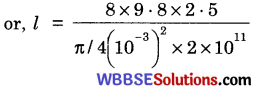
Example 4 : one end of an iron wire of length 250 cm of diameter 1 mm is rigidly fixed with a beam and a weight of 8 kg} is placed at the other end. Calculate the elongation of the wire.
(Y. of iron = 20 × 1011 dyne cm-2 ; g = 9.8 ms-2)
Answer:
L = 250 cm = 2.5 m
d = 1 mm = 10-3m
W = 8 kg . wt
Y = 20 × 1011 dyne cm-2
= 2.0 × 10¹¹ Nm-2
g = 9.8 ms-2
l = ?
l = \(\frac{F L}{A}\)
WBBSE Class 9 Physical Science Solutions Chapter 3 Matter Structure and Properties 1
= 0.125 × 10⁻² m

Example 5 : Find the pressure at a depth of 5 m below the surface of a lake. (Density of water = 1000 kgm-3).
Answer:
h = 5 m
d = 1000 kgm-3
g = 9.8 ms-2
p = ?
P = hdg
P = 5 × 1000 × 9.8
Or,
= 4.9 × 10⁴ Nm-2

WBBSE Class 9 Physical Science Solutions Chapter 3 Matter: Structure and Properties

Example 6 : Atmospheric pressure at a place is 750 mm. Find the pressure at the place. (Given density of mercury = 13.6 g / cc and g = 980 cm/s2)
Answer:
h = 750 mm = 75 mm
d = 13.6 g / cc
g = 980 cm / s2
p = ?
P = hdg
= 75 × 13.6 × 980
= 0.9995 × 10⁶ dyne/cm2

Example 7 : A body having volume of 50 cm 3 weighs 0.5 kg in air. Find its density.
Answer:
m = 0.5 kg
v = 50 cm
= 50 × 10-6 m3
D = ?
Density of the body (D) = \(\frac{m}{v}\)
= \(\frac{0.5}{50 × 10^{-6}}\)
= 104 kgm-3

Example 8 : Relative density of silver is 10.5 Find the density of silver.
Answer:
Given, relative density of silver = 10.5
Now, relative density of silver = \(\frac{\text { density of silver }}{\text { density of water }}\)
∴ density of silver
= relative density of silver × density of water
= 10.5 × 1000 = 10500 kgm-3

Example 9 : A block of 36 cc. ice floats on water. What volume of it remains above water surface?
Answer:
It is known that nearly \(\frac{1}{12}\) part of the volume of an ice block remains above water when it floats on water.
Here total volume of the ice block is 36 cc.
∴ \(\frac{1}{12}\) of 36 cc = 3 cc
So, 3 cc of ice remains above water surface.

WBBSE Class 9 Physical Science Solutions Chapter 3 Matter: Structure and Properties

Example 10 : Gold has density 19.3 g/cc. An ornament weighs 5.80 g in air and 5.25 g in water. Is the ornament made of pure gold ?
Answer:
From Archimedes’ principle we get, volume of the ornament = (5.80 – 5.25) cc = 0.55 cc.
Now, considering density of pure gold 19.3 g / cc, the weight of the ornament in air = (19.3 × 0.55) g-wt. = 10.615 wt. But as indicated in the problem, weight of the ornament in air is 5.80 g-wt. Hence, the ornament is not made of pure gold.

Example 11 :
A metallic wire of length 60 cm when stretched along length by a normal force becomes 61 cm Find the longitudinal strain.
Answer:
Given, original length of wire, l = 60 cm
final length of the wire, l’ = 61 cm
increase in length Δ l = l’-1 = (61-60)
cm = 1
∴ longtudinal strain = \(\frac{\Delta l}{l}\) = \(\frac{1}{60}\) = 0 . 017

Example 12 : A metallic wire of radius 0.1 cm and length 2 m is extended by a weight of 2.5 kg. Find the normal stress set up.
Answer:
Given external deforming
force, F = 2.6 kg-wt = 2.5 × 9.8 N
radius of the wire, r = 0 . 1 cm
= 0.1 × 10⁻² m
area of cross-section of the wire = π r2 = π(10-3)2 m2
Since normal stress = \(\frac{\text { external deforming force }}{\text { area }}\)
= \(\frac{2.5 × 9.8}{\pi(10^{-3})^2}\)
= 7.8 × 10⁶ Nm-2

WBBSE Class 9 Physical Science Solutions Chapter 3 Matter: Structure and Properties

Example 13 :
The ratio radiis of two wires of same material is 2: 1. If these wires are stretched by equal force, find the ratio of stresses produced in them.
Answer:
Given r1: r2 = 2 : 1
F1 = F2 = F
Stress (S) = \(\frac{\text { force }}{\text { area }}\) = \(\frac{F}{\pi \sigma^2}\) or, s α \(\frac{1}{r^2}\)
∴ \(\frac{S_1}{S_2}\) = \(\frac{r_2^2}{r_1^2}\) = \((\frac{1}{2})^2\) = \(\frac{1}{4}\)

WBBSE Class 9 Physical Science MCQ Questions Chapter 4.2 Mole Concept

Well structured WBBSE Class 9 Physical Science MCQ Questions Chapter 4.2 Mole Concept can serve as a valuable review tool before exams.

Mole Concept Class 9 WBBSE MCQ Questions

Multiple Choice Questions :

Question 1.
Which scientist first gave the concept of molecule ?
(i) Dalton
(ii) Avogadro
(iii) Berzelius
(iv) Boyle
Answer:
Avogadro

Question 2.
What is the volume of 1 gram-molecule of a gas or vapour at NTP ?
(i) 22.4 ml
(ii) 22.4 lit
(iii) 1000 ml
(iv) 2.24 lit
Answer:
22.4 lit

WBBSE Class 9 Physical Science MCQ Questions Chapter 4.2 Mole Concept

Question 3.
In the reaction, N2 + 3H2 = 2NH3, the ratio of volumes of nitrogen, hydrogen and ammonia is 1 : 3 : 2. These figures illustrate the law of :
(i) constant proportion
(ii) multiple proportion
(iii) reciprocal proportion
(iv) Gay Lussac’s law of gaseous volumes
Answer:
Gay Lussac’s law of gaseous volumes

Question 4.
At NTP, 5.6 lit of a gas weigh 8 grams. The vapour density of the gas is :
(i) 32
(ii) 40
(iii) 16
(iv) 8
Answer:
16

Question 5.
Which of the following contains the least number of molecules ?
(i) 1g H2
(ii) 2g N2
(iii) 4g O2
(iv) 11g CO2
Answer:
2g N2

WBBSE Class 9 Physical Science MCQ Questions Chapter 4.2 Mole Concept

Question 6.
Which of the following volume of the gas at NTP contains the largest number of molecules?
(i) 200 ml H2
(ii) 100 ml O2
(iii) 150 ml N2
(iv) 22.5 ml NH3
Answer:
200ml H2

Question 7.
One of the following statements is not applicable to 1 mole of carbon dioxide :
(i) 22g CO2
(ii) 22.4 lit of the gas
(iii) 1 gram atom of carbon and 2 gram atoms of oxygen
(iv) 6.023 × 10²³ molecules of carbon dioxide
Answer:
22g CO2

Question 8.
A mole of any gas :
(i) always occupies one litre
(ii) always occupies 22.4 lit at NTP
(iii) can occupy any volume at NTP
(iv) always occupies 11.2 lit at NTP
Answer:
Always occupies 22.4 lit at NTP

WBBSE Class 9 Physical Science MCQ Questions Chapter 4.2 Mole Concept

Question 9.
The latest standard of atomic weight is :
(i) Hydrogen = 1
(ii) Oxygen = 16
(iii) Carbon = 12
(iv) Nitrogen = 14
Answer:
Carbon = 12

Question 10.
The approximate number of molecules in 4.25 g of ammonia is :
(i) 1.0 × 10²³
(ii) 1.5 × 10²³
(iii) 2.0 × 10²³
(iv) 3.5 × 10²³
Answer:
1.5 × 10²³

Question 11.
Atomic weight of chlorine is 35.5 . It has two isotopes of atomic weight 35 and 37 . What is the percentage of the heavier isotope in the sample?
(i) 5
(ii) 25
(iii) 20
(iv) 15
Answer:
25

Question 12.
Number of molecules in one litre of water, is close to :
(i) \(\frac{6.023}{23.4}\) × 1023
(ii) 18 × 6.023 × 102
(iii) \(\frac{18}{22.4}\) × 1023
(iv) 55.5 × 6.023 × 1023
Answer:
55.5 × 6.023 × 1023

WBBSE Class 9 Physical Science MCQ Questions Chapter 4.2 Mole Concept

Question 13.
Volume at NTP of 0.22 g of CO2 is the same as that of
(i) 0.01 g of H2
(ii) 0.085 g of NH3
(iii) 320 mg of gaseous SO2
(iv) All of the above
Answer:
All of the above

Question 14.
Avogadro’s number of helium atoms weighs :
(i) 1 g
(ii) 4 g
(iii) 8 g
(iv) 4 × 6.023 × 1023 g
Answer:
4 g

Question 15.
The molecular mass of CO2 is 44 amu. Avogadro’s number is 6.023 × 10²³, therefore the mass of one molecule of CO2 is :
(i) 7.31 × 10⁻²³
(ii) 3.65 × 10⁻²³
(iii) 1.01 × 10⁻²³
(iv) 2.01 × 10⁻²³
Answer:
7.31 × 10⁻²³

WBBSE Class 9 Physical Science MCQ Questions Chapter 4.2 Mole Concept

Question 16.
4.0 grams of caustic soda contains :
(i) 6.023 × 10²³ atoms of hydrogen
(ii) 4 g} atoms of sodium
(iii) 6.023 × 10²² atoms of sodium
(iv) 4 moles of caustic soda
Answer:
6.023 × 10²² atoms of sodium

Question 17.
Which of the following weighs the least ?
(i) 24g of magnesium
(ii) 0.9 moles of nitric oxide
(iii) 22.4 lit of N2
(iv) 6.023 × 1024 molecules of oxygen
Answer:
24g of magnesium

Question 18.
One mole of CO2 contains :
(i) 6.023 × 10²³ atoms of carbon
(ii) 6.023 × 10²³ atoms of oxygen
(iii) 18.1 × 10²³ molecules of carbon dioxide
(iv) 3 gram atoms of carbon dioxide.
Answer:
6.023 × 10²³ atoms of carbon

WBBSE Class 9 Physical Science MCQ Questions Chapter 4.2 Mole Concept

Question 19.
One amu is :
(i) 1.00748 g
(ii) 0.000549 g
(iii) 1.66 × 10⁻²⁴ g
(iv) 6.023 × 10⁻²³ g
Answer:
1.66 × 10⁻²⁴ g

Question 20.
The vapour density of a gas is 11.2. The volume occupied by 11.2 g of the gas at NTP is :
(i) 1 L
(ii) 11.2 L
(iii) 22.4 L
(iv) 10 L
Answer:
11.2 L

Question 21.
The vapour density of pure ozone would be :
(i) 16
(ii) 24
(iii) 32
(iv) 48
Answer:
24

Question 22.
At STP 5.6 lit of a gas weighs 60g. The vapour density of the gas is :
(i) 30
(ii) 60
(iii) 120
(iv) 240
Answer:
120

WBBSE Class 9 Physical Science MCQ Questions Chapter 4.2 Mole Concept

Question 23.
The largest number of molecules is in :
(i) 34 g water
(ii) 54 g oi CO2
(iii) 46 g of CH3 OH
(iv) 54 g of N2 O5
Answer:
34g water

Question 24.
The number of oxygen atoms in 4.4 g of CO2 is approx:
(i) 1.2 × 10²³
(ii) 6 × 10²³
(iii) 6 × 10²²
(iv) 12 × 1023
Answer:
1.2 × 10²³

Question 25.
The number of molecules in 16g of methane (CH4) is :
(i) 3.0 × 10²³
(ii) 6.023 × 10²³
(iii) \(\frac{16}{6.023}\) × 1023
(iv) \(\frac{16}{3}\) × 1023
Answer:
6-023 × 1023

WBBSE Class 9 Physical Science MCQ Questions Chapter 4.2 Mole Concept

Question 26.
0.56 g of a gas occupies 280 ml at NTP, then its molecular mass is :
(i) 4.8
(ii) 44.8
(iii) 2
(iv) 22.4
Answer:
448

Question 27.
‘Mole’ means
(i) a molecule
(ii) number of molecules
(iii) number of atoms
(iv) avogadro’s number of any particle
Answer:
Avogadro’s number of any particle

Question 28.
0.012 kg2 C-12 isotope contains howmany C-12 atoms ?
(i) 12
(ii) 6.022 × 10²³
(iii) 1.66 × 10⁻²⁴ g
(iv) 12 g atom.
Answer:
6.022 × 10²³

Question 29.
Avogadro’s number is used in
(i) Chemistry only
(ii) Physics only
(iii) Biology only
(iv) Chemistry, Physics and biology
Answer:
Chemistry, physics and biology.

WBBSE Class 9 Physical Science MCQ Questions Chapter 4.2 Mole Concept

Question 30.
The value of Avogadro’s number is :
(i) 6.320 × 10²³
(ii) 6.022 × 10²³
(iii) 6.320 × 10²³
(iv) 6.029 × 10²³
Answer:
6.022 × 10²³

Question 31.
Formula unit mass of KCl is :
(i) 57.4 U
(ii) 45.7 U
(iii) 49.8 U
(iv) 74.5 U
Answer:
74.5 U

Fill in the blanks :

1. Equal volumes of all gases under the same condition of temperature and pressure contain the same number of _______ .
Answer:
molecules

2. Atomic weight of an element expressed in gram is called its ______ atomic weight.
Answer:
gram

WBBSE Class 9 Physical Science MCQ Questions Chapter 4.2 Mole Concept

3. Avogadro’s number is ______ which is the fixed number of constituent particles present in 1 gram-molecule or in 1 gram or in 1 gram ion of any substance.
Answer:
6.023 × 10²³

4. Normal density = ______ density of a gas at NTP × 0.089
Answer:
Vapour

5. Molecular weight of a gas = _______ × vapour density:
Answer:
2

6. The gram-molecular volume of any gas or vapour occupies ______ litres at NTP.
Answer:
22.4 lit

7. Molecules of elementary gases are ______.
Answer:
diatomic

8. Molar volume is the volume of gram-molecular ______ of an element or a compound.
Answer:
weight

WBBSE Class 9 Physical Science MCQ Questions Chapter 4.2 Mole Concept

9. The molecular mass of sulphuric acid is _______.
Answer:
98

10. 22.4 litres of hydrogen at STP contain ______ number of hydrogen molecules.
Answer:
6.023 × 10²³

11. ______ was the first scientist who introduced the term molecule to indicate the smallest particle of both elements and compounds.
Answer:
Avogadro

12. 2g of hydrogen and 32g of oxygen contain the _______ number of molecules.
Answer:
same

13. The number of molecules contained in 8g of oxygen is ______.
Answer:
1.505 × 10²³

14. The molecular weight of chlorine is 71 . Clearly, 6.023 × 10²³ atoms of chlorine weighs ______ grams.
Answer:
35.5

WBBSE Class 9 Physical Science MCQ Questions Chapter 4.2 Mole Concept

15. The gram atoms contained in 5 g of calcium are ______.
Answer:
0.125

16. The number of atoms present in 16 g of oxygen is ______.
Answer:
6.023 × 10²³

17. The number of gram moles present in 7g of CO is _______.
Answer:
3.0115 × 10²³

18. Only one atom of carbon is available from _______ of carbon.
Answer:
12u

19. Between (i) 36g of H2O and (ii) 46g of nitrogen dioxide, the larger number of molecules is in ______.
Answer:
36g H2O

20. The number of moles present in 90.0 g} of water is ______.
Answer:
5

21. Modern atomic weights of elements are based on _____.
Answer:
126 C

WBBSE Class 9 Physical Science MCQ Questions Chapter 4.2 Mole Concept

22. The volume occupied by 2g H2 and 32g O2 at STP is ______ cm3.
Answer:
22400

23. The value 6.0233 × 10²³ mol-1 is assigned to ______ constant.
Answer:
Avogadro’s.

24. The mass of one mole molecules of any substance is equal to ______.
Answer:
Gram molecular mass

25. 12U of carbon contains how many atom of carbon.
Answer:
Only one atom of carbon.

26. 1 mole of carbon contains ________.
Answer:
12 g of C.

27. (z1) 16 g oxygen is equal to ______ moles of oxygen.
Answer:
0.5

WBBSE Class 9 Physical Science MCQ Questions Chapter 4.2 Mole Concept

28. (z2) Atomic mass of element X 1 amu is ______ mass of one atom of the element.
Answer:
Actual.

WBBSE Class 9 Physical Science MCQ Questions Chapter 5 Work, Power and Energy

Well structured WBBSE Class 9 Physical Science MCQ Questions Chapter 5 Work, Power and Energy can serve as a valuable review tool before exams.

Work, Power and Energy Class 9 WBBSE MCQ Questions

Multiple Choice Questions :

Question 1.
What type of energy a raised hammer possesses ?
(i) Kinetic energy
(ii) Potential energy
(iii) Gravitational energy
Answer:
Potential energy

Question 2.
What is the absolute unit of force in SI system ?
(i) 1 kg-m
(ii) 1 joule
(iii) 1 erg
Answer:
1 Joule

WBBSE Class 9 Physical Science MCQ Questions Chapter 5 Work, Power and Energy

Question 3.
What is the relation between power and force ?
(i) power = force × velocity
(ii) velocity = force × power
(iii) force = power × velocity
Answer:
power = force × velocity.

Question 4.
What is the amount of work performed by a person on the weight w that he carries and moves horizontally through a distance d ?
(i) No work is done
(ii) Work done = w × d
(iii) work done = w ÷ d
Answer:
No work is done

Question 5.
The dimension of energy is :
(i) [M L2 T-2]
(ii) [M2 L2 T3]
(iii) [M L2 T3]
(iv) [M L3 T2]
Answer:
ML2 T-2

Question 6.
1 Horse power = ______.
(i) 7.46 watt
(ii) 74.6 watt
(iii) 746 watt
(iv) 7460 watt
Answer:
746 watt

WBBSE Class 9 Physical Science MCQ Questions Chapter 5 Work, Power and Energy

Question 7.
All energies are transformed ultimately into :
(i) heat energy
(ii) kinetic energy
(iii) sound energy
(iv) electric energy
Answer:
Heat energy

Question 8.
Which is a scalar quantity :
(i) Force
(ii) Displacement
(iii) Work
(iv) Velocity
Answer:
Work

Question 9.
If the velocity of a body is doubled then kinetic energy will be :
(i) Same
(ii) Doubled
(iii) Tour times
(iv) Half times
Answer:
Four times

WBBSE Class 9 Physical Science MCQ Questions Chapter 5 Work, Power and Energy

Question 10.
Work done in unit time is known as :
(i) Power
(ii) Energy
(iii) Force
Answer:
Power

Question 11.
1 kilowatt = ________.
(i) \(\frac{2}{3}\) HP
(ii) \(\frac{4}{3}\) HP
(iii) \(\frac{7}{3}\) HP
Answer:
\(\frac{4}{3}\) HP

Question 12.
What is the unit of kinetic energy in SI system :
(i) erg
(ii) HP
(iii) joule
Answer:
joule

Question 13.
1 mega-watt = _________.
(i) 103 watt
(ii) 104 watt
(iii) 105 watt
(iv) 106 watt
Answer:
105 watt

Question 14.
What is the practical unit of power in CGS system :
(i) erg
(ii) watt
(iii) joule
Answer:
watt

WBBSE Class 9 Physical Science MCQ Questions Chapter 5 Work, Power and Energy

Question 15.
Kilogram-meter is the unit of :
(i) energy
(ii) power
(iii) work
Answer:
Work

Question 16.
The dimension of work is :
(i) [M L2 T-2]
(ii) [M2 L2 T2]
(iii) [M L3 T-2]
Answer:
[ML2 T-2]

Question 17.
The dimension of power is :
(i) [M L2 T-3]
(ii) [M2 L2 T2]
(iii) [M L3 T3]
Answer:
[ML2 T-3]

Question 18.
1 watt = ______.
(i) 105 erg/sec
(ii) 106 erg/sec
(iii) 107 erg/sec
Answer:
107 erg/sec.

Question 19.
SI unit of energy is :
(i) Joule
(ii) erg
(iii) dyne
(iv) newton
Answer:
Joule

WBBSE Class 9 Physical Science MCQ Questions Chapter 5 Work, Power and Energy

Question 20.
The potential energy of a boy is maximum when he is :
(i) sitting on the floor
(ii) standing on the floor
(iii) sleeping on the floor
Answer:
Standing on the floor.

Question 21.
Water stored in a dam possesses :
(i) KE
(ii) PE
(iii) elecric energy
(iv) no energy
Answer:
Electric energy

Question 22.
The kinetic energy of an object is K. If its mass is reduced to half, them its kinetic energy will be :
(i) K
(ii) 2 K
(iii) \(\frac{K}{2}\)
Answer:
\(\frac{K}{2}\)

Question 23.
The work done on an object does not depend upon the :
(i) force applied
(ii) initial velocity
(iii) displacement
Answer:
Initial velocity

Question 24.
In case of negative work, the angle between the force and displacement is :
(i) 0°
(ii) 45°
(iii) 180°
Answer:
180°

WBBSE Class 9 Physical Science MCQ Questions Chapter 5 Work, Power and Energy

Question 25.
In a tug of war, work done by a losing team is :
(i) Zero
(ii) Positive
(iii) negative
Answer:
Negative

Question 26.
A stone is thrown vertically upward. It comes to rest momentarily at the highest point. What happens to its kinetic energy ?
(i) It convents into elastic potential energy
(ii) It convents into gravitational potential energy
(iii) It converts into chemical energy.
Answer:
It convents into gravitational potential energy.

Question 27.
A force of 100 N acting on a body does 100 j work. The distance through which the body is displaced –
(i) 5 m
(ii) 10 cm
(iii) 10 m
Answer:
10 m

Question 28.
When electric current passes through an electric bulb, electric energy is converted into :
(i) heat energy only
(ii) light energy only
(iii) both heat and light energy
Answer:
Both heat and light energy.

Fill in the blanks :

1. The gravitational unit of work in the _____ system is newton-meter.
Answer:
SI

2. Power is the ratio between work and _____
Answer:
time

3. Just before touching the ground, a freely falling body possesses only ______ energy.
Answer:
kinetic energy

WBBSE Class 9 Physical Science MCQ Questions Chapter 5 Work, Power and Energy

4. Watt is the unit of ______ in SI system.
Answer:
power.

5. A raised hammer possesses ______ energy.
Answer:
potential

6. Water current or air current mainly possesses ______ energy.
Answer:
kinetic energy

7. 1 horse power = ______ watt.
Answer:
746

8. Both power and energy are ______ quantities.
Answer:
scalar

9. 1 joule = ________ erg.
Answer:
107

10. Potential energy of body is taken as ________
Answer:
mgh

11. 1 kilowatt = _______ Horse power.
Answer:
134

WBBSE Class 9 Physical Science MCQ Questions Chapter 5 Work, Power and Energy

12. Power × time = ________
Answer:
work done

13. Work is a _______ quantity.
Answer:
scalar

14. newton × meter = _______.
Answer:
joule

15. The capacity of a body or a person to do work is its ________
Answer:
energy

16. kinetic energy = _______ × m × v2
Answer:
\(\frac{1}{2}\)

17. When a force acts _______ to the direction of displacement of the particle, the force does not do any work.
Answer:
perpendicular

WBBSE Class 9 Physical Science MCQ Questions Chapter 5 Work, Power and Energy

18. If there is no _______ of the point of application of the force, then the force is called no work force.
Answer:
displacement

19. If the direction of displacement (S) makes an angle θ with the direction of the applied force (F), component of the force along the direction of displacement will be ________
Answer:
FS\cos\θ

20. The ______ work is done, when the displacement is in the direction of the force.
Answer:
positive

21. In SI, the absolute unit of work is ______.
Answer:
joule

22. work done per unit time is called _______.
Answer:
power

23. One horse power is equal to _______ watt.
Answer:
746

24. The capacity of a body to do work is ______.
Answer:
energy

25. A stretched spring has potential energy due to its ______.
Answer:
shape.

WBBSE Class 9 Physical Science MCQ Questions Chapter 5 Work, Power and Energy

26. The gravitational potential energy of body when raised from ground to certain height is _______ of the path followed.
Answer:
independent

27. Larger the mass of a body ______ is the kinetic energy of the body.
Answer:
greater

28. Total energy of a system is ______ , when energy is changed from one form to other.
Answer:
conserved

29. The mechanical energy is of _______ types.
Answer:
two

WBBSE Class 9 Physical Science Solutions Chapter 4.1 Atomic Structure

Detailed explanations in West Bengal Board Class 9 Physical Science Book Solutions Chapter 4.1 Atomic Structure offer valuable context and analysis.

WBBSE Class 9 Physical Science Chapter 4.1 Question Answer – Atomic Structure

Very short answer type questions

Question 1.
Which atom has no neutron?
Answer:
Ordinary hydrogen atom has no neutron.

Question 2.
Which force binds the nucleons?
Answer:
The nuclear force, a short ranged attractive force binds the nucleons.

Question 3.
Which fundamental particle is responsible to produce isotopes?
Answer:
Neutron is responsible to produce isotopes, variation of it causes variation of mass number.

Question 4.
Name the element of the same mass number and atomic number?
Answer:
Ordinary hydrogen has the same mass number and atomic number, each being 1.

Question 5.
What are nucleons ?
Answer:
The constituents of the nucleous of an atom, proton and neutron are called nucleons.

WBBSE Class 9 Physical Science Solutions Chapter 4.1 Atomic Structure

Question 6.
Name the heaviest isotope of hydrogen.
Answer:
Tritium is the heaviest isotope of hydrogen.

Question 7.
State one difference between H and H+.
Answer:
H is an unstable hydrogen atom having no net electric charge. H+ is a positive hydrogen ion carrying unit positive charge.

Question 8.
What is deuteron and what is triton ?
Answer:
The nucleous of deuterium is called deuteron and that of tritium is called triton.

Question 9.
What is isotopic weight ?
Answer: The weight of an isotope of an element is known as isotopic weight.

Question 10.
Can there be a doubly ionised hydrogen ion ?
Answer:
Hydrogen has only one electron, so it can be ionised singly by losing the electron, so there cannot be a doubly ionised hydrogen ion.

Question 11.
What is the relation between atomic number and mass number ?
Answer:
The relation is A = Z + N, where A = mass number, Z = atomic number, N = number of neutrons.

Question 12.
Name two particies of an atom which are always equal in number.
Answer:
Proton and electron.

WBBSE Class 9 Physical Science Solutions Chapter 4.1 Atomic Structure

Question 13.
What is the magnitude of charge of a neutron ?
Answer:
Neutron has no charge.

Question 14.
Which part of an atom contains protons?
Answer:
Nucleus.

Question 15.
Why an atom always remains neutral inspite of the existence of electrons and protons which are charged particles ?
Answer:
As electrons and protons of an atom are always equal in number, the positive charges of the protons and negative chargy of the electrons cancell each other. As a result, an atom always remains neutral.

Question 16.
Who discovered neutron?
Answer:
J. Chadwick (1932) discovered neutron.

Question 17.
Who discovered nucleus of the atom ?
Answer:
Rutherford discovered nucleus of the atom.

Question 18.
What are electron-shells ?
Answer:
The electrons outside the nucleus of the atom rotate in definite number in certain specified circular paths around the nucleus. These con-centric circular paths of the rotating electrons are called electronshells.

Question 19.
Write the electronic configuration of chlorine.
Answer:
The electronic configuration of chlorine is :
K L M
2 8 7

WBBSE Class 9 Physical Science Solutions Chapter 4.1 Atomic Structure

Question 20.
What are ions ?
Answer:
Electrically charged atoms (or, group of atoms) are called ions.

Question 21.
How are ions formed from neutral atom ?
Answer:
The formation of ions from neutral atoms involves loss or gain of one or more than one electrons.

Question 22.
What are the fundamental particles that constitute an atom ?
Answer:
Electron, proton and neutron are the fundamental particles that constitute an atom.

Question 23.
Among the different fundamental particles, which one is positively charged and which one is negatively charged ?
Answer:
Proton is positively charged particle and electron is negatively charged particle.

Question 24.
What is cation ?
Answer:
Positively charged atom or radical is callled a cation.

Question 25.
What is anion?
Answer:
Negatively charged atom or radical is called an anion.

Question 26.
Among electron, proton and neutron, which one is the heaviest and which one is the lightest particle?
Answer:
Neutron is the heaviest particle and electron is the lightest particle.

WBBSE Class 9 Physical Science Solutions Chapter 4.1 Atomic Structure

Question 27.
Calculate the number of protons and neutrons in \({ }_{92}^{235} \mathrm{U}\).
Answer:
\({ }_{92}^{235} \mathrm{U}\) → protons : 92
neutrons : (235-92)=143

Question 28.
What is the relation between \({ }_{92}^{235} \mathrm{U}\) and \({ }_{92}^{238} \mathrm{U}\) ?
Answer:
These are two isotopes of uranium.

Question 29.
Give example where mass number and atomic numbers are equal.
Answer:
Mass number and atomic numbers are equal in those elements which do not have any isotope. e.g. Na, F etc.

Question 30.
Between K and K+ which one is more stable?
Answer:
K+is more stable than K as in the earlier case the electronic configuration is just like inert gas argon.

Question 31.
What is heavy water ?
Answer:
Oxide of deuterium (D2O) is called heavy water.

Question 32.
What is the maximum capacity of L shell to accommodate electrons ?
Answer:
8 electrons.

WBBSE Class 9 Physical Science Solutions Chapter 4.1 Atomic Structure

Question 33.
What is the mass of an electron ?
Answer:
Mass of an electron is 9.11 × 10⁻²⁸ g.

Question 34.
What is the charge of an electron ?
Answer:
Charge of an electron is 1.602 × 10⁻¹⁹ coulomb or 4.8 × 10⁻¹⁰ esu}

Question 35.
What is amu?
Answer: It is an unit used for measuring the atomic mass of an atom. 1 amu} = 1.66.3 × 1024 g

Question 36.
What is the mass of a neutron ?
Answer:
Mass of a neutron is 1.675 × 10⁻²⁴ g.

Question 37.
What is the radius of an electron ?
Answer:
The radius of an electron is 2.8 × 10⁻¹³ cm.

Question 38.
Which is the smaliest partices present in all atoms ?
Answer:
Electrons.

Question 39.
What is cathode ray ?
Answer:
When electric discharge passes from high by potential source through a gas at very low pressure (0.01 mm of Hg) in a glass tube provided with two metallic electrodes, a stream of invisible rays is emitted from the surface of the cathode which moves in straight line towards the anode with a high velocity. These rays are called cathode rays as they originate at the cathode.

WBBSE Class 9 Physical Science Solutions Chapter 4.1 Atomic Structure

Question 40.
Who discovered radio-activity ?
Answer:
Madam curie discovered radio-activity.

Short answer type questions

Question 1.
What are the postulates of Dalton’s atomic theory ?
Answer:
Postulates of Dalton’s atomic theory :
(i) Every element is composed of infinite number of very small indivisible particles. These smallest particles are known as ‘atoms’.
(ii) Atoms cannot be created or destroyed by a chemical reaction.
(iii) Atoms of different elements are different. But atoms of a definite element are same.

Question 2.
What are the fundamental particles? Why are they called ‘fundamental’ ?
Answer:
Fundamental particles: The sub-atomic particleselectron, proton and neutrons are known as fundamental particles.

Reason : Experimentally it is found that these particles are the primary components of all atoms of all elements, except ordinary hydrogen, the nucleus of which does not contain any neutron. That is why they are known as fundamental particles.

Question 3.
State some other sub-atomic particles other than electron, proton and neutron.
Answer:
Other sub-atomic particles are :

  1. Positron
  2. Antiproton
  3. Messon
  4. Neutrino
  5. Antineutrino
  6. V-particle
  7. Deuteron etc.

Question 4.
What makes electrons move round the nucleus ?
Answer:
Explanation : The negatively charged electrons in each shell are attracted by Coulombian electrostatic force towards the positive nucleus that contains positively charged protons. To counter balance this inward force the electrons rotate about the nucleus, as a revolving body is always accompanied with an outward force.

Question 5.
What is nuclear force?
Answer:
Nuclear force: In the nucleus of an atom, the protons and neutrons are strongly held together by nuclear forces which result from the attraction between the constituent protons and neutrons. This force is so strong that it is very difficult to separate the nucleons.

WBBSE Class 9 Physical Science Solutions Chapter 4.1 Atomic Structure

Question 6.
Define atomic number. Atomic number is the fundamental property of an element – Explain.
Answer:
Atomic number : The atomic number of an atom of an element is the number of protons in its nucleus.
Atomic number is the fundamental property : Number of protons determine the nature of the element. Change in the number of protons changes its chemical properties. As a result, a new element is formed. So, atomic number of an element is its intrinsic property.

Question 7.
What do you mean by mass number of an element ?
Answer:
Mass number : The mass number of an atom of an element is the total number of protons and neutrons present in the núcleus of the atom.
Mass number of atom = Number of protons + Number of neutrons. Mass number is written on the upper left-hand side of the symbol of the element.

Question 8.
What is the relation between mass number and atomic number ?
Answer:
Relation between mass number and atomic number :
We know that,
Mass number of an atom = Number of protons + Number of neutrons

Suppose, number of protons in the nucleus of an atom = Z, number of neutrons = N, and mass number = A
Then we can write,
A = Z + N
As number of protons = atomic number
∴ Atomic number = mass number – number of neutrons

Question 9.
Define isotope.
Answer:
Isotope : The different atomic species of the same element, which have necessarily the same atomic number but different mass number are called isotopes.
e.g. Hydrogen has three isotopes :
\({ }_1^1 \mathrm{H}\) (Ordinary hydrogen) ; \({ }_1^2 \mathrm{H}\) (Deuterium) ; \({ }_1^3 \mathrm{H}\) (Tritium)

WBBSE Class 9 Physical Science Solutions Chapter 4.1 Atomic Structure

Question 10.
What is meant by \({ }_8^{16} \mathrm{O}\) ? Show its electronic configuration.
Answer:
\({ }_8^{16} \mathrm{O}\) is meant by : \({ }_8^{16} \mathrm{O}\) stands for an isotope of oxygen that has 8 protons and 8 neutrons in the nucleus and 8 electrons surrounding the nucleus.
The electronic configuration is :
K – shell has 2 electrons, L-shell has 6 electrons.

Question 11.
How do the physical and chemical properties differ in the isotopes of an element? Have they any common property?
Answer:
Difference between physical and chemical properties of isotopes of an element : Isotopes of an element have the same chemical property since their atomic number is same i.e. number of valence electrons is same. Physical property of the isotopes of an element slightly differ due to the increase of mass number which results to slight increase of density, melting point and boiling point.
Common property : As isotopes have same atomic number, so they have same chemical properties.

WBBSE Class 9 Physical Science Solutions Chapter 4.1 Atomic Structure

Question 12.
Define atomic weight of an element on the basis of carbon-12.
Answer:
Atomic weight of an element on the basis of carbon-12 : The relative weight of one atom of carbon 12c is taken as the atomic weight of the element. Here, one-twelvth part of the weight of a carbon atom (C = 12) has been taken as the unit.

WBBSE Class 9 Physical Science Solutions Chapter 4.1 Atomic Structure 1

Question 13.
Distinguish between atomic number and mass number.
Answer:
Difference between atomic number and mass number:

Atomic Number Mass Number
(i) It is equal to the number of protons present in the nucleus of an atom. (i) It is equal to the sum of the numbers of protons and neutrons present in the nucleus of an atom.
(ii) From atomic number, number of valence electrons can be determined which in turn gives the idea of chemical combination of the atom. (ii) Mass number gives an idea about the atomic mass of the element concerned but it does not give any idea about chemical activity of the element until the number of protons or the number of neutrons is indicated.

WBBSE Class 9 Physical Science Solutions Chapter 4.1 Atomic Structure

Question 14.
How is an atom transformed to an ion? What are cations and anions ?
Answer:
Ions : Electrically charged atoms or radicals are called ions. Cation : Positively charged atom or radical is known as cation. e.g. NH4 +, Ca2+, Na+etc.
Anion: Negatively charged atom or radical is called an anion. e.g. SO4-2, NO3, Cletc.

Question 15.
What are the differences between an atom and ion ?
Answer:
Differences between an atom and an ion:

Atom Ion
(i) An atom is electrically neutral. (i) An ion is electrically charged atom. It is formed when an atom either gains or loses one or more electrons.
(ii) An atom may or may not have free existence.
e.g. Na atom reacts immediately when it comes in contact with water.
2 Na + 2 H2O = 2 NaOH + H2
(ii) An ion exists freely in solution.

WBBSE Class 9 Physical Science Solutions Chapter 4.1 Atomic Structure

Question 16.
What are the differences between atomic weight and actual weight of an atom ?
Answer:
Distinction between atomic weight and actual weight of an atom :

Atomic weight Actual weight of an atom
(i) It is a number which represents how many times an atom of an element is heavier than 1/12 weight of carbon atom (C-12) (i) It is a number which represents how many times an atom is heavier than one atomic mass unit (a.m.u.) which is equivalent to 1.6603 × 10⁻²⁴ g.
(ii) It is a simple ratio and therefore has no unit. (ii) It represents the actual weight of an atom and therefore has unit.

Question 17.
Mention two similarities between atomic structure and the structure of the solar system.
Answer:
Similarities between atomic structure and the structure of the solar system :

Atomic Structare Solar system
(i) Nucleus is at the centre, electrons revolve round it. (i) The sun is at the centre, planets revolve round it.
(ii) Mass of the nucleus is much greater than that of an electron moving round it. (ii) Mass of the sun is much greater than that of any planet revolving round it.

Question 18.
Mention three dissimilarities betwoen atomic structure and the structure of the solar system.
Answer:
Dissimilarities between atomic structure and the structure of the Solar system :

Atomic Structure Solar system
(i) More than one electron may be held in the same orbit. (i) More than one planet never be held in the same orbit.
(ii) Force between the nucleus and electrons is electrostatic in nature. (ii) Force between the sun and the planets is gravitational in nature.
(iii) In the atom, the protons and electrons are electrically charged bodies. (iii) The sun and all other heavenly planets are uncharged.

Broad answer type questions

Question 1.
What conclusions are found from Rutherford’s experiment ?
Answer:
Conclusions from Rutherford’s experiment :
(i) The atom consists of an extremely small, centrally located region called the nucleus in which the whole mass and the entire positive charge carried by the protons remain confined.
(ii) The major portion of the space in an atom is empty.
(iii) Negatively charged electrons present in the atom remain outside the nucleus at relatively large distances and they revolve round the nucleus at some definite circular path known as orbit.

WBBSE Class 9 Physical Science Solutions Chapter 4.1 Atomic Structure

Question 2.
What is the fundamental difference between Rutherford’s model and Bohr’s model?
Answer:
Difference between Rutherford’s model and Bohr’s model : The fundamental difference between the two models is that Bohr’s model is based on the concept of quantisation of energy and angular momentum of electron. Electrons can move only is certain permitted orbits with definite amount of energy and angular momentum. Rutherford’s model does not give an idea about the permitted orbits.

Question 3.
What are the uses of Radio-isotopes ?
Answer:
Uses of Radio-isotopes :
(i) In medicine : Radio isotopes and proved to be very useful in medical diagnosis. Radio-isotope of iodine is used by the patients with thyroid disorder.
(ii) In agriculture : By introducing radioactive phosphorous fertiliser, it has been possible to enhance growth of the plant and crop.
(iii) In Industry : In research and process control radio-isotopes are used as a tracer.
(iv) Radio-carbon dating : With the help of radioactive isotope of carbon \({ }_6^{14} \mathrm{C}\) it has been possible to estimate the age of our earth which is about 4-5 billion years.

Question 4.
What is valence electron ? What is radioactivity ? Give the name of the natural radioactive elements and artificial radioactive elements.
Answer:
Valence Electron : Electron or electrons present in the outermost orbit of the electronic shell of an atom is known as valence electron.

Radioactivity : It is a neuclear phenomenon in which the elements having higher atomic number and mass number (n / p>1.54) disintegrate spontaneously emitting energy from the nucleus in the form of radioactive rays and this emission cannot be stopped by any physical or chemical process which means this emission is independent of external agencies and conditions.
Natural Radioactive element :
Radium (Ra), Thorium (Th), Uranium (U) etc.
Artifical Radioactive element :
Neptunium (Np), Eistenium (Es) etc.

WBBSE Class 9 Physical Science Solutions Chapter 4.1 Atomic Structure

Question 5.
‘Atomic number is the intrinsic property of an element’-explain.
Answer:
Explanation: Atomic number, the number of protons in the nucleus of an atom of an element is unique for an element. It cannot

change even during or after any chemical or physical change that the element undergoes. No two elements have the same atomic number, on the other hand, different elements have different atomic numbers. The atomic number of an element indicates the ability of chemical reactivity of the element. So, atomic number is the intrinsic property of the element.

Question 6.
Atomic weight or relative atomic mass of most of the elements is not a whole number. Why?
Answer:
Explanation : It is found that the atomic weights of most of the naturally occuring elements are fractional although their mass numbers (n+p) are whole numbers. This happens because, most of the natural element consist of a mixture of two or more of their isotopes in various proportions but almost in constant composition.

For example : The atomic weight of chlorine as found by chemical methods is 35.457 . Such fractional atomic weight is due to the fact that chlorine exists in nature as a mixture containing 75.4 % of the ligher \({ }_{17}^{35} \mathrm{Cl}\) and 24.6 % of the heavier \({ }_{17}^{37} \mathrm{Cl}\) isotopes. The composition of the mixture is always found to be constant.
∴ Atomic weight of chlorine
= \(\frac{75.4 × 35+24.6 × 37}{100}\) = 35.457

Numerical Problems

Working formula

(i) 1 gram-molecular weight of a substance contains molecules = 6.022 × 10²³
(ii) 1 gram-atom of an element contains atoms = 6.022 × 10²³
(iii) At NTP, the volume of 1 gram-molecular gas = 22.4 lit.
(iv) At NTP, 22.4 lit. volume of gas has molecules = 6.022 × 10²³
(v) Atomic number = Number of protons
(vi) Mass number = Number of protons + Number of neutrons
(vii) Maximum number of electron in an Bohr’s orbit = 2 n2(n = 1,2,3 … etc.)
(viii) Atomic weight = \(=\frac{\text { Weight of one atom of an element }}{\text { Weight of one atom of carbon }} \times 12\)
(ix) 1 mole = 1 gram-molecular weight of a substance.

WBBSE Class 9 Physical Science Solutions Chapter 4.1 Atomic Structure

Example 1: Calculate the number of moles in 50 g CaCO 3.
Answer:
Formula mass of CaCO3 = 40+12+3 × 16 = 100
Gram formula mass of CaCO3 = 100 g
Agin we know, gram formula mass of CaCO3 = 1 mole ∴ 100 g CaCO3 = 1 mole
∴ 50 g CaCO3 = (\(\frac{1}{100}\) × 50) mole = 0.5 mole

Example 2 : Calculate the mass of a silver atom.
Answer:
Atomic mass of silver = 108
∴ Gram-atomic mass of silver = 108 g
Now, 6.022 × 10²³ atoms of silver = 1 mole of silver atoms = 108 g
∴ Mass of 6.022 × 10²³ atoms of silver = 108 g
∴ Mass of 1 atom of silver = \(\frac{108}{6.022 \times 10^{23}}\) = 17.93 × 10⁻²³ g

Example 3 : Calculate the mass of water in gram of 5 gram-molecular water.
Answer:
We know,
molecular weight of water = 2 × 1+16 = 18
1 gram-molecular mass of water = 18 g water
5 gram-molecular mass of water = (18 × 5) g = 90 g water

Example 4 : What is the volume of oxygen at NTP of 4 gram-molecular weight of Oxygen ?
Answer:
We know, at NTP,
1 gram-molecular weight of oxygen gas has volume 22.4 lit.
∴ 4 gram-molecular weight of oxygen gas has volume = (22.4 × 4) lit. = 89.6 lit.

WBBSE Class 9 Physical Science Solutions Chapter 4.1 Atomic Structure

Example 5 : Calculate the number of hydrogen molecules in 1 grammolecular weight of hydrogen and 1 gram of hydrogen.
Answer:
We know,
1 gram-molecular weight of hydrogen gas has molecule = 6.022 × 10²³.
Molecular weight of hydrogen gas = 2
∴ Gram-molecualr weight of hydrogen gas = 2 g.
∴ 2 g hydrogen has molecule = 6.022 × 10²³
1 g hydrogen has molecule = \(\frac{6.022 \times 10^{23}}{2}\)
= 3.0115 × 10²³

Example 6 : At NTP, 1.12 lit of a gas has weight 2.2 g. Calculate its molecular weight.
Answer:
At NTP 1.12 lit. of a gas weight = 2.2 g
At NTP, 22.4 lit. of a gas has weight = \(\frac{2.2}{1.12}\) × 2.2 .4 g
= 44 g
∴ The molecular weight of the gas = 44

Example 7 : What are the numbers of protons, neutrons, and electrons in \({ }_{28}^{65} \mathrm{Cu}\) atom ?
Answer:
We know from the symbol \({ }_{29}^{65} \mathrm{Cu}\), the atomic number of Cu atom is 29 and the mass number is 65 .
So, the number of protons in Cu atom is 29 ; the number of electrons in Cu atom is also 29.
∴ Number of neutrons = (65-29) = 36

WBBSE Class 9 Physical Science Solutions Chapter 4.1 Atomic Structure

Example 8: What is the mass number and what is the atomic number of \({ }_{92}^{235} \mathrm{X}\) ? What will be its symbol if the number of neutrons are three more?
Answer:
In \({ }_{92}^{235} \mathrm{X}\), the number of protons are 92 and the sum total of protons and neutrons are 235 .
So, the atomic number is 92 and mass number is 235 .
If the number of neutrons are three more, then the mass number will be (235+3) = 238.
In that case the symbol will be \({ }_{92}^{238} \mathrm{X}\).

Example 9: What is the relation between \({ }_{35}^{17} \mathrm{A}\), and \({ }_{37}^{17} \mathrm{B}\) ? Is there any difference in their chemical properties?
Answer:
\({ }_{35}^{17} \mathrm{A}\), and \({ }_{37}^{17} \mathrm{B}\), both have same atomic number but different mass numbers. So they are isotopes of each other. As the chemical property depends on number of protons, so they have same chemical properties.

WBBSE Class 9 Physical Science Solutions Chapter 4.4 Acids, Bases and Salts

Detailed explanations in West Bengal Board Class 9 Physical Science Book Solutions Chapter 4.4 Acids, Bases and Salts offer valuable context and analysis.

WBBSE Class 9 Physical Science Chapter 4.4 Question Answer – Acids, Bases and Salts

Very short answer type question

Question 1.
Which element must an acid contain?
Answer:
Hydrogen

Question 2.
The aqueous solution of HCl shows acidic character. Which ion is responsible for it?
Answer:
Hydronium ion (H3O+)

WBBSE Class 9 Physical Science Solutions Chapter 4.4 Acids, Bases and Salts

Question 3.
Give the name and formula of anion present in the aqueous solution of bases.
Answer:
Flydroxyl ion (OH)

Question 4.
Which indicator is used in the titration of strong acid and weak base?
Answer:
Methyl orange

Question 5.
Name an acid salt.
Answer:
Sodium bisuiphate (NaHSO4)

Question 6.
Which ions disappear in neutralization?
Answer:
W ions generated by acid and OH ions generated by alkali disappear in a neutralization process.

Question 7.
What is an oxide?
Answer:
An oxide is a compound of oxygen formed with another element.

Question 8.
Name a tribasic acid.
Answer:
Phosphoric acid (HPO4)

WBBSE Class 9 Physical Science Solutions Chapter 4.4 Acids, Bases and Salts

Question 9.
Give an example of an organic acid.
Answer:
Formic acid (HCOOH)

Question 10.
Give an example of a normal salt.
Answer:
Sodium chloride (NaCl)

Question 11.
What is the nature of aqueous solution of carbon dioxide?
Answer:
Acidic

Question 12.
What type of salt is this — NaHCO3?
Answer:
Acidic.

Question 13.
What is the use of methyl orange?
Answer:
As an indicator

Question 14.
What is neutralisation?
Answer:
Neutralisation: It is the process in which acids and alkalis in equivalent quantities in their aqueous solutions react to produce salt and the neutral substance water.

Question 15.
Give an example of a neutral oxide.
Answer:
Carbon monoxide (CO)

Question 16.
What will be the colour of the solution if few drops of phenolphthalein are added in aqueous solution of ammonium hydroxide?
Answer:
Pink colour

WBBSE Class 9 Physical Science Solutions Chapter 4.4 Acids, Bases and Salts

Question 17.
What will be the colour of the solution if few drops of phenolphthalein are added in aqueous solution of sodium carbonate?
Answer:
Pink colour

Question 18.
Which Indicator is used in the titration of weak acid and strong base?
Answer:
Phenolphthalein.

Question 19.
What is the nature of ZnO?
Answer:
Amphoteric oxide.

Question 20.
Give an example of an acid which has oxidising property.
Answer:
Nitric acid (HNO3)

Question 21.
What will be the colour of the solution if few drops of phenolphthalein are added in aqueous solution of sodium hydrogen carbonate?
Answer:
Colourless

Question 22.
Which one is used in vanishing colour— NH4OH or NaOH?
Answer:
NH4OH

Question 23.
What is the basicity of CH3COOH?
Answer:
Basicity of CHCOOH is 1.

Question 24.
What is the acidity of NaOH?
Answer:
Acidity of NaOH is 1.

WBBSE Class 9 Physical Science Solutions Chapter 4.4 Acids, Bases and Salts

Question 25.
Give an example of an oxide of metal which is not basic in nature.
Answer:
Mn3O4.

Question 26.
Give an example of a double salt.
Answer:
K2SO4 ,Al2(SO4)3, 24H2O (Potassium alum)

Question 27.
How many replaceable hydrogen atoms are present in sulphuric acid?
Answer:
Two replaceable hydrogen atoms are present in sulphuric acid.

Question 28.
Give an example of an organic base.
Answer:
Methylamine (CH3NH2)

Question 29.
Give an example of an inorganic gaseous compound which has basic property.
Answer:
Ammonia (NH3)

Question 30.
What are the colour of methyl red in acidic and alkaline medium?
Answer:
The colour of methyl red in acidic medium is red and that in alkaline medium is yellow.

Question 31.
What is an Indicatlor?
Answer:
An indicator: It is some weak organic acid or base which indicates distinctive colours in acid, alkali and neutral solutions.

Question 32.
Why the farmers add slaked lime in the soil?
Answer:
Farmers add slaked lime (Calcium hydroxide) to reduce acidity of the soil.

Question 33.
What should we take in case of acidity and why?
Answer:
We should take antacid in case of acidity because magnesium hydroxide is present in antacid which neutralises excess HCl produced in the stomatch.

WBBSE Class 9 Physical Science Solutions Chapter 4.4 Acids, Bases and Salts

Question 34.
Give one example of basic salt.
Answer:
Basic lead nitrate [Pb(OH)NO3

Short answer type questions 

Question 1.
What are oxides ? What are the types of oxides?
Answer:
Oxides : Binary compounds of oxygen with any element (metallic and non-metallic) are called oxides.
Types of oxides :

  • Acidic oxide
  • Basic oxide
  • Neutral oxide
  • Amphoteric oxide
  • Peroxide
  • Mixed oxide
  • Poly-oxide
  • Sub-oxide
  • Super-oxide

Question 2.
Define acidic oxide.
Answer:
Acidic oxide : An acidic oxide is an oxide of a non-metal usually. It reacts with an alkali or a base to form salt and water. Example : CO2, SO2, P2O. etc.

Question 3.
Define basic oxide.
Answer:
Basic oxide: A basic oxide is usually an oxide of a metal usually. It reacts with an acid to produce salt and water. Example: CaO, MgO. CuO etc.

Question 4.
Define neutral oxide.
Answer:
Neutral Oxide : The oxides of certain non-metals which neither react with acid nor with base are called neutral oxide. Example : CO, H2O, NO etc.

Question 5.
Define amphoteric oxide.
Answer:
Amphoteric oxide : The oxides of certain weak electropositive metals which react with both acids and bases to form salts and water are called amphoteric oxides. Example : Al2O3, ZnO, PbO etc.

Question 6.
What are acids ?
Answer:
Acids : Ordinarily, an acid is a compound, the molecules of which contain one or more hydrogen atoms replaceable partially or completely, directly or indirectly by a metal or a group of elements behaving like a metal to form salt. Example : HCl, H2SO4, HNO3 etc.

WBBSE Class 9 Physical Science Solutions Chapter 4.4 Acids, Bases and Salts

Question 7.
What are bases ?
Answer:
Bases : A base in general is an oxide or hydroxide of a metal and when reacts with an acid produces salt and water. Example : Al2O3, Al(OH)3, CaO etc.

Question 8.
What are alkalis ?
Answer:
Alkalis : Water-soluble hydroxide of metals are called alkalis. Example : NaOH, KOH etc.

Question 9.
What are salts ? What are the different types of salt ?
Answer:
Salt : The replaceable hydrogen atoms in an acid when replaced by metal or basic radical partially or fully then the compound so produced is called salt.
Types of salt:

  •  normal salt
  • acid salt
  • basic salt
  • double salt and
  • complex salt

Question 10.
Define normal salts.
Answer:
Normal salts : The salts produced by complete displacement of all the replaceable hydrogen atom or atoms present in the molecule of an acid by a metal or a radical acting like metal are called normal salts. Example : NaCl, Na2SO4, Na3PO4 etc.

Question 11.
Define acid salts or bi-salts.
Answer:
Acid salts or bi-salts : The salts produced by the partial displacement of the replaceable hydrogen atoms present in the molecule of an acid by a metal or a radical acting like metal are known as acid salts or bi-salts. Example : NaHSO4, NaHCO3, Na2HPO4 etc.

Question 12.
Define basic salt.
Answer:
Basic salt: Salts formed by the partial displacement of oxide or hydroxide of alkalis by an acid is known as basic salt. Example: Pb(OH)Cl, Pb(OH)NO3 etc.

Question 13.
Define double salt.
Answer:
Double salt : It is formed by the association of two or more normal salts.
Example : KBSO4, Al2(SO4)3, 24H2O; (NH4)2 SO4, FeSO4, 6H2O etc.

Question 14.
Define complex salt.
Answer:
Complex salt : Salts that dissociate in water to give one simple ion and one complex ion are called complex salts.
Example : K4[Fe(CN)6], [Cu(NH3)4]SO4, [Ag(NH3)2Cl] etc.

Question 15.
What is neutralisation reaction ?
Answer:
The reaction in which equivalent amount of an acid reacts with equivalent amount of a base and therefore the properties of acid and base are completely lost by forming salt and water is called neutralisation reaction.

Question 16.
What do you mean by titration ?
Answer:
Titration : The process by which bases are neutralised with the help of acids or vice-versa is known as titration.

WBBSE Class 9 Physical Science Solutions Chapter 4.4 Acids, Bases and Salts

Question 17.
What is an indicator ?
Answer:
The substances which indicate the completion moment or end point of a titration reaction by changing their own colour are known as indicators.
Example : Methyl yellow, Methyl orange.

Question 18.
Which ions disappear in neutralisation ?
Answer:
Ions disappear in neutralisation: H+ ions generated by acid and OH ions generated by alkali disappear in a neutralisation process.

Question 19.
What is vanishing colour ? How is it prepared ?
Answer:

  •  Vanishing colour : It is a coloured solution which becomes colourless on exposure to air for a passage of time.
  • Preparation of vanishing colour : It is a dilute solution of ammonia in water with a few drops of phenolpthalein. Its colour is deep pink.

Question 20.
How does vanishing colour act ?
Answer:
Action of vanishing colour : When the pink solution of vanishing colour is spread over a white linen, the linen turns pink. On allowing the pink-coloured wet linen to dry in air, the ammonia from the solution evaporates and therefore the linen regains its original white colour.

Question 21.
Can a vanishing colour be prepared with dilute NaOH solution ?
Answer:
Vanishing colour cannot be prepared with dilute NaOH solution due to the fact that sodium hydroxide (NaOH) does not evaporate.

Question 22.
Why is acid called a proton donor ?
Answer:
Acid is called a proton donor: Acids produce cation (H+) in aqueous solution. H+ is known as proton. So acid is called a proton donor.

Question 23.
Why is aikali called a proton acceptor ?
Answer:
Alkali is called a proton acceptor: Alkali produces hydroxyl ion (OH) in aqueous solution, hydroxyl accepts proton (H+) coming from aqueous solution of acid to produce water. So, alkali is called a proton acceptor.

Question 24.
Aqueous solution of HCl turns blue litmus red but HCl vapour does not, why ?
Answer:
Reason: HCl vapour is a covalent compound, so it does not ionises in vapour state. In aqueous solution, HCl produces H3O+ (hydronium ion) and acts as an electrovalent compound which turns blue litmus red.

Question 25.
Sodium carbonate is a neutral salt, but its aqueous solution is alkaline in nature, why ?
Answer:
Reason: Sodium carbonate reacts with water and produces caustic soda which is a strong alkali, and a weak acid carbonic acid. Due to the production of strong alkali, after neutralisation of H+, there is excess OH (hydroxyl ion) in the solution. So the solution will be alkaline in nature.
Equation : Na2CO3 + H2O → (Na+ + OH) + H2CO3

Question 26.
Why CaH2 and CH4 are not acids ?
Answer:
CaH2 and CH4 are not acids : Calcium hydride (CaH2) and methane (CH4) do not produce H+ ions in aqueous solution, so these are not acids, for every acid produces H+ ions in aqueous solution.

Broad answer type questions 

Question 1.
What is Arrhenius concept of acid ?
Answer:
Arrhenius concept of acid : According to Arrhenius, a Swedish scientist, an acid is a chemical compound that dissociates in water, producing H+ ions (cations) as the only positive ions. H+ ion is called proton. So an acid is known as proton donor. But H+ (proton) does not remain in free state in solution, it attains stability being attached to a molecule of the solvent. In water solution proton combines with a water molecule to produce hydronium ion (H3O+).
Example:
WBBSE Class 9 Physical Science Solutions Chapter 4.4 Acids, Bases and Salts 1

WBBSE Class 9 Physical Science Solutions Chapter 4.4 Acids, Bases and Salts

Question 2.
What is Arrhenius concept of base?
Answer:
Arrhenius concept of base: According to Arrhenius, a base is a chemical compound which produces OH ions (hydroxyl ions) as the only anions when they are dissolved in water.
Example:
WBBSE Class 9 Physical Science Solutions Chapter 4.4 Acids, Bases and Salts 2

Question 3.
Acids are hydrogen compounds but all hydrogen compounds are not acids — Explain.
Answer:
Explanation : It is to be noted that any acid contains hydrogen but any compound containing hydrogen is not an acid. A compound containing one or more than one hydrogen atom in its molecule will be termed as acid only when its hydrogen atom or atoms are replaceable by a metal and the product thus obtained must be a salt.

Example : None of the four hydrogen atoms of methane (CH4) can be replaced by a metal. The metals like sodium, potassium displace hydrogen from water (H2O) but the product obtained in each case is not a salt. So, methane and water, though they contain hydrogen atoms in their molecules are not acids.

Question 4.
What are the important properties of acids ?
Answer:
Important properties of acids :

  • Taste : Generally, the aqueous solutions of acids have a sour taste.
  • pH value : pH value of an acid is generally less than 7.
  • In aqueous solution, the acids conduct electricity.
  • Reactions with metals : The solutions of acids in water react with many metals like zinc, magnesium, iron etc. which are more electropositive than hydrogen with the liberation of hydrogen gas and formation of corresponding salts.
  • Reactions with oxides and hydroxides of metals: Acids react with metallic oxides or hydroxides producing salts and water.
  • Reactions with carbonates and bicarbonates : Acids are also characterised by their tendency to react with metallic carbonates and bicarbonates evolving carbon dioxide.
  • According to Arrhenius theory of electrolytic dissociation, the acids in aqueous solutions produce hydrogen ions as the positive ions or cations (H+).
  • The aqueous solution of an acid turns blue litmus red.

WBBSE Class 9 Physical Science Solutions Chapter 4.4 Acids, Bases and Salts

Question 5.
What are the important properties of alkalis ?
Answer:
Important properties of alkalis :

  • Alkalis react vigorously with acids to produce salts and water,
  • Their aqueous solution turn red litmus blue.
  • The aqueous solutions of alkalis are soapy to touch and conduct electricity.
  • The alkalis in aqueous solution ionise to produce hydroxyl ions (OH).

Question 6.
State the properties of acids and bases with respect to indicators.
Answer:
Properties of acids with respect to indicators : The aqueous solution of acids turns —

  • blue litmus to red.
  • orange coloured methyl organge to pinkish red :
  • phenolphthalein remains colourless in aqueous solution of an acid.

Properties of bases with respect to indicators : The aqueous solution of bases turns  —

  • red litmus to blue.
  • orange coloured methyl orange to yellow.
  • olourless phenolphthalein solution to pink.

Question 7.
Discuss the role of indicators in case of titration.
Answer:
Uses of indicators in titration reaction : Indicators are able to determine the end-point of a titration reaction. List of some well-known indicators are given below

Indicator Colour changes in
Neutralsolution Acidic solution Alkaline solution
1. Litmus Violet Red Blue
2. Methyl-orange Orange Red Yellow
3. Phenolphthalein Colourless Colourless Pink

The selection of a suitable indicator to determine the correct end point of a reaction :

  • Strong acid and weak base: Methyl orange
  • Weak acid and strong base: Phenolphtyalein
  • Strong acid and strong base: Any indicator
  • Weak acid and weak base: No suitable indicator.

Question 8.
How to ascertain whether a given colourless solution is acidic or alkaline by a simple test?
Answer:
Test: A strip of filter paper is dipped in red litmus solution. As a result, the colour of the paper turns red. The piece of paper is dried and the dry piece of paper is dipped in the given solution. If its colour remains red, the given solution is acidic. But if the colour of the litmus paper turns blue, the given solution is alkaline.

WBBSE Class 9 Physical Science Solutions Chapter 4.4 Acids, Bases and Salts

Question 9.
What is basicity of an acid and acidity of a base?
Answer:
Basicity of an acid : Basicity of an acid is expressed by the number of replaceable hydrogen atoms present in each molecule of the acid.
Example: Monobasic acid : HCl, HNO.

(i.e. basicity is 1)
Dibasic acid : H2
Tribusic acid : H3PO4
(i.e. basicity is 3)

Acidity of a base : Acidity of a base is expressed by the number of hydroxyl groups present in each molecule of the base.
Example: Monoacidic base : NaOH, KOH
Diacidic base : Ca(OH)2, Mg(OH)2
Triacidic base : Al(OH)3

Question 10.
All alkalis are bases but all bases are not alkalis – Explain.
Answer:
Explanation : Bases are the oxides or hydroxides of metals and react with acids to produce salts and water. The bases which are soluble in water are known as alkalis. Ferric hydroxide (Fe(OH3), Zinc hydroxide (Zn(OH2), Aluminium hydroxide (Al(OH3), Sodium hydroxide (NaO), Potassium hydroxide (KOH) all are bases but not alkalis. Among them only water soluble metallic hydroxides NaOH and KOH are alkalis. From the above examples of bases and alkalis, it is clear that all alkalis are bases but all bases are not necessarily alkalis.

WBBSE Class 9 Physical Science MCQ Questions Chapter 4.1 Atomic Structure

Well structured WBBSE Class 9 Physical Science MCQ Questions Chapter 4.1 Ideas of History can serve as a valuable review tool before exams.

Atomic Structure Class 9 WBBSE MCQ Questions

Multiple Choice Questions :

Question 1.
Atoms of which element have no neutron?
(i) Oxygen
(ii) Hydrogen
(iii) Carbon
(iv) Nitrogen
Answer:
Hydrogen

Question 2.
Which force binds the nucleons ?
(i) Gravitational force
(ii) Electrostatic force
(iii) Nuclear force.
(iv) Electromagnetic force
Answer:
Nuclear force.

Question 3.
Which scientist first enunciated the atomic concept of matter ?
(i) Newton
(ii) Einstein
(iii) Dalton
(iv) Rutherford
Answer:
Dalton.

WBBSE Class 9 Physical Science MCQ Questions Chapter 4.1 Atomic Structure

Question 4.
The atomic number is –
(i) mass of an atom
(ii) total number of protons and neutrons
(iii) number of protons
(iv) number of neutrons
Answer:
Total number of protons and neutrons.

Question 5.
The maximum possible number of electrons in the outermost shell of an atom is –
(i) 16
(ii) 18
(iii) 8
(iv) 10
Answer:
8.

Question 6.
The magnitude of the negative charge an electron carries is–
(i) 1.602 × 10⁻² coulombs
(ii) 1.602 × 10⁻⁹ coulombs
(iii) 1.602 × 10⁻¹⁹ coulombs
(iv) 1.602 × 10⁻²⁵ coulombs
Answer:
1.602 × 10⁻¹⁹ coulombs.

Question 7.
If two isotopes of a certain element are known, it follows that the atoms of the element :
(i) differ chemically from each other
(ii) have different number of electrons surrounding their nuclei.
(iii) have different number of neutrons in their nuclei.
(iv) have the same mass number.
Answer:
Have different number of neutrons in their nuclei.

WBBSE Class 9 Physical Science MCQ Questions Chapter 4.1 Atomic Structure

Question 8.
which of the following are example of isotopes ?
(i) \({ }_6^{14} \mathrm{C}\) and \({ }_7^{14} \mathrm{N}\)
(ii) \({ }_{19}^{40} \mathrm{K}\) and \({ }_{20}^{40} \mathrm{Ca}\)
(iii) \({ }_8^{16} \mathrm{O}\) and \({ }_8^{18} \mathrm{O}\)
(iv) \({ }_6^{14} \mathrm{C}\) and \({ }_8^{16} \mathrm{O}\)
Answer:
\({ }_8^{16} \mathrm{O}\) and \({ }_8^{18} \mathrm{O}\).

Question 9.
Sodium atom forms a cation by losing one electron. The cation will be :
(i) S+
(ii) Na+
(iii) K+
(iv) H+
Answer:
Na+

Question 10.
A deutron contains –
(i) a neutron and a positron
(ii) a neutron and a proton
(iii) a neutron and two protons
(iv) a proton and two neutrons
Answer:
A neutron and a proton.

Question 11.
The nucleus of an atom contains –
(i) electrons
(ii) protons alone
(iii) neutrons alone
(iv) protons and neutrons
Answer:
Protons and neutrons.

WBBSE Class 9 Physical Science MCQ Questions Chapter 4.1 Atomic Structure

Question 12.
The neutron was discovered by –
(i) J. J. Thomson
(ii) G.T. Seaborg
(iii) E. Rutherford
(iv) James Chadwick
Answer:
James Chadwick.

Question 13.
The number of electrons in the nucleus of \({ }_6^{12} \mathrm{C}\) is –
(i) 6
(ii) 12
(iii) 0
(iv) 3
Answer:
0.

Question 14.
Positron is – (i) \({ }_{-1}^0 \mathrm{e}\)
(ii) \({ }_{+1}^0 \mathrm{e}\)
(iii) \({ }_{+1}^1 \mathrm{H}\)
(iv) None of these
Answer:
\({ }_{+1}^0 \mathrm{e}\).

Question 15.
The average distance of an electron in an atom from its nucleus is in the order of :
(i) 106 m
(ii) 10-6 m
(iii) 10-10 m
(iv) 10-15 m
Answer:
10-10 m.

WBBSE Class 9 Physical Science MCQ Questions Chapter 4.1 Atomic Structure

Question 16.
A neutral atom (atomic no. > 1) contains
(i) Proton oniy
(ii) Neutron + Proton
(iii) Neutron + Electron
(iv) Neutron + Proton + Electron
Answer:
Neutron + Proton + Electron

Question 17.
The radius of an atom is in the order of –
(i) 10-16 cm
(ii) 10-13 cm
(iii) 10-15 cm
(iv) 10-8 cm
Answer:
10-8 cm}.

Question 18.
Chlorine atom differs from chlorine ion in the number of which of the following :
(i) Protons
(ii) Neutrons
(iii) Electrons
(iv) Both Protons and Neutrons
Answer:
Electrons.

WBBSE Class 9 Physical Science MCQ Questions Chapter 4.1 Atomic Structure

Question 19.
Neutrons are present in the nuciei of all elements except –
(i) Hydrogen
(ii) Oxygen
(iii) Deuterium
(iv) Chlorine
Answer:
Hydrogen.

Question 20.
When electrons revolve in stationary orbits –
(i) there is no change in energy level
(ii) they become stationary
(iii) they are gaining kinetic energy
(iv) there is increase in energy
Answer:
There is no change in energy level.

Question 21.
Which of the following isoelectronic species has less electrons than protons ?
(i) O2-
(ii) F
(iii) Na*
(iv) Mg2+
Answer:
O2-.

Question 22.
As we move away from the nucleus, the energy of an orbit –
(i) decreases
(ii) increases
(iii) remains unchanged
(iv) none of these
Answer:
increases.

WBBSE Class 9 Physical Science MCQ Questions Chapter 4.1 Atomic Structure

Question 23.
If one electron is added to the outermost shell of a chlorine atom, it produces a –
(i) new atom
(ii) anion
(iii) cation
(iv) there will be no change
Answer:
anion

Question 24.
Neucleons are –
(i) only protons
(ii) only neutrons
(iii) protons and neutrons
(iv) protons, electrons and neutrons
Answer:
protons and neutrons.

Question 25.
Rutherford’s α-particle scattering experiment led to the discovery of
(i) electrons
(ii) protons
(iii) neutrons
(iv) atomic neucleus
Answer:
atomic neucleus

Question 26.
The electronic configuration of sodium atom is –
(i) 2,8,3
(ii) 2,8,8
(iii) 2,8,1
(iv) 2,5,3
Answer:
2,8,1

WBBSE Class 9 Physical Science MCQ Questions Chapter 4.1 Atomic Structure

Question 27.
The valency of the element having electronic configuration 2,8,8,1 is-
(i) 1
(ii) 2
(iii) 3
(iv) 7
Answer:
1

Fill in the blanks :

1. Most part of an atom is _____.
Answer:
vacant or empty.

2. The number of protons in an atom of an element is the ______ number.
Answer:
atomic.

3. Atom is the smallest part of an _______ that participates in chemical reactions but does not usually exist freely in nature.
Answer:
element.

WBBSE Class 9 Physical Science MCQ Questions Chapter 4.1 Atomic Structure

3. Chemical combination takes place by the union of ______ number of atoms of the elements in simple ratios 1: 3,2: 3,1: 2 etc.
Answer:
integral.

4. Only the nucleus of ordinary _______ does not contain any neutron.
Answer:
hydrogen.

5. Constituents of the nucleus are called ______.
Answer:
nucleons.

6. An ion is an atom or a group of atoms that carries ______ charge.
Answer:
electric.

7. Since the mass of ______ is negligibly small, the whole mass of an atom is supposed to be concentrated at its nucleus.
Answer:
electrons.

8. isotope are the atoms of the same element which have the same _______ number but different mass number.
Answer:
atomic.

9. The tota! number of electrons present in all the shells of an atom is equal to the number of ______ present in its nucieus.
Answer:
protons.

WBBSE Class 9 Physical Science MCQ Questions Chapter 4.1 Atomic Structure

10. Round the nucleus, negatively charged particles called _______ revolve in different paths.
Answer:
electrons.

11. Nuclear force is a _______ attractive torce active within the range of 2 × 10-15 metre that acts between the nucieons.
Answer:
short range.

12. The nucleus of an atom is _______ charged.
Answer:
positively.

13. The outermost orbit of an atom can possess maximum _______ electrons.
Answer: eight.

14. To calculate the number of neutrons in an atom, we substract its ________ from its mass number.
Answer:
atomic number.

15. The whole mass and positive charges of an atom remain confined to its _______.
Answer:
nucleus.

16. For the isotope \({ }_6^{13} \mathrm{C}\), the number of neutrons is ______
Answer:
7.

WBBSE Class 9 Physical Science MCQ Questions Chapter 4.1 Atomic Structure

17. The atomic number of an atom of an element is the number of ______ in its nucleus.
Answer:
protons.

18. The maximum capacity of a shell to accommodate electrons is given by the general rule _______.
Answer:
2 n2.

19. The atomic number of potassium is _______.
Answer:
19.

20. Hydrogen has ______ isotopes.
Answer:
three.

21. _______ recognised that an element might have atoms of identical chemical properties but of different atomic weights.
Answer:
Soddy.

22. An electron has wave as well as ________ nature.
Answer:
particle.

WBBSE Class 9 Physical Science MCQ Questions Chapter 4.1 Atomic Structure

23. A proton is ______ times heavier than an electron.
Answer:
1837.

24. An ______ is a well-defined circular path in which the electron revolves.
Answer:
orbit.

25. The lowest energy level in an atom is _______ level.
Answer:
K.

26. Electrically charged atoms are called _______.
Answer:
ions.

27. The particles, which Thomson called corpuscles, later came to known as ______.
Answer:
electrons.

28. Becquerel put small crystals of _______ upon the black paper.
Answer:
Potassium uranyl sulphate [K(UO2)(SO4)3.3H2 O]

29. The diameter of the atom is about while that of the nucleus is -.
Answer:
10-8 cm}, 10-13 cm}

30. 114 Be + 42 He ______ + 10n.
Answer:
\({ }_6^{14} \mathrm{C}\) →

WBBSE Class 9 Physical Science MCQ Questions Chapter 4.1 Atomic Structure

31. The definite small quantity of energy is known as energy –
Answer:
quanta.

32. The radius of nucleus is – time less than that of the atom.
Answer:
105.

33. The particles in the nucleus are called
Answer:
Nucleons

WBBSE Class 9 Physical Science MCQ Questions Chapter 7 Sound

Well structured WBBSE Class 9 Physical Science MCQ Questions Chapter 7 Sound can serve as a valuable review tool before exams.

Sound Class 9 WBBSE MCQ Questions

Multiple Choice Questions :

Question 1.
What should be the minimum frequency of a vibrating body for producing sound?
(i) 2000 Hz
(ii) 100 Hz
(iii) 20 Hz
(iv) 150 Hz
Answer:
20 Hz

Question 2.
How does pitch of sound depend on frequency ?
(i) pitch increases with decrease of frequency
(ii) pitch decreases with increase of frequency
(iii) pitch increases or decreases accordingly with increase or decrease of frequency
(iv) none of these.
Answer:
Pitch increases or decreases accordingly with increase or decrease of frequency.

Question 3.
The unit of frequency is :
(i) ohm
(ii) mho
(iii) Hz
(iv) torr
Answer:
Hz

WBBSE Class 9 Physical Science MCQ Questions Chapter 7 Sound

Question 4.
Migraine is caused by –
(i) sound pollution
(ii) air pollution
(iii) water pollution
(iv) soil pollution.
Answer:
sound pollution

Question 5.
When one end of a long iron pipe is struck –
(i) two
(ii) three
(iii) four sounds are heard.
Answer:
Two

Question 6.
The relation between velocity (v) of a sound with its density (d) is :
(i) v ∝ \(\frac{1}{d}\)
(ii) v ∝ \(\frac{1}{\sqrt{d}}\)
(iii) v = \(\frac{1}{d}\)
(iv) v = \(\frac{1}{\sqrt{d}}\)
Answer:
v ∝ \(\frac{1}{\sqrt{d}}\)

Question 7.
The relation between velocity (v) of a sound with the absolute temperature (T) is –
(i) v ∝ √T
(ii) v ∝ T
(iii) v = T
(iv) v = √T
Answer:
v ∝ √T

WBBSE Class 9 Physical Science MCQ Questions Chapter 7 Sound

Question 8.
If the size of the sounding body be bigger then intensity of sound will be :
(i) increased
(ii) decreased
(iii) remains same
Answer:
increased

Question 9.
The velocity of sound through iron is –
(i) 4 times
(ii) 10 times
(iii) 15 times
(iv) 16 times than the velocity of sound through air.
Answer:
15 times

Question 10.
The sensation due to short sound remains for about –
(i) \(\frac{1}{20}\) second
(ii) \(\frac{1}{10}\) second
(iii) \(\frac{1}{30}\)
(iv) \(\frac{1}{5}\) second and is known as persistence of hearing.
Answer:
\(\frac{1}{10}\) second.

Question 11.
Relation among velocity (v), wavelength (λ) and frequency (v) is :
(i) v = v λ
(ii) v = v λ
(iii) λ = v\v
(iv) v = vλ
Answer:
v = v\λ

WBBSE Class 9 Physical Science MCQ Questions Chapter 7 Sound

Question 12.
If the velocity of a wave havingwave length 1.7 m is 340 m / s then what will be the frequency of the wave?-
(i) 20 Hz
(ii) 200 Hz
(iii) 2000 Hz
(iv) 100 Hz
Answer:
200 Hz

Question 13.
If the tones present in a note are of frequencies 100,150,200,280, 300,450 and 500 , what is the fundamental tone ?-
(i) 100
(ii) 280
(iii) 500
(iv) 450
Answer:
100

Question 14.
The sound of lightning is heard after 6 sec. it is seen. If the velocity of sound is 330 m/s at that time what will be the distance of the cloud?
(i) 1980 m
(ii) 2000 m
(iii) 330 m
(iv) 350 m
Answer:
1980 m

WBBSE Class 9 Physical Science MCQ Questions Chapter 7 Sound

Question 15.
Wave motion transfers –
(i) matter
(ii) energy
(iii) momentum
(iv) all of these
Answer:
energy

Question 16.
Distance between two successive compressions is –
(i) \(\frac{\lambda}{2}\)
(ii) \(\frac{\lambda}{4}\)
(iii) λ
(iv) 2 λ
Answer:
λ

Question 17.
Sound wave can travel –
(i) only in solid
(ii) only in liquid
(iii) only in gas
(iv) in all of these
Answer:
in all of these

Question 18.
The speed of sound in air-
(i) decreases with the increase in temperature
(ii) remains the same with the increase in temperature
(iii) remains the same with the decrease in temperature
(iv) increases with the increase in temperature.
Answer:
decreases with the increase in temperature.

Question 19.
Sound wave is –
(i) transverse in nature
(ii) longitudinal in nature
(iii) both transverse and longitudinal in nature
(iv) none of these
Answer:
longitudinal in nature

WBBSE Class 9 Physical Science MCQ Questions Chapter 7 Sound

Question 20.
Distance between a compression and a rarefaction is
(i) \(\frac{\lambda}{4}\)
(ii) \(\frac{\lambda}{2}\)
(iii) λ
(iv) 2λ
Answer:
\(\frac{\lambda}{2}\)

Question 21.
Which of the following waves is a mechanical wave ?
(i) light wave
(ii) Sound wave
(iii) X-rays
(iv) Ultra-violet ray
Answer:
Sound wave

Question 22.
The speed of sound is maximum in –
(i) air
(ii) hydrogen
(iii) water
(iv) iron
Answer:
iron

Question 23.
In SONAR, we use –
(i) infrasonic
(ii) radio waves
(iii) audible sound
(iv) ultrasonic
Answer:
ultrasonic

WBBSE Class 9 Physical Science MCQ Questions Chapter 7 Sound

Question 24.
Infra sound can be heard by –
(i) bat
(ii) rhinoceros
(iii) dolphin
(iv) human being
Answer:
rhinoceros.

Fill in the blanks :

1. Sound moves ______ through solid than through liquid.
Answer:
faster

2. Sound of frequency above is known as ultrasonic ______ sound.
Answer:
20,000 Hz

3. The sound of frequency below 20 Hz is called ______ sound.
Answer:
subsonic

WBBSE Class 9 Physical Science MCQ Questions Chapter 7 Sound

4. Sound originates from a mechanically ______ body.
Answer:
vibrating

5. We can hear sound only if the frequency of a vibrating body lies within the limits of ______ to 20,000 Hz.
Answer:
20

6. The maximum displacement of a particle in a medium on either side of its mean position is known as ______.
Answer:
amplitude.

7. Time period is the time required by a particle to make ______ complete oscillation.
Answer:
one

8. The number of complete oscillations of a body per second is known as its ______ .
Answer:
frequency

9. To perceive the initial and the reflected sounds clearly, the minimum time interval between these should be at least ______ second.
Answer:
\(\frac{1}{10}\)

WBBSE Class 9 Physical Science MCQ Questions Chapter 7 Sound

10. Pitch is the characteristic of a musical sound that distinguishes a sharp sound from a ______ sound.
Answer:
flat

11. Pitch increases corresponding to ______ in wavelength.
Answer:
decrease

12. Pitch of sound produced by a vibrating air column increases with the ______ of the air column.
Answer:
length

13. Note is analogous to white or polychromatic light and ______ analogous to light of a single colour.
Answer:
tone

14. In a note, the sound of least frequency is called the ______ tone.
Answer:
fundamental

15. A ______ continuous noise of level may cause tension, headache, migraine, neurological diseases.
Answer:
high

16. A ______ is necessary for the propagation of sound.
Answer:
medium

WBBSE Class 9 Physical Science MCQ Questions Chapter 7 Sound

17. If the frequency of sound is high, pitch of the sound will also be ______.
Answer:
high

18. The particular harmonic whose frequency is double the fundamental frequency is called ______ of the fundamental.
Answer:
octave

19. Sound is a form of ______ .
Answer:
energy

20. A ______ medium is required for the propagation of sound.
Answer:
material

21. The velocity of sound in a gas is proportional to the square root of the _______ of the gas.
Answer:
density

22. The source of sound in laboratory is _______.
Answer:
sonometer

23. _______ is the safe intensity of sound according to WHO.
Answer:
45 decibel (or 45 dB)

24. Sound originates from a body that ______
Answer:
vibrates

WBBSE Class 9 Physical Science MCQ Questions Chapter 7 Sound

25. The maximum displacement of particle in vibratory motion is called ______.
Answer:
amplitude

26. Light moves as _____ wave
Answer:
transverse

27. Sound travels through gases as ______ waves
Answer:
longitudinal

28. A wave transmits ______ through the medium
Answer:
energy

29. the unit of frequency is ______.
Answer:
Hertz.

WBBSE Class 9 Physical Science MCQ Questions Chapter 7 Sound

30. For a echo to be heard the minimum distance between the source and the reflector should be ______ m
Answer:
16.6

31. ultrasonic waves have frequency greater than ______ Hz.
Answer:
20,000

32. Loudness, pitch and quality are the _____ of musical sound
Answer:
characteristics.

WBBSE Class 9 Physical Science Notes Chapter 7 Sound

Comprehensive WBBSE Class 9 Physical Science Notes Chapter 7 Sound can help students make connections between concepts.

Sound Class 9 WBBSE Notes

Wave motion and wave : When a disturbance produced in one portion of space travels to another portion, without involving the transfer of any material with it, the motion of the disturbance is called wave motion.

The disturbance itself is called a wave.

  • Longitudinal wave : If the particles of a medium move along the direction of the motion of the wave, the wave is called a longitudinal wave.
  • Transverse wave : If the particles of a medium move perpendicular to the direction of the motion of the wave, the wave is called a transverse wave.

WBBSE Class 9 Physical Science Notes Chapter 7 Sound

Characteristics of sound :

  • Sound is produced by a vibrating source.
  • Sound travels as a longitudinal wave through a material medium.
  • A vibrating source produces compression and rarefaction pulses, one after the other in the medium. These pulses travel one behind the other as a sound wave.
  • In sound propagation, it is the energy of the sound that travels and not the particles of the medium.
  • Sound cannot travel in vacuum.

Oscillation : The change in density from one maximum value to the minimum value and again to the maximum value makes one complete oscillation.

Periodic motion : Any motion which repeats itself after a fixed interval of time is called periodic motion.

All oscillatory motions are periodic motions but all periodic motions are not oscillatory motions.

Examples of oscillatory motion :

  • Motion of a pendulum
  • To and fro motion of a loaded spring.
  • Vibrations of the wire of a stringed musical instrument.
  • Motion of liquid contained in U-tube when it is compressed once in one limb and left to itself etc.

Compression pulses correspond to regions of high density and pressure, whereas rarefaction pulses correspond to regions of low density and pressure in the medium.

Some definitions :
(a) Displacement : The displacement of a particle in oscillatory motion at any instant is the distance of the particle from its equilibrium position at that instant.

(b) Amplitude : The maximum displacement of a particle in oscillatory motion an either side of its equilibrium position is called amplitude of its motion.

(c) Time period : The time required for a complete oscillation by a particle in oscillatory motion is called its time period. It is usually denoted by T and is measured in second (s).

(d) Wavelength : The distance between two consecutive compressions or two consecutive rarefactions is called the wavelength (A,). It is measured either in centimetre (cm) or in metre (m).

(e) Frequency : The number of oscillations of the density of the medium at a place per unit time is called the frequency (v).
\(v=\frac{1}{T}\) (V = frequency, T = time period)

WBBSE Class 9 Physical Science Notes Chapter 7 Sound

Frequency is measured in per second (s-1), which is also known as hertz (Hz).
Relation among wavelength, frequency and velocity of a wave : In a medium, the distance travelled by the wave in unit time is called the velocity of the wave in the medium.

The number of complete vibrations made per unit time by a particle in the path of wave is called the frequency of the wave.
Velocity of sound = Frequency × wave length
i..e v = vγ

Reflection of sound : When sound waves hit on the boundary separating two homogeneous media, a portion of sound changes its direction from the surface of separation and returns to the first medium. This is known as reflection of sound.

Laws of reflection of sound :

  • The incident sound, reflected sound and the normal on the surface of separation through the point of incidence remain on the same plane.
  • The angle of incidence is equal to the angle of reflection.

Mach number : The ratio of speed of a body to the speed of sound is called mach number of the body. If the mach number of a body is greater than 1, then the velocity of the body is supersonic velocity.

Echo : When a sound after reflection from some reflector is again heard separated from the original sound, then this reflected sound is known as an echo.

Condition for echo : For occurrence of an echo the minimum distance between the source of sound and a reflector of sound producing echo should be around 16.6m.

Reverberation : The persistence of sound due to repeated reflection and its gradual fading away is called reverberation of sound.

Subsonic sound : We cannot hear the sound generated from the sources having frequency less than 20Hz. These sounds are known as subsonic sound or infrasonic sound.

Ultrasonic sound : We can not hear sound generated from the sources having frequency 20,000 Hz (20 kHz) or more. These sounds are known as ultrasonic sound.

Audible sound : We can hear only the sounds of the sources producing about 20 Hz to 20,000 Hz in frequencies. The sounds are known as audible sound.

Applications of ultrasound :

  • Ultrasound is generally used to clean parts located in hard-to- reach places, for example spiral tube, odd shaped parts, electronic components etc.
  • Ultrasound is used for drilling holes or making cuts of desired shape.
  • Ultrasounds can be used to detect cracks and flaws in megtal blocks.
  • Ultrasonic waves have given doctors powerful and safe tools for imaging human organs.

(a) Echocardiography is a technique in which ultrasonic waves, reflected from various part of the heart, form an image of the heart.

(b) Ultrasonography is routinely used to show image of patient’s organs such as the liver, gall bladder, uterus etc. to doctors.

(c) A technique called phacoemulsification (phaco stands for the lens of the eye) uses the power of ultrasound to break the hardened gel into tiny pieces.

(d) Ultrasound is also employed to break small ‘stones’ that form in the kidneys into fine grains.

  • Sonar : The acronym SONAR stands for SOund Navigation AND Ranging. This is a method for detecting and finding the distance of objects under water by means of reflected ultrasonic waves.
  • Note : A sound with a number of frequencies is called a note.
  • Tone : A sound with a single frequency is called a tone.

WBBSE Class 9 Physical Science Notes Chapter 7 Sound

Characteristics of Musical Sound :

  • Loudness or intensity : Loudness is the measure of how intense or loud a sound is, loudness of a sound is measured by energy contained per unit volume of the medium through which sound passes.
  • Pitch : The pitch is that physical cause by which we can distinguish a shrill sound from a flat one of same intensity. It depends on the frequency of sound.
  • Quality or timbre : Quality is that characteristic of a musical sound by which we can distinguish a note sounded on a musical instrument from a note of same pitch and intensity produced.

Structure of human ear : The structure of human ear can be divided into three parts :

(i) Outer ear : The outer ear consists of pina and ear canal. Pina is the part which is visible from the outside. The function of the outer ear is to guide sound waves to the middle ear.

(ii) Middle ear : The middle ear is separated from the ear canal by a tightly stretched membrane called eardrum. Beyond it, three interconnected bones called the hammer, anvil and stirrup are situated.
The function of the middle ear is to pick up, amplify and transmit sound waves to inner ear.

(iii) Inner ear : The inner ear consists of a liquid-filled coiled tube called cochlea, which is shaped like a snail. This tube is connected to the stirrup. The cochlea has special sensory cells called hair cells, which are so called because of the hairlike structures that stick out of them. The hair cells are connected to the auditory nerve, which is connected to the brain.

Sound pollution : Any unpleasant and unwanted sound is noise. Sound pollution means creation of discomfort, disturbance and irritation which result to ill effects to mental and physical health.

Sources of sound pollution :

  • The sound vehicle causes sound pollution.
  • The machinery used in industry creates sound of intensity more than tolerance limit and thereby causes sound pollution.
  • Loud-speakers, amplifiers, air horn played at top volume on the roads, are major sources of sound pollution.
  • The sound crackers cracked in different functions, particularly marriages and Puja Festivals causes sound pollution.

Harmful effects of sound pollution :

  • Sound pollution may cause hindrance in the growth of nervous system of a child in the womb, That is yet to be born.
  • One may become deaf due to sound pollution.
  • The sound of high intensity and pitch may cause increase of blood pressure, nervous breakdown, heart disease, loss of memory etc.

WBBSE Class 9 Physical Science Notes Chapter 7 Sound

Remedial measures of sound pollution :

  • Factories, smaller or big, should be prohibited in residential areas.
  • Sound resistant measures may be taken in industry.
  • Unnecessary use of horn in the vicinity of hospital, school etc. should be restricted.
  • Airports should be away from residential area.
  • Sound pollution awareness programme should be taken up at regular interval.

WBBSE Class 9 Physical Science Solutions Chapter 4.2 Mole Concept

Detailed explanations in West Bengal Board Class 9 Physical Science Book Solutions Chapter 4.2 Mole Concept offer valuable context and analysis.

WBBSE Class 9 Physical Science Chapter 4.2 Question Answer – Mole Concept

Very short answer type questions

Question 1.
What is mole of a substance ?
Answer:
Molecular weight of a substance expressed in gram is called mole of the substance.

Question 2.
What is molar volume of a substance ?
Answer:
Molar volume of a substance is the volume of gram molecular weight of any substance in gaseous state.

WBBSE Class 9 Physical Science Solutions Chapter 4.2 Mole Concept

Question 3.
What is vapour density of a gas ?
Answer:
Vapour density is the ratio of weight of some volume of a gas or vapour to the weight of same volume of hydrogen at same temperature and pressure.

Question 4.
What is Avogadro’s number ?
Answer:
Avogadro’s number is the number of molecules present in 1 gram molecule of a substance.

WBBSE Class 9 Physical Science Solutions Chapter 4.2 Mole Concept

Question 5.
What is the value of Avogadro’s number ?
Answer:
The value of Avogadro’s number is 6.023 × 10²³

Question 6.
How many molecules are present in 44g CO2?
Answer:
6.023 x 10²³

Question 7.
What is the gram molecular weight of nitrogen ?
Answer:
28g

Question 8.
What is the atomicity of helium ?
Answer:
Atomicity of helium is 1.

WBBSE Class 9 Physical Science Solutions Chapter 4.2 Mole Concept

Question 9.
What will be the volume of 22g of CO2 at NTP ?
Answer:
\(\frac{22 \cdot 4}{2}\) lit = 11.2 lit

Question 10.
Who postulated the atomic theory ?
Answer:
John Dalton postulated the atomic theory.

Question 11.
What is the molar volume of a gas at NTP ?
Answer:
22.4 lit

Question 12.
Give the name of a gas which has same atom and molecule ?
Answer:
Argon (Ar)

Question 13.
Who gave the first concept of molecule ?
Answer:
idea about the molecules was put forward first by an Italian physicist, Amedeo Avogadro (1811).

WBBSE Class 9 Physical Science Solutions Chapter 4.2 Mole Concept

Question 14.
Which element has atomicity 4 ?
Answer:
Phosphorus

Question 15.
What is the volume of 1 mole CO2 at NTP ?
Answer:
22.4 lit

Question 16.
What is the number of 1 mole electron ?
Answer:
6.023 x 10²³

Question 17.
What is the mass of 1 gram-mole of water.
Answer:
18g

Question 18.
If a gas has vapour density 14, what will be its molecular weight ?
Answer:
Molecular weight of the gas = 2 × 14 = 28

WBBSE Class 9 Physical Science Solutions Chapter 4.2 Mole Concept

Question 19.
How many number of molecules are present in 18g water ?
Answer:
18g water contains 6.023 × 1023 molecules of water.

Question 20.
What is the atomicity of Argon gas ?
Answer:
The atomicity of Argon is 1.

Question 21.
What will be the volume of gas of 64g SO2 at NTP ?
Answer:
22.4 lit

Question 22.
Calculate the number of molecules in 4.5 g water.
Answer:
The number of molecules present in 4.5 g water
\(=\frac{6.023 \times 10^{23} \times 4.5}{18}=1.505 \times 10^{23}\)

Question 23.
What will be the weight of 44.8 lit CO2 at NTP ?
Answer:
The weight of 44.8 lit CO2 at NTP

WBBSE Class 9 Physical Science Solutions Chapter 4.2 Mole Concept

Question 24.
What are the number of electrons in 2 moles electron ?
Answer:
The number of electrons present in 2 moles electron
= 2 x 6.023 x 1023 = 12.046 x 10²³

Question 25.
Which one is heavier : 2 gram-molecule ammonia and 2 gram molecule carbon dioxide ?
Answer:
2 gram-molecule ammonia = (2 x 17) g = 34g NH3
2 gram-molecule carbon dioxide = (2 x 44)g = 88g CO2
So, 2 gram-molecule carbon dioxide is heavier than 2 gram-molecule ammonia.

Question 26.
If the vapour density of any gas is 35.5, what will be its molecular weight ?
Answer:
The molecular weight of the gas will be = 2 x 35.5 = 71

Question 27.
One atomic mass unit (amu) is how much grams ?
Answer:
1.6603 x 10⁻²⁴g

Question 28.
What is the volume of 7g nitrogen at STP ?
Answer:
5.6L

Short Answer Type Question

Question 1.
State Avogadro’s hypothesis.
Answer:
Avogadro’s hypothesis : Under the same conditions of temperature and pressure, equal volume of all gases (both elementary and compound) contain equal number of molecules.

WBBSE Class 9 Physical Science Solutions Chapter 4.2 Mole Concept

Question 2.
What is Gay Lussac’s law ?
Answer:
Gay Lussac’s law : If different gases react chemically under the same condition of temperature and pressure and if the product is gaseous then the reactants and the products maintain a simple ratio in their volumes.

Question 3.
What is Berzelius hypothesis ?
Answer:
Berzelius hypothesis : Under the same conditions of temperature and pressure, equal volumes of all gases contain the same number of atoms.

Question 4.
What is vapour density ?
Answer:
Vapour density : Vapour density of a gas is the ratio of the weight of a certain volume of the gas to the weight of the same volume of hydrogen under similar conditions of temperature and pressure.

Question 5.
What is molecule ?
Answer:
Molecule : The smallest particle of an element or compound which can exist in the free state is known as molecule.

Question 6.
What are the types of molecules ?
Answer:
There are two types of molecules :

  • Elementary molecule
  • Compound molecule

Elementary molecule : The molecule which is formed by one or more atoms of an element is known as elementary molecule, e.g. Na, K, B, C etc.
Compound molecule : The molecule which is formed by atoms of more than one element is known as compound molecule, e.g. H2O, NH3, HCl etc

WBBSE Class 9 Physical Science Solutions Chapter 4.2 Mole Concept

Question 7.
What is molecular weight ?
Answer:
Molecular weight : The molecular weight of a substance is a number which represents how many times a molecule of the substance is heavier than \(\frac{1}{12}\)part of the weight of a C-12 isotope.

Question 8.
What is atomic weight ?
Answer:
Atomic weight : Atomic weight of an element
\(=\frac{\text { Weight of } 1 \text { atom of the element }}{\frac{1}{12} \text { of the weight of } 1 \text { atom of } \mathrm{C}^{12}}\)

Question 9.
What is gram atomic mass ?
Answer:
Gram atomic mass : When the atomic mass of an element is expressed in gram then the amount of element in gram is known as gram atomic mass or gram-atom of the element.

Question 10.
What is gram molecular mass ?
Answer:
Gram molecular mass : When the molecular mass of an element or compound in expressed in gram then that amount of element or the compound in gram is known as gram molecular mass or gram molecule or gram-mole of the element or the compound.

Question 11.
What is Molar volume ?
Answer:
Molar volume or gram-molar volume : The volume of a gaseous substance (element or compound) under a fixed temperature and pressure is known as molar volume or gram molar volume.

Question 12.
What is Avogadro’s number ?
Answer:
Avogadro’s number : One gram-molecule of any element or compound contains equal number of molecules. This number is known as Avogadro’s number.
It is denoted by N and its value is 6.023 × 10²³

Question 13.
What is atomicity ?
Answer:
Atomicity : Atomicity is. the number of atoms by which an elementary molecule is composed of.
e.g. atomicity of He = 1; atomicity of oxygen = 2; atomicity of ozone = 3; atomicity of phosphorous = 4

WBBSE Class 9 Physical Science Solutions Chapter 4.2 Mole Concept

Question 14.
What do you mean by mole ?
Answer:
Mole : The ‘mole’ is regarded as the amount of the substance in grams which contains Avogadro’s number of elementary entities (such as molecules, atoms, ions) constituting the substance under investigation.

Question 15.
What is atomic mass unit (amu) ?
Answer:
Atomic mass unit (amu) : It is the quantity of mass equal to \(\frac{1}{12}th\) of the mass of carbon atom (c12).
1 amu = 1.6606 x 10⁻²⁴ g

Question 16.
What is the difference between molecular weight and actual weight of a molecule ?
Answer:
Distinction between molecular weight and actual weight of a molecule : Gram molecular weight is the weight of 6.023 × 10²³ molecules, while the actual weight is the weight of one molecule.
Weight of molecule = \(\frac{\text { Gram-molecular weight }}{6.023 \times 10^{23}}\)

Question 17.
Give statement of two important deductions of Avogadro’s law
Answer:
Two important deductions of Avogadro’s law :

  • Molecules of common elementary gases like hydrogen, oxygen, nitrogen etc. are diatomic.
  • The gram-molecular (or molar) volume of all gases under the same condition of temperature and pressure is the same and at STP, it is 22.4 litBroad answer type questions

Broad answer type questions 

Question 1.
Explain Berzelius hypothesis on the basis of Dalton’s atomic theory.
Answer:
Explanation of Berzelius hypothesis on the basis of Dalton’s atomic theory : Under the same conditions of temperature and pressure one volume of hydrogen and one volume of chlorine combine to form two volumes of hydrogen chloride gas. According to Berzelius hypothesis, suppose that under the same conditions of temperature and pressure each volume of a gas contains
n-number of atoms.
We can say,
n-number of hydrogen atoms + n-number of chlorine atoms
= 2n number of hydrogen chloride atoms
∴ 1 atom of hydrogen + 1 atom of chlorine
= 2 atoms of hydrogen chloride
∴ \(\frac{1}{2}\) atom of hydrogen + \(\frac{1}{2}\) atom of chlorine
= 1 atom of hydrogen chloride
Now, existence of \(\frac{1}{2}\) atom of hydrogen and chlorine is impossible according to Dalton’s atomic theory, so the hypothesis clashed with the basic concept of atomic theory. Hence, it was rejected by Dalton.

WBBSE Class 9 Physical Science Solutions Chapter 4.2 Mole Concept

Question 2.
Explain Gay-Lussac’s law with the help of Avogadro’s hypothesis.
Answer:
Explanation of Gay-Lussac’s law with the help of Avogadro’s hypothesis :
From experimental result it has been found that under the same conditions of temperature and pressure one volume of hydrogen combines with one volume of chlorine to produce two volumes of hydrogen chloride gas.

Suppose, under the same conditions of temperature and pressure each volume of gas contains
n-number of molecules.
So,
n-number of hydrogen molecules + n-number of chlorine molecules
= 2n-number of hydrogen chloride molecules.
∴ 1 molecule of hydrogen + 1 molecule of chlorine
= 2 molecules of hydrogen chloride gas.
∴ \(\frac{1}{2}\) molecule of hydrogen + \(\frac{1}{2}\) molecule of chlorine
= 1 molecule of hydrogen chloride gas
This is to say,
1 molecule of hydrogen chloride must contain \(\frac{1}{2}\) molecule of hydrogen and \(\frac{1}{2}\) molecule of chlorine.
This fact does not go against Dalton’s atomic theory. Later on, it is known from Avogadro’s hypothesis that each molecule of hydrogen and chlorine contains two atoms.
So, 1 atom of hydrogen + 1 atom of chlorine
= 1 molecule of hydrogen chloride gas. in this way Dalton’s atomic theory and Gay-Lussac’s law were harmonized with the help of Avogadro’s hypothesis.

Question 3.
What are the application of Avogadro’s hypothesis ?
Answer:
Application of Avogadro’s hypothesis :

  • Excepting the inert gases, all other active elementary gases are diatomic i.e. molecule containing two atoms.
  • Molecular weight of any gas is twice its vapour density.
  • Volume of a gram-mole of all elementary or compound gases is 22.4 lit at NTP.
  • Number of atoms or molecules of all elementary or compound gases at their gram-atomic or gram-molecular weight is 6.023 x 10²³ at NTP.
  • Molecular formula of a gaseous molecule can be deducted from its volumetric composition.
  • Atomic weight of an element can be found out by the application of this hypothesis.

WBBSE Class 9 Physical Science Solutions Chapter 4.2 Mole Concept

Question 4.
Prove that hydrogen molecule is diatomic in nature.
Answer:
Profit of diatomic nature of hydrogen molecule : From experimental result we know that under the same conditions of temperature and pressure one volume of hydrogen and one volume of chlorine combine chemically to form two volumes of hydrogen chloride gas.

Let us suppose that under the conditions of pressure and temperature at the time of experiment, one volume of hydrogen gas contains re-molecules. So, according to Avogadro’s hypothesis, under the same conditions of temperature and pressure one volume of chlorine contains remolecules and two volumes of hydrogen chloride gas contain 2n molecules.

We can write,
re-molecules of hydrogen + re-molecules of chlorine
= 2re molecules of hydrogen chloride gas.
∴ 1 molecule of hydrogen + 1-molecule of chlorine = 2 molecules of hydrogen chloride gas.
So, 1 molecule of hydrogen chloride
= \(\frac{1}{2}\) molecule of hydrogen + \(\frac{1}{2}\) molecule of chlorine
Now, according to Dalton’s atomic theory, an atom is indivisible.
So, one molecule of hydrogen chloride contains at least one atom of hydrogen and one atom of chlorine. This one atom of hydrogen comes from \(\frac{1}{2}\) molecule of hydrogen.
So one molecule of hydrogen must contain two atoms.

Question 5.
Deduce the relation of density and vapour density of a gas on the basis of hydrogen.
Answer:
Relation of density and vapour density of a gas on the basis of hydrogen
We know,
WBBSE Class 9 Physical Science Solutions Chapter 4.2 Mole Concept 3
∴ Density of gas (d) = D x 0.089
(Density of hydrogen gas = 0 089)
∴ d = D x 0.089

Question 6.
Deduce the relation between vapour density and the molecular weight of a gas.
Answer:
Relation between vapour density and the molecular weight of a gas : From the definition of vapour density
WBBSE Class 9 Physical Science Solutions Chapter 4.2 Mole Concept 1
Suppose, V volume of the gas contains ‘n’ molecules. Then by Avogadro’s hypotheis, V volume of hydrogen will also contain ‘n’ molecules of hydrogen.
WBBSE Class 9 Physical Science Solutions Chapter 4.2 Mole Concept 2
i.e. Molecular weight of a gas 2 x its vapour density.

WBBSE Class 9 Physical Science Solutions Chapter 4.2 Mole Concept

Question 7.
Gram-molecular volume of all gases at NTP is 224 litres – prove it.
Answer:
If the molecular mass of a gas is M, then we know that the limiting density of the gas 0.0898 × \(\frac{M}{2}\) g/litre
From the definition of limiting density it can be written that mass of 1 litre of a gas at NTP = 00898 x \(\frac{M}{2}\)g
So. at NTP, volume of 0.0898 × g gram of the gas = 1 litre
∴ At NTP volume of 1 gram of the gas = \(\frac{2}{M \times 0.0898}\) litre
∴ At NTP. volume of M g or 1 gram molecule of the gas
\(=\frac{2 \times M}{M \times 0.00898}=\frac{2}{0.0898}\) = 2227 litre
Atomic mass of hydrogen in oxygen scale is 2 016. in that case calculating in a similar way, we can obtain,
Volume of I gram-molecule gas at NTP\(=\frac{2.016}{0.0898}=22.4 \text { litre }\)
So, at NTP, volume of 1 gram-molecule of any gas is 224 litre.

WBBSE Class 9 Physical Science Solutions Chapter 4.2 Mole Concept

Question 8.
What is the actual weight of a molecule ? What is the actual weight of an atom?
Answer:
Actual weight of a molecule:
Suppose, the molecular mass of any substance M
So, gram-molecular weight of the substance = Mg
We know that there are present 6.023 × 10² molecules in gram-
molecular weight.
∴ Weight of 6.023 x 10²³ molecules Mg
∴ Weight of 1 molecule = \(=\frac{M}{6.023 \times 10^{23}} \mathrm{~g}\)
Actual weight of an atom:
Suppose, the atomic mass of an element = A
So, gram-atomic weight of the element = Ag
We know that there are 6.023 x 10²³ atoms present in gram-atomic weight.
∴ Weight of 6.023 × 10²³ atoms = Ag
∴ Weight of 1 atom \(=\frac{A}{6.023 \times 10^{23}} \mathrm{~g}\)

Question 9.
What are the difference between molecular weight and acutal weight (mass) of a molecule?
Answer:
Difference between molecular weight and actual weight (mass) of a molecule :
WBBSE Class 9 Physical Science Solutions Chapter 4.2 Mole Concept 4

Numerical Problem:
WBBSE Class 9 Physical Science Solutions Chapter 4.2 Mole Concept 5

Problem 1.
If 200 ml of a gas at NTP weighs 0.27g and the normal density of hydrogen be 0.09 glut, calculate vapour density of the gas.
Answer:
At NTP, vapour density × 0.09 = Normal density
Now, 200 ml of the gas weighs 0.27 g
WBBSE Class 9 Physical Science Solutions Chapter 4.2 Mole Concept 6

WBBSE Class 9 Physical Science Solutions Chapter 4.2 Mole Concept

Problem 2.
Find the actual weight of 1 molecule water. (H = 1, O = 16)
Answer:
Molecular weight of water = (1 × 2 + 16) = 18
gram molecular weight of water = 18 g
So, 18g water contains = 6.023 × 10²³ molecules
Hence, actual weight of 1 water molecule
= \(\frac{18}{6.023 \times 10^{23}}\) = 2.988 × 10⁻²³g (approx)

Problem 3.
How many gram-moles of chlorine are present in 213 g chlorine and what is the volume of 6.023 x 1030 hydrogen molecules at STP ? Given, atomic weight of chlorine is 35.5.
Answer:
Molecular weight of chlorine 355 × 2 = 71
∴ 71g chlorine = 1 gram-mole chlorine
∴ 213 g chlorine = \(\frac{1 \times 213}{71}\) gram-mole = 3 gram mole
At STP, 6.023 × 10²³ molecules occupy 224 lit
∴ At STP, 6.023 × 1030 molecules occupy
\(=\frac{22.4 \times 6.023 \times 10^{30}}{6.023 \times 10^{23}} \mathrm{lit}\)
= 22.4 ×10⁷ lit

Problem 4.
Find the number of hydrogen and oxygen atoms in 425.6 lit of water vapour at NTP.
Answer:
Number of molecules in 22.4 lit water vapour at NTP
6.023 x 10²³
∴ Number of molecules in 425.6 lit water vapour at NTP
\(=\frac{6.023 \times 10^{23} \times 425 \cdot 6}{22 \cdot 4}=114437 \times 10^{20}\)
Now, 1 molecule of water contains number of hydrogen atom = 2
∴ In 114437 x 1020 molecules of water contains number of hydrogen atom
= 2288874 × 1020
Again, 1 water molecule contains 1 oxygen atom
∴ 114437 x 1020 water molecules contain 114437× 1020 oxygen atom.

WBBSE Class 9 Physical Science Solutions Chapter 4.2 Mole Concept

Problem 5.
What is the weight of one gram oxygen and how many number of oxygen atoms are there ?
Answer:
One gram-atom of oxygen = 16 g of oxygen
From Avogadro’s hypothesis,
32 g of oxygen contains = 6.023 × 10²³ molecules
∴ 16 g of oxygen contains  \(=\frac{6023 \times 10^{23}}{32} \times 16\) molecules
= 3.0115 × 10²³ molecules
Again oxygen is a diatomic element,
Hence, it contains 2 × 3.0115 x 1023 atoms = 6.023 × 1023 atoms.

Problem 6.
Calculate the number of mole in 9 grams of water and calculate the number of hydrogen atoms present in it.
Answer:
18 g water contain = 6.023 × 10²³ molecules
9 g water contain \(\frac{6.023 \times 10^{23}}{2}\) = 3.0115 x 10²³ molecules of water
One molecule of water contains 2 hydrogen atoms. So the number of hydrogen atoms =
(3.0115 × 1023) x 2 = 6.023 × 1023

Problem 7.
250 cm3 of a gas at NTP weigh 0.7924. What is the molecular weight of the gas ?
Answer:
250 cm3 of the gas at NTP weighs = 0.7924 g
∴ 22400 of the gas at NTP weighs
= \(\frac{0.7924 \times 22400}{250} \mathrm{~g}\)
= 70 999 g
∴ Gram-molecule of the gas = 70.999 g
∴ Molecular weight of the gas = 70.999

Problem 8.
The molecular weight of a gaseous substance is 200. What is the volume of 5 g of the substance at NTP?
Answer:
The molecular weight of the substance = 200
∴ 1 gram-molecule of the substance = 200 g
Volume of 1 gram-molecule or 200 g of the substance at NTP = 224 lit.
Volume of 5 g of the substance at NTP = \(\frac{22.4 \times 5}{200}=0.56 \mathrm{lit}\)

WBBSE Class 9 Physical Science Solutions Chapter 4.2 Mole Concept

Problem 9.
Calculate the number of molecules in a drop of water weighing 0.05 g (H = 1, 0 = 16)
Answer:
Molecular mass of water = (2 × 1 + 1 × 16) = 18
∴ Gram-molecular mass of water = 18 g
Now, 18 g of water contains 6.023 × 10²³ molecule
∴ 0.05 g of water contains
\(\frac{6.023 \times 10^{23}}{18} \times 0.05\) molecule
= 1.672 × 10²¹

Problem 10.
Calculate the total number of electrons present in 1.6g of methane (CH4). [H = 1, C = 12]
Answer:
Molecular mass of methane = 16 g
16 g of methane 1 mole
∴ 16 g of methane = 0.1 mole
Now, 1 mole of methane = 6.023 × 10²³ molecules
∴ 0.1 mole of methane = 6.023 × 10²² molecules
We know that one atom of carbon contains six electrons and one atom of hydrogen contains one electron.
∴ One molecule of CH4 contains = 6 + 1 × 4 = 10 electrons
∴ 6.023 × 10²² molecules contain = 10 x 6.023 x 1022
= 6.023 × 10²³ electrons

Problem 11.
A tetra-atomic gas occupies 1.4 lit at 0°C and 76cm pressure. Find the number of atoms in the gas.
Answer:
At 0°C and 760 cm pressure, number of molecules present
= 224 lit of the gas.
= 6.023 × 1023
= 6.023 × 1023 x 4 atoms
Number of atoms present in 1.4 lit
= \(\frac{1 \cdot 4}{22 \cdot 4}\) x 6.023× 1023 × 4 = 1.505 x10²³

Problem 12.
Calclulate the molecular mass of CO2
Answer:
CO2 molecule contains one C-atom and two oxygen atoms.
Molecular mass of CO2= (1 x 12 + 2 x 6) = 44U

WBBSE Class 9 Physical Science Solutions Chapter 4.2 Mole Concept

Problem 13.
Calculate the formula of unit mass of MgCl2
Answer:
MgCl2 molecule contains one Mg-atom and two Cl-atoms.
∴ Formula of unit mass of MgCl2
= 24+2 x 35.5 = 24+71=95U

Problem 14.
Calculate the following :
(i) 1 milimole of NH3
(ii) 3.011 x 10²³ number of \({ }_8^{16} \mathrm{O}\)
Answer:
(i) 1 milimole = 10 mole.
Mass = molar mass x no. of moles
= 17 × 10-3= 0.017g

(ii) Mass = number of moles × atomic mass
\(=\frac{3.011 \times 10^{23}}{6.022 \times 110^{23}} \times 16=8 \mathrm{~g}\)

Example 15 :
Calculate the number of particles in each of the following :
(i) 35.5g of Na atoms.
(ii) 11g of CO2
(iii) 0.2 mole of 2C atoms.
Answer:
(i) the number of atoms
\(=\frac{\text { given mass }}{\text { molar mass }}\)×Avogadro’s number
\(\frac{35 \cdot 5}{23}\)

(ii) Number of Melecules of CO2

WBBSE Class 9 Physical Science Solutions Chapter 4.2 Mole Concept 7

(iii) No of 12C atoms
= No of moles of particle x Avogadro’s number.
= 0.2 × 6.022 × 1023 = 1.2044 × 10²³

Problem 16.
Calculate the mass of 250 molecules of sodium chloride.
Answer:
Molecular mass of NaCl
= 1 × 23 + 1 × 35.5 = 58.5
1 mole of NaCl = 58.5g NaCl
6.022 × 10²³ molecules of NaCl have mass 58.5g
250 molecules of NaCl have mass = \(\frac{58 \cdot 5 \times 250}{6.022 \times 10^{23}}\) = 2.428 ×10⁻²³g.

Problem 17.
What is the actual weight of one molecule of H2 and one atom of hydrogen ? The gram molecule of H2 is 2.016g.
Answer:
6.022 x 10⁻²³ molecules of hydrogen weigh 2.016g.
1 molecule of hydrogen weigh \(\frac{2 \cdot 016}{6 \cdot 022 \times 10^{23}} \mathrm{~g}\) = 3.34 × 10⁻²⁴g
Hydrogen is diatomic i.e. one molecule of hydrogen consists of two atoms. Therefore, one atom of hydrogen weighs
\(=\frac{3.34 \times 10^{-24}}{2}\) = 1.67 × 10⁻²⁴g

WBBSE Class 9 Physical Science Solutions Chapter 4.2 Mole Concept

Problem 18.
How many moles or milimoles are present in 0.49 g of H2SO4? [H = 1, S=32, O=16]
Answer:
Molecular mass of H2SO4
=2 x 1+1 x 32+4  x 16=98
1g mole of H2SO4 is equal to 1 mole of H2SO4
∴ 0.49g of H2SO4 is equal to \(\frac{0.49}{98}\) = 0.005 mole
So. no of millimoles
= 0.005 × 103 = 5 millimole
[Since 1 mole 103 millimole]

WBBSE Class 9 Physical Science Notes Chapter 1 Measurement

Comprehensive WBBSE Class 9 Physical Science Notes Chapter 1 Measurement can help students make connections between concepts.

Measurement Class 9 WBBSE Notes

Science : This word originated from Latin word ‘Scientia’ meaning ‘to know’. Thus knowledge acquired by man through systemetic observations and experiments is called Science.

Physical Quantity : A physical quantity is any measurable quantity of an object or an event. Example : mass, length, time, weight, density etc.

Types of physical quantity :

  • Scalar quantity
  • Vector quantity

Scalar quantity : The quantity which has only magnitude but no direction is called scalar quantity.
Example : mass, length, time etc.

WBBSE Class 9 Physical Science Notes Chapter 1 Measurement

Vector quantity : The quantity which has both magnitude and direction is called vector quantity.
Example : weight of matter, velocity, acceleration, force etc.

Unit : In measuring any physical quantity, some convenient and definite quantity of it is taken as the standard and in terms of this standard the physical quantity is measured. This standard is called a unit.

Importance of units :

  • Measurement of any physical quantity without unit is meaningless. Because we cannot have any idea about a physical quantity with its magnitude only.
  • Unit establishes relation between different measures of same quantity.

Characteristics of units :

  1. The unit should be well defined.
  2. The unit should be of suitable size.
  3. The unit should be easily reproducible.
  4. The unit should be imperishable.
  5. The unit should not change with time or with physical conditions like pressure, temperature etc.

Fundamental unit : This units of physical quantities which are independent of each other and from which other units can be derived are called the fundamental units.
Example : units of length, mass, time etc.

Derived unit : The units of physical quantity which are derived with the help of one or more than one fundamental units are called derived units.

Example : The unit of area is obtained by using the unit of length twice. Similarly units of speed, force, work etc. are all derived units.

Different systems of fundamental units :

  1. CGS system : The word ‘C’ is the unit of length-Centimeter, ‘G’ is the unit of mass gram, ‘S’ is the unit of time-Second.
  2. EPS system : This is the British system of units in which units of length, mass and time are foot, pound and second respectively.
  3. MKS system : This is basically practical systems of units in which units of length, mass and time are metre, kilogram and second respectively.

SI units : In 1960, an international system of units was adopted to have a consistent system of units. This system of units is known as SI units.

WBBSE Class 9 Physical Science Notes Chapter 1 Measurement

Types of SI units :

  • Fundamental SI units
  • Derived SI units

Fundamental SI Units :

WBBSE Class 9 Physical Science Notes Chapter 1 Measurement 1

Derived SI units :

WBBSE Class 9 Physical Science Notes Chapter 1 Measurement 2

Some important rules for writing SI units :

  • The symbol of the units are always written in Roman small letter. Example : {kg}, {m}, {s} etc.
  • If a unit is named after a person, the symbol is written in capital letter. Example : Newton-N, Ampere-A, Volt-V etc.
  • The symbols of the units are always used in singular form. Example : Mass- 5 kg not 5 kgs.
  • When temperature is expressed in Kelvin scale, (0°) degree sign is not used i.e. we write 273 K, not 273°k
  • Full stop, comma, etc. are not written after the symbols of the units. (e.g. we should write cm and not cm. or cm,)
  • The multiplication of two units are written as symbols of unit sequencially, e.g. kgm.
  • units like metre per second is written as m/s or ms-1 or in case of Joule per kelvin per mole is written as JK-1 mol-1 or J/K mol but not J/K/mol.

WBBSE Class 9 Physical Science Notes Chapter 1 Measurement

Definitions of units of SI :

Metre : The distance between the two marks made on a platinumiridium bar maintained at 0°C temperature preserved at International Bureau of Weights and Measures (Bureau international des poids et measures) at Sevres near Paris considered as one metre (symbol : m).

Modern definition of metre : The standard metre is exactly equal to 1650763.73 wavelengths in vacuum, of the radiation from Krypton isotope of mass number 86.

Kilogram : Mass of a solid cylinder made of platinum-iridium and preserved at the standard office at Sevres near Paris, is called one kilogram (kg).

Modern definition of second : One second is the duration of 9192631770 periods of radiation corresponding to unperturbed transition between the two hyperfine levels of the ground state of \({ }^{193} {C}_{{s}}\) atom.

Units of volume :

Volume : It is defined to be the space occupied by a substance.
Solids have three dimensions, i.e. length, breadth and height and so the unit of volume is CGS system in cm × cm × cm = cm3.
Unit of volume in SI system is m3.

Volume of some solid figures :

  1. Volume of a rectangle solid = length × breadth × height.
  2. Volume of a cube = (length)3.
  3. Volume of a sphere = \(\frac{4}{3}\) πr3
  4. Volume of a cone = \(\frac{1}{3}\) πr2 h
  5. Volume of a right circular cylinder = πr2 h

[r = radius, π = \(\frac{22}{7}\), h = the perpendicular height]

WBBSE Class 9 Physical Science Notes Chapter 1 Measurement

Unit of volume of liquid :

Litre (L)= Volume of 1 kg of pure water at 4°C or 277 K is called a litre. This is not an SI unit. 1 L = 1000 ml = 1000 cm9 = 10 dm3

Volume of 1 kg of water is 1000 ml.
Hence, volume of 1000 ml (cc) of pure water at 277 K is called a litre.
It is the unit of liquid in CGS system.
1 ml = 1 cc

Advantage of increased volume of water on solidification : In the winter season in the cold country water solidifies to ice and the volume of water increased on solidification. The density of ice being less than water it floats on the upper surface of water. Again by costing water reaches at the temperature of 4°C and it attains its maximum density and thereby it cannot come on the upper surface of water below the surface of ice and remain at 4°C. So aqua life is possible in winter.

Measurement of length : The measurement of lengths are of two types :

  • direct method
  • indirect method

Length measuring device in direct method :

  • a metre scale : for 10-3 m-102 m length
  • a Vernier – Callipers : for distances upto 10-4m
  • a screw gauge or a spherometer : for distances upto 10-5 m.

WBBSE Class 9 Physical Science Notes Chapter 1 Measurement

Length measuring device in indirect method for large distance :

Parallax method : The change in the position of an object with respect to the background, when seen from two different positions is known as parallax. The distance between the two positions of observation is called the basis.
Size of an astronomical object : The size of an astronomical object, such as the moon can be measured with the help of an astronomical telescope.

Indirect methods for determination of very small length : The optical microscopes, working on visible light of wavelengths ranging from 4 × 10⁻⁷ m to 8 × 10⁻⁷ m, cannot be used to measure the sizes of molecules (10-8 m. to .10-16 m).
An electron microscope is usually used for this purpose.

Wavelength of radiations are expressed in angstrom (A°).
1 A°=10-8 cm = 10-10m

Some commonly used prefixes in CGS and SI system :

WBBSE Class 9 Physical Science Notes Chapter 1 Measurement 3

Measurement of Mass :

The mass of a body is the quantity of matter contained in it. The range of mass varies from that of electron having mass of the order of 10-30 kg to observable universe with masses of the order of 1055 kg}.

WBBSE Class 9 Physical Science Notes Chapter 1 Measurement

Mass measuring device :

  1. The mass of ordinary objects-common balance
  2. The large masses of planets etc-gravitational methods are adopted.
  3. For measuring of very small masses of atomic or sub-atomic particles – mass spectrograph.

Few important points related to common balance :

If the mass of right-hand side pan and left-hand side pan in balance are unequal but same in length then the actual mass of substance

m = \(\frac{m_1+m_2}{2}\)
(where, m1 and m2 are mass of substance in two different pans)

If the length of balance is unequal but the pans are same in mass, then the actual mass of substance
m = \(\sqrt{m_1 m_2}\) (where m1 and m2 are mass in two pans)

Characteristics of Good balance :

  • The pillar should be vertical, i.e. the balance beam horizontal with the help of levelling screws and plumb line.
  • The balance should be correct.
  • The balance should be rigid.
  • The balance should be stable.

WBBSE Class 9 Physical Science Notes Chapter 1 Measurement

Different portion of comman balance :

  • balance beam
  • stirrups
  • pointer
  • lever
  • scale pans
  • plumb line
  • glass case

Weight box : A wooden box for holding weights are called weight box is supplied each balance.
It may be noted that in a weight box weights one in the ratio 1 : 2 : 2 : 5.
A common balance can measure a minimum weight of 5 mg accurately. The upper range is about 200 g.

Spring balance: The weight of a body is the force with which is attracted by the earth towards its centre. The weight of a body is measured by spring balance.

Measurement of time : The range of time interval of events varies from as small as of the order 10-24 s} for life span of most unstable particle to as large as of the order of 1017 s} for age of universe.

For measurement of time interval, we need a clock based on any phenomenon that repeats itself regularly.
Commonly used clocks and watches are based on spring, pendulum etc.

WBBSE Class 9 Physical Science Notes Chapter 1 Measurement

Time measuring device :

Stop watch : It is used to measure the interval of incident starting and ending. This watch can measure a time interval of one-tenth of a second accurately. This watch is used in sports, scientific work etc. for measuring time.

Sand watch : This consists of two conical shaped glass vessels joined with each other with a narrow opening in the middle. The upper vessel contains a measured quantity of dry sand and it takes a definite interval of time for the sand to pass from the upper vessel to the lower one. The bottle is inverted for reuse when the upper vessel becomes empty.

Sundial : Sun rays are used in this time-measuring device. It consists of a horizontal circular disc with a thin triangular plate of metal fixed at its centre and pointing in the north-south direction. This triangular plate serves as an obstacle to the rays of the sun and casts shadow on the circular disc on the other side. The circular disc has graduations from 1 to 12 like that on a clock. Any particular time of the day, is indicated by the position of the shadow.

The sundial can be used only on a sunny day and not at night or on a cloudy day.

The pendulum clock : In this clock a simple pendulum is used. At a particular place, a pendulum of a given length takes fixed time to complete one oscillation i.e. starting from one extreme position and coming back to that position. This time is called the time period of the pendulum. A seconds pendulum is that whose time period is 2 seconds. In a pendulum clock such a seconds pendulum is used.

Atomic or caesium clock : These clocks are based on periodic vibrations produced in a caesium atom. These clocks are very accurate and in a year such a clock lose or gain not more than 3s.

Electric oscillators : The A.C. main electric supply has a frequency of 50 Hz. The synchronous rotations of an A.C. motor can be used for having a time scale.

Electronic oscillators : Vacuum tubes and transistors can be used for producing electro-magnetic waves of high frequencies and their small time periods of oscillations are used small time intervals accurately.

Quartz crystal clock : A quartz crystal shows piezo-electric effect. When fluctuating pressure is applied across one pair of faces of a crystal, an oscillating emf is developed across another pair perpendicular faces. These oscillations may be used for measuring time. It has an accuracy of 1 second in every 10-9second.

Decay of elementary particles : Many unstable elementary particles decay in time interval as short as 10-10 second to 10-24 second. Thus studying their decay very small time intervals can be measured.
Radioactive dating : This technique is used for measuring long time interval of the order of 10-17 second.

Accuracy : The closeness of the measured value to the true value of the physical quantity is known as the accuracy of the measurement.

Precision : It means the extent or limit to which the measurement of a physical quantity is done.
Errors in measurement : The error in the measurement of a physical quantity is defined as the difference between the true value and the measured value of the physical quantity.

WBBSE Class 9 Physical Science Notes Chapter 1 Measurement

Types of errors :

  • Systematic errors
  • Random errors

Systematic errors : The error which occurs according to a definite pattern is known as systematic error.

Types of systematic errors :

  1. Instrumental errors : The errors caused due to defective instrument are called instrumental errors.
  2. Personal errors : The errors in the measurement of a physical quantity due to limitations or carelessness of the person experimenting are known as personal errors.
  3. Natural errors : The errors due to the change in the conditions of the environment (temperature, pressure etc.) are known as natural errors.

Random error : Random or chance errors are due to unknown causes. These errors cannot be controlled by the observer and are not constant in magnitude. They may be positive or negative.
The errors are expressed in different ways :

Absolute error: The absolute error of a given value of physical quantity is the difference between mean value of the physical quantity and the observed value under consideration.
Absolute error of the i-th observation

WBBSE Class 9 Physical Science Notes Chapter 1 Measurement 5 the mean value of the measured quantity,

xi = the value of the measured quantity in the i th observation.]

Mean absolute error : The arithmetic mean or average of all absolute errors of the measurements is called the mean absolute error.
Mean absolute error

WBBSE Class 9 Physical Science Notes Chapter 1 Measurement 4

Relative error : The ratio of the absolute error to the physical quantity is called the relative error.
Relative error = Sk = \(\frac{\Delta \bar{x}}{x}\)

Percentage error = Relative error × 100%
= \(\frac{\Delta \bar{x}}{x}\) × 100%
Accuracy : The closeness of the measured value to the true value of the physical quantity is known as the accuracy of the measurement.

WBBSE Class 9 Physical Science Notes Chapter 1 Measurement

The degree of accuracy of any measurements depends upon :

the accuracy of the measuring device used.
Precision : It means the extent or limit to which the measurement of a physical quantity is done.

Significant figures : It is in the reported result of a measurement of a quantity is the number of digits that are known with certainty plus one that is uncertain, beginning with the first non-zero digit.

Rounding off : The observed results of various measurements may have different precisions. Thus, the results obtained at various stages of calculation are to be rounded off because the final result cannot be more precised than that of the least precised measurement.

Precautions in the measurement of measuring devices :

Ordinary scale : We often use ordinary scale for measuring length. It is usually a thin rectangular bar of box-wood, metal or plastic.

WBBSE Class 9 Physical Science Notes Chapter 1 Measurement

Precautions in measurement :

  • The scale is to be placed on the straight line in such a way that the graduations of the scale be perpendicular to the straight line. By doing this the error in the reading due to thickness of the scale is avoided.
  • It is better not to use any end of the scale, for that edge may be broken.
  • The length of a straight line should be measured by different parts of the scale and average length should be determined.
  • By doing this, the error in the reading due to irregularities in the graduations in the different parts of the scale, if any, is eliminated.
  • IN.B. In making an ordinary scale wood or plastic is usually used instead of metal. With the change in atmospheric temperature metal scales changes in length.]

Measuring cylinder : A measuring cylinder is used for measuring the volume of a liquid. It is a glass cylindrical jar graduated in millilitre. The internal volumes of the jar are marked with horizontal marks, the reading starting from the bottom of the jar. The liquid whose volume is to be determined, is poured, into the jar. The volume of the liquid is obtained from the reading corresponding to the level of the liquid in the jar.

Precautions in measurement :

  1. During determination of volume of a liquid, it should be noted that free surface of the liquid in the jar is always either concave or convex.
  2. In either case (concave or convex), the reading is to be taken along a line tangential to the curved surface of the liquid. The reading is taken avoiding parallax error.

Common balance : In the laboratory we measure the mass of a body usually with a common balance. Actually we find the mass of the body by comparing its mass with some standard weights. Common balance is much more sensitive and masses of even small objects can be determined accurately with its help.

WBBSE Class 9 Physical Science Notes Chapter 1 Measurement

Precautions in measurement :

  1. Body whose mass is to be determined must be dry and at room temperature.
  2. The weights must be held with a pair of forceps.
  3. The balance beam should be on the beam support when weights are being placed on or taken away from the scale pan, otherwise the beam may topple down.

Dimensions : Dimensions of a physical quantity give the relation of its unit with the units from which it is derived.

The dimensions of a physical quantity are expressed as the powers to which the fundamental units of masses, length and time are raised to obtain the derived unit of the quantity.

Fundamental units from which the unit of a physical quantity are derived are each expressed in capital letters.

For example, the length is denoted by [L], unit of mass by [M], unit of time [T] etc. The dimensions are always written within square bracket.
w Dimensonal formula and equation : The dimensional formula of a physical quantity is an expression which gives the fundamental units on which the physical quantity depends and the nature of the dependence.

Thus, the dimensional formula of velocity is [M° L1 T-1]. If we represent velocity by [v], then [v]=[ M°L1T-1] is called dimensional equation of velocity. So, when a physical quantity is equated to its dimensional formula, we get the dimensional equation of the physical quantity.

Dimensional formulae of some physical quantities :

WBBSE Class 9 Physical Science Notes Chapter 1 Measurement 6

Different types of variables and constants :

Dimensional constants : The quantities which have dimensions but of constant value are called dimensional constants.
Example : Gravitational constant, Planck’s constant.

Dimensionless constants : The constant quantities having no dimensions are called dimensionless constants.
Example : pure numbers 1,2,3 …., π, e ( = 2 .718).

Dimensional variables : The quantities which have dimensions but do not have any fixed value are called dimensional variables.
Example: volume, velocity, force etc.

Dimensionless variables : The quantities which have neither dimensions nor any constant value are called dimensionless variables.
Example : angle, specific gravity, strain etc.

WBBSE Class 9 Physical Science Notes Chapter 1 Measurement

Use of dimensional analysis :

The dimensional analysis have following applications :

  • To check the correctness of a physical equation.
  • To derive the relation between different physical quantities involved in a physical phenomena.
  • To convert from one system of units to another.

Limitations of dimensional analysis :

  1. This method fails to determine the dimensionless constants in the formula.
  2. If a physical quantity depends on more than three factors, having dimensions, the formula cannot be determined.
  3. This method cannot be used to derive a relation if it involves trigonometric or exponential or log functions.
  4. This method fails to derive an exact form of a relation when it consists of more than one part on any one side.
  5. It gives no information whether a physical quantity is scalar or vector.
  6. Even when dimensions are given, the physical quantity may not be unique, as many physical quantities have the same dimensions.

WBBSE Class 9 Physical Science Notes Chapter 1 Measurement

Some uses of different measuring devices :

  1. Determination of areas of an irregularly shaped sheet of metal or paper: This is done with the help of a graph paper.
  2. Determination of the length of a curved line: This is done by using a thread and a linear scale.
  3. Determination of thickness of a sheet of a thin paper : This is indirectly done with the help of linear scale.
  4. Determination of volume of an irregularly shaped solid: This is done by using a measuring cylinder.
  5. Determination of rate of fall of water from a tap : This is done by using measuring cylinder and stopwatch.