WBBSE Class 9 Physical Science Solutions Chapter 5 work, power and energy

Detailed explanations in West Bengal Board Class 9 Physical Science Book Solutions Chapter 5 work, power and energy offer valuable context and analysis.

WBBSE Class 9 Physical Science Chapter 5 Question Answer – Chapter 5 Work, Power and Energy

Very short answer-type questions

Question 1.
What is the absolute unit of force in SI system?
Answer:
1 joule.

Question 2.
What is power?
Answer:
Work done in unit time is called power.

WBBSE Class 9 Physical Science Solutions Chapter 5 work, power and energy

Question 3.
What is the relation between power and force?
Answer:
Power = force X velocity.

Question 4.
What is energy of a body?
Answer:
Energy is defined as the capacity of a body to perform work.

Question 5.
Is work a scalar or a vector quantity?
Answer:
Work is a scalar quantity.

Question 6.
Write down the absolute and gravitational SI units of work.
Answer:
The absolute SI unit of work : joule.
The gravitational SI unit of work : kg-m.

Question 7.
What is the relation between work and power?
Answer:
Work done (W) = Power P) x Time (t)

WBBSE Class 9 Physical Science Solutions Chapter 5 work, power and energy

Question 8.
What is the gravitational SI unit of power?
Answer:
The gravitational SI unit of power: kg-m/sec

Question 9.
How many kinds of mechanical energy are there?
Answer:
Mechanical energy is of two types :

  • Potential energy and
  • Kinetic energy.

Question 10.
How is work measured?
Answer:
Work done (W = Force (F) x Displacement (S)

Question 11.
What is the practical unit of work?
Answer:
The practical unit of work is Joule.

Question 12.
Give the expression of kinetic energy ?
Answer:
Kinetic energy =\(\frac{1}{2}\) × mass × (velocity)2

Question 13.
Give the expression of gravitational potential energy ?
Answer:
Gravitational potential energy = mass of the body (m) x acceleration due to gravity (g) x height of the body above the surface of the earth (h).

WBBSE Class 9 Physical Science Solutions Chapter 5 work, power and energy

Question 14.
A man swims in a river against the current water. If he remains fixed with respect to shore, does he work with respect to shore ?
Answer:
Here work done by the man is zero as his displacement with respect to the shore is zero.

Question 15.
Define watt.
Answer:
If an agent does 1 joule of work in 1 second, its power is 1 watt.

Question 16.
Define horse power.
Answer:
The power of work at the rate of 550 ft-lb per second is called one horse power.

Question 17.
Does applied force always perform work ?
Answer:
No work force :

  • If there is no displacement of the point of application of the force.
  • Again if any force acts perpendicularly to the direction of the displacement.

Question 18.
Is work done due to rotation of the earth round the sun ?
Answer:
A force does no work in a direction perpendicular to its direction of application. Here no work is done.

Question 19.
What do you mean by the rate of work done ?
Answer:
Power.

Question 20.
What is the relation between horse power and watt ?
Answer:
1 horse power = 746 watt.

WBBSE Class 9 Physical Science Solutions Chapter 5 work, power and energy

Question 21.
Give an example of a scalar quantity where three fundamental units are used.
Answer:
Power

Question 22.
Is energy a scalar or a vector quantity ?
Answer:
Energy is a scalar quantity.

Question 23.
What is the SI unit of power ?
Answer:
Watt.

WBBSE Class 9 Physical Science Solutions Chapter 5 work, power and energy

Question 24.
What is the SI unit of energy ?
Answer:
Joule

Question 25.
A heavier body and a lighter body are moving with the same velocity. Which of them can do more work ?
Answer:
Heavier body can do work more.

Question 26.
How much work is done by a man who tries to push the wall of a house but fails to do so.
Answer:
No work is done in this case.

Question 27.
What is the work done by the earth in moving around the Sun ?
Answer:
No work is done.

Question 28.
When is work done by a force negative ?
Answer:
The work done is negative when force acts opposite to the direction of the displacement.

Question 29.
When is work done by a force positive ?
Answer:
The positive work is done when the displacement is in the direction of the force.

Question 30.
identify the kind of energy possessed by a rolling stone.
Answer:
Kinetic energy.

WBBSE Class 9 Physical Science Solutions Chapter 5 work, power and energy

Question 31.
State the law of conservation of energy.
Answer:
Law of conservation of energy: When one form of energy is changed into other forms of energy, the total energy of an isolated system remains the same i.e. the total energy before transformation is equal to the sum of the different energies transformed.

Question 32.
Define Potential energy.
Answer:
Potential energy – Energy acquired by a body by virtue of its position or configuration is called its potential energy and measured by the amount of work the body can do in passing from its present position or configuration to some standard position or configuration.

Short answer type questions 

Question 1.
Define work.
Answer:
Work : Work is said to be done when the point of application of a force moves and is measured by the product of the force and the distance moved in the direction of the force.

Question 2.
How is work measured?
Answer:
Measurement of work:
WBBSE Class 9 Physical Science Solutions Chapter 5 work, power and energy 3

  • If the force F acts on a body and causes a displacement S, then the amount of work done (w) F × S,
  • If the direction of displacement makes an angle θ with the direction of the applied force, then component of the force along the direction of displacement will he F cos θ.
    So, work done (w) = F cosθ.S = FS cosθ.

WBBSE Class 9 Physical Science Solutions Chapter 5 work, power and energy

Question 3.
Will work be done by applied forces in all cases ?
Answer:
No work force :

  • If there is no displacement of the point of application of the force, then the force is called a no work force.
  • Again, if any force acts perpendicularly to the direction of the
    displacement, then the force does not do any work. Because in this case 0 90° and cos 90° = 0.
    The amount of work done = F cosθ.S = F cos 90°.S = 0.

Question 4.
Show with an example that work is done by overcoming some resistive force.
Answer:
When a body lying on a surface is pushed, it moves overcoming the opposing frictional force. Here the body when moves, does some work by overcoming frictional force offered by the surface.

Question 5.
What do you understand by ‘work done by a force’ ? Give one example.
Answer:
Work done by a force : If the displacement of the point of application of the force takes place in the direction of the force then the force is said to have done the work.
Example : When a body is dropped vertically the gravitational force attracts it downward. The displacement of the body takes place in the direction of gravitational force. Here work is done by the gravitational force.

Question 6.
What do you understand by ‘work done against a force’? Give one example.
Answer:
Work done against a force: When the displacement of the point of application of the force takes place in the direction opposite to the applied force, then work is said to be done against the force.
Example: When a body is lifted vertically upward, displacement of the body is in the direction opposite to the gravitational force and work is done against the gravitational force.

Question 7.
What is no-work force ? Give an example.
Answer:
No-work force: When a force acts perpendicular to the direction of displacement of a particle, then the force does not do any work and is known as no-work force.
Example: A porter while carrying luggage does no work, since, he moves horizontally and perpendicular to the force of gravity. The porter, of course, did work at the beginning while he lifted the luggage against the gravity.

WBBSE Class 9 Physical Science Solutions Chapter 5 work, power and energy

Question 8.
State an unbalanced force and indicate the direction and the work it does.
Answer:
Two unequal oppositely directed forces acting on a body create an unbalanced force which is equal to the difference of the forces. The unbalanced force causes displacement and work on the body in the direction of the greater force.

Question 9.
Deduce the relation between joule and erg.
Answer:
Relation between joule and erg :
1 joule = 1 Newton × 1 meter
= 105 dyne × 100 cm
= (105 × 102) dyne-cm
= 107 erg
∴ 1 joule = 107 erg

Question 10.
Are watt and watt-hour same physical quantities ? Explain.
Answer:
Explanation: Watt and watt-hour are not same physical quantities. Watt which means 1 joule/sec is the unit of power, i.e. work done per unit time, but watt-hour (work/time x time) which equals to work or energy. 1 watt-hour is the work performed by a machine or an agent which works at the rate of 1 joule per second.

Question 11.
Establish a relation between power, force and velocity.
Answer:
Relation between power, force and velocity
\(\text { Power }=\frac{\text { work }}{\text { time }}\)

WBBSE Class 9 Physical Science Solutions Chapter 5 work, power and energy 4
∴ Power = Force × velocity

Question 12.
If an agent does large amount of work, does it always mean that the agent possesses large power ?
Answer:
Explanation: Only the magnitude of work performed does not clearly indicate the power of a body, if the time in which the work performed is mentioned. It gives the idea of power clearly.

A large quantity of work done, but in a long time, results to a small power but a smaller quantity of work done in a very short period of time results to a greater power.

WBBSE Class 9 Physical Science Solutions Chapter 5 work, power and energy

Question 13.
Express kinetic energy of a body in terms of momentum and velocity.
Answer:
Kinetic energy : Kinetic energy is the energy which a body possesses by reason of its motion.
Kinetic energy (KE) – \(\frac{1}{2}\) × m × υ2
(m = mass of the body
υ = velocity of the moving body)
∴ KE = \(\frac{1}{2}\)m×υ×υ2
(m = mass of the body
υ = velocity of the moving body)
∴ KE = \(\frac{1}{2}\)mυ.υ
\(\frac{1}{2}\)p.υ
(p = mυ = momentum of the body)
So, Kinetic energy = \(\frac{1}{2}\) × momentum × velocity

Question 14.
A particle starting from rest requires kinetic energy ‘E’ in time ‘f and its momentum is ‘p’. Find Its acceleration In terms of E, p and t
Answer:
Deduction: Let acceleration be f, velocity acquired in time t be y and mass of the body be m.
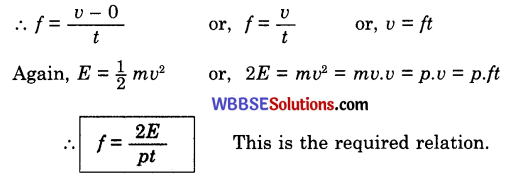
WBBSE Class 9 Physical Science Solutions Chapter 5 work, power and energy 5

Question 15.
Find the kinetic energy (KE) of a particle of mass ‘m’ gram and momentum ‘p’ g-cm/sec in terms of ‘m’ and ‘p’.
Answer:
Deduction: Let the particle moves with velocity υ cm/sec.
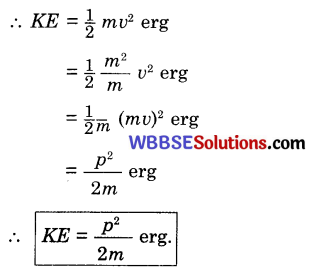
WBBSE Class 9 Physical Science Solutions Chapter 5 work, power and energy 6
This is the required relation.

WBBSE Class 9 Physical Science Solutions Chapter 5 work, power and energy

Question 16.
Momentum of a heavy body is equal to that of a light body. Which of the two possesses greater kinetic energy?
Answer:
Explanation: Let the mass of the heavy body be M and its velocity υ. The corresponding quantities of the light body are
and ‘υ’.
So, by the given condition, MV = mυ. Since, M is greater than ‘m’,
so ‘υ’ must be proportionally greater than V, for keeping equality between MV and mυ.
Now, if mυ be multiplied with the larger quantity υ and MV with smaller quantity V, the first product mυ.υ will be larger than the second product MV V.
Hence, m.υ.υ. > MV.V.
or, \(\text { or, } \frac{1}{2} m v^2>\frac{1}{2} M V^2\)
i.e. kinetic energy of the light body> kinetic energy of the heavy body.

Question 17.
Two bodies of unequal masses have the same kinetic energy. How do their momenta compare in terms of their masses?
Answer:
Explanation: Let masses of the bodies be m1, m2 and their corresponding velocities be υ1 and υ2.
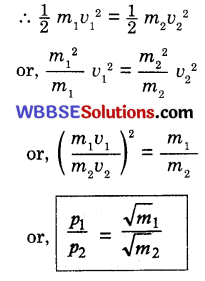
WBBSE Class 9 Physical Science Solutions Chapter 5 work, power and energy 7
Thus, momenta of the two bodies are directly proportional to the square root of their corresponding masses.

Question 18.
A heavy body and a light body have equal kinetic energy, which of them possesses greater momentum?
Answer:
Explanation: Let the mass of a heavier body be m1 and that of the lighter body be m2 also let the velocity of the heavier body be y1 and that of the lighter body be y2.
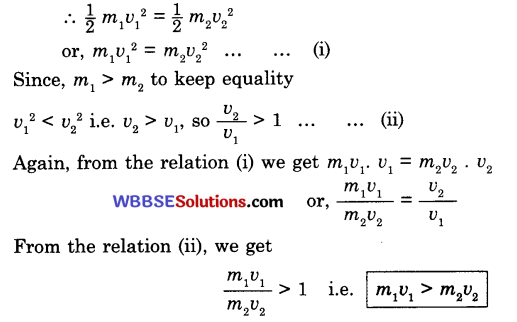
WBBSE Class 9 Physical Science Solutions Chapter 5 work, power and energy 8
So, momentum of the heavier body (m1υ1) is greater than the momentum of the lighter body (m2υ2)

Question 19.
A man carrying a bag stands in an ascending lift. Explain
(i) does the man do work on the bag?
(ii) is there any change of energy occuring in the bag?
Answer:
Explanation:
(i) Since the weight does not displace with respect to the man, so the man does no work on it.
(ii) The height of the weight from ground gradually increases, so, its potential energy increases. Also, the weight moves upward with the same velocity as that of the lift, so it has kinetic energy.

Question 20.
What is potential energy? Write down a mathematical expression for potential energy of a certain mass raised to a certain height above ground.
Answer:
Potential energy: Potential energy is the energy which a body possesses by virtue of its position or configuration.
Calculation: Weight of the body of mass ‘m’ is mg, where ‘g’ is acceleration due to gravity at the place. To raise the body, an upward force mg has to be applied on it. If it is raised ‘h’ distance above,
work done = mg x h [Force x displacement]
∴ work done = mgh
This work remains stored in the body as potential energy.

WBBSE Class 9 Physical Science Solutions Chapter 5 work, power and energy

Question 21.
Is work done when the Earth moves round the Sun ?
Answer:
Explanation: The centripetal force (the force with which the sun attracts the earth) of the Sun on the Earth does no work, since direction of displacement of the Earth at every point of its orbit is perpendicular to it. So, it is a no-work force.

Question 22.
In a tug of war one team wins over the other. Which team does work and how ?
Answer:
Explanation: In a tug of war the winning team works against the force applied by the losing team who are displaced through some distance.

Question 23.
A moving object suddenly comes to rest. Which energy converts to which other in this case ?
Answer:
In moving condition the body possesses kinetic energy. When it stops, the kinetic energy is expended in doing mechanical work against the opposing forces which stopped the body.

Question 24.
Which energy converts to which other when the spring in a toy is compressed ?
Answer:
Explanation: While the spring of a toy is brought to a compressed condition mechanical energy is expended. This energy remains stored in the spring as potential energy created due to change of configuration of different parts of the spring.

Question 25.
A man carrying a briefcase in hand walks on flat horizontal surface. Does he do work ?
Answer:
Reason: The man does not do work on the briefcase. Because, as the man holds the briefcase in hand, he exerts a force on it vertically upward but the briefcase is made to move horizontally. So, the force and its point of application are perpendicular to each other, i.e. no work is done.

Board answer type question :

Question 1.
What is the comparison of potential and kinetic energy?
Answer:
Comparison of potential and kinetic energy :
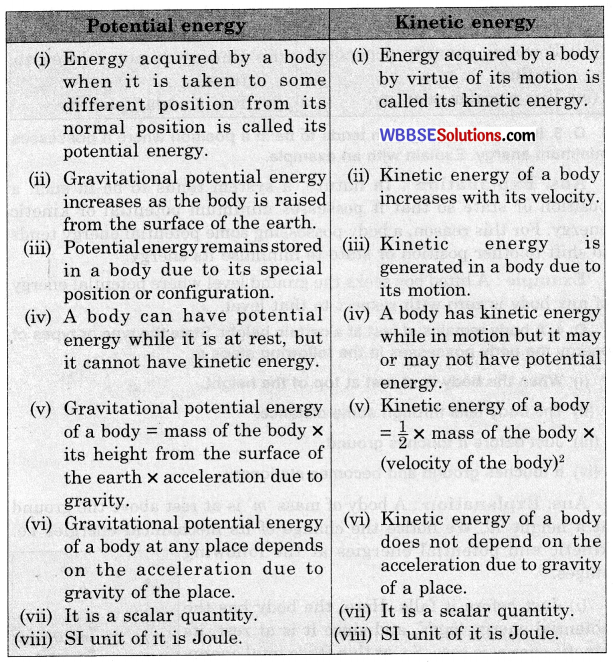
WBBSE Class 9 Physical Science Solutions Chapter 5 work, power and energy 9

Question 2.
What is the comparison of energy and power?
Answer:
Comparison of energy and power:

Energy Power
(i) The capacity of a body or person to do work is its energy. (i) Power is the rate of doing work.
(ii) Energy of two persons may be same, but their powers may be different. (ii) The quantity of energy of two persons may be different, although they have same power.
(iii) Power is quantity dependent on time. (iii) Energy is not related to time.
(iv) It is a scalar quantity. (iv) It is a scalar quantity.

Question 3.
In nature, any system tends to be in a position where it possesses minimum energy. Explain with an example.
Answer:
Explanation: In nature, a system tends to be in such a position or state so that it possesses minimum potential or kinetic energy. For this reason, a body possessing some potential energy tends to shift to other position or state to minimise its energy.
Example: A lifted boy seeks the ground level where potential energy of any body is zero with respect to that level.

WBBSE Class 9 Physical Science Solutions Chapter 5 work, power and energy

Question 4.
A body remains at rest at a certain height. State the type or types of energy the body possesses in the following steps :
(i) When the body is at rest at top of the height.
(ii) The body falls through some distance.
(iii) Just before it touches ground.
(iv) it touches ground and becomes stationary.
Answer:
Explanation : A body of mass ‘m’ is at rest above the ground at a height ‘h’. We notice the change of its mechanical energies i.e. kinetic and potential energies at the following stages.

(i) Just before it falls. Here, the body has the potential energy ‘mgh’, and since it is at rest, its kinetic energy is zero. So, at this stage total energy of the body is mgh.

(ii) The body descends through ‘a’, where, a < h.
The height of the body above ground is (h – a), so its potential energy is mg (h – α). The potential energy thus decreases by mga. While the body descends, it acquires some velocity, υ(say). So its kinetic energy is \(\frac{1}{2}\) mυ2 which can be proved equal to mga. Thus decrease of potential energy equals gain in kinetic energy.
So, the total energy
= mg (h – α) + mga
= mgh – mgα + mgα = mgh

(iii) The body is just above the ground before touching it. Here ‘h’ is almost zero, so the potential energy is negligible. The body possesses only kinetic energy which may be proved equal to mgh. Thus, at all stages, the total energy of the body, before it touches ground, is constant and equal to mgh.

(iv) When the body touches ground ‘h’ is zero, so potential energy is zero. Since, it comes to rest, its kinetic energy is also zero. The energy of the body dissipates in environment as heat energy and sound energy.

Question 5.
Can a body possess energy without momentum ? is the reverse possible ?
Answer:
Explanation: A body remaining motionless at a certain position other than its normal position on the surface of the earth may have potential energy but it is without momentum. The body also has no kinetic energy.

In the reverse case, if the body has momentum it must have velocity and thus kinetic energy, hence momentum without kinetic energy is not possible. Of course, the body may have momentum without potential energy, if it confines its motion on the surface of the earth.

Numerical Problems

Working formula

(i) Work done = Force x displacement of the point of application.

(ii) Power (p) = \(\frac{\text { work done }(w)}{\text { time taken }(t)}\)

(iii) Kinetic energy (KE) = \(\frac{1}{2}\) × mass of the body (m) × (velocity of the body)2 (y)2

(iv) Potential energy
(PE) – mass of the body (m) × acceleration due to gravity (g) × height of the body above the surface of the earth (h)

(iv) 1 Horse power = 746 watt

(vi) 1 kilowatt = 103 watt

(vii) 1 mega watt = 105 watt.

Problem 1.
A rifle bullet of mass 15g travelling at a speed of 300 meter/sec. Find the kinetic energy of the bullet
Answer:
m = 15, g = 0.015kg
y = 300 m/sec
KE =?
kinetic energy = \(\frac{1}{2}\) × mass ×(velocity)2
= \(\frac{1}{2}\) × m × ν2
= \(\frac{1}{2}\) × 0.015 x (300)2
= 675 joule.

WBBSE Class 9 Physical Science Solutions Chapter 5 work, power and energy

Problem 2.
The power of a motor car is 10 kW. What is the amount of work done by the car in 1 hr?
Answer:
1 hr = 60 × 60 = 3600 sec
1 kW = 103W
Power of the car = 10 kW = 10 × 103 J/sec
∴ work done by the car in 1 hr
= 10 × 103 x 3600J
= 36 × 107J

Problem 3.
If a pump lifts 500 liter of water per hour to a height of 30m. Then find the work done by the pump and its power in watt. [mass of 1 liter of water = 1 kg]
Answer:
Work done by the pump
= weight of water x displacement of water
= 5000 × 1 × 98 × 30J
= 14.7 × 10⁵J
Power of the pump = \(\frac{\text { Work done }}{\text { time }}=\frac{14.7 \times 10^5 \mathrm{~J}}{60 \times 60 \mathrm{sec}}\)
= 408W

Problem 4.
If a boy weighing 40 kg runs up a flight of stairs to a height of 10 m against the gravitational pull on him, i.e. his weight, so
Answer:
Work done = 40 × 98 × 10 = 3920 J
Power of the boy = \(\frac{\text { Work done }}{\text { Time }}=\frac{3920}{15}\) = 261.33W

Problem 5.
If 150 joule work is done for the displacement of 15 m of a body. Calculate the amount of force applied here.
Answer:
Work is done here = 150 joule
displacement = 50 m
we known,Applied force  = \(\frac{\text { Work done }}{\text { displacement }}\)
= \(\frac{150}{50}\) = 3 Newton

WBBSE Class 9 Physical Science Solutions Chapter 5 work, power and energy

Problem 6 :
If 10 Newton force is applied on a body then 5 m displacement of the body occurs towards the direction of the force. What will be the work done?
Answer:
We know,
Work done = Force x displacement
= 10 × 5 Newton-meter
= 50 joule

Problem 7.
If 100 g mass of a body is dropped from 80 cm high place then calculate the amount of potential energy is lost during this
process.
Answer:
m = 100 g = 0.1 kg
g = 98 m/sec2
h = 80 cm = 0.8 m
Amount of potential energy lost = m × g × h
= 0.1 × 9.8 × 0.8 joule
= 0.784 joule

Problem 8.
One body has mass 50 g and velocity 10 cm/sec. The other body has mass 20 g and velocity 20 cm/sec. Compare their velocities and kinetic energies.
Answer:
We know,
Momentum of a body = mass of the body × velocity
Here, velocity of first body : velocity of second body
=(50×10):(20×20) = 5 : 4
We also know,
Kinetic energy = \(\frac{1}{2}\) × mass × (velocity)2
Here, kinetic energy of first body: kinetic energy of second body
= \(\frac{1}{2}\)× 50 × (10)2 : \(\frac{1}{2}\) × 20 × (20)2
∴ The ratio of velocities of two bodies = 5 : 4
The ratio of kinetic energies of two bodies 5 : 8

Problem 9.
A rifle bullet of mass 50 g travelling at a speed of 200 rn/sec. Find the kinetic energy of the bullet.
Answer:
m= 50g g = 0.05kg
υ = 200 m/sec
KE=?
Kinetic energy = \(\frac{1}{2}\) × mass × (velocity)2
\(\frac{1}{2}\) × m × (velocity)2
= \(\frac{1}{2}\) × m x ν2
= \(\frac{1}{2}\) 005 × (200)2
= 103 joule

WBBSE Class 9 Physical Science Solutions Chapter 5 work, power and energy

Problem 10.
The power of a machine is 40 W. What is the amount of work done by the machine in 30 sec?
Answer:
Power of the machine = 40 W
= 40 joule/sec
∴ Work done by the machine (40 × 30) joule
= 1200 joule

Problem 11.
A car and a truck have the same speed of 30ms. If their masses are in the ratio of 1: 3, find the ratio of their kinetic energies.
Answer:
Given V1 = V2 30 ms-1
m1 = m2 = 1 : 3

WBBSE Class 9 Physical Science Solutions Chapter 5 work, power and energy 1

WBBSE Class 9 Physical Science Solutions Chapter 5 work, power and energy

Problem 12.
A particle of mass ‘m’ at rest is acted upon by a force ‘p’ for a time ‘t’. Show that the particle acquires the kinetic energy after the time ‘t’.
Answer:
It is known from Newton’s second law of motion that, force (p) = mass (m) × acceleration (f)
WBBSE Class 9 Physical Science Solutions Chapter 5 work, power and energy 2

WBBSE Class 9 Physical Science Solutions Chapter 4.6 Water

Detailed explanations in West Bengal Board Class 9 Physical Science Book Solutions Chapter 4.6 Water offer valuable context and analysis.

WBBSE Class 9 Physical Science Chapter 4.6 Question Answer – Water

Very short answer type questions

Question 1.
On which basis water is called hard and soft?
Answer:
Water is classified in hard and soft according to its ability of forming lather with soap.

Question 2.
Chemical activity of which is greater — potassium and magnesium ?
Answer:
Potassium has greater chemical activity than magnesium.

WBBSE Class 9 Physical Science Solutions Chapter 4.6 Water

Question 3.
What type of water is used in a boiler ?
Answer:
Soft water

Question 4.
Which gas is produced when calcium reacts with water ?
Answer:
Hydrogen.

Question 5.
Which one has greater affinity towards water — Zn or Hg ?
Answer:
Zn.

Question 6.
In the activity series of the metals, which one has upper position – Ai or Au ?
Answer:
Al.

Question 7.
What is temporary hardness of water ?
Answer:
Temporary hardness of water is caused by the presence of soluble bicarbonates of calcium, magnesium and iron in it.

Question 8.
What is the cause of hardness of water ?
Answer:
Hardness of water is caused due to dissolved bicarbonate, chloride, sulphate salts of Ca, Mg and Fe in water.

WBBSE Class 9 Physical Science Solutions Chapter 4.6 Water

Question 9.
State two causes of water crisis.
Answer:
Causes of water crisis :

  •  Misuse of water
  • Water pollution.

Question 10.
What are the products obtained from the reaction of sodium and water ?
Answer:
The two products are Sodium hydroxide and hydrogen.

Question 11.
What is the cause of black foot disease ?
Answer:
Black foot disease is caused by arsenic poison.

Question 12.
What is fluorosis disease ?
Answer:
Excess fluoride in water is responsible for fluorosis disease.

Question 13.
What are the types of hardness of water ?
Answer:
Two types of hardness of water :

  • Temporary hardness
  • Permanent hardness.

Question 14.
Which one is more pure ……….. deionised water or distilled water ?
Answer:
Distilled water.

Question 15.
What is electrochemical series ?
Answer:
Electrochemical series is arranged the position of metals according to their standard oxidation potential values.

WBBSE Class 9 Physical Science Solutions Chapter 4.6 Water

Question 16.
Which metal reacts with water at ordinary temperature ?
Answer:
Potassium.

Question 17.
What is the process by which both types of hardness are removed ?
Answer:
Removal of both types of hardness is done by ion-exchange process

Question 18.
Give one cause of water crisis.
Answer:
Wastage of water.

Question 19.
What amount of potable water is present in total water of earth ?
Answer:
0.3%.

Question 20.
Which metalloid is the cause of water pollution ?
Answer:
Arsenic (As).

Question 21.
What amount of water is present in human body ?
Answer:
70%.

Question 22.
What is the value of specific heat of water ?
Answer:
4200  kg-1 K-1.

Question 23.
What is the latent heat of fusion of ice ?
Answer:
80 cal g-1

Question 24.
What is the latent heat of vaporisation of water ?
Answer:
540 cal g-1

Question 25.
What is potable water ?
Answer:
Potable water — Natural water free from suspended impurities and dissolved poisonous impurities, germs, bacteria, etc., so that it can be safely used for consumption of human beings and animals, is called potable water.

WBBSE Class 9 Physical Science Solutions Chapter 4.6 Water

Question 26.
What is the method by which coliform count is made ?
Answer:
Most probable number index method (MPNI).

Question 27.
Dissolved oxygen is measured in which unit ?
Answer:
mg L-1

Question 28.
What is Algal bloom ?
Answer:
An Algal bloom is a rapid increase or accumulation in the population of algae (typically microscopic) in an aquatic system.

Question 29.
Which plant can reduce the amount of fluoride in drinking water ?
Answer:
Tulsi plant leaf can reduce the amount of fluoride in drinking water.

Question 30.
What is the function of AIAA ?
Answer:
Alumina impregnated activated alumina (AIAA) is an important adsorbent for removal of fluoride.

Short answer type questions 

Question 1.
What are the sources of natural water ?
Answer:
Sources of natural water: Natural water is available from various sources, such as seas, rivers, lakes or ponds, wells, springs and rain.

Question 2.
What is soft water ?
Answer:
Soft water: The class of water that easily forms lather or foam with soap is called soft water.

Question 3.
What is hard water ?
Answer:
Hard water: The class of water that does not easily form lather with soap, or does so after much wastage of soap is called hard water.

Question 4.
What is the cause of hardness ?
Answer:
Causes of hardness of water: The hardness of water is due to the presence of dissolved salts of metals (except Na, K) particularly calcium, magnesium and iron.

Question 5.
What is soap ?
Answer:
Soap : Soap is a salt of sodium or potassium of giant acid. Fatty acids are normally stearic acid (C17H35COOH), palmitic acid (C15H31COOH), oleic acid (C15H33COOH).

Question 6.
What is meant by temporary hardness of water ?
Answer:
Temporary hardness of water: Temporary hardness is caused by the presence of soluble bicarbonates of calcium, magnesium and iron in water.

Question 7.
What is meant by permanent hardness of water ?
Answer:
Permanent hardness of water: Permanent hardness is caused by the presence of chloride and sulphate salts of calcium, magnesium and iron in water.

WBBSE Class 9 Physical Science Solutions Chapter 4.6 Water

Question 8.
What is meant by removal of hardness of water ?
Answer:
Removal of hardness of water: Hardness is due to the dissolved calcium, magnesium and iron salts. Now if these soluble salts are converted to insoluble salts by any process, then hardness of water is removed.

Question 9.
What is permutit ?
Answer:
Permutit : Permutit is a trade name for artificially prepared zeolite which is sodium aluminosilicate (Na2O, Al2O3, 3SiO2 ,2H2O). Permutit is used to remove the hardness (both types, temporary and permanent).

Question 10.
What is deionised water ?
Answer:
Deionised water : The water that contains no cation other than H+ ion and anion other than OH ion is called deionised water. Deionised water is prepared only when hard water is allowed to pass through both cation ion-exchange and anion exchange resins.

Uses :

  • In chemical laboratory for qualitative as well as quantitative analysis of presence of ions in a substance, other than OH and H+ ions.
  • In batteries having lead electrodes.

Question 11.
Discuss the action of water on sodium and calcium metals ?
Answer:
Action of sodium and calcium on water: Sodium and calcium react promptly with water at ordinary temperature with fire and sound. At the end of the reaction metallic hydroxides and hydrogen are formed :
2Na + 2H2O = 2NaOH + H2
Ca + 2H2O = Ca(OH)2 + H2

Question 12.
What is water pollution ?
Answer:
Water pollution: Some soluble and insoluble matters in water which produce some harmful effect to men and aquatic animals are called water pollution.

Question 13.
What is black foot disease ?
Answer:
Black foot disease: Ground water sometimes is contaminated with arsenic acid and arsenius acid as a deprotonated form. Consumption of these arsenic contaminated water for a long period has some poisonous effects in the form of black spots on palms and feets, skin become rough. The disease caused by arsenic poison is called black foot disease.

Question 14.
What is Fluorosis ?
Answer:
Fluorosis: Sea-water, river water contain fluoride from natural source. Excess fluoride in water is responsible for fluorosis disease which is a cause of dental decay and bone decay.

Question 15.
Write down two processes of getting arsenic free water.
Answer:
Two processes of getting arsenic free water :

  • Arsenic is removed from water if water is allowed to pass through a bag made of cloth containing alumina or ferric hydroxide replacing the candle used in the filter. Arsenic or arsenious ions are absorbed in the alumina bed or ferric hydroxide bed and thus are removed.
  • Take 20 liter of water, i- amount of tea-spoonful of bleaching powder and the same amount of ferrous sulphate in a bucket. After stirring well, arsenic is removed.

WBBSE Class 9 Physical Science Solutions Chapter 4.6 Water

Question 16.
What is water crisis ?
Answer:
Water crisis: Within 2010 AD we are to face a critical situation for potable water. This is because of population is gradually increasing though storage of sweet water is fixed. This crisis can be overcome by avoiding the wastage of water and by judicious use of available water.

Collection of rain water and its uses for certain purposes like gardening, car-washing, floor-washing and even bathing can also mitigate water crisis. Scientists in different countries are engaged in finding a solution how saline water in sea be desalinated.

Question 17.
How is harvesting of water done for agriculture ?
Answer:
Harvesting of water for agriculture : In India and also in some other parts of world excessive rain water is stored in underground reservoirs. Such subsurface stores of water is freed from huge loss of water by evaporation as it happens in surface reservoirs. This stored water may be used for agricultural works

Board Answer Type Question 

Question 1.
Describe a method of removal of temporary hardness of water.
Answer:
Removal of temporary hardness by boiling: Temporary hardness of water is due to the presence of soluble bicarbonates of calcium, magnesium and iron in water. It is removed by boiling when soluble bicarbonate precipitate as insoluble carbonates and carbon dioxide gas evolves. On filtration soft water is obtained.
WBBSE Class 9 Physical Science Solutions Chapter 4.6 Water 1

Question 2.
Describe the process by which both the temporary and the permanent hardness of water are removed.
Answer:
Removal of both temporary and permanent hardness by ion-exchange resin process :

Principle: Cations present as soluble salts in hard water are exchanged with the cations present in suitable resins producing insoluble salts containing the resin. After that step acids are produced, anions of which are exchanged with the anion present in other type of suitable resins.
Nature and function of resin : Resins are artificially prepared organic polymers widely used to remove hardness of water. These are of two types :

(a) Cation-exchanger resins carrying radicals like, -SO3H, – COOH contain exchangeable W ions. These cations can be exchanged for equivalent positive ions like Ca2, Mg2, etc. present in soluble salt in water.

(b) Anion-exchanger resins carry – NHOH, NH3OH containing exchangeable OH ions.

Process:
(a) On passing hard water through a chamber containing the cation-exchanger resin, exchange of Ca2 and Mg2 with the W of the  – COOH or – SO3H group of the resin takes place.

The reactions are :
WBBSE Class 9 Physical Science Solutions Chapter 4.6 Water 2
Now the water obtained after passing through the cation exchanger is acidic.

WBBSE Class 9 Physical Science Solutions Chapter 4.6 Water

(b) Water after passing through cation exchange resin is now allowed to flow over anion exchange resin (expressed as RNH) due to exchange of anion, resin gets precipitated. Water thus obtained is completely deionised.
WBBSE Class 9 Physical Science Solutions Chapter 4.6 Water 3
After these two steps, hardness of water is completely removed,the water contains no cation other than H+ ions and no anion other than OH ions.

Useful-exchangers :
(a) Cation-exchangers :

  •  Amberlite IR-120
  • Dowex-50
  • Zeocarb 225

(b) Anion-exchangers :

  • Amberlite IRA-400
  • Dowex I
  • Dowex II

Regeneration of resins: Cation exchange resin is regenerated by passing dilute H2SO4 and anion exchange resin is generated by using dilute solution of NaOH solution.

WBBSE Class 9 Physical Science Solutions Chapter 4.6 Water

Question 3.
Why is water called versatile solvent?
Answer:
Water is a versatile solvent: Water molecule is amphiprotic, i.e. it behaves both as an ionic compound and a covalent compound. As a result, water can dissolve both ionic and covalent compound. Thus, on the one hand, acids, bases and salts (ionic compounds) easily dissolve in water and on the other hand, it can dissolve covalent compounds like alcohol, (methanol, ethanol), acetone, glycerol, sugar, urea, etc.
For this reason water is called versatile solvent.

Question 4.
How is delonised water prepared?
Answer:
Preparation of deionised water : Water is treated with some resins which contain carboxylic acid radical  – COOH or  – SO3H
(suiphonic acid radical). The cations, Ca2+, Na+, Fe2+, etc. present in water are removed on exchange of these with H+ ions of – COOH or – SO3H of resins.
If the resin is represented as RH, where R is the resin polymer,
H is hydrogen of acid radicals present in the resin.
CaCl2 + 2RH =  R2Ca↓ + 2HCl
NaCl + RH = RNa + HCl
After removal of cations, water contains some acid radicals like, HCl. To remove the acid radicals, water is treated with another type resin of basic nature. In this way, the water is freed from all types of ions, except H’ and OH- ions and this is deionised water.

Question 5.
(a) What is fluoride ?
(b) Name one harmful fluoride and state some of its bad effects on human.
(c) State some injurious effects of presence of fluoride in water.
Answer:
(a) Fluoride is meant by any binary compound of fluorine.
(b) The most harmful compound of fluorine is hydrogen fluoride (HF). It violently attacks skin, forming sores. Due to inhalation of vapour of this fluoride, loss of voice takes place and finally death results.
(c) Presence of traces of some fluorides in water is very dangerous.
Some of the injurious effects of fluoride are given below.

  • Loss of calcium from bones causing skeletal weakness.
  • Carries and discolouration of teeth.
  • Bending of the knees of sides, known as, Genu Valgum.

WBBSE Class 9 Physical Science Solutions Chapter 4.6 Water

Question 6.
(a) When the water in a soil layer may be considered arsenic-polluted?
(b) State two harmful effects of drinking water that contains arsenic beyond permissible limit.
(c) State one arrangement for supply or arsenic-free water.
Answer:
(a) According to the World Health Organisation (WHO), the permissible limit of arsenic in drinking water is 0.05 mg/L. So, the water in a soil layer that contains more than this specified quantity of arsenic is polluted.

(b) Harmful effects of arsenic : On drinking water containing arsenic beyond the permissible limit, diseases like skin pigmentation, organ failure may occur.

(c) Supply of arsenic-free water :

  • Arsenic is removed from water, if water is allowed to pass through a bag made of cloth containing alumina or ferric hydroxide replacing the candle used in the filter. Arsenic or arsenious ions are absorbed in the alumina bed or ferric hydroxide bed and thus are removed.
  • Take 20 liter of water, \(\frac{1}{4}\)th amount of tea-spoonful bleaching powder and the same amount of ferrous sulphate in a bucket. After stirring well, arsenic is removed.

Question 7.
Discuss the difference of activity of the metals with water on the basis of the position of the metals in Electrochemical series.
Answer:
Difference of activity of the metals in reaction with water:
(a) A metal with highest electron releasing ability is placed in the top most position. Metals placed in the electro-chemical series react with water according to their positions in the series.
WBBSE Class 9 Physical Science Solutions Chapter 4.6 Water 4
(b) Chemical activity of metal entirely depends on their position in the electro-chemical series. Metal which occupies higher position than any other metal has greater value of

  • Electropositive character
  • Reducing capacity
  • Chemical reactivity.

WBBSE Class 9 Physical Science Solutions Chapter 4.6 Water

Question 8.
What is Permutit process?
Answer:
Permutit process: Both types of hardness can be removed cheaply in this process. Permutit is a trade name for artificially prepared zeolite which is sothum aluminosiicate (Na2O, Al2O3, 3SiO2, 2H2O). It is a natural hydrated large-sized crystalline substance. A bed of granules of permutit is kept in a porous shelf slightly upper middle of a big drum made of iron.

Other porous shelves staged with stone and sand are placed above and below the shelf containing bed of permutit. When hard water kept in a tank is allowed to pass through the bed of permutit due to exchange of ions the hardness of water is removed and soft water is obtained. Let the ion-exchange material permutit be formulated as Na2Ze, where Ze is the zeolite radical.

WBBSE Class 9 Physical Science Solutions Chapter 4.6 Water 5
After the use of permutit for sometime when the permutit gets exhausted and loses its activity. It is regenerated by passing an aqueous solution of sodium chloride by which permutit gets back its exchange capacity.
CaZe + 2NaCl = Na2Ze + CaCl2
MgZe + 2NaCl Na2Ze + MgCl2
Permutit water-softening plants are used in private houses and factories and also for softening public water supplies of towns.

Question 9.
Discuss water pollution. How it is caused ? What are the dangers of water pollution ?
Answer:
Water pollution : Some soluble and insoluble matters in water which produce some harmful effect to men and aquatic animals are called water pollution.

Cause of water pollution : Pollution of water may be natural or man-made. Natural water coming from underground sources like tube-wells, wells, etc. and that flowing over earth’s surface often give rise to natural pollution due to presence of fluorides of alkali metals and arsenic compounds.

Man-made water pollution arises from the indiscriminate use of fertilizers, insecticides, pesticides in agriculture, and by the dumping of chemical effluents like metal salts, acids, alkalis, etc. from factories into the river or lakes. The washing of clothes and cooking utensils, bathing men and animals make water of ponds and lakes polluted.

Apart from these, the sub-soil water are contaminated with worms, bacilli amoeba and several other pathogenic bacteria and virus.

WBBSE Class 9 Physical Science Solutions Chapter 4.6 Water

Dangers of water pollution :

  • Appreciable amounts of fluorides in water give rise to gum diseases, decay of the enamel of teeth and also deseases of bones.
  • Presence of considerable amount of arsenic compounds in water causes ailments of the digestive system and severe skin diseases. Consumption of arsenic contaminated water for a long period has some poisonous effects in the form of black spots on palms and feets. Black foot disease is due to arsenic poison.

WBBSE Class 9 Physical Science MCQ Questions Chapter 4.6 Water

Well structured WBBSE Class 9 Physical Science MCQ Questions Chapter 4.6 Water can serve as a valuable review tool before exams.

Water Class 9 WBBSE MCQ Questions

Multiple Choice Questions :

Question 1.
The salt which is the cause of hardness of water :
(i) NH4 Cl
(ii) NaNO3
(iii) MgSO4
(iv) K2 SO4
Answer:
(iii) MgSO4

Question 2.
Soap is a salt of :
(i) Acetic acid
(ii) Palmitic acid
(iii) Formic acid
(iv) Nitric acid.
Answer:
(ii) Palmitic acid

Question 3.
Which of the following metals does not react with cold and hot water :
(i) Fe
(ii) K
(iii) Ni
(iv) Ag
Answer:
(iv) Ag

WBBSE Class 9 Physical Science MCQ Questions Chapter 4.6 Water

Question 4.
Which of the following is soft water:
(i) rain water
(ii) river water
(iii) tube well water
(iv) sea water
Answer:
(i) rain water

Question 5.
The salt which is the cause of temporary hardness :
(i) NaHCO3
(ii) NaCl
(iii) Ca(HCO3)2
(iv) MgSO4
Answer:
(iii) Ca(HCO3)2

Question 6.
Which of the following metals reacts easily with water at ordinary temperature :
(i) Ca
(ii) Zn
(iii) Cu
(iv) Ag
Answer:
(i) Ca

Question 7.
Tube well water becomes brown due to :
(i) Ca(HCO3)2
(ii) Fe(HCO3)2
(iii) MgSO4
(iv) MgCl2
Answer:
(ii) Fe(HCO3)2

Question 8.
D2 O reacts with CaC2 to form :
(i) C2 D2
(ii) CaD2
(iii) Ca2 D2 O
(iv) CD2
Answer:
(i) C2 D2

WBBSE Class 9 Physical Science MCQ Questions Chapter 4.6 Water

Question 9.
Permutit is regenerated by passing :
(i) 10% NaOH solution
(ii) 10% NH4 Cl solution
(iii) 10% NaCl solution
(iv) none of these
Answer:
(iii) 10% NaCl solution.

Question 10.
If 1 lit. water contains 0.001 mol MgSO4. What will be the hardness of water?
(i) 100 ppm
(ii) 200 ppm
(iii) 500 ppm
(iv) 150 ppm
Answer:
500 ppm

Question 11.
Water has high boiling point because :
(i) specific heat of water is high
(ii) heat of dissociation is high
(iii) presence of hydrogen bonding
(iv) molecules weight is low
Answer:
Presence of hydrogen bonding.

Question 12.
Anion exchange resin is regenerated by passing :
(i) dilute NaCl solution
(ii) dilute H2 SO4 solution
(iii) dilute HNO3 solution
(iv) dilute NaOH solution
Answer:
dilute NaOH solution

WBBSE Class 9 Physical Science MCQ Questions Chapter 4.6 Water

Question 13.
When hard water is passed through zeolite, the Na (present in zeolite) is exchanged by :
(i) OH
(ii) Ca2+
(iii) \(\mathrm{SO}_4^{2-}\)
(iv) H+
Answer:
Ca2+

Question 14.
Water is oxidised to oxygen by :
(i) ClO2
(ii) KMnO4
(iii) H2 O2
(iv) F2
Answer:
F2

Question 15.
Sodium promptly reacts with water at ordinary temperature to form sodium hydroxide and what ?
(i) oxygen
(ii) nitrogen
(iii) chlorine
(iv) hydrogen
Answer:
hydrogen

Question 16.
Which state of water provides medium of life ?
(i) Solid
(ii) liquid
(iii) vapour
(iv) gas
Answer:
liquid.

Question 17.
Which property of water controls environmental temperature ?
(i) specific heat capacity
(ii) Latent heat of vaporisation
(iii) density
(iv) surface tension
Answer:
Specific heat capacity

WBBSE Class 9 Physical Science MCQ Questions Chapter 4.6 Water

Question 18.
Air obtained from dissolved air in water contain oxygen and nitrogen respectively in what percentage?
(i) 21% O2, 78% N2
(ii) 17% O2, 83% N2
(iii) 33% O2, 66% N2
(iv) 66% O2, 33% N2
Answer:
33% O2, 66% N2

Question 19.
What is the prescribed limits of pH of potable water?
(i) 4.5
(ii) 6.5-8.5
(iii) 1.5-4.5
(iv) 8.5-9.5
Answer:
6.5-8.5

Question 20.
Which of the following ions responsible for hardness of water?
(i) Fe2+
(ii) Na+
(iii) Cr3+
(iv) Mn2+
Answer:
Fe2+

Fill in the blanks :

1. _______ reacts with water at ordinary temperature.
Answer:
Calcium

2. Soft water readily forms lather with _______.
Answer:
soap

3. Water of sea, river are examples of _______ water.
Answer:
hard

WBBSE Class 9 Physical Science MCQ Questions Chapter 4.6 Water

4. By using _______ water thermal plants can cut water requirements by about 98%.
Answer:
recycled

5. Depletion of oxygen dissolved in water due to enhanced growth of algae is called _______.
Answer:
eutrophication

6. Elements having greater tendency to gain electrons from their solution are called _______ elements.
Answer:
electronegative

7. Deionised water contains only H+ cation and _______ anion.
Answer:
OH

8. A more reactive metal displaces a _________ reactive metal from the latter’s solution.
Answer:
less

9. Cation-exchanger resins contain COOH, _______ radicals.
Answer:
SO3 H

10. Temporary hardness of water is due to presence of soluble _______
Answer:
bicarbonates

WBBSE Class 9 Physical Science MCQ Questions Chapter 4.6 Water

11. Permanent hardness of water is due to presence of dissolved chloride and _______ salts of Ca and Mg.
Answer:
sulphate

12. The class of water that does not easily form _______ with soap is called hard water.
Answer:
lather

13. The class of water that easily form lather with soap is called ______ water.
Answer:
soft

14. Water is a _______ solvent.
Answer:
versatile

15. Removal of both temporary and permanent hardness is done by ______ process.
Answer:
ion exchange

16. Removal of temporary hardness of water is done by _______.
Answer:
boiling

17. De-ionised water is made by _______.
Answer:
de-ioniser

18. Among river water, rain water and tubewell water, _______ is soft water.
Answer:
rain water

WBBSE Class 9 Physical Science MCQ Questions Chapter 4.6 Water

19. Cu does not react with _______ at ordinary temperature.
Answer:
water

20. The 97 % water of the total amount of earth’s water is called _______ water.
Answer:
underground

21. _______ is the chemical name of zeolite.
Answer:
Sodium aluminosilicate (Na2 O, Al2 O3, 3 SiO2, 2 H2 O)

22. The permissible limit of arsenic in drinking water is _______.
Answer:
0.05 mg / L

23. Amberlite IR-120 is a useful _______ exchanger.
Answer:
cation

24. RSO3 H is a ______ exchanger resin.
Answer:
cation

25. If pressure on the surface of water is increased, its boiling point and freezing point ______.
Answer:
increases, decreases.

26. Temporary hard water contains ______ salt of calcium, magnesium and iron.
Answer:
hydrogen carbonate

WBBSE Class 9 Physical Science MCQ Questions Chapter 4.6 Water

27. RNH3+ OH – is ______ exchanger resin.
Answer:
anion

WBBSE Class 9 Physical Science MCQ Questions Chapter 3 Matter: Structure and Properties

Well structured WBBSE Class 9 Physical Science MCQ Questions Chapter 3 Matter: Structure and Properties can serve as a valuable review tool before exams.

Matter: Structure and Properties Class 9 WBBSE MCQ Questions

Multiple Choice Questions :

Question 1.
atmospheric pressure is measured by :
(i) hygrometer
(ii) pyrometer
(iii) Barometer
(iv) spherometer
Answer:
Barometer

Question 2.
Construction of a submarine is based on :
(i) Archimedes’ principle
(ii) Bernoulli’s theorem
(iii) Pascal’s law
(iv) Boyle’s law
Answer:
Archimedes’ principle

Question 3.
Why is the dam of water reservoir is thick at the bottom?
(i) quantity of water increases with depth
(ii) density of water increases with depth
(iii) pressure of water increases with depth.
(iv) temperature of water increases with depth.
Answer:
The pressure of water increases with depth.

WBBSE Class 9 Physical Science MCQ Questions Chapter 3 Matter: Structure and Properties

Question 4.
A wooden block is taken to the bottom of a deep, calm lake and then released. it rises up with a :
(i) constant acceleration
(ii) decreasing acceleration
(iii) constant velocity
(iv) decreasing velocity
Answer:
Constant acceleration

Question 5.
A capillary tube made of glass is dipped into mercury. Then
(i) mercury rises in the capillary tube
(ii) mercury falls in the capillary tube
(iii) mercury rises and flows out of capillary tube
(iv) mercury neither rises nor falls in the capillary tube
Answer:
Mercury falls in the capillary tube

Question 6.
If the diameter of a capillary tube be doubled then the height of the liquid that will rise is :
(i) twice
(ii) half
(iii) same as earlier
(iv) none of these.
Answer:
Half

Question 7.
Two pieces of glass plates one upon the other with a little water in between them cannot be separated easily because of :
(i) inertia
(ii) pressure
(iii) surface tension
(iv) viscosity
Answer:
Surface tension

WBBSE Class 9 Physical Science MCQ Questions Chapter 3 Matter: Structure and Properties

Question 8.
There is dip in the capillary tube when the angle of contact θ is :
(i) θ = 90°
(ii) θ = 0°
(iii) θ > 90°
(iv) θ < 90° but not zero
Answer:
θ < 90° but not zero

Question 9.
The rise of liquid in a capillary tube has a meniscus. If the angle of contact be 90°, the shape of the meniscus is :
(i) concave
(ii) convex
(iii) flat
(iv) none of the above
Answer:
Flat

Question 10.
In Bernoulli’s theorem, which of the following is conserved ?
(i) mass
(ii) linear momentum
(iii) energy
(iv) angular momentum
Answer:
Energy

Question 11.
The gale blows over a house. The force due to gale on the roof is :
(i) in the direction downward
(ii) in direction upward
(iii) zero
(iv) in the horizontal direction.
Answer:
In direction upward

Question 12.
To calculate the flow of a liquid, which of the following is used?
(i) Stoke’s law
(ii) Bernoulli’s theorem
(iii) Poiseuille’s law
(iv) Conservation of pressure
Answer:
Poiseuille’s law

WBBSE Class 9 Physical Science MCQ Questions Chapter 3 Matter: Structure and Properties

Question 13.
Scent sprayer is based on :
(i) Charles’s law
(ii) Archimedes’ principle
(iii) Boyle’s law
(iv) Bernoulli’s theorem.
Answer:
Bernoulli’s theorem

Question 14.
In old age arteries carrying blood in the human body become narrow resulting in an increase in the blood pressure. This follows from
(i) Pascal’s law
(ii) Stoke’s law
(iii) Bernoullis’ principle
(iv) Archimede’s principle
Answer:
Bernoulli’s principle

Question 15.
On which of the following the terminal velocity of a solid ball in a viscous fluid is independent?
(i) area of cross-section
(ii) height of the liquid
(iii) density of the both
(iv) density of the liquid
Answer:
Height of the liquid

Question 16.
A body of weight mg is hanging on a strain, which extends its length by 1. The work done in extending the string is :
(i) mgl
(ii) mgl / 2
(iii) 2 mgl
(iv) none of these
Answer:
mgl / 2

WBBSE Class 9 Physical Science MCQ Questions Chapter 3 Matter: Structure and Properties

Question 17.
According to Hooke’s law of elasticity, if stress is increased the ratio of stress to strain :
(i) increases
(ii) decreases
(iii) becomes zero
(iv) remains constant
Answer:
Remains constant

Question 18.
S.I. unit of pressure is
(i) pascal
(ii) Kgfm-2
(iii) atmosphere
(iv) none of these
Answer:
pascal

Question 19.
upthrust depends upon –
(i) volume
(ii) density
(iii) g
(iv) all of these
Answer:
all of these

Question 20.
If the density of the object placed in a liquid to the density of the liquid, the object will –
(i) float wholly immersed
(ii) float half immersed
(iii) sink
(iv) float completely above the liquid
Answer:
float wholly immersed

WBBSE Class 9 Physical Science MCQ Questions Chapter 3 Matter: Structure and Properties

Question 21.
Atmospheric pressure is measured by –
(i) hydrometer
(ii) barometer
(iii) sonometer
(iv) ammeter
Answer:
barometer.

Question 22.
Relative density s of a substance is related to the density of the substance ρ and density of water at 40C d as –
(i) s = ρ × d
(ii) \(\mathrm{s}=\frac{d}{\rho}\)
(iii) \(\frac{\rho}{d}\)
(iv) \(\frac{1}{\rho d}\)
Answer:
\(\frac{\rho}{d}\)

Question 23.
SI unit of surface tension is
(i) Nm
(ii) kgfm-1
(iii) mN-1
(iv) Nm-1
Answer:
Nm-1

WBBSE Class 9 Physical Science MCQ Questions Chapter 3 Matter: Structure and Properties

Question 24.
The terminal velocity of a spherical body depends on
(i) radius of the body
(ii) density of the medium
(iii) viscosity of the medium
(iv) all of these
Answer:
all of these

Question 25.
Bernoulli’s theorem is based on conservation of –
(i) mass
(ii) mass and energy
(iii) energy
(iv) none of these
Answer:
energy.

Question 26.
With increase in temperature, the elasticity of a material
(i) increases
(ii) decreases
(iii) remains unchanged
(iv) nothing can be said
Answer:
decreases

Question 27.
The solids if break soon after crossing elastic limit are called
(i) ductile
(ii) brittle
(iii) malleable
(iv) plastic
Answer:
brittle

Fill in the blanks :

1. The word fluid comes from a Latin word _______.
Answer:
Fluere (meaning ‘to flow’)

2. The branch of physics which deals with fluid at rest is called _______.
Answer:
Hydrostatics

WBBSE Class 9 Physical Science MCQ Questions Chapter 3 Matter: Structure and Properties

3. The branch of physics which deals with fluid in motion is called _______.
Answer:
Hydrodynamics

4. Specific gravity of a substance is the ratio of the density of a substance to the density of _______ at 4°C.
Answer:
Water

5. In CGS system, the density of a substance is numerically _____ its specific gravity.
Answer:
Equal

6. The unit of pressure in SI is ______.
Answer:
Pascal (Nm-2)

7. The liquid pressure is a ______ quantity.
Answer:
Scalar

8. Archimede’s principle does not hold when the body is in ______ condition.
Answer:
Weightless

WBBSE Class 9 Physical Science MCQ Questions Chapter 3 Matter: Structure and Properties

9. When the weight of the body is greater than the weight of the liquid displaced, then the body ______.
Answer:
Sinks

10. Condition of floatation of a body is such, that the weight of the floating body must be ______ to the weight of the liquid dispiaced.
Answer:
Equal

11. If the density of the body be equal to the density of the liquid, the body ______ completely immersed any where in the liquid.
Answer:
Floats

12. The height of a water barometer is ______.
Answer:
10.33 m

13. The forces between the molecules of substances are called ______ forces.
Answer:
Inter-molecular

14. The unit of surface tension in SI system is : ______.
Answer:
Newton per metre (Nm-1)

WBBSE Class 9 Physical Science MCQ Questions Chapter 3 Matter: Structure and Properties

15. Rain drops attain ______ shape to acquire minimum surface area.
Answer:
Spherical

16. A tube with a very fine uniform bore throughout its length called a ______ tube.
Answer:
Capillary

17. A towel soaks water on account of ______ action.
Answer:
Capillary

18. Antiseptics have very ______ surface tension, so that can spread quickly.
Answer:
Low

19. The relative viscosity of a liquid is the ratio of viscosity of a liquid to viscosity of ______.
Answer:
Water

20. The terminal velocity of a sphere varies directly as the square of the ______ of it.
Answer:
Radius

21. The viscosity of a liquid ______ with increase in temperature.
Answer:
Decreases

22. Reynold’s number is the ratio of the inertial force per unit area to ______ force per unit area for a flowing iluid.
Answer:
Viscous

WBBSE Class 9 Physical Science MCQ Questions Chapter 3 Matter: Structure and Properties

23. The deep water runs ______ in a river.
Answer:
Slow

24. The dimensional formula of stress is ______.
Answer:
[ML-1 T-2]

25. The fractional change in the length, volume or shape of a body relative to that in its original configuration is a measure of the ______.
Answer:
Strain

26. The deformation of an elastic body is directly proportional to the applied force within ______ limit.
Answer:
Elastic

27. The normal force exerted by fluid on any surface in contact with its, called ______.
Answer:
thrust

28. The liquid ______ its own level.
Answer:
finds

29. A ______ is an instrument for measuring the pressure of the atmosphere.
Answer:
barometer.

WBBSE Class 9 Physical Science MCQ Questions Chapter 3 Matter: Structure and Properties

30. A siphon acts under ______ pressure.
Ans,
atmospheric

31. The upward thrust which any fluid exerts upon a body partly or completely immersed in it, is called its ______.
Answer:
buoyancy

32. Relative density is a pure ______ having no unit.
Answer:
number

33. Surface tension is a ______ quantity.
Answer:
scalar

34. The critical velocity is fixed for a fluid for a given ______.
Answer:
temperature

WBBSE Class 9 Physical Science MCQ Questions Chapter 3 Matter: Structure and Properties

35. Bernoulli’s theorem is based on principle of conservation of ______.
Answer:
energy

36. The elasticity of a material is ______ on hammering it.
Answer:
increased

WBBSE Class 9 Physical Science MCQ Questions Chapter 4.5 Separation of Mixtures

Well structured WBBSE Class 9 Physical Science MCQ Questions Chapter 4.5 Separation of Mixtures can serve as a valuable review tool before exams.

Separation of Mixtures Class 9 WBBSE MCQ Questions

Multiple Choice Questions :

Question 1.
Which metal is lighter than water ?
(i) Calcium
(ii) Mercury
(iii) Sodium
(iv) Gold
Answer:
Sodium

Question 2.
Which non-metal exists in liquid state at room temperature?
(i) Mercury
(ii) Bromine
(iii) Carbon
(iv) Sulphur
Answer:
Bromine

WBBSE Class 9 Physical Science MCQ Questions Chapter 4.5 Separation of Mixtures

Question 3.
Which natural element is hardest ?
(i) Fullerine
(ii) Iron
(iii) Gold
(iv) Diamond
Answer:
Diamond

Question 4.
Name a substance whose properties are intermediate between metal and non-metal ?
(i) Germenium
(ii) Potassium
(iii) Iron
(iv) Carbon
Answer:
Germenium

Question 5.
Which gas has the smell of rotten egg?
(i) Ammonia
(ii) Sulphuretted hydrogen
(iii) Carbon dioxide
(iv) Oxygen
Answer:
Sulphuretted hydrogen.

Question 6.
What is the nature of aqueous solution of NaCl ?
(i) Acidic
(ii) Alkaline
(iii) Neutral
(iv) None of these.
Answer:
Neutral.

WBBSE Class 9 Physical Science MCQ Questions Chapter 4.5 Separation of Mixtures

Question 7.
Cite an example where both physical and chemical changes occur ?
(i) Incomplete burning of candle.
(ii) Burning of a magnesium ribbon
(iii) Slaking of lime
(iv) Melting of ice.
Answer:
Incomplete burning of candle.

Question 8.
Name a non-metal that conducts heat and electricity ?
(i) Graphite
(ii) Sulphur
(iii) Diamond
(iv) Nitrogen
Answer:
Graphite

Question 9.
MnO2 is a catalyst :
(i) positive
(ii) negative
(iii) both positive and negative
(iv) none of these
Answer: Positive

Question 10.
Heating of a platinum wire is a :
(i) physical change
(ii) chemical change
(iii) both physical and chemical change
(iv) none of these.
Answer:
Physical change

WBBSE Class 9 Physical Science MCQ Questions Chapter 4.5 Separation of Mixtures

Question 11.
The boiling point of water is :
(i) 100° C
(ii) -100° C
(iii) 0° C
(iv) 78° C
Answer:
100° C

Question 12.
Which catalyst is used to prepare oxygen from KClO3 ?
(i) MnO
(ii) MnO2
(iii) Mn3 O4
(iv) V2 O5
Answer:
MnO2

Question 13.
The method to separate sugar from its equeous solution a –
(i) evaporation
(ii) distillation
(iii) sedimentation
(iv) centrifugation
Answer:
Evaporation

WBBSE Class 9 Physical Science MCQ Questions Chapter 4.5 Separation of Mixtures

Question 14.
lodine and ethanol can be separated by –
(i) filtration
(ii) evaporation
(iii) distillation
(iv) fractional distillation
Answer:
distillation

Question 15.
Mixture of carbon tetra-chloride and water are separated by using –
(i) funnel
(ii) separating funnel
(iii) breaker
(iv) fractionating column.
Answer:
separating funnel

Question 16.
Boiling point of a liquid –
(i) decreases with increase of pressure
(ii) boiling point has no effect on pressure
(iii) increases with increase of pressure
(iv) do not always increase with increase of pressure.
Answer:
Increases with increase of pressure.

Question 17.
The components of crude oil can be separated by –
(i) fractional distillation
(ii) distillation
(iii) fractional crystallisation
(iv) none of these
Answer:
fractional distillation.

Fill in the blanks :

1. Quick lime when treated with water converts to _______ lime.
Answer:
slaked

WBBSE Class 9 Physical Science MCQ Questions Chapter 4.5 Separation of Mixtures

2. Graphite is _______ to touch.
Answer:
slippery

3. NH4 Cl treated with NaOH liberates _______ gas.
Answer:
ammonia

4. Rusting of iron is a _______ change.
Answer:
chemical

5. Both physical and chemical changes occur in burning of _______.
Answer:
candle

6. _______ is a liquid non-metal.
Answer:
Bromine

7. Odour of _______ is pungent.
Answer:
ammonia

8. _______ is a metalloid.
Answer:
Arsenic/Antimony

WBBSE Class 9 Physical Science MCQ Questions Chapter 4.5 Separation of Mixtures

9. Snow at the base of a glacier melts due to its heavy _______.
Answer:
weight

10. _______ is a soft metal.
Answer:
Sodium

11. Colour of copper suiphate crystal is _______.
Answer:
blue

12. Aqueous solution of oxides of some solid _______ are acidic.
Answer:
non-metals

13. Being non-metal _______ conducts electricity.
Answer:
graphite

14. Water is added to conc. H2SO4. This is a _______ change.
Answer:
physical

15. _______ are typically brittle.
Answer:
Non-metals

WBBSE Class 9 Physical Science MCQ Questions Chapter 4.5 Separation of Mixtures

16. _______ shows the characteristics of both metais and non-metals.
Answer:
Metalloids

17. _______ is insoluble in water but soluble in carbon disulphide.
Answer:
Sulphur.

18. Heating of platinum wire is an example of _______ change.
Answer:
physical

19. Chemical change is _______.
Answer:
permanent

20. Copper sulphate and sulphur are identified by _______.
Answer:
solubility

21. Silver nitrate solution is added to sodium chloride solution to give a curdy white precipitate; the precipitate can be separated from the mixture by a process called _______.
Answer:
filtration.

22. Glycerol is distilled under reduced pressure to avoid _______.
Answer:
evaporation

WBBSE Class 9 Physical Science MCQ Questions Chapter 4.5 Separation of Mixtures

23. The suspension of chalk in water can be separated by _______.
Answer:
decomposition.

24. Kerosene is lighter and immiscible in water, they can be separated by using _______.
Answer:
separating funnel.

WBBSE Class 9 Physical Science MCQ Questions Chapter 4.4 Acids, Bases and Salts

Well structured WBBSE Class 9 Physical Science MCQ Questions Chapter 4.4 Acids, Bases and Salts can serve as a valuable review tool before exams.

Acids, Bases and Salts Class 9 WBBSE MCQ Questions

Multiple Choice Questions :

Question 1.
Which element is present in all acids ?
(i) Hydrogen
(ii) Oxygen
(iii) Carbon
(iv) Nitrogen
Answer:
Hydrogen

Question 2.
ZnO is –
(i) acidic
(ii) basic
(iii) amphoteric
(iv) neutral oxide
Answer:
amphoteric

WBBSE Class 9 Physical Science MCQ Questions Chapter 4.4 Acids, Bases and Salts

Question 3.
The weak acid is
(i) HCl
(ii) HNO3
(iii) H2 SO4
(iv) H2 CO3
Answer:
H2 CO3

Question 4.
Aqueous solution of P2 O5 is
(i) HPO3
(ii) H3 PO4
(iii) H3 PO3
(iv) H3 PO2
Answer:
H3 PO4

Question 5.
Methyl orange is a/an ___
(i) base
(ii) alkali
(iii) indicator
(iv) oxide
Answer:
indicator

Question 6.
Minimum quantity of an indicator used in neutralisation reaction is ____
(i) 5 mL
(ii) 5.2 mL
(iii) 5.5 mL
(iv) 2-3 drops
Answer:
2-3 drops

WBBSE Class 9 Physical Science MCQ Questions Chapter 4.4 Acids, Bases and Salts

Question 7.
The aqueous solution of bases turn red litmus into ____
(i) blue
(ii) colourtess
(iii) violet
(iv) yellow
Answer:
blue

Question 8.
NaCl is a/an ____
(i) normal
(ii) acid
(iii) basic
(iv) complex salt
Answer:
normal

Question 9.
The strong acid is _____
(i) H2 SO4
(ii) H2 CO3
(iii) H3 PO4
(iv) CH3 COOH
Answer:
H2 SO4

Question 10.
Caustic soda is a/an _______
(i) salt
(ii) weak base
(iii) strong base
(iv) acid
Answer:
strong base

WBBSE Class 9 Physical Science MCQ Questions Chapter 4.4 Acids, Bases and Salts

Question 11.
Sulphuric acid is a/an _________
(i) inorganic acid
(ii) organic acid
(iii) weak acid
(iv) hydracid
Answer:
inorganic acid

Question 12.
Disodium hydrogen phosphate is a/an ______
(i) normal salt
(ii) basic salt
(iii) acid salt
(iv) double salt
Ans.
acid salt

Question 13.
Which of the following compounds is used to prepare vanishing colour
(i) NH4 OH
(ii) NaOH
(iii) Ca(OH)2
(iv) KOH
Answer:
NH4 OH

Question 14.
Na2 SO4 is a/an ____
(i) normal salt
(ii) acid sait
(iii) basic salt
(iv) complex salt
Answer:
normal salt

Question 15.
Indicator used for neutralisation reaction of H2 SO4 and NaOH is _____
(i) methyl orange
(ii) phenolphthalein
(iii) litmus
(iv) any indicator
Answer: any indicator

WBBSE Class 9 Physical Science MCQ Questions Chapter 4.4 Acids, Bases and Salts

Question 16.
The colour of phenolphthalein in dilute sulphuric acid solution becomes –
(i) red
(ii) yellow
(iii) blue
(iv) colourless
Answer:
colourless

Question 17.
The colour of methyl orange in acidic solution becomes –
(i) red
(ii) yellow
(iii) blue
(iv) orange
Answer:
red

Question 18.
Sulphuric acid contains
(i) 1
(ii) 2
(iii) 3
(iv) 4 replaceable hydrogen atom/atoms by a metal.
Answer:
2

Question 19.
Ammonia is
(i) an acid
(ii) a base
(iii) a salt
(iv) none of these
Answer:
a base

WBBSE Class 9 Physical Science MCQ Questions Chapter 4.4 Acids, Bases and Salts

Question 20.
The acidity of CaO is ___
(i) 1
(ii) 2
(iii) 3
(iv) 4
Answer:
2

Question 21.
The basicity of hydrochloric acid is
(i) 1
(ii) 2
(iii) 3
(iv) 4
Answer:
1

Question 22.
Phosphoric acid is a –
(i) monobasic acid
(ii) dibasic acid
(iii) tribasic acid
(iv) none of these
Answer:
tribasic acid

Question 23.
An aqueous solution turns blue litmus solution into red. Excess addition of which of the following solution to the above solution reverse the change –
(i) HCl solution
(ii) vinegar solution
(iii) H2 SO4 solution
(iv) caustic soda solution
Answer:
caustic soda solution

WBBSE Class 9 Physical Science MCQ Questions Chapter 4.4 Acids, Bases and Salts

Question 24.
Which of the following substance change the colour of pH paper to greenish – blue ?
(i) common salt
(ii) vinegar
(iii) an antacid
(iv) orange juice
Answer:
An antacid

Question 25.
To protect tooth decay you are advised to brush your teeth regularly, the nature of commonly used paste is –
(i) neutral
(ii) acidic
(iii) basic
(iv) corrosive
Answer:
Basic

Question 26.
If you soak a pH paper into gastric juices, it will indicate a pH value of –
(i) more than 7
(ii) less thati 7
(iii) equal to 7
(iv) less than 1
Answer:
less than 7

Question 27.
Which of the following is responsible for acid rain ?
(i) N2
(ii) CH4
(iii) SO2 and NO2
(iv) H2
Answer:
SO2 and NO2

Fill in the blanks :

1. An acidic oxide is called _______ of the acid, which forms with water.
Answer:
anhydride

2. An oxide is a ______ of oxygen formed with another element.
Answer:
compound

3. ______ oxides are some metallic oxides which behave both as an acidic and a basic oxide.
Answer:
Amphoteric

4. CO, NO are examples of _____ oxide.
Answer:
neutral

5. Basic oxides which are soluble in water produce _____ when they are disssolved in water.
Answer:
alkalis

6. A base in general is an oxide or hydroxide of a ____ and when reacts with an acid produces _____ and water.
Answer:
Metal, salt

WBBSE Class 9 Physical Science MCQ Questions Chapter 4.4 Acids, Bases and Salts

7. _____ is a process in which acids and alkalis in equivalent quantities react in their aqueous solutions to produce salt and water.
Answer:
Neutralisation

8. An acid salt is produced when insufficient quantity of a base reacts with a ______ acid.
Answer:
polybasic

9. Normal salts are formed by the complete replacement of the replaceable ______ atoms from an acid molecule by a suitable substance.
Answer:
hydrogen

10. Indicators are some weak organic acids or bases which indicate distinctive _____ in acid, alkali and neutral solutions.
Answer:
colours

11. Substances with a pH value below 7 are _____
Answer:
acidic

12. The aqueous solution of a base makes _____ litmus blue.
Answer:
red

13. The colour of methyl orange in acid medium is _____ and that in alkaline medium is –
Answer:
Pinkish-red, Yellow

14. An aqueous solution of an acid turns ______ litmus into red.
Answer:
blue

WBBSE Class 9 Physical Science MCQ Questions Chapter 4.4 Acids, Bases and Salts

15. pH scale is a scale that runs from ____ to _____.
Answer:
0, 14

16. Na3 PO4 is a _____ salt.
Answer:
normal

17. The substance used to determine the end point of neutralisation of an acid and a base is called _____.
Answer:
indicator

18. Al2 O3 is an _____ oxide.
Answer:
amphoteric

19. H2 O is a ______ oxide.
Answer:
neutral

20. Pb(OH) NO3 is a ______ salt.
Answer:
basic

21. HCN is hydracid but H2 SO3 is _____.
Answer:
oxyacid

22. Concentrated _______ is a strong oxidising acid.
Answer:
H2 SO4

WBBSE Class 9 Physical Science MCQ Questions Chapter 4.4 Acids, Bases and Salts

23. An aqueous solution of acid must contain _____ ion.
Answer:
H+

24. The formula of permanganic acid is _____.
Answer:
HMnO4

25. P2 O5 is an _____ oxide.
Answer:
acidic

26. Na2 HPO4 is an_____ salt.
Answer:
acid

27. K4 [Fe(CN)6] is a _____ salt.
Answer:
complex

28. Acetic acid is known as _____.
Answer:
Vinegar

WBBSE Class 9 Physical Science MCQ Questions Chapter 4.4 Acids, Bases and Salts

29. Acids have a ______ taste.
Answer:
sour

30. Tooth enamel is made of ____.
Answer:
Ca3 (PO4)2

31. pH value of pure water is ______.
Answer:
0

32. Exact pH value of acid rain is _____.
Answer:
5.6

33. ______ indicator is a such indicator which can determine the strength of solution.
Answer:
universal

WBBSE Class 9 Physical Science Solutions Chapter 4.3 Solution

Detailed explanations in West Bengal Board Class 9 Physical Science Book Solutions Chapter 4.3 Solution offer valuable context and analysis.

WBBSE Class 9 Physical Science Chapter 4.3 Question Answer – Solution

Very short answer type questions

Question 1.
Write down the name of an inorganic and an organic solvent.
Answer:
Name of an inorganic solvent: water Name of an organic solvent: benzene

Question 2.
Write down the name of a substance whose solubility remains almost the same with rise of temperature.
Answer:
Solubility remains almost the same with rise of temperature: Sodium chloride (NaCl).

WBBSE Class 9 Physical Science Solutions Chapter 4.3 Solution

Question 3.
Write down the name of a substance whose solubility decreases with the increase of temperature.
Answer:
Solubility decreases with the increase of temperature: Calcium sulphate (CaSO4).

Question 4.
Write down the name of a substance whose solubility increases tremendously with the increase of temperature.
Answer:
Solubility increases tremendously with the increase of temperature: e.g. Potassium nitrate (KNO3)

Question 5.
What is the unit of solubility ?
Answer:
Solubility has no unit.

Question 6.
Which gas is soluble in soda water ?
Answer:
Carbon dioxide (CO2) is soluble in soda water.

Question 7.
Give an example of a drying agent.
Answer:
Drying agent : concentrated H2SO4.

Question 8.
Give a common example of colloidal solution.
Answer:
Common example of colloidal solution : milk.

WBBSE Class 9 Physical Science Solutions Chapter 4.3 Solution

Question 9.
What are the components of a colloidal solution ?
Answer:
Components of a colloidal solution :

  • dispersed phase
  • dispersion medium

Question 10.
Give one example of a salt having water of crystallisation.
Answer:
Example of a salt having water of crystallisation :
Blue vitriol (CuSO4. 5H2O)

Question 11.
Mention one particulate matter in air that causes its pollution.
Answer:
Particulate matter in air that causes its pollution : Fine particules of dust.

Question 12.
What are the sizes of the colloid particles?
Answer:
Sizes of the colloid particles : 10-5 cm to 10-7 cm in diameter.

Question 13.
State whether solution is a mixture or compound.
Answer:
Solution is a mixture.

Question 14.
Why edible salt (NaCl) becomes moist in the rainy season?
Answer:
Edible salt (NaCl) becomes moist in rainy season due to the presence of deliquescent MgCL2 6H2O as impurity in it.

WBBSE Class 9 Physical Science Solutions Chapter 4.3 Solution

Question 15.
Name an efflorescent substance.
Answer:
Efflorescent substance: Washing soda (Na2CO3.10H2O)

Question 16.
Name a deliquescent substance.
Answer:
Deliquescent substance : Calcium chloride (CaCl2)

Question 17.
What happens if a saturated solution is cooled?
Answer:
The cooled solution sheds the excess solute as crystals.

Question 18.
What is the effect of increase of pressure on the solublilty of a gas In water?
Answer:
Increase of pressure increases solubility of a gas.

Question 19.
What is the effect of increase of pressure on the sotubility of a solid in water?
Answer:
Increase of pressure does not cause any change of solubility of a solid in water.

Question 20.
What is occlusion?
Answer:
Hydrogen get dissolved in spongy palladium in some similar metals. This phenomenon is called occlusion.

WBBSE Class 9 Physical Science Solutions Chapter 4.3 Solution

Question 21.
What is TEL?
Answer:
Tetra ethyl lead (TEL).

Question 22.
What is epsome salt?
Answer:
Epsome salt : MgSO4, 7H2O

Question 23.
What is SPM?
Answer:
Suspended particulate matter (SPM)

Question 24.
What do you mean by smog ?
Answer:
Smog is fog containing smoke.

Question 25.
How a saturated solution may be made unsaturated ?
Answer:
A saturated solution may be made unsaturated either by :

  • adding more solvent
  • or, raising temperature of the solution.

Question 26.
State the biological importance of dissolved O2 in water.
Answer:
Aquatic plants and animals can take oxygen for their respiration.

WBBSE Class 9 Physical Science Solutions Chapter 4.3 Solution

Question 27.
What is the effect of temperature on the solubility of KNO3 and CasO4 ?
Answer:
Solubility of KNO3 increases with rise of temperature.
Solubility of CaSO4 decreases with rise of temperature.

Question 28.
How can you increases the solubility of a given volume of gas in water ?
Answer:
An increase of pressure on the surface of water causes increase of solubility of gas in water.

Question 29.
Why does the CO2 gas rapidly bubbles out when the lid of its bottle is opened ?
Answer:
CO2 gas rapidly bubbles out when the lid of its bottle is opened because on opening the lid the pressure on the solution suddenly decreases.

Question 30.
Which solution is more concentrated : 10g/L NaOh or 10 molar NaOH solution ?
Answer:
10 molar NaOH solution.

Short Answer Type Question

Question 1.
What is a solution ?
Answer:
Solution : A solution (or true solution) is a uniformly homogeneous mixture of two or more substances whose relative proportions may be varied upon a certain limit.

Question 2.
Name the different types of solution known to you in respect of concentration.
Answer:
Classification of solution : Solutions are classified into three types based on concentration at a certain temperature. These are :

  •  unsaturated
  • saturated
  • super saturated solutions.

Question 3.
What is an unsaturated solution ?
Answer:
Unsaturated solution : At a particular temperature, an unsaturated solution is one in which the solvent is capable of dissolving further amount of the solute.

WBBSE Class 9 Physical Science Solutions Chapter 4.3 Solution

Question 4.
What is a saturated solution ?
Answer:
Saturated solution : A saturated solution at a particular temperature is one in which the amount of the solvent has reached its maximum capacity of dissolving the solute.

Question 5.
What is a supersaturated solution ?
Answer:
Supersaturated solution : A supersaturated solution is one, in which the amount of the solvent has dissolved more amount of the solute than is necessary to make a saturated solution at the particular temperature.

Question 6.
How can you detect a saturated sugar solution ?
Answer:
Detection for saturated sugar solution : To the given solution, some amount of sugar is added into the solution and stirred. If the added sugar does not dissolve, the solution is said to be a saturated solution at that temperature.

Question 7.
How can you detect an unsaturated sugar solution ?
Answer:
Detection for unsaturated sugar solution : To the tested solution some sugar is added and stirred. If the sugar readily dissolves, the given solution is said to be an unsaturated solution.

Question 8.
What do you mean by solute ?
Answer:
Solute : The substances which are present in smaller quantities and gets dissolved are called solute.

Question 9.
What is meant by solvent ?
Answer:
Solvent : The medium in which the solutes are uniformly dispersed through dissolution is called the solvent.

Question 10.
Define a colloid or colloidal solution.
Answer:
Colloid or colloidal solution : A colloid or colloidal solution is a stable heterogeneous solution consisting of finely divided particles of a substance (of the size of 10-5 cm to 10-7 cm in diameter) uniformly dispersed in a continuous medium.

Question 11.
What do you mean by solubility ?
Answer:
Solubility : Solubility of a given solute in a solvent is defined as the weight in grams of the solute dissolved in 100 grams of solvent so as to saturate the solution at a given temperature.

Question 12.
What is meant by ‘solubility is dependent on temperature’ ?
Answer:
Solubility is dependent on temperature: It means, in general, solubility of a solid in a liquid solvent increases with increasing temperature and decreases with decreasing temperature. This rule is not obeyed in some cases.

Question 13.
What are the effects of temperature on solubility of CaSO4) KNO4, NaCl ?
Answer:
Effect of temperature on solubility of CaSO4, KNO3, NaCl.
Solubility of CaSO4 decreases with increasing temperature.
Solubility of KNO3 increases rapidly with rise of temperature.
Solubility of NaCl remains almost unchanged with rise of temperature

WBBSE Class 9 Physical Science Solutions Chapter 4.3 Solution

Question 14.
What do you mean by ‘dispersed phase’ and ‘dispersion medium’ ?
Answer:

  • Dispersed phase : The component of colloid present in small amount and which behaves like a solute in a solution is called dispersed phase.
  • Dispersion medium : The component of colloid present in excess amount and which behaves like a solvent in solution is called dispersion medium.

Question 15.
Define crystal.
Answer:
Crystal : Crystals are homogeneous solid particles bounded by plane surfaces arranged symmetrically and meeting at sharp edges and forms a definite three-dimenstional geometrical shape.

Question 16.
What do you mean by crystallisation ?
Answer:
Crystallisation : Crystallisation is a process by which crystals of a substance are obtained from its solution.

Question 17.
What is water of crystallisation ?
Answer:
Water of crystallisation : The fixed number of water molecules that are associated with a crystal as an integral part of the constitution of the crystal is called water of crystallisation.
Example : Blue vitriol (CuSO4, 5H2O) has five molecules of water of crystallisation.

Question 18.
What is meant by efflorescent substance ?
Answer:
Efflorescent substance : Efflorescent substances are those which crumble to powder when exposed to air due to partial or total loss of water molecules present in their crystalline structures.
Example : Washing soda (Na2CO3, 10H2O)

Question 19.
What do you mean by deliquescent substance ?
Answer:
Deliquescent substance : Deliquescent substances are those solid which when exposed to atmosphere form concentrated solution dissolving in the moisture absorbed by them from air.
Example : Calcium chloride (CaCl2).

Question 20.
What happens if a saturated solution is cooled ?
Answer:
If a hot saturated solution is cooled, the capacity of holding solute by the solution decreases. The cooled solution sheds the excess solute as crystals.

Question 21.
What are the effects of increase of pressure on the solubility of a gas and a solid solute in water ?
Answer:
Increase of pressure increases solubility of a gas in water ; increase of pressure does not cause any change of solubility of a solid in water.

Question 22.
Why is temperature mentioned in defining solubility ?
Answer:
In defining solubility of a substance, temperature is to be mentioned, because, with change of temperature solubility of most of the substances changes.

WBBSE Class 9 Physical Science Solutions Chapter 4.3 Solution

Question 23.
Why is a solution kept stirred continuously during its preparation ?
Answer:
It is done to mix well the saturated and the unsaturated portions of the solution to bring about homogeneity of the solution.

Question 24.
What are hygroscopic substances ?
Answer:
Hygroscopic substances : Certain substances exposed to air absorb moisture from air but are not dissolved in the absorbed water. These substances are called hygroscopic substances.

Question 25.
What are drying agents ?
Answer:
Drying agents : Some substances have the property to absorb moisture from moisturous bodies present nearby. These substances are called drying agents.
Example : Concentrated H2SO4, Phosphorous pentoxide (P2O5), Silica gel.

Question 26.
What is Mother liquor ?
Answer:
Mother liquor : In the process of crystalisation, the saturated solution left after separation of crystals is known as Mother liquor.

Question 27.
Define unit of concentration of solution in percentage.
Answer:
Concentration of solution in percentage :
If V ml of the solution contains W g of the solute, percentage of the solution is \(\frac{W}{V}\) × 100%

Question 28.
Define unit of concentration of solution in grams per litre.
Answer:
Concentration of solution in grams per litre :
Its unit is g/L. When 1 litre (1000 ml) of the solution, contains w grams of the solute, its strength is w g/1L.

Broad answer type questions 

Question 1.
‘Solubility of A of t°C is y’ — what does it mean ?
Answer:
‘Solubility of A at t°C is y’ — it means y’ g of A can produce a saturated solution when dissolved in a solvent at t°C.

Question 2.
How can you transform a saturated solution into an unsaturated one without adding more solvent ?
Answer:
Without adding more solvent a saturated solution may be made unsaturated by raising its temperature at which the solubility of the solute increases appreciably and the solution thus turns unsaturated.

Question 3.
How does solubility of KNO3, NaCl and CaSO4 change with rise of temperature ?
Answer:
Solubility of KNOt increases rapidly with rise of temperature.
Solubility of NaCl remains almost unchanged with rise of temperature.
Solubility of CaSO4 decreases with increasing temperature.

WBBSE Class 9 Physical Science Solutions Chapter 4.3 Solution

Question 4.
What is the cause of efflorescence ? Give one example of efflorescent substance.
Answer:
Cause of efflorescence : Efflorescence happens only when the vapour pressure within the hydrated crystal at ordinary temperature is greater than the vapour pressure of the atmosphere. These hydrated crystals are called efflorescent substances.
Example : Na2CO3, 10H2O

Question 5.
What is the cause of deliquescence ? Give one example of deliquescent substance.
Answer:
Cause of deliquescnces : Deliquenscence occurs when the vapour pressure of water in the deliquescent substance is less than the vapour pressure in the atmosphere at ordinary temperature.
Example : CaCl2

Question 6.
Why does effervescence occur when a soda water bottle is opened ?
Answer:
Soda water is a solution of carbon dioxide in water, prepared under high pressure. For this reason when a bottle of soda water is opened, i.e. pressure on the liquid content in the bottle is reduced, effervescence or raising bubbles occur. These effervescences form, as a part of dissolved carbon dioxide gas, escapes through the liquid.

Question 7.
Why edible salt becomes moist in rainy season ?
Answer:
Edible salt (NaCl) becomes moist in rainy season due to the presence of deliquescent substances like MgCl2 and CaCl2 as impurities in it.

Question 8.
How can you prepare a super saturated solution of a solid solute (hypo) at room temperature ?
Answer:
Preparation of a super saturated solution : Super saturated solution can be prepared by heating a few crystals of sodium thiosulphate or hypo (Na2S2O3, 5H2O) in a test tube. The crystals appear to melt or they dissolve in their own water of crystallization and a very concentrated solution of the salt in water is obtained.

The test tube is plugged with cotton wool and allowed to cool to the room temperature. This solution is super saturated and even after cooling, no excess solute separates out. If a crystal of the salt is now added into this solution, the crystal groups in size and the whole liquid begins to solidify with evolution of heat.

Question 9.
Why does clear lime water turn milky when heated ?
Answer:
Clear lime water turns milky when heated : Since solubility of slaked lime [Ca(OH)2] decreases with increase of temperature, clear lime water which is an aqueous solution of Ca(OH)2 or slaked lime turns milky when heated.
Reason : Due to decrease of solubility at a higher temperature, the excess undissolved slaked lime remains in suspension for which the solution appears milky.

Question 10.
Briefly describe the process of crystallisation.
Answer:
Crystallisation : Crystallisation is a process from which crystal of a substance is obtained from its solution. Process of crystallisation for the preparation of crystal :

(a) From saturated solution of a substance : A hot saturated solution of the substance is slowly cooled and then the crystal of that substance is obtained.

(b) From unsaturated solution : An unsaturated solution is vapourised and thus a concentrated solution of it is obtained. Now if this solution is gradually cooled then crystals of the substance are obtained.

(c) Sublimation process : Iodine, camphor etc. are sublimed. If the sublimate so formed is cooled, then the crystals of the substances are deposited in the pot.

(d) From molten matter : Solid sulphur taken in a pot is heated to melt it and then by slowly cooling, the crystals of P-sulphurs are obtained.

Question 11.
What is colloid ? How does it differ from a true and a suspension state ?
Answer:
Colloid : A colloid is a stable heterogenous solution consisting of finely divided particles of a substance (of the size of 10-5 cm to 10-7 cm in diameter) uniformly dispersed in a continuous medium. The component of colloid present in small amount and it behaves like a solute in a solution which is called dispersed phase. The component of colloid present in excess amount and which behaves like a solvent in a solution is called dispersion medium.

Identification of true solution, colloid and suspension : True solution, colloid and suspension are identified on the basis of particle size in it Size of a particle in colloidal state is 10-5 cm to 10-7 cm in diameter. The particle in true solution is 10-8 cm in diameter. The particle in suspension state is
10-8 cm in diameter.

Question 12.
How can an unsaturated solution be converted to saturated state without adding more solute ?
Answer:
(i) Without adding more solute an unsaturated solution may be made saturated by evaporating off a part of the solvent when the remaining lesser quantity of solvent becomes saturated with the initial content of solute.

(ii) Also, by lowering the temperature of the given solution, it may be made saturated since the solute present in the solution may make it saturated at a lower temperature, because solubility of a substance in general decreases with lowering of temperature.

Question 13.
Describe briefly the mechanism of formation of a solution where a solid dissolves in a liquid.
Answer:
Mechanism of formation of solution of a solid in the liquid : When a solid solute comes in contact with a liquid solvent, the tiny solid particles of diameter 10-8 cm or less leave the surface of the solid solute depending on temperature and as concentration of the solution increases, some solid particles return and get deposited on the surface of the lump of solute.

At the initial stage, the rate of leaving the solute surface increases and it slows down when concentration of the solution increases. If the rate of leaving the surface of solute is greater than that of their return, the solid dissolves totally.

Question 14.
Why does the colour of sky appear to be blue ?
Answer:
Colour of sky appears to be blue due to the scattering of blue light by dust particles along with water suspended in air.

WBBSE Class 9 Physical Science Solutions Chapter 4.3 Solution

Question 15.
What is fire foam ?
Answer:
Fire foam : Carbon dioxide froth made by mixing solution of sodium bicarbonate and alum is called fire foam. It is used in fire extinguishers. A protective colloid such as glue or dextrin is added to stabilise the foam.

Question 16.
Does formation of a solution accompany heat exchange ?
Answer:
There is almost always heat changes accompanying formation of solutions. This means some solutes, when go into solution, heat is evolved and for some other solutes heat is absorbed.
e.g.

  • NH4Cl, KNO3 etc. absorbs heat while they go into the solution i.e. the change is endothermic occurs, so their solubility increases with rise of temperature.
  • Solubility of sodium chloride remains almost unchanged with rise of temperature.
  • Heat evolves when calcium hydroxide, anhydrous sodium sulphate etc. go into solution. The change in such cases is exothermic, so solubility of them decreases with rise of temperature.

WBBSE Class 9 Physical Science MCQ Questions Chapter 4.3 Solution

Well structured WBBSE Class 9 Physical Science MCQ Questions Chapter 4.3 Solution can serve as a valuable review tool before exams.

Solution Class 9 WBBSE MCQ Questions

Multiple Choice Questions :

Question 1.
Solution is a :
(i) mixture
(ii) element
(iii) compound
(iv) none of these.
Answer:
mixture.

Question 2.
The solvent of sulphur is :
(i) Water
(ii) Ethyl alcohol
(iii) Carbon disulphide
(iv) Benzene
Answer:
Carbon disulphide

Question 3.
If a saturated solution is heated :
(i) the solution becomes unsaturated.
(ii) the solution becomes super saturated.
(iii) the solution remains saturated
Answer:
The solution becomes unsaturated.

WBBSE Class 9 Physical Science MCQ Questions Chapter 4.3 Solution

Question 4.
If more solvent is added to a saturated solution :
(i) the solution becomes super saturated
(ii) the solution becomes unsaturated
(iii) the solution remains saturated
Answer:
The solution becomes unsaturated.

Question 5.
Solubility decreases with increasing temperature :
(i) KNO3
(ii) CaSO4
(iii) NaCl
(iv) none of these
Answer:
CaSO4

Question 6.
When temperature rises, solubility of gas in liquid:
(i) decreases
(ii) increases
(iii) remains unaltered
(iv) None of these
Answer:
decreases

Question 7.
If the size of the particles are 10-5 cm to 10-7 cm then the solution will be :
(i) true solution
(ii) suspension
(iii) colloid
(iv) none of these
Answer:
colloid

WBBSE Class 9 Physical Science MCQ Questions Chapter 4.3 Solution

Question 8.
Number of water molecules present in washing soda :
(i) 5
(ii) 6
(iii) 10
(iv) 7
Answer:
10

Question 9.
Deliquescent substance is :
(i) Magnesium chloride
(ii) Washing soda
(iii) Glauber’s salt
(iv) Blue vitriol
Answer:
Magnesium chloride

Question 10.
Fog is :
(i) a solution of liquid in gas
(ii) a solution of gas in gas
(iii) a solution of solid in gas
(iv) a solution of liquid in liquid.
Answer:
a solution of liquid in gas.

Question 11.
Smoke is :
(i) a solution of gas in gas
(ii) a solution of carbon in gas
(iii) a solution of liquid in liquid
(iv) a solution of solid in solid.
Answer:
a solution of Carbon in gas.

WBBSE Class 9 Physical Science MCQ Questions Chapter 4.3 Solution

Question 12.
Solubility remains almost unchanged with rise of temperature :
(i) NaCl
(ii) CaSO4
(iii) Na2 SO4, 10 H2O
(iv) KNO3
Answer:
NaCl

Question 13.
Phosphorus pentoxide is :
(i) efflorescent substance
(ii) deliquescent substance
(iii) drying agent
Answer:
drying agent

WBBSE Class 9 Physical Science MCQ Questions Chapter 4.3 Solution

Question 14.
Soluble in chloroform :
(i) sugar
(ii) common salt
(iii) oil
(iv) blue vitriol
Answer:
oil

Question 15.
lodine is soluble in :
(I) water
(ii) aicohol
(iii) acetone
Answer:
alcohol

Question 16.
Unit of concentration of solution is :
(i) g / L
(ii) g / m2
(iii) g / m
(iv) g / cm
Answer:
g / L

Question 17.
Percentage strength is :
(i) 6 g
(ii) 6 kg
(iii) 6%
(iv) 6
Answer:
6%

WBBSE Class 9 Physical Science MCQ Questions Chapter 4.3 Solution

Question 18.
If excess amount of solute is dissolved in saturated solution then the solution is called :
(i) unsaturated solution
(ii) super saturated solution
(iii) colloid
(iv) emulsion
Answer:
super saturated solution

Question 19.
The ratio of the components of a solution is
(i) fixed
(ii) may vary
(iii) may vary to any extent
(iv) may vary within a limit
Answer:
may vary within a limit.

Question 20.
Aerated cold drinks contain CO2, sugar and water here ; solution is of
(i) Sugar
(ii) CO2
(iii) water
(iv) Sugar and CO2
Answer:
Sugar and CO2

WBBSE Class 9 Physical Science MCQ Questions Chapter 4.3 Solution

Question 21.
Which one is true solution ?
(i) solution of common salt
(ii) solution of chalk
(iii) milk
(iv) butter
Answer:
Solution of common salt

Question 22.
Particle size of colloid is
(i) 10-8 cm
(ii) 10-4 cm
(iii) 10-3 cm
(iv) 10-5 – 10-7cm
Answer:
10-5 – 10-7cm

Question 23.
Which will not diffuse ?
(i) Suspension
(ii) true solution
(iii) Coloids
(iv) none
Answer:
Suspension

Question 24.
When liquid is dispersed in solid, the product is called :
(i) gel
(ii) sol
(iii) Emulsion
(iv) foam
Answer:
gel

WBBSE Class 9 Physical Science MCQ Questions Chapter 4.3 Solution

Question 25.
Which of the following in aqueous solution can enter into intermolecular space of water: (i) urea (ii) protein
(iii) DNA
(iv) starch
Answer:
urea

Question 26.
Solubility of which increases with increase of temperature ? :
(i) O2
(ii) NH3
(iii) KNO3
(iv) SO2
Answer:
KNO3

Question 27.
Which of the following solutions is unstable?
(i) Saturated
(ii) Unsaturated
(iii) Super saturated
(iv) Colloidal
Answer:
Super saturated

Question 28.
Which of the following solvents is used to remove nail-polish :
(i) Ethyl alcohol
(ii) Methyl alcohol
(iii) Acctone
(iv) Terpentine oil
Answer:
Acctone

Fill in the blanks :

1. Solute + solvent = _______.
Answer:
Solution

WBBSE Class 9 Physical Science MCQ Questions Chapter 4.3 Solution

2. A true solution is a ______ mixture.
Answer:
homogeneous

3. The solubility of KNO3 in water ________ tremendously with the rise of temperature.
Answer:
increases

4. A solution is _______ at a temperature if it can dissolve more solute or if its concentration increases.
Answer:
unsaturated

5. A solution of low solute-content is a solution.
Answer:
dilute

6. Solubility of CaSO4 _______ with increasing temperature.
Answer:
decreases

WBBSE Class 9 Physical Science MCQ Questions Chapter 4.3 Solution

7. A solution is saturated if it does not dissolve any more _______ at a given temperature and if its concentration remains unchanged.
Answer:
solute

8. _____ is a typical state of matter which is intermediate between true solution state and coarse suspension state of matter.
Answer:
Colloid

9. Efflorescent sustances crumble to powder when exposed to ________ due to partial or total loss of water molecules present in their crystalline structures.
Answer:
air

10. Water of crystallisation are some waster molecules which are _______ attached to the molecule of a compound as essential building components of crystals.
Answer:
chemically

11. Solubility of NaCl remains almost _______ with rise of temperature.
Answer:
unchanged

12. Water is a _____ liquid solvent.
Answer:
versatile

WBBSE Class 9 Physical Science MCQ Questions Chapter 4.3 Solution

13. Soda water contains _______ under pressure.
Answer:
carbon dioxide

14. The particle size (diameter) of colloid lies in between _____.
Answer:
10-5 cm to 10-7 cm.

15. Calcium chloride is a ______ substance.
Answer:
deliquescent

16. Glauber’s salt ( Na2 SO4,10 H2O) is an __________ substance.
Answer:
efflorescent.

17. Crystals are homogeneous solid particles bounded by plane surfaces which meet at sharp edges and have a regular and definite _________ shapes.
Answer:
geometric.

18. Solubility of gas in liquid ________ when temperature rises.
Answer:
decreases

19. Emulsion is a colloid where small particle of one liquid are dispersed in another ________.
Answer:
liquid

20. A solution is a ________ mixture of two or more substances in solid, liquid or gaseous state.
Answer:
homogeneous.

WBBSE Class 9 Physical Science MCQ Questions Chapter 4.3 Solution

21. Anhydrous copper sulphate is a ________ substance.
Answer:
hygroscopic

22. Unit of concentration of solution is _______.
Answer:
g/L

23. Sodium amalgam is a solution of sodium and _____.
Answer:
mercury

24. A saturated solution can be converted to an unsaturated solution by _____ the solution (Heating/Cooling).
Answer:
heating

25. Solubility of a gas in water increases by ______ pressure.
Answer:
increasing

26. Solubility of a yas at constant pressure may be increased by _______ temperature.
Answer:
decreasing

WBBSE Class 9 Physical Science MCQ Questions Chapter 4.3 Solution

27. Sodium chloride remains in solution as _____.
Answer:
ions.

28. Rate of crystallization from saturated solution may be increased by ______.
Answer:
seeding

29. Solution is a ______ of a solute in a solvent.
Answer:
homogenous mixture.

30. Colloidal solution contains two components, ____ and ______ .
Answer:
dispersed phase/dispersed medium.

31. Milk is an example of ________ emulsion.
Answer:
oil in water

32. In case of icecream ______ acts as a emulsifier.
Answer:
gelatin

WBBSE Class 9 Physical Science MCQ Questions Chapter 4.3 Solution

33. Ca(OH)2 shows a ______ of solubility with the _____ of temperature.
Answer:
decrease, increase

34. _____ has no influence an the solubility of a solid ______ in a liqud solvent.
Answer:
Pressure, solute

WBBSE Class 9 Physical Science MCQ Questions Chapter 2 Force and Motion

Well structured WBBSE Class 9 Physical Science MCQ Questions Chapter 2 Force and Motion can serve as a valuable review tool before exams.

Force and Motion Class 9 WBBSE MCQ Questions

Multiple Choice Questions :

Question 1.
Which of the following has no fixed melting point ?
(i) Ice
(ii) Wax
(iii) Lead
(iv) Iron
Answer:
Wax.

Question 2.
The value of acceleration due to gravity :
(i) 980 m/sec
(ii) 9.81 m / sec2
(iii) 9810 m / sec
(iv) 98 m / sec2
Answer:
9.81 m / sec2

WBBSE Class 9 Physical Science MCQ Questions Chapter 2 Force and Motion

Question 3.
If a body is taken in the moon then its weight will be :
(i) increased
(ii) decreased
(iii) same
(iv) zero
Answer:
Decreased.

Question 4.
Soda lime is :
(i) Na2 CO3, 10 H2O
(ii) NaOH
(iii) Mixture of NaOH and CaO
(iv) NaCl
Answer:
Mixture of NaOH and CaO.

Question 5.
Which is most fundamental ?
(i) mass
(ii) weight
(iii) density
Answer:
mass.

Question 6.
What is the ultimate form of all energies ?
(i) Heat
(ii) Light
(iii) Sound
(iv) Chemical
Answer:
Heat.

Question 7.
In an electric cell which type of energy changes to which other ?
(i) Chemical energy to electric energy
(ii) Heat energy to sound energy
(iii) Electric energy to chemical energy
(iv) Chemical energy to sound energy.
Answer:
Chemical energy to electric energy.

WBBSE Class 9 Physical Science MCQ Questions Chapter 2 Force and Motion

Question 8.
When a body is taken to a high altitude from the earth, what changes of mass and weight of the body are observed ?
(i) Mass remains same, weight decreases
(ii) Weight remains same, mass increases
(iii) Both mass and weight increase
(iv) Both mass and weight decrease
Answer:
Mass remains same, weight decreases.

Question 9.
What is the Einstein’s mass energy-equation ?
(i) E = mc2
(ii) E = m2c2
(iii) E = m2c
(iv) E2 = mc2
Answer:
E = m c2.

Question 10.
A non-conventional fuel is :
(i) natural gas
(ii) organic gas
(iii) petroleum gas
(iv) coal
Answer:
Organic gas.

WBBSE Class 9 Physical Science MCQ Questions Chapter 2 Force and Motion

Question 11.
Law of conservation of mass was emunicated by :
(i) Lavoisier
(ii) Dalton
(iii) Proust
(iv) Landolt.
Answer:
Lavoisier.

Question 12.
During photosynthesis, light energy is converted into :
(i) chemical energy
(ii) sound energy
(iii) electric energy
(iv) heat energy
Answer:
Chemical energy.

Question 13.
The force by which a body is attracted towards the centre of the earth is called :
(i) mass
(ii) weight
(iii) density of the body
Answer:
Weight.

Question 14.
Absolute unit of weight in CGS system is :
(i) newton
(ii) dyne
(iii) Joule
Answer:
Dyne.

WBBSE Class 9 Physical Science MCQ Questions Chapter 2 Force and Motion

Question 15.
The ability of doing work is known as :
(i) mass
(ii) weight
(iii) energy
Answer:
Energy.

Question 16.
During nuciear fission, atomic energy is converted into :
(i) heat energy
(ii) electric energy
(iii) magnetic energy
Answer:
Heat energy.

Question 17.
The earth receives solar energy at the rate of about :
(i) 1.8 × 10⁹ megawatt
(ii) 18 × 109 megawatt
(iii) 20 × 109 megawatt
(iv) 2.1 × 10⁹ megawatt
Answer:
18 × 109 megawatt.

WBBSE Class 9 Physical Science MCQ Questions Chapter 2 Force and Motion

Question 18.
In photo-electric cells, light energy is converted into :
(i) sound energy
(ii) magnetic energy
(iii) electrical energy
Answer:
Electrical energy.

Question 19.
The value of acceleration due to gravity at the centre of the earth is :
(i) 0
(ii) less than 0 (zero)
(iii) greater than 0 (zero)
Answer:
0 (zero).

Question 20.
If a body covers equal distances in equal time intervals, then it is :
(i) at rest
(ii) moving with uniform speed
(iii) moving with uniform velocity
(iv) moving with uniform acceleration
Answer:
Moving with uniform speed.

WBBSE Class 9 Physical Science MCQ Questions Chapter 2 Force and Motion

Question 21.
If a body moves with a constant speed, the distance – time graph is
(i) a straight line
(ii) a circle
(iii) a line like a staircase
(iv) a polygon
Answer:
A straight line

Question 22.
The area under the speed-time graph is a :
(i) circle
(ii) parabola
(iii) distance
(iv) none of these
Answer:
distance

Question 23.
The slope of a distance-time graph is :
(i) velocity
(ii) acceleration
(iii) displacement
(iv) speed
Answer:
Speed

Question 24.
The momentum of a body of given mass is proportional to its
(i) volume
(ii) shape
(iii) speed
(iv) density
Answer:
speed

WBBSE Class 9 Physical Science MCQ Questions Chapter 2 Force and Motion

Question 25.
Which of the following has the largest inertia ?
(i) a pin
(ii) your body
(iii) an orange
(iv) a brick
Answer:
your body

Question 26.
A body acted upon by a force must have :
(i) velocity
(ii) displacement
(iii) acceleration
(iv) none of these
Answer:
acceleration

Fill in the blanks :

1. Mass and energy cannot be always considered as ______ quantities.
Answer:
absolute.

2. Einstein showed that in high energy atomic reactions, a small part of ______ of the reactants transforms to energy.
Answer:
mass.

WBBSE Class 9 Physical Science MCQ Questions Chapter 2 Force and Motion

3. After a few changes and transformations, almost all kinds of energy may be proved to originate from the ______.
Answer:
sun.

4. Indian philosophers enunciated that anything that ______ is unperishable.
Answer:
exists.

5. An energy can produce mechanical work directly or after undergoing some ______ transformations.
Answer:
intermediate.

6. Every form of energy ultimately transforms to ______ energy directly or after some intermediate transformations.
Answer:
heat.

7. Energy can neither be created nor destroyed, only one form of ______ energy to other forms.
Answer:
transforms.

8. Electric energy transforms to ______ energy in electric lamps.
Answer:
light.

9. Mass of a body is the quantity of ______ it is made of.
Answer:
matter.

WBBSE Class 9 Physical Science MCQ Questions Chapter 2 Force and Motion

10. Mass is more fundamental than ______
Answer:
weight.

11. Mass of a body is measured by a common balance and ______ of a body is measured with the help of a spring balance.
Answer:
weight.

12. Weight is the ______ that a material body experiences towards the centre of the earth due to the gravitational pull of the earth.
Answer:
force.

13. The weight of a body is ______ in different places of the world.
Answer:
different.

14. Coal, petroleum, natural gas are – sources of energy.
Answer:
non-renewable.

15. If the earth’s gravitational attraction ceases, the acceleration due to gravity also ______
Answer:
ceases.

16. Mass of a body × ______ = Weight of body.
Answer:
Acceleration due to gravity.

WBBSE Class 9 Physical Science MCQ Questions Chapter 2 Force and Motion

17. Energy is defined as ______ to perform work.
Answer:
capacity.

18. Weight of a body is a ______ quantity.
Answer:
vector.

19. Mass is an ______ property of a body.
Answer:
intrinsic.

20. The energy of a moving body possessed by virtue of its ______ is called the kinetic energy.
Answer:
motion.

21. Mass of a body is the ______ of matter it is made of.
Answer:
quantity.

WBBSE Class 9 Physical Science MCQ Questions Chapter 2 Force and Motion

22. To accelerate a body, a must apply ______ on it.
Answer:
force.

23. The SI unit of force is ______.
Answer:
newton

24. A body at rest will remain at ______ it no unbalanced force is applied.
Answer:
rest

25. Action and reaction forces act on ______ bodies.
Answer:
different

WBBSE Class 9 Physical Science MCQ Questions Chapter 2 Force and Motion

26. The force is equal to the product of mass and ______ of the body.
Answer:
acceleration.

WBBSE Class 9 Physical Science Solutions Chapter 4.5 Separation of Mixtures

Detailed explanations in West Bengal Board Class 9 Physical Science Book Solutions Chapter 4.5 Separation of Mixtures offer valuable context and analysis.

WBBSE Class 9 Physical Science Chapter 4.5 Question Answer – Separation of Mixtures

Very short answer type questions

Question 1.
Name a metal and a non-metal which exists in liquid state at room temperature.
Answer:
Mercury is a liquid metal at room temperature.
Bromine is a liquid non-metal at room temperature.

Question 2.
Name a non-mental heavier than water.
Answer:
Iodine is a non-metal heavier than water

Question 3.
What type of change occurs when milk is converted to curd ?
Answer:
Chemical change occurs when milk is converted to curd.

WBBSE Class 9 Physical Science Solutions Chapter 4.5 Separation of Mixtures

Question 4.
What type of change occurs when quick lime is treated with water ?
Answer:
Chemical change occurs when quick lime is treated with water.

Question 5.
Name a non-metal having lustre.
Answer:
Iodine is a non-metal having lustre.

Question 6.
Name a metal lighter than water.
Answer:
Lithium is a metal lighter than water.

Question 7.
Mention chemical reaction which is influenced by pressure.
Answer:
In crackers, a mixture of potassium chlorate and sulphur explodes under pressure.

Question 8.
Mention chemical reaction which is influenced by contact.
Answer:
Quick lime in contact with water produces slaked lime with evolution of heat.

Question 9.
Which gas has the smell of rotten egg ?
Answer:
Hydrogen sulphide (H2S) gas has the smell of rotten egg.

Question 10.
Mention a chemical reaction that is influenced by a catalyst.
Answer:
When a mixture of MnO2 and KClO3 are heated, oxygen gas is evolved. In this reaction MnO2 acts as a catalyst.

Question 11.
Name two solids which may be identified by colour.
Answer:
The colour of blue vitriol or hydrated copper sulphate is blue. The colour of chalk powder is white.

Question 12.
Mention a chemical reaction where heat is absorbed.
Answer:
Quick lime in contact with water produces slaked lime with evolution of heat.

WBBSE Class 9 Physical Science Solutions Chapter 4.5 Separation of Mixtures

Question 13.
Name a non-mental that conducts electricity.
Answer:
Graphite or Gas carbon, a non-metal conducts electricity.

Question 14.
Name two metalloids.
Answer:
Arsenic (As) and Antimony (Sb) are two metalloids.

Question 15.
Sugar is added to
(i) concentrated sulphuric acid and
(ii) water. State whether a physical change occurs or a chemical change during these two incidents.
Answer:
(i) Chemical change occurs when sugar is added to concentrated sulphuric acid.
(ii) Physical change occurs when sugar is added to water.

Question 16.
Name an electropositive metal and an electropositive non-metal.
Answer:
Sodium is an electropositive metal.
Hydrogen is an electropositive non-metal.

Question 17.
Cite one physical change where heat is absorbed.
Answer:
When ammonium chloride or ammonium nitrate is dissolved in water heat is absorbed.

WBBSE Class 9 Physical Science Solutions Chapter 4.5 Separation of Mixtures

Question 18.
Name a soft metal.
Answer:
Sodium (Na) is a soft metal.

Question 19.
Give an example where physical and chemical changes take place simultaneously.
Answer:
Burning of candle is an example of simultaneous occurrence of both physical and chemical change.

Question 20.
Give an example of a slow reaction.
Answer:
Rusting of iron is an example of a slow reaction.

Question 21.
State one chemical change where heat is absorbed.
Answer:
Heat is absorbed when nitrogen and oxygen combine to form nitric oxide.

Question 22.
Give an example of a metal which reacts both with acid and alkali.
Answer:
Zinc is the metal which reacts both with acid and alkali.

Question 23.
Which type of ion is formed by hydrogen in NaH ?
Answer:
H(-) ion is formed by hydrogen in NaH.

Question 24.
Give an example of natural physical change.
Answer:
Melting of glacier is an example of natural physical change.

WBBSE Class 9 Physical Science Solutions Chapter 4.5 Separation of Mixtures

Question 25.
Give an example of a natural chemical change.
Answer:
Forest fire is an example of natural chemical change.

Short Answer Type Question

Question 1.
Define properties of matter ?
Answer:
Properties of matter : Each and every substance has its special characteristics by which we can identify it. These characteristics of matter are known as the properties of matter.

Question 2.
What do you mean by physical properties of matter ?
Answer:
Physical properties of matter : Physical properties of matter are those which are observed externally and can be determined without changing the composition of matter.

Question 3.
What are the different forms of matter ?
Answer:
Matters can exist normally in three forms.
These forms are :

  • solid
  • liquid
  • gas or vapour

WBBSE Class 9 Physical Science Solutions Chapter 4.5 Separation of Mixtures

Question 4.
Define melting point of a solid.
Answer:
Melting point of a solid: Melting point of a solid is the temperature at which the solid begins to transform to liquid under normal pressure, the temperature remains constant till the whole mass of the solid converts to liquid.

Question 5.
Define boiling point of a liquid.
Answer:
Boiling point of a liquid: Boiling point of a liquid is the temperature at which the liquid begins to transform rapidly to its vapour state under normal atmospheric pressure and the temperature remains constant until whole mass of the liquid converts to its vapour.

Question 6.
What do you mean by chemical properties of matter ?
Answer:
Chemical properties of matter: Chemical properties of matter are those which are manifested when the matter undergoes chemical changes involving the change of its composition.

Question 7.
What do you mean by physical change ?
Answer:
Physical change : The physical change is a temporary change in which internal structure of the molecules of the component remains unchanged, only physical state of matter is changed.

Question 8.
What do you mean by chemical change ?
Answer:
Chemical change : A chemical change is a permanent change in which the substance gives rise to one or more new substances with different compositions and properties.

WBBSE Class 9 Physical Science Solutions Chapter 4.5 Separation of Mixtures

Question 9.
Which of the following are physical changes and which are chemical changes ? Give one reason for each answer.
(i) Lime is treated with water
(ii) Water is boiled to steam
(iii) Rice is converted to puffed rice
(iv) Sugar is dissolved in water
(v) Iron is magnetised
(vi) Souring of milk
(vii) Coal is burnt in air
(viii) A platinum wire is heated
(ix) Rusting of iron
(x) Burning of magnesium wire
(xi) Melting of ice
(xi) Burning of candle.
Answer:
(i) Lime is treated with water: This is a chemical change.
When quick lime is added to water, it boils and ultimately slaked lime is formed. It is heavier than quick lime having different properties also. So it is a chemical change.
CaO + H2O → Ca (OH)2 + heat

(ii) Water is boiled to steam: This is a physical change.
After some time steam returns to water, so it is a temporary change.

(iii) Rice is converted to puffed rice: This is a chemical change. Puffed rice cannot be converted to rice again, so it is a permanent change.

(iv) Sugar is dissolved in water: This is a physical change. A lump of sugar breaks into tiny pieces while it dissolves in water. If the solution is now heated to boil off water, sugar is again obtained. So it is a temporary change.

(v) Iron is magnetised: This is a physical change. An iron bar acquires magnetism when it is rubbed with a magnet several times. There has been only a rearrangement of its molecules. The new property acquired by the iron is temporary because when it is heated strongly, its magnetic property is removed.

WBBSE Class 9 Physical Science Solutions Chapter 4.5 Separation of Mixtures

(vi) Souring of milk: Souring of milk is a chemical change. In this process, milk is converted to curd which is sour in taste. The sour taste is due to the conversion of fat molecules of milk to sour lactic acid. Curd thus produced cannot be converted back to milk.

(vii) Coal is burnt in air: Burning of coal in air is a chemical change. When coal is burnt in air, carbon dioxide gas and some ashes produce from which the original substance cannot be recovered. So it is a permanent change.

(viii) A platinum wive is heated: This is a physical change. When platinum wire is heated it burns becoming white hot and radiates light but there is no change in the composition of the matter. It regains its initial state on cooling.

(ix) Rusting of iron: This is a chemical change. Rusting is nothing but hydrated ferric oxide which is formed by the reaction of iron, oxygen and water. It is heavier than iron. Iron and rusting of iron are different in composition. So, it is a permanent change.

(x) Burning of magnesium wire : This is a chemical change.
When magnesium burns in air or oxygen, magnesium oxide is produced.
2Mg + O2 = 2MgO.

When magnesium is burnt in air, Mg3 N2 also produces. Magnesium cannot be recovered from these new substances. So, this is a permanent change.

(xi) Melting of ice: This is a physical change. No new substance produces during this change. Water can be cooled back to ice. So, this is a temporary change.

(xii) Burning of Candle: This is a chemical change. New substances like carbon dioxide and water vapour are produced during this change. Original substance cannot be obtained from these new substances. So, this is a permanent change.

Question 10.
Explain one natural physical change.
Answer:
Natural physical change (Melting of Glacier): Ice exists in the peak of a mountain but in summer it flows down as water in the plane surface or earth. Glacier, a slowly moving mass of ice is transformed into water when pressure, temperature and other geographical conditions change.

Water thus produced is ultimately mixed with sea. In summer, water from river, sea and other sources are again transformed to vapour and is condensed to ice in peak of mountain in cold. So melting of glacier is a temporary change. So, melting of glacier is an example of natural physical change.

WBBSE Class 9 Physical Science Solutions Chapter 4.5 Separation of Mixtures

Question 11.
Explain one natural chemical change.
Answer:
Natural chemical change (Forest fire) : Far from seaside, in summer or any hot condition fire is formed in the forest due to friction of woods. The fire spreads quickly in the forest. As a result the trees and the bushes burn forming carbon dioxide and the wood charcoal with some other organic materials. So, forest fire is a permanent change.For this reason, forest fire is considered as natural chemical change.

Question 12.
Physical and chemical changes take place simultaneously when a candle burns — Explain.
Answer:
Simultaneous occurrence of physical and chemical change: When a candle burns in air, a portion of it melts. The molten part when cooled returns to solid wax, the material of candle. So this part is a physical change.

Major part of the candle converts into water vapour and carbon dioxide gas. Original portion of the candle cannot be obtained from these water vapour and carbon dioxide. So this is a chemical change.
So, in this case, physical and chemical changes occur at the same time.

Question 13.
Give an example where physical and chemical changes take place simultaneously.
Answer:
When water is sprayed over quick lime, and much heat generates and quick lime converts to slaked lime. The produced heat converts a part of water to steam which is a physical change since steam may be cooled to water again.

The conversion of quick lime to slaked lime is a chemical change as the slaked lime thus formed cannot be converted to its original form (quick lime) easily. So, both the physical and chemical changes occur simultaneously.

Question 14.
Give the example of a slow reaction.
Answer:
Slow reaction: The reaction in which the amount of activation energy is high, is called slow reaction.
Example : Organic compounds or some of the covalent compounds undergo chemical reactions slowly.
WBBSE Class 9 Physical Science Solutions Chapter 4.5 Separation of Mixtures 1

Question 15.
Give the example of a fast reaction.
Answer:
Fast reaction : The reaction in which the amount of activation energy is low, called fast reaction at given temperature. The time required for the completion of such reactions is about 10-14 to 10-15 second.

Example : Ionic compounds which are inorganic in nature normally undergo fast reaction.

  • NaCl + AgNO3 → AgCl ↓ + NaNO3
  • BaCl2 + H2SO4 → BaSO4 ↓ + 2HCl

Question 16.
What do you mean by catalyst and catalysis?
Answer:
Catalyst and catalysis : A catalyst is a substance that alters the rate of a chemical reaction without itself being used up and can be recovered unchanged chemically at the end of a chemical reaction. The phenomenon of acceleration or retardation of chemical reactions by the presence of a catalyst is called catalysis.

Question 17.
Explain positive catalyst with example.
Answer:
Positive catalyst: Catalyst which can accelerate the rate of chemical reaction is called positive catalyst.
Example:
WBBSE Class 9 Physical Science Solutions Chapter 4.5 Separation of Mixtures 2

WBBSE Class 9 Physical Science Solutions Chapter 4.5 Separation of Mixtures

Question 18.
Explain negative catalyst with example.
Answer:
Negative catalyst: Catalyst which can retard the rate of the themical reaction is called negative catalyst.
WBBSE Class 9 Physical Science Solutions Chapter 4.5 Separation of Mixtures 3

(ii) Antifreezes like glycerol which retard the rusting of the machines.

Question 19.
What do you mean by exothermic change?
Answer:
Exothermic change: Exothermic change is one in which a substance undergoing a physical change or a chemical change releases heat into its surroundings.

Examples :
(j) Exothermic physical changes: When caustic soda (NaOH) dissolves in water or when concentrated sulphuric acid (H2SO4) is mixed in water, plenty of heat evolves in each of the physical change 8.
(ii) Exothermic chemical changes:

  • C + O2 = CO2 + heat (94,000 cal)
  • CaO + H2O = Ca(OH)2 + heat

Question 20.
What do you mean by endothermic change?
Answer:
Endothermic change: Endothermic change is one where a substance undergoing physical or chemical change takes heat from its surroundings.

Examples :
(i) Endothermic physical changes : In the dissolution process of ammonium chloride (NH4Cl) or ammonium nitrate (NH4NO3) in water, heat is absorbed.
(ii) Endothermic chemical changes:

  • C + 2S = CS2 — heat (25,000 cal)
  • N2 + O2 = 2NO — heat (43,000 cal)

Question 21.
What is fractional distillation?
Answer:
Fractional distillation : The process by which two or more miscible liquids are separated by distillation using the difference in their boiling point is known as fractional distillation. When the boiling points of two or more miscible liquids differ by about 15°C — 20°C, these are separated by simple fractional distillation.

WBBSE Class 9 Physical Science Solutions Chapter 4.5 Separation of Mixtures

Question 22.
How two immiscible liquids are separated?
Answer:
Separation of two immiscible liquids: When two different liquids do not mutually dissolve in each other but remain floating one above the other, it is called a mixture of two immiscible liquids. They are separated with the help of a separating funnel.

Question 23.
What is chromatography?
Answer:
Chromatography : It is a modern technique by which mixture of different substances are separated. In this method due to difference in adsorption of different substances in solid phase (adsorbent) and the difference in migration of the substances in the mobile phase (liquid or gas) various substances are separated.

Question 24.
What do you mean by paper chromatograpny?
Answer:
Paper chromutographv : This is a very easy technique to separate the various organic dyes present in the writing ink or printing ink.

Question 25.
What are the advantages of chromatography?
Answer:
Advantage of chromatography :

  • A small amount of the compound present in the mixture can be separated.
  • The properties of the individuals present in the mixture do not alter.
  • This is very easier method to separate the different components present in the mixture.

Question 26.
What do you mean by sublimation?
Answer:
Sublimation: There are some solids which on heating directly transform into vapour phase without transforming through the intermediate liquid state. This phenomenon is known as sublimation. Using this method two different solids ammonium chloride (NH4Cl) and sand (SiO9) can be separated.

Question 27.
What are metals?
Answer:
The elements having lustre, normally solid and heavy, which conduct heat and electricity, electro-positive in nature producing metallic sound on striking are called metals.
Example : Fe, Al, Zn, Na, Ag etc.

Question 28.
What do you mean by non-metals
Answer:
Non -Metals: The elements which do not possess any lustre, normally exist in liquid and gaseous state, poor conducting ability of heat and electricity, electronegative in character are called non metals.
Example : H2, O2, Cl2, N2, C, S, P etc.

WBBSE Class 9 Physical Science Solutions Chapter 4.5 Separation of Mixtures

Question 29.
What is a metalioid ?
Answer:
Metalloids : The elements which have both metallic and non metallic characters are known as metafloids. Arsenic (As), antimony (Sb).

Question 30.
What are reasons for separting the components of mixture?
Answer:
The components of a mixture are separated because of the following reasons :

  • To get a pure sample of a substance.
  • To remove any undesirable or harmful components.
  • To obtain the useful components of a mixture.

Question 31.
What is distillation?
Answer:
Distillation: The process of converting a liquid into its vapour by heating and the subsequent condensation of the vapour back into the original liquid is known as distillation.

Question 32.
What is separatory funnel?
Answer:
It is an apparatus used for sepating immiscible liquids. The liquids do not mix with each others and due to the difference in densities, the liquids remain in separate layers in the sepratory funnel.

Broad answer type questions 

Question 1.
Give an example for each of the chemicaì changes influenced by
(a) Contact
(b) Heat
(c) Pressure
(d) Light
Answer:
(a) Contact: Quick lime (CaO) in contact with water produces slaked lime [Ca(OH)2] with generation of heat.
(b) Heat: When mercury is heated in air, red mercuric oxide is formed.”
2Hg + O2 = 2HgO (red)
(c) In Haber’s process nitrogen combines with hydrogen at 200 atmospheric pressure forming ammonia.
WBBSE Class 9 Physical Science Solutions Chapter 4.5 Separation of Mixtures 5
(d) Light induces and regulates the chemical reactions involved in photography.

Question 2.
Explain with examples how matter is identified with the help of physical properties.
Answer:
Matters are identified by physical properties :
(a) Physical State: At ordinary conditions all matters do not exist in the same state.
e.g. at ordinary temperature, gold, silver, iron all are solid.

WBBSE Class 9 Physical Science Solutions Chapter 4.5 Separation of Mixtures

Water, milk, oil are liquid.
Hydrogen, oxygen, carbon dioxide etc. are gaseous.

(ii) Touch: Many substances may be identified by touching.
e.g. Slippery nature of graphite is easily distinguished with the coarse nature of chalk.

(iii) Smell : Different substances have different smell.
e.g. Ammonia gas has pungent smell, hydrogen suiphide has the distinctive smell of rotten egg and oxygen gas is odourless.

(iv) Colour : Some substances have distinctive colours which help us to identity them.
e.g. Blue vitriol (hydrated copper sulphate) has blue colour while gold has a bright yellow colour.

(v) Solubility : Different substances have different solubilities in different solvents.
e.g. Sugar is soluble in water but not in petrol. On the other hand sulphur is not soluble in water but soluble in carbon disuiphide.

(vi) Magnetic property : Different substances may be distinguished with their different magnetic properties.
e.g. Iron, cobalt, nickel and some of their alloys may be magnetised or attracted by a magnet while gold, copper etc. have no such property.

(vii) Melting point and boiling point: Different crystalline solids have different melting points and they are identified by their melting points or freezing point. Again different pure liquids have different boiling point and they are identified by their boiling point.
e.g. At 1 atm. pure ice has melting point 0°C while pure water has boiling point 100°C.

Question 3.
Explain with examples how matter is identified with the help of chemical properties.
Answer:
Matters are identified by chemical properties:
(i) Action of heat:
WBBSE Class 9 Physical Science Solutions Chapter 4.5 Separation of Mixtures 4
But sugar when treated with water, it simply dissolves without producing any chemical change.

(iii) Action with acid:
Zn (Zinc) + (dilute) H2SO4 → ZnSO4 + H2
But the same acid in ordinary condition has no action on copper.

(iv) Action with alkalis:
NH4Cl + NaOH → NaCl + NH3 ↑ + H2O
But sodium chloride does not react with alkali.

WBBSE Class 9 Physical Science Solutions Chapter 4.5 Separation of Mixtures

Question 4.
Compare between physical change and chemical change.
Answer:
Difference between physical and chemical change:
WBBSE Class 9 Physical Science Solutions Chapter 4.5 Separation of Mixtures 6

Question 5.
What are the characteristics of catalyst?
Answer:
Characteristics of catalyst :

  • The catalyst is unchanged chemically at the end of the reaction.
  • Only a small quantity of the catalyst is generally needed.
  • The catalyst does not alter the position of equilibrium in a reversible reaction.
  • The catalyst does not initiate the reaction.
  • The catalyst is generally specific in its action.
  • The catalyst cannot alter the nature of the products of the reaction.
  • A catalyst has an optimum temperature at which the efficiency of the catalyst is maximum.
  • A catalyst is poisoned by certain substances.
  • The activity of a catalyst is enhanced by the presence of substances called promoters.

Question 6.
Describe how two miscible liquids may be seperated by fractional distillation.
Answer:
Separation of two miscible liquids by fractional distillation:
When the boiling points of two or more miscible liquids differ by about 15°C — 20°C, these are separated by simple fractional distillation.

Procedure: The liquid mixture is kept in a distilation flask fitted with a Leibig’s condenser. The other end of the condenser is connected with a receiving flask for collection of the distillate. Now the liquid mixture is heated. The volatile liquid i.e. liquid having lower boiling point through the condenser in the form of vapour.

The vapour is condensed to liquid and collected in a receiver. Liquid having higher boiling point is left in the distillation flask. By controlling rate of heating and temperature of the fractionating column, a good separation of the components is possible.

WBBSE Class 9 Physical Science Solutions Chapter 4.5 Separation of Mixtures

Question 7.
Discuss the method of separation of two immiscible liquids by separating funnel.
Answer:
Separation of two immiscible liquids by separating funnel:
A mixture of two immiscible liquids are easily separated by using separating funnel. Each liquid forms its own liquid layer due to difference in density.

Procedure: Two immiscible liquids are kept in a separating funnel and are shaken for few minutes keeping the stop-cock closed. The liquid mixture is allowed to stand for half an hour. The immiscible liquids separate into two distinct layer.

The liquid with lower density remains in the upper layer and the liquid with higher density will be deposited in the lower layer. The denser liquid in the lower layer can be easily run out by opening the stop-cock lying in the bottom of the funnel and collected in a conical flask. Later, the liquid in the upper layer may be collected in another flask.

Question 8.
Briefly describe how the colouring matters of ink can be separated by paper chromatoqraphy.
Answer:
Separation of colouring matters of ink by paper chromatography:
Paper chromatography: It is a very easy technique to separate the colouring matters present in the ink.

Materials required :

  • Adsorbent. : Filter paper
  • Solvent : Water, ethanol, acetone etc.
  • Chroniatographic chamber : A glass jar fitted with a tightly fitting lid.

Procedure :

  • A spot of ink is applied on and near the lower edge of a long strip of filter paper. The spot is allowed to dry.
  • The paper is hung in an airtight container that does not absorb solvent vapour.
  • A glass jar fitted with a tightly fitting lid may serve the purpose as a chromatographic chamber.
  • Enough quantity of a solvent (water, ethanol, acetone etc.) is introduced in the flask, so that the level of solvent almost, but not quite, reaches the spot.
  • The solvent rises in the porous paper by capillary action. The components of the ink also travel along with it. The various components in the ink lie at different heights in the paper for their differences of speeds in the solvent on the paper.
  • The different components of different colours are visible at different levels on the filter paper.
  • The colourless substance may be detected by spraying with a substance that reacts to give a coloured spot.
  • Different coloured portions of the paper are cut off which are then treated separately in suitable solvents and the components of ink are recovered.

WBBSE Class 9 Physical Science Solutions Chapter 4.5 Separation of Mixtures

Question 9.
How will you separate ammonium chloride and sand by the method of sublimation?
Answer:
Separation of ammonium chloride and sand by the method of sublimation:
Procedure :

  • A small quantity of a mixture of ammonium chloride and sand is taken in a flat basin.
  • A funnel is inverted over it. The outer surface of the funnel is wrapped with a water-soaked filter paper. The end portion of the funnel is plugged with a piece of cotton wool to prevent the vapours from escaping.
  • The basin is then gently heated on a sand bath. The vaporised ammonium chloride is coming in contact with the colder wall of the funnel condenser kept there as powdered ammonium chloride.
  • The sand remains in the flat basin, ammonium chloride is scrapped off. In this way ammonium chloride and sand are separated.

Question 10.
State three basic characteristics of metal and non-metal with respect to
(a) ion formation
b) reaction with oxygen
(c) conduction of electricity and heat.
Answer:
(a) Ion formation : Metals form positive ions by loss of electron.
e.g. Na – e → Na+ ; Mg – 2e → Mg2+ ; Al – 3e → Al3+

Non-metals form negative ions by gaining electron.
e.g. Cl + e → Cl ; O + 2e → O2- ; N + 3e → N3-

(b) Reaction with oxygen : Almost all metals (except Ag, Au) react with oxygen to produce metallic oxides; aqueous solution of some of these like Na2O, K2O are alkali.
Na + O2 → Na2O; Na2O + H2O = 2 NaOH
K + O2 → K2O ; K2O + H2O = 2 KOH

Oxides of non-metals are usually acidic in nature. Aqueous solution of oxides of C, S, P etc. are acidic.
C + O2 → CO2 ; CO2 + H2O = H2CO3 (Carbonic acid)
S + O2 → SO2 ; SO2 + H2O = H2SO3 (Sulphurous acid)

(c) Conduction of electricity : Metals are good conductors of heat and electricity.
Non-metals are usually bad conductors of heat and electricity.
Exception: Graphite, though a non-metal is a good conductor of heat and electricity.
WBBSE Class 9 Physical Science Solutions Chapter 4.5 Separation of Mixtures 7