WBBSE Class 9 Physical Science MCQ Questions Chapter 6 Heat

Well structured WBBSE Class 9 Physical Science MCQ Questions Chapter 6 Heat can serve as a valuable review tool before exams.

Heat Class 9 WBBSE MCQ Questions

Multiple Choice Questions :

Question 1.
What is the unit of heat in SI system ?
(i) calorie
(ii) Joule
(iii) erg
(iv) Newton
Answer:
Joule

Question 2.
Who designed absolute scale of temperature ?
(i) Newton
(ii) Lord Kelvin
(iii) Celsius
(iv) Boyle
Answer:
Lord Kelvin

WBBSE Class 9 Physical Science MCQ Questions Chapter 6 Heat

Question 3.
Which substance has the highest specific heat ?
(i) water
(ii) iron
(iii) gold
(iv) ice
Answer:
Water

Question 4.
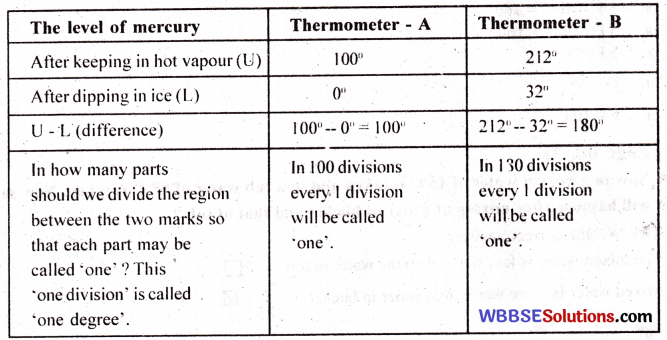
The fundamental interval of celsius scale is divided into –
(i) 100
(ii) 180
(iii) 120
(iv) 102 division
Answer:
100

Question 5.
The fundamental interval of Fahrenheit scale is divided into
(i) 180
(ii) 100
(iii) 32
(iv) 212 division
Answer:
180

Question 6.
If C and F represent a particular temperature in Celsius and Fahrenheit scales respectively, then their relation is :
(i) \(\frac{C}{4}\) = \(\frac{F-32}{9}\)
(ii) \(\frac{C}{5}\) = \(\frac{F-32}{9}\)
(iii) \(\frac{C}{3}\) = \(\frac{F-32}{5}\)
(iv) \(\frac{C}{9}\) = \(\frac{F-32}{5}\)
Answer:
\(\frac{C}{5}\) = \(\frac{F-32}{9}\)

Question 7.
The temperature of a body is measured by the instrument :
(i) hydrometer
(ii) thermometer
(iii) voltameter
(iv) ammeter
Answer:
thermometer

WBBSE Class 9 Physical Science MCQ Questions Chapter 6 Heat

Question 8.
How much calorie of heat would be produced by converting 42 joule of work completely into heat ?
(i) 100 calorie
(ii) 10 calorie
(iii) 1000 calorie
(iv) 90 calorie
Answer:
10 calorie

Question 9.
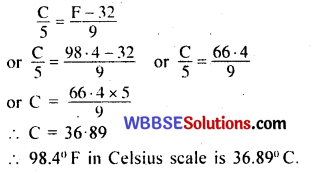
Normal body temperature of a man is –
(i) 98.4° C
(ii) 98.4° F
(iii) 98.4 K
(iv) 100° F
Answer:
98.4° F

Question 10.
Which substance has the highest specific heat?
(i) ethanol
(ii) water
(iii) acetone
(iv) ether
Answer:
water

Question 11.
If the specific heat of copper be 0.09, what will be the water equivalent of a block of copper of mass 50 g ?
(i) 45 g
(ii) 4.5 g
(iii) 450 g
(iv) 44 g
Answer:
4.5 g

WBBSE Class 9 Physical Science MCQ Questions Chapter 6 Heat

Question 12.
What is the melting point of ice in Fahrenheit scale ?
(i) 0° F
(ii) 32° F
(iii) 180° F
(iv) 121° F
Answer:
32° F

Question 13.
What is the specific heat of water in SI system ?
(i) 4 2 joule
(ii) 4200 joule/kg
(iii) 4200 joule/kg/K
(iv) 42 erg
Answer:
4200 joule / kg / K

Question 14.
The dimension of heat is –
(i) M L T
(ii) M L2 T-2
(iii) M L-1 T-2
(iv) M L-1 T-1
Answer:
ML2 T-2

Question 15.
Generally body temperature of a man is measured in :
(i) Celsius scale
(ii) Fahrenheit Scale
(iii) Kelvin scale
(iv) none of these
Answer:
Fahrenheit

Question 16.
Heat reaches the earth from the sun by the process of –
(i) conduction
(ii) convection
(iii) radiation
(iv) expansion
Answer:
Radiation

Question 17.
The value of mechanical equivalent of heat in CGS system is :
(i) 4.18 × 10⁷ erg / calorie
(ii) 4.8 erg / calorie
(iii) 5.18 × 10⁷ erg / calorie
(iv) 5.18 erg / calorie
Answer:
4.18 × 10⁷ erg / calorie

WBBSE Class 9 Physical Science MCQ Questions Chapter 6 Heat

Question 18.
How much work is to be done to produce 50 calorie of heat ?
(i) 210 joule
(ii) 200 joule
(iii) 201 joule
(iv) 310 joule
Answer:
210 joule

Question 19.
The water equivalent of a body is equal to :
(i) mass of the body x specific heat
(ii) mass of the body / specific heat
(iii) mass of the body + specific heat
(iv) mass of the body – specific heat
Answer:
Mass of the body × specific heat

Question 20.
Mercury remains in liquid state for long range of temperature :
(i) -39° C to 357° C
(ii) -57° C to 457° C
(iii) -10° C to 257° C
(iv) -12° C to 122° C
Answer:
-39° C to 357° C

Question 21.
-40° C is equal to :
(i) -50° F
(ii) -40° F
(iii) -60° F
(iv) -80° F
Answer:
-40° F

WBBSE Class 9 Physical Science MCQ Questions Chapter 6 Heat

Question 22.
1 Calorie is equal to –
(i) 4.18 Joule
(ii) 5.18 Joule
(iii) 3.18 Joule
(iv) 4.18 erg
Answer:
4-18 Joule.

Question 23.
If a temperature in Kelvin scale is TK and the temperature in Celsius scale is t° C, the relation is :
(i) TK = (273 + t°C)
(ii) TK = (273 – t°C)
(iii) TK = (273 / t°C)
(iv) none of these
Answer:
T K = (273 + t°C)

Question 24.
Calorimetry relates to the measurement of –
(i) heat
(ii) temperature
(iii) mechanical energy
(iv) none of these
Answer:
heat

Question 25.
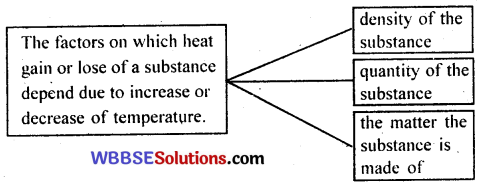
Quantity of heat of a body depends on its –
(i) temperature
(ii) mass
(iii) material of the body
(iv) all of them
Answer:
all of them

WBBSE Class 9 Physical Science MCQ Questions Chapter 6 Heat

Question 26.
Quantity of heat is given by –
(i) \(\frac{m s}{t}\)
(ii) mst
(iii) \(\frac{m t}{s}\)
(iv) \(\frac{m s t}{w}\)
Answer:
mst

Question 27.
Work done W and heat produced H are related to each other as(where J is the mechanical equivalent of heat)
(i) WH = J
(ii) H = JW
(iii) W = J H
(iv) W J H = 1
Answer:
W = JH

Question 28.
The value of mechanical equivalent of heat (in erg/calorie) is –
(i) 4.2 × 10⁻⁷
(ii) 4.2 × 10⁷
(iii) \(\frac{1}{4.2}\)
Answer:
4.2 × 10⁷

Question 29.
The latent heat of fusion of ice is –
(i) 80 cal g-1
(ii) 3.36 × 10⁵ cal g-1
(iii) 80 joule kg-1
(iv) 3.36 cal g-1
Answer:
80 cal g-1

WBBSE Class 9 Physical Science MCQ Questions Chapter 6 Heat

Question 30.
Saturated vapours obeys –
(i) Boyle’s law
(ii) Charles’ law
(iii) pressure law
(iv) none of these
Answer:
none of these

Question 31.
Dews are formed at a temperature –
(i) greater than dew point
(ii) less than dew point
(iii) equal to dew point
(iv) at critical temperature.
Answer:
equal to dew point

Question 32.
The volume of water is minimum at a temperature –
(i) -4°C
(ii) 4°C
(iii) 0°C
(iv) 1°C
Answer:
4°C

Question 33.
Thermal capacity of a body of mass m and specific heat s is –
(i) \(\frac{\mathrm{m}}{\mathrm{s}}\)
(ii) \(\frac{\mathrm{m}}{\mathrm{s}}\)
(iii) \(\frac{\mathrm{m}}{\mathrm{s}}\)
(iv) ms
Answer:
ms

Fill in the blanks :

1. Heat is the cause and temperature is the _____.
Answer:
effect

2. Heat is a form of _____ a body possesses.
Answer:
energy

WBBSE Class 9 Physical Science MCQ Questions Chapter 6 Heat

3. The range of temperature between the upper and lower fixed point is known as _____ interval.
Answer:
fundamental

4. Kelvin scale of temperature starts from the temperature corresponding to _____, taken as zero Kelvin.
Answer:
-273° C

5. Mean calorie is _____ of the heat necessary to raise the temperature of 1 gram pure water from 0° C} to 100° C.
Answer:
(\(\frac{1}{100}\)) th

6. 1 calorie = 4.18 or approximately 4.2 _____.
Answer:
joule

7. Specific heat of _____ in SI system is 4200 J/kg/K.
Answer:
water

8. Thermal capacity or heat capacity of a body is defined as the ratio of the heat supplied to a body to its consequent rise in _____.
Answer:
temperature.

9. In _____ process heat is transmitted in wave form.
Answer:
radiation

10. In radiation process _____ is not required.
Answer:
medium

11. Heat reaches the earth from the sun by _____ process.
Answer:
radiation

12. Normal body temperature of a man is _____ degree celsius.
Answer:
36.9

13. 94° F = _____ °C.
Answer:
34.4

WBBSE Class 9 Physical Science MCQ Questions Chapter 6 Heat

14. The water equivalent of a body is = mass x _____.
Answer:
specific heat

15. A body becomes hot by _____ heat and becomes cold on giving away heat.
Answer:
taking

16. Temperature is the condition of a body.
Answer:
thermal

17. Melting point of _____ under normal atmospheric pressure is taken as the lower fixed point of a scale of temperature.
Answer:
ice

18. The quantity of heat required to raise the _____ of unit mass of a substance through one degree is called the specific heat of the substance.
Answer:
temperature

19. When work is completely converted into heat or heat is compietely converted into work, one is _____ to the other.
Answer:
equivalent

WBBSE Class 9 Physical Science MCQ Questions Chapter 6 Heat

20. Work done to produce unit heat is known as _____ equivalent of heat.
Answer:
mechanical

21. Heat is a _____ quantity.
Answer:
scalar

22. In CGS system the unit of specific heat is _____
Answer:
Calorie/g/°C

23. The unit of specific heat in SI system is _____
Answer:
J/kg/K

24. -40°C = _____ °F
Answer:
-40

25. What is the dimension of heat ?
Answer:
The dimension of heat is ML2 T-2.

WBBSE Class 9 Physical Science MCQ Questions Chapter 6 Heat

26. 1°C = ______ °F
Answer:
\(\frac{9}{5}\)

27. in CGS system heat is measured by the unit called _____.
Answer:
Calorie

28. Temperature of a body depends on the _____ contained in it.
Answer:
heat

29. In SI system the unit of thermal capacity is _____.
Answer:
JK-1

30. 1 kcal = _____ cal
Answer:
1000

31. In case of change of state, heat is _____ or liberated.
Answer:
absorbed

32. Latent heat of fusion of ice is _____ Jkg-1
Answer:
3.36 × 10⁵

WBBSE Class 9 Physical Science MCQ Questions Chapter 6 Heat

33. Specific heat of _____ is highest than any other common substance.
Answer:
Water

34. The temperature at which dews are formed called _____point.
Answer:
dew

35. The density of water at 4°C is _____.
Answer:
maximum

36. In CGS system, latent heat of vapourization of water is _____.
Answer:
540 cal/g/°C

WBBSE Class 7 Science Solutions Chapter 7 Crisis of Environment, Plants and Conservation

Detailed explanations in West Bengal Board Class 7 Science Book Solutions Chapter 7 Crisis of Environment, Plants and Conservation offer valuable context and analysis.

WBBSE Class 7 Science Chapter 7 Question Answer – Crisis of Environment, Plants and Conservation

(Page no. 227)

Question 1.
What is happening in the pictures given above? Write down the reasons behind them.
Answer:
Storm, Oceanic high tide, melting of snow cap in polar regions, flood, landslides. These occur due to increasing environmental pollution.

WBBSE Class 7 Science Solutions Chapter 7 Crisis of Environment, Plants and Conservation

Question 2.
Now write the difference between Weather and Climate.
Answer:

Weather Climate
1. Weather is a day-to-day atmospheric condition. 1. Climate is the average of weather condition for a long period (years)
2. Weather reflects changes of every day every hour even in every moment. 2. Climate reflects condition of a definite specific period of time.
3. Weather is an atmospheric condition of a small place. Weather of two nearly places can be different. 3. Climate is the weather condition of a vast region.


(Page no. 228)

Question 1.
What are the important factors on which weather and climate depend?
Answer:

  • Temperature of atmosphere.
  • Humidity of atmosphere
  • Rainfall.
  • Snowfall.
  • Movement of wind.
  • Ocean current

Try to answer the following question:

1. When do buds appear in a mango tree?
Answer:
In Spring season.

2. When do migratory birds visit our country from abroad?
Answer:
During winter season.

3. When do the Husa fishes lay eggs?
Answer:
In Rainy season.

4. When does Palash bloom?
Answer:
In Spring season.

5. Write the name of some natural phenomena which occur in a definite time of the year.
Answer:

  • Merrigold blooms in winter season,
  • Sunflower blossoms in summer season.
  • Suli flower blossoms autumn season.
  • Cabbage and Cauliflower vegetables grow only in winter season.

6. In which time of the year, is our country very warm.
Answer:
Summer season.

7. Do you know the name of any other season apart from Summer, Monsoon, Autumn and Winter?
Answer:
Spring.

8. Does Monsoon arrive at a definite time in every year?
Answer:
Now dueto imbalance in ecosystem as a result of environmental pollution monsoon arrive late than the expected time.

9. How long does the winter stay?
Answer:
For three months.

What can happen if seasons stay for a longer or shorter period of time? Fill up the table below :
Answer:

Name of the season Problems due to its longer or shorter stay
1. Summer 1. Due to longer stay of summer the water bodies dry up, there is scarcity of water, draught occurs, production of crop is hampered.
2. Rainy 2. Due to heavy rain flood and landslide occur, scanty rain affects the production of rice and other crops
3. Winter 3. If winter stays shorter then the production of vegetables will be affected mainly the production of potato will be hampered.
4. Spring 4. If Spring stays shorter ecological balance will be hampered as in spring many new plants grow and it is mating season of animal world.

WBBSE Class 7 Science Solutions Chapter 7 Crisis of Environment, Plants and Conservation

(Page no. 129)

Worksheet

1. What is your name? Sufal Mahoto
2. How old are you ? 55 years
3. Write the name of your locality and mention the characteristics of weather of your locality –
Answer:
Midnapore, it is very hot in the month of May, monsoon comes here in June-July months, winter seasons are December and January.

Question 4.
What are the changes that you have experienced in the climatic conditions (temperature, rainfall etc.) in comparison with your childhood?
Answer:

  • Average amount of rainfall has decreased
  • Temperature had exceeded than before.
  • Summer has become very severe than before and it lasts longer than past.
  • Winter season remains for shorter period than before.

Question 5.
What are the differences of present day climate with that of 20 years earlier?
Answer:

  • Duration of winter season has decreased than before.
  • Due to deforestation summer lasts longer and it had become unbearable and severe.
  • Average Rainfall is less than before.
  • Spring season lasts for shorter time

WBBSE Class 7 Science Solutions Chapter 7 Crisis of Environment, Plants and Conservation

Question 6.
What can be the reasons behind these changes?
Answer:

  • Deforestation.
  • Establishment of factories in large number has polluted the atmosphere.
  • Excessive use of petrol and diesel vehicles.
  • Brick built houses has increased which has lead to increase in temperature.

Question 7.
Do you know about any physical problem that arises due to these changes?
Answer:

  • Indigestion and other diseases regarding stomach.
  • Skin problem.
  • Cancer in various parts of body.
  • Asthma and rise in blood pressure.

Question 8.
Trace out different problems (other than physical problems) of your locality due to climatic changes.
Answer:

  • Production of food crop has decreased.
  • There is scarcity of drinking water as the water of lakes and ponds has become polluted.
  • Temperature has increased.
  • Flood occurs frequently.

Question 9.
What can be done so that the climatic change do not cause major disruptions?
Answer:

  • Afforestation.
  • Use of unbaded petrol and of CNG (Compressed Natural Gas) in automobiles.
  • installation of tall chimneys in factories and fitting them with filters to prevent pollution.
  • Decreasing the number of vehicles on road.

(Page no. 230)

(i) What do you see from the above pictures?
Answer:
Pollution of environment.

(ii) Where does the emitted gases from various sources go?
Answer:
In the atmosphere.

WBBSE Class 7 Science Solutions Chapter 7 Crisis of Environment, Plants and Conservation

(Page no. 233)

Find out different news on global warming and write them down briefly.

Topic News
1. Melting of the glaciers. I. It will cause swage of water in the rivers nourished by the glaciers and then the water will decrease resulting in severe water crisis.
2. Rise in sea level. 2. The coastal areas may become flooded. There will be loss of life and huge economic loss.
3. Destruction of biodiversity. 3. Many marine animals and fishery resources in the oceans and seas will be come extinct, ecological balance will be hampered.


(Page no. 235)

Make a list of the organisms that live near your school or home. If you have seen any organism in other places, then include them in the following list.

Nature of habitat The plants that you saw (Herb/Shrub/tree) The animals that you see (vertibrate/invertebrate)
1. Wet land grass, water-lily, moss. snake, frog, snail.
2. Wet dyke moss, small bushes. Earth-warm, Centipede, Scorpion

WBBSE Class 7 Science Solutions Chapter 7 Crisis of Environment, Plants and Conservation

Nature of habitat The plants that you saw (Herb/Shrub/tree) The animals that you see (vertibrate/ invertibrate)
3. Dense bush near a pond Sandhyamalati, Aakando. Dhatura Mongoose, Rat, water bird.
4. Rathole Rat
5. Hole in the thick trunk of a tree. creepers, mosses owl. squirrel
6. Termite Hill grass Termite, Ant
7. Cracks on the bricks of an old house Peepal, planting, climbers. bat; pigeons
8. Roof top of house lizard, behive.
9. Garden Rose plant, Jasmine, Hibiscus grass, coconut tree. Cameleon, squirrel, crow, cuckoo, wood pecker


(Page no. 237)

Question 1.
Do we get any benefit from all these animals and plants? Let’s write them down. You can add some other plants and animals to this list.
Answer:

Name of plant Benefits animal Name of animal Benefits
1. Paddy Services as main food crop for human beings. 1. Panchax fish serves as food for acquatic animals and birds.
2. Banyan Gives cool shade, leaves are eaten by animals, birds builts nests. 2. Snake Eats different harmful insects.
3. Neem leaves have medicinal value, wood is very useful. 3. Bat Eats different harmful worms and insects.
4. Coconut fruit is eaten and also used to make different dishes leaves are useful to make broom, rope, wood is useful 4. Crow Eats rotten things, dead things and helps to keep our environment clean

(Page no. 241)

Question 1.
Reasons for loss of bio-diversity of earth: Reason for loss of habitat
Answer:

  • Deforestation to meet the requirement of wood.
  • For increasing demand of agricultural land.
  • To increase the habitat area of human being.
  • Establishment of industries and factories.

Question 2.
What will happen if The Sundarban is wiped out to meet the requirement of wood?
Answer:
The Sundarbans is natural habitat of many wild lifes especially of Royal Bengal tigers. They will become extinct. We get wax and honey from this forest area that will also not be available. It is a famous tourist spot. So a great source of income from tourism will also come to and end.

WBBSE Class 7 Science Solutions Chapter 7 Crisis of Environment, Plants and Conservation

Question 3.
Let’s make a list of different animals who fall prey to the greed of the poachers.
Answer:

Substance obtained by killing the animal Animal killed for getting the  substance Use of those parts How can we obtain these subtances without killing the animals.
1. Teeth Elephant decorative items when the animal dies.
2. Hide Tiger, Lion, Rhinocerous garments, bag, drum when the animal dies naturally
3. Horns Deer decorative items can be created artificially
4. Fur Bear, Sheep garments, shawl can be made artificially
5. Musk Deer perfume When the animal dies naturally

(Page no. 242)

Question 1.
What will happen if The number of tiger or other big carnivores decreases significantly in a forest:
Answer:
The ‘food web’ and the flow energy in the different level of animal will get hampered. This will destroy ecological balance.

Question 2.
What will happen if some fishes were introduced in a pond which eat other small fishes.
Answer:
Small fishes will become extinct. These fishes are valuable source of nutrients to our body

(Page no. 243)

Question 1.
What will happen if The amount of rainfall decreases in a certain region?
Answer:
The trees and plants of that area will dry up, agricultural production will be hampered, soil will become dry leading to soil erosion, there will scarcity of drinking water.

Question 2.
What will happen if Industrial waste is poured into the river water?
Answer:
The water will become contaminated, this can spread different diseases, the fishes and other acquatic animals will die.

WBBSE Class 7 Science Solutions Chapter 7 Crisis of Environment, Plants and Conservation

(Page no. 244)

Question 1.
What will happen in case of large-scale exploitation of a plant that is a source of medicine
Answer:
Then a time will come when that plant will not be available to us any more, so the medicine will not be available as a result the disease will become uncurable.

(Page no. 245)

Wastes and Risks to Human Health :

  • Contaminated water.
  • Smoke from factories.
  • Pesticides in fruits and vegetables.
  • Unbygenic condition inside factories.
  • Municipal waste causing choking hazard in street animals.
  • Plastic bottles and packets daily waste in our day-to-day life.

Mention the nature and components of different wastes shown in the picture.

SI. No Source of waste Nature of waste (solid/liquid) Component of waste
1. Sewage liquid waste from domestic activities Kitchen waste, toilet and other household waste waters.
2. Factories
WBBSE Class 7 Science Solutions Chapter 7 Crisis of Environment, Plants and Conservation
gaseous pollutants CO2, SO2, and CO and also oxides of nitrogen.
3. Pesticides solid pesticides in
veg­etables and fruit.
4. Factories Solid, gaseous pieces of glass, plastic, chemicals
5. Rural and Urban areas Solid, liquid, gas rotten things bottle, plastic
6. Dumping ground of waste. Solid, liquid plastic bags, glass, bottles, plastic, rotten things:

WBBSE Class 7 Science Solutions Chapter 7 Crisis of Environment, Plants and Conservation 1

(Page no. 246)

Make a list of different wastes from different sources and trace their nature.
Answer:

Source Name of the waste product Nature of waste product
1. School torn paper, broken pen, pencil, polythene. snake, frog, snail.
2. Rice Mill Husk of paddy, ashes solid
3. Pond dirty water, cleaning agent like detergent, soap. solid; liquid
4. Agricultural chemical fertilizer, pesticide, straw, husk solid
5. Hospital Syringe, cotton. wrapped of medicine, bottle. solid
6. Hospital Syringe, cotton, wrapper of medicine, bottle. solid
7. Playground plastic bottle, torn papers solid
8. Bus stand shell of ground nut, torn paper, bottles solid
9. Houses peel of fruit and veg­etable, torn clothes paper, bottle. solid

(Page no. 247)

Diseases are as follows :

1. Infectious diseases spread by vectors (Mosquito fly, rat, cat, dog)-Malaria. Filaria. Dengue, Diarrhoea, Plague, Diptheria. Rabies)
2. Infectious diseases spread by used clothes of patients of hospitals – Hepatitis, Jaundice, Phenuiuonia, Malaria, Tuberculosis
3. Infectious diseases spread by different untreated compound or metals of factories – Cancer, nervous disorder, pain in bones, skin disease, lungs problem, Asthma.

WBBSE Class 7 Science Solutions Chapter 7 Crisis of Environment, Plants and Conservation

Have you noticed symptoms of such disease in people known to you? Write it down.
Answer:

Where does he work What can be the reason What is the problem What to do
1. Asbestos factory Asbestos Pulmonary problem Should consult doctor
 2. Cement factory powder of cement Pulmonary problem Should consult  doctor
3. Pesticide factory Smell of chemicals Breathing Problem, consult Cancer Should consult doctor
4. Alcohol factory Alcohol problem relating to stomach, problem of indigestion Should consult doctor

Now find out what unhealthy habits or reasons are responsible for these diseases or risks of diseases
Answer:

Disease/Risk Cause Which unhealthy nature/lack of precaution is responsible What to do
Hepatitis Viral infection through water Drinking polluted water One should drink boiled water
Malaria Bite of Mosquito Sleeping without mosquito net One should sleep inside mosquito net instead of only using mosquito coil
Cholera Virus in drinking water Drinking polluted water, coming in contact with disease person One should boil water before drinking
Plague Rats Not killing rats inside shops and houses. We should keep our house and shop clean,

(Page no. 249)

Teacher showed these pictures to the students and asked to complete the following table on role of plant in one’s life.
Answer:

What will happen if there are no plants What will happen if plants are present
1. Environmental pollution. 1. Rainfall will occur.
2. Draught and flood occur. 2. Oxygen supply increase so the greenhouse effect will decrease.
3. Green house effect increases. 3. Supply of food remains.
4. Scarcity of food. 4. Ecological balance remains.
5. Ecological balance becomes disturbed. 5. Stops soil erosion.
6. Rainfall will decrease. 6. We gel life saving medicine.


WBBSE Class 7 Science Solutions Chapter 7 Crisis of Environment, Plants and Conservation

(Page no. 250)

Describe how do the following animals depends on forest plant for food.
Answer:

Name of the animal Food and their sources Does they get same amount throughout the year What will happen if sources are lost
Dear grass, leaves No. it decreases during summer supply of food will be hampered
Elephant leaves No, decreases in summer supply of food will be hampered
One horned Rhino grass, small shrubs No may die in absence of food.
Bat fruits Yes may extinct
Squirrel fruits and nuts Yes shortage of food
Hornbill Cereals Yes will die
Red Ponda leaves of Bamboo No shortage of food
Monkey leaves, fruit flower, root No supply of food will be hampered
Goat leaves, gram Yes shortage of food

Answer:
1. Nectar of flower → Bee → Lizard → Eagle
2. Leaf → Deer → Tiger
3. Rotten leaves → Fish → Civet cat
4. Twig → Elephant
5. Grain → Small bird → Hawk

Now construct different food chain from the following plants and animals.
Grass. goat. small fishes. boal fish. Kingfisher. Crane. Kite. Rat. Hawk. Rice plant, Stem borer, Hen. Leopard, Zebra. Lion, Rhino, Tiger.

SI. Organisms of food chain No. Shape of food chain
1. Grass → goat → Lion Forest food chain
2. Rice plant → Rat → Kite Grassland food chain
3. Stem borer → Zebra → Leopard Forest food chain
4. Small fish → boal fish → Crane Acquatic food chain
5. Rice plant → Hen → Hawk Grassland food chain


(Page no. 253)

If there is any mango/banyan/peepul/simul/tamarind tree near your home, then notice that which animals are living there.

1. Insects — Grasshopper. Honey bee
2. Birds — Bulbul, owl, crow
3. Mamais — Bat, Monkey
4. Reptiles— Snake, Chameleon, Lizard

(Page no. 254)

If one plant can give shelter to all these animals then you can understand that how many animals can live in a forest. Now can you say which animals live in the following forests —

1. Coniferous forest — Snow Leopard, Elephant, Snake, Tiger.
2. Deciduous forest — Tiger, Lion, Rhinoceros, Elephant.
3. Mangrove forest — Tiger, Deer, Crocodile, Bee, Birds.
4. Grassland forest — One-horned Rhino, Deer, Zebra, Giraffe
5. Weed forests of wetland — Mongoose. Civet cat, Iguana.
6. Bushes and trees around your house — Iguana, Cat, Frog, Snake. Squirrel.

WBBSE Class 7 Science Solutions Chapter 7 Crisis of Environment, Plants and Conservation

Many animals are becoming extinct on earth due to loss of plant. Name some of these animals which depend exclusively on plants.

Name of the animal Depends on plant for food/shelter
1. Adjutant stork
2. Owl
3. Civet Cat
4. Langur
peepal
Mango
Tamarind
Arjun, Banyan

Class 7 Science Chapter 7 Question Answer West Bengal Board – Crisis of Environment, Plants and Conservation

Multiple Choice Questions & Answers : (1 mark for each question)

Question 1.
The ability to absorb CO2 in different plants is ……………….
i) same
ii) different
iii) may be same, may be different
Answer:
ii) different

Question 2.
Corals become affected due to the increase in ……………….
i) acidity
ii) temperature
iii) acidity and temperature
Answer:
iii) acidity and temperature

Question 3.
Indiscriminate use of chemicals can bring about the destruction of ……………….
i) animals
ii) plants
iii) animals and plants
Answer:
iii) animals and plants

Question 4.
Trees of a jungle are felled ……………….
i) to produce luxury materials
ii) for increasing agricultural land
iii) to increase the habitable areas
iv) all are true
Answer:
iv) all are true

Question 5.
Musk is obtained by killing ……………….
i) deer
ii) elephant
iii) bear
iv) sheep
Answer:
i) deer

Question 6.
Hide is obtained by killing ……………….
i) elephant
ii) bear
iii) tiger
iv) sheep
Answer:
iii) tiger

Question 7.
Horns of deer are used for……………
i) decorative items
ii) medicine
iii) perfume
iv) garments
Answer:
i) decorative items

WBBSE Class 7 Science Solutions Chapter 7 Crisis of Environment, Plants and Conservation

Question 8.
Reserpine is received from ……………
i) Penicillium
ii) Rauwolfia
iii) Basil
iv) Cinchona
Answer:
ii) Rauwolfia

Question 9.
The habitate of grass, moss, water-lily is ……………
i) near a pond
ii) termite hill
iii) wet dyke
iv) wet land
Answer:
iv) wet land

Question 10.
The ice cover of Alaska Bay adjoining the North Pole has reduced by 40% in the last ……………
i) 10 years
ii) 30 years
iii) 20 years
iv) 40 years
Answer:
ii) 30 years

Question 11.
The average temperature of earth had increased by 1°C in last ……………
i) 100 years
ii) 50 years
iii) 200 years
iv) 150 years
Answer:
i) 100 years

Question 12.
More than 99% of the glacieric are present in ……………
i) North poles
ii) South poles
iii) North and South poles
Answer:
iii) North and South poles

Fill in the blanks : (1 mark for each question)

1. …………… is an atmospheric condition which changes every day, every hour even in every moment.
Answer:
Weather

2. …………… is the average of weather of a particular area for a long period (years).
Answer:
Climate

3. Climatic changes have an important correlation with ……………
Answer:
global warming.

WBBSE Class 7 Science Solutions Chapter 7 Crisis of Environment, Plants and Conservation

4. CO2 is one of the important gases produced by …………… activities.
Answer:
anthropogenic

5. The biggest source of fresh water on the earth is ……………
Answer:
glaciers

6. More than …………… of the glaciers are present in North and South poles of earth.
Answer:
99%.

7. The …………… nourishes nine big rivers of Asia.
Answer:
Himalayas

8. …………… is the shelter for the largest clan of the world.
Answer:
Sunderbans

9. …………… is a type of marine invertebrate animal.
Answer:
Coral.

WBBSE Class 7 Science Solutions Chapter 7 Crisis of Environment, Plants and Conservation

10. The biodiversity of our country is so rich that India is termed as a …………… Nation.
Answer:
mega diversity.

11. We get Quinine from ……………
Answer:
Cinchona.

12. Ranwolfia medicine is derived from ……………
Answer:
Keserpine.

State whether True or False : (1 mark for each question)

1. Climate is the average for small period of time.
Answer:
Flase

2. Hilsa fish lay eggs in the rainy season.
Answer:
True.

3. Climatic changes does not have any relation with global warming.
Answer:
False.

4. Some glaciers are also found in Himalayas.
Answer:
True.

5. Sea level may fall due to the melting of these glaciers.
Answer:
False.

6. The coastal areas may become flooded if the sea level rises.
Answer:
True.

WBBSE Class 7 Science Solutions Chapter 7 Crisis of Environment, Plants and Conservation

7. Glaciers reflect nearly 20% of the sunlight and absorbes 80 of it.
Answer:
False.

8. Coral exoskeleton is made up of sodium bicarbonate and it protects the body.
Answer:
False.

9. Dead corals and other organic materials help in forming the coral island.
Answer:
True.

10. The temperature of Indian Ocean have risen due to global warming.
Answer:
True.

11. India is the habitat of 30% of all the plants of the world.
Answer:
False.

12. Introduction of Tilapia and giant African magur in the ponds of rural Bengal posed a huge problem for the existence of indigenous fishes.
Answer:
True.

Match the column A With column B.

Column A Column B
a) Coral reefs are in danger
b) Glaciers reflect nearly 80%
c) 2005 was the warmest year
d) Weather of two nearby places
c) Some gases are naturally produced
f) Some glaceries are found
g) In 1988 nearly 16% of corals
h) Bengal vulture is
i) Hepatitis is a
j) The plant with greater surface area
i) in the atmosphere
ii) of the world were lost forever
iii) of leaf absorb more CO2
iv) due to global warming
v) viral infection
vi) on the verge of extinction
vii) of sunlight
viii) can be different
ix) in the Himalayas
x) in the last century

Answer:
a) Coral reefs are in danger due to global wanning.
b) Glaciers reflect nearly 80% of sunlight.
c) 2005 was the warmest year in the last century.
d) Weather of two nearby places can be different.
e) Some gases are naturally produced in the atmosphere.
f) Some glaceries are found in the Himalayas.
g) In 1988 nearly 16% of corals of the world were lost forever.
h) Bengal vulture is on the verge of extinction,
i) Hepatitis is a viral infection.
j) The plant with greater surface area of leaf absorb more CO2

WBBSE Class 7 Science Solutions Chapter 7 Crisis of Environment, Plants and Conservation

Very Short Questions & Answers : (1 mark for each question)

Question 1.
Which animal eat the egg of the turtle in Galapagos Island?
Answer:
Dogs and pigs used to eat the eggs of the turtle.

Question 2.
From which country Tilapia and giant Magur came?
Answer:
They came from Africa.

Question 3.
Name three fishes which are on the verge of being extinct?
Answer:
Mourala, Punti, Khalse.

Question 4.
The polar ice caps are melting, why?
Answer:
Due to global warming.

Question 5.
Name some animals that live in the Coral reefs.
Answer:
Fishes, molusca, echinodermata, sponge, Crustacea etc animals live in the coral reefs.

WBBSE Class 7 Science Solutions Chapter 7 Crisis of Environment, Plants and Conservation

Question 6.
What is Global Warming?
Answer:
Due to unplanned human activities the amount of carbon dioxide and other gaseous compound in the atmoshere are increasing. This gaseous substances in turn retain the excess heat on earth. As a result, the temperature of earth increases than what is normal. This is Global Warming.

Question 7.
Name some gases which are present in smoke emitted from different sources.
Answer:
Carbon dioxide (CO2), Methane (CH4), Nitrous Oxide (N2O). Chloro-Fluoro-Carbon. Sulpher di-oxide (SO2) and particles of dust, Carbon etc.

Question 8.
Name some animals which are on the verge of extinction?
Answer:
Royal Bengal Tiger, Bengal Vulture. One-horned Rhinoceros. Gangetic Dolphin. Cheetah, Chimpanzee, Orangutan and Gorilla.

Long Questions & Answers : (3 marks for each question)

Question 1.
What is Coral? Write a short note on it.
Answer:
Coral is a type of marine invertebrate animal. It be longs to the Phylum Cuidaria. They live together by forming colonies. They form an exoskeleton surrounding their body. This exoskeleton is made up Calcium Carbonate which protects the body. The exoskeletons are very colourful and have high demand in the fields of making of fancy items and jewelleries.
WBBSE Class 7 Science Solutions Chapter 7 Crisis of Environment, Plants and Conservation 2

Question 2.
What is Food Chain?
Answer:
Green plants trap solar energy and make their food by photosynthesis. Animals cannot make their own food, so they obtain energy by eating plants or by eating animals which have eaten plants. This predator-prey relationship is called food chain.

WBBSE Class 7 Science Solutions Chapter 7 Crisis of Environment, Plants and Conservation

Question 3.
What do we get from biodiversity?
Answer:

  • Diversity of food crops helps us to get all kinds of nutrients necessary to our body and also helps to increase agricultural production.
  • Plants and micro-organisms can absorb CO2, and maintain O2 – CO2 balance in environment.
  • Rooted plants increases the water retention capacity of the soil and also sustain the rainfall by returning back the excess water in the form of water vapour.
  • Fungi and bacteria help in maintaining the level of nutrients present in the soil.
  • Biodiversity of plants is a source of life saving medicine, wood, and other industries like silk industry, Lac industry etc.

Question 4.
What are the reasons of loss of biodiversity of earth?
Answer:
The reasons behind the loss of biodiversity of earth are as follows —

  • Deforestation is done to meet the requirement of wood agricultural land and habitat area for human beings, so other organisms are losing their habitat.
  • Illegal hunting or poaching is done to get teeth, hides, horns, fur and other body parts of animals. This greed is responsible for endangering the lives of different animals.
  • If an organism cannot adapt with the climatic changes its existence will be in question. Animals like Emperor Penguin, Polar Foxes, Polar Bears are endangered due to melting of ice in polar region.
  • Increasing environmental pollution is another reason for destruction of animals and plants.
  • If some plants or animal is economically important then excessive use of them can be dangerous for their existance.

Question 5.
Name four Biodiversity hot spots of India.
Answer:

  • Eastern Himalayas : Sikkim, Darjeeling, Dooars and Terai region.
  • Western Ghat and Srilankas: The hilly forest region along the western coast of India.
  • Indo-Burma: North-eastern states of India (e.g.: Meghalaya, Arunachal Pradesh)
  • Sundaland : Andaman -Nicobar region of India.

WBBSE Class 7 Science Solutions Chapter 7 Crisis of Environment, Plants and Conservation

Question 6.
How is plant helpful to us?
Answer:

  • Due to plants water cycle remains on earth.
  • Temperature of environment is controlled by plant.
  • Velocity of storm is checked by plant.
  • Environmental Pollution is prevented by plants.
  • Plant stops soil erosion.
  • Plants provide shelter of organisms.

WBBSE Class 7 Science Solutions Chapter 3 Atom, Molecule and Chemical Reaction

Detailed explanations in West Bengal Board Class 7 Science Book Solutions Chapter 3 Atom, Molecule and Chemical Reaction offer valuable context and analysis.

WBBSE Class 7 Science Chapter 3 Question Answer – Atom, Molecule and Chemical Reaction

(Page no. 85)

Try to write the symbols from names of elements given below in the first two tables.

table 1

Name of Element Symbol
Aluminiun Al
Nickel Ni
Arsenic As
Silicon Si
Zinc Zn
Boron B

table 2

Name of Element Latin name Symbol
Tin Stannum Sn
Mercury Hydrogirum Hg
Lead Plumbum Pb

WBBSE Class 7 Science Solutions Chapter 3 Atom, Molecule and Chemical Reaction

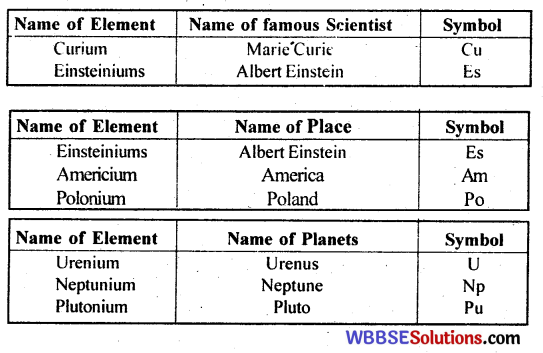
Now we will learn the names and symbols of elements that originate from the names of famous scientists, the place of discovery, the native country of the discoverer or some planet.

WBBSE Class 7 Science Solutions Chapter 3 Atom, Molecule and Chemical Reaction 1

(Page no. 87)

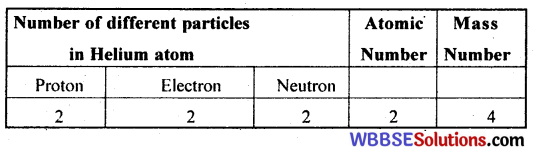
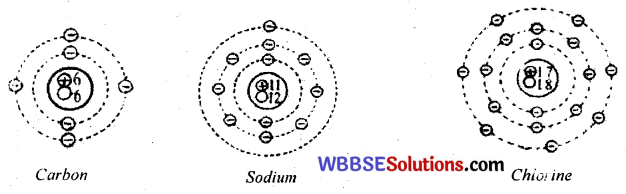
Now fill up the following table using the diagram for atomic structure of Helium atom as shown on the previous page.

WBBSE Class 7 Science Solutions Chapter 3 Atom, Molecule and Chemical Reaction 2

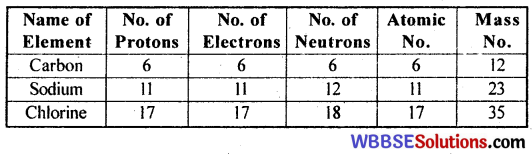
Impact the diagrams above and fill up the following table :

WBBSE Class 7 Science Solutions Chapter 3 Atom, Molecule and Chemical Reaction 3

(Page no. 88)

Fill up the following table with help from your teacher, if necessary.

WBBSE Class 7 Science Solutions Chapter 3 Atom, Molecule and Chemical Reaction 4

(Page no. 89)

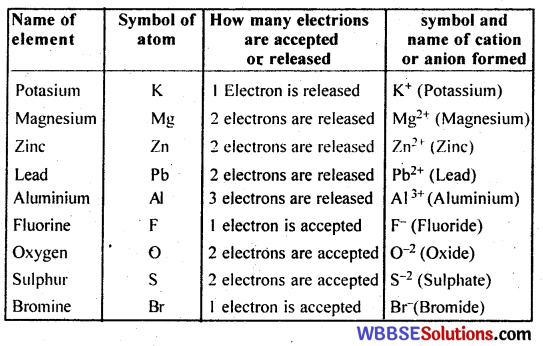
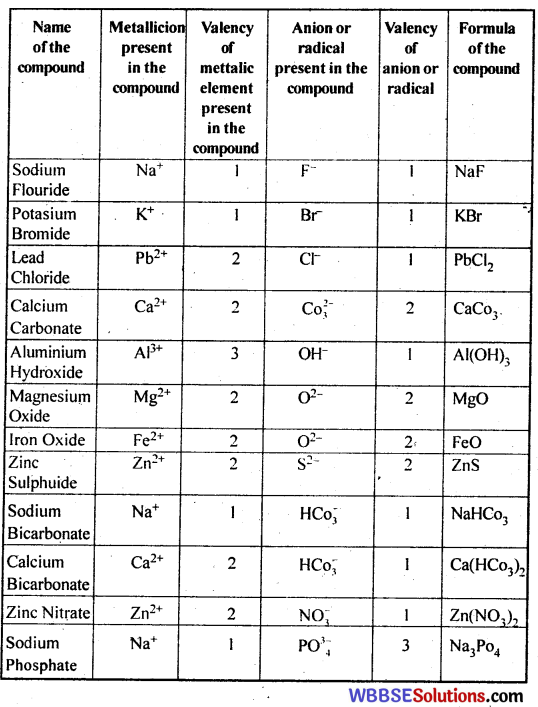
Discuss among yourselves and fill up the following table :

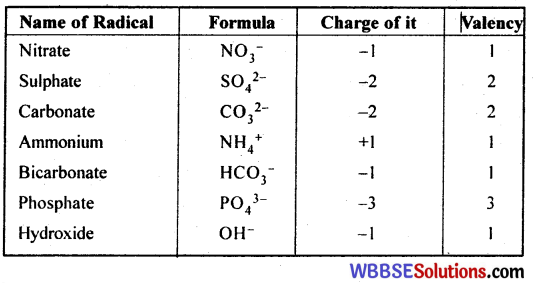
WBBSE Class 7 Science Solutions Chapter 3 Atom, Molecule and Chemical Reaction 5

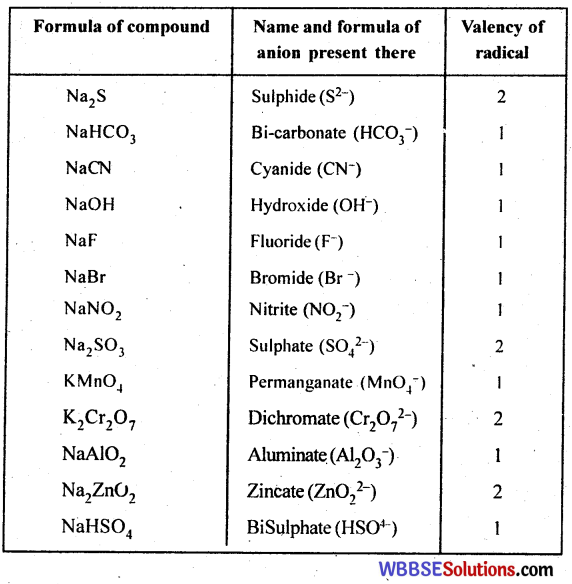
Write the valencies of radicals from the number of Sodium or Potassium atom.

WBBSE Class 7 Science Solutions Chapter 3 Atom, Molecule and Chemical Reaction 6

(Page no. 90)

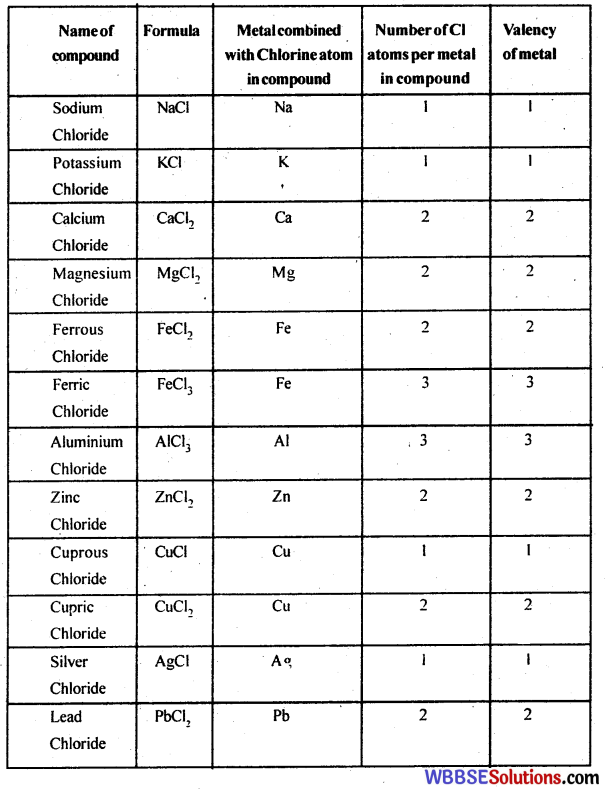
Now we shall determine the valencies of different metals and non-metals from their compounds with Chlorine. The number of Chlorine atoms which combine with an atom of an elements is the valency of that element.

WBBSE Class 7 Science Solutions Chapter 3 Atom, Molecule and Chemical Reaction 7

(Page no. 92)

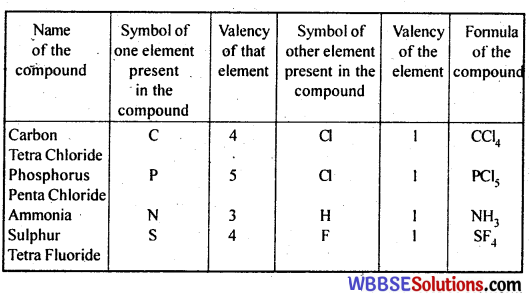
Symbols and valencies of some elements are given below. Write down the formula of the compounds by using the above procedure.

WBBSE Class 7 Science Solutions Chapter 3 Atom, Molecule and Chemical Reaction 8

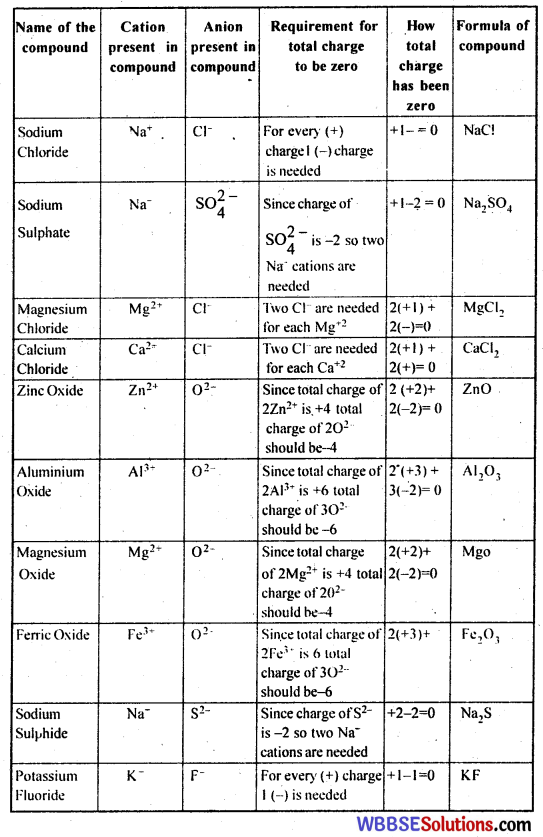
Discuss among yourselves and fill up the following table using the valencies of elements and radicals.

WBBSE Class 7 Science Solutions Chapter 3 Atom, Molecule and Chemical Reaction 9

(Page no. 93)

Now discuss among yourselves and fill up the following table.

WBBSE Class 7 Science Solutions Chapter 3 Atom, Molecule and Chemical Reaction 10

(Page no. 97)

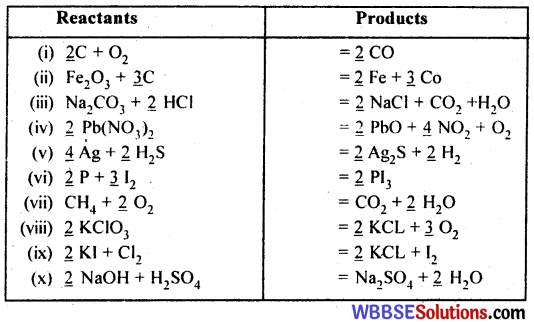
Discuss among yourselves and balance the chemical equations by putting suitable numbers in the blank places (. . .) in them

WBBSE Class 7 Science Solutions Chapter 3 Atom, Molecule and Chemical Reaction 11

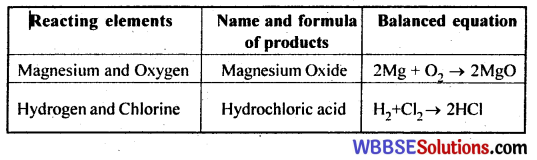
Write the names and formula of products and balanced equations of the reactions by discussing among yourselves.

WBBSE Class 7 Science Solutions Chapter 3 Atom, Molecule and Chemical Reaction 12

Discuss anong yourselves and write the formula (e) of missing product (s) in each case.

WBBSE Class 7 Science Solutions Chapter 3 Atom, Molecule and Chemical Reaction 13

(Page no. 100)

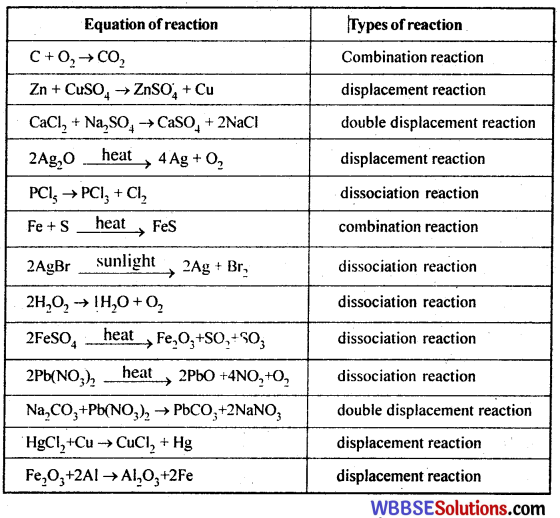
Discuss among yourselves and write the type of reaction against each equation in the table.

WBBSE Class 7 Science Solutions Chapter 3 Atom, Molecule and Chemical Reaction 14

Class 7 Science Chapter 3 Question Answer West Bengal Board – Atom, Molecule and Chemical Reaction

Multiple Choice Questions & Answers : (1 mark for each question)

Question 1.
Symbol of Arsenic is-
i) Ar
ii) As
iii) An
iv) Ac
Answer:
ii) As

Question 2.
Symbol of Mercury is-
i) Mc
ii) Me
iii) Mu
iv) Hg
Answer:
iv) Hg

WBBSE Class 7 Science Solutions Chapter 3 Atom, Molecule and Chemical Reaction

Question 3.
Symbol of Lead-
i) Pb
ii) Ld
iii) Le
iv) Pm
Answer:
i) Pb

Question 4.
Formula of Lead Chloride is-
i) pbCl
ii) pbCl3
iii) pbCl2
iv) pbCl3
Answer:
iii) pbCl2

Question 5.
Formula of Ferric Chloride is-
i) FeCl2
ii) FeCl3
iii) FeCl3
iv) FeCl2
Answer:
ii) FeCl3

Question 6.
Formula of Potasiam Chloride-
i) KCl2
ii) KCl2
iii) PCl
iv) KCl
Answer:
iv) KCl

WBBSE Class 7 Science Solutions Chapter 3 Atom, Molecule and Chemical Reaction

Question 7.
Formula of Cupric Chloride-
i) CuCl2
ii) CuCl
iii) CuCl2
iv) CuCl3
Answer:
i) CuCl2

Question 8.
Formula of Sodium Sulfate is-
i) NaSO
ii) NaSO4
iii) Na2 SO4
iv) Na2 SO2
Answer:
iii) Na2 SO4

Question 9.
Formula of Aluminium Oxide is-
i) AlO3
ii) Al2 O3
iii) Al2 O2
iv) AlO
Answer:
ii) Al2 O3

WBBSE Class 7 Science Solutions Chapter 3 Atom, Molecule and Chemical Reaction

Question 10.
Formula of Silver Chloride is-
i) AgCl3
ii) AgCl2
iii) Ag2 Cl
iv) AgCl
Answer:
iv) AgCl

Fill in the blanks : (1 mark for each question)

1. Formula of Magnesium Chloride is ______.
Answer:
MgCl2

2. The atomic number of an element is 6 and mass number is 12 then the number of neutrons in nucleus would be ______.
Answer:
6.

3. In L orbit maximum _____ electrons can revolve.
Answer:
8 .

4. In compound P2 O5 the valency is ______.
Answer:
5.

5. Symbol of Aluminium Oxide is ______.
Answer:
Al2 O3.

6. Atomic weight of carbondioxide is ______.
Answer:
44.

WBBSE Class 7 Science Solutions Chapter 3 Atom, Molecule and Chemical Reaction

7. In chemical equation the atomic number of both sides are ______.
Answer:
equal.

8. Symbol of Silver is ______.
Answer:
Ag.

9. Valency of Carbon is ______.
Answer:
4.

10. Mass of one electron particle is ________ of one Hydrogen atom.
Answer:
1 / 1837.

State whether True or False : (1 mark for each question)

1. Hydrogen reacts with nitrogen to produce ammonia.
Answer:
true

WBBSE Class 7 Science Solutions Chapter 3 Atom, Molecule and Chemical Reaction

2. Chemical reaction is of one type.
Answer:
false

3. Ammonia is formed by the reaction of nitrogen and hydrogen.
Answer:
true

4. Mercury and oxygen are produced when mercuric oxide is heated.
Answer:
true

5. Formula of Ferric Oxide is Fe2 O.
Answer:
false

6. Slacked lime is produced by the reaction of water with quicklime.
Answer:
true

WBBSE Class 7 Science Solutions Chapter 3 Atom, Molecule and Chemical Reaction

7. Water is produced by chemical combination of oxygen and hydrogen.
Answer:
true

8. The formula of hydrogen sulfide is H2 S2.
Answer:
false

Short Questions & Answers : (1, 2 marks for each question)

Question 1.
What is the meaning of Greek word ‘Atom’?
Answer:
Meaning of the word ‘Atom’ is indivisible.

Question 2.
What is atom?
Answer:
The smallest particle of an element that retains the properties of the element is called an atom.

Question 3.
What is the mass number of an atom?
Answer:
The total number of protons and neutrons in the nucleus of atom is called the mass number of that atom.

Question 4.
What is Atomic Number?
Answer:
The number of Protons present in the nucleus of an aton of an element is known as the Atomic Number of the element.

WBBSE Class 7 Science Solutions Chapter 3 Atom, Molecule and Chemical Reaction

Question 5.
What is Mass Number?
Answer:
The total number of Protons and Neutrons present in the nucleus of an atom of an element is known as the Mass Number of the element.

Question 6.
What is the difference between H2 and 2H ?
Answer:
H2 means 2 atoms of Hydrogen and 2H mears 2 molecules of Hydrogen.

Question 7.
Write the name of an element whose atom has no neutron.
Answer:
Ordinary Hydrogen atom or Protium.

Question 8.
What is the largest number of electron in K orbit?
Answer:
The largest number of electron in K orbit is 2 .

Question 9.
What is the atomic number of Helium?
Answer:
The atomic number of Helium is 2 .

Question 10.
How do the atoms exists in molecules?
Answer:
Ator exists in combined state.

WBBSE Class 7 Science Solutions Chapter 3 Atom, Molecule and Chemical Reaction

Question 11.
Write the symbols of Potassium and Mercury.
Answer:
Symbol of Potassium is K and Mercury is Hg.

WBBSE Class 7 Science Solutions Chapter 3 Atom, Molecule and Chemical Reaction 15

Question 12.
Who founded the theory of Molecules?
Answer:
Amedeo Avogadro.

Question 13.
What is total number of Natural Element?
Answer:
92.

Question 14.
What is ti.e molecular atomicity of Phosphorus.
Answer:
4.

WBBSE Class 7 Science Solutions Chapter 3 Atom, Molecule and Chemical Reaction

Question 15.
What is tlit valency of Phosphate (PO4) ?
Answer:
Valen y is 3.

Question 16.
If the orbit gues away from nucleus what would happen, will the number of electron increase 0 – decrease?
Answer:
Nurber c elect:on would increase.

Question 17.
W at is :ine charge of Nucleus?
Answer:
Pusitive.

Question 18.
A + B = Carbond 1 oxice, write the reacting element A and B of this reaction.
Answer:
A is Carbon (C) and : 3 is Oxygen (O2)

Question 19.
Why the symbol of iron is Fe?
Answer:
The Latin nam: of iron is Ferrum. So the symbol is taken as Fe.

Question 20.
What is the total number of atoms in molccule of Ammonia?
Answer:
In Amonia (NH3) molecule, the number of atoms are 4.

WBBSE Class 7 Science Solutions Chapter 3 Atom, Molecule and Chemical Reaction

Question 21.
Which elements have zero valency?
Answer:
Non-reacting elements like inert gases (He, Ni, Ar etc.) have zero valency.

Question 22.
Name the element and the radical whcih have same valency.
Answer:
The element Sodium (Na) and radical Nitrate (NO3) have same valency.

Question 23.
Can we say Neutron that is the main constituent of fromation of atoms of all substances?
Answer:
No, we cannot say that neutron is the main constituent.

Question 24.
What is the valency of Nitrogen in compound Ammonia?
Answer:
Valency of Nitrogen is 3 in Ammonia- (NH3).

Question 25.
What is the charge of Electron?
Answer:
Negative.

WBBSE Class 7 Science Solutions Chapter 3 Atom, Molecule and Chemical Reaction

Question 26.
When we can say an equation is balanced?
Answer:
If the number of atoms of each element on the left hand side is equal to the number of atoms of that element on the right hand side, then we can say that the equation is balanced.

Long Questions & Answers : (3 marks for each question)

Question 1.
What is symbol? Give example.
Answer:
When the name of an element is represented by a single letter or two letters of english alphabet it is called symbol of that element. By using symbol we can express briefly an atom. As example – symbol of Aluminium is Al, symbol of Mercury is Hg.

Question 2.
What is sign?
Answer:
The way of expressing briefly the molecules of elements and compounds is called sign. For example –
Carbon-di-oxide (CO2), Sulphur-di-oxide (SO2). Nitric Oxide (NO).

Question 3.
Explain the process of writing symbols.
Answer:
(1) For some elements the first letter of the name of the element written in capital. is used as Symbol.
Example: H – Hydrogen, O – Oxygen,
S-Sulphur, \quad N-Nitrogen.

(2) When there are two or more than two elements whose names start with the same alphabet. the elements are given a two-letter symbol. The first letter of the symbol is the first letter of the name of the element, written in small letters.
Examples –
B – Boron, Be- Beryllium, Br- Bromine

WBBSE Class 7 Science Solutions Chapter 3 Atom, Molecule and Chemical Reaction

(3) The symbol of each element is written in capital letter.
Example –
Carbon -C, Oxygen -O, Nitrogen -N.
(4) The symbols of a few elements are derived from their Latin names.
Examples –
Sodium – Na (derived from latin name Natrium); Iron – Fe (latin name Ferrum).

Question 4.
What is an element?
Answer:
A element is a pure substance that is made up of identical minute particles called atoms. Elemelits cannot be split into two or more simplers substances by chemical methods. There are only about 114 elements known till date, out of which 92 are found in nature.

Question 5.
What is molecule?
Answer:
Atoms sometimes exist alone but more often they combine with other atoms of the same or different kind. A group of atoms formed by the combination of atoms is called a molecule. A molecule can exist by itself. A molecule may contain similar or dissimilar atoms.

Question 6.
How many particles are there in an atom?
Answer:
Three types of particles are present in an atom –
i) Proton,
ii) Electron,
ii) Neutron.
(-) Indicates particles called Proton. These are charged with positive electricity or positively charged particles.
(O) Indicates particles called electrons. These are negatively charged particles.
( ) Indicates particles called Neutron. They have no electricity.

WBBSE Class 7 Science Solutions Chapter 3 Atom, Molecule and Chemical Reaction

Question 7.
What is nucleus? Where do the electrons revolve?
Answer:
The Protons and Neutrons are grouped at a tiny place in the center of an atom. This place is called nucleus of an atom.
Electrons revolve in differenrt paths around the nucleus. The paths around the nucleus in which electrons can revolve are called orbits.

Question 8.
What are ions?
Answer:
The atoms whcih attain positive or negative charges due to gain or loss of one or more electrons are called ions.
The positively charged ions formed by the loss of electrons from an atom are called cations. The negatively charged ions formed by the gain of electrons by an atom are called anions. As example Na^{+is a cation and Cl^{-is an anion.

Question 9.
What are radicals?
Answer:
Sometimes one or more than one atom of same or different elements assemble of to form ions. These are called radicals. These radicals participate in chemical reaction in such assembled condition.
As example – Radical Lead (Pb+2)., Radical Nitrate (NO3 )

Question 10.
What is Valency?
Answer:
The capacity of elements to combine with each other is called their valency.
Valency is equal to the number of electrons of an atom can donate or accept to attain the stability of a complete valence shell. The elements with valency 1,2 and 3 are respectively called monovalent, divalent and trivalent element.
Example –
Valency of Sodium(Na) is 1.
Oxygen (O) is 2.
Nitrogen (N) is 3.

Question 11.
What is variable valency?
Answer:
Various elements like Iron, Copper etc. possesses more than one valency. These elements can form different compounds by changing their valencies when they combine with different number of atoms of the same element. These elements have variable valencies. For example, iron forms two compounds with chlorine, FeCl2 (Ferrous Chloride) and FeCl3 ( Ferric Chloride). The valency of Iron in the two compounds is 2 and 3 respectively.

WBBSE Class 7 Science Solutions Chapter 3 Atom, Molecule and Chemical Reaction

Question 12.
What is a chemical equation? Define reactants and products.
Answer:
If we express the chemical reaction in brief by using the formulae of reactants and products, then it is called a chemical equation.
The elements or compounds that take part in the chemical reaction are called the reactants.
The elements or compounds that form as a result of the chemical reaction are called the products.

Question 13.
How many types of chemical reactions are there?
Answer:
There are four types of chemical reactions –

  1. Combination reaction.
  2. Dissociation reaction.
  3. Displacement reaction.
  4. Double displacement reaction.

Question 14.
What is combination reaction? Give an example.
Ans:
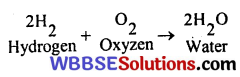
The chemical reaction in which two or more elements or compounds combine to form a single new compound is called a combination reaction.
For example :-
Water is produced by combination of oxygen and Hydrogen.

WBBSE Class 7 Science Solutions Chapter 3 Atom, Molecule and Chemical Reaction 16

Question 15.
What is dissociation reaction? Give example.
Answer:
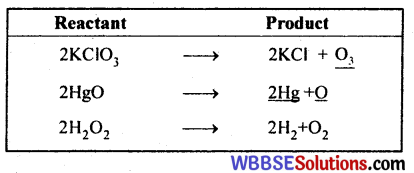
When a single compound is dissociated into more tharrone subtance by the influence of heat or electricity then such type of reaction is called dissociation reaction.
For example –
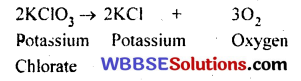
When Potassium Chlorate is heated, oxygen is liberated.

WBBSE Class 7 Science Solutions Chapter 3 Atom, Molecule and Chemical Reaction 17

Question 16.
What is Displacement reaction? Give example.
Answer:
Such a reaction, where one element takes its place by replacing another element of the compound is called displacement or substitution reaction.
For example – Iron displaces Copper from Copper Sulphate solution

WBBSE Class 7 Science Solutions Chapter 3 Atom, Molecule and Chemical Reaction 18

Question 17.
What is double displacement reaction? Give example.
Answer:
The chemical reaction in which two compounds exchange their radicals is called a double displacement reaction.
For example –
If dilute hydrochloric acid (HCl) is added to a solution of Silver Nitrate, a white insoluble solid (Silver Chloride) is formed.

WBBSE Class 7 Science Solutions Chapter 3 Atom, Molecule and Chemical Reaction 19

Question 18.
What information we can get from symbol CO2 ?
Answer:

  1. Carbondioxide is a compound.
  2. It is a molecule of Carbondioxide.
  3. In a molecule of Carbondioxide there is one atom of carbon and two atoms of oxygen.
  4. Molecular weight of carbondioxide is 44.

WBBSE Class 7 Science Solutions Chapter 8 Environment and Public Health

Detailed explanations in West Bengal Board Class 7 Science Book Solutions Chapter 8 Environment and Public Health offer valuable context and analysis.

WBBSE Class 7 Science Chapter 8 Question Answer – Environment and Public Health

(Page no. 256)

1. Which instrument do we use to measure temperature?
Answer:
thermometer.

2. Which kind of street lamps are now being used instead of electric bulbs and tube lights?
Answer:
Fluroscent bulb

WBBSE Class 7 Science Solutions Chapter 8 Environment and Public Health

3. A special kind of metal, liquid in nature is used to make thermometer and fluroscent bulb. Name it.
Answer:
mercury.

4. Now, let us find out the other sources from which mercury can enter the human body.
Answer:

  • mirror
  • light
  • vegetables
  • water.

(Page no. 257)

1. Now, let us find out the other sources through which Arsenic and Fluoride can enter our bodies.
Answer:

  • water
  • pesticide
  • food crops.

2. Write the effects of X-ray on different organs of human below.
Answer:

  • Oesophagous – Tendency of vomiting, Diarrhoea
  • Lung-Breathing trouble.
  • Bone marrow-Improper formation of blood cell. Haemorrhage, Cancer.

(Page no. 260)

Besides many other physical factors increase the risks and cause many diseases. Discuss with your friends or teacher and complete the chart.
Answer:

 Physical factors causing disease in the professional field Symptoms/disease
1. Electricity Shock, Heart problem, Nerve disorder.
2. Heat Burn, boils, injury
3. Cold Frost bite, fever, cough and sneezing
4. Sound Deafness, Headache.
5. Radioactive element Anaemia, Cancer, skin disease.

B. 1. Compounds of which metal did ancient Egyptians used to colour their potteries? (Iron/ Copper/Zinc) Copper.
2. Which gas can cause death in closed mine? (Hydrogen/Oxygen Carbon monoxide) Carbon- mono-oxide.
3. Which chemicals are used in colouring cosmetic cotton and toilet articles? (water/ Sodium chloride/Synthtic organic dies) Synthetic organic dies.
4. Which metal or metallic compounds are used in wall paints, making toys or making batteries? (Iron, Sodium, Lead) Lead.
We came to know about many components of chemical environments from the above discussion.

WBBSE Class 7 Science Solutions Chapter 8 Environment and Public Health

As per chemical nature these are-

Chemical Nature Name of the component
1. Gas Carbon-di-oxide, Carbon monoxide, Sulphurdioxide.
2. Metal Mercury, Flouride.
3. Synthetic compound              ‘ Organic dies, chemicals.

Now discuss with your friends/teachers/doctors what diseases may occur in being engaged in above mentioned professions.

  • Diabetes
  • High blood pressure
  • Pain in neck
  • Insomnia
  • Sugar
  • Arthritis.

(Page no. 262)

Try to write down the diseases on problem related to the following professions :
Answer:

Professions Related diseases/problems
1. Those who pick up tea leaf decay of fingertips
2. Those who are traffic police. breathing problem, poor eyesight, restlessness.
3. Those who are carpenter. breathing problem, muscle cramp
4. Those who carry goods pain in neck, anaemia
5. Rickshaw-puller Arthritis, muscle cramp
6. Those who cook in front of oven ache in eye, breathing problem, diz ziness
7. Those who work in cotton factory breathing problem, anaemia
8. Those who are hospital worker dizziness, vomiting tendency
9. Those who are worker in mines breathing problem, dizziness, wound in skin
10. Those who are worker in construction industries. Arthritis, cancer, wound in skin, muscle cramp, brittle bone
11. Those who work in laboratories. ache in eye, poor eye sight, vomiting tendency, less or more hunger
12. Those who works in different factories deafness, restlessness, cancer, heat cramp
13. Those who work in Jute factories faint, anaemia
14. Those who are hawker heat cramp, varicose vein of legs, less or more hunger


(Page no. 273)

Which of the following picture will you choose to control your anger and why ?

Listening Music, Do exercise, singing, Reading Books, Playing, Face to Face talking, Dancing with Music, Watering in the garden, Meditation or Yoga.

Way out of controlling anger Why did you choose this method
Reading books. It gives pleasure and calms down our mind.
Meditation or Yoga. relieves mental tension and increases concentration.
Dancing with Music. It gives joy and relieves tension.
Playing. Increases concentration, calms mind.
Watering in the garden. It gives pleasure and increases love for nature


WBBSE Class 7 Science Solutions Chapter 8 Environment and Public Health
(Page no. 274)

Name of the disease How it spreads
1. Common cold 1. By air
2. Dysentery 2. By water
3. Malaria 3. By mosquito
4. Plague 4. By rats
5. Rabies, Hydrophobia 5. By dogs.


(Page no. 275)

Can you tell me how diseases spread through air? Let us write how common cold spreads.

How does common cold spread? What precautions should a person suffering from common cold take so that the disease does not spread?
1. By sneezing 1. We should use handkerchief while sneezing.
2. By spitting or coughing 2. We should not spit or cough in front of any person.
3. Talking with affected person 3. We should keep distance or cover our mouth while talking
4. By air 4. We should not move freely in pub­lic places.


(Page no. 277)

Now discuss with your friends. Try to find out who among you suffer from the same problems.

Cause behind the problem. Nature of the problem How did you get rid of the problem
I. Eating eggs rashes in body, sneezing, vomitting take medicine
2. Dust entering the nose. burning sensation in eyes and nose sneezing, water comes out from nose. use handkerchief
3. Eating Prawn. red rashes, itching sensation take medicine
4. Inhaling pollen of flower. sneezing, burning sensation in nose.

Measures to prevent air-borne diseases :

  • When ill, at the time of sneezing/ coughing cover your mouth and nose with a handkerchief.
  • Do not spit here and there.
  • Do not come in close contact with affected person.

(Page no. 278)

Fill up the following table after bearing about some other air borne diseases.

WBBSE Class 7 Science Solutions Chapter 8 Environment and Public Health 1

WBBSE Class 7 Science Solutions Chapter 8 Environment and Public Health

(Page no. 285)

Fill up the following table after barning about some water-borne disease.
WBBSE Class 7 Science Solutions Chapter 8 Environment and Public Health 2

(Page no. 288)

Try to write the name of some other disease which are spread by animals.

Name of the disease The organism that spreads the disease
1. Malaria
2.  Dengue
3.  Typhoid
4.  Plague
5. Cholera
6.  Yellow Fever
7.  Rabies
8.  Filaria (Elephantiasis)
bite of female Anopheles mosquito
bite of Aedes aegypti mosquito,
rod-shaped bacteria Salmonella Typhi bite of rat fliesAedes mosquito
biting of dogs and foxes
small worm Wuchereria

Class 7 Science Chapter 8 Question Answer West Bengal Board – Environment and Public Health

Multiple Choice Questions & Answers : (1 mark for each question)

Question 1.
Which one of the following in water-borne disease?
i) Diabetes
ii) Cholera
iii) Allergy
iv) Scurvy
Answer:
ii) Cholera.

Question 2.
Which of the following disease has been eradicated?
i) Small Pox
ii) Plague
iii) Polomyelities
iv) Kala-zar
Answer
i) Small-Pox

WBBSE Class 7 Science Solutions Chapter 8 Environment and Public Health

Question 3.
Well known effective drug for Malaria is ………….
i) Penicilin
ii) Paracitamol
iii) Quinine
iv) Cough syrup
Answer:
iii) Quinine.

Question 4.
A viral disease is …………..
i) Cancer
ii) Leukaemia
iii) Typhoid
iv) Yellow fever
Answer:
iv) Yellow fever

Question 5.
Dehydration results from …………..
i) Pneumonia
ii) Measles
iii) Rabies
iv) Cholera
Answer:
iv) Cholera.

Question 6.
Name of the British army doctor who proved that Malaria is a mosquito-borne disease is ………
i) Louis Pasteur
ii) Ronald Ross
iii) Dr. Edward Jenner
iv) Joseph Lister
Answer:
ii) Ronald Ross

Question 7.
Aedes mosquito spreads ………
i) Dengue
ii) Typhoid
iii) Malaria
iv) Kala-zar
Answer:
i) Dengue

Question 8.
Which is a beneficial fungi?
i) Neurospora
ii) Claviceps
iii) Penicuilium
iv) Rhizopus
Answer:
iii) Penicillium.

WBBSE Class 7 Science Solutions Chapter 8 Environment and Public Health

Question 9.
A harmful chemical added to chowmin and chilly chicken to impart a meaty flavour is ……………….
i) Clove
ii) Turmeric
iii) Ajinomoto
iv) Chilly
Answer:
iii) Ajinomota

Question 10.
Which seed is mixed with mustard seed—
i) Poppy seed
ii) Rapeseed
iii) Gramseed
iv) Argemone seed
Answer:
iv) Argemone seed.

Fill in the blanks : (1 mark for each question)

1. The…………. look after our mental health.
Answer:
psychologists.

2. The menance of …………. has been fully eradicated from the world by vaccination alone by the year 1977.
Answer:
small pox.

3. Tuberculosis is a …………. disease.
Answer:
communicable

4. The substances that cause allergy in our body are termed as ………….
Answer:
allergen.

5. …………. spreads from contaminated water.
Answer:
cholera.

WBBSE Class 7 Science Solutions Chapter 8 Environment and Public Health

6. Diseases which spread through water are termed as ………….
Answer:
water-borne diseases.

7. …………. is one type of malarial parasite.
Answer:
Plasmodium Vivax.

8. Mosquito is the …………. host and other vertebrate animals are the host.
Answer:
primary or definitive, secondary or intermediate.

9. …………. spread diseases like Typhoid and Diarrhoea.
Answer:
House fly.

10. Usually the …………. grow on food items rich in Carbohydrates.
Answer:
fungi.

State whether True or False : (1 mark for each question)

1. Powdered khesari dal is mixed with besan because khesari dal is very cheap.
Answer:
true

2. Lathyrism has been observed in America.
Answer:
false

3. Argemone seeds are darker than mustard seeds.
Answer:
true

4. Coloured sweets and icecreams may contain colourants that can cause cancer.
Answer:
true

WBBSE Class 7 Science Solutions Chapter 8 Environment and Public Health

5. Various dyes used during Holi can cause problems of heart.
Answer:
false

6. Sometimes immediately after eating food items like prawn and brinjal uneasiness sets in the body.
Answer:
true

7. Poultry products, raw vegetables unpasteurized milk often contain harmful mi¬crobes.
Answer:
true

8. Usually the fungi grow on food items rich in fats.
Answer:
false

9. The mosquito is a mechanical vector.
Answer:
false

10. Spoilage of various types of food is due to the microbial degradation by various microorganisms.
Answer:
true

11. House flies spread Kala-azar.
Answer:
false

12. Legs of sand flies are long and thin.
Answer:
true

Match the column A with column B

Column A Column B
a) Lathyrism has been observed i) attacks the poultry birds
b) Some safe colours are now being ii) may be present in food
c) A type of influenza virus iii) made from flowers
d) Yeast is required for iv) spread Malaria
e) Some very dangerous types of bacteria v) make no sound while flying
f) Aedes mosquitoes vi) in Ethiopia, Bangladesh and India
g) Anopheles mosquitoes vii) spread dangue
h) Culex mosquitoes viii) making bread

Answer:
a) Lathyrism has been observed in Ethiopia, Bangladesh and India.
b) Some safe colours are now being made from flowers.
c) A type of influenza virus attacks the poultry birds.
d) Yeast is required for making bread.
e) Some very dangerous types of bacteria may be present in food.
f) Aedes mosquitoes spread dangue.
g) Anopheles mosquitoes spread Malaria.
h) Culex mosquitoes make no sound while flying.

WBBSE Class 7 Science Solutions Chapter 8 Environment and Public Health

Very Short Questions & Answers : (1 mark for each question)

Question 1.
Name some chemical which can cause harm if they enter our body.
Answer:
Arsenic and Fluoride.

Question 2.
Define the term health.
Answer:
Health means physical, mental and social healthiness, it does not only mean fitness of body.

Question 3.
Mention some steps of prevention of disease.
Answer:
Vaccination, to add nutritious ingredients from outside (Iodine, iron, Vitamin)

Question 4.
Name some diseases which spread through air.
Answer:
Common cold, Cough, Flu, Chicken Pox, Scarlet fever, Diptheria etc.

Question 5.
Name some water-borne diseases.
Answer:
Cholera, Diarrhoea, Jaundice, Typhoid, Tuberculosis and Dysentery.

WBBSE Class 7 Science Solutions Chapter 8 Environment and Public Health

Question 6.
Name the organs mosquitoes use to drink blood.
Answer:
Labium, Mandible, Maxilla, Hypopharynx and Labrum.

Question 7.
What kind of mosquitoes spread Malaria?
Answer:
Anopheles mosquitoes spread Malaria.

Question 8.
What kind of mosquitoes spread Filaria?
Answer:
Culex mosquitoes spread Filaria.

Question 9.
What kind of mosquitoes spread Dengue?
Answer:
Aedes mosquitoes spread Dengue.

Question 10.
Mention an identifying feature of Asdes mosquitoes.
Answer:
While taking rest they sit almost paralleliy to the ground.

Question 11.
Mention an identifying feature of Anopheles mosquitoes.
Answer:
While taking rest they sit making an acute angle with the surface.

Question 12.
Mention an identifying feature of Culex mosquitoes.
Answer:
While taking rest they sit paralleliy as the surface.

Question 13.
Mention a symptom of Polio.
Answer:
Unnatural fatigue in the muscles of hands and legs.

WBBSE Class 7 Science Solutions Chapter 8 Environment and Public Health

Question 14.
What is the name of pathogen of Tuberculosis?
Answer:
Bacteria is the pathogen of Tuberculosis.

Question 15.
Write a measure to prevent airborn diseases.
Answer:
When ill, at the time of sneezing/coughing one must cover his mouth and nose with a handkerchief.

Question 16.
What is the name of pathogen of common cold.
Answer:
Virus is the pathogen of common cold.

Question 17.
When Cholera appeared in form of epidemic in bengal?
Answer:
In the year 1817 Cholera appeared in form of epidemic in bengal.

Question 18.
In what type of food items bacteria grow?
Answer:
Generally Bacteria grow in food items rich in protein (e.g. meat, egg, fish, dairy products)

Question 19.
In what type of food items fungi grow?
Answer:
Usually the fungi grow on food items rich in Carbohydrate.

Question 20.
Name some Bacterial Pathogen caused disease.
Answer:
Salmonellosis. Campylobacteriosis, Food-borne toxicity, Botlism.

B Short Questions & Answers : (2 marks for each question)

Question 1.
How are fungi beneficial?
Answer:
Fungi is used to produce food like bread, cheese and alcoholic beverages. Some antibiotics are produced from fungi, penicilium and yeast is required for making bread.

Question 2.
Why House fly is called a Mechanical vector and mosquito a Biological Vector?
Answer:
House fly only does the work of carrying the germ, so it is called Mechanical Vector. On the other hand the mosquitoes allow the germ to breed inside their body, so the mosquito is a Biological Vector.

Question 3.
What are Parasites?
Answer:
Some worms infest various organs of animals. These worms are parasites. If we take raw or under cooked meat of such animals, the parasites enter our bodies causing many diseases.

Question 4.
What is Bird-flu? How it effects other birds and human beings?
Answer:
Often a type of influenza virus (H5N1) attacks the poultry birds, this is called Bird-flu. The saliva catarrhal discharge or excreta of affected birds can infect other birds too. If human beings come in contact with skin, excreta or blood of virus-infected chicken, they can catch the diseases.

WBBSE Class 7 Science Solutions Chapter 8 Environment and Public Health

Question 5.
How microbial contamination of food occurs?
Answer:
Poultry products (egg, milk), raw vegetables unpasteurized milk often contain harmful microbes. If these food items are not properly processed or if they are taken raw, various types of infections may arise.

Question 6.
What is Allergy?
Answer:
Our immune system sometimes reacts to different proteins or other substances present in food. Allergy is basically the response generated by our immune system towards foreign proteins. This may cause itching sensation, rashes on skin and uneasiness in the body.

Question 7.
what can happen if food items with harmful additives is taken for a long time?
Answer:
Prolonged use of food items containing such harmful additives can lead to serious problems of the degestive and nervous system. It can also cause kidney diseases and may even cause cancer.

Question 8.
What is radioactive substances?
Answer:
Some invisible rays are emited continuously from elements like uranium and plutonium and other compounds. These are called radioactive substances.

Long Questions & Answers : (3 marks for each question)

Question 1.
Mention some causes of mental problem.
Answer:

  • Disorder by birth: malnutrition of foetus, various infection after birth prevents the growth of mind and intelligence of the child.
  • Mental pressure: various violent activities, unexpected incidents some times causes mental pressure beyond tolrance.
  • Many family problems.
  • Conflict and being unable to take decision.
  • Addiction.

WBBSE Class 7 Science Solutions Chapter 8 Environment and Public Health

Question 2.
What is the proboscis? Did it help in male mosquito in sucking blood? How it is used by the mosquito to spread diseases?
Answer:
Various mouth parts of a mosquito get transformed into a proboscis for their special food habit. The mosquito has a long tubes like proboscis. In case of female mosquitoes the proboscis is slender and pointed just like an injection needle. But the proboscis in a male mosquito is blunt, so they can suck only different plant juice like necter, juice of fruits etc.

At the time of sucking blood a female mosquito infuses to saliva into the body and that animal through proboscis. They do so for preventing the blood from getting coagulated while sucking. Through this saliva the germs from the blood of a female mosquito enter into the body of that animal.

Question 3.
Which mosquito spread Malaria? Write down its identifying features.
Answer:
Female Anopheles spread Maleria. Its identifying features are-

  • Black spot on the wings.
  • At the time of taking rest they sit making an acute angle with the surface
  • Make sound while flying.
  • Come out in the evening.
  • Lay eggs in clean water.

Question 4.
Name the diseases spread by Sand Fly. How can you identify it?
Answer:
Sand Fly spreads Kala-zar and Sand Fly fever.

  • Sand flies are smaller than mosquitoes in size.
  • Body is very hairy.
  • Legs are long and thin.
  • Come out after dark.

Question 5.
Describe the identifying features of Culex Mosquito. Name the diseases Culex can spread ?
Answer:
Identifying features of Culex mosquitoes are

  • No spot on the wings.
  • Sit parallelly as the surface while taking rest.
  • Make no sound while flying.
  • Come out at night.
  • Lay eggs in dirty water. Culex mostquitoes spread Filaria and Encephalitis.

Question 6.
Name the diseases Aedes mosquitoes spread. How can we identify them?
Answer:
Aedes mosquitoes spread Dengue and Chickungunia diseases. Each identifying features are —

  • White and Black stripes on the abdomen and legs.
  • While taking rest sit almost parallely to the ground.
  • Make no sound while flying.
  • They come out in day time.
  • Lay eggs in clean water.

WBBSE Class 7 Science Solutions Chapter 8 Environment and Public Health

Question 7.
What are the identifying features of House Fly? Name the diseases they can spread.
Answer:
A House Fly has ……..

  • Grey-coloured thorax.
  • 4 long black stripes on the back.
  • Whole body is covered with hair.
  • They come out during day time and remain inactive at night. House Flies spread Typhoid and Diarrhoea.

Question 8.
Onchocerciasis disease is spread by a fly, name it and describe its features.
Answer:
Black Fly spreads on Onchocerciasis

  • Black Fly is black in colour.
  • Proboscis is small in size and like a toothed dagger.
  • Body is stout
  • Come out during day time in groups and are very active just before down and dusk.

Question 9.
How fly spreads diseases?
Answer:
The fly spreads diseases in three different manners.
(i) Whenever they sit on stool, urine, pus, spittle etc. then minute particles of those things get stuck to their legs and antennae. When this fly sits on food items, germs are mixed with those food stuff and infection occurs.

(ii) The fly can not take solid food. So they vomit on solid food. As a result, parts of the solid food gets liquified and the fly takes the food with the help of the proboscis. With that vomit the germs from the body of the fly get mixed with our food items and infection occurs.

(iii) House flies excrete throughout the whole day at the interval of five minutes wherever
they sit. Many germs are present in the stool of the fly. When they defecate on our food, these germs get mixed with our food.

WBBSE Class 7 Science Solutions Chapter 8 Environment and Public Health

Question 10.
Tell the difference in the ways of transmission of diseases by the flies and the mosquitoes
Answer:
WBBSE Class 7 Science Solutions Chapter 8 Environment and Public Health 3

Question 11.
Describe some resources to control mosquito.
Answer:

  • Water in reservoirs, buckets, flower vases should be changed every 2-3 days.
  • Fishes like (Guppy, Panchax, Shol, Lata, Gambusia etc.) should be allowed to grow in stagnants waters because they eat the larvae of mosquitoes.
  • Kerosene, diesel, bleaching powder should be spiaiged in the drains.
  • Mosquito killer spray or liquid water should be used inside house to keep it free from mosquitoes.

Question 12.
Why food stuff gets spoiled?
Answer:
Spoilage of various types of food is due to the microbial degradation of food by various micro organisms. These micro-organisms are generally bacteria and fungi. When the microbes present in a food grow, they degrade the food with their enzymes and absorb the simple compounds thus obtained into their cells.

Question 13.
Name some Bacteria which are beneficial.
Answer:
Lactobacillus Bacteria help to-make curd. We obtain many life saving drugs from several species of streptomyces Bacteria. Some special Bacteria residing in the stomach of cattle help them in digesting cellulose. Some intestinal Bacteria help human beings by producing the much-needed vitamin Bp.

Question 14.
What is pasteurization?
Answer:
In simple words, pasteurization is the process of destroying the pathogenic microbes along with to their spores in food, especially liquid food (mild and dairy products, fruit juice etc.) This method of making foods and beverage free from microbes was discovered by the french Louis Pasteur, so to honour him the method is named as Pasteurization.

WBBSE Class 7 Science Solutions Chapter 8 Environment and Public Health

Question 15.
What are the common symptoms of allergy from food?
Answer:

  • Rashes on skin.
  • Itching sensation all over the body.
  • Swelling of lips, throat and tongue
  • Uneasiness in throat respiratory problems.
  • Redness in eye and face,
  • Vomiting
  • Abdominal cramp
  • Diarrhoea.

Question 16.
When a food can be said to be adultered?
Answer:

  • When something is added to food that lowers its nutritional value.
  • When some cheap additive is mixed with food instead of some necessary ingredients.
  • When some harmful additive is added to the food to make the food look more attractive and to bring desirable flavour.

Question 17.
What is ‘dropsy’? How dropsy affects us?
Answer:
Argemone seeds closely resemble mustard seeds are cheaper than mustard. The oil extracted from argemone seeds is deliberately mixed with mustard oil. Long term use of such idulterated mustard oil. cause a disease called ‘dropsy’. Dropsy severely damages skin and organs like liver, lungs, kidney and heart. It can even cause failure of heart and the lungs, leading to death.

Question 18.
What is Lathyrism?
Answer:
Often Khesari daal which is very cheap (seeds of Lalhyrus Sativus) mixed with Arhar daal. Continued intake of substantial amount of Khesari daal for 2-3 months can cause progressive spastic paralysis. This is Lathyrism.

Question 19.
How fungi can be beneficial?
Answer:
We take the help of fungi to produce food items like bread, cheese and alcoholic beverages. The affinity of fungi for carbohydrate-rich food help the fungi in making those food items and beverages. For example, some antibiotics are produced from the fungus penicillium yeast is required for making bread.

WBBSE Class 7 Science Solutions Chapter 2 Time and Motion

Detailed explanations in West Bengal Board Class 7 Science Book Solutions Chapter 2 Time and Motion offer valuable context and analysis.

WBBSE Class 7 Science Chapter 2 Question Answer – Time and Motion

(Page no. 70)

Select the correct option from below and fill in the blanks:
1. Rectilinear motion.
2. Motion in a circular path.
3. Rotational motion.
4. Combination of Rotational and Rectilinear motion.
5. Curvilinear motion
Answer:

Examples of different types motion Name of the motion
1. The motion of the pencil tip while drawing a straight line with a ruler. Rectilinear motion
2. Motion of the tips of clock-hand Motion in a circular path.
3. Motion of a stone which is thrown away from the roof. Curvilinear motion.
4. Motion of merry-go-round. Motion in a circular path.
5. Motion of a spinning top at a fixed point. Combination of rotational motion and rectilinear motion.
6. Motion of a clock’s pendulum. Rectilinear motion.
7. Motion of a car along a straight road. Rectilinear motion.
8. Motion of a cycle along a straight line. Rectilinear motion.
9. Motion of a screw driver. Curvilinear motion.
10. Motion of an electric fan’s blade. Rotational motion.

Class 7 Science Chapter 2 Question Answer West Bengal Board – Time and Motion

Multiple Choice Questions & Answers : (1 mark for each question)

Question 1.
The rate of change of displacement with time is called-
i) speed
ii) retardation
iii) velocity
Answer:
iii) velocity

WBBSE Class 7 Science Solutions Chapter 2 Time and Motion

Question 2.
Distance travelled by a moving object-
i) can be zero
ii) cannot be zero
Answer:
ii) cannot be zero

Question 3
If the velocity of the body decreases with time, the motion is said to be
i) acceleration
ii) retardation
iii) displacement
is Answer:
ii) retardation

Question 4.
In SI system unit of retardation is-
i) MS2
ii) MS-1
iii) MS-2
Answer:
iii) MS-2

Question 5.
The state of motion and rest of an object is-
i) absulute
ii) relative
Answer:
ii) relative

Question 6.
The average velocity of an object-
i) could be zero
ii) could not be zero
Answer:
ii) could not be zero

WBBSE Class 7 Science Solutions Chapter 2 Time and Motion

Question 7.
A rotating fan take sometime to stop when it is suitched off due to
i) interia of motion
ii) momentum
iii) air current
Answer:
i) interia of motion

Question 8.
The distance travelled by the body in a unit time interval is called
i) velocity
ii) speed
iii) acceleration
Answer:
ii) speed

Question 9.
If force is applied from outside on a moving body then its momentum
i) decrease
ii) increase
iii) does not change
Answer:
ii) increase

Question 10.
If a rubber ball is thrown on a wall it comes back, this can be explained by Newton’s-
i) First law
ii) Second law
iii) Third law
Answer:
iii) Third law

WBBSE Class 7 Science Solutions Chapter 2 Time and Motion

Question 11.
The action and the reaction both act on-
i) two different objects
ii) same object
Answer:
i) two different objects

Question 12.
We come to know about the rate of change of momentum when force is applied, from the Newton’s-
i) first law
ii) second law
iii) third law
Answer:
ii) second law

Question 13.
We know about definition of force from Newion’s-
i) first law
ii) second law
iii) third law
Answer:
i) first law

Question 14.
In CGS unit of force is-
i) Newton
ii) gram-weight
iii) dyne
Answer:
iii) dyne

Question 15.
The property of a body to remain at rest forever is called-
i) inertia of motion
ii) inertia of rest
iii) momentum
Answer:
ii) inertia of rest

WBBSE Class 7 Science Solutions Chapter 2 Time and Motion

Question 16.
Th property of inertia of a body is-
i) fundaniental
ii) not fundamental
Answer:
i) fundamental

Fill in the blanks : (1 mark for each question)

1. The tendency of a body to keep itself at rest for ever is known as _______ of rest.
Answer:
inertia.

2. Speed is a _______ quantity.
Answer:
scalar.

3. Two vector quantities with same units are _____ and ________.
Answer:
acceleration, retardation.

4. ____ is the rate of change of velocity with time.
Answer:
Acceleration.

WBBSE Class 7 Science Solutions Chapter 2 Time and Motion

5. Dimensional formula of retardation ______.
Answer:
LT-2

6. To change the state of inertia we apply ______.
Answer:
force.

7. Dimensional formula of velocity _____.
Answer:
LT-1

8. A body which changes is position with time is called a ____ object.
Answer:
moving.

9. Force = mass × ________.
Answer:
acceleration.

10. 1 Kgf = ______.
Answer:
9.8 N (Newton).

WBBSE Class 7 Science Solutions Chapter 2 Time and Motion

11. One newton is the force which when acts on a body of mass 1 kg produces an acceleration of _____.
Answer:
1 m/ sec-2

12. Dimensional formula of momentum _______.
Answer:
MLT-1

13. In SI system the gravitational unit of force is ______.
Answer:
Newton.

14. 1 Newton = 1 kg × _________.
Answer:
1 m/sec2

15. In SI system the unit of momentum is _______.
Answer:
Kilogram-meter/second.

16. The action and the reaction both act on ______ bodies.
Answer:
two different.

WBBSE Class 7 Science Solutions Chapter 2 Time and Motion

17. The rate of change of momentum is proportional to _______.
Answer:
force.

18. Momentum is a _____ quantity.
Answer:
Vector.

State whether True or False : (1 mark for each question)

1. If a body has zero speed it can have acceleration.
2. Acceleration is a scalar quantity.
3. Velocity is a vector quantity but speed is not.
4. In speed magnitude and direction both are to be mentioned.
5. A body may have uniform speed but it may not have uniform velocity.
6. The rate of increasing velocity is called uniform velocity.
7. Motion of the tips of clock-hand is called rotation.
8. When a moving object change its place it is called displacement.
9. If an object have zero displacement, it can have distance.
10. To express velocity we have to mention both its derection and magnitude.
11. We got defination of force from Newton’s second law.
12. In SI system unit of force is Newton.
13. Measure of force is known from Newton’s third law.
14. Action and reaction cannot suppress each other.
15. If a moving bus suddenly stops the passengers moves in front ward direction.
16. If 1 Newton force works on 1 gm mass then 1cm / sce2 acceleration is produced the body.
17. Reaction remains as long as action persists.
18. If a body has less mass then it has less accleration.
19. If a vehicle suddenly starts to move it’s pas: engers lean backward direction.
20. Force applied = mass × retardation.
Answer:
1. true
2. false
3. true
4. false
5. true
6. false
7. true
8. false
9. true
10. true
11. false
12. true
13. false
14. true
15. true
16. false
17. true
18. false
19. true
20. false

WBBSE Class 7 Science Solutions Chapter 2 Time and Motion

Match the column A with column B.

Column A Column B
a) Capacity of doing work i) more work is done
b) Increase in the rate of respiration ii) was the president of Royal Society
c) Increase in the rate of heartbeat iii) to do work
d) When we spend more energy iv) is called energy
e) Energy’ is the ability v) is Newton
f) To every action there is an vi) we apply force
g) Sir Issac Newton vii) generates more heat
h) In SI system the unit of force viii) increase in the rate of respiration
i) To change the state of inertia ix) is Dyne
j) In CGS system the unit of force x) equal and opposite reaction

Answer:
a) Capacity of doing work is called energy.
b) Increase in the rate of respiration generates more heat.
c) Increase in the rate of heartbeat increase in the rate of respiration.
d) When we spend more energy more work is done.
e) Energy is the ability to do work.
f) To every action there is an equal and opposite reaction.
g) Sir Issac Newton was the president of Royal Society.
h) In SI system the unit of force is Newton.
i) To change the state of inertia we apply force.
j) In CGS system the unit of force is Dyne.

WBBSE Class 7 Science Solutions Chapter 2 Time and Motion

Short Questions & Answers : (1,2 marks for each question)

Question 1.
How many types of motion are there?
Answer:
There are two types of motion.
i) Rotation and ii) Revolution.

Question 2.
What is Revolution?
Answer:
When a moving object travels in an orbit while rotating on its own axis then the motion of that object is called revolution.

Question 3.
What type of motion is seen in a moving car?
Answer:
Moving car has mixed motion.

Question 4.
Why displacement is a vector quantiny?
Answer:
Displacement has both magnitude and direction. So it is a vector quantity.

Question 5.
What type of motion has a moving electric fan?
Answer:
It has rotational motion.

WBBSE Class 7 Science Solutions Chapter 2 Time and Motion

Question 6.
What is the unit of speed in SI system?
Answer:
In SI system the unit of speed in meter/second.

Question 7.
Is speed vector or scalar quantity?
Answer:
Speed is vector quantity.

Question 8.
Which physical quantity has unit as meter/second2 ?
Answer:
In SI system acceleration has unit as meter/second2.

Question 9.
What is the unit of velocity? Is it a scalar or vector quantity?
Answer:
In CGS system unit of velocity in centimeter/sec. and in SI system unit of velocity is meter/second. Velocity is a vector quantity.

Question 10.
A body after moving in a circular part comes back to its starting point, what is its displacement?
Answer:
If a body after travelling in a circular part comes back to its starting point, the displacement is zero.

WBBSE Class 7 Science Solutions Chapter 2 Time and Motion

Question 11.
What we come to know from Newton’s Fast law?
Answer:
From Newton’s fast law, we come to know about- (i) Inertia and (ii) force.

Question 12.
From which law of Newton we come to know about force?
Answer:
We come to know about force from Newton’s fast law.

Question 13.
What is the unit of force in CGS system?
Answer:
In CGS system the unit of force is Dyne.

Question 14.
What is the unit of force in SI system?
Answer:
In SI system the unit of force is Newton.

Question 15.
One Newton = ? Dyne.
Answer:
One Newton = 105 Dyne.

WBBSE Class 7 Science Solutions Chapter 2 Time and Motion

Question 16.
Name the types of Inertia.
Answer:
Inertia are of two types – i) Inertia of rest and ii) Inertia of motion.

Question 17.
Is force vector quantity or scalar quantity?
Answer:
Force is vector quantity.

Question 18.
What is’ the unit of momentum in SI system?
Answer:
In SI system the unit of momentum is Kilogram-meter/second.

Question 19.
1 gm. force = how much Dyne?
Answer:
lgf = 980 dyne.

Question 20.
What is the unit of work in SI system?
Answer:
A unit of work in SI system is Joule.

Question 21.
What is energy? How we get energy?
Answer:
The energy of a body is its capacity to do work.
We get energy from food. We get something from food which gives us ability for doing work.

WBBSE Class 7 Science Solutions Chapter 2 Time and Motion

Question 22.
How can we feel that energy is being spent inside our body?
Answer:
Fatigue, increase in the rate of heart beat, increase in the rate of respiration, increase in the temperature of the body etc help us to understand that energy is being spent inside our body.

Question 23.
Sometimes you may have noticed that birds glide some disatance without moving its wings. Why does the birdmove in this manner?
Answer:
A flying bird is a moving object. It tries to remain in uniform motion when there is no force on it. So, without moving its wings it goes farther distance because of inertia of motion.

Question 24.
What is inertia?
Answer:
The tendency of a body of remaining at rest or in uniform motion is known as ‘inertia’ of the body.

Question 25.
What is ‘inertia of rest’ and ‘inertia of motion’?
Answer:
The tendency of a body to keep itself at rest forever is known as ‘inertia of rest’.
The tendency of remaining in uniform motion of the body is called as ‘inertia of motion’.

Question 26.
What is force?
Answer:
What we apply to change the state of inertia is called as force.

WBBSE Class 7 Science Solutions Chapter 2 Time and Motion

Question 27.
Explain Newton’s Third law of motion?
Answer:
Newton’s third law of motion is – To every action, there is an equal and opposite reaction.

Question 28.
When we can say a work is done?
Answer:
Work is said to be done only when body move (i.e. there is a displacement of the body).

Long Questions & Answers : (3 marks for each question)

Question 1.
Explain the concept of Newtons first law of motion.
Answer:
If there is no external force acting on a body, then-
i) The body at rest will remain at rest forever,
ii) The moving body will go with constant speed in the same direction of its motion.

WBBSE Class 7 Science Solutions Chapter 2 Time and Motion

Question 2.
Explain Newton’s second law of motion.
Answer:
Newton’s second law of motion states that-
i) If we apply more force on a body of fixed mass, its change of velocity will be more in one second. If we double the force, the acceleration of the body also doubles. That is to say there is a linear relation between force and acceleration.
ii) The direction to which the froce acts, the direction of acceleration is also the same. That is the velocity of the body increases along the direction of applied force.

Question 3.
Write down the equation for the magnitude of applied force, according to Newton’s second law of motion.
Answer:
Applied force = mas of the body × change in velocity in 1 second. = mass of the body × acceleration produced (change in velocity in one second = acceleration)

F = m × a[F = force, m = mass, a = acceleration]
The unit of force in SI system is 1 Newton.
1 Newton =1 kg × 1 m / sec2

Question 4.
Who was Sir Issac Newton?
Answer:
Sir Issac Newton was an English physicist, mathematician and astronomer. He proposed the Three Laws of Motion, Spectrum of Sunlight. Universal Law of Gravitation, Binomial Theo rem. Differential calculus etc. On December, 1642. Newton was born in a peasant family of Willsthrope in England. He got BA degree from Trinity college of Cambridge University in 1669 at the age of 27 . He died in 1727.

Question 5.
Why was Sir Issac Newton famous?
Answer:
Sir Issac Newton invented laws of Motion, Spectrum of sunlight, Binomial theorem, Differential Calculus etc expanded a new era of science and mathematics. He was the president of Royal society from 1672 for next 25 years. He wrote the famous book “Principia Mathematica”.

WBBSE Class 7 Science Solutions Chapter 2 Time and Motion

Question 6.
When a bus suddenly starts moving from rest, the passengers in the bus leans in backward direction, explain why?
Answer:
When the bus is not in motion, the passenger with the bus are at rest. When the bus suddenly starts moving the situation change. The foot of the passengers starts moving with the bus. but the upper part of the body tries to remain at rest. So the legs move away in forward direction. the body leans in reverse direction.

Question 7.
Explain how we can find out the quantity of work done in physics.
Answer:
Word done = ( applied force) × displacement in the direction of the force) W = F × d[W = Work, F = Force, d = displacement]
If the displacement of the body is 1m in the direction of a force of 1N. Then the work done is I Joule or 1J.
& W = F × d
1J = 1N × 1M = 1N.m

WBBSE Class 7 Science Solutions Chapter 1.5 Use of Environment Friendly Energy

Detailed explanations in West Bengal Board Class 7 Science Book Solutions Chapter 1.5 Use of Environment Friendly Energy offer valuable context and analysis.

WBBSE Class 7 Science Chapter 1.5 Question Answer – Use of Environment Friendly Energy

(Page no. 63)

Write some other uses of thermal energy in the gaps given below :
Answer:
WBBSE Class 7 Science Solutions Chapter 1.5 Use of Environment Friendly Energy 1

(Page no. 64)

WBBSE Class 7 Science Solutions Chapter 1.5 Use of Environment Friendly Energy 2

Mention some of other uses of electric energy to the gaps given above. Similarly fill in the gaps given below about the uses of fossil fuels known to you.
Answer:
WBBSE Class 7 Science Solutions Chapter 1.5 Use of Environment Friendly Energy 3

(Page no. 65)

What are directly related to population explotion? (Fill up the blanks) :
Answer:
WBBSE Class 7 Science Solutions Chapter 1.5 Use of Environment Friendly Energy 4

(Page no. 67)

Foreign countiies are using solar energy since long time back.
We have also started using solar energy extensively in our state.
Fill in the blanks if you have noticed it.

WBBSE Class 7 Science Solutions Chapter 1.5 Use of Environment Friendly Energy

Where is solar energy used?
Answer:
Solar energy is used in homes and on streets.

What purpose is it used for?
Answer:
Solar cooker is used to prepare food and solar light is used on streets.

(Page no. 68)

Write the names of the places in our state or other states where you have seen such wind mills.
Answer:
Rajasthan and Tamil Nadu.

(Page no. 68)

Write the uses of bio-gas.
Answer:
1. For cooking
2. To lit bulbs.

WBBSE Class 7 Science Solutions Chapter 1.5 Use of Environment Friendly Energy

Discuss the potentials of degradable organic municipal waste or weeds like water hyacinth. How can we use them?
Answer:
Energy can be obtained from wastes. It can be used to lit bulb, run fans and cook food.

Class 7 Science Chapter 1.5 Question Answer West Bengal Board –Use of Environment Friendly Energy

Fill in the blanks : (1 mark for each question)

1. We need _______ to do any kind of work.
Answer:
energy.

2. To run power tiller ______ is used.
Answer:
diesel.

3. ______ is used as Jet fuel.
Answer:
Kerosene.

WBBSE Class 7 Science Solutions Chapter 1.5 Use of Environment Friendly Energy

4. ______ is used in motor cycle.
Answer:
Petrol.

5. ______ is used to run fan and use light.
Answer:
electrical energy.

6. ______ fuels are formed from the remains of plants and animals over a span of millions of years.
Answer:
Fossil.

7. The large portion of electrical energy is produced in our country by burning ______.
Answer:
coal.

8. _______ of years are required for the formation of energy sources like coal or petroleum under the soil of earth.
Answer:
Millions and millions.

9. Demands for the conventional forms of energy are increasing day by day due to ______.
Answer:
Population explosion.

WBBSE Class 7 Science Solutions Chapter 1.5 Use of Environment Friendly Energy

10. Petroleum is obtained by ______ holes in the Earth crust, where the oil is found.
Answer:
drilling.

11. Due to excessive use of fossil fuel ______ is increasing.
Answer:
pollution.

12. ______ is an environment friendly energy.
Answer:
Solar energy.

13. Coal, petroleum and natural gas are _____ fuels.
Answer:
fossil

14. Solar energy can be used to generate electricity in _______ cells.
Answer:
solar.

State whether True or False: (1 mark for each question)

1. Coal and petroleum is formed from the remains of plants and animals buried under the earth.
2. Animals depend upon sun indirectly.
3. Drilling of petroleum first started in Asia continent.
4. Solar energy is being used in our country since long time back.
5. Solar panel didn’t cause any harm to our environment.
6. Solar panel lasts for 100 years.
7. There are large wind mills in Bakkhali in our state.
8. Natural gas is obtained from organic waste.
9. Remains of plants and animals are called fossils.
10. Bio-gas is produced from the various organic waste.
Answer:
1. true
2. true
3. true
4. false
5. true
6. false
7. true
8. false
9. false
10. true

WBBSE Class 7 Science Solutions Chapter 1.5 Use of Environment Friendly Energy

Short Questions & Answers : (1, 2 marks for each question)

Question 1.
What are the uses of fossil fuels?
Answer:
Fossil fuels are used to – a) run generator. b) run power tiller. c) for running launch, aeroplane.

Question 2.
What are directly related to population explosion?
Answer:
With the growth of population – a) production of more food, b) Construction of more accomodation, c) increase of transport and d) establishment of more factories are necessary.

Question 3.
In early days how people used to go from one place to another?
Answer:
In early days people used bullock cart, horse, ass, elephant, stagecoach, boat etc or walked on foot to go from one place to another.

Question 4.
Nowadays how people travel from one place to another?
Answer:
Nowadays people use train, tram, bus, aeroplane, motorcycle, ship, launch etc to travel from one place to another.

Question 5.
What are environment-friendly forms of energies?
Answer:
Conventional forms of energies are exhausting day by day, they have also detrimental effects on our environment. Hence, we have to explore the posibilities of some new sources of energy. These energies would have less harmful effect on us. These are environment friendly forms of energies. Some such energies are – solar energy, wind energy, energy from biomass.

WBBSE Class 7 Science Solutions Chapter 1.5 Use of Environment Friendly Energy

Question 6.
How solar energy is produced?
Answer:
The solar cell generates electricity during the day-time using the sunlight directly. The energy thus generated, is being accumulated in the batteries connected with solar pannels. It has got its use at night or during dimlight of day.

Question 7.
What are the various uses of solar energy?
Answer:
The various uses of solar energy are solar light, solar cap, solar cooker, solar bike, solar water-heater, solar signal, solar mobile charger

Question 8.
What are the advantages of using wind energy?
Answer:
The advantages are –
i) Their is no shortage of air flow.
ii) Once installed, the wind mills serve for a long time.
iii) The wind mills can be used as local generators for areas where installation of long transmission cable is not possible.

WBBSE Class 7 Science Solutions Chapter 1.5 Use of Environment Friendly Energy

Question 9.
How energy from Bio-mass is produced?
Answer:
The excreta of animals the various organic wastes and different materials of plant and animal origin can be gathered in a large ditch. After anacrobic digestion, it produces bio-gas which can be used for different purposes.

Question 10.
Name some other eco-friendly sources of energy?
Answer:
Some other eco-friendly sources of energy are Tidal energy, Geo-thermal energy etc.

Long Questions & Answers : (3 marks for each question)

Question 1.
Mention some of the uses of heat energy.
Answer:
Heat energy is used –
a) for cooking.
b) electricity generation.
c) sterilising of knife, scissors before operation.
d) making bricks.
e) driving the steam engine.
f) burning of clay made things.
g) in smithy to make different kinds of tools.

Question 2.
Write down some uses of electrical energy.
Answer:
Electrical energy is used –
a) to operate the machine in industry.
b) for using computer.
c) for playing loudspeaker.
d) for running rail, tram.
e) to operate washing machine.
f) charging of mobile phone.
g) X-ray.

WBBSE Class 7 Science Solutions Chapter 1.5 Use of Environment Friendly Energy

Question 3.
Is the source of underground fossil fuels in exhaustible?
Answer:
Yes, the source of under guound fossil is exhaustible. It took many millions and millons of years for the formation of the energy sources like coal or petroleum under the soil of earth. We are spending the resources in very short time comparable to the time of their formation. In this way a day will come when all the sources of coal or minerals would be exhausted.

WBBSE Class 7 Science Solutions Chapter 1.5 Use of Environment Friendly Energy 5

Question 4.
Discuss the ways how the use of energy could be done as minimum as possible?
Answer:
a) The over use and wastages of energy have to be scaled down.
b) The life of coal and petroleum can be lengthened by producing less-polluting fuel in an appropriate way.
c) The gases emitted from the bed of rocks underneath or from the crevices of the hills, are generally wasted, we have to make use of such gases.
d) Instead of pumping out underground water for irrigation or drinking purposes, we can use the surface water from rivers etc.
e) If possible use of non-machanised boat for transportation or use of bicycles would be encouraged, it will save fossil-fuel.
f) Unnecessary use of energy in various types of amusements is to be curtailed down.
g) We have to ensure the awareness of everyone about the use of non-conventional sources of energy.

WBBSE Class 7 Science Solutions Chapter 1.4 Electricity

Detailed explanations in West Bengal Board Class 7 Science Book Solutions Chapter 1.4 Electricity offer valuable context and analysis.

WBBSE Class 7 Science Chapter 1.4 Question Answer – Electricity

(Page no. 55)

Complete the table.
Answer:
WBBSE Class 7 Science Solutions Chapter 1.4 Electricity 1

Class 7 Science Chapter 1.4 Question Answer West Bengal Board –Electricity

Multiple Choice Questions & Answers : (1 mark for each question)

Question 1.
The fish that can produce electricity in their body-
i) electric eel fish
ii) cat fish
iii) trout fish
Answer:
i) electric eel fish

WBBSE Class 7 Science Solutions Chapter 1.4 Electricity

Question 2.
Inside electric iron there is wire made of-
i) Copper
ii) Silver
iii) Nichrome
Answer:
iii) Nichrome.

Question 3.
Filament is made up of –
i) Aluminium
ii) Tungsten
iii) Nickel
Answer:
ii) Tungsten

Question 4.
At a relatively low temperature fuse wire-
i) melts
ii) remains it is
iii) changes slightly
Answer:
i) melts

Question 5.
A combination of number of cells forms-
i) dry cell
ii) filament
iii) battery
Answer:
iii) Battery.

Question 6.
Positive terminal is marked by the sign-
i) +
ii) –
iii) ×
Answer:
i) +

WBBSE Class 7 Science Solutions Chapter 1.4 Electricity

Question 7.
Good conductor of electricity is-
i) wood
ii) plastic
iii) copper
iv) paper
Answer:
iii) copper.

Question 8.
In the cell chemical energy is converted into-
i) mechanical energy
ii) chemical energy
iii) magnetic energy
iv) electrical energy
Answer:
iv) electrical energy

Question 9.
Other name of disposal cell is-
i) secondary cell
ii) primary cell
iii) button cell
iv) terminal
Answer:
ii) primary cell

WBBSE Class 7 Science Solutions Chapter 1.4 Electricity

Question 10.
If the circuit is not disconnected any where then that circuit is called-
i) closed circuit
ii) open circuit
iii) blocked circuit
Answer:
i) closed circuit

Question 11.
A bad conductor of electricity-
i) copper
ii) iron
iii) China clay
iv) silver
Answer:
iii) China clay

Question 12.
In electric calling bell there is-
i) static electricity
ii) electromagnet
iii) natural magnet
Answer:
ii) electromagnet.

Question 13.
In solar calculator the energy of light from the sun is transformed into-
i) electrical energy
ii) magnetic energy
iii) electromagnetic energy
Answer:
i) electrical energy

Question 14.
The sfficiency of solar panel is-
i) high
ii) very high
iii) low
iv) very low
Answer:
iv) very low

Fill in the blanks : (1 mark for each question)

1. ________ is formed by combination of a number of cells.
Answer:
Battery.

2. ________ is called ‘primary cell’ or ‘disposable cell’.
Answer:
Dry cell.

WBBSE Class 7 Science Solutions Chapter 1.4 Electricity

3. There are ________ substances in the cell of torch.
Answer:
chemical.

4. The inner part of the bulbs which glows when switch is on, is called ________.
Answer:
filament.

5. Plastic, china clay, wood ete are all ________ of electricity.
Answer:
bad conductor.

6. In electric calling bell ________ is used.
Answer:
electromagnet.

7. In electric iron there is ________ wire.
Answer:
Nichrome.

8. The filament of bulb is made of ________ metal.
Answer:
tungsten.

9. ________ wire is used for the safety of any electrical circuit.
Answer:
Fuse.

WBBSE Class 7 Science Solutions Chapter 1.4 Electricity

10. In telephone ________ is used.
Answer:
electromagnet.

11. The body fluids of all organisms contain various charged ________.
Answer:
particles.

12. The positive end of LED is ________ than the negative end.
Answer:
larger.

State whether True or False : (1 mark for each question)

1. Dry cells are used in torch.
2. There are physical substances in the cell of a torch.
3. Battery is formed by combination of a number of cells.
4. If the number of turns of wire increases then the magnetic strength of electromagnet also increases.
5. If the quantity of electricity increases, the strength of the electromagnet decreases.
6. Fuse wire is used for the safety of any electrical circuit.
7. The filament of bulb is made of Aluminium metal.
8. The bodies of all living organisms consist of molecules and atom.
9. There is a system to generate electricity in bodies of Hilsa, Trout fish.
10. Brain consists of numerous nerve cells.
Answer:
1. true
2. false
3. true
4. true
5. false
6. true
7. false
8. true
9. false
10. false

WBBSE Class 7 Science Solutions Chapter 1.4 Electricity

Match the column A with column B.

Column A Column B
a) Electro magnet is used i) electronic wristwatch
b) The number of cells increases ii) has two terminals
c) Electricity can not pass iii) in solar calculator
d) Button cell is used in iv) relatively low tremperature
e) A cell v) through plastic goods
f) Primary cell is known as vi) inside the electric iron
g) Solar panel supplies electricity vii) to make motor
h) Fuse wire melts at a viii) is made of tungsten
i) Nicrome wire is used ix) strength of electreomagnet increases
j) The filament of a bulb x) disposable cell

Answer:
a) Electro magnet is used to make motor.
b) The number of cells increases strength of electreomagnet increases
c) Electricity can not pass through plastic goods.
d) Button cell is used in electronic wristwatch.
e) A cell has two terminals.
f) Primary cell is known as disposable cell.
g) Solar panel supplies electricity in solar calculator.
h) Fuse wire melts at a relatively low tremperature.
i) Nicrome wire is used inside the electric iron.
j) The filament of a bulb is made of tungsten.

WBBSE Class 7 Science Solutions Chapter 1.4 Electricity

Short Questions & Answers : (1,2 marks for each question)

Question 1.
What is ‘primary cell’ or ‘disposable cell’?
Answer:
There are chemical substances in the cell of torch. In the cell chemical energy is converted into electrical energy. This cell is called ‘pimary cell’ or ‘disposable cell’.

Question 2.
How many terminals are there in a ‘cell’?
Answer:
A ‘cell’ has two terminals-a) ‘Metallic cap’ terminal or (+) signed terminal. b) ‘Metallic disk’ terminal or (-) signed terminal.

Question 3.
Do you know any device which can be run by solar energy?
Answer:
Solar cooker. solar table fan, solar tubelight. solar street light etc. are run by solar energy.

Question 4.
What is Button cell?
Answer:
The cell present in the electronics wrist watch looks like a button. This is called Button cell.

Question 5.
What is secondary cell?
Answer:
There are six or more than that cells in the powerful battery of a car. Such type of cell is called secondary cell.

WBBSE Class 7 Science Solutions Chapter 1.4 Electricity

Question 6.
What is filament? Explain how it is connected inside a bulb?
Answer:
The inner part of the bulb which glows when switch is on, is called filament.
Filament is connected between two thick metallic wires. One of that two thick wires is connected with the positive (+ signed) terminal of the cell and other is connected with the negative (- signed) terminal of the cell.

Question 7.
What is circuit?
Answer:
To make the bulb glow, both the terminals of the bulb are connected with the opposite terminals of the cell. This arrangement is called circuit.

Question 8.
What is open and closed circuit?
Answer:
An open circuit is one where the continuity has been broken by an interruption in the path for current to flow. A closed circuit is one that is complete, with good continuity throughout.

Question 9.
Which subtances are called ‘good conductors of electricity’?
Answer:
The subtances through which electricity can pass easily are called good conductor of electricity. As example – Copper, Iron, Aluminium.

Question 10.
Which substances are called ‘bad conductors of electricity’ or insulators?
Answer:
The subtances through which electricity cannot pass are called bad conductors of electricity or insulators. As example-plastic, wood, glass.

Question 11.
What is electromagnet?
Answer:
If wire is bound around a magnetic substance (Iron, Nickel, Cobalt) and electricity is passed through it, the magnetic substance transforms into a magnet. This type of magnet is called electromagnet. When flow of electricity is stopped, it loses its magnetic property.

WBBSE Class 7 Science Solutions Chapter 1.4 Electricity

Question 12.
How the strength of a electromagnet could be increased?
Answer:
(a) If the number of turns of wire increases then the magnetic strength of electromagnet also increases.
(b) If the number of cells increases i.e. the quantity of electricity increases, the strength of the electromagnet increases.

Question 13.
Name some organisms which can generate electricity in their body. How they use it?
Answer:
There is a system to generate electricity in the bodies of the Jellyfish and electric eel fish. They can generate sufficiently strong electricity. This electricity stuns the enemies and keeps them away.

Long Questions & Answers : (3 marks for each question)

Question 1.
What is LED?
Answer:
The full form of LED is Light Emitting Diode.
It is an electronic device that glows even by a little amount of electricity. It has no filament. Its positive end is larger than the negative end. An LED is not destroyed even in 20 years. Different coloured LEDs are available in the market.

Question 2.
Mention some applications of heating effect of electric current.
Answer:
Some applications of heating effect of electric current are –
a) Electric Iron : Here Nichrome wire is wrapped on Mica. Nichrome wire is heated when electricity is passed through it.
b) Electric Bulb : The filament of bulb made of Tungsten generates heat when electricity is passed through it. Light energy is generated due to transform of heat.
c) Fuse wire : Fuse wire melts at very low temperature. So it is used for the safety of any electrical circuit. When an excess amount of electricity passes through fuse wire due to any reason, it is heated very much and melts. As a result the circuit is cut off and flow of electricity is stopped.

WBBSE Class 7 Science Solutions Chapter 1.4 Electricity

Question 3.
What is solar calculator?
Answer:
Solar calculator is a special type of electronic device. This device runs by electrical energy. Actually solar panel supplies electricity in solar calculator. This panel is constituted by some solar cells. The energy of sunlight is transformed into electrical energy when it falls on solar panel.

Question 4.
Discuss the relation between electrical energy and living world.
Answer:
The relation between electrical energy and living world is very close. The bodies of all living organisms consist of molecules and atoms. Sometimes they can be ionised. At the time of staying in different liquids of living organisms ionised atoms or radicals participate in different physiological activities.

Question 5.
Discuss the influence of electrical energy in the body of human being.
Answer:
a) A special type of component is present in the muscles of heart. The electrical stimulation made by them generates heart beats which is spread in the body in the form of waves.
b) Nerve impulse of brain is also electrical. Brain consists of numerous nerve cells. Different informations are conducted through nerve cells with the help of electrical stimulations. As a result, contraction and expansion of muscles are possible. We can move and do various types of activities.

WBBSE Class 7 Science Solutions Chapter 1.4 Electricity

Question 6.
What is resting potential?
Answer:
In normal situation due to the presence of excess positive charge in the outside of membrance and excess negative charge inside of membrance a potential difference is developed. This is called resting potential. Nerve cells conducts the stimulation only when changes in resting potential occur.

WBBSE Class 7 Science Solutions Chapter 1.3 Magnet

Detailed explanations in West Bengal Board Class 7 Science Book Solutions Chapter 1.3 Magnet offer valuable context and analysis.

WBBSE Class 7 Science Chapter 1.3 Question Answer – Magnet

(Page no. 38)

Now take the bar magnet near each of these obfects and note which of these are being attracted by the magnet.
Answer:
WBBSE Class 7 Science Solutions Chapter 1.3 Magnet 1

Class 7 Science Chapter 1.3 Question Answer West Bengal Board –Magnet

Multiple Choice Questions & Answers : (1 mark for each question)

Question 1.
A magnetic substance-
i) plastic
ii) wood
iii) iron
iv) stone
Answer:
iii) iron

Question 2.
A non-magnetic substance-
i) plastic
ii) cobalt
iii) iron
iv) nickel
Answer:
i) plastic

WBBSE Class 7 Science Solutions Chapter 1.3 Magnet

Question 3.
Magnetities are called-
i) natural magnets
ii) artificial magnets
iii) man-made magnets
Answer:
i) natural magnets

Question 4.
The attractive power of a bar magnet is strongest at its-
i) north pole
ii) midpoint
iii) both poles
Answer:
iii) both poles

Question 5.
Two opposite poles of magnets-
i) repulse
ii) attract
iii) remain neutral
Answer:
ii) attract

Question 6.
Which is incorrect-
i) induction occurs before attraction
ii) like poles repel each other
iii) a magnet has directional property
iv) single magnetic pole can exist
Answer:
iv) single magnetic pole can exist

Question 7.
Heating destroys magnetic property of-
i) ATM card
ii) hard disk of a computer
iii) loudspeaker
iv) all of these
Answer:
iv) all of these

WBBSE Class 7 Science Solutions Chapter 1.3 Magnet

Question 8.
There is a magnetite in pigeon’s body between-
i) neck and head
ii) neck and breast
iii) skull and brain
iv) between two wings
Answer:
iii) skull and brain

Fill in the blanks : (1 mark for each question)

1. About 2500 years ago a shepherd named _____ discovered magnet.
Answer:
Magnes

2. Material that are not attracted by a magnet are called _____ substances.
Answer:
non-magnetic.

3. Materials that are attracted by a magnet are called _______ substances.
Answer:
magnetic

4. ______ is a non-magnetic substance.
Answer:
Rubber

5. One end of a magnet is north-pole and another end is ______.
Answer:
south-pole

WBBSE Class 7 Science Solutions Chapter 1.3 Magnet

6. Magnetites are called ______.
Answer:
natural magnets

7. A _____ has the property to attract iron.
Answer:
magnet

8. Unlike poles of magnets _____, whereas like poles _____ each other.
Answer:
attract, repel

9. The earth itself behaves like a huge _______.
Answer:
magnet

10. ______ are used in dynamo of a bicycle.
Answer:
magnets

WBBSE Class 7 Science Solutions Chapter 1.3 Magnet

11. _____ birds and ______ travel following the lines of force of earth’s magnetic field.
Answer:
Migratory, turtles.

12. There is a small black magnetic substance between the skull and brain of ________.
Answer:
pigeons

State whether True or False : (1 mark for each question)

1. Electromagnets are used in electric calling bell.
2. A blade is attracted by magnet.
3. A rubber is attracted by magnet.
4. Cobalt is not attracted by magnet.
5. North poles of two magnets attı act each other.
6. A magnet suspended freely always comes to rest only north-south direction.
7. Only one pole exists in a magnet.
8. Magnetic poles always exist in pairs.
9. The earth itself behaves like a huge magnet.
10. Magnets are not used in loudspeakers.
11. Magnetic trips are used in ATM cards and credit cards.
12. Attraction occures before induction.
Answer:
1. true
2. true
3. false
4. false
5. false
6. true
7. false
8. true
9. true
10. false
11. true
12. false

WBBSE Class 7 Science Solutions Chapter 1.3 Magnet

a. Match the column A with column B.

Column A Column B
a) A magnet has i) in electric meters
b) A magnet attracts ii) before attraction
c) Heating destroys iii) can not exist
d) Magnets are used iv) two opposite poles
e) An animal can v) kept near loudspeakers
f) Induction occurs vi) magnetized strip of steel
g) Single magnetic poles vii) magnetic materials
h) Strong magnet should not viii) two types
i) Magnetic needle is small ix) magnetic property
j) Magnets are of x) recognize earth’s magnetic field

Answer:
a) A magnet has two opposite poles.
b) A magnet attracts magnetic materials.
c) Heating destroys magnetic property.
d) Magnets are used in electric meters.
e) An animal can recognize earth’s magnetic field.
f) Induction occurs before attraction.
g) Single magnetic poles can not exist.
h) Strong magnet should not kept near loudspeakers.
i) Magnetic needle is small magnetized strip of steel.
j) Magnets are of two types.

Very Short Questions & Answers : (1 mark for each question)

Question 1.
What type of magnet is magnetite?
Answer:
Magnetite is a natural magnet.

WBBSE Class 7 Science Solutions Chapter 1.3 Magnet

Question 2.
Who and how many years ago discovered magnet?
Answer:
About 2500 years ago a shepherd named Magnes discovered magnet.

Question 3.
What are Magnetic substances? Give example.
Answer:
Materials that are attracted by a magnet are Magnetic subtances. Example-iron, nickel, cobalt.

Question 3.
What are Magnetic substances?
Answer:
Materials that are not attracted by a magnet are called non-magnetic substances. Example-plastic, rubber, wool.

Question 5.
What type of magnet is produced if electricity is passed through iron?
Answer:
Electro-magnet is produced.

WBBSE Class 7 Science Solutions Chapter 1.3 Magnet

Question 6.
Name two things where electromagnets are used.
Answer:
Electromagnets are used in electric calling bell and electric motors.

Question 7.
What are Artificial Magnets?
Answer:
Artificial Magnets are prepared by magnetising some suitable magnetic subtances.

Question 8.
What is the directive property of magnet?
Answer:
The property by which a floating or hung magnet is able to rotate freeely orienting itself North-South is called directive property of magnet.

Question 9.
What is bar magnet?
Answer:
A bar magnet is a magnetised sample of steel having a rectangular paralleopipod shape.

Question 10.
What are non-magnetic substances?
Answer:
Materials that are not attracted by a magnet are called non-magnetic substances. Example – plastic, wood, paper.

Short Questions & Answers : (2 marks for each question)

Question 1.
What are Natural Magnets or Magneite?
Answer:
Magnets which are available in nature are Natural Magnets or Magnetite. However, these are not commercially available. Such materials are available in specific areas only

Question 2.
Where do you think the attracting power of the magnet is (i) the strongest, (ii) the weakest.
Answer:
i) The attracting power of a bar magnet is strongest at its both ends. These regions are called the ‘pole of the magner’.
ii) Attracting power of a magnet is practically zero at its mid point. The region is called the ‘neutral zone’ of a magnet.

WBBSE Class 7 Science Solutions Chapter 1.3 Magnet

Question 3.
What is magnetic length? How it can be calculated?
Answer:
The distance between the north and the south poles of a magnet is called magnetic length of a bar fisagnet. This length is about 0.86 times the geometric length of the magnet.
So magnetic : ingth = 0.86 × geometric lentgth of the magnet.

Question 4.
What is magnetic axis?
Answer:
The line segments obtained by joining the geometric poles of a magnet, is called the magnetic axis.

Question 5.
Mention some roles of Magnetic field on the Physiology of Animals.
Answer:
The effect of magnetic field on some organisms had been studied by scientists. Beginning their journey from their native habitats, migratory birds and animals reach their winter habitats by following the lines of force of earth magnetic field.

Question 6.
What is magnetic field?
Answer:
The region around a magnet where its attractive and repulsive effects are felt, is called the magnetic field of the bar magnet.

Long Questions & Answers : (3 marks for each question)

Question 1.
What is magnetic induction?
Answer:
When a magnet attracts a magnetic material, the material is magnetised by induction, then it becorves a temporary magnet and under the influence of the bar magnet it can attract other magnetic materials. This phenomenon is known as ‘magnetic induction’.

WBBSE Class 7 Science Solutions Chapter 1.3 Magnet

Question 2.
Write down the properties of a magnet.
Answer:
The properties of a magnet are –
a) A magnet attracts magnetic materials.
b) A magnet has directive property.
c) Like poles repel each other, unlike poles attract each other.
d) A magnet can induce magnetism in a magnetic substance.
e) Attraction follows induction.
f) A magnet always has two opposite poles.
g) Single magnetic poles cannot exist.

Question 3.
Is the Earth a magnet?
Answer:
The earth itself behaves like a huge bar magnet. We have learnt that the unlike poles attract each other. If a bar magnet is suspended from a support and allowed to rotate freely, it rests itself in North-South direction. This is because the magnetic North Pole of the earth is near the geographical South Pole, whereas the magnetic south pole is near the geographical North Pole.

Question 4.
What the North Pole and South Pole of a magnet actually means?
Answer:
Actually the so-called North and South Poles of a magnet should properly be called ‘Nouth-seeking pole’ and ‘South-seeking pole’ respectively. However, in our everyday ‘North pole’ and ‘South pole’ respectively.

WBBSE Class 7 Science Solutions Chapter 1.3 Magnet

Question 5.
What are Electro-magnets?
Answer:
When an iron bar is wrapped with an electric wire and electricity is passed through it. it behaves like a magnet. This type of magnet is called electromagnet.

Question 6.
Write down some uses of magnet.
Answer:
Uses of magnet –

  1. Crews of ship use marine conpass that help them navigate their vessel.
  2. The spools of audio and video cassettes are coated with a magnetic substance.
  3. Magnetic strips are used in ATM cards and credit cards.
  4. The hard disks of computers contains plastic disk coated with a magnetised material.
  5. Many toys employ magnets.
  6. Doctors use a special type of magnet to extract finer dust of iron accidentally fallen in someone’s eyes.
  7. Magnets are used in loudspeakers.
  8. Magnets are used in dynamo of a cycle.
  9. Magnets are used in electric meters.
  10. The door of refrigerators have magnets attached with them.

Question 7.
What precautions should be used in handling magnets?
Answer:
Instruments in which magnets are used must be handled with care. Such instruments must not be heated. Heating destroys magnetic property. The magnetic strips of two ATM cards kept together must not face each other. No strong magnet should not be kept near loudspeakers, TV, radio or hard disk of a computer.

Question 8.
How Aurora is formed?
Answer:
A special kind of rays called cosmic rays, enter the earth’s atmosphere. The charged particles in cosmic rays interact with the earth’s magnetic field and two radiation zones (Van Allen radiation belt) are formed. Auroral is also fromed. Living organisms utilise this aurora for their survival.

WBBSE Class 7 Science Solutions Chapter 1.3 Magnet

Question 9.
How can an animal recognize earth’s magnetic field?
Answer:
There is a black structure between the skull and brain of pigeons. This contains magnetic substance, called magnetite. In the dusk, pigeons return to their nests without mistake. However. if small magnets are fixed to their head. they fail to do so and fly in wrong direction. Magnetites have been found in some bees and animals.

WBBSE Class 7 Science Solutions Chapter 1.2 Light

Detailed explanations in West Bengal Board Class 7 Science Book Solutions Chapter 1.2 Light offer valuable context and analysis.

WBBSE Class 7 Science Chapter 1.2 Question Answer – Light

(Page no. 16)

1. Fill in the blanks in the following table. Put a [✓] mark in the appropriate place.
Answer:
WBBSE Class 7 Science Solutions Chapter 1.2 Light 1

Class 7 Science Chapter 1.2 Question Answer West Bengal Board –Light

Multiple Choice Questions & Answers : (1 mark for each question)

Question 1.
A luminous object-
i) umbrella
ii) brick
iii) star
iv) wood
Answer:
iii) star

Question 2.
A non-luminous object-
i) sun
ii) firefly
iii) burning candle
iv) stone
Answer:
iv) stone

WBBSE Class 7 Science Solutions Chapter 1.2 Light

Question 3.
A transparent object-
i) air
ii) wood
iii) iron
iv) wall
Answer:
i) air

Question 4.
An opaque object-
i) air
ii) wood
iii) water
iv) transparent glass
Answer:
ii) wood

Question 5.
A translucent object–
i) air
ii) water
iii) glass
iv) oil paper
Answer:
iv) oil paper

Question 6.
Light can propagate-
i) without medium
ii) with medium
iii) both are true
iv) both are false
Answer:
i) without medium

Question 7.
Ultra violet rays of sun-
i) can cause skin cancer
ii) is harmful to the DNA molecules
iii) can cause harm lens of eye.
iv) all are true
Answer:
iv) all are true

WBBSE Class 7 Science Solutions Chapter 1.2 Light

Question 8.
Number of colours present in sunlight are-
i) five
ii) three
iii) seven
iv) six
Answer:
iii) seven

Question 9.
Flowering is possible in wheat if daylight length-
i) exceeds 12 hours
ii) less than 12 hours
iii) exceeds 8 hours
iv) less than 8 hours
Answer:
i) exceeds 12 hours

Question 10.
Fireflies produce light in their own body-
i) to search food
ii) to communicate between themselves
iii) to attack others
Answer:
ii) to communicate between themselves

Question 11.
When reflection occures from uneven surfaces, it is called-
i) regular reflection
ii) diffuse reflection
iii) none of the two
Answer:
ii) diffuse reflection

Question 12.
In letter M Lateral inversion-
i) will not occur
ii) will occur
iii) may occur, may not occur
Answer:
i) will not occur

Fill in the blanks : (1 mark for each question)

1. The reflection from any smooth surface is ______ reflection of light.
Answer:
regular

WBBSE Class 7 Science Solutions Chapter 1.2 Light

2. Tracing paper is an example of ______ object.
Answer:
translucent

3. Objects on the other side of ______ objects can not be seen at all.
Answer:
opaque

4. A ______ camera is a simple camera without a lens but with a tiny aperture.
Answer:
pinhole

5. The sunlight is a mixture of rays of different ______ .
Answer:
colours

6. In a plane mirror if the angle of reflection is 60° then the angle of deviation would be ______ .
Answer:
60°

7. In nature a ______ is formed due to dispersion of sunlight.
Answer:
rainbow

8. Movement of migratory birds from colder regions to warmer regions depends on the intensity of ______.
Answer:
sunlight

9. The ray that represents the light reflected by the surface is known as ______ .
Answer:
incident ray

10. The angle between the normal and incident ray is known as ______ .
Answer:
angle of incidence

11. In a pinhole camera the smaller the hole, the finer is the optical ______ .
Answer:
impression

WBBSE Class 7 Science Solutions Chapter 1.2 Light

12. When the source of light is ______ both penumbra and umbra are formed.
Answer:
large

State whether True or False : (1 mark for each question)

1. Firefly can emit light, so it is called source of light.
2. When the size of the light source is very small, we call it a point source.
3. When the source of light is large, only the umbra is formed.
4. The ray of light that bounces back from the mirror is called the index ray.
5. The angle between the normal and incident ray is known as angle of incidence
6. The angle of incidence and the angle of reflection are equal:
7. When reflection occurs from uneven surfaces, it is called regular reflection.
8. Rainbow is formed due to dispersion of sunlight.
9. The sunlight is a mixture of eight rays of different colours.
10. Sir Issac Newton discovered dispersion in 1866.
11. The process of seperation of different colours of light from a polychromatic light is called dispersion.
12. Sunlight is a polychromatic light.
13. Layer of Ozone gas prevents ultraviolet rays.
14. X-ray is one type of invisible light which can not pass through our skin and flesh.
Answer:
1. true
2. true
3. false
4. false
5. true
6. true
7. false
8. true
9. false
10. false
11. true
12. true
13. true
14. false

a. Match the column A with column B.

Column A Column B
a) Ultraviolet light very harmful i) under our skin
b) Fingerlings of Salmon fishes ii) is known as spectrum
c) Movements of migratory birds iii) straight line
d) Plants can not prepare food iv) is regular reflection of light
e) We have melanin v) the umbra is formed
f) The band of seven colours vi) depends on the intensity of sunlight
g) The reflection from smooth surface vii) to the DNA molecules
h) Light moves along a viii) without any medium
i) When we use a point source ix) without sunlight
j) Light can propagate x) die if they receive less light

Answer:
a) Ultraviolet light very harmful.to the DNA molecules.
b) Fingerlings of Salmon fishes die if they receive less light.
c) Movements of migratory birds depends on the intensity of sunlight.
d) Plants can not prepare food without sunlight.
e) We have melanin under our skin,
f) The band of seven colours is known as spectrum.
g) The reflection from smooth surface is regular reflection of light.
h) Light moves along a straight line.
i) When we use a point source the umbra is formed.
j) Light can propagate without any medium.

WBBSE Class 7 Science Solutions Chapter 1.2 Light

Very Short Questions & Answers : (1 mark for each question)

Question 1.
How many kinds of reflection are there?
Answer:
According to the nature of reflector reflection of light are of two types – a) regular reflection and b) diffuse reflection.

Question 2.
What kind of reflection helps us to see objects?
Answer:
Diffuse reflection helps us to see objects.

Question 3.
Which reflection creates image?
Answer:
Regular reflection creates image.

WBBSE Class 7 Science Solutions Chapter 1.2 Light

Question 4.
What type of image is formed in a plane mirror?
Answer:
Virtual image is formed in a plane mirror.

Question 5.
State an example of internal full reflection in nature.
Answer:
Mirage is an example of internal full reflection.

Question 6.
Is mirage a real image or virtual image?
Answer:
Mirage is a virtual image.

Question 7.
Which image cannot be formed on a screen?
Answer:
Virtual image cannot be fromed on a screen.

Question 8.
What type of reflection occurs in opaque glass?
Answer:
Diffuse reflection occurs in a opaque glass.

Question 9.
Which of these letters would have lateral inversion – D, T, A, P, B, C, N, W.
Answer:
D, P, B, C and N – these letters would have lateral inversion.

Question 10.
Give a natural example of internal full reflection.
Answer:
Air bubble in water dazzles – this is an example of internal full reflection.

WBBSE Class 7 Science Solutions Chapter 1.2 Light

Question 11.
How a ray of light changes its path when it travels from denser medium to rarer medium?
Answer:
A ray of light travelling from a denser medium to a rarer medium bends away from the normal. The angle of refraction is more than the angle of incidence.

Question 12.
Give an example of natural dispersion of light.
Answer:
A rainbow is an example of natural dispersion of light.

Question 13.
What is pure dispersion?
Answer:
In a dispersion where every colour is clearly and distinctly visible, it is called pure dispersion.

Question 14.
Give two uses of magnifying glass.
Answer:
Magnifying glass is used to read small letters in a book. It is used by watchmakers and repairers to see the minute parts of the watches.

Question 15.
At what distance an object should be placed from a convex lens to form image? What kind of image would be formed diminished or enlarged image?
Answer:
If an object is placed nearer than the length of focus of a convex lens then the object would have enlarged virtual image.

WBBSE Class 7 Science Solutions Chapter 1.2 Light

Question 16.
Is the velocity of red light and blue light same in glass? If not which one is faster?
Answer:
In glass the velocity of red and blue light are not same. In glass the velocity of red light is the greatest.

Question 17.
How we can distinguish between planet and a star?
Answer:
The heavenly bodies whose light seems to be constant are planets, and those whose lights seems to twinkle are stars.

Question 18.
What is the velocity of light in vaccum?
Answer:
The velocity of light in vaccum is = 3 × 10⁸ m/sec.

Question 19.
What is the velocity of light in water?
Answer:
The velocity of light in water is = 2.25 × 10⁸ m/sec.

Question 20.
What is complementary colour?
Answer:
If the two colours mixed create white colour then they are called complementary colours. As example – yellow and blue are complementary colours.

Question 21.
In which medium water or glass, velocity of light is greater?
Answer:
Light travels faster in rarer medium than in denser medium. So light travels faster in water than in glass.

Question 22.
What type of wave is light?
Answer:
Light is a form of electromagnetic wave that needs no medium to travel.

WBBSE Class 7 Science Solutions Chapter 1.2 Light

Question 23.
What is the similarity between reflection and internal full reflection?
Answer:
The similarity is both of them follow rules.

Question 24.
At which position of an object convex lens forms real image?
Answer:
From convex lens if an object is placed at the length same or greater to its focus length then the object will form real image.

Question 25.
What is reflection?
Answer:
When light falls on a mirror, it comes back, this incident is caled reflection.

Question 26.
What is ‘point of incidence’.
Answer:
The point at which the ray of light touches the mirror is known as ‘point of incidence’.

Question 27.
What is reflector?
Answer:
The line which represents the position of the mirror is known as ‘reflector’.

Question 28.
What is normal?
Answer:
The line drawn perpendicular to the reflector at the point of incidence is called the normal.

WBBSE Class 7 Science Solutions Chapter 1.2 Light

Question 29.
What is angle of incidence?
Answer:
The angle between the normal and incident ray is known as angle of incidence.

Question 30.
What is angle of reflection?
Answer:
The angle between the normal and the reflected ray is known as angle of reflection.

Question 31.
Write the names of few flowers that bloom during summer days.
Answer:
Sunflower, Balsam, Tulip.

Question 32.
Write the names of few flowers that bloom during winter days.
Answer:
Marrigold, Dahlia, Rose.

Question 33.
Write the names of two plants whose process of flowering – requires day-length more than 12 hours.
Answer:
Wheat. Radish.

WBBSE Class 7 Science Solutions Chapter 1.2 Light

Question 34.
Write the names of two plants whose process of flowering requires day length less than 12 hours.
Answer:
Sunflower, Tomato.

Short Questions & Answers : (2 marks for each question)

Question 1.
What is luminous object? Give example.
Answer:
The object which smits light from its own source internally is called luminous object. Sun. stars. glowworm etc. are luminus objects.

Question 2.
What is non-luminous object?
Answer:
The objects which emit light from other source externally or through reflection of the luminous body is called non-luminous object. Bricks. wood, stone etc. are non-luminous object

Question 3.
What is extended luminous source?
Answer:
When the size of a luminous source is larger than the ‘point source’, the source is known as extended luminous source, like – Sun, torch, electric bulb etc.

Question 4.
What is point source?
Answer:
When the size of the light source is very small, we call it point source, like – light passing through a pinhole in black cardboard.

WBBSE Class 7 Science Solutions Chapter 1.2 Light

Question 5.
What is transparent medium?
Answer:
The medium through which light can pass easily is called transparent medium. Air, transparent glass. water etc. are known as ‘transparent objects”.

Question 6.
What is ‘Incident Ra’ and what is ‘Reflected Ray’?
Answer:
The ray of the light approaching the mirror is known as ‘Indcident Ray’.
The ray of light that leaves the mirror is called ‘Reflected Ray’.

Question 7.
What is opaque medium?
Answer:
The objects or medium through which light cannot pass at all are called opaque medium. Objects like wood, wall, iron etc. are known as opaque objects as light cannot pass through them.

Question 8.
What is Translucent media?
Answer:
Through some objects light couldn’t pass well. it passes in a mild and faded way, those sorts of objects or media are called translucent objects or translucent media. Ground glass. fog. tracing paper etc are translucent media.

Question 9.
Write down a property of light.
Answer:
Light moves along a straight line. This is one of the properties of light.

WBBSE Class 7 Science Solutions Chapter 1.2 Light

Question 10.
What is light ray?
Answer:
The imaginary rectilinear path with an arrow representing a path of light is known as light ray. Light ray does not exist in reality.

Question 11.
What is Beam of light? How many types are they?
Answer:
A collection of light rays is called as beam of light. Beam of light are of three types –
a. Parallel beam of light.
b. Divergent beam of light.
c. Convergent beam of light.

Question 12.
When umbra and penumbra is formed?
Answer:
When the source of light is large, then both the penumbra and umbra are formed, but when we use a point source only the umbra is formed. The darker portion of a shadow is umbra and the partially dark portion is penumbra.

Question 13.
State the laws of reflection.
Answer:
a) The angle of incidence and the angle of reflection are equal.
b) Incident ray, reflected ray and the normal on the reflector at the point of incidence must lie on the same plane.

WBBSE Class 7 Science Solutions Chapter 1.2 Light

Question 14.
What is Regular reflection?
Answer:
When reflection occurs on the polished surface it is called Regular reflection. The reflection from any smooth surface is regular reflection of light. The reflection on a plane mirror or curved mirror is an example of Regular reflection.

WBBSE Class 7 Science Solutions Chapter 1.2 Light 2

Question 15.
What is the surface of the separation of the two media?
Answer:
When two liquids of different density is mixed, then the surface of contact of the two liquidshaving different density, is called surface of separation of the two media.

Question 16.
What is the refraction of light?
Answer:
When light ray pases from one medium to another medium, it changes its path from the surface of separation of two media. This phenomenon of light is called refraction of light.

Question 17.
Which letter from A to Z suffer lateral inversion?
Answer:
The letters which suffer lateral inversion are – B, C, D, E, F, G, J, K, L, N, P, Q, R, S, Y and Z.

Question 18.
Why is word ‘AMBULANCE’ written in a reverse way on the car?
Answer:
The letters on the front of an ambulance are written laterally inverted like. The driver of the vehicle moving on road ahead of the ambulance reads these words laterally inverted as AMBULANCE in his rear view mirror and so he gives side to pass the ambulance first.

WBBSE Class 7 Science Solutions Chapter 1.2 Light

Question 19.
What is compound light?
Answer:
The Sunlight is actually a compound of number of rays of different colours. This type of light is called compound light.

Question 20.
What is ‘Spectra’? What is ‘dispersion’?
Answer:
When the Sunlight passes through a prism, the lights of different colours are separated from each other. We distinguish the light in seven colours. This band of seven colours is known as ‘Spectra’. The process of separation of different colours of light from a compound light is called as “dispersion”.

Question 21.
Who discovered ‘dispersion’? What are seven colours in Sunlight?
Answer:
The famous scientist Sir Issac Newton discovered ‘dispersion’ in 1666. The seven colours in sunlight are 1. Violet
2. Indigo
3. Blue
4. Green
5. Yellow
6. Orange
7. Red

Question 22.
How the living world is saved from the ultra-violet ray of Sun?
Answer:
in the atmosphere high above the Earth, there is a layer of Ozone gas. This is known as Ozonosphere. This layer absorbs Ultra-violet rays otherwise the living world would have been in great danger.

Long Questions & Answers : (3 marks for each question)

Question 1.
What is Deffuse reflection?
Answer:
When reflection occurs in uncven surfaces. then it is called diffuse reflection of light. In diffuse reflection, when a parallel beam of light falls on a rough surface. they donot remain parallel after reflection. The diffused rays, after reflection goes in different directions. For example, the reflection on the wall, trees, soil, screen of the cinema hall etc.

Question 2.
What is a pinhole camera and how does it work?
Answer:
A pinhole camera is a simple camera without a lens but with a tiny apperature. A pinhole camera – effectively a light-proof box with a small hole in one side. Light frpom a scene passes through the aperture and projects an inverted image on the opposite side of the box, which is known as the camera obscure effect.

Question 3.
Why the ozone layer is being progressively destroyed? State its ill-effect.
Answer:
Various human activities produce such gaseous compound that reach the ozone layer and destroy ozone molecules and prevent their formation. As a result of this. the ozone layer is being progressivly destroyed. Progressive destruction of the Ozone layer leads to the rise in the number of skin cancer patients all over the world day by day.

WBBSE Class 7 Science Solutions Chapter 1.2 Light

Question 4.
Write a short note on X-ray.
Answer:
X-ray is one type of an invisible light. It can pass through our skin and flesh, but it cannot pass through the bones. So we can have a photograph of the damaged portion of the bone. But prolonged use of X-ray can also cause cancer. For that reason, a baby in the womb must not be exposed to X-ray.

Question 5.
Why cannot a plant survive in dark conditions?
Answer:
It is not possible for plants to prepare food with sunlight. The green parts of plants absorb solar energy and convert it into energy of food. Different parts of plant body are able to respond to external stimuli by utilising the energy derived from food. That is why, plants cannot survive when placed in dark conditions.

Question 6.
What is Rainbow? How is it formed?
Answer:
The Rainbow is formed in nature by the process of natural dispersion of sunlight. Rainbow is generally seen in the afternoon or evening sky after a shower. There are some floating water droplets in the sky. The sunrays while passing through them undergoes dispersion and finally it produce rainbow.

Question 7.
Name one harmful invisible light. Explain how this light is harmful.
Answer:
One harmful invisible light is Ultra-Violet light. It is extremely harmful to cells of living organism. It can cause harm to lens of eye and also to the photosensitive cells in the inner layer of eyeball (ratina). Besides, the ultra-violet ray of sun can cause skin canser.

Question 8.
Distinguish between reflection of light and refraction of light.
Answer:
When light rays move from one medium to another medium. a part of the light after undergoing reflection on the surface goes back to the former medium. This phenomenon is known as reflection of light. The remaining part of the light rays enter into the second medium and changes its path. Then each ray of light moves along a different straight line. This phenomenon is called refraction of light.

WBBSE Class 7 Science Solutions Chapter 1.2 Light

Question 9.
When a pencil or stick is placed in a glass of water, it appears to be bent, why?
Answer:
This is due to refraction of light in passing from water to air. The rays of light coming from tip of pencil or stick inside water, bend away from the normal at the surface of separation of the two media. So the immersed part of the pencil or stick appears to be bent on the surface of water.

Question 10.
When water is filled in a bucket and seen from above the base of the bucket seems to have risen, why this happen?
Answer:
This happens due to refraction of light. When the light ray from the base of the bucket after passing through water (the denser medium) enters into air (the rarer medium), at that time it deviates from the normal at the surface of separation. When it reaches our eye we can see the image of the base at a height above its original position.

Question 11.
Now try to find the examples of following influences in different animals –
a. Movement of animals under the influence of light.
Answer:
Locust stop their movement when sun remains covered by dark cloud.

b. Laying of eggs of animals under the influence of light.
Answer:
Salman fishes lay eggs in sufficient light as the Fingerlings of Salman fishes die if they receive less light.

c. Changing of colour of eye under the influence of light.
Answer:
The eyes of dog, cat. tiger glow at night in darkness.

d. Changing of colour of skin under the influence of light.
Answer:
If some cave-dwelling animals are brought into sunlight, coloured pigments start to be synthesized in their skin.

WBBSE Class 7 Science Solutions Chapter 1.1 Heat

Detailed explanations in West Bengal Board Class 7 Science Book Solutions Chapter 1.1 Heat offer valuable context and analysis.

WBBSE Class 7 Science Chapter 1.1 Question Answer – Heat

(Page no. 2)

Both of the thermometers are of same type. Bulbs of both the thermometers are – immersed into the same liquid as shown in the figures 1 and 2.

a Do you think that the height of the mercury columns in the two thermometers in figure 1 have been shown correctly? Justify your answer.
Answer:
Yes, because the height of the mercury columns in the both the thermometers are same.

WBBSE Class 7 Science Solutions Chapter 1.1 Heat

Do you think that the heights of the mercury columns in the two thermometers in figure 2 have been shown correctly ? Give reason for your answer.
Answer:
No, thermometers are different and ‘B’ thermometers are different. This is impossible because they immersed in same liquid.

Write the numbers chosen by you in the exact portions given below. (Page – 4)

WBBSE Class 7 Science Solutions Chapter 1.1 Heat 1

(Page no. 5)
Fill in the following table by taking date from Table -1 and Table -2.

WBBSE Class 7 Science Solutions Chapter 1.1 Heat 2

(Page no. 6)

Now say how many divisions are there from θ° to C and 32° to F.
Answer:
50 and 90 divisions respectively.

WBBSE Class 7 Science Solutions Chapter 1.1 Heat

Now calculate 40°C in terms of degree Fahrenheit.
Answer:
WBBSE Class 7 Science Solutions Chapter 1.1 Heat 3

(Page no. 7)

Now in a bucket water of 15°C is taken and in a tub water of 9°C is taken. Now say, what will happen after mixing of water of bucket and that of tub?
Tick ‘✓’ the correct answer.
The mixed water is less warm than the water in tub [ ]
Mixed water is more warm than water in bucket. [✓]

(Page no. 8)

Fill in the following blanks
Answer:
The rise in temperature of the water in the first container = 50°C.
The rise in temperature of the water in the second container = 75°C.

Water in which container has observed more heat to obtain the temperatures stated above?
Answer:
The second container.
Now the two containers with water at 50°C and 75°C are kept at room temperature (25°C).
After sometime water of the two containers will separately reach room temperature. The irst container with decrease by (50-25)°C = 25°C and the second container will decrease by (75-25)°C = 50°C.

WBBSE Class 7 Science Solutions Chapter 1.1 Heat

water of which container will lose more quantity of heat?
Answer:
The second container.

(Page no. 9)

In which case will water absorb more heat in going from a temperature of 25°C to 50°C ? Will it be the case of one glass of water or twenty glasses of water ?
Answer:
Twenty glass of water.

Fill in the table given below :- (Page no. 10)

WBBSE Class 7 Science Solutions Chapter 1.1 Heat 4

Now fill up the following table : (Page no. 12)

WBBSE Class 7 Science Solutions Chapter 1.1 Heat 5

Now see whether you can explain the incidents given below. (Page no.13)

Why there is a cool sensation after bathing ?
Answer:
When we bath. some water evaporates taking the latent heat from our body. So our body loses some amount of heat. The temperature of our body becomes less than adjacent surrounding. So we feel a cool sensation after bathing.

Why the floor becomes cool when it is mopped with water?
Answer:
When floor of a room is mopped with water, the water evaporates taking the latent heat from the floor and also from the adjacent surroundings. So the floor loses heat and becomes cool.

WBBSE Class 7 Science Solutions Chapter 1.1 Heat

During summer if all the doors and windows are kept open and wet curtains are hung, the room remains moderately cool. Explain.
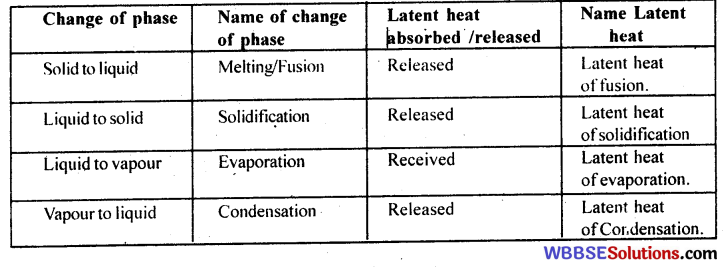
Answer:
During summer if all the doors and windows are kept open and wet curtains are hung. the water from the curtain evaporates slowly. In this process the required latent heat is taken by water from room. so the room become cool.

Influence of heat and temperature on living being.
Answer:
Influence of heat and temperature is observed on the variation of stucture, nature and lifestyle of living being. Animals of winter zone are more hairy than the animals of summer zone. In a hot day more sweating from the human body and panting of dog is observed. All of them keep the body cool. Again to keep the body warm there is dense fur on the body of Polar Bear. The penguins hug each other for the same reason. Plats are dried up in very hot condition. Again cameleon. cold blooded animals like snake enjoy the heat of the sun or heat of the sand. These phenomena occur as a result of the influence of heat.

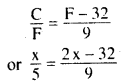
Let’s see, what people do when the temperaturerises. (Page no. 14)
Word troves : breathing. food intake, perspiration, work.

1. They raise perspiration rate. 2. Breathing rate is increased. 3. The diameter of Blood vessel is increased. 4. Amount of food intake is decreased. 5. Aversion to work and lethergy are seen.

What happens in the body of human beings when temperature of the body is decreased? Write that with the help of following word trove.
Word troves : trembling, food intake, sweating, hairs.
1. Trembling occurs. 2. The rate of food intake decreases. 3. Excessive sweating increases. 4. The hairs stand on end.

Discuss yourselves about phenomena where influence of heat is observed on living organisms of atmosphere and write in the space given below.
Generally white flowers blessom in the night in less temperature, the flowers with coloured petals bloom in daytime, sunflower blossoms when sun’s ray fall on it, during winter season merrigold blooms only in cold temperature.

Class 7 Science Chapter 1.1 Question Answer West Bengal Board –Heat

Multiple Choice Questions & Answers : (1 mark for each question)

Question 1.
Celsius scale is divided into-
i) 80 parts
ii) 180 parts
iii) 100 parts
iv) 120 parts
Answer:
iii) 100 parts

WBBSE Class 7 Science Solutions Chapter 1.1 Heat

Question 2.
Freezing point of Fahrenheit scale is –
i) 32° F
ii) 0°F
iii) 180° F
iv) 80°F
Answer:
i) 32° F

Question 3.
To make thermometer quickly effective-
i) Shape of the bulb should be large
ii) Shape of the bulb should be small
iii) Bulb should be made round in shape
Answer:
ii) Shape of the bulb should be small

Question 4.
1 Calorie =
i) 4.18400 joules
ii) 1.18400 joules
iii) 2.18400 joules
iv) 3.18400 joules
Answer:
i) 4.18400 joules

Question 5.
The amount of heat required to change the temperature of unit mass of the substance by one unit is called-
i) latent heat
ii) heat
iii) specific heat capacity
Answer:
iii) specific heat capacity

Question 6.
Temperature of substance A is 100°F and temperature of substance B is 100° C. Then say which of the following is correct.
i) B substance has more heat
ii) A substance has more heat
iii) Two substance has same heat
Answer:
i) B substance has more heat

WBBSE Class 7 Science Solutions Chapter 1.1 Heat

Question 7.
Which of the following substances have highest specific heat capacity-
i) Alcohot
ii) Kerosene
iii) Water
Answer:
iii) Water

Question 8.
The instrument by which heat absorbd or heat released is measured is called-
i) Barometer
ii) Thermometer
iii) Caloriemeter
Answer:
iii) Caloriemeter

Question 9.
Heat is a from of-
i) substance
ii) energy
iii) absorber
Answer:
ii) energy

Question 10.
The amount of heat energy required to raise the temperature of 1 ~g of water by 1°C is called-
i) 1 J
ii) 1 K cal
iii) 1 Calorie
Answer:
iii) I Calorie

Question 11.
Water stored in earthen pots gets cooled due to-
i) evaporation
ii) boiling
iii) freezing
Answer:
i) evaporation

Question 12.
If in two same type of kettle equal quantity of water and milk are boiled by same time keeping side by side the-
i) Water and milk would began to boil at the same time
ii) Milk will boil quicker than water
iii) Water will boil faster than milk
Answer:
ii) Milk will boil quicker than water

WBBSE Class 7 Science Solutions Chapter 1.1 Heat

Question 13.
Change of vapour to liquid is called-
i) melting
ii) evaporation
iii) boiling
iv) condensation
Answer:
iv) condensation

Question 14.
In SI system specific heat capacity of water is-
i) 4.2 Joule
ii) 4200 J/Kg
iii) 42 J/Kg
Answer:
ii) 4200 J/Kg

Question 15.
Change of solid to liquid is called-
i) melting
ii) evaporation
iii) melting
iv) cordensation
Answer:
i) nelting

Fill in the blanks : (1 mark for each question)

1. All the substances do _____ a definite melting point.
Answer:
not have

2. When pressure is increased, melting point of ______ decrease.
Answer:
ice.

WBBSE Class 7 Science Solutions Chapter 1.1 Heat

3. In a definite pressure pure crystal shaped substances have _______ melting and freering point.
Answer:
same.

4. When moulded iron is solidified its shape ______.
Answer:
increase.

5. Wax has _______ definite melting point.
Answer:
no.

6. Ether is a _____ liquid.
Answer:
volatile

7. If heat is the reason then temperature is its _____.
Answer:
result.

8. 0°C = – °F
Answer:
32°.

9. Clinical thermometer should not be immersed in ______ water.
Answer:
Boiling.

WBBSE Class 7 Science Solutions Chapter 1.1 Heat

10. Heat is a form of ______.
Answer:
energy.

11. The degree of hotness or coldness of a body is called _______.
Answer:
temperature.

12. When two bodies of different temperatures are kept in contact, the hot body loses heat and the cold body gains lieat, till their temperatures are ______.
Answer:
same

13. The boiling process takes place ove ______ liquid.
Answer:
entire.

14. In CGS system the unit of heat is ______ .
Answer:
calories

15. Heat always flows from ______ temperature to ______ temperature.
Answer:
higher, lower.

WBBSE Class 7 Science Solutions Chapter 1.1 Heat

16. Heat is a _______ quantity.
Answer:
scaler.

17. Normal temperature of a human body is 98.4°F. In celcius scale it is _______.
Answer:
36.89°C.

18. Hahrenheit is divided into _______ equal parts.
Answer:
180°

19. _____ is responsible for the change of state of a substance.
Answer:
latent heat.

20. ____ has a very high latent heat of vaporisation.
Answer:
water.

State whether True or False : (1 mark for each question)

1. The floor becomes cold after mopping it with water.
2. Spirit evaporates very slowly.
3. Change from liquid to solid is calied solidification.
4. The unit used in SI system to measure heat is calorie.
5. The change of phase of a substance from solid to liquid is called melting.
6. If water is kept in an earthen pitcher, it becomes cool.
7. The leaves of babul and radhachura ere open at night.
8. When temperature of human body decreases trembling occures.
9. When body temperature rises in people breathin, rate is increased.
10. Plants are dried up in very cold condition.
Answer:
1. true
2. false
3. true
4. false
5. true
6. true
7. false
8. true
9. true
10. false

WBBSE Class 7 Science Solutions Chapter 1.1 Heat

Match the following: (1 mark for each question)

a) Match the column A with column B.

Column A Column B
a) Liquid to solid– i) after bathing
b) Vapour to liquid– ii) snake
c) Cold-blooded animal– iii) volatile substance
d) Spirit is a iv) open in daylight
e) Cool sensation is felt v) solidification
f) 0° C to 100°C– vi) are hairy
g) Latent heat is required for vii) condensation
h) Animals of of cold region viii) Celsius scale
i) The leaves of some trees ix) evaporation

Answer:
a) I.iquid to solid — solidification.
b) Vapour to liquid — condensation.
c) Cold-blooded animal — snake
d) Spirit is a volatile substance.
e) Cool sensation is felt after bathing.
f) 0° C to 100° C – Celsius scale.
g) Latent heat is required for evaporation.
h) Animals of cold region are hairy.
i) The leaves of some trees open in daylight.

Very Short Questions & Answers : (1 mark for each question)

Question 1.
What is the SI unit of temperature?
Answer:
The SI unit of temperature is Kelvin (K).

WBBSE Class 7 Science Solutions Chapter 1.1 Heat

Question 2.
Which liquid has the highest specific heat capacity?
Answer:
Water has the highest specific heat capacity.

Question 3.
What are the limitations of Celsius scale?
Answer:
In Celsius scale lower limit is 0°C and upper limit is 100°C.

Question 4.
How many divisions are there between upper and lower limit of Fahrenheit scale?
Answer:
In Fahrenheit scale there are divisions Upper limit – lower limit = 212°F-32°F=

Question 5.
Is heat vector quantity?
Answer:
No, heat is scaler quantity.

Question 6.
0°C or 0° F which one is lesser?
Answer:
between 0°C and 0°F, 0°F is lesser.

Question 7.
In CGS system what is the unit of temperature?
Answer:
In CGS system the unit of temperature is degree celsius.

Question 8.
What is the heat r.easering property of mercury thermometer?
Answer:
The measuring property of thermometer is its expansion due to heat.

WBBSE Class 7 Science Solutions Chapter 1.1 Heat

Question 9.
1 Calorie = how many Joule?
Answer:
1 Calorie =4.2 Joule.

Question 10.
What do you mean by primary difference of a thermometer?
Answer:
The difference between the upper limitation and lower limitation of a thermoneter is called the primary difference of a thermometer.

Question 11.
What is the amount of heat given out by a body?
Answer:
Heat given out by a body = mass of the body × specific heat capacity of the body × fall in temperature of the body.

Question 12.
What is the amount of heat absorbed by a body ?
Answer:
Heat absorbed by a body = mass of the body × specific heat capacity of the body × rise in Temperature of the body.

Question 13.
How could you find out specific heat capacity of a substance?
Answer:
WBBSE Class 7 Science Solutions Chapter 1.1 Heat 6

Question 14.
What is the unit of specific heat capacity in CGS system?
Answer:
In CGS system the unit of specific heat capacity is Calorie / gran / °C.

Question 15.
What is melting?
Answer:
Change of a substance from solid to liquid state is called melting.

WBBSE Class 7 Science Solutions Chapter 1.1 Heat

Question 16.
What is solidification?
Answer:
Change of a substance from liquid to solid state is called solidification.

Question 17.
What is evaporation?
Answer:
Change of a substance from liquid to vapour state is called evaporation.

Question 18.
What is condensation?
Answer:
Change of a substance from vapour to liquid state is called condensation.

Question 19.
What is latent heat of a substance?
Answer:
Latent heat of a substance is defined as the amount of heat required to change the state of the substance without any change in temperature.

Question 20.
What is latent heat of fusion?
Answer:
The latent heat of fusion is the amount of heat required to change a substance from the solid state to its liquid state at its melting point without any change in temperature.

Question 21.
What is the latent heat of the fusion of ice?
Answer:
The latent heat of the fusion of ice is 80 calorie / gram.

WBBSE Class 7 Science Solutions Chapter 1.1 Heat

Question 22.
Name a volatile substance.
Answer:
Sprit or ether is a volatile substance.

Question 23.
What is vaporization?
Answer:
Vaporization is a transitional phase of a compound or an element and it occurs during the boilling or sublimation process.

Question 24.
What is evaporation?
Answer:
Evoporation is nothing but a type of vaporization which mostly occurs at temperatures below the boiling point.

Question 25.
What is necessary for vaporization?
Answer:
Latent heat is necessary for vaporization.

Question 26.
What a dog do to keep its body cool?
Answer:
A dog projects its tongue out and pants to keep its body cool.

Question 27.
What is the unit of measuring heat in SI system?
Answer:
In SI system heat is measured in joule.

Question 28.
Name another unit other than joule which is used to measure heat.
Answer:
Other than joule heat is measured in calorie.

WBBSE Class 7 Science Solutions Chapter 1.1 Heat

Question 29.
What is used to measure fever?
Answer:
Clinical thermometer is used to measure fever.

Question 30.
What is used inside thermometer?
Answer:
Mercury is used inside the thermometer.

Question 31.
In what degree celsius water converts into ice?
Answer:
In 0° celsius water converts into ice.

Short Questions & Answers : (2 marks for each question)

Question 1.
What is heat? Write down its units.
Answer:
Heat is a form of energy which causes a sensation of hotness and coldness and which can be transferred from a hotter body to a cooler body.
Units of heat are – In CGS system it is calorie and in SI system it is joule. I Calorie = 4.2 joule.

Question 2.
What is temperature? Write down its units.
Answer:
Temperature is the degree of hotness or coldness of a body. Temperture is a relative measure, or indication of hotness or coldness.
Units of temperature are – In CGS system it is degree celsius (0°C) and in SI system it is Kelvin (K).

Question 3.
What is thermometer? What is mercury thermometer?
Answer:
Thermometer is an instrument which measures the temperature of a substance perfectly. A thermometer in which mercury is used for measuring temperature is called mercury thermometer.

WBBSE Class 7 Science Solutions Chapter 1.1 Heat

Question 4.
What is Celsius scale?
Answer:
The thermometer scale which was invented by the Swidish as tranomer Anders Celsius is named after him. He devised the inverted form of this scale – ice point 0°n and steam point 100°. The scale is divided into 100 parts. Every part is called 1°C.

Question 5.
What is Fahrenheit scale?
Answer:
Fahrenheit scale is a temperature scale in which the temperature of boiling water is taken as 212 degrees and the temperature of melting ice is taken as 32 degrees. It was invented by Gabriel Fahrenheit a German physicist. The scale is diveded into 180 parts and each part is taken as 1°F.

Question 6.
What do you mean by 1 calorie of heat? Is it a vector quantity?
Answer:
The amount of heat energy required to raise the temperature of 1 gram of pure water by 1°C is called 1 caloric. Heat is has only magnitude but no direction so it is a scalar quantity. It is not vector quantity.

Question 7.
What is specific latent heat ?
Answer:
Specific latent heat of a substance is defined as the amount of heat required to change the state of unit mass of the substance without any change in temperature.

WBBSE Class 7 Science Solutions Chapter 1.1 Heat

Question 8.
Name three factors that determine the quantity of heat absorbed by a body.
Answer:
The quantity of heat gained by a body depends on the following three factors.
a) Mass of the substance
b) Nature of the substance
c) Rise in temperature of the substance.

Question 9.
What is the principal of calorimetry ?
Answer:
The principal of calorimetry states that if two bodies at different temparatures are placed in contact with each other, the hot body will lose heat till they reach a common temperature.

Question 10.
At what temperature the reading of Fahrenheit will be twice than Celsius scale?
Answer:
Taking C = x and F = 2x.

WBBSE Class 7 Science Solutions Chapter 1.1 Heat 7
or, 9 x = 10x – 160 or, 9x – 10 x =-160
or, – x = – 160 or x = 160
∴ Required temperatures are 160°C or 320°F

Long Questions & Answers : (3 marks for each question)

Question 1.
What are the fixed points of a thermometer? What do you mean by lower fixed point and upper fixed point of a thermometer?
Answer:
Two definite temperatures are taken as upper and lower limits to make a scale of a thermometer. There two definite limits are called fixed points of a thermometer.

Lower fixed point – In a definite temperature and in a definite atınospheric pressure when ice changes into water. then this temperature is called lower fixed point.

Upper fixed point – In a definite temperature and in a definite atmospherie pressure when water begings to boil and change into vapour, then this temperature is called upper fixed point.

WBBSE Class 7 Science Solutions Chapter 1.1 Heat

Question 2.
What is relation between Celsius scale and Fahrenheit scale ?
Answer:
100 division in Celsius scale is equal to 180 division in Fahrenheit scale.
Then 1 division in Celsius scale = \(\frac{180}{100}\) division in Fahrenheit scale.
C division in Celsius scale =\(\frac{180}{100}\) divisions in Fahrenheit scale.
Then we can write \(\frac{180}{100}\) = F-32 or \(\frac{9}{5}\)=F-32 or c=(F-32)

Again \(\frac{9C}{5}\) = F-32
then \(\frac{C}{5}\) = \(\frac{F-32}{9}\)
C =\(\frac{5}{9}\)(F-32)

Question 3.
State the difference between Heat and Temperature.
Answer:

Heat Temperature
1. Heat is a form of energy. 1. Temperature is the degree of hotness or coldness of a body.
2. Heat is the reason of temperarure. 2. Temperature is the result of heat.
3. Units of heat in CGS system is calorie and in SI system is Joule 3. Units of temperature in CGS system is degree celsius and in SI system is Kelvin.
4. Heat is measured by an instrument called calorimeter. 4. Temperature is measured by thermometer.

Question 4.
Explain why water in an earthen pitcher remains cool.
Answer:
Water in earthen pitcher remains cool. Water in earthen pitcher remains cool. In fact, numerous capillary holes are there, in the wall of earthen pitcher. Through the holes a little amount of water comes out from the pitcher. Then envaporation takes place. The process needs latent heat. Then the water on the wall absorbs requirite latent heat the pitcher and water in it. As a result the pitcher and water in side it loses that heat and become cool.

Question 5.
Why cooling sensation is felt when ether or sprit is poured on hand?
Answer:
In fact, spirit or ether is a volatile compound (this type of substance evaporates very quickly). Latent heat is required for evaporation. The spirit or ether absorbs latent heat fron the surrounding also and from the hand. Therefore, the particular position of hand loses heat, that is why, when spirit or ether is poured on hand, cooling sensation is felt at that spot.

WBBSE Class 7 Science Solutions Chapter 1.1 Heat

Question 6.
State the difference between evaporation and boiling.
Answer:

Evaporation Boiling
1. Evaporation taks place at all temperatures. 1. Boiling takes place at the boiling point of the liquid.
2. Evaporation is a slow and slient process. 2. Boiling is a fast and violent process.
3. Evaporation takes place only at the surface of the liquid. 3. Boiling takes place over the entire mass of the liquid.
4. Evaporation causes cooling. 4. Boiling does not cause cooling.

Question 7.
Normal temperature of a body in clinical thermometer is 98.4°F, how much it will be in Celsius scale ?
Answer:
We know that
WBBSE Class 7 Science Solutions Chapter 1.1 Heat 8

Question 8.
How much heat 50 gm of water at 25°C will take to reach boiling point ?
Answer:
Mass of water =50 gm
Intial temperature =25°C
Final temperature =100°C
Specific heat of water =1 Cal/g /°C
Heat gained = 50 × 1 × (100-25) Cal =3750 Cal.
∴ Required heat = 3750 Calorie.