WBBSE Class 10 Physical Science Notes Chapter 8.6 Organic Chemistry

Comprehensive WBBSE Class 10 Physical Science Notes Chapter 8.6 Organic Chemistry can help students make connections between concepts.

Organic Chemistry Class 10 WBBSE Notes

Organic Chemistry : All carbon containing compounds except oxides of carbon, metal carbonates, bicarbonate, hydrogen cyanide and metallic cyanides are organic compounds and the chemistry of organic compounds is known as organic chemistry.

Organic compounds is a separate branch because organic compounds:

  • are large in number
  • show isomerism
  • are soluble in non-polar solvents
  • have complex structures
  • are bad conductors
  • show catenation
  • are made from small number of elements.

WBBSE Class 10 Physical Science Notes Chapter 8.6 Organic Chemistry

Role of organic compounds in life process : Organic compounds are intemately related to our daily life. In order to maintain the life process of our body the following process are required.

  • Intake of nutritional food for the growth the living body.
  • For repairing the depreciation of health.
  • Mobility
  • Reproduction

All these are fulfilled almost by all organic materials.

(i) The main ingredients in our food chart are classified of three types : carbohydrates (e.g. rice, wheat, sugar etc.), proteins (e.g. milk, fish, egg etc.) and fats (e.g. milk, oil, butter etc.)

(ii) These food materials are ultimately converted to single organic compounds in different metabolic process with the help of enzymes in our body.

(iii) Vitamin, an organic compound plays indirectly a very important role for maintaining the growth of our health.

(iv) For the translation and mobility of the animals, energy which is required is stored in our body. This energy is associated in an organic compound. This is known as ATP (adenosine triphosphate).

(v) Haemoglobin which is an organic compound an oxygen carrier supplies oxygen in the body.

Biomoleculcs: The molecules of compounds like carbohydrates, amino acids, proteins, vitamins, fats, RNA, DNA etc. which are essential for the continuation of life processes of biological species like plants and animals (including human beings) are known as biomolecules.

WBBSE Class 10 Physical Science Notes Chapter 8.6 Organic Chemistry

Some essential biomolecules are :

(i) Carbohydrates : These molecules are composed of carbon, hydrogen and oxygen. General formula of it is Cn(H2O)n. Carbohydrates. are the class of compounds that include polyhydric aldehydes, polyhydric ketones and large polymeric molecules that can be broken down to polyhydric aldehydes and ketones.

Carbohydrates which contain aldehyde groups are called aldose and the carbohydrate containing keto groups are called ketose.

Carbohydrates are mainly of three types :

(a) Monosaccharides : These are the simplest form and are not hydrolysed, e.g. glucose, fructose etc.

(b) Oligosaccharides: During hydrolysis they form fixed number (2-10) of more saccharides.
WBBSE Class 10 Physical Science Notes Chapter 8.5 Metallurgy 18

(c) Polysaccharides: These are the natural polymer of large number of mono saccharides. It has general formula (C6H10O5)n. e.g. starch, cellulose etc.
WBBSE Class 10 Physical Science Notes Chapter 8.5 Metallurgy 19

(ii) Proteins: Another class of compounds essential for living being are proteins. They contain carbon, hydrogen, oxygen and nitrogen. Proteins are consumed daily from our diet. During hydrolysis of proteins by acid, base or enzyme amino acids are produced.WBBSE Class 10 Physical Science Notes Chapter 8.5 Metallurgy 20
Proteins are of three types :
(a) Simple protein
(b) Conjugated protein
(c) Derived protein.

WBBSE Class 10 Physical Science Notes Chapter 8.6 Organic Chemistry

(a) Types of simple protein :

  • Albumin: This type of protein can be isolated from egg, milk, wheat, serum etc.
  • Globulin: Proteins that are isolated from egg yolk, tissues, belong to this class of protein.
  • Glutemin: This type of protein is present in wheat, rice etc.
  • Protamin: This type of protein is present in wheat, barli etc.

(b) Conjugated protein : Examples of this type of protein are : nucleo protein, chromoprotein, glycoprotein, phosphoprotein, lipoprotein, metalloprotein.

(c) Derived protein : This type of proteins are available by the partial hydrolysis of protein of very high molecular weight by acid, base or enzyme to simpler protein.

(ii) Fats: Fats are composed of carbon, hydrogen and oxygen. These are made of glycerol and fatty aids. Fats may be of animal or vegetable origin.

Animal fats are found in : milk, cheese, butter, eggs, meat and oily fish.

Vegetable fats are found in : walnut, almonds, groundnut and coconut, mustard seeds, seasame seed etc.

Fat is a concentrated source of energy.

(iv) Vitamins: Vitamins are organic compounds containing carbon, hydrogen, oxygen and sometimes nitrogen and sulphur. Vitamins are necessary to carry out many vital processes. Their absence or deficiency causes many ailments and impairs the healthy living oi human being.

(v) Amino acids: Proteins are made of amino acids. These are the essential for living beings. Amino acids are the class of compounds containing amino group and carboxylic acid group. 1

WBBSE Class 10 Physical Science Notes Chapter 8.6 Organic Chemistry

Amino acids are of three types :

Neutral amino acids : Amino acids containing the same number of amino and carboxylic acid groups are called neutral amino acids. These have one -NH2 group and one -COOH group. Total number  of amino acids in this group is 19. e.g. glycine (NH2CH2COOH), alanin [CH3CH(NH2)COOH] etc.

  • Basic amino acids : This type of amino acids have two -NH2 groups and one-COOH group, e.g. lysine, histidine etc.
  • Acidic amino acids : This type of amino acids have two -COOH groups ’• and one -NHZ group, e.g. aspartic acid, glutamic acid.

The essential amino acids are :

  • Valine
  • Lucine
  • Iso-lucine
  • Phenylalanine
  • Threonine
  • Methionine
  • Argenine
  • Lysine
  • Histidine
  • Tryptophan.                                                                                                              1

DNA (Deoxyribo nucleic acids): It is found in nucleus, mitochondria and chloroplast of the body cells. James Watson and Francis Crick were able to establish the structure of DNA in 1953. DNA molecule is double helical in nature. It contains three different chemical compositions.

  • Phosphoric acid
  • Deoxy ribose
  • Pyridine like base adenine and guanine, pyrimidine like base thymine and cytonine.

DNA has two strands of polynucleotides coiled around each other by hydrogen; bond in the form of double helix.

Function of DNA :

  • Transmission of herediatary characteristics.
  • Biosynthesis of proteins.

The genetic information for the cell is preserved in the sequence of this base in the DNA molecule. When a cell divides, DNA molecules replicate and make exact copies of themselves so that daughter cell will have identical DNA to that of parent cell.

RNA (Ribonucleic acid): RNA molecule is single stranded, containing 1 ribose, phosphoric acid and uracil as the nitrogenenous base. RNA plays a very Vital role in life process. RNA carries the message of DNA and acts accordingly.

WBBSE Class 10 Physical Science Notes Chapter 8.6 Organic Chemistry

Type of RNA : (a) mRNA (b) tRNA (c) rRNA. RNA(tRNA, mRNA) helps synthesis of polypeptides, the intermediates of proteins.

Bonding In organic compounds Electronic configuration of carbon shows that the number of electrons available in the outermost orbit is 4. The outermost electrons can only be capable to form covalent bond by sharing and pairing of its electrons with that of other element. So, valency of carbon becomes 4.

Catenation : The property by virtue of which carbon forms covalent linkage amongst them to form stable carbon chains is knoun as catenation. Catenation is an unique property of carbon. As a result of catenation, carbon can form innumerable chemical species with the supplement in various ways by the necessary addition of other elements like H, O, N, P, S, halogens etc.

Difference between organic and inorganic compounds :

Organic Compounds Inorganic Compounds
(i) Catenation property of carbon atoms and its effect : The catenation property of carbon atoms among themselves and other atoms gives rise to limitless number of organic compounds with strain chains and rings of carbon atoms. (i) Due to absence of catenetion property of its atoms, the number of inorganic compounds formed by the rest erf the elements in not so large.
(ii) Class similarity : Organic compounds can be easily classified into different groups with certain similar characteristic properties. (ii) In organic compounds cannot generally be classified into such groups with similar characteristics.
(iii) Thermal stability : Organic
compounds are in general, thermally unstable and decompose at higher temperature.
(iii) These are more or less thermally stable., These can tolerate comparatively higher temperatures without decomposition.
(iv) Bonding: Organic compounds are formed through covalent bonding in their molecules. (iv) These compounds are generally formed by eledrovalent or ionic bonding in their molecules.
(v) Melting and boiling points: As these compounds are covalent in nature, so they have comparatively lower melting and boiling points. (v) As these compounds are ionic in nature, so they have high melting and boiling points.
(vi) Solubility: These are soluble in organic solvents like alcohol, ether, benzene etc. but generally insoluble in water. (vi) These are soluble in ionising solvents like water but are generally insoluble in organic solvents.
(vii) Structural characteristics: They have widely varying structural forms, from simple chain structure to complex ring. (vii) They have mostly simple structure.
(viii) Isomerism: Different types of isomerism often occur in organic compounds. (viii) Isomerism is practically unknown in inorganic compounds.
(ix) Electrolytic character: These are generally non-electrolytes (ix) Inorganic compounds are general electrolytes.

Classification of organic compounds :
WBBSE Class 10 Physical Science Notes Chapter 8.6 Organic Chemistry 3

WBBSE Class 10 Physical Science Notes Chapter 8.6 Organic Chemistry

Functional group : The groups which are responsible to characterise the compounds are Known as functional group.

WBBSE Class 10 Physical Science Notes Chapter 8.6 Organic Chemistry 2

Homologous series : It is a group of compounds in which the various members have similar chemical properties, possess the same functional group and can be represented by the same general formula. The different members of a homologous series are called homologous and the phenomenon is called homology.

Constitutional or Structural Isomerism : The phenomenon in which two or more different compounds obviously having different physical and chemical properties possess the same molecular formula but different molecular structures due to the arrangements of the constitutional or structural isomerism.

Types of structural isomerism : Three types

(a) Chain isomerism; The compounds of the same class, with the same molecular formula, have chain isomerism due chain carbon atoms.

WBBSE Class 10 Physical Science Notes Chapter 8.6 Organic Chemistry 4

(b) Position isonierism : The compounds of the same dass, with the same molecular formula, have position isomerism due to the position of functional groups.

WBBSE Class 10 Physical Science Notes Chapter 8.6 Organic Chemistry 5

(c) Functional group isomerism : The compounds of the same class, with the same molecular formula, have functional group isomerism due to different functional groups.
WBBSE Class 10 Physical Science Notes Chapter 8.6 Organic Chemistry 6

Hydrocarbons : Hydrocarbons are organic compounds containing only carbon and hydrogen atoms in their molecules.

WBBSE Class 10 Physical Science Notes Chapter 8.6 Organic Chemistry

Types of hydrocarbons: Hydrocarbons are divided into two classes, namely

  • Saturated hydrocarbons
  • Unsaturated hydrocarbons.

Alkane : Open chain saturated hydrocarbons are known as alkanes. General formula of these compounds are : CnH2n+2 (n = integers)

Carbon atoms of these compounds are linked by single covalent bonds. Hy­drogen atoms of these compounds are also linked to one or more carbon atoms by a single covalent bonds.

Saturated hydrocarbon molecules do not contain any formal functional group and as such exhibit very little chemical activity. These are therefore known as paraffins.

Methane: Methane is the first member of the hydrocarbons of the alkane series. It is a colourless gas with molecular formula CH4.

Source:
WBBSE Class 10 Physical Science Notes Chapter 8.6 Organic Chemistry 7

(ii) Main source of methane is the natural gas. It is formed in nature in bio­logical decay of plants of swamps and marshes. Methane is called marsh gas. A little phosphine (PH3) and phosphorous dihydride (P2H4) accompany the methane gas and make it spontaneously inflammable. So, it often burns with flashes of flame over marshes. This is well known as ‘will-O-the-wisp’. It is just a natural phenomenon.

Chemical properties:
(i) Burning of methane: It burns in air or oxygen when ignited, and is oxidised to carbon dioxide and water with the evalution of heat.
CH4+2O2 = CO2 + H2O + 213 kcal/ molecule.

(ii) Substitution reaction : It undergoes substitution reaction. The first step of the reaction is :
WBBSE Class 10 Physical Science Notes Chapter 8.6 Organic Chemistry 8

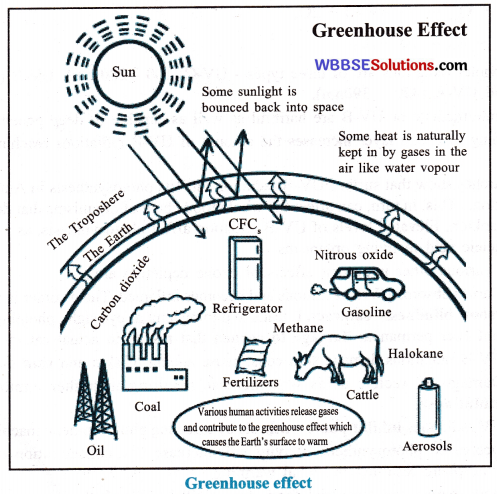
Methane: A green house gas: Like carbon dioxide, water vapour etc. methane is known as a green house gas (contribution 19%) because it is capable to absorb visible light from sun-rays and keep the earth surface and its surrounding warm.

WBBSE Class 10 Physical Science Notes Chapter 8.6 Organic Chemistry

Uses of methane:

  • It is used as a domestic and industrial fuel by burning in gas-stoves. Almost 40% by volume of methane is present in coal gas.
  • It is used in the large-scale production of carbon black which is largely
    used for making printers’ ink, paints, typewriter, ribbon, motor tyres etc.
  • It is now used as a source of hydrogen for the synthesis of NH3.
  • It is used for the manufacture of methanol, chloromethane, chloroform etc.

Alkene: An alkene is an unsaturated aliphatic hydrocarbon with a double bond in-between two adjacent carbon atoms of its molecule.

General formula of alkene : CnH4 (where n is an integer)

Ethylene [or, Ethene]
The molecular formula of ethylene is C2H4 which can be written as CH2 = CH2.
It i colourless gas.

Source :
(i)
WBBSE Class 10 Physical Science Notes Chapter 8.6 Organic Chemistry 9
(ii) It is present in very small amount in coal gas.
(iii) Natural gas rich in methane when ignited at 1400°C — 1500°C at normal pressure, acetylene is obtained after cooling.
WBBSE Class 10 Physical Science Notes Chapter 8.6 Organic Chemistry 10

Chemical reaction :
(i) Addition reaction with hydrogen:
WBBSE Class 10 Physical Science Notes Chapter 8.6 Organic Chemistry 11
(ii) Addition reaction with bromine :
WBBSE Class 10 Physical Science Notes Chapter 8.6 Organic Chemistry 12
Uses of acetylene :

  • As an illuminant acetylene is used in acetylene lamp.
  • It is used as an oxyacetylene flame 2700°C, for cutting and welding iron plates and sheets.
  • It is used for the preparation of acetaldehyde, acetic acid, ethyl alcohol, acetone etc.
  • Acetylene is used for the preparation of weston, a solvent used in industry.
  • It is used for the preparation of synthetic rubber and plastics.
  • It is used as an anaesthatic agent.

Polymer : There are some organic molecules of low molecular weight, a large number of which join with one another repeatedly to produce a very big molecule of high molecular weight. The small molecules are known as monomers and the resulting large molecules are known as p tymers.

WBBSE Class 10 Physical Science Notes Chapter 8.6 Organic Chemistry

Some common polymers :
WBBSE Class 10 Physical Science Notes Chapter 8.6 Organic Chemistry 13

Hazards of using polymer materials in our environment :

  • Polythene, PVC, synthetic rubber after use are left anywhere else. Tyre used in the wheel of a vehicles are also thrown in the dustbin or these are burnt out. These materials have no natural decay in the soil by bacteria.
  • As a result there is a dumping of plastic materials and creates an environ­ment pollution.
  • It destroys the soils where it is dumping.
  • The plastic materials left in hills and mountain, is the cause of landslide.
  • Tyre prepared from synthetic rubber when left in air produces free radicals in presence of sunlight which is cancer producer.

Possible alternatives to avoid the hazards :

  • To get relief from these, limited uses are desirable
  • Now-a-day some reagents are added to plastic materials so that they would not create any problem or hazard to mankind.
  • Bags made to cloth, paper, jute should be used instead of polythene bags.

IUPAC (International Union of Pure and Applied Chemistry, 1957) nomenclature simple organic compounds :

WBBSE Class 10 Physical Science Notes Chapter 8.6 Organic Chemistry 14
WBBSE Class 10 Physical Science Notes Chapter 8.6 Organic Chemistry 15
Polymerisation: The process or technique through which monomer units combine to give a polymer is known as polymerisation.

WBBSE Class 10 Physical Science Notes Chapter 8.6 Organic Chemistry

Biodegradable polymers : The polymers that can be dissociated into small segments enzymes (produced by microorganisms) are called biodegradable polymers.

Example :
(i) PHBV (poly β-hydroxy butyrate co-β-hydroxy-valerate)
WBBSE Class 10 Physical Science Notes Chapter 8.6 Organic Chemistry 16

LPG (Liquified Petroleum Gas) : In refinning the crude petroleum, the gaseous products thus obtained the hydrocarbons of lower molecular weight after purification of these gaseous mixtures if there are cooled at hith pressure and low temperature, these are all condensed to liquidand. The liquid is known as Liquified Petroleum Gas (LPG).

Types of LPG :

  • Heavier grade LPG (80-90%) : C4-hydrocarbon (Butane, Isobutane, butene)
  • Lighter grade LPG (90%) : C3 hydrocarbon (Propane and propene, 10% C4-hydrocarbon (Butane and butene) 2% Ethane and ethylene.

Calorific value : Amount of heat energy produced by the complete com­bustion of one gram of the fuel is known as its calorific value.
Calorific value of LPG ; 29500 kcal/m3

CNG (Compressed Natural Gas):
It is compressed natural gas. It contains mainly methane. It has calorific value 21300 Btu/Ib

Uses of Ethanol:

  • Ethanol (C2H5OH) is used for drinking purpose.
  • Ethanol is widely used as a solvent.
  • Ethanol burns of give carbon dioxide and water and thus can be used as fuel.
  • Ethanol is used as antifreeze.

WBBSE Class 10 Physical Science Notes Chapter 8.6 Organic Chemistry

Physical properties of Ethanol :

  • It is colourless liquid having a sweet smell.
  • It is highly soluble in water.
  • It is volatile and inflammable.
  • It is neutral and it does not change the colour of litmus solution.

Reaction of Ethanol :

(i) Reaction with sodium (active metal): Ethanol reacts with sodium, to form sodium ethoxide and hydrogen.
2C2H5OH + 2Na → 2C2H5ONa + H2

(ii) Reaction of ethanol with cone. H2SO4 for dehydration :
Ethanol reacts with cone. H2SO4 at about 170°C to form ethylene.
WBBSE Class 10 Physical Science Notes Chapter 8.6 Organic Chemistry 18

Uses of acetic acid (CH3COOH)

  • It is used as an aid in cooking and for making pickles as also a preservative of fish, meat, vegetable etc. as vinegar (6-8% water solution of acetic acid)
  • It is used to prepare white paint.
  • It is used to concentrate the latex of leather.

Reactions of acetic acid :

(i) Reaction of acetic acid with NaHCO3 : During reaction of acetic acid with NaHCO3, sodium acetate, carbon dioxide and water are produced.
CH3COOH + NaHCO3 → CH3COONa + CO2↑+ H2O

(ii) Reaction of acetic acid with NaOH : Acetic acid reacts with NaOH to form sodium acetate and water.
CH3COOH + NaOH → CH3COONa + H2O

(iii) Reaction of acetic acid with C2H5OH : This reaction is called esterifi­cation. During this reaction ethyl acetate and water are produced.
WBBSE Class 10 Physical Science Notes Chapter 8.6 Organic Chemistry 17

Toxicity of Methanol : Methanol has a high toxicity in human. If as little as 10 mL of pure methanol is ingested, for example, it can break down into formic acid, which can cause permanent blindness by destruction of the opti nerve and 30 mL is potentially fatal, although the median lethal dose is typically 100 mL. Toxic effects take hours to start and effective antidotes can often prevent permanent damage.

WBBSE Class 10 Physical Science Notes Chapter 8.6 Organic Chemistry

Methanol is toxic by two mechanisms. First methanol (whether it enters the body by ingestion, inhalation or absorption through the skin) can be fatal due to its CNS depressant properties in the same manner as ethanol poisoing. Second, in a process of toxication, it is metabolized to formic acid (which is present as the formate ion) via formaldehyde in a process initiated by the enzyme alcohol dehydrogenase in the liver.

Methanol is converted to formal­dehyde via alcohol dehydrogenase (ADH) and formaldehyde is converted to formic acid (formate) via aldehyde dehydrogenase (ALDH). The conversion to formate via ALDH proceeds completely, with no detectable formaldehyde remaining.

Formate is toxic because it inhibits mitochondrial cytochrome C oxides, causing the symptoms of hypoxia at the cellular level, and also caus­ing metabolic acidosis, among a variety of other metabolic disturbances. So methanol is highly toxic and causes blindness insanity and even death. Ethanol is non-toxic but when drunk, it produces physiological effect and disturbs the brain activities.

Denatured spirit : Alcohol used for making beverages is highly taxed but the ethyl alcohol supplied to the chemical laboratories and industries is very cheap.

To make it unfit for drinking purposes, industrial alcohol is mixed with poisonous substance like methanol, pyridine etc. The process is known as denaturing and the product is called denatured alcohol. The ethylalcohol mixed with the methanol is called methylated spirit.

WBBSE Class 10 Physical Science Notes Chapter 8.5 Metallurgy

Comprehensive WBBSE Class 10 Physical Science Notes Chapter 8.5 Metallurgy can help students make connections between concepts.

Metallurgy Class 10 WBBSE Notes

Occurrence of metals : A few metals particularly noble metals (Au, Pt, Ag etc.) having least electropositive charader occur in free state. About 75% of the known elements are metals. Most of the metals are found in the combined state in nature as their compounds.

Minerals : The natural materials containing metals and their compounds associated with earthy and other impurities found under earth’s crust are called minarals.

WBBSE Class 10 Physical Science Notes Chapter 8.5 Metallurgy

Ores : The minerals from which the metals can be extracted conveniently and profitably. All ores are minerals but all minerals are not ores.

Metallurgy : It is a process of extracting metals from their ores.

Gangue or Matrix: They are the rocky and earthy impurities associated with the minerals.

Concentration of ore : It is the process of removal of gangue from the ore.

Flux: It is the substance which combines with gangue to form light and easiÍilusible material called slag.

WBBSE Class 10 Physical Science Notes Chapter 8.5 Metallurgy 1

WBBSE Class 10 Physical Science Notes Chapter 8.5 Metallurgy 2

Slag : It is the light and fusible material obtained by the combination of flux with gangue.

Calcination : It is the process of heating an ore in a limited supply of air or in absence of air at a temperature just below its melting point.

Roasting : It is the process of heating an ore in a limited supply of air or in absence of air at a temperature just below its melting point.

WBBSE Class 10 Physical Science Notes Chapter 8.5 Metallurgy

Extraction of metal : Different processes that are used for the extraction of pure metals from ores are called extraction of meials;

Alumimium (AI)

Symbol: Al; Valency : 3;
Atomic weight: 26-78
Atomic Number: 13,

Position in Periodic Table:
Period: 3, Group IIIA (13);
Electronic configuration : ls22s22p63s23p1

Occurrence: Aluminium is not found in pure state. It occurs to the extent of 8% in earth’s crust in many silicate rocks and clays. It is the third most abundant element in the earth’s crust.

Important aluminium minerals are :
WBBSE Class 10 Physical Science Notes Chapter 8.5 Metallurgy 3

  • Chief ore of aluminium : Chief ore of aluminium is bauxite (Al2O3-2H2O).
  • Mines : In India, large quantities of bauxite are available in Bihar, Jharkhand, Orissa, Andhra Pradesh, Madhya Pradesh, Rajasthan, Tamilnadu, Gujarat and Jammu-Kashmir. But large deposit of quality grade bauxite are found in Andhra Pradesh.
  • Extraction of aluminium : Initially alumina is prepared from bauxite then after mixing with cryolite and fluosper aluminium is extracted by electrolysis at about 950°C
  • The ore of aluminium (bauxite) is purified by Baeyer’s process, Hall’s process or Serpeck’s process depending upon the type of impurities present in it. Baeyer’s process or Hall’s process is used for ores containing oxides of iron as main impurity while Serpeck’s process is used for ores containing silica as main impurity.

WBBSE Class 10 Physical Science Notes Chapter 8.5 Metallurgy

Physical properties of Aluminium :

  • It is silvery white metal and is very light, (sp.gr. = 21)
  • It melts at 660°C and boils at 2270°C.
  • It is a good conductor of heat and electricity.
  • It is malleable and ductile.
  • Atomic radius of aluminium is 125 pm.
  • The ionisation enthalpies of Aluminium are 600 KJ mol-1, 2427 KJ mol-1 and 3568 KJ mol-1
  • Sum of the first three ionisation enthalpies being very high, aluminium forms covalent compounds.

Chemical Properties :

(i) Action on

  • Dry air has no action on aluminium. In moist air, it forms a thin film of oxide on its surface.
  • When heated strongly, it burns with a brilliant white light, producing aluminium oxide and little nitride.

WBBSE Class 10 Physical Science Notes Chapter 8.5 Metallurgy 4

(ii) Action of water : Pure water has no effect on the metal due to the presence film on the surface. Amalgamation with mercury prevents the protective oxide film. Amalgamated metal, therefore, can decompose even cold water. Commercial aluminium can be readily attacked by sea water. It decomposes boiling water, liberating hydrogen. 2Al + 6H2O = 2Al(OH)3 + 3H2

(iii) Action of chlorine : when aluminium is heated gently with chlorine, it forms aluminium chloride.
2Al + 3Cl2 = 2AlCl3
A mixture of aluminium powder and iodine catches fire when a drop of water is added on it.

(iv) Action of acids: (a) With dilute sulphuric acid, hydrogen gas is evolved at a slow rate. In hot concentrated sulphuric acid, metal dissolves with the evolution of
2Al + 3H2SO4 (dilute) = Al2(SO4)3 + 3H2
2Al + 6H2SO4 (cone) = Al2(SO4)3 + 3SO2 + 6H2O

(b) With dilute nitric acid, aluminium nitrate and ammonium nitrate are produced.
Action with carbon Sulphur :
8Al + 3OHNO3 = 8Al(NO3)3 + 9H2O + 3NH4NO3

WBBSE Class 10 Physical Science Notes Chapter 8.5 Metallurgy

(v) Action with carbon and sulphur :
Aluminium reacts with boiling caustic soda or caustic potash forming sodium aluminate or potassium aluminate respectively with the evolution of hydrogen gas.
WBBSE Class 10 Physical Science Notes Chapter 8.5 Metallurgy 6

(vi) Action of alkalls: Aluminium reacts with boiling caustic soda or caustic potash forming sodium aluminate or potassium aluminate respectively with the evolution of hydrogen gas.
2Al + 2NaOH + 2H2O = 2NaAlO2 + 3H2
2M + 2KOH + 2H2O = 2KAlO2 + 3H2
That is why, caustic soda is not boiled in aluminium pot.

(vii) Displacement reactions: Aluminium is strongly electropositve. Hence, it readily displaces less electropositive metals, such as-murcury, silver, gold etc.
2Al + 3HgCl2 = 2AlCl3 + 3Hg.

(viii) Peducing property: Due to its strong affinity of oxgen it acts as a strong reducing agent. It readily reduces certain metallic oxides to the metal.
WBBSE Class 10 Physical Science Notes Chapter 8.5 Metallurgy 5
These reactions are highly exothermic and they can be utlised for welding (Thermite welding) of metals.

Uses of Aluminium:
At present, use of aluminium is just after iron.

  • Being a light material as also stable and resistance to water vapour it is used to prepare external structures of air-ships and motor cars.
  • It is used in electric wire and electric equipments as it is a very good conductor of electricity.
  • It forms many useful alloys used for different purposes. Alloys like dural­umin, magnelium bronze etc. and also in flash bub used in photography aluminium metals are used.
  • Aluminium is used in thermit process. Due to its strong affinity for oxygen, it is used for the extraction of metals like Cr and Mn from their ores.
  • Mixed with linseed oil, powdered aluminium is used as paint.
  • Ammonal, a mixture of ammonium nitrate and aluminium powder, is used in explosive bombs.
  • Aluminium power has the use in fireworks.
  • Aluminum is used in the preparation of different utensils, chair, table and the packing over a cigarette, coffee, chocolate etc.

Artificial gem are produced by dropping powdered alumina mixed with little of other metallic oxides to obtain desired colour (e.g. 2-5% chromic oxide for artificial ruby). Sapphire is similary produced from alumina with addition of a little magnetic iron oxide and titanium oxide.

WBBSE Class 10 Physical Science Notes Chapter 8.5 Metallurgy

Foods having sour taste should not be preserved in aluminium foil, since fatty acid present in those types of foods react with aluminium foil producing salts which are very harmful to health.

Magnesium (Mg)

Symbol: Mg ; Valency: 2 ; Atomic weight: 24
Atomic Number: 12 :
Position in Periodic Table :
Period: 3; Group: IIA (2) :
Electronic Configuration : Is22s22p63s2
Occurrence: Magnesium is not found in free state in nature.

Important magnesium minerals are :

Nature Minerals
1. As carbonates Magnesite : MgCO3
Dolomite : MgCO, CaCO
2. As chloride Carnallite : MgCl2 . KCl . 6H2O
3. As sulphate Kieserte : MgSO4 . H2O
Kainite : MgSO4 – KCl- 3H2O
Epsom Salt : MgSO4– 7H2O
4. As silicate Asbestos: CaMg3 (SiO3)4

Chief ore: Magnesium is extracted from the ores magnesite and carnallite. Magnesium metal is also found in sea-water, chlorophyll and also in sping.

Mines : The chief ore of magnesium is carnallite. But carnallite is not available in India. It is imported from Germany, where it exists as deposits at stassfurt. Other important ores of magnesium are magnesite and dolomite which are abundantly available in Tamilnadu, Karnataka and in many parts of Bihar, Jharkhand, Orissa, West Bengal and Sikkim.

Extraction: Magnesium is prepared by:

  • Electrolytic reduction of the fused magnesium chloride.
  • Chemical reduction of MgO by carbon or ferro-silicon.

Physical properties of magnesium:

  • Magnesium is a light, white metal with a bright lustre which tarnishes in moist air due to the deposition of a film of oxide.
  • Soft, malleable, and ductile, it can be readily drawn into a wire of ribbon.

Chemical properties:
(i) Action with air: Mg does not react with dry air. If magnesium metal is left in moist air it gradually becomes dull and pale due to the formation of a layer of MgO. Magnesium metal when heated in presence of air it burns with bright white flame. Magnesium oxide and magnesium nitride are thus formed.
2Mg + O2 = 2MgO ; 3Mg + N2 = Mg3N2

(ii) Reaction with water (a) At ordinary temperature Mg metal does not react with water, (b) Heated Mg burns in presence of water vapour magnesium oxide and hydrogen are formed.
Mg + H2O = MgO + H2

WBBSE Class 10 Physical Science Notes Chapter 8.5 Metallurgy

(iii) Reaction with dilute nitric acid: It dissolves in dilute nitric acid, liberating hydrogen, but not in alkalis.
Mg + 2HNO3 = Mg(NO3)2 + H2

(iv) Mg acts as reducing agent. It is a powerful reducing agent; the heated metal reduces such stable oxides as silica, sodium oxide and potassium oxide. Ignited magnesium continues to burn in CO2 depositing carbon.
WBBSE Class 10 Physical Science Notes Chapter 8.5 Metallurgy 7

(v) Reaction with chlorine Heated magnesium burns in chlorine and form magnesium chloride.
Mg + Cl2 = MgCl2

Uses of magnesium : It is used

  • In flash light powders (magnesium powder mixed with potassium chlorate or barium peroxide) for photography, in military star shell, in light signals and in fire works.
  • for the preparation of Grignerd reagent in organic chemistry and for reducing agent.
  • In the production of light alloys, such as-duralumin, magnelium in the construction of airships and motor cars.
  • In incendiary explosive (goop is an incendiary containing magnesium powder).
  • In the extraction boron and silicon.

Zine (Zn)

Symbol : Zn ; Valency : 2; Atomic weight: 65.3
Atomic Number : 30;
Position in Periodic Table;
Period: 4, Group : IIB (12);
Electronic Configuration : ls22s22p63s23p63d104s2

Occurrence : Zinc does not occur free in nature. In the combined state, it occurs in the form of following minerals.

Nature Minerals
1. As sulphide Zinc blende : ZnS
2. As oxide Franklinite : ZnC Zincite : ZnO,Fe2O3
3. As carbonate Calamine : ZnCO3
4. As silicate Willemite : Zn2SiO4

Chief ore: The most important source of zinc is zinc hiende, usually containing about 6% Zn.

Mines: Zinc blende is obtained from zawar at Udaipur (Rajasthan) in India. Calamine is obtained at smithsonite in the U.S.A.

WBBSE Class 10 Physical Science Notes Chapter 8.5 Metallurgy

Extraction: Zinc is extracted mostly from zinc blende. The zinc blende which invariably contains so me galena in concentrated by oil floating process. Zinc is obtained from the zinc concentrate either. (a) by the carbon reduction process (b) by the electrolytic process.

  • Physical properties of zinc:
  • It is a bluish white solid which melts at 420°C and boils at 920°C.
  • Its density is 7-14 g/c.c.
  • It is a good conductor of electricity.

Chemical properties of zinc :

(i) Action of air: It burns in air with a green flame, if strongly heated, forming white clouds of zinc oxide which settles in wooly flocks (philosopher’s wool) 2Zn + O2 = ZnO

(ii) Action of water Pure zinc has no action of water. Impure zinc decomposes boiling water. Zn-Cu couple decomposes water producing hydrogen gas.
Zn + 2H2O = ZnO + H2

(iii) Action of chlorine and sulphur Zinc reacts with chlorine forming zinc choride with sulphur, zinc sulphide is formed.
Zn + Cl2 = ZnCl2
Zn + S = ZnS

(iv) Reactions with acids :
(a) With HCl : Zn + 2HCl (dilute) = ZnCl2 + H2
(b) With H2SO3 :
(i) Zn + H2SO4 (dilute) = ZnSO4 + H2
(ii) Zn + 2H2SO4 (cone.) = ZnSO4 + SO2 + 2H2OWBBSE Class 10 Physical Science Notes Chapter 8.5 Metallurgy 9
Action with alkalis:
Zinc dissolves in hot solutions of caustic soda and potash, yielding hydrogen and zincate.
WBBSE Class 10 Physical Science Notes Chapter 8.5 Metallurgy 8

(vi) Displacement of less electropositive metals :
When zinc is added to the salt solution of a less electropositive metal like copper, silver, the metal is displaced.
CuSO4 + Zn = ZnSO4 +Cu ↓
2AgNO3 + Zn = Zn(NO3)2 + 2Ag ↓

WBBSE Class 10 Physical Science Notes Chapter 8.5 Metallurgy

Uses of zinc : It is used:

  • For galvanisation of iron sheets because zinc is resistant to atmospheric corrosion due to the formation of basic carbonate on its surface.
  • In the extraction of silver and gold by cyanide process.
  • as a cathode in dry cells.
  • zinc is used for the preparation white paint zinc oxide (ZnO).
  • for the preparation of hydrogen in the laboratory.
  • in the preparation of alloys such as brass, german silver, etc.

Iron (Fe):

Symbol: Fe ; Valency : 2, 3; Atomic weight: 55-85
Atomic number: 26 ;
Position in Periodic Table :
Period : 4, Group VIII(8);
Electronic Configuration : 1s2 2s22p63s23p63d64s2

Occurrence : Iron is not obtained in free state. Next to aluminium, iron is the most abundant metal in the earth’s crust. Compounds of iron occur in the soil, in green plants and in haemoglobin (0-336% Fe) the red colouring matter of blood.

Meteorites sometimes consist of iron with (3 -30)% of Ni; because of its nickel content meteoric iron does not rust readily.

The chief minerals of iron are given below :

Nature Minerals
1. As oxide
Brown Haematite: Magnetite: Fe3O4
Red Haematite: Fe2O3
2Fe2O3. 3H2O (Limonite)
2. As sulphide Iron pyrites: FeS2
3. As carbonate (Siderite) Spathic iron ore: FeCO3
  • Chief ore : Iron is extracted mainly from the ore Haematite an<-’ magnetite may be used.
  • Extraction : Iron is extracted from its oxide and carbonate ores (burnt pyrites which is chiefly ferric oxide, is sometimes used) by reduction with carbon in a blast furnace.
  • Mines : Rich deposits of good quality haematite are available in many parts of India, such as in Orissa, Bihar, West Bengal, Tamilnadu, Karnataka, Andhra Pradesh and Madhya Pradesh.

WBBSE Class 10 Physical Science Notes Chapter 8.5 Metallurgy

Physical properties of iron :

  • Pure iron is silvery white lustrous metal resembling platinum in appearance. It can take high polish.
  • It is malleable and ductile and good conductor of heat and electricity.
  • It is relatively soft and possesses high tensile strength.
  • It is the most magnetic of all metals but loses this property above 760°C.
  • Iron melts at 1525°C, boils at 2450°C and its density is 7-86 g cm-3.

Chemical properties :

(i) Action of water : Iron decomposes steam to liberate hydrogen. This reaction is utilized for the manufacture of hydrogen. 3Fe + 4H2O = Fe3O4 + 4H2

(ii) Action of moisture : When exposed to moist air, iron gets covered with a reddish yellow film. This is known as rust and the phenomenon is called rusting. The composition of rust is 2Fe2O3. 32O. Rusting is formed when iron reacts with oxygen and water vapour.

(iii) Action of water : Iron decomposes steam to liberate hydrogen. This reaction is utilized for the manufacture of hydrogen. 3Fe + 4H2O = Fe3O4 + 4H2

(iv) Action of halogens and sulphur
WBBSE Class 10 Physical Science Notes Chapter 8.5 Metallurgy 17

WBBSE Class 10 Physical Science Notes Chapter 8.5 Metallurgy

(v) Displacement of less electropositive metals: It displaces less electropos­itive metals like copper from their salts. CuSO4 + Fe = FeSO4 + Cu4

(vi) Reaction with alkalis : It has no reaction with alkalis.

(vii) Action of acids :
(a) Fe + H2SO4 (dilute) = FeSO4 + H↑
(b) Fe + 2HCl (dilute) = FeCl2 + H2
(c) 4Fe + 10HNO3 (dilute) = 4Fe(NO3)2 + NH4NO3 + 3H2O
(d) (i) Fe + 2H2SO4 (cone.) = FeSO4 + SO2 + 2H2O
(ii) 2FeSO4 + 2H2SO4 (cone.) = Fe2(SO4)3 + 2H2O + SO2

(viii) Passivity of iron: Fairly strong nitric acid gives ferric nitrate and a mixture of oxides of nitrogen. However, cone., nitric acid makes iron passive i.e. it becomes chemically inert and does not react further.

Uses of iron :

  • Iron is widely used for making beams, rafters, rods for building and for con­structing ships, submarines, rails and rail-wagons.
  • It is also used for preparing nuts, bolts, screws, wires, covers of drains, rain water pipes and pipes for conveying drinking water etc.
  • It is also used to make ordinary steel and alloy-steels.

Iron is classified according to quantity of carbon present:

(i) Cast iron : (2-4)%
carbon and small amount of silica, Mn, R S etc are present in iron.
use: (t is used for the manufacture of railings, drain pipes, radiators, gutters.
(ii) Wrought iron :
Smallest quantity of carbon is present in it. Iron of this type contains (01- 015)% of carbon.
use: It is used for the manufacture of nails, chair, anchors, horse shoes.
Steel : In steel (0-15- 1-5)% and small quantities of silicon, Mn are mixed with iron.
use: It is used for the manufacture of car wheel springs razor blades, ma­chine parts, ships, opera­tion equipments, building structures and arms.

Copper (Cu)

Symbol: Cu; valency : 1, 2; Atomic weight: 63-5
Atomic number : 29 ;
Position in Periodic Table :
Period : 4, Group IB(ll) ;
Electronic Configuration : ls22s22p63s23p63d104s1

Occurrence : Copper occurs in minute quantities in plants, particularly in green peas. It is present in the haemocyanin of blood cuttlefish, which acts like haemoglobin as an oxygen carrier. Copper helps in the formation of haemoglobin in the body. Lower organisms are very sensitive to copper salts and hence their use as fungicide, copper exists in small amount in free state in nature. The chief minerals are :

Nature Minerals
(i) As oxide Cuprite : Cu2O
Malaconite : CuO
(ii) As sulphide Chalcocite (copper glance): Cu2S
Chalcopyrite (copper pyrites): Cu2SFe2S3
(iii) As carbonate Malachite : CuCO3Cu(OH)2
Azurite : 2CuCO3 Cu(OH)2
(iv) As chloride Attacamite : CuCl2 . 3Cu(OH)2

Chief ore: Copper is mainly extracted from copper pyrities.

Mines: The chief copper-producing regions are : Montana, Ariz una, Canada, Japan, Russia, Germany, Cango, Spain and Chile. India is not rich in copper ore. In India, copper pyrites is available in small amounts in Singhbhum, Bihar, Tamilnadu, Karnataka, Uttar Pradesh, Sikkim, Orissa.

Extraction of copper from copper pyrities :

  • crushing
  • concentration by froth floatation
  • roasting
  • smelting with coke and sand in a blast furnace
  • best merization of molten matte obtained from blast furnace to get blister copper.
  • purification by electrolytic process.

Physical properties of copper :

  • It is a reddish brown metal.
  • It is highly malleable and ductile.
  • Copper melts at 1083°C and boils at 2323°C
  • Copper is a quite heavy metal (density 8.94g/cc )
  • It is an extremely good conductor of heat and electricity.
  • It readily forms alloys.

WBBSE Class 10 Physical Science Notes Chapter 8.5 Metallurgy

Chemical properties of copper :

(i) Action of air: (a) Dry air has no effect on copper metal. However, when it is exposed to damp air for a long time, a green coating of basic copper carbonate. CaCO.Cu(OH)2 is formed on its surface.
WBBSE Class 10 Physical Science Notes Chapter 8.5 Metallurgy 11

(b) When heated with air, copper forms cupric and cuprous oxides.
WBBSE Class 10 Physical Science Notes Chapter 8.5 Metallurgy 12

(ii) Action of Water (and even stearia) has no action on copper. How ever, at very 1 temperatures (at white heat), it is attacked by steam when slight oxidation takes place.

(iii) Action of acids on copper:
WBBSE Class 10 Physical Science Notes Chapter 8.5 Metallurgy 13

(iv) Reaction with chlorine and sulphur:
WBBSE Class 10 Physical Science Notes Chapter 8.5 Metallurgy 14

(v) Reducing properties:
WBBSE Class 10 Physical Science Notes Chapter 8.5 Metallurgy 15

Displacement reactions: Copper displaces less electropositive metal like silver, gold, platinum and mercury from their salts.
Cu + 2AgNO3 = Cu(NO3)2 + 2Ag
3Cu + 2AuCl3 = 2Au + 3CuCl2

(vi) Action with cyanides: It also dissolves in an aqueous solution of potassium cyanide yielding the complex, [Cu(CN)4]2-

(vii) Formation of colloidal copper : On striking an ore between two copper electrodes immersed in water, a dark red colloidal solution of copper is obtained.

WBBSE Class 10 Physical Science Notes Chapter 8.5 Metallurgy

Uses of copper :

  • Due to its very high electrical conductivity it is largely used for telegraph and telephone, and also for electrical machinary.
  • Copper is not attacked by air or water. So, it can be used for making household utensils, and water pipes.
  • It is used in electroplating and electrotyping and in coinage.
  • It is used in making a number of useful alloys.
    e.g. Brass: Cu (60-80)%, Zn (40-20%); Bronze: Cu (75-90)%, Sn (25-10)%

Alloy : It is homogeneous mixture (or, sometimes, a heterogeneous combination) of two or more metals, behaving as single metal in most of its physical properties.

Alloy is formed not only combination metals alone but also many non-metals viz. C, Si, S, P are added to prepare alloys.

Amalgam : If one of the component metals of an alloy be mercury, it is termed as amalgam, e.g. sodium amalgam (Na/Hg), aluminium amalgam (Al/Hg) etc.

Advantages of using alloys over pure metals :

  • Increase of hardness: as in gold for ornaments, high speed steel etc. N.B. Pure gold is somewhat soft. It is made harder by alloying with a little amount of Cu or Ag.
  • Increase in resistance to corrosion: as in stainless steel.
  • Increase in strength: as in steel, duralumin etc.
  • Increase of resistance to electricity: as in nichrome.
  • Increase in fusibility or decrease in melting point : as in solders, fuse wires etc.
  • Betterment of appearance . as in aluminium bronze, stainless steel etc.
  • Improvement of casting property : as in type metal.
  • Change in chemical activity : as in sodium amalgam, zinc amalgam etc.

WBBSE Class 10 Physical Science Notes Chapter 8.5 Metallurgy

Some important alloys :

WBBSE Class 10 Physical Science Notes Chapter 8.5 Metallurgy 16

WBBSE Class 10 Physical Science Notes Chapter 7 Atomic Nucleus

Comprehensive WBBSE Class 10 Physical Science Notes Chapter 7 Atomic Nucleus can help students make connections between concepts.

Atomic Nucleus Class 10 WBBSE Notes

Atom and its constituents:

WBBSE Class 10 Physical Science Notes Chapter 7 Atomic Nucleus 1

Inventor Sub-atomic particles
J.J. Thomson (1897) Electron
E. Rutherford (1911) Proton
J. Chadwick (1932) Neutron
Anderson (1932) Positron
Yukawa (1935) π – meson
Name given by Fermy (1956) Neutrino

Nucleus : From Rutherford’s experiment on scattering of α-particles, it was established that the positive charge of an atom and almost whole of its mass must be concentrated in a small region (10-12 -10-13cm) & (while dimensions of atoms 10-8cm)
Atomic number: The number of protons in the nucleus is called the atomic number of atom.
Mass number: The sum of the number of protons and neutrons is called mass number.
Nucleons : The protons and neutrons are collectively known as nucleons.
Nuclear reactions : Nuclear reactions are the reactions in which nucleus of an atom undergoes a change.
Nuclear chemistry: The branch of chemistry which deals with the phenomenon of nucleus of atoms is known as nuclear chemistry.

WBBSE Class 10 Physical Science Notes Chapter 7 Atomic Nucleus

Type of species :

(i) Isotopes: The atoms of an element having same atomic number but different mass number are called isotopes.

WBBSE Class 10 Physical Science Notes Chapter 7 Atomic Nucleus 17

(ii) Isobars : The nuclides of different chemical elements having same mass number but different atomic numbers are called isobars.

WBBSE Class 10 Physical Science Notes Chapter 7 Atomic Nucleus 3

(iii) Isotones: The nuclides of different chemical elements having the same number of neutrons but different atomic numbers are called isotones.

WBBSE Class 10 Physical Science Notes Chapter 7 Atomic Nucleus 4

(iv) Nuclear isomers : The nuclear species having same atomic number and same mass number but different radioactive properties are called isomers or nuclear isomens.

Examples:
WBBSE Class 10 Physical Science Notes Chapter 7 Atomic Nucleus 5

(v) Isodiaphers : Atoms having the same isotopic number or isotopic excess (number of neutrons-number of protons) are called isodiaphers.

Examples : \(\quad{ }_{92}^{238}\) U and \({ }_{90}^{234}\) Th

(vi) Isoster : Molecules or ions with same number of atoms and also the same number of electrons are said to form isosteric group or more simply isosters.

Examples : In N2 O and CO2;
number of electrons = 22. So, they are isosters.

WBBSE Class 10 Physical Science Notes Chapter 7 Atomic Nucleus

Radioactive radiations :

WBBSE Class 10 Physical Science Notes Chapter 7 Atomic Nucleus 7

Characteristics of alpha (α), beta (β) and gamma (γ) – rays.

WBBSE Class 10 Physical Science Notes Chapter 7 Atomic Nucleus 8

Stability of Nucleus : The stability of the nucleus is decided by the following factors:

(a) Nuclear forces: The forces which held the nucleons together within the small nucleus are called nuclear forces.
These force exist among p-p, p-n and n-n.

Nuclear force has been explained by yukawa by the discovery of a new fundamental particle called π-meson
These may be denoted as π+, π and π0

WBBSE Class 10 Physical Science Notes Chapter 7 Atomic Nucleus 9

The mesons keep on exchanging among the nucleons very rapidly (about 1024 transfers per second) and hold the nucleons together.

All nuclei with 84 or more protons i.e. atomic number ≥ 84 are unstable.

(b) Mass defect : Δm, the difference between the experimental and calculated masses of the nucleus is called the mass defect.

(Experimental mass of nucleus) – (mass of proton + mass of neutron) = mass defect.

(c) Binding energy: Atomic nucleus is made of protons and neutrons closely in a small volume. Although there exist intensive repulsive forces between the component protons, the nucleus is not slit apart. This is so because the nucleons are bound to one another by very powerful forces. The energy that binds the nucleons together in the nucleus is called the nuclear binding energy.
The binding energy of a nucleus can be calculated from its mass defect by using Einstein’s equation,
Δe = Δ m × c2 or Binding energy = Δm × 931 MeV

WBBSE Class 10 Physical Science Notes Chapter 7 Atomic Nucleus

By plotting the binding energy per nuclear against the mass number, we get the graph shown in figure below.

WBBSE Class 10 Physical Science Notes Chapter 7 Atomic Nucleus 10

(d) Packing fraction : Packing fraction was proposed by Aston and defined as the difference of actual isotopic mass and the mass number.

Packing fraction =\(\frac{\text { (acutal isotopic mass-mass number) }}{\text { mass number }} 10^4\)

The value of packing fraction may be negative, positive or zero. A negative packing fraction indicates less stability of nucleus. In general, for lower packing fraction the binding energy will be greater and the nucleus will be more stable.

(e) Neutron-Proton ratio (N / P ratio) : The stability of a nucleus seems depend on the neutron to proton (n / p) in the nucleus.

WBBSE Class 10 Physical Science Notes Chapter 7 Atomic Nucleus 11

(i) In lower elements (upto z=20 ), the stable nuclei have about equal number of protons and neutrons i.e. \(\frac{n}{p}\) = 1
(ii) For higher elements to be stable, there must be more neutrons than protons i.e. \(\frac{n}{p}\) >1.
(iii) The shaded portion in figure represents the region or belt of stability. The elements whose n / p ratios lie inside the belt are stable.
(iv) A nucleus whose n / p lies above or below the stability belt is radioactive or unstable on account of unfavourable n / p ratio. It emits α or β-particles so as to move into the stability range.

WBBSE Class 10 Physical Science Notes Chapter 7 Atomic Nucleus

Know more :
(a) If \(\frac{n}{p}\) > 1 to 1.5 i.e. it places above the stability belt. Such nuclei emit- β particle in order to lower its \(\frac{n}{p}\) ratio

WBBSE Class 10 Physical Science Notes Chapter 7 Atomic Nucleus 12

(b) If \(\frac{n}{p}\) < 1 to 1.5 i.e. places below its stability belt, such nuclei either emit positrons or undergo electron capture.

WBBSE Class 10 Physical Science Notes Chapter 7 Atomic Nucleus 13

(c) The even odd nature of the number of protons and neutrons : The number of stable nuclides is maximum when both p and n are even number. However, the number of stable nuclides in which either the z(p) or n is odd is about one third of those where both are even.

WBBSE Class 10 Physical Science Notes Chapter 7 Atomic Nucleus 14

The magic numbers : Magic numbers are the numbers 2, 8, 20,50, 82 and 126. Nuclides having magic number of either proton or neutrons or both are more stable. Nuclides with atomic numbers equal to magic numbers have more number of stable isotopes than their neighbours. Nuclides having even number of protons and neutrons are more stable than nucli containing odd number of these particles.

Radioactivity : It is a process in which nucleus of certain elements undergo spontaneous disintegration without excitation by any external means. This phenomenon was first discovered by Henry Becquerel (1866). However, the term radioactivity was proposed by Madam Curie.

Group Displacement Law (Fajans and Soddy in 1913) : We know that an α-emission decreases the atomic number of the parent by 2 and β emission increases the atomic number by 1 .
Thus ‘In an α emission, the parent element will be displaced to a group two places to the left and in β emission, it will be displaced to a group one place to the right’.

Disintegration Series : The whole series of elements starting with the parent radioactive element to the stable end product is called a radioactive disintegration series.

WBBSE Class 10 Physical Science Notes Chapter 7 Atomic Nucleus 15

Radioactive Decay: If N be the number of undecay atoms of an isotope present in a sample of the isotope, at time t, then

\(\frac{-d N}{d t} \alpha N\)
or, \(\frac{-d N}{d t}=\lambda N\)

where, \(\frac{-d N}{d t}\) tmeans the rate of decrease in the number of radioactive atoms in the sample and λ is the proportionality constant. This is known as disintegration constant.

WBBSE Class 10 Physical Science Notes Chapter 7 Atomic Nucleus

Disintegration constant : It may be defined as the proportion of atoms of an isotope decaying per second.

Various forms of equation for radioactive decay are :

(i) Nt = N0 e-λt
(ii) λ = \(\frac{2 \cdot 303}{t}\) log \(\frac{N_0}{N_t}\)
(N0= No. of atoms initially
Nt = No. of atoms after time t)

Half-Life period : Half-life period of a radioactive isotope is the time required for one-half of the isotope of decay.

t1/2 = \(\frac{0.693}{\lambda}\)

The value of λ can be found experimentally be finding the number of disintegrations per second with the help of a Geiger-Muller Counter.

The unit of half life period : time-1

Average life : The statistical average of the lives of all atoms present at any time is called the ‘average life’.

τ = 1.44 × t1/2
(τ = Average life
τ = \(\frac{1}{\lambda}\))

Activity of a Radioactive Substance :

  • Higher is the activity of a substance, faster will be its disintegration and vice-versa.
  • The greater the half-life of the substance, lesser is its activity and vice-versa.
  • The activity of a radioactive sample is usually determined experimentally with the help of a Gieger Muller counter.

Radioactive Equilibrium : Radioactive change being an irreversible process shows equilibrium when a daughter element disintegrates at the same rate at which it is formed from parent element.

WBBSE Class 10 Physical Science Notes Chapter 7 Atomic Nucleus 16

Unit of Radioactivity :

  • Curie : If a radioactive substance disintegrates at the rate of 3.7 × 10¹⁰ disintegrations per second, its activity is said to be 1 curie.
  • Rutherford : If a radioactive substance has 106 disintegrations per second, it is said to have an activity of one Rutherford.
  • Becqurel (SI unit) : If a radioactive substance has 1 disintegration per second, it is said to have an activity of one Becquerel.

WBBSE Class 10 Physical Science Notes Chapter 7 Atomic Nucleus

Measurement of Radioactivity : The instruments used are

  • Geiger-Muller counter
  • Wilson cloud
  • Electroscope

Natural transmutation : It is a process in which elements such as radium undergoes transmutation on their own.

Artificial transmutation: It is the process in which a stable nuclei is changed into another by artificial methods i.e. by bombarding the target nuclide with projectiles such as α-particles, neutrons etc.
The first artificial transmutation was carried out by Rutherford (1919) by bombarding nitrogen with α-particles.

WBBSE Class 10 Physical Science Notes Chapter 7 Atomic Nucleus 18

Artifical radioactivity : It is the phenomenon in which artificial transmutation of a stable nucleus leads to the formation of a radioactive nuclide.

Contributions of Artificial Transmutation : The following are the important contributions of artificial transmutation :
(i) Discovery of neutron
(ii) Artificial radioactivity
(iii) Nuclear fission
(iv) Nuclear fusion

Alchemy : The process of transforming one element into other is known as alchemy and the person involved in such experiments is called alchemist.
Nuclear reaction: It is a reaction in which the number of protons in the nucleus of an element changes to form a new element.

WBBSE Class 10 Physical Science Notes Chapter 7 Atomic Nucleus

Difference between Nuclear and Chemical Reactions :

Nuclear reactions Chemical reactions
(i) Proceed by distribution of nuclear particles. (i) Proceed by the rearrangement of extra nuclear electrons.
(ii) One element may be converted into another. (ii) No new element can be produced.
(iii) Often accompanied by release or absorption of enormous amount of energy. (iii) Accormpanied by release or absorption of relatively small amount of energy.
(iv) Rate of reaction is unaffected by external factors such as concentration, temperature, pressure and catalyst. (iv) Rate of reaction is influenced by external factor.

Types of Nuclear reactions-

A. On the basis of mechainism

(i) Projectile capture reaction : The bombarding particle is absorbed with or without the emission of γ radiations
Example:
WBBSE Class 10 Physical Science Notes Chapter 7 Atomic Nucleus 19
(ii) Particle-particle reactions : Majority of nuclear reactions come under this category

WBBSE Class 10 Physical Science Notes Chapter 7 Atomic Nucleus 20

B. On the basis of bombarding particle

WBBSE Class 10 Physical Science Notes Chapter 7 Atomic Nucleus 21

Nuclear Fission : The process of artificial transmutation in which heavy nucleus is broken down into two lighter nuclei of nearly comparable masses with release of large amount of energy is termed as nuclear fission.
(i) The first nuclear fission to be discovered was that of \({ }_{92}^{225} \mathrm{U}\).
(ii) Over 200 different isotopes of 35 different elements have been found among the fission products of \({ }_{92}^{225} \mathrm{U}\). Most of them are radioactive.
(iii) During fission, there is always lose of mass which is converted into energy according to Einstein equation.
E = Δ mc2(Δ m = mass defect)

(iv) It has been found that at the moment, the energy available from 1 kg of uranium is equivalent to that available from 20,000 kg of coal

WBBSE Class 10 Physical Science Notes Chapter 7 Atomic Nucleus 25

Application of Nuclear fission –

(i) Nuclear reactor: A nuclear fission reactor is a device that permits a controlled chain nuclear fission, control rods made of elements such as boron and cadmium, absorb additional neutrons and can therefore, show the chain reaction.
(ii) Atom bomb : It is based on uncontrolled chain reaction. In the atom bomb fissionable material ( 235U or 239Pu) is taken in parts in such a way that each is in sub-critical stage. At the time of explosion these pieces one driven together rapidly by using explosives like TNT lying behind each piece of fissonable material make one large piece of fissonable material. At this instant, the overcritical stage is achieved and a fast chain reaction is set up. This result is a violent explosion with the release of tremendous amount of energy.

WBBSE Class 10 Physical Science Notes Chapter 7 Atomic Nucleus 22

Nuclear fusion : A nuclear reaction in which two lighter nuclei are fused together to form a havier nuclei is called nuclear fusion.
The process of fusion can take place at extremely high temperature only (>106 K). Such reactions are known as thermo-nuclear reactions.
WBBSE Class 10 Physical Science Notes Chapter 7 Atomic Nucleus 23

Application of Nuclearfusion :
(i) Energy of sun : Every second, the sun loses 4.3 × 10⁹ kg (4,20,000 tons) of mass by the fusion reactions. This mass is converted to energy.
(ii) Hydrogen bomb : Hydrogen bomb is based on the fusion of hydrogen nuclei into heavier ones by the thermonuclear reactions with release of enormous energy. In hydrogen bomb, a mixture of deuterium oxide (D2O) and tritium oxide (T2O) is enclosed in a space surrounding an atomic bomb. The temperature produced by the explosion of atomic bomb initiates the fusion reaction between \({ }_1^3 \mathrm{H}\) Hand \({ }_1^2 \mathrm{H}\) Hreleasing huge amount of energy.

WBBSE Class 10 Physical Science Notes Chapter 7 Atomic Nucleus

Difference between Nuclear Fission and Nuclear Fusion :

Nuclear fission Nuclear fusion
(i) A bigger nucleus splits into smaller nuclei. (i) Lighter nuclei fuse together to form the heavier nucleus.
(ii) It does not require high temperature. (ii) Extremely high temperature is required for fusion to take place.
(iii) A chain reaction sets in. (iii) It is not a chain reaction.
(iv) It can be controlled and energy released can be used for peaceful purposes. (iv) It cannot be controlled and energy released cannot be used properly.

Application of Redioactivity

WBBSE Class 10 Physical Science Notes Chapter 7 Atomic Nucleus 24

WBBSE Class 10 Physical Science Notes Chapter 8.4 Inorganic Chemistry in the Laboratory and in Industry

Comprehensive WBBSE Class 10 Physical Science Notes Chapter 8.4 Inorganic Chemistry in the Laboratory and in Industry can help students make connections between concepts.

Inorganic Chemistry in the Laboratory and in Industry Class 10 WBBSE Notes

Discovery: In 1774 Priestly prepared the ammonia gas by heating a mixture of ammonium chloride and calcium hydroxide.

Occurrence: Traces of ammonia occur in the atmosphere. Ammonia is a product of the decomposition of organic matter containing nitrogen. The stable manure e.g. urea [CO(NH2)2], derived from the urine of animals. The urea is converted by the action of bacteria into ammonium carbonate which slowly decomposes, yielding ammonia and hence its smell is a stable and its presence in traces in air.

  • Molecular formula : NH3
  • Molecular weight : 17

Preparation of ammonia:
Principle Normally ammonia gas is prepared in the laboratory by heating a mixture of ammonium chloride (1 part) and slaked lime (3 parts). Instead of using slaked lime quick lime also be used.
Chemicals required: Ammonium chloride (NH4Cl) and quick lime (CaO) or dry slaked lime [Ca(OH)2]

WBBSE Class 10 Physical Science Notes Chapter 8.4 Inorganic Chemistry in the Laboratory and in Industry

Chemical reactions:
2NH4Cl + Ca (OH)2 = 2NH3↑ + CaCl2 + 2H2O
2NH4Cl + CaO = 2NH3↑ + CaCl2 + H2O

Collection: Ammonia is lighter than air, it may be collected by the down­ward displacement of air. Ammonia is not collected through the downward displacement of water because, it is highly soluble in water. Precautions: The ingradients, the test-tube, the delivery pipes and the gas- jar should be absolutely dry. All the connections in the apparatus should be leak-proof.

Drying of ammonia : As ammonia is a basic substance, it cannot be direct by acidic drying agents like cone. H2SO4 or P2O5.
2NH3 + H2SO4 = (NH4)2SO4; 6NH3 + P2O5+ 3H2O = 2 (NH4)3PO

It forms an additive compound with calcium chloride. So fused CaCl2 cannot also be used to dry ammonia.
CaCl2 + 8NH3 = CaCl2-8HO (Additive compound)
It is best dried with the basic drying agent, quicklime (CaO).

2. Other methods of preparation of Ammonia

(a) By hydrolysis of a metallic nitride by heating with an alkali solution.
Mg3N2 + 6H2O= 3Mg (OH)2 + 2NH3
A1N + NaOH + H2O = NaAlO2 + NH3

(b) By heating a solution of a nitrate or nitrite with zinc and strong caustic soda solution.
3NaNO3 + 8Al + 5NaOH + 2H2O = 8NaAlO2 + 3NH3
NaNO2 + 3Zn + 5NaOH = 3N2ZnO2 + H2O + NH3

WBBSE Class 10 Physical Science Notes Chapter 8.4 Inorganic Chemistry in the Laboratory and in Industry

(c) By heating ammonium salts at high temperature.
(NH4)2SO4 = NH3↑ + NH4HSO4
2(NH4)3PO4 = 6NH3↑ + P2O5 + 3H2O

(d) By the reduction of the oxides of nitrogen (except nitrous oxide) e.g. by passing a mixture of nitric oxide and hydrogen over heated spongy platinum.
2NO + 5H2 = 2NH2+ 2H2O

(e) Calcium cyanamide is hydrolysed by highly heated steam to form ammonia.
CaCN2 + 3H2O = CaCO3 + 2NH3

(f) Harber’s process : In Haber’s synthetic process the mixture of one volume of nitrogen and three volume of hydrogen is heated at 550°C temperature and 200 atm pressure under the influence of iron as catalyst and MO as promoter to form ammonia.
WBBSE Class 10 Physical Science Notes Chapter 8.4 Inorganic Chemistry in the Laboratory and in Industry 1

Physical properties of ammonia :

  • Smell Ammonia is a colourless gas with very pungent smell that affects eyes, nose and throat.
  • Density Ammonia has a density (vapour density = 8 5) less than air (vapour density of air = 144). The gas is readily liquefied by pressure alone (6 atm at 0°C).
  • It is highly soluble in water. 1 volume of water at 0°C dissolves 1150 volumes of ammonia and 739 at 20°C.

Liquor ammonia : A saturated aqueous solution of ammonia (sp. gr. = 0.88) contains only 35% NH3 by weight is known as liquor ammonia. Liquor ammonia is dangerous for eyes.
NH3 + H2O = NH4OH

WBBSE Class 10 Physical Science Notes Chapter 8.4 Inorganic Chemistry in the Laboratory and in Industry

The solution of ammonia is alkaline and turns red litmus to blue. Its basic character is due to the formation of OH.
NH3+ H2O \(\rightleftharpoons\) NH4++ OH
A bottle of liquor ammonia should be carefully opened after cooling in ice, as there is always a high pressure inside.

Chemical properties of NH3

(i) Reaction with oxygen:

(a) It does not support combustion, nor does it burn in air, but in oxygen it burns with a greenish-yellow flame, forming nitrogen and steam. 4NH3 + 3O2 = 2N2 + 6H2O

(b) In presence of heated platinum gauze catalyst at 500°C – 700°C, ammonia is oxidised to nitric oxide by air or oxygen. 4NH3 + 5O2 = 4NO + 6H2O

(ii) Reaction with acid : As ammonia is a base, it readily reacts with an acid to form salt.

NH3 + HCl = NH,Cl
NH3 + HNO3 = NH4NO3
2NH3 + H2SO4 = (NH4)2 SO4

The reaction of NH3 (gas) with HCl (gas) produces NH4Cl as a white solid.
This reaction shows the formation of a solid substance from the reaction of two gaseous substances.
NH3(gas) + HCl (gas) = NH4Cl (solid)

(iii) Reaction with alkali metals: Ammonia reacts with alkali metals at red-heat (360°C), forming amides which are violently decomposed by water, yielding ammonia.
2Na + 2NH3 = 2NaNH2 + H2
2K + 2NH3 = 2KNH2 + H2
NaNH2 + H2O = NaOH + NH3

(iv) Reaction with chlorine (non-metal): Ammonia reacts with chlorine in two ways.

(a) In excess ammonia Excess ammonia is oxidised by chlorine forming nitro­gen and is reduced itself to hydrochloric acid. Hydrochloric acid thus formed combines with ammonia producing ammonium chloride. This reaction also proves that ammonia contains nitrogen.
WBBSE Class 10 Physical Science Notes Chapter 8.4 Inorganic Chemistry in the Laboratory and in Industry 15

(b) In excess chlorine : When excess chlorine reacts ammonia forming nasent nitrogen which again combines with chlorine producing nitrogen trichloride, an oily yellow explosive compound.
WBBSE Class 10 Physical Science Notes Chapter 8.4 Inorganic Chemistry in the Laboratory and in Industry 16

(v) Reducing property: Ammonia reduces some metal oxides at high tempera­ture lo the F corresponding metals and itself gets oxidised to nitrogen gas. Ammonia gas is passed over heated black cupric oxide which is reduced to red metallic copper and ammonia is oxidised to nitrogen.

WBBSE Class 10 Physical Science Notes Chapter 8.4 Inorganic Chemistry in the Laboratory and in Industry 17

(vi) Formation of additive compounds :
Anhydrous CaCl2,  ZnCl2 etc. absorb ammonia to form additive compounds.
CaCl2 + 8NH3 = CaCl2 .8NH3
ZnCl2 + 8NH3 = ZnCl2 .8NH3

(vii) Reaction with carbon dioxide :
(a) Urea is formed with the reaction of ammonia and carbon dioxide at 200°C and 150 atm pressure.
WBBSE Class 10 Physical Science Notes Chapter 8.4 Inorganic Chemistry in the Laboratory and in Industry 19

WBBSE Class 10 Physical Science Notes Chapter 8.4 Inorganic Chemistry in the Laboratory and in Industry

(b) Ammonia is converted into ammonium sulphate with the direct use of sul­phuric acid.
2NH3 + CO2 + H2O + CaSO4 = (NH4)2SO4 + CaCO3

(vii) Reactions with salts: Salts like ferric chloride, aluminium chloride react with ammonium hydroxide forming brown precipitate of ferric hydroxide and white gelatinus precipitate of aluminium hydroxide respectively.
WBBSE Class 10 Physical Science Notes Chapter 8.4 Inorganic Chemistry in the Laboratory and in Industry 20
(ix) Formation of complex salts: In some cases the precipitated hydroxide dissolves in excess of ammonia forming a cationic complex e.g. (a) copper sulphate gives a pale blue precipitate of basic copper sulphate with ammo­nia which dissolves in excess of the precipitant forming a deep blue solution containing the complex salt, tetra-tetra-ammine cupric sulphate [Cu(NH3)4] SO4.WBBSE Class 10 Physical Science Notes Chapter 8.4 Inorganic Chemistry in the Laboratory and in Industry 21

(b) Silver nitrate solution gives a white precipitate which quickly passess into brown oxide, soluble in excess of ammonia.
WBBSE Class 10 Physical Science Notes Chapter 8.4 Inorganic Chemistry in the Laboratory and in Industry 22

(c) Ammonia produces brown colouration or precipitate in Nessler’s reagent (an alkaline solution of potassium mercuric iodide, k2Hgl4
WBBSE Class 10 Physical Science Notes Chapter 8.4 Inorganic Chemistry in the Laboratory and in Industry 23

Precaution to be taken to combat the effect of NH3 leaked from industires and ammonia tanks :
Ammonia has a strong pungent smell and is highly soluble in water. It is harmful for eyes. It gives troubles in eyes when exposed in small quantities but in excess it could damage eyes permanently.

Possible measure :
(a) As NH3 is highly soluble in cold water, it is neces­sary to spray cold water so that dispersed ammonia gas would be dissolved and minimizes its bad effect.

(b) If individual is affected then eyes should be washed readily with cold water time and again. If ammonia is leaked from ammonia tanks then the portion from which it is leaked should be kept immersed in cold water.

WBBSE Class 10 Physical Science Notes Chapter 8.4 Inorganic Chemistry in the Laboratory and in Industry

Identification  of Ammonia : Ammonia can be identified by the following tests:

  • Ammonia is a colourless gas with a strong pungent smell.
  • White fumes are obtained when ammonia gas brought in contact with a glass rod moistened, with hydrochloric acid.
  • Ammonia (or its aqueous solution) forms a brown colour precipitate with Nessler’s reagent solution (an alkaline solution of K2Hgl2.
  • Ammonia turns moist red litmus paper into blue.
  • A strip of filter paper, soaked in mercurous salt solution, when exposed to ammonia gas, turns black.

Using Ammonia:
(a) Ammonia is used for the industrial preparation of nitric acid (by Ostwald process), sodium carbonate (by Solvay process).

(b) Large quantities of ammonia are used in the manufacture of fertilizers, such as-urea [CO(NH2)2], ammonium sulphate [(NH4)2SO] etc.

(c) It is also used in pharmaceutical industries and also in the preparation of smelling salt.

(d) Ammonia is used as solvent.

(e) It is used as laboratory reagent.

(f) Liquid ammonia is used as a refrigerant in ice making.

(g) Ammonia is used as cleaning agent for removing grease.

Structure of  Ammonia molecule :
Ammonia molecule has a pyramidal sharp vith nitrogen atom at the apex. The nitrogen atom of ammonia is sp3 hybridized and < H-N-H = 106°45C
WBBSE Class 10 Physical Science Notes Chapter 8.4 Inorganic Chemistry in the Laboratory and in Industry 24

(b) Hydrogen Sulphide (H2S)

Discovery: In 1774, Shele discovered the gas sulphurated hydrogen.

Occurrence : Hydrogen sulphide is found in volcanic gases and in many hot spring waters. Its presence in the atmosphere is in very small amount. Hydrogen sulphide is also present in rotten egg as also in leather.

Molecular formula : H2S

Molecular weight : 34

WBBSE Class 10 Physical Science Notes Chapter 8.4 Inorganic Chemistry in the Laboratory and in Industry

Preparation of hydrogen sulphide :

1. Laboratory preparation:

Principle: At ordinary temperature ferrous sulphide taken in a woulfe’s bottle reacts with dilute sulphuric acid (1 volume acid and 6 volumes water), hydrogen sulphide is prepared.

Chemical required . Ferrous sulphide (FeS) and dilute sulphuric acid (H2SO4).
Chemical reaction : FeS + H2SO4 = FeSO4 + H2ST↑
Collection : Because the gas is heavier than air, it is collected over the upward displacement of air. Hydrogen sulphide is dissolved in water, so it is not colleced over downward displacement of water. It can also be collected in downward displacement of hot water because the gas is insoluble in hot water.

Purification : The hydrogen sulphide gas can be purified by absorbing it into a suspension of magnesium oxide in water and then regenerating it by heating magnesium bisulphide [Mg(HS)2] thus formed at 60°C.
WBBSE Class 10 Physical Science Notes Chapter 8.4 Inorganic Chemistry in the Laboratory and in Industry 25
Pure H2S gas is obtained by heating antimony sulphide, Sb2S3 with pure cone hydrochloric acid.
Sb2S3 + 6HCl = 2SbCl3 + 3H2S

Drying of hydrogen sulphide :
Hydrogen sulphide may be dried by passing it through phosphorus pen oxide (P2O5)

(i) Anhydrous CaCl2 is not used for drying H2S gas.
CaCl2 + H2S = CaS + 2HCl

(ii) Conc. H2SO4 is not used for drying H2S gas.
H2S + H2SO4 = S↓ + SO2↑ + H2O

(iii) Quick lime also cannot be used for drying H2
CaO + H2S = CaS + H2O

(iv) Hg is not used for drying H2 But pure H2S does not react with Hg.

N.B. Dilute sulphuric acid is used in the preparation of H2S because it is non-volatile and dilute H2SO4 does not behave as an oxidising agent but cone. H2SO4 oxidises H2S when sulphur is precipited.
H2S + H2SO4 = S’ + SO2↑ + 2H2O

Nitric acid cannot be used for preparing H2S from a sulphide for H2S thus produced is oxidised by HNO3 into sulphur. Dilute HCl is not used for the preparation of H2S because HCl is a vol­atile acid.

WBBSE Class 10 Physical Science Notes Chapter 8.4 Inorganic Chemistry in the Laboratory and in Industry

It is mixed with hydrogen sulphide gas in such a way, separation becomes difficult.

Procautions should be taken not to inhale the gas and not to allow its prolonged contact with skin, during handling H2S.

2. Other methods of preparation of H2S
From metallic sulphide : Different metallic sulphides react with dilute HCl or H2SO4 to form H2S.
Na2S + 2HCl = 2NaCl + H2S↑
CaS + H2SO4 = CaSO4 + H2S↑
Reaction of insoluble sulphide with dilute acid reacts with insoluble .sulphide As2S3 to form H2S.
As2S3 + 12H (Zn + dil H2SO4) = 12 AsH3 + 3H2S↑

Synthetic process : Hydrogen gas and sulphur vapour are mixed with each other at 450°C in the presence of Ni-dust to produce hydrogen sulphide.
WBBSE Class 10 Physical Science Notes Chapter 8.4 Inorganic Chemistry in the Laboratory and in Industry 26

Physical properties of hydrogen sulphide :

(i) Smell : Hydrogen sulphide is a colourless gas with bad smell like rotten eggs.
(ii) Density : The density of H2S (vapour density = 17) is higher than that of air (vapour density of air = 14 4)
(iii) Solubility in water: Hydrogen sulphide is appreciably soluble in cold water, (4-37 volumes at 0°C, 3-40 volumes at 10°C and 2-6 volumes at 20°C) but practically insoluble in hot water. The solution of H2S in water is acidic and it turns blue litmus red.
(iv) It is poisonous when inhaled in small amounts, it causes headache and is fatal in large amounts.
(v) It liquefies at 212 2K and freezes at -190 K to a transparent solid.

Chemical properties of H2S
(i) Combustibility : It does not support combustion, but it burns a blue flame in excess of air or oxygen, giving water and sulphur dioxide; but sulphur is deposited, if the supply of oxygen is limited.
2H2S + 3O2 = 2SO2 + 2H2O
2H2S + O2 = 2Sl + 2H2O

WBBSE Class 10 Physical Science Notes Chapter 8.4 Inorganic Chemistry in the Laboratory and in Industry

(ii) Acidic properties: Hydrogen sulphide is a weak dibasic acid. Its aqueous solution is acidic to litmus. With sodium hydroxide (NaOH), it forms sodium sulphide (NagS) as the normal salt and sodium hydrogen sulplide (NaHS) as the acid salt.
WBBSE Class 10 Physical Science Notes Chapter 8.4 Inorganic Chemistry in the Laboratory and in Industry 27

Reducing property :

(a) Reaction with Cl2 : When hydrogen sulphide is passed over chlorine water, chlorine is reduced to HC1, on the other hand H2S is oxidised to sulphur.
\(\stackrel{0}{\mathrm{C}} l_2+\mathrm{H}_2 \stackrel{-2}{\mathrm{~S}}=2 \mathrm{H} \stackrel{-1}{\mathrm{C}} 1+\stackrel{0}{\mathrm{~S}} \downarrow\)

(b) Reaction with SO2 : Hydrogen sulphide reduces sulphur dioxide to sulphur and itself oxidised to sulphur.
\(\stackrel{+4}{\mathrm{~S}} \mathrm{O}_2+2 \mathrm{H}_2 \stackrel{-2}{\mathrm{~S}}=3 \stackrel{0}{\mathrm{~S}}+2 \mathrm{H}_2 \mathrm{O}\)

(c) Reaction with HNO3 : H2S reduces cone. HNOs to brown nitrogen dioxide (NO2) and is itself oxidised to sulphur.
\(2 \stackrel{+5}{\mathrm{H}^{\mathrm{N}}} \mathrm{O}_3+\mathrm{H}_2 \stackrel{-2}{\mathrm{~S}}=2 \stackrel{+4}{\mathrm{NO}_2}+\stackrel{0}{\mathrm{~S}}+2 \mathrm{H}_2 \mathrm{O}\)

(d) Reaction with cone. H2SO4 H2S reduces cone. H2SO4 to SO2 and is itself oxidised to sulphur.
\(\mathrm{H}_2 \stackrel{+6}{\mathrm{~S}} \mathrm{O}_4+\mathrm{H}_2 \stackrel{-2}{\mathrm{~S}}=\stackrel{+4}{\mathrm{~S}} \mathrm{O}_2+\stackrel{0}{\mathrm{~S}}+2 \mathrm{H}_2 \mathrm{O}\)

(e) When H2S is passed through a yellow solution of ferric chloride (FeCl3), the salt is reduced to colourless ferrous chloride (FeCl2) and H2S itself on oxidation gives a precipitate of sulphur.
\(2 \stackrel{+3}{\mathrm{~F}} \mathrm{eCl}_3+\mathrm{H}_2 \stackrel{-2}{\mathrm{~S}}=2 \stackrel{+2}{\mathrm{FeCl}_2}+2 \cdot \mathrm{\textrm {HCl }}+\stackrel{0}{\mathrm{~S}} \downarrow\)

(f) H2S redues pink solution of potassium permanganate acidified with dilute sulphuric acid to a colourless solution.
WBBSE Class 10 Physical Science Notes Chapter 8.4 Inorganic Chemistry in the Laboratory and in Industry 28

(g) H2S also reduces potassium dichromate solution acidified with dilute sulphuric acid-the orange-red colour of the solution turns green.
WBBSE Class 10 Physical Science Notes Chapter 8.4 Inorganic Chemistry in the Laboratory and in Industry 29

(h) H2S reduces H2O2 to water and H2S is oxidised to sulphur.
WBBSE Class 10 Physical Science Notes Chapter 8.4 Inorganic Chemistry in the Laboratory and in Industry 31

(iv) Reactions with metallic salts: Hydrogen sulphide reacts with different metallic salts giving rise different coloured metallic sulphides. The basic redicals in the salts are separated from different in colours and solubilities.

WBBSE Class 10 Physical Science Notes Chapter 8.4 Inorganic Chemistry in the Laboratory and in Industry

(a) The following precipitates ate obtained in acid medium
CuSO4 + H2S = H2SO4 + CuSl ↓ (Black)
Pb(NO3)2 + H2S = 2HNO3 + PbSl ↓(Black)
CdCl2 + H2S = 2HCl + CdS ↓ (Yellow)
SnCl2 + H2S = 2HCl + SnS ↓ (Brown)

(b) Certain sulphides are precipitated only in alkaline solution. In ammonical solution zinc salts give a white sulphide, iron salts give black sulphide.
ZnSO4 + (NH4)2S = (NH4)2SO4 + ZnS ↓ (White)
FeSO2 + (NHS = (NH4)2SO4 + FeS ↓ (Black)

Identification of Hydrogen sulphide:

Hydrogen sulphide can be identified  by the following tests.

(i) It is a colourless gas with foul smell like rotten egg.
(ii) A bright silver coin, when held in the gas, turns black.
2Ag+ H2S = Ag2S4- (black) + H2
(iii) Lead acetate paper turns black when it is held in H2S gas.
Pb(CH3COO)2 + H2S = PbS↓ (black) + 2CH3COOH
(iv) The gas is passed through a solution of sodium hydroxide solution and then sodium nitroprusside solution is added to it. The solution turns purple colour.
WBBSE Class 10 Physical Science Notes Chapter 8.4 Inorganic Chemistry in the Laboratory and in Industry 32

Absorbent: An acidic gas H2S is absorbed by the caustic alkalis, NaOH and KOH; lead nitrate solution also absorbs the gas.
Pb (NO3)2 + H2S = 2HNO3 + PbSl (black)

Uses of H2S :

  • H2S is used as a reagent in the separation of metal ions in group analysis.
  • It is sometimes used as a reducing agent.
  • It is used for preparing metallic sulphides. Some sulphides are used as pigments.

Structure of hydrogen  Sulphate : It has bent structure like water and H-S-H bond angle is 92-2°. In H2S molecule S atom is sp3 hybridized.
WBBSE Class 10 Physical Science Notes Chapter 8.4 Inorganic Chemistry in the Laboratory and in Industry 33

C. Nitrogen (N2)

Nitrogen was discovered by Danil Rutherford in 1772 Laviosier showed that nitrogen is an elementary gas present in air and it is not a supporter of combustion and respiration.

Atomic Number : 7; Symbol: N ; Molecular formula : H2; Atomic weight : 14008

Electronic configuration : \(\text { Is } 2 s^2 2 p_x^1 2 p_y^1 2 p_z^{11}\)
Postion in priodic Table : Period 2, Group VA ;
Oxidation number : -3 to + 5.

WBBSE Class 10 Physical Science Notes Chapter 8.4 Inorganic Chemistry in the Laboratory and in Industry

Comparation of Nitrogen :

A concentrated aqueous solution of ammonium nitrite is heated to produce nitrogen gas. But this reaction is very fast so there is a chance of explosion. For this reason, the concentrated aqueous solution of sodium nitrite and ammonium are mixed molar ratio then if this mixture is heated nitrogen gas is produced.

Chemical  Requird : (i) Sodium nitrite (NaNO2)
(ii) Ammonium Chloride (NH4Cl)

Chemical Reaction  :
(i) NaNO2 + NH4Cl = NH4NH2 + NaCl

Collection : Though nitrogen gas is slightly soluble in water, it is collected by the download displacement of water.

Drying : The gas is dried by passing through a U-tube containing cone. H2SO4.

2. Other methods of preparation of nitrogen :
(a) From ammonium dichromate : Ammonium dichromate on gentle heating decomposes violently, evolving nitrogen.
WBBSE Class 10 Physical Science Notes Chapter 8.4 Inorganic Chemistry in the Laboratory and in Industry 34

(b) From ammonia : N2 is also formed by slowly passing chlorine into concen­trated ammonia, when ammonium chloride (NH4Cl) and nitrogen (N2) are formed.
8NH3 + 3Cl2 = 6NH4Cl + N2

(c) From urea Nitrogen is obtained by reaction with alkaline hypobromite solution.
CO (NH2)2 + 3NaOBr = CO2↑+ 3NaBr + 2H2O + N2
From azide compounds: Spectroscopically pure nitrogen is obtained by heating barium azide at 300°C. The metal remains.

(d) From nitric acid : Moderately dilute nitric acid reacts with copper evolving nitric oxide, which when passed over the heated metal yields nitrogen.
Ba(N3)2 = Ba + 3N2

(e) From nitric acid : Moderately dilute nitric acid reacts with copper evolving nitric oxide, which when passed over the heated metal yields nitrogen.
3Cu + 8HNO3 = 3Cu (NO3)2 + 2NO + 4H2O
2NO + 2Cu = 2CuO + N2

(f) From air : By passing over red-hot copper filings which fix the oxygen as oxide of copper : 2Cu + O2 = 2CuO, and nitrogen passes out. It contains about 1 percent argon.

WBBSE Class 10 Physical Science Notes Chapter 8.4 Inorganic Chemistry in the Laboratory and in Industry

Physical properties of Nitrogen :

  • Nitrogen is a colourless gas without any smell or taste.
  • Vapour density of nitrogen (14) is slightly less than that of air (14 4).
  • It is slightly soluble in water (23 5 ml of N2 is dissolved in 1 lit water at STP).

Chemical properties : It is an inert element at ordinary temperature because of very large of dissociation of the molecules, but it enters into combination with many elements at higher temperature.

(i) Reactions with non-metals:

(a) Reaction with hydrogen : At 550°C and 200 atmopsheric pressure in presence of iron catalyst reacts with hydrogen to produce ammonia. This is an industrial process of NH3 (Haber’s process).
N2 + 3H2 \(\rightleftharpoons\) 2NH3 + 22.4 Kcal

(b) Reaction with oxygen : Nitrogen combines with oxygen forming nitric oxide under the influence of electric arc at a temperature of 3000°C.
N2 + O2 \(\rightleftharpoons\) 2NO – 43.3 Kcal

(c) Covalent nitrides are obtained by reacting nitrogen with Boron and Silican at high temperature.
2B + N2 = 2BN ; 6Si +4N2= 2Si3N4

Nitrogen is absorbed by heated metals like Ca, Mg and Al to form nitrides which by Hydrolysis gives ammonia.
3Ca + N2 = Ca3N2 ; Ca3N2 + 6H2O= 3Ca (OH)2 + 2NH3
3Mg + N2 = Mg3N2 ; Mg3N2 + 6H2O = 3Mg(OH)2 + 2NH3
2Al + N2= 2AlN ; AlN + 3H2O = Al (OH)3 + NH3

WBBSE Class 10 Physical Science Notes Chapter 8.4 Inorganic Chemistry in the Laboratory and in Industry

(iii) Reaction with compounds : calcium carbide is heated in a current of nitrogen at temperature of 1100° C, calcium cyanamide and carbon are formed which is commercially known as nitrolim.
WBBSE Class 10 Physical Science Notes Chapter 8.4 Inorganic Chemistry in the Laboratory and in Industry 35
Significance of the presence of nitrogen in air : About 78% by volume of nitrogen is present in the air but neither plant nor animal tissues can directly absorb nitrogen from air except a few leguminous plants, such as pea, bean clover etc. There are two ways of fixation of nitrogen as

(i) By electric discharge
(ii) Bio-chemical reaction through bacteria.

(i) Electric discharge due to thundering : During electric discharge in the atmosphere nitrogen and oxygen present in air combine to form nitric oxide. This nitric oxide is then oxidised by atmospheric oxygen to produce nitrogen dioxide. Later this oxide upon mixing with water vapour or rain water forms nitric acid which falls upon our earth. Nitric acid then reacts with the bases present in the soil forming nitrate salts.
WBBSE Class 10 Physical Science Notes Chapter 8.4 Inorganic Chemistry in the Laboratory and in Industry 36

(ii) Fixation of nitrogen due to bacteria : Some micro organism and blue green algae convert nitrogen present in air to ammonia and nitric salts by chemical process.

Uses of nitrogen

  • Atmospheric nitrogen is fixed in large quantities as ammonia, nitric acid and nitrolim.
  • Liquid nitrogen is a refirgerant.
  • Nitrogen gives an inert atmosphere in certain metallurgical operations.
  • In making gas thermometers and for filling electric bulbs.
  • Nitrogen is used in the preparation of different explosives.

d. Hydrogen Chloride (Hydrochloric Acid, HCl), Nitric Acid (HNOs), Sulphuric Acid (H2SO4)

Hydrogen Chloride œ Hyrochioric Acid (HCl)

  • Molecular weight; 365; Formula : HCl (Murlatic Acid)
  • Prepared from sea-salt first; Prestly (1772)
  • Devy established that it is a compound of hydrogen and chlorine.

Laboratory method of preparation of hydrogen chloride : Hydrogen chloride is obtained by heating a mixture of common salt or sodium chloride and concentrated sulphuric acid.

Reaction occurs in two steps :
(a) When the mixture is heated at 150°C – 200°C then sodium bisulphate and hydrogen chloride gas are obtained.
WBBSE Class 10 Physical Science Notes Chapter 8.4 Inorganic Chemistry in the Laboratory and in Industry 37
(b) When it is heated at 500°C then sodium sulphate and hydrogen chloride gas are produced.
WBBSE Class 10 Physical Science Notes Chapter 8.4 Inorganic Chemistry in the Laboratory and in Industry 38

  • In the laboratory the reaction is performed at lower temperature because :
  • At high temperature the flask used may be cracked.
  • Sodium sulphate at higher temperature forms a hand crust and sticks to the glass. Its removal is very difficult.
  • Collection : As dry hydrogen chloride gas is heavier than air, it is collected by downward displacement of air.
  • Hydrogen chloride is highly soluble in water, so it is not collected over displacement of water.

Drying agent To remove water vapour, hydrogen chloride is passed over concentrated sulphuric acid.
P2O5 is not used for drying HCl gas because

WBBSE Class 10 Physical Science Notes Chapter 8.4 Inorganic Chemistry in the Laboratory and in Industry

(ii) CaO, NaOH, KOH are not used for drying HCl gas because :
CaO + 2HCl = CaCl2 + H2O
NaOH + HCl = NaCl + H2O
KOH + HCl = KCl + H2O

Nitric acid la not used to prepare HCl gas :

(a) Nitric acid is not used because during the preparation of HCl gas, nitric acid oxidises the produced HCl gas into Cl2 gas.
HNO3 + 3HCl = HOCl + 2Cl + 2H2O

(v) Reaction with silver nitrate : An aqueous solution of hydrochloric acid (or any soluble metallic chloride) gives a curdy white precipitate of silver chloride with silver nitrate solution—the precipitate is soluble in ammonia but insoluble in nitric acid.
HCl + AgNO3 = AgCl + HNO3
AgCl + 2NH3 = [Ag(NH3)2]Cl

(vi) Reaction with Nitric acid : The mixture of three volume of cone. HCl acid and one volume of cone. HNO3 acid is called aqua-regia. Noble metals like gold, platinum etc. are dissolved in aquaregia.
3HCl + HNO3 = NOCl + 2 [Cl] + 2H2O
Au + 3[Cl] = AuCl3 ; AuCl3 + HCl = HAuCl4 (soluble)
Pt + 4[Cl] = PtCl4 ; PtCl4 + 2HCl = H2PtCl6 (soluble)

Identification of hydrogen chloride and hydrochloric acid :

  • HCl gas is identified by its strong choking smell.
  • It fumes in moist air. Dense white fumes are produced when a glass-rod, moistened with strong ammonia solution, is held in the gas.
  • HCl gas turns a moist blue litmus paper red. Hydrochloric acid also turns blue litmus paper red.
  • It forms a white curdy precipitate of AgCl with colourless. AgNO3 solution. The curdy precipitate is soluble in ammonium hydroxide solution.

Uses of hydrochloric acid :

  • It is used in dyeing and calico-printing.
  • It is used in the manufacture of glucose, glue and many useful metal-chlorides. HCl is used as reagents in chemical laboratories.
  • It is used in preparing aqua-regia.
  • It is used for washing (pickling) iron sheets before galvanization and tinning. It is used for the preparation of chlorine and chlorides.

Nitric Acid (HNO3)

Molecular weight: 63 ; Formula : HNO3 (aqua forties)
Prepared by distilling KNO3 (nitre) with concentrated sulphuric acid : Glauber (1650)

Preparation :
Laboratory method of preparation : Nitric acid is prepared in the lab­oratory by heating a mixture of sodium nitrate (or potassium nitrate) and concentrated sulphuric acid (in 3 : 2 mole proportion)

WBBSE Class 10 Physical Science Notes Chapter 8.4 Inorganic Chemistry in the Laboratory and in Industry

Reaction occurs in two steps :
When the reaction is kept at 200°C -300°C temperature, then sodium bisul­phate or potassium bisulphate and nitric acid are produced.
NaNO3 + H2SO4 = NaHSO4 + HNO3 KNO3 + H2SO4 = KHSO4 + HNO3

At 800°C, sodium sulphate and nitric acid are formed in the reaction between sodium nitrate or potassium nitrate and concentrated sulphuric acid.
2NaNO3 + H2SO4 = Na2SO4 + 2HNO3
2KNO3 + H2SO4 = K2SO4 + 2HNO3

In the laboratory the reaction is performed at lower temperature because :
(a) At high temperature of about 800°C, nitric acid is decomposed to nitrogen dioxide (NO2) and oxygen (O2).
4HNO3 = 4NO2 + O2 + 2H2O

(b) Both HNO3 and HCl are volatile in nature. So, they will be collected jointly in a receiver where HNO3 may oxidise HCl into Cl2. This difficulty is removed by using cone. H2SO4 (b.p. 338°C) non-volatile acid.

Pure HCl preparation: Pure hydrogen chloride is prepared by the action of water upon silicon tetrachloride:
SiCl4 + 4H2O = Si(OH)4 + 4HCl↑

Hydrochloric acid is not prepared by dissolving hydrogen chloride gas in water directly because : HCl gas is highly soluble in water and the rate of dissolving of HCl gas in water is much higher than the rate of formation of HCl gas as a result there is a vacuum in the flask. To fill up the vacuum water in the beaker enters into the flask and creates explosion when it contacts with H2SO4.

Properties :

Physical properties :

  • Colour ; HCl gas and hydrochloric acid are both colourless.
  • Odour : HCl gas has a strong choking odour and the odour of hydrochloric acid is less choking.
  • Solubility : It is highly soluble in water. At 0°C, 450 c.c. of HCl are dis­solved in 1c. of water.
  • Boiling Point : HCl gas is easily converted to colourless liquid by applying pressure at low temperature. The liquid HCl is of boiling point -84’5°C. Liquid hydrochloride is transformed crystals at -111-4°C.
  • Density : The density of cone, hydrochloric acid is 119 g/ml. The vapour density of HCI gas is 18.25.

WBBSE Class 10 Physical Science Notes Chapter 8.4 Inorganic Chemistry in the Laboratory and in Industry

Chemical properties :

(i) Reaction with alkali Hydrochloric acid reacts with alkalis forming salt and water.
NaOH + HCl = NaCl + H2O
Ca(OH)2 + 2HCl = CaCl2 + 2H2O

(ii) Reactions with metals : Metals lying above hydrogen in the electrochemical series react with dilute HCI forming hydrogen gas and chlorides of metals.
Mg + 2HCl = MgCl2 + H2
Fe + 2HCl = MgCl2 + H2

Noble metals, such as — gold, platinum, etc. are not reacts with the acid. Copper slowly dissolves in hot and concentrated acid and silver is slowly reacts in the presence of air only.
2Cu + 4HCl + O2 = 2CuCl2 + 2H2O
4Ag + 4HCl + O2 = 4AgCl + 2H2O

(iii) The aqueous acid dissolves metallic oxides, hydroxides and carbonates. Hy­drogen chloride reacts with ammonia in presence of trace of moisture, forming dense fumes of ammonium chloride.
CuO + 2HCl = CuCl2 + H2O
NaOH + HCl = NaCl + H2O
NH3(g) + HCl(g) = NH4Cl(s)
CaCO3 + 2HCl = CaCl2 + H2O + CO2

(iv) Reaction with MnO2 : HCl is readily oxidised to chlorine by manganese dioxide or potassium permanganate.

WBBSE Class 10 Physical Science Notes Chapter 8.4 Inorganic Chemistry in the Laboratory and in Industry 40

  • At high temperature glass retort may be cracked.
  • At high temperature sodium sulphate (Na2O4) or potassium sulphate (KgSO) produced forms a hard emst and sticks to tine glass. It cannot be removed easily.

WBBSE Class 10 Physical Science Notes Chapter 8.4 Inorganic Chemistry in the Laboratory and in Industry

Concentrated HCl is not used in the preparation of HNOa because:

  • It is because of the fact that HCl is more volatile than HNO3.
  • During heating with HCl will be collected in the receiver, as a result HNO3 will not be produced.
    3HCl + HNO3 = NOCl 4- 2[Cl] + 2H2O

Fumming nitric acid : When NO2 is dissolved in concentrated HNO3, it is then called fumming nitric acid. NO2 is evolved as brown fumes from the acid. Hence, it is called fumming nitric acid. It is a strong oxidising agent. Fumming nitric acid is prepared when cone, nitric acid is distilled with As2O3 (arsenious oxide) or starch.

Large scale production : (Ostwald process, 1914) :
The following steps are followed :WBBSE Class 10 Physical Science Notes Chapter 8.4 Inorganic Chemistry in the Laboratory and in Industry 41

Properties :

Physical properties:

  • Colour : Pure nitric acid is a colourless liquid.
  • Odour : Nitric acid has a choking smell.
  • Solubility : It is highly soluble in water.
  • Density : Cone. HNO3 has a density of 142 g/ml
  • Boiling point : Pure nitric acid boils at 86°C and freezes to a white solid at -42°C. The specific gravity of pure acid is T52.
  • It fumes in air if it is kept opened.
  •  Concentrated nitric acid is corrosive to skin.

Chemical properties:

(i) Acidic character : Aqueous solution of nitric acid is ionised to great extent, hence it is strong acid. It is a monobasic acid.
\(\mathrm{HNO}_3 \rightleftharpoons \mathrm{H}^{+}+\mathrm{NO}_3^{-}\)
HNO3 turns blue litmus to red.

(ii) Reactions with alkali : It reacts with alkalis forming salt and water.
NaOH + HNO3 = NaNOs + H2O
Ca(OH)2 + 2HNO3 = Ca(NO3)2 + 2H2O

WBBSE Class 10 Physical Science Notes Chapter 8.4 Inorganic Chemistry in the Laboratory and in Industry

(iii) Reaction with metals : Nitric acid reacts all metals with the exception of gold and platinum forming different products. The actual product formed depends upon the following factors :

  • nature of the metal.
  • concentration of the acid.
  • temperature

(a) Reaction with magnesium : Strong nitric acid on reaction with magnesium forms magnesium nitrate and nitric oxide.
3Mg + 8HNO3 = 3Mg(NO3)2 + 2NO + 4H2O
Very dilute nitric acid on treatment with magnesium and manganese liberates hydrogen.
Mg + 2HNO3 = Mg (NO3)2 + H2

(b) Reaction with iron : Hot and cone. HNO3 makes metallic iron passive. Passive iron does not exhibit its normal chemical properties.

(c) Reaction with copper : Hot concentrated nitric acid reacts with copper metal forming copper nitrate and nitrogen dioxide.
Cu + 4HNO3 = Cu(NO3)2 + 2NO2 + 2H2O

(iv) Reaction with AgNOs solution and BaCl2 solution : Nitric acid does not react with AgNO3 solution and BaCl2

(v) Decomposition : When nitric acid is strongly heated, it forms nitrogen dioxide and oxygen
4HNO3 = 2H2O + 4NO2 + O2

(vi) Oxidising nature: Since nitric acid has a strong tendency to give nascent oxygen it therefore, acts as a poweful oxidising agent both in the concentrated and dilute solutions. Concentrated nitric acid is generally related to nitrogen dioxide while the dilute acid is reduced to nitric oxide.
2HNO3 (cone.) = 2NO2 + H2O + [O]
2HNO3 (dilute) = 2NO + H2O + 3 [O]

(a) Concentrated nitric acid oxidises copper turnings to copper nitrate and itself is reduced to brown coloured nitrogen dioxide gas.
WBBSE Class 10 Physical Science Notes Chapter 8.4 Inorganic Chemistry in the Laboratory and in Industry 47

(b) Concentrated nitric acid oxidises charcoal i.e. carbon to carbondioxide and itself reduced to nitrogen dioxide.
WBBSE Class 10 Physical Science Notes Chapter 8.4 Inorganic Chemistry in the Laboratory and in Industry 43

(vii) Aquaregia : A mixture to concentrated nitric acid (1 volume) and hydrochloric acid (3 volume) is called aquaregia; it dissolves gold and platinum.
WBBSE Class 10 Physical Science Notes Chapter 8.4 Inorganic Chemistry in the Laboratory and in Industry 44
WBBSE Class 10 Physical Science Notes Chapter 8.4 Inorganic Chemistry in the Laboratory and in Industry 45
(viii) A mixture of concentrated nitric acid and sulphuric acid is used in the nitration of aromatic compounds.

WBBSE Class 10 Physical Science Notes Chapter 8.4 Inorganic Chemistry in the Laboratory and in Industry 48

Identification of Nitric acid :

  • Nitric acid is a colourless liquid with a choking smell.
  • On heating with copper turnings, nitric acid produces broun fumes to NO2 and copper turnings dissolve to form a blue solution of copper nitrate.
  • Ring test (or a nitrate): Equal volumes of freshly prepared ferrous sulphate solution and dilute HNO3 (dilute solution of a nitrate) are mixed together in a test tube and cooled. Cone. H2SO4 is now added carefully into the inner side of the test tube so as to form a heavy bottom layer; a brown ring is formed at the junction of the two liquids.

6FeSO4 + 2HNO3 + 3H2SO4 = 3Fe2(SO4)3 + 4H2O +NO
FeSO4 + NO = FeSO4.NO
(nitroso ferrous sulphate, brown in colour)

WBBSE Class 10 Physical Science Notes Chapter 8.4 Inorganic Chemistry in the Laboratory and in Industry

Uses of nitric acid :

  • In the manufacture of explosives like T.N.T. (trinitrotoluene), nitroglycerine, picric acid etc.
  • As a laboratory reagent.
  • It is used in the manufacture of fertilizers, such as — calcium ammonium nitrate.
  • In the manufacture of sulphuric acid by chamber process.
  • In the manufacture of dyes, artifical silk and perfumes.
  • It is used in the purification of gold and silver.
  • It is used in making celluloid, rayon and other nitro cellulose products.

Pollution of air, water from Goldsmith’s workshop : Pure gold is of 24 carats. But in ornaments it is 22 carats or less. Gold ornaments are prepared by mixing requisite amount of copper with gold. When these gold ornaments are redesigned to any other form it requires breaking. Goldsmiths use nitric acid to purify gold ornaments.’ Fumes of nitric acid and brown NO2 are formed in the process. These gases pollute air in the locality.
Cu + 4HNO3 = Cu(NO3)2 + 2NO2 + 2H2O

Air pollution : Excess amount of NO2 is coming from Goldsmith’s workshop is inhaled. There is an oozing of blood from lungs. Photochemical oxidant produced from NO and NO2 have harmful effect on plant and animals.

Water pollution : Copper nitrate produced in Goldsmith’s workshop is poisonous. This compound is mixed in ponds through drains. As a result of this, fishes and plants like algae in water of this ponds may be destroyed to certain extent.

Remedy from the pollution : The works in a Goldsmith factory should Be carried out in a fume cupboard with effective device for the gaseous and particulate pollutants to escape high in the atmosphere.

Acid rain: The acidic gaseous oxides, such as – SO2, NO2 and CO2 in the atmosphere in the formation of acid rain :
S + O2 = SO2 ; 2SO2 + O2 = 2SO3; SO3 + H2O= H2SO4
NO + O3 = NO2 + O2 ; NO2 + O3 = NO3 + O2
NO3 + NO2 = N2O5 ; N2O5 + H2O= 2HNO3

Acid rain affect

  • Plantation and agriculture by washing out the soil nutrients.
  • It also damages the building materials of houses, historic monuments and sculptures and may even destroy aquatic lives like fish.

Sulphuric Acid (H2SO4)

  • Moleculars weight : 98; Formula : H2O4 (oil of vitriol)
  • It is called : king of chemicals

Preparation:
Contact process :
Chemicals required : Sulphur or iron pyrities or spent sulphide, excess air, platinised asbestos or V2O5 (vanadium pentoxide) and water.

Principle :
(i) Sulphur or iron pyrites are burnt in aim to form SO2.
S + O2 = SO2
4FeS2 + 11O2 = 2Fe2O3 + 8SO2

(ii) The process is named as contact process because conversion of SO2 to SO3 carried out in presence of porous catalyst having large contact surface.
WBBSE Class 10 Physical Science Notes Chapter 8.4 Inorganic Chemistry in the Laboratory and in Industry 49

According to Le-chatlier’s principle, the conditions for the maximum yield of SO3 are :

  • Excess of O2 (SO2 : O2 ratio is 2 : 3)
  • High pressure (2 atm to avoid corrosion of plant)
  • Low temperature (450°C)
  • Presence of catalyst (finely divided platinum or V2Os)

(iii) SO3 formed is absorbed into concentrated H2SO4 when oleum or fuming sulphuric acid gets formed.
SO3 + H2SO4 = H2S2O7 (oleum)

(iv) Oleum formed is diluted with water to get sulphuric acid or any desired concentration.
H2S2O7 + H2O = 2H2SO4

Sulphuric acid is not prepared directly by adding water to SO3 because:
The gas forms a dense sulphuric fog or mist with water on account of the following highly exothermic reaction. H2O + SO3 = H2SO4 + 89.2 KJ

WBBSE Class 10 Physical Science Notes Chapter 8.4 Inorganic Chemistry in the Laboratory and in Industry

Fuming sulphuric acid or oleum : Fuming sulphuric acid or oleum is obtained when sulphur trioxide is passed over 98% sulphuric acid.
H2SO4 + SO3 = H2S2O7 (Pyro sulphuric acid)
Sulphuric acid can further be obtained if requisite amount of water is added to oleum.

Properties :

  • Physical properties :
  • Colour : It is a colourless oily liquid.
  • Odour : It is an odourless liquid.
  • Solubility : It is soluble in water in any proportions.
  • Density : Cone. H2SO4 is a heavy liquid with a density 1-84 g/ml.
  • Boiling point : Cone. H2SO4 boils at 338°C under atmospheric pressure.
  • It produces severe burns on the skin.

Chemical properties :

(i) Dissociation : It is quite stable but on strong heating, it dissociates into SO3 and H2
\(\mathrm{H}_2 \mathrm{SO}_4 \rightleftharpoons \mathrm{H}_2 \mathrm{O}+\mathrm{SO}_3\)

(ii) Acidic character : In aqueous solutions, sulphuric acid turns blue litmus red indicating its acidic character. It inoises in two steps as :
WBBSE Class 10 Physical Science Notes Chapter 8.4 Inorganic Chemistry in the Laboratory and in Industry 50
Sulphuric acid is dibasic acid and reacts with metals, metaloxides and car­bonates etc. which are the characteristic reactions of an acid.

Reactions with alkalis :
NaOH + H2SO4 = NaHSO4 (acid salt) + H2O
2NaOH + H2SO4 = Na2SO4 (normal salt) + 2H2O

Reaction with metals : Metals lying above hydrogen in the electrochemical series react with dilute H2SO4 yielding hydrogen gas.
Mg + H2SO4 = MgSO4 + H ↑
Fe + H2SO4 = FeSO4 + H2
Hot concentrated sulphuric acid reacts with metal copper forming sulphur dioxide.
Cu + 2H2SO4 = CuSO4 + SO2 + 2H2O

(iii) Reactions with solutions of AgNOs and BaCl2 : It does not react with AgNO3 sulphuric acid gives a heavy white precipitation with BaCl2 solution. This precipitation is in soluble in any mineral acids.
H2SO4 + BaCl2 = BaSO4 (white precipitate) ↓ + 2HCl

(iv) Oxidising action Hot concentrated sulphuric acid is an oxidising agent since it decomposes to give atomic oxygen. H2SO4 = H2O + SO2 + [O]

(a) Concentrated sulphuric acid oxidises copper metal to copper sulphate and itself reduced to sulphur dioxide.
WBBSE Class 10 Physical Science Notes Chapter 8.4 Inorganic Chemistry in the Laboratory and in Industry 51

(b) Hot and concentrated sulphuric acid oxidises carbon to carbon dioxide and itself reduced to sulphur dioxide.
WBBSE Class 10 Physical Science Notes Chapter 8.4 Inorganic Chemistry in the Laboratory and in Industry 52

(v) Dehydration action of cone. H2SO4 H2SO4 is a strong dehydrating agent and desiccating agent due to its great affinity for water.

(a) It dehydrates the white crystals of cane sugar to black mass of carbon.
C12H22O11(sugar) + [H2SO4] = 12C + [11H2O + H2SO4]

(b) Concentrated sulphuric acid absorbs water molecule from formic acid yielding carbon monoxide.
HCOOH + [H2SO4] = CO + [H2O + H2SO4]

(c) Oxalic acid decomposes to produce carbon dioxide and carbon monoxide.
WBBSE Class 10 Physical Science Notes Chapter 8.4 Inorganic Chemistry in the Laboratory and in Industry 53

(d) The blue crystals of CuSO4, 5H2O are dehydrated to white, anhydrous CuSO4.

Indentification of H2SO4

  • H2SO4 is a heavy oilly liquid. It chars sugar and paper.
  • When barium chloride solution is added to dilute solution of H2SO4, a heavy white precipitate is formed. The precipitate is insoluble in HCl, HNO3 and NH4OH solutions.
    BaCl2 + H2SO4 = BaSO4 ↓ + 2HCl

Uses of sulphuric acid :

  • It is used to prepare HCl3, HNO3, H3PO4 etc
  • It is used to prepare the fertilisers like ammonium sulphate, superphosphate of lime etc.
  • In dyes, drugs and explosive industries for the manufacture of paints, pig­ments, dyes, drugs, picric acid and explosives like TNT.
  • For refining petroleum.
  • It is used for a laboratory reagent and for drying of gases.
  • It is used for cleaning the surface of metals before carrying out electroplating,
  • Sulphuric acid is used for the manufacture of rayon, photographic films, rubber and synthetic detergents.

Pollution due to SO2 : SO2, obtained from different sources, such as — ex­haust gas from motor vehicle, petroleum refining plant, extraction of metals etc. mixes in our atmosphere and creates environmental pollution.

Effect:

  • SO2 produces problems in eyes and also in lungs.
  • Possibility of cancer.
  • Asthama, broncrities, allergy in our body.

Stone cancer : Due to the corrosive action of SO2, SO3, and H2SO4 on marble stone i.e. on calcium carbonate are the main cause of damaging effect of historical monuments like the Tajmahal.
CaCO3 (Marble stone) + H2SO4 = CaSO4 + CO2 + H2O

An insoluble layer of CaSO4 is formed over monuments. As a result once layer is formed sulphuric acid does not come in contact with marble stone. The reaction is stopped and there is no further decay of the monuments. But if this layer is removed by any means then decay continuous. It is called stone cancer.

WBBSE Class 10 Physical Science Notes Chapter 8.4 Inorganic Chemistry in the Laboratory and in Industry

Possible remedy :

  • Banning of acid (sulphuric) factories by an ordinance.
  • Excessive uses of motor vehicles should be restricted.
  • Petroleum refining plant should be kept 90 km apart.

Distinction of HCl, HNO3 and H2SO4 :

WBBSE Class 10 Physical Science Notes Chapter 8.4 Inorganic Chemistry in the Laboratory and in Industry 54

WBBSE Class 10 Life Science Solutions Chapter 5D Biodiversity and Conservation

Detailed explanations in West Bengal Board Class 10 Life Science Book Solutions Chapter 5D Biodiversity and Conservation offer valuable context and analysis.

WBBSE Class 10 Life Science Chapter 5D Question Answer – Biodiversity and Conservation

Short Snswer Type Questions : 2 Marks

Question 1.
What are the objectives of conservation.
Answer:
The objective behind conservation of living resources are as follows :

  1. To maintain essential ecological processes and life supporting system.
  2. To preserve the diversity of species or the range of genetic material found in the world’s organisms.
  3. To ensure sustainable utilisation of species and ecosystems which support millions of rural communities as well as major industries.

Question 2.
How are forests useful for the protection of wall?
Answer:
Forests protect land by :

  1. preventing soil erosion by wind and water and
  2. by checking the velocity of wind or raindrops striking the ground and reducing dislodging of the soil particles.
  3. The root systems firmly hold the soil.

WBBSE Class 10 Life Science Solutions Chapter 5D Biodiversity and Conservation

Question 3.
State the role of forest in retaining sub-soil water.
Answer:
Role of forests in retaining sub-soil water :
(i) Forests add humus to soil which absorbs water during rains. It does not allow it to evaporate or run of quickly.

Question 4.
What steps are required for conservation of forest.
Answer:
Steps for conservation of forests :

  1. Discourage the use of firewood, by providing alternative sources of energy like biogas etc.
  2. Limit felling of trees for timber, combined with tree plantation.
  3. Adopting modern forest management practices like optimization of silviculture, use of irrigation, fertilizers, bacterial and mycorrhizal inoculation, control of weeds, breeding of new varities and use of biotechnology.

Question 5.
Distinguish between the following :
Answer:
WBBSE Class 10 Life Science Solutions Chapter 5D Biodiversity and Conservation 1

Question 6.
What is biodiversity?
Answer:
The variety of living organisms in an ecosystem is called biodiversity. The exact number of species in the world is not known. The taxonomists have described about 1.4 million species. But taxonomists estimate that there are 4 to 31 million more species. Much of these species are unnoticed.

Question 7.
What is MAB?
Answer:
Man and biosphere programme is an international biological programme of UNESCO (United Nations Educational Scientific and Cultural Organisation) which was started in 1971 but was introduced in India in 1986. MAB has studied human environment, impact of human interference and pollution on biotic and abotic environment and conservation strategies for the present as well as future.

Question 8.
What do you mean by hotspots of biodiversity?
Answer:
The concept of hotspots was developed by Norman Myers in 1988. These areas are rich in species diversity with high endemism and priority areas for in situ conservation because these areas are under constant threat. Endemism is the situation where particular species confined to a particular area and not found anywhere else. The key criteria for determining a hot spot are
(i) Number of endemic species.
(ii) Degree of threat which is measured in terms of habitat loss.

WBBSE Class 10 Life Science Solutions Chapter 5D Biodiversity and Conservation

Question 9.
Name the hotspots present in the Indian territory?
Answer:
There are four hotspots in India.

  1. East Himalaya : India’s Hotspot -1
  2. Indo-Burma : India’s Hotspot -2
  3. Western Ghats and Sri lanka : India’s Hotspot -3
  4. Sundaland : India’s Hotspot -4

Question 10.
Write about the causes of destruction of biodiversity?
Answer:
Causes of destruction of biodiversity :
The biodiversity is threatened all over the world. Acid rain, pollution, urban development and agriculture are present everywhere. The expanding human populations destroy the habitat. It is the main threats to biological diversity.

Humans are exploiting about 40% net primary production on the earth. They convert the natural areas into agricultural land. They destroy the native species. The loss of habitat destroys thousands of native plants and animals.

Long Answer Type Questions : 5 Marks

Question 1.
How is the preservation of wildlife important for human progress?
Answer:

  1. Economic value : Provide diverse variety of food materials.
  2. In argiculature : Wildlife provides variations. Using these in breeding programmes man has been able to produce high yielding and disease resistant varieties of crop plants.
  3. In animal husbandry and fishery : Breeding of high yielding disease and stres resistance breeds of animals and better quality fishes has been possible by introduction and hybridization.
  4. In modern medicine and surgery : Selection and development of strains of anibiotic producing microoganisms. Identification of medicines and drug producing plants like Cinchona and Rauwolfia.
  5. Development of biofertilizers : Use of Nostoc, Anabaena and Azospirllium has been possible as a result of study of naturally growing microorganisms.
  6. Biological control of pests and pathogens: Cactoblatis cactorum used to control growth of cacti in Australia, has been possible through identification of wildly occuring insects.

Question 2.
What are the needs for conservation?
Answer:

  1. Maintenance of balance of nature
  2. Economic value
  3. Scientific value
  4. Aesthetic value – enjoyment of the beauty of nature
  5. Culural value
  6. Protection of our civilization
  7. Evolutionary responsibility

Question 3.
What are the strategies for conservation of wildlife?
Answer:
i. Forest fires-natural and man-made

ii. Hunting as sport e.g. disappearance of Dodo a unique bird of Mauritius and Cheetah from India.

iii. Deforestation and habitat destruction: Due to the conversion of habitat of wildlife for human settlement, crop lands, grazing grounds, plantation, mining, dams reservoirs, harbours.

iv. Introduction of exotic species: Causes competition, predation, habitat destruction, transmission of diseases, e.g. introduction of goats and rabbits in the Islands of Pacific and Indian Ocean have destroyed habitats of plants, birds and reptiles.

v. Over-exploitation of natural resources: Killing of animals for hides and skin, meat and flesh, aphrodisiacs and decoration pieces. Collection of rare plants of wild origin for pharmaceuticals, perfumes, cosmetics and for museum collections. Students inadvertently destroy rare plants and insects during excursions for collections.

WBBSE Class 10 Life Science Solutions Chapter 5D Biodiversity and Conservation

Question 4.
Write the importances of biodiversity?
Answer:
Importance of the following biodiversity :

  1. Forests hold back flood waters and recycle CO2 and nutrients.
  2. Insects pollinate crops and control insect pests.
  3. The subterranean organisms promote soil fertility through decomposition.
  4. Many of these undescribed species will provide new food crops, petroleum substitutes, new fibres and pharmaceuticals. All of these functions require large healthy populations.
  5. Large populalions promote the genetic diversity.

This diversity is required for the survival of the species in the changing environment. The genetic diversity is lost forever. The zoologists are trying to save endangered species. But they are able to save only a tiny portion of genetic pool.

Question 5.
What are the causes for the extinction of wildlife?
Answer:
Causes for the extinction of wildlife :
Natural calamities : Many species of wildlife have become depleted or extinct because of natural calamities, such as earthquakes, floods, droughts, fire and epidemics.
Depriving of natural habitat: A major cause of the extinction of wildlife is human activity. Conversion of vast areas of grasslands and forests into agricultural lands have deprived wildlife of their natural habitats.

Deforestation : Wherever civilization advances, forests are destroyed. Forests were cleared to obtain building material, fuel or land for agriculture.

Hunting : Hunting for sport or for animal products led to large scale endangerment and extinction of many species of animals. Tigers and leopards were killed for their skins, rhinoceros for their horns, elephants for their tusks, musk deer for the perfumed pods under their bellies, black bears for their gall bladder, alligators for their skin used in the making of fancy luggage and shoes and snakes for making belts and purses. Fantastic price are obtained in the underground markets.

WBBSE Class 10 Life Science Solutions Chapter 5D Biodiversity and Conservation

Question 6.
Write about in situ conservation.
Answer:
In situ conservation : It is conservation and protection of the whole ecosystem and its biodiversity at all levels in order to protect the threatened species. Two alternate methods are being used to save biodiverstiy, hotspots and protected areas.
Hotspots : They are areas with high density of biodiversity or mega diversity which are also the most threatened ones. Ecologically hotspots are determined by four factors.

  • Number of species/species diversity.
  • Degree of endemism.
  • Degree of threat to habitat due to its degradation and fragmentation.
  • Degree of exploitation.

Myers (1988) initially identified 12 hotspots with 14% of plant species in an area of only 0.2%. Four more hotspots were added by Myers (1991). Today the number of hotspots identified by ecologists is 34 , covering an area less than 2% of land surface with about 20% of human population living there. India has three hotspots Indo-Burma, Himalayas and Western Ghats – Sri Lanka. India is even otherwise a country of mega diversity with 2.4% of land area and having 8.1% ‘of global diversity. Major centres of biodiversity are Agasthyamalai hills, Silent valley and Amambalam reserve. There is high degree of endemism as well as richness of species of flowering plants, amphibians, reptiles, some mammals and butterflies. Indo-Burma hotspot extends from Bhutan to Myanmar covering most of north-east. Valleys of this region are rich in endemic species, it has been an active centre of evolution of flowering plants, being rich in primitive angiosperm genera (e.g., Magnolia, Betula) and primitive angiosperm families (e.g., magnoliaceae, winteraceae).

Protected areas : They are ecological/biogeographical areas where biological diversity along with natural and cultural resources is protected, maintained and managed through legal or other effective measures. They are delimited on the basis of biological diversity, e.g. cold desert (Ladakh and Spiti), hot desert (Thar), wetland (Assam), saline swampy area (Sundarbans) etc. Protected areas include national parks, sanctuaries and biosphere reserves.

National parks: They are areas maintained by government and reserved for betterment of wildlife. Cultivation, grazing, forestry and habitat manipulation are not allowed.

Sanctuaries : They are tracts of land with or without lake where wild animals/ fauna can take refuge without being hunted. Other activities like collection of forest products, harvesting of timber, private ownership of land, tilling of land etc. are allowed. India has 448 wildlife sanctuaries.

Biosphere reserves : They are multipurpose protected areas which are meant for preserving genetic diversity in representative ecosystems of various natural biomes and unique biological communities by protecting wild populations, traditional life style of tribals and domesticated plant/animal genetic resources. Creation of biosphere reserve was initiated in 1975 under MAB programme of UNESCO. Till May 2002,408 biosphere reserves had been established in 94 countries. In India, 14 potential sites were identified in 1979 by Core Advisory Group. They are also notified as national parks. Each biosphere reserve has

Core or Natural Zone : No human activity is allowed. The area is undisturbed and has legally protected ecosystem.

Buffer Zone : It surrounds the core area. Limited human activity is allowed like resource use strategies, research and education.

Transition Zone (Manipulation Zone) : It is the outermost or peripheral part of biosphere reserve where an active cooperation is present between reserve management and local people for activities like settlements, cropping, recreation, forestry and other economic uses without disturbing ecology. Transition zone has different parts like forestry, agriculture, tourism and restoration regions. Restoration region is degraded area which is selected for restoration to near natural form.

WBBSE Class 10 Life Science Solutions Chapter 5D Biodiversity and Conservation 2

Importance of biosphere reserves includes :

  1. Restoration – Biosphere reserves help in restoration of degraded ecosystems and habitats.
  2. Conservation – They are means of conserving genetic resources, species, ecosystems and landscapes without uprooting the local people.
  3. Development – They ensure culturally, socially and ecologically sustainable economic development.
  4. Monitoring – There is a regular monitoring of development and conservation progress.
  5. Education and research – Each biosphere reserve supports education of information about research, restoration, conservation and development aspects at the national and global levels.

Sacred forests and lakes – Sacred forests (= sacred groves) are forest patches around places of worship which are held in high esteem by tribal communities. They are the most undisturbed forest patches (island of pristine forests), which are often surrounded by highly degraded landscapes. They are found in several parts of India, e.g.- Karnataka, Maharashtra, Rajasthan. Not a single branch is allowed to be cut from these forests. As a result many endemic species which are rare or have become extinct elsewhere can be seen to flourish here.

WBBSE Class 10 Life Science Solutions Chapter 5D Biodiversity and Conservation

Question 7.
Write about ex situ conservation :
Answer:
Ex situ conservation : It is conservation of threatened plants/animals in places outside their natural homes. Ex situ conservation includes offsite collections and gene banks. The two are also a source of genetic material for breeders and genetic engineers.

Offsite collections : They are live collections of wild and domesticated species in botanical gardens, zoological parks, wildlife safari parks, arboreta (approx arboretums = arboretums) etc. Currently, there are more than 1500 botanical gardens and arboreta (gardens with trees and shrubs) having more than 80,000 species. Many of them have seed banks, tissue culture facilities and other in situ technologies.The number of zoos/ zoological parks is more than 800 . They have about 3000 species of mammals, birds, reptiles and amphibians. Most of them have well managed captive breeding programmes. As a result many animals which have become extinct in the wild continue to be maintained in zoological parks.

Gene banks : They are institutes that maintain stocks of viable seeds (seed banks), live growing plants (orchards), tissue culture and frozen germplasm with the whole range of genetic variability.

Seed banks : Seeds are of two types, orthodox and recalcitrant. Orthodox seeds are those seeds which can tolerate reduction in moisture content (upto 5%), anaerobic conditions and low temperature of -10° to -20°C or even lower for prolonged periods, e.g. cereals, legumes. At intervals the seeds are allowed to germinate, form plants and develop fresh seeds for storage. Recalcitrant seeds are those seeds which get killed on reduction of moisture and exposure to low temperature, e.g., tea, cocoa, jackfruit, coconut. They can be stored for shorter duration after treatment with fungicides in rooms having humid air and normal oxygen.

Orchards : Plants with recalcitrant seeds are grown in orchards where all possible strains and varieties are maintained, e.g. litchi, oil palm, rubber tree etc. .

Tissue culture – It is carried out through callus formation, embryoids, pollen grain culture and shoot tip culture for those plants which are either seedless, have recalcitrant seeds, variable seed progeny or where clone is to be maintained. The method is useful in maintaining a large number of genotypes in small area, rapid multiplication of even endangered species and for hybrid rescue. Shoot tip culture maintains virus free plants. It is used for international exchange of germplasm in vegetatively multiplied cultivars, e.g., banana, potato.

Cryopreservation : Preservation at -196°C (liquid nitrogen) can maintain tissue culture, embryos, animal cells/tissues, spermatozoa indefinitely. The cryopreserved material is revived through special technique when required.

WBBSE Class 10 Life Science Solutions Chapter 5D Biodiversity and Conservation

Question 8.
Give a list of some important wild animal on india.
Answer:
WBBSE Class 10 Life Science Solutions Chapter 5D Biodiversity and Conservation 3

Question 9.
List some National Parks of India
Answer:
WBBSE Class 10 Life Science Solutions Chapter 5D Biodiversity and Conservation 4

Question 10.
Compare National park, sanctuary and biosphere reserve.
Answer:

National park Sanctuary Biosphere reserve
1. Hitched to the habitat for particular wild animal species like tiger, lion, angul, rhino etc. Generally species-oriented as Citrus, pitcher plant, Great Indian Bustard. Not hitched to anyone, two or more species, but to the whole ecosystem i.e. totality of all forms of life i.e., ecosystem oriented.
2. India, the size range is 0.04 to 3162 sq. km. Most common (in about 40%) is 100 to 500. km. In 15% is 500 to 1000sq. km. Size range.is 0.61 to 7818 sq. km. Most common (in about 40%) is 100 to 500 sq. km. In 25% is 500 to 1000 sq. km. Size range over 5670 sq. km.
3. Boundaries circumscribed by legislation. Boundries not sacrosanct. Boundaries circumscribed by legislation.
4. Except the buffer zone, no biotic interference. Limited biotic interference. Except of buffer zone, no biotic interference.
5. Tourism permissible. Tourism permissible. Tourism normally not permissible
6. Research and scientific management lacking Lacking Managed
7. So far no attention to genepools and conservation. So far no attention. Attention given

WBBSE Class 10 Life Science Solutions Chapter 5D Biodiversity and Conservation

Question 11.
Give a list of some important sanctuaries in India.
Answer:

Name, location and area (in sq. km.) Important animals found
1. Annamalai Sanctuary, Coimbatore (Tamil Nadu), 958 Elephant, tiger, panther, gaur, sambhar, spotted deer, sloth bear, wild dog, barking deer.
2. Jaldapara Sanctuary, Madarihat (West Bengal), 1,155 Rhino, elephant, tiger, leopard, gaur, deer, sambhar, different kinds of birds.
3. Keoladeo Ghana Bird Sanctuary, Bharatpur (Rajastnan) (Earlier it was once the duck shooting ground of a king), 29 Siberian crane, storks, egrets, herons, spoon bill etc. Drier parts of this marshy sanctuary have spotted deer, black buck, sambhar, wild boar, blue bull, python. This sanctuary is famous for aquatic birds.
4. Sultanpur Lake Bird Sanctuary, Gurgaon (Haryana), 12 Crane, sarus, spotbill, duck, drake, green pigeon, wild boar, crocodile, python.
5. Bir Moti Bagh Wildlife Sanctuary, Patiala (Punjab), 8.3 Mandi (Himachal Pradesh), 213 Nilgai, wild boar, hog deer, black buck, blue bull, jackal, peafowl, partridge, sparrow, myna, pigeon, dove.
6. Shikari Devi Sanctuary, Black bear, snow leopard, flying fox, barking deer, musk deer, chakor, partridge.
7. Dachigam Sanctuary
Srinagar, (Jammu and Kashmir), 89
Hangul or Kashmiri stag, musk deer, snow leopard, black bear, brown bear.
8. Mudumalai 11. wildlife Sanctuary

Nilgiri (Tamil Nadu), 520

Elephant, gaur, sambhar, chital, barking deer, mouse deer, four homed antelope, langur, giant squirrel, flying squirrel, wild dog, wild cat, civet, sloth bear, porcupine, python, rat, snake, monitor lizard, flying lizard.
9. Nagarjuna Sagar Sanctuary Guntur, Kamool and Nalgonda (Andhra Pradesh), 3, 568 km Tiger, panther, wild boar, chital, nilgai, sambhar, black buck, fox, jackal, wolf, crocodile.
10. Periyar Sanctuary, Idduki (Kerala), 777 km Elephants, gaur, leopard, sloth bear, sambhar, bison, black · langur, hornbill, egret. It is famous for elephants.
11. Chilka Lake Bird Sanctuary, Balagaon (Odisha) (Largest brackish water lagoon in Asia), 900 km An oasis of birds like water fowls ducks, crane’s, golden plovers, sand pipers, flamingoes.
12. Manas Wildlife Sanctuary, Kamrup (Assam) Tiger, panther, rhino, gaur, wild buffalo, sambhar, swamp deer, golden Tangur, wild dog, wild boar.

WBBSE Class 10 Life Science Solutions Chapter 5D Biodiversity and Conservation

Question 12.
Make a list of some Biosphere reserves in India.
Answer:

Biosphere Reserve State
1. Nilgiri (First biosphere reserve established in India (1986)] Karrnnataka
2. Nanda Devi(1988) Uttaranchal
3. Gulf of Mannar Tamil Nadu
4. Agasthyamalai Kerela.
5. Sundarbans West Bengal
6. Panchmari M.P
7. Manas Assam
8. Kanchenjunga Sikkim
9. Nokrek (Tura range) Meghalaya
10. Great Nicobar Andaman and Nicobar
11. Similipal Odisha
12. Dibru Saikhowa Assam
13. Dehang Debang Arunachal Pradesh
14. Achanakmar – Amarkantak Chhattisgarh

WBBSE Class 10 Life Science Solutions Chapter 5D Biodiversity and Conservation

Question 13.
State the environmental problems of Sundarban.
Answer:
The threats to the mangrove eco-system are arising partly due to biotic pressure from the surrounding environment and partly due to human induced or natural changes in the upper catchments. These can be outlined as below

  • Reduced flow of sweet water into Sundarban mangrove system
  • Extension of non-forestry land use into mangrove forest
  • Straying of tiger into villages along the western boundary of Sundarban
  • Demand for small timber and fuel wood for local consumption
  • Poaching of tiger, spotted deer, wild boar, marine turtles, horse shoe crab etc
  • Uncontrolled collection of prawn seedlings
  • Uncontrolled fishing in the water of reserve forests
  • Continuous trampling of river/creek banks by fishermen and prawn seed collectors
  • Chemical pollution through marine paints and hydrocarbons
  • Long international border along the Eastern boundary of Indian Sundarban
  • Organizational and infrastructure deficiencies

Question 14.
What do you mean by JFM?
Answer:
Joint Forest Management often abbreviated as JFM is the official and popular term in India for partnerships in forest movement involving both the state-forest departments and local communities. The policies and objectives of Joint Forest Movement are detailed in the Indian comprehensive National Forest Policy of 1988 and the Joint Forest Movement Guidelines of 1990 of the Government of India.

Although schemes vary from state to state and are known by different names in different Indian languages. Usually a village committee known as the Forest Protection Committee (FPC) and the Forest Department enter into a JFM agreement. Villagers agree to assist in the safeguarding of forest resources through protection from fire, grazing, and illegal harvesting in exchange for which they receive non-timber forest products and a share of the revenue from the sale of timber products.

WBBSE Class 10 Life Science Solutions Chapter 5D Biodiversity and Conservation

Question 15.
What do you mean by PBR?
Answer:
People’s Biodiversity Register (PBR) : One of the mandates of the biodiversity board is to prepare biodiversity registers for each LSG involving the local communities. Biodiversity registers are being prepared with the help of the local people and hence referred as People’s Biodiversity Register (PBR).
Preparation of biodiversity register is an attempt to realize the biodiversity at

local self government level, states and the whole country. Identification of biological resources and documentation is one of the prerequisites for the Register preparation which can lead to new discoveries and development of new commercial products, patenting of such products, equitable distribution of benefits, if any, and through this paving the way for a new economic order in the country through biodiversity conservation.

PBR is not simply a register with names of species and their distribution in a given area. It is a comprehensive data base recording people’s traditional knowledge and insight of the status, uses, history, ongoing changes and forces driving these changes on the biological diversity resources of their own localities. This will also provide information on the current utilization patterns of biodiversity, its economic benefits to the local communities. The registers form a baseline data for future management strategies required for the sustainable utilization of biodiversity in a decentralized manner. Further, it helps equitable sharing of benefits arising out of commercial utilization of biodiversity resources and knowledge on their uses. The biodiversity register offers conservation, protection of IPR and the traditional knowledge.

Multiple Choice Questions : 1 Mark

Question 1.
Rare endangered and endemic taxa can be found intact and flourishing in
(a) sacred groves
(b) tropical forest
(c) oases
(d) buffer zone of biosphere reserve.
Answer:
(a) sacred groves

Question 2.
Antilope cervicapra/Black Buck is
(a) vulnerable
(b) endangered
(c) critically endangered
(d) extinct in the wild.
Answer:
(a) vulnerable

WBBSE Class 10 Life Science Solutions Chapter 5D Biodiversity and Conservation

Question 3.
Susceptibility to extinction is due to
(a) large body size
(b) small population
(c) high trophic level
(d) all of these
Answer:
(d) all of these

Question 4.
World Conservation Union maintains
(a) red data book
(b) red list
(c) pink list
(d) both (a) and (b)
Answer:
(d) both (a) and (b)

Question 5.
Keoladeo Ghana National Park is situated in
(a) Bihar
(b) Rajasthan
(c) Uttar Pradesh
(d) West Bengal
Answer:
(b) Rajasthan

Question 6.
First biosphere reserve was established in 1986 at
(a) Nilgiri
(b) Nanda Devi
(c) Rann of Kutch
(d) Sundarbans
Answer:
(a) Nilgiri

Question 7.
Nanda Devi Biosphere Reserve is found in
(a) Uttaranchal
(b) Assam
(c) Himachal Pardesh
(d) Andhra Pardesh.
Answer:
(a) Uttaranchal

Question 8.
Symbol of WWF is
(a) Tiger
(b) Rhododendron
(c) White bear
(d) Giant panda.
Answer:
(d) Giant panda.

Question 9.
National Forest Policy was enunciated in
(a) 1972
(b) 1978
(c) 1982
(d) 1988
Answer:
(d) 1988

WBBSE Class 10 Life Science Solutions Chapter 5D Biodiversity and Conservation

Question 10.
Social Forestry Programme was started in
(a) 1970
(b) 1976
(c) 1968
(d) 1985
Answer:
(b) 1976

Question 11.
Forest destruction results in
(a) loss of wild life
(b) floods and drought
(c) soil erosion
(d) all of these
Answer:
(d) all of these

Question 12.
Tiger is not a resident in which one of the following National park?
(a) Sundarbans
(b) Gir
(c) Jim Corbett
(d) Ranthambhor
Answer:
(b) Gir

Question 13.
Chipko movement was launched for the protection of
(a) forests
(b) livestock
(c) wetlands
(d) grasslands
Answer:
(a) forests

Question 14.
Which one of the following is a pair of endangered species?
(a) Garden lizard and Mexican poppy
(b) rhesus monkey and sal tree
(c) Indian peacock and carrot grass
(d) hornbill and Indian aconite
Answer:
(d) hornbill and Indian aconite

Question 15.
If the Bengal tiger becomes extinct
(a) hyenas and wolves will become scarce
(b) the wild areas will be safe for man and domestic animals
(c) its gene pool will be lost for ever
(d) the populations of beautiful animals like deers will get stabilized.
Answer:
(d) the populations of beautiful animals like deers will get stabilized.

WBBSE Class 10 Life Science Solutions Chapter 5D Biodiversity and Conservation

Question 16.
One of the ex situ conservation methods for endangered species is
(a) wildlife sanctuaries
(b) biosphere reserves
(c) cryopreservation
(d) national parks
Answer:
(c) cryopreservation

Question 17.
Biosphere reserves differ from national parks and wildlife sanctuaries because in the former
(a) human beings are not allowed to enter
(b) people are an integral part of the system
(c) plants are paid greater attention than the animals
(d) living organisms are brought from all over the world and preserved for posterity
Answer:
(b) people are an integral part of the system

Question 18.
Red Data Book is concerned with
(a) red pigmentation of plants
(b) red algae
(c) endangered species
(d) exotic species
Answer:
(c) endangered species

Question 19.
The chipko movement for conservation of forests was started in 1972 in
(a) North Kanara district
(b) Silent Valley
(c) Sundarbans
(d) Tehri-Garhwal
Answer:
(d) Tehri-Garhwal

Question 20.
Which of the following plant is an endangered species in India?
(a) Lycopodium sp.
(b) Pinus roxburghii
(c) Hydrua
(d) Cedrus deodara.
Answer:
(a) Lycopodium sp.

WBBSE Class 10 Life Science Solutions Chapter 5D Biodiversity and Conservation

Question 21.
Under the umbrella of social forestry a system has been launched in which agriculture and forestry are involved. Select the name of the system
(a) block cutting system
(b) jhum cultivation system
(c) taungya system
(d) none of these
Answer:
(c) taungya system

Question 22.
Which of the following birds is on the verge of extinction in India?
(a) Peacock
(b) Pintail ducks
(c) Hornbill
(d) Great Indian Bustard
Answer:
(d) Great Indian Bustard

Question 23.
Germplasm conservation at liquid N2 temperature is
(a) stratification
(b) cryopreservation
(c) scarification
(d) none of these
Answer:
(b) cryopreservation

Question 24.
Which one of the following the first national park in India?
(a) Kanha national park
(b) Periyar national park
(c) Corbett national park
(d) Bandipur national park
Answer:
(a) Kanha national park

Question 25.
Deforestation causes
(a) water pollution
(b) soil erosion
(c) noise pollution
(d) soil pollution
Answer:
(b) soil erosion

Question 26.
Which national park is the new home of the Indian one-horned rhinoceros ?
(a) Dudhwa
(b) Corbett
(c) Kanha
(d) Bandhavgarh
Answer:
(a) Dudhwa

WBBSE Class 10 Life Science Solutions Chapter 5D Biodiversity and Conservation

Question 27.
Which was the first national park established in India?
(a) Kanha
(b) Jim corbett
(c) Kaziranga
(d) Gir
Answer:
(a) Kanha

Question 28.
List of endangered species was released by
(a) IUCN
(b) BBC
(c) WCC
(d) UN
Answer:
(a) IUCN

Question 29.
A threatened species category included
(a) only endangered species
(b) only vulnerable species
(c) endangered and rare species
(d) endangered, vulnerable and rare species
Answer:
(d) endangered, vulnerable and rare species

Question 30.
and are combination of Agroforestry
(a) Fodder crops, fibre crop
(b) Food crops, fibre crop
(c) Trees, grasses
(d) Food crops, tree crop
Answer:
(d) Food crops, tree crop

Question 31.
A non-renewal source of energy is
(a) Wild life
(b) Fossil fuels
(c) Water
(d) Forest
Answer:
(b) Fossil fuels

Question 32.
A plant endemic to India is
(a) Banyan
(b) Ginkgo
(c) Sequoia
(d) Triticum
Answer:
(a) Banyan

Question 33.
A recent technique for the study of vegetation is
(a) Ground photography
(b) Remote sensing
(c) Field work
(d) Observation
Answer:
(b) Remote sensing

Question 34.
A renewable exhaustible natural resource is
(a) Forest
(b) Coal
(c) Petroleum
(d) Minerals
Answer:
(a) Forest

WBBSE Class 10 Life Science Solutions Chapter 5D Biodiversity and Conservation

Question 35.
A species restricted to a given area is
(a) Endemic species
(b) Allopatric species
(c) Sympatric species
(d) Sibling species
Answer:
(a) Endemic species

Question 36.
According to IUCN red list, what is the status of Red Panda (Ailurus fulgens)
(a) Critically endangered
(b) Endangered species
(c) Vulnerable species
(d) Extinct species
Answer:
(b) Endangered species

Question 37.
Agroforestry and social forestry both include
(a) Production forestry
(b) Commercial forestry
(c) Afforestation
(d) Plantation of trees
Answer:
(d) Plantation of trees

Question 38.
An endangered bird is
(a) Passenger Pigeon
(b) Pink-headed duck
(c) Great Indian Bustard
(d) Vulture
Answer:
(c) Great Indian Bustard

Question 39.
An endangered species from the following
(a) Azardirachta
(b) Rosa indica
(c) Rauvolfia serpentina
(d) Acacia arabica
Answer:
(c) Rauvolfia serpentina

Question 40.
An example of ex-situ conservation is
(a) Seed bank
(b) Sacred groves
(c) National parks
(d) Wildlife sanctuary
Answer:
(a) Seed bank

Question 41.
An exhaustible renewable resource is
(a) Coal
(b) Solar energy
(c) Fresh water
(d) Petroleum
Answer:
(c) Fresh water

Question 42.
An inexhaustible and renewable source of energy is
(a) Wood
(b) Natural gas
(c) Fossil fuel
(d) Hydropower
Answer:
(d) Hydropower

WBBSE Class 10 Life Science Solutions Chapter 5D Biodiversity and Conservation

Question 43.
Antíropogenic extinction occurs due to
(a) Earthquakes
(b) Floods
(c) Changing environmental conditions
(d) Human activities
Answer:
(d) Human activities

Question 44.
Biogas is which type of natural resources
(a) Renewable
(b) Inexhaustible
(c) Non-conventional
(d) Both(a) and(c)
Answer:
(a) Renewable

Question 45.
Chipko Movement is an example of forest conservation through
(a) Tehri-Garhwal district
(b) Uttaranchal
(c) Public awareness and participation
(d) Political issue
Answer:
(c) Public awareness and participation

Question 46.
Chipko movement is related to
(a) Forest conservation
(b) Soil conservation
(c) Water conservation
(d) Wetland conservation
Answer:
(a) Forest conservation

Question 47.
Chipko movement was launched for protection of
(a) Forests
(b) Grasslands
(c) Wetlands
(d) Livestocks
Answer:
(a) Forests

Question 48.
Conservation of species in its natural habitat is
(a) In-situ
(b) Ex-situ
(c) In-vitro
(d) Both(b) and(c)
Answer:
(a) In-situ

Question 49.
Deforestation brings about
(a) Soil erosion
(b) Weed control
(c) Decreased drought
(d) Increased sunlight
Answer:
(a) Soil erosion

Question 50.
Deforestation is caused due to
(a) Silviculture
(b) Construction of roads
(c) Rainfall
(d) Plantation of trees
Answer:
(b) Construction of roads

Question 51.
Deforestation is the major causal agent of
(a) Depletion of natural resources
(b) Environmental pollution
(c) Desertification of habitat
(d) Genetic erosion
Answer:
(c) Desertification of habitat

Question 52.
Deforestation will decrease
(a) Soil erosion
(b) Land slides
(c) Soil fertility
(d) Rainfall
Answer:
(d) Rainfall

WBBSE Class 10 Life Science Solutions Chapter 5D Biodiversity and Conservation

Question 53.
Development of botanical garden is what type of conservation
(a) Ex-situ
(b) A common
(c) An easy
(d) In-situ
Answer:
(a) Ex-situ

Question 54.
Ex-situ conservation is carried out in
(a) Sanctuary
(b) National park
(c) Biosphere reserve
(d) Zoo
Answer:
(d) Zoo

Question 55.
Extensive planting of trees to increase forest cover is called
(a) Deforestation
(b) Agroforestry
(c) Social forestry
(d) Afforestation
Answer:
(d) Afforestation

Question 56.
For mapping, Remote sensing equipment is mounted on
(a) Aircraft and satellite
(b) Ship and spacecraft
(c) Satellite and spacecraft
(d) All of these
Answer:
(a) Aircraft and satellite

Question 57.
Forests control drought by
(a) Preventing soil erosion
(b) Increasing oxygen
(c) Increasing humidity and rainfall
(d) Preventing floods
Answer:
(c) Increasing humidity and rainfall

Question 58.
Fresh water present on earth is
(a) 97.5%
(b) 0.01%
(c) 2.5%
(d) 1.97%
Answer:
(c) 2.5%

WBBSE Class 10 Life Science Solutions Chapter 5D Biodiversity and Conservation

Question 59.
Fresh water problem arises due to
(a) Globally available stocks are insufficient
(b) Uneven distribution on earth
(c) No regeneration of required quantity through natural hydrological cycle
(d) Anyone of the above
Answer:
(d) Anyone of the above

Question 60.
Gamma and X-rays are not used for remote sensing because
(a) They are absorbed by object
(b) They are reflected by object
(c) They are absorbed by layer of atmosphere
(d) They are not absorbed
Answer:
(c) They are absorbed by layer of atmosphere

Question 61.
Geo-stationary satellites
(a) Rotate very fast
(b) Are located near the earth
(c) Are stationary
(d) Rotate with speed equal to that of earth
Answer:
(d) Rotate with speed equal to that of earth

Question 62.
Human dominated biosphere is called
(a) Troposphere
(b) Stratosphere
(c) Hemisphere
(d) Noosphere
Answer:
(d) Noosphere

Question 63.
In a National Park protection is provided to
(a) Entire ecosystem
(b) Flora and fauna
(c) Fauna only
(d) Flora only
Answer:
(b) Flora and fauna

WBBSE Class 10 Life Science Solutions Chapter 5D Biodiversity and Conservation

Question 64.
In India, common type of forest is
(a) Tropical thorn forests
(b) Sal and Teak forests
(c) Tropical moist deciduous forest
(d) Tropical dry deciduous forest
Answer:
(d) Tropical dry deciduous forest

Question 65.
Inexhaustible resource among the following is
(a) Minerals
(b) Solar energy
(c) Plants
(d) Fossil fuels
Answer:
(b) Solar energy

Question 66.
INSAT system is type of
(a) Satellite
(b) Geo-stationary satellite
(c) Sun-synchronous satellite
(d) Orbital satellite
Answer:
(b) Geo-stationary satellite

Question 67.
Islands have higher number of endemic species as they are separated from land masses by
(a) Deserts
(b) Mountains
(c) Large expanses of water
(d) Valleys
Answer:
(c) Large expanses of water

Question 68.
It is not a protected forest
(a) Reserve forest
(b) Sanctuary
(c) Core of biosphere
(d) Orchard
Answer:
(d) Orchard

Question 69.
IUCN stands for
(a) Indian Union of chemical Nomenclature
(b) Indian Union of Conservation of Nature
(c) International Union for Conservation of Nature
(d) International Union for Conservation of Nutrients
Answer:
(c) International Union for Conservation of Nature

Question 70.
Life supporting zone of earth’s surface is
(a) Lithosphere
(b) Biosphere
(c) Stratospere
(d) Ecotene
Answer:
(b) Biosphere

WBBSE Class 10 Life Science Solutions Chapter 5D Biodiversity and Conservation

Question 71.
Main cause of extinction of species from tropical areas is
(a) Afforestation
(b) Deforestation
(c) Pollution
(d) Soil erosion
Answer:
(b) Deforestation

Question 72.
Main source of water to soil is
(a) Rainfall
(b) River
(c) Canals
(d) Lakes
Answer:
(a) Rainfall

Question 73.
Maximum use of fresh water is in
(a) Agriculture
(b) Domestic use
(c) Industry
(d) Pisciculture
Answer:
(a) Agriculture

Question 74.
More than 70% of world’s fresh water is contained in
(a) Ponds
(b) Glaciers and polar ice caps
(c) Green land
(d) Oceans
Answer:
(b) Glaciers and polar ice caps

Question 75.
Most effective controlling flood is
(a) Deforstation
(b) Constructing dams
(c) Reforestation
(d) Dagging canal
Answer:
(c) Reforestation

Question 76.
Most of the endangered species are victims of
(a) Acid rain
(b) Competition with exotic species
(c) Over hunting
(d) Habitat Destruction
Answer:
(d) Habitat Destruction

Question 77.
Natural resource which have definite cycle is
(a) Exhaustible Non-renewable
(b) Inexhaustible
(c) Non conventional
(d) Exhaustible Renewable
Answer:
(d) Exhaustible Renewable

Question 78.
Natures hydrogical cycle involves
(a) Evaporation, condensation
(c) Evaporation, precipitation
(b) Condensation, precipitation
(d) Evaporation, condensation and precipitation
Answer:
(d) Evaporation, condensation and precipitation

Question 79.
Out of total amount of water, the water found in seas and oceans is about
(a) 70%
(b) 90%
(c) 97%
(d) 85%
Answer:
(c) 97%

Question 80.
Planned management of natural resources is
(a) Not possible
(b) Not easy
(c) called conservation
(d) Called depletion
Answer:
(c) called conservation

Question 81.
Plantation of trees along with monocot crops is known
(a) Agroforestry
(b) Silviculture
(c) Social forestry
(d) Afforestation
Answer:
(a) Agroforestry

Question 82.
Planting of trees on unused farm land, rail and road sides etc. is called
(a) Commercial forestry
(b) Agroforestry
(c) Social forestry
(d) Reforestation
Answer:
(a) Commercial forestry

WBBSE Class 10 Life Science Solutions Chapter 5D Biodiversity and Conservation

Question 83.
Planting of trees, shrub sand others in between crop plants for commercial exploitation and stabilization of soil is
(a) Taungya system
(b) Social forestry
(c) Agroforestry
(d) Production plantation
Answer:
(c) Agroforestry

Question 84.
Plants of endangered species are conserved through
(a) Herbarium
(b) Gene library
(c) Gene bank
(d) Reducting pollution
Answer:
(c) Gene bank

Question 85.
Population of species decreasing over a period called as
(a) Extinct
(b) Eliminated
(c) Endangered
(d) Rare
Answer:
(c) Endangered

Question 86.
Radiations not useful in remote sensing are
(a) UV radiations
(b) Microwave
(c) Ultrasonic waves
(d) Infra-red radiations
Answer:
(c) Ultrasonic waves

Question 87.
Red Data Book contains information about
(a) Red coloured insects
(b) Red eyed bird
(c) Red coloured fishes
(d) Endangered plants and animals
Answer:
(d) Endangered plants and animals

Question 88.
Red Data Book deals with
(a) Maintains and publish list of endangered and endemic species
(b) Maintains and publish list of Plants that are extinct
(c) Maintains and publish list off Animals that are extinct
(d) Maintains and publish list of dangerous species
Answer:
(a) Maintains and publish list of endangered and endemic species

Question 89.
Reforestation is
(a) Plantation of forests
(b) Plantation forests in deforested areas
(c) Cutting down of forests
(d) Management of forests
Answer:
(b) Plantation forests in deforested areas

Question 90.
Remote sensing involves the use of
(a) EMR
(b) NMR
(c) ESR
(d) SSR
Answer:
(a) EMR

WBBSE Class 10 Life Science Solutions Chapter 5D Biodiversity and Conservation

Question 91.
Resources which are available in unlimited quantity are
(a) National resources
(b) Exhaustible resources
(c) Inexhaustible resources
(d) Natural resources.
Answer:
(c) Inexhaustible resources

Question 92.
Serious threat to wild life is
(a) Habitat destruction
(b) International trade
(c) Introduction of exotic species
(d) Over-exploitation
Answer:
(a) Habitat destruction

Question 93.
Shifting cultivation is also known as
(a) Taungya system
(b) Shum cultivation
(c) Social forestry
(d) Plant cultivation
Answer:
(b) Shum cultivation

Question 94.
Solar energy is which type of natural resources
(a) Renewable
(b) Non-renewable
(c) Exhaustible
(d) Inexhaustible
Answer:
(d) Inexhaustible

Question 95.
Taungya is practice of
(a) Shifting cultivation
(b) Agroforestry
(c) Production forestry
(d) Both A and B
Answer:
(d) Both A and B

Question 96.
The base on which remote sensors are mounted is termed as
(a) Camera
(b) Energy source
(c) Platform
(d) Scanner
Answer:
(c) Platform

Question 97.
The endangered fauna is
(a) The Great Indian Bustard
(b) Viviparous toad
(c) Forest owl
(d) Kashmiri stag
Answer:
(a) The Great Indian Bustard

Question 98.
The function of tree plantation is celebrated through
(a) Environment day
(b) Vanikaran
(c) Social forestry programme
(d) Vasant Mahotsav
Answer:
(c) Social forestry programme

Question 99.
The human activities resulting in endangered species are
(a) Poaching
(b) Deforestation
(c) Forest fires
(d) All of these
Answer:
(d) All of these

Question 100.
The life supporting gases such as O2, CO2 and N2 are primarily concentrated in
(a) troposphere
(b) exosphere
(c) homosphere
(d) stratosphere
Answer:
(a) troposphere

WBBSE Class 10 Life Science Solutions Chapter 5D Biodiversity and Conservation

Question 101.
The main reserve of fresh water on earth surface is
(a) Ground water
(b) Rivers
(c) Lakes
(d) Polar ice caps and glaciers
Answer:
(d) Polar ice caps and glaciers

Question 102.
The management of resources on earth which maintains the balance between human requirements and other species is
(a) Conservation
(b) Industrialization
(c) Diversity of ecosystem
(d) Geological diversity
Answer:
(a) Conservation

Question 103.
The natural cause for extinction of species is
(a) Floods
(b) Hunting
(c) Industrialization
(d) Destruction of natural habitats
Answer:
(a) Floods

Question 104.
The natural resources available in limited quantity at global level is
(a) Non-renewable
(b) Renewable
(c) Exhaustible
(d) Inexhaustible
Answer:
(c) Exhaustible

Question 105.
The natural resources which are continuously consumed by man but are replenished by nature with a reasonable period of time is called
(a) Exhaustible
(b) Inexhaustible
(c) Exhaustible renewable
(d) Exhaustible non-renewable
Answer:
(c) Exhaustible renewable

Question 106.
The percentage of evaporation of water from land and ocean surface are respectively
(a) 16 and 84%
(b) 84 and 16%
(c) 65 and 35%
(d) 60 and 40%
Answer:
(a) 16 and 84%

Question 107.
The restricted distribution of species in small area called
(a) Biome
(b) Niche
(c) Endemism
(d) Ectosphere
Answer:
(c) Endemism

Question 108.
The vehicle used to carry the sensor in remote sensing is
(a) Camera
(b) Shuttle
(c) Scanner
(d) Platform
Answer:
(d) Platform

WBBSE Class 10 Life Science Solutions Chapter 5D Biodiversity and Conservation

Question 109.
There is decrease in because of deforestation
(a) Soil erosion
(b) Global warming
(c) Rainfall
(d) Drought
Answer:
(c) Rainfall

Question 110.
Which has caused maximum damage to Indian forests
(a) Selective harvesting
(b) Block cutting
(c) Taungya cultivation
(d) Jhum cultivation
Answer:
(d) Jhum cultivation

Question 111.
Which of the following acts as a main source of ground water?
(a) Rain
(b) River
(c) Ocean
(d) Canals
Answer:
(a) Rain

Question 112.
Which of the following soil is the best for plant growth?
(a) Loamy soil
(b) Clay
(c) Gravel
(d) Sandy soil
Answer:
(a) Loamy soil

Question 113.
Which of the following species is endemic?
(a) Vanda
(b) Drosera sp
(c) Gnetum ula
(d) Ginkgo biloba
Answer:
(d) Ginkgo biloba

Question 114.
Which one is not an exhaustible resource
(a) Solar energy
(b) Coal
(c) Rainfall
(d) Wind power
Answer:
(b) Coal

Question 115.
Which one is not endangered species?
(a) Bald Eagle
(b) Giant Panda
(c) Podophyllum
(d) Mergosa
Answer:
(d) Mergosa

Question 116.
Which one of the following in endangered species?
(a) Cuscuta
(b) Nepenthes
(c) Datura
(d) Butea sps.
Answer:
(b) Nepenthes

WBBSE Class 10 Life Science Solutions Chapter 5D Biodiversity and Conservation

Question 117.
The recent technique used for study of vegetation is
(a) Remote sensing
(b) Field works
(c) Ground photography
(d) Observation
Answer:
(a) Remote sensing

Very Short Answer Type Questions : 1 Mark

Question 1.
What is the total number of Hotspot situated in the world?
Answer:
34.

Question 2.
Who many hotspots present in India.
Answer:
4

Question 3.
Write the two causes of loss of biodiverity.
Answer:
(i) Hunting and poaching. (ii) Land use pattern.

Question 4.
Name two natural calamities due to loss of biodiversity.
Answer:
(i) Earthquakes, (ii) Tsunami.

Question 5.
Name two exotic species causing loss of biodiversity.
Answer:
Parthenium (Plant) Pesiplaneta americana.

Question 6.
Name two mangrove forests in India.
Answer:
(i) Sundarban mangrove forest.
(ii) Andaman mangrove forest.

Question 7.
How many types of conservation there are?
Answer:
Two types- (i) In-situ conservation, (ii) Ex-situ conservation.

Question 8.
Name one National Park in West Bengal.
Answer:
Jaldapara National Park.

WBBSE Class 10 Life Science Solutions Chapter 5D Biodiversity and Conservation

Question 9.
Name one Sanctuary in West Bengal.
Answer:
Chapramari Sanctuary.

Question 10.
Name one Reserve forest in West Bengal.
Answer:
Bauxa Reserve forest.

Question 11.
Name one Biosphere reserve in West Bengal.
Answer:
Sundarban Biosphere reserve

Question 12.
Give two examples of ex-situ conservation.
Answer:
Zoological garden, Botanical garden.

Question 13.
What is the temperature for cryopreservation.
Answer:
-196° C

Question 14.
What is the full form of JFM
Answer:
Joint Forest Management.

Question 15.
Where and when JFM was started in India?
Answer:
Arabari forest in West Midnapur in 1971.

Question 16.
What is PBR?
Answer:
People’s Biodiversity Register.

Question 17.
Name one Tiger Project in West Bengal.
Answer:
Sundarban Tiger Project.

WBBSE Class 10 Life Science Solutions Chapter 5D Biodiversity and Conservation

Question 18.
Name one Rhino Project in West Bengal.
Answer:
Jaldapara Sanctuary One-horned Rhinoceros Reserve Project.

Question 19.
Name one Lion Reserve Project.
Answer:
Lion Reserve Project in Gir Forest.

Question 20.
Name the Crocodile Reserve Project in West Bengal.
Answer:
Bhagabatpur Crocodile Reserve Project.

Question 21.
Name one Red Panda Reserve Project in West Bengal.
Answer:
Singalila National Project : Red Panda Reserve Project; Darjeeling.’

Question 22.
Which Logo is used for Red Panda conservation.
Answer:
WWF-N.

Fill in the blanks with suitable words :

1. The species of plants and animals which have disappeared from the face of the earth are said to be ___________.
2. Gene for resistance against a pest on rice, brown plant hopper (Nilaparvata lugens) was identified from old varieties of rice from ___________.
3. About ___________ plant species and ___________ vertebrate species are threatened with extinction.
4. Species of plants and animals which are in danger of becoming extinct or have become rare and are at risk are known as ___________ species.
5. Species of plants and animals which have been reduced to a critical level and are in immediate danger of becoming extinct are known as ___________ species.
6. Species of plants and animals which have been severely depleted and are likely to move into endangered category are known as ___________ species.
7. Species of plants and animals which occur in small populations restricted to localised areas or are thinly scattered over more extensive range are known as ___________ species.
8. Conservation is concerned with plants, animals, micro-organisms and their ___________.
9. The rice pest that threatened the entire rice cultivation is ___________ ___________ (Scientific name)
10. Over-fishing is depleting the ___________ living resources.
11. In the ___________ zone of biosphere reserves, no human activity is permitted.
12. In ___________ zone of bíosphere reserves, large number of human activities are allowed.
13. Only ___________ Indian Bustard birds are still living.
14. There are ___________ National Parks in our country.
15. ___________ Forestry Programme aims at planting trees for aesthetic purposes in urban settlements.
Answer:
1. extinct
2. Kerala
3. 25,000 ; 1,000
4. threatened
5. endangered
6. vulnerable
7. rare
8. environment
9. Nilaparvata lugens
10. marine
11. core
12. manipulation
13. 800
14. 66
15. Urban.

WBBSE Class 10 Life Science Solutions Chapter 5D Biodiversity and Conservation

State whether the following statements are True or False. If False, then write the correct statement

Question 1.
California condor, the largest flying birds, is being affected by human cleanliness.
Answer:
True.

Question 2.
Forests play an important role in reducing atmospheric pollution.
Answer:
True.

Question 3.
Agroforestry Programme aims at reviving forests on barren agricultural land.
Answer:
False. Agroforestry Programme aims at reviving ancient practice of using same land for farming, forestry and animal husbandry.

Question 4.
The Great Indian Bustard, inhabitant of semiarid areas of Rajasthan, Gujarat and Maharashtra is considered as a rare bird.
Answer:
False. The Great Indian Bustard, inhabtant of semi-arid areas of Rajasthan, Gujarat and Maharashtra is a highly endangered bird.

Question 5.
In manipulation zone of biosphere reserve, limited human activity is allowed.
Answer:
False. In buffer zone of biosphere reserve limited human activity is allowed.

WBBSE Class 10 Life Science Solutions Chapter 5D Biodiversity and Conservation

Question 6.
In a sanctuary, protection is given only to animals.
Answer:
True.

Question 7.
In-situ protection refers to the conservation of wildlife in zoos and botanical gardens.
Answer:
False. In-situ protection refers to the conservation of wildlife in their natural habited.

Question 8.
Uttarakhand Biosphere Reserve includes Silent valley in north western Himalayas.
Answer:
False. Uttarakhand Biosphere Reserve includes Valley of Flowers in northwestern Himalayas.

Question 9.
Silent valley is located in Tamil Nadu.
Answer:
False. Silent Valley is located in Kerala.

WBBSE Class 10 Life Science Solutions Chapter 5D Biodiversity and Conservation

Question 10.
Tropical rain forests are the most productive forest types in the world.
Answer:
True.

WBBSE Class 10 Life Science Solutions Chapter 5C Environment and Human Population

Detailed explanations in West Bengal Board Class 10 Life Science Book Solutions Chapter 5C Environment and Human Population offer valuable context and analysis.

WBBSE Class 10 Life Science Chapter 5C Question Answer – Environment and Human Population

Short Answer Type Questions : 2 Marks

Question 1.
What environmental damage are caused by mercury poliution? What are the main sources of mercury pollution?
Answer:
Mercury is a metal that when present in the water of rivers, lakes and seas contaminates fish, crustaceans, molluscs and other living organisms. The mercury accumulates along the food chain and, in each following trophic level, the amount of the metal within the individuals is higher. When humans eat contaminated animals, they also become contaminated and severe nervous system injuries may result from it. The main sources of mercury pollution are gold mining and the use of substances derived from it in industry and agriculture.

Question 2.
Besides mercury, which other heavy metals cause toxic pollution?
Answer:
Examples of other heavy metals that cause toxic pollution are lead, cadmium and chromium.

WBBSE Class 10 Life Science Solutions Chapter 5C Environment and Human Population

Question 3.
What are persistent organic poliutants (POPs)?
Answer:
POPs, or persistent organic pollutants, are toxic substances formed from organic compounds. POPs are produced in several industrial processes, such as the production of PVC, paper whitened by chlorine, herbicides, insecticides and fungicides, as well as in the incineration of waste. Examples of POPs are dioxins, furanes, chlordane, DDT, dieldrin, heptachlor, toxaphene and hexachlorobenzene.

POPs are toxic and highly harmful since, like the heavy metals, they are bioaccumulative, meaning that they are not broken down by the body and accumulate even more in each following trophic level of the food chain. In humans, POPs can cause cancer and nervous, immune and reproductive disorders.

Question 4.
Is the upward movement of warm air good or bad for the dissipation of pollutants?
Answer:
The upward movement of warm air is a natural method of dispersing pollutants. The air near the ground is hotter because the sun heats the soil and the soil heats the air nearby. Since it is less dense, the warm air tends to move towards higher and colder strata of the atmosphere. Such movement helps to disperse pollutants.

Question 5.
Why does thermal inversion increase air pollution? What harm can thermal inversion cause to humans?
Answer:
Thermal inversion confines a layer of pollutants at low altitude, which otherwise would have been dispersed by the natural upward movement of warm air. The solid particles present in the atmosphere cause health problems, such as the exacerbation of asthma and other pulmonary diseases, coughing, respiratory unease and eye discharges. Over time, pollution can also trigger the appearance of cardiovascular and neoplastic diseases.

Question 6.
What are the health consequences of air pollution?
Answer:
Air pollution increases the risk of respiratory and heart disease in the population. Both short and long term exposure to air pollutants have been associated to health impacts. More severe impacts affect people who are already ill. Children, the elderly and poor people are more susceptible.

Question 7.
What is pathogen pollution?
Answer:
Pathogen pollution refers to the introduction of disease-causing microbes(pathogens) and/or their hosts (infected individuals) to new locations around the world. European bird species, including pigeons and the house sparrow, for example, introduced West Nile virus to the United States.

Question 8.
What is an emerging infectious disease (EID)?
Answer:
EIDs include diseases that have jumped from wildlife populations to humans, diseases that have become more frequent, and diseases that are entirely new to science. Examples of EIDs include HIV/AIDS, West Nile virus, and SARS. Lung diseases are some of the most common medical conditions in the world. Tens of millions of people suffer from lung disease in the U.S. Smoking, infections, and genetics are responsible for most lung diseases. The lungs are part of a complex apparatus, expanding and relaxing thousands of times each day to bring in oxygen and expel carbon dioxide. Lung disease can result from problems in any part of this system.

WBBSE Class 10 Life Science Solutions Chapter 5C Environment and Human Population

Question 9.
Write the health effect on air pollution.
Answer:
Air Pollution Effects :

  1. Reduced lung functioning
  2. Irritation of eyes, nose, mouth and throat
  3. Asthma attacks
  4. Respiratory symptoms such as coughing and wheezing
  5. Increased respiratory disease such as bronchitis
  6. Reduced energy levels
  7. Headaches and dizziness
  8. Disruption of endocrine, reproductive and immune systems
  9. Neurobehavioral disorders
  10. Cardiovascular problems
  11. Cancer
  12. Premature death.

WBBSE Class 10 Life Science Solutions Chapter 5C Environment and Human Population

Question 10.
Write the health effect on water pollution.
Answer:
Water Pollution Effects :

  1. Waterborne diseases like typhoid,jaundice,cholera
  2. Hepatitis, encephalitis, gastroenteritis, diarrhoea, vomiting, and stomach aches
  3. Cancer, including prostate cancer and non-Hodgkin’s lymphoma
  4. Hormonal problems that can disrupt reproductive and developmental processes
  5. Damage to the nervous system
  6. Liver and kidney damage
  7. Damage to the DNA

Question 11.
Write the health effect on soil pollution.
Answer:
Soil Pollution Effects :

  1. Lead in soil is especially hazardous for young children causing developmental damage to the brain
  2. Mercury can increase the risk of kidney damage; cyclodienes can lead to liver toxicity
  3. Causes neuromuscular blockage as well as depression of the central nervous system
  4. Also causes headaches, nausea, fatigue, eye irritation and skin rash
  5. Causes cancers including leukaemia

Long Answer Type Questions : 5 Marks

Question 1.
What do you mean by overpopulation? Write its causes.
Overpopulation
Answer:
Overpopulation is an undesirable condition where the number of existing human population exceeds the carrying capacity of Earth.Overpopulation is caused by number of factors. Reduced mortality rate, better medical facilities, depletion of precious resources are few of the causes which results in overpopulation. It is possible for a sparsely populated area to become densely populated if it is not able to sustain life.
Causes of Overpopulation
Decline in the Death Rate : At the root of overpopulation is the difference between the overall birth rate and death rate in populations. If the number of children born each year equals the number of adults that die, then the population will stabilize.

Better Medical Facilities : Following this came the industrial revolution. Technological advancement was perhaps the biggest reason why the balance has been permanently disturbed. Science was able to produce better means of producing food, which allowed families to feed more mouths.

More Hands to Overcome Poverty : For thousands of years, a very small part of the population had enough money to live in comfort. The rest faced poverty and would give birth to large families to make up for the high infant mortality rate.

Families that have been through poverty, natural disasters or are simply in need of more hands to work are a major factor for overpopulation.

Technological Advancement in Fertility Treatment : With latest technological advancement and more discoveries in medical science, it has become possible for couple who are unable to conceive to undergo fertility treatment methods and have their own babies.

Immigration : Many people prefer to move to develop countries like US, UK, Canada and Australia where best facilities are available in terms of medical, education, security and employment. The end result is that those people settle over there and those places become overcrowded.

Lack of Family Planning : Most developing nations have large number of people who are illiterate, live below the poverty line and have little or no knowledge about family planning. Getting their children married at an early age increase the chances of producing more kids.

WBBSE Class 10 Life Science Solutions Chapter 5C Environment and Human Population

Question 2.
Write the effects and solution of overpopulation.
Answer:
Effects of Overpopulation
Depletion of Natural Resources : The effects of overpopulation are quite severe. The first of these is the depletion of resources. The Earth can only produce a limited amount of water and food, which is falling short of the current needs. Most of the environmental damage being seen in the last fifty odd years is because of the growing number of people on the planet.

Degradation of Environment : With the overuse of coal, oil and natural gas, it has started producing some serious effects on our environment. Rise in the number of vehicles and industries have badly affected the quality of air. Rise in amount of CO2 emissions leads to global warming. Melting of polar ice caps, changing climate patterns, rise in sea level are few of the consequences that we might we have to face due to environment pollution.

WBBSE Class 10 Life Science Solutions Chapter 5C Environment and Human Population 1

Conflicts and Wars : Overpopulation in developing countries puts a major strain on the resources, it should be utilizing for development. Conflicts over water are becoming a source of tension between countries, which could result in wars. It causes more diseases to spread and makes them harder to control. Starvation is a huge issue facing the world and the mortality rate for children is being fuelled by it. Poverty is the biggest hallmark we see when talking about overpopulation.

Rise in Unemployment : When a country becomes overpopulated, it gives rise to unemployment as there fewer jobs to support large number of people. Rise in unemployment gives rise to crime as people will steal various items to feed their family and provide them basic amenities of life.

High Cost of Living: As difference between demand and supply continues to expand due to overpopulation, it raises the prices of various commodities including food, shelter and healthcare. This means that people have to pay more to survive and feed their families.
Solutions to Overpopulation

Better Education : One of the first measures is to implement policies reflecting social change. Educating the masses helps them understand the need to have one or two children at the most. Families that are facing a hard life and choose to have four or five children should be discouraged. Family planning and efficient birth control can help in women making their own reproductive choices.

Making People Aware of Family Planning : As population of this world is growing at a rapid pace, raising awareness among people regarding family planning and letting them know about serious after effects of overpopulation can help curb population growth.

Tax Benefits or Concessions : Government of various countries might have to come with various policies related to tax exemptions to curb overpopulation. One of them might be to waive of certain part of income tax or lowering rates of income tax for those married couples who have single or two children.

Knowledge of Sex Education : Imparting sex education to young kids at elementary level should be must. Most parents feel shy in discussing such things with their kids which result in their children going out and look out for such information on internet or discuss it with their peers. Mostly, the information is incomplete which results in sexually active teenagers unaware of contraceptives and embarrassed to seek information about same. It is therefore important for parents and teachers to shed their old inhibitions and make their kids or students aware of solid sex education.

WBBSE Class 10 Life Science Solutions Chapter 5C Environment and Human Population

Question 3.
Describe about the Lung Diseases Affecting the Airways
Answer:
The trachea (windpipe) branches into tubes called bronchi, which in turn branch to become progressively smaller tubes throughout the lungs.
Diseases that affect the airways include :
Asthma : The airways are persistently inflamed and may occasionally spasm, causing wheezing and shortness of breath. Allergies, infections, or pollution can trigger asthma’s symptoms.

Chronic obstructive pulmonary disease (COPD) : Lung conditions defined by an inability to exhale normally, which causes difficulty breathing.

Chronic bronchitis : A form of COPD characterized by a chronic productive cough.

Emphysema : Lung damage allows air to be trapped in the lungs in this form of COPD. Difficulty blowing air out is its hallmark.

Acute bronchitis : A sudden infection of the airways, usually by a virus.
Cystic fibrosis : A genetic condition causing poor clearance of mucus from the bronchi. The accumulated mucus results in repeated lung infections.

WBBSE Class 10 Life Science Solutions Chapter 5C Environment and Human Population 2

Question 4.
Describe about the Lung Diseases affecting the air sacs (Alveoli).
Answer:
The airways eventually branch into tiny tubes (bronchioles) that dead-end into clusters of air sacs called alveoli. These air sacs make up most of the lung tissue. Lung diseases affecting the alveoli include :
Pneumonia : An infection of the alveoli, usually by bacteria.
Tuberculosis: A slowly progressive pneumonia caused by the bacteria Mycobacterium tuberculosis.

Emphysema results from damage to the fragile connections between alveoli. Smoking is the usual cause. (Emphysema also limits air flow, affecting the airways as well.)

Pulmonary edema : Fluid leaks out of the small blood vessels of the lung into the air sacs and the surrounding area. One form is caused by heart failure and back pressure in the lungs’ blood vessels ; in another form, direct injury to the lung causes the leak of fluid.

Lung cancer has many forms, and may develop in any part of the lungs. Most often this is in the main part of the lung, in or near the air sacs. The type, location, and spread of lung cancer determine the treatment options.

Acute respiratory distress syndrome (ARDS): Severe, sudden injury to the lungs caused by a serious illness. Life support with mechanical ventilation is usually needed to survive until the lungs recover.

Pneumoconiosis : A category of conditions caused by the inhalation of a substance that injures the lungs. Examples include black lung disease from inhaled coal dust and asbestosis from inhaled asbestos dust.

WBBSE Class 10 Life Science Solutions Chapter 5C Environment and Human Population

Question 5.
Describe about the Lung Diseases affecting the interstitium.
Answer:
The interstitium is the microscopically thin, delicate lining between the lungs’ air sacs (alveoli). Tiny blood vessels run through the interstitium and allow gas exchange between the alveoli and the blood. Various lung diseases affect the interstitium:
Interstitial lung disease (ILD) : A broad collection of lung conditions affecting the interstitium. Sarcoidosis,idiopathic pulmonary fibrosis, and autoimmune disease are among the many types of ILD.
Pneumonias and pulmonary edemas can also affect the interstitium.

Question 6.
Describe about the Lung Diseases affecting blood vessels.
Answer:
The right side of the heart receives low-oxygen blood from the veins. It pumps blood into the lungs through the pulmonary arteries. These blood vessels can suffer from disease, as well.

Pulmonary Embolism (PE) : A blood clot (usually in a deep leg vein,deep vein thrombosis) breaks off, travels to the heart, and is pumped into the lungs. The clot lodges in a pulmonary artery, often causing shortness of breath and low blood oxygen levels.

Pulmonary hypertension : Various conditions can lead to high blood pressure in the pulmonary arteries. This can cause shortness of breath and chest pain. When no cause is identified, the condition is called idiopathic pulmonary arterial hypertension.

Question 7.
Describe about the Lung Diseases affecting the pleura.
Answer:
The pleura is a thin lining that surrounds the lung and lines the inside of the chest wall. A tiny layer of fluid allows the pleura on the lung’s surface to slide along the chest wall with each breath. Lung diseases of the pleura include :
Pleural effusion : Fluid collects in the normally tiny pleura space between the lung and the chest wall. Pneumonia or heart failure is usually responsible. If large, pleural effusions can impair breathing, and should be drained.
Pneumothorax : Air may enter the space between the chest wall and the lung, collapsing the lung. To remove the air, a tube is typically inserted through the chest wall.
Mesothelioma : A rare form of cancer that forms on the pleura. Mesothelioma tends to emerge several decades after asbestos exposure.

WBBSE Class 10 Life Science Solutions Chapter 5C Environment and Human Population

Question 8.
Describe about the Lung Diseases affecting the chest wall.
Answer:
The chest wall also plays an important role in breathing. Muscles connect the ribs to each other, helping the chest to expand. The diaphragm descends with each breath in, also causing chest expansion.
Obesity hypoventilation syndrome : Extra weight on the chest and abdomen makes it difficult for the chest to expand. Serious breathing problems can result.
Neuromuscular disorders : Poor function in the nerves controlling the respiratory muscles causes difficulty of breathing. Amyotrophic lateral sclerosis and myasthenia gravis are examples of neuromuscular lung disease.

Multiple Choice Questions : 1 Mark

Question 1.
Who among the following are resource creating factors as well as resources themselves?
(a) Animals
(b) Plants
(c) Human beings
(d) Nature
Answer:
(c) Human beings

Question 2
In which of the following instances does a natural event like a flood or Tsunami become a “disaster”?
(a) Only when they affect a crowded village or town
(b) When the natural events are of great intensity
(c) When they happen in the environment
(d) When they affect large uninhabited areas
Answer:
(a) Only when they affect a crowded village or town

Question 3.
The numbers, distribution, growth and characteristics of which of the following provide the basic background for understanding and appreciating all aspects of the environment?
(a) Natural resource
(b) Population
(c) Flora
(d) Fauna
Answer:
(b) Population

Question 4.
Why is it important to know how many people are there in a country, where do they live, how and why their numbers are increasing and what are their characteristics?
(a) Population is the pivotal element in social studies
(b) To exploit the natural resources of the country
(c) Human beings are producers and consumers of resources
(d) None of these
Answer:
(c) Human beings are producers and consumers of resources

WBBSE Class 10 Life Science Solutions Chapter 5C Environment and Human Population

Question 5.
From which of the following do we get information regarding the population of our country?
(a) Text books
(b) Survey of India
(c) Census
(d) Geological Survey of India
Answer:
(c) Census

Question 6.
Which of the following is a major concern of study about the population of a country?
(a) Population size and distribution
(b) Population growth and processes of population change
(c) Characteristics or qualities of the population
(d) All of these
Answer:
(d) All of these

Question 7.
The average number of persons per unit area, such as a square kilometre, is termed as which of the following?
(a) Population distribution
(b) Population density
(c) Absolute population
(d) Population growth
Answer:
(b) Population density

Question 8.
Which of the following reasons is responsible for uneven population distribution in India?
(a) Variations in topography or relief in different parts of India
(b) Variations in climate and rainfall distribution
(c) Variations in the rate of industrialisation and urbanisation
(d) All of the above
Answer:
(d) All of the above

Question 9.
When did the National Population Policy come into effect?
(a) 2001
(b) 1947
(c) 1952
(d) 2000
Answer:
(d) 2000

WBBSE Class 10 Life Science Solutions Chapter 5C Environment and Human Population

Question 10.
The unfavourable alteration of environment due to human activities is termed as
(a) ecological disturbance
(b) catastrophe
(c) ecological degradation
(d) pollution
Answer:
(d) pollution

Question 11.
Which of the following is the best indicator of SO2 pollution
(a) bryophyte
(b) pteridophyte
(c) lichen
(d) algae
Answer:
(c) lichen

Question 12.
Heavy dust can cause
(a) leaf blights
(b) opening of stomata
(c) closure of stomata
(d) browning of leaves
Answer:
(c) closure of stomata

Question 13.
Which of the following is the major cause of pollution
(a) Plants
(b) man
(c) fungi
(d) hydrocarbon gases
Answer:
(d) hydrocarbon gases

Question 14.
Minamata disease was caused by pollution of water by
(a) mercury
(b) lead
(c) tin
(d) methyl isocyanate
Answer:
(a) mercury

Question 15.
BOD stands for
(a) biotic oxidation demand
(b) biological oxidation demand
(c) biological oxygen demand
(d) biochemical oxygen demand
Answer:
(c) biological oxygen demand

WBBSE Class 10 Life Science Solutions Chapter 5C Environment and Human Population

Question 16.
A river with high BOD value is
(a) highly polluted
(b) highly clean
(a) highly productive
(d) none of these
Answer:
(a) highly polluted

Question 17.
5 June is observed as
(a) world forest day
(b) world environment day
(a) world wildlife day
(d) world population day
Answer:
(b) world environment day

Question 18.
Cement factory labourers are prone to
(a) leukemia
(b) bone marrow disease
(c) asbestosis
(d) cytosilicosis
Answer:
(d) cytosilicosis

Question 19.
Noise is measured using sound meter and the unit is
(a)) hertz
(b) decibel
(c) joule
(d) sound
Answer:
(b) decibel

Very Short Answer Type Questions : 1 Mark

Question 1.
What is overpopulation?
Answer:
For a period of time, excess population in an area.

Question 2.
Which gas mostly causes global warming?
Answer:
CO2

Question 3.
Which situation causes scarcity of food?
Answer:
Overpopulation.

Question 4.
Mention two situation due to over population.
Answer:
Deforestation, shrinkage of Agricultural land.

Question 5.
Mention two diseases of water borne.
Answer:
Hepatitis, Typhoid.

WBBSE Class 10 Life Science Solutions Chapter 5C Environment and Human Population

Question 6.
Name two diseases of food borne,
Answer:
Cholera, Aspergilosis.

Question 7.
Mention two ariborne diseases.
Answer:
Influenza, Pneumonia.

Question 8.
What is the cause of minamata disease?
Answer:
Due to excess amount of mercury.

Question 9.
Name two lung diseases.
Answer:
Asthma, Bronchitis.

Question 10.
Name the agent causing cancer.
Answer:
Carcenogen.

Question 11.
Name two causative agents for lung cancer.
Answer:
Pesticides, Food adulteration, smoke from industry.

Question 12.
Name two agents for Asthma.
Answer:
Pollens, dust, fungus.

WBBSE Class 10 Life Science Solutions Chapter 5C Environment and Human Population

Question 13.
Name the disease due to lead pollution.
Answer:
Dislexia.

Question 14.
Name the causative agent of Aspergilosis.
Answer:
Fungus.

WBBSE Class 10 Life Science Solutions Chapter 5B Environmental Pollution

Detailed explanations in West Bengal Board Class 10 Life Science Book Solutions Chapter 5B Environmental Pollution offer valuable context and analysis.

WBBSE Class 10 Life Science Chapter 5B Question Answer – Environmental Pollution

Short Answer Type Questions : 2 Marks

Question 1.
Why does the concentration of harmful substances increase significantly in certain location?
Answer:
Atmospheric diffusion of air is minimum at elevation of 3000 metres above earth’s surface. Many pollutants do not rise above 600 metre. Mixing and dilution of pollutants are often hampered by natural and artificial barriers. Therefore, concentration of harmful substances often becomes high in certain locations.

Question 2.
What is Acid rain?
Answer:
Oxidation of sulphur in the fossil fuels mainly produces sulphur dioxide and sulphur trioxide, which are harmful. These gases react with water to form sulphuric or sulphurous acids. The acids, when precipitated as rain or snow, create acid rain or acid precipitation.

Question 3.
How has the average temperature of the earth remained constant?
Answer:
The average temperature of the earth has remained fairly constant because there is a balance between the amount of energy received and that reflected from the earth back into space.

WBBSE Class 10 Life Science Solutions Chapter 5B Environmental Pollution

Question 4.
Why does the concentration of pollutants become high in certain location?
Answer:
Increase in the concentration of pollutants takes place because mixing a dilution of pollutants is hampered by artificial barriers, i.e. diffusion of pollutants above 300 metres above earth’s surface is minimal. Many pollutants do not rise above 600 metres.

Question 5.
What are particulate pollutants?
Answer:
Pollutants in the form of solid or liquid particles are known as particulate pollutants.

Question 6.
Name the major pollutants emitted by motile commercial source.
Answer:
The major pollutants emitted by motile commercial sources are carbon monoxide (77.2%), nitrogen oxides (7.7%), hydrocarbons (13.7%) and a small fraction of lead products.

Question 7.
What is the effect of sulphur dioxide on human?
Answer:
Sulphur dioxide is highly soluble in water. It enters soft tissues and causes dryness of the mouth, scratchy throat and irritation of the eyes.

WBBSE Class 10 Life Science Solutions Chapter 5B Environmental Pollution

Question 8.
Name the respiratory problems caused by polluted air?
Answer:

  1. Bronchitis
  2. Emphysema
  3. Lung cancer, especially in children.

Question 9.
Name two ways by which air pollutian is controlled at the source.
Answer:
(i) By separating the pollutants from the harmless gases, and (ii) By converting the pollutants into innocuous products.

Question 10.
What is BOD?
Answer:
Biochemical Oxygen Demand (BOD) is the amount of oxygen taken up by micro-organisms in the water.
BOD is measured by keeping a sample of water containing known amounts of oxygen for five days at 20° C in the dark. At the end of five days the oxygen content is measured again.
A high level of BOD indicates intense level of microbial pollution, signifying the presence of high level of organic pollutants.

Long Answer Type Questions : 5 Marks

Question 1.
What do you mean by soil pollution?
Answer:
Soil pollution :

  • Soil pollution, also called land pollution is addition or removal of nutrients which reduces the productivity of soil.
  • The substances which are responsible for the reduction of soil productivity are called as soil pollutants.
  • Soil pollutants alter the basic composition of the soil that may kill important soil organisms.
  • There are two types of soil pollution-positive and negative soil pollution.
  • When there is addition of undesirable substance in the soil then it is called as positive pollution.
  • When there is reduction of soil fertility due to loss of its top layer, it is called as negative pollution.
  • Negative pollution is also sometimes called third pollution or landscape pollution in which fertile land is converted into barren areas by addition of solid wastes like leather goods, spoiled food items etc.

WBBSE Class 10 Life Science Solutions Chapter 5B Environmental Pollution 1

  • Pesticides, fertilizers, chemicals and radioactive wastes are the main sources of soil pollution.
  • Excessive use of fertilizers causes soil deterioration through decrease of natural mircoflora. Leaching down causes pollution of underground water (third poison).
  • Salts entering crop plants in excess may prove harmful.
  • For example, nitrate rich leaves, fruits and water produce nitrite in alimentary canal that enters blood, combines with haemoglobin forming met-haemoglobin and reducing oxygen transport. It may prove fatal in infants.
  • Soild wastes from municipalities and industries are often dumped temporarily over land. During rains heavy metals and toxic chemicals are washed down into soil and pollute the same.
  • Quality of land also deteriorate due to deforestation, desertification, water logging and flooding.

WBBSE Class 10 Life Science Solutions Chapter 5B Environmental Pollution

Question 2.
What do you mean by pesticides?
Answer:
Pesticides include insecticides, fungicides, algicides, rodenticides and weedicides. Along with target organism they harm nontarget organism as well. This destroys the ecosystem of the soil.
Pesticides are of following types :

  • Organochlorines/Chlorinated Hydrocarbons : DDT, BHC, aldrin, dieldrin and endrin. They are persistent and show biomagnification and thus prove harmful to higher trophic level organisms.
  • Organo-pesticides : Degradable but toxic to workers, e.g. malathion, parathion, carbamates.
  • Inorganic pesticides : They contain arsenic and sulphur and are persistent. Hence their use is highly restricted.
  • Weedicides : They are persistent and harmful.

Question 3.
What do you mean by solid wastes?
Answer:
Solid wastes :
Solid wastes are discarded or left over solid materials. The terms rubbish and trash are often used interchangeably for solid waste materials. The various sources of solid wastes are municipal wastes, industrial wastes, mining wastes, hazardous wastes, defunct ships and electronic wastes.

Municipal wastes are solid wastes from homes, shops, offices, schools, street and road sweepings which are collected and disposed off by municipalities. The major components are waste paper, textiles, leather, metals, glass, plastic and polythene, food wastes etc.

Industrial wastes include scrap, effluents, sludge and flyash. Flyash is fall out from industrial emissions especially thermal plants which is often mixed with smoke. It consists of oxides of silica, aluminium and iron alongwith small quantities of heavy metals.

Mining wastes include mine dust, rock tailings, slack and slag. Toxic metals and chemicals present in the mining wastes destroy vegetation and produce many deformities in animals and human beings.

Opencast mining is a process where the surface of the earth is dug open to bring out the underground mineral deposits completely devastating the topsoil and contaminates the area with toxic metals and chemicals.

Hazardous solid wastes are generated by industries producing pesticides, rubber, dyes, chemicals, paper and metals. They are not only highly toxic to humans and other organisms but are also corrosive and highly inflammable.

Hospital wastes are full of hazardous materials like infected organic wastes, pathogens, pathogen carriers, harmful chemicals, needles, syringes, vials etc. along with some disinfectants.

Electronic wastes are irreparable computers, mobiles and other electronic goods often called e-wastes. Electronic wastes are generally sent to developing countries like India, China and Pakistan for extraction of metals through recycling.

WBBSE Class 10 Life Science Solutions Chapter 5B Environmental Pollution

Question 4.
Write the control of soil pollution and solid wastes.
Answer:
Control of soil pollution :

  • Soil pollution can be checked by improving the disposal wastes, appropriate use of chemical fertilizers and use of biological pest.control.
  • The most important measure to check land degradation is restoration of forest, crop rotation, improved drainage etc.

Control of solid wastes :

It involves collection and categorisation of wastes, transport to disposal site and disposal of waste. Disposal of waste consists of recovery and recycling, source reduction, burning and dumping.
The articles which can be recovered and recycled are tins, cans and other metal wastes, glass, plastic, polyethylene, rags, paper and cardboard.
Metal waste can be melted and purified. Broken glass is used similarly to form new glass.
Waste polyethylene is melted and recast to form new polyethylene.
In source reduction garbage and other organic wastes are taken out of urban areas and used for formation of compost, biogas and manure.
On small scale vermiculture is practised to form manure and compost.
All types of organic wastes of a town are used to prepare a manure called compost. In composting the sludge obtained after primary treatment of sewage alongwith other wastes are allowed to decompose in an open space. In 4 6 months compost is ready for use as a manure.
Cowdung and other organic wastes of farm houses can now be profitably placed in gobar gas plants which not only enrich manure but also provide gas for domestic use.
Burning is combustion of solid waste containing organic compounds in open places. It, however, produces offensive odours and air pollutants. Better methods are incineration and pyrolysis.
Incineration : It is controlled aerobic combustion of wastes inside chambers at temperature of 900-1300° C.
Pyrolysis : It is combustion inside chambers in the absence of oxygen at a temperature of 1650° C. It does not yield pollutant.
Dumping is piling of waste on selected low lying land. It is of two types, open and sanitary.
In open dumping (open landfill), waste is accumulated on uncovered low lying area and it is periodically burnt or compressed at intervals to reduce its bulk.
In sanitary dumping (sanitary landfill), the waste is pulverised, compacted or covered over by a layer of earth.

WBBSE Class 10 Life Science Solutions Chapter 5B Environmental Pollution

Question 5.
What do you mean by noise pollution with their sources, effect and control measures?
Answer:
Noise Pollution :
Unpleasent loud sound is called as noise (also called slow killer) and disturbing level of noise is known as noise pollution.
Annoying noise from industries, transport vehicles, agricultural machines, defence equipments, domestic gadgets, music systems, public address systems and demonstrations are various causes of noise pollution.
Noise pollution is measured in decibels.
Generally sound above 80 dB is termed as noise.
A sound more than 115 dB is harmful to the ears.
Moderate conversation has a noise value of 60 dB; scooter, buses, trucks etc. create noise of about 90 dB; jets of about 150 dB and rockets of 180 dB.
A decibel value above tolerable limit of noise is about 140 dB.
Sources of noise pollution

Main sources of noise pollution are:
Various industries such as textile mills, printing presses, engineering establishments.
Agricultural machines like tractors, harvesters, tubewells etc.
Defence equipment such as tanks, artillery, rocket launching, shooting practices, explosions.
Entertaining equipment like radios, record players, television sets.
Domestic gadgets such as desert coolers, air conditioners, vacuum cleaners, exhaust fans, mixers, pressure cooker.
Public address systems like loud speakers.
Transport vehicles like scooters, motor-cycles, ear, buses, trucks, trains, jet planes.
Dynamite blasting.
Crackers used at occasions like marriages and festivals.
Bull dozing, stone crushing, construction work etc.
Effects of noise pollution
Auditory effects
Auditory fatigue appears in the 90 dB region and greatest at 4000 Hz. It may be associated with side effects such as whistling and buzzing in the ears.
Deafness or hearing loss is the most serious pathological effect.
Further, it has been found that prolonged noise at 95 dB will produce deafness, nervous tension and rise in blood pressure.
A regular exposure to sound of 80 dB reduces hearing by 15 dB in 10 years.
Noise becomes uncomfortable above 100 dB.
Non-auditory effects
Noise interferes with speech communication. In everyday life the frequencies causing most disturbance to speech communication lie in the 300-500 Hz range. Such frequencies are commonly present in noise produced by road and air traffic.

WBBSE Class 10 Life Science Solutions Chapter 5B Environmental Pollution 2

The first effect of noise pollution is anxiety and stress reactions. Annoyance is primarily a psychological response. Neurotic people are more sensitive to noise than balanced people.

Work men exposed to higher intensities of noise in occupational capacities, were often irritated, short tempered and impatient and more likely to resort to agitation and disrupt production.
A number of temporary physiological changes occur in the human body as a direct result of noise exposure. These are a rise in blood pressure, a rise in intracranial pressure, .an increase in heartrate and breathing and an increase in sweating.
Efficiency to work decreases by noise pollution. Noise stimulates the secretion of adrenaline which increases irritability, nervousness, neuromuscular tension and feeling of fatigue, so decreasing the working efficiency.
Noise causes vasoconstriction which decreases the blood flow.
Control of noise pollution
For controlling the noise pollution, several methods have been suggested.
In metropolitan areas green belt vegetation and open space in general may have a great value in noise control as in air purification.
Green muffler scheme involves the growing green plants along roadsides to reduce noise pollution.
The enclosure of machinery with sound absorbing materials is an example of the industrial noise reduction pattern already practised by industries in advanced countries. Protection to workers can be provided through wearing devices such as a ear-plugs.
Specific legislation and regulations should be proposed for designing and operation of machines, vibrations control, sound-proof cabins and sound-absorbing materials.

WBBSE Class 10 Life Science Solutions Chapter 5B Environmental Pollution

Question 6.
What do you mean by ozone layer depletion and its effects?
Answer:
Ozone layer depletion
Stratosphere have a thick layer of ozone called ozonosphere which protects life on earth from harmful effects of UV radiations. Thickness of ozone is measured in Dobson unit.
Ozone in the Earth’s atmosphere is generally created by ultraviolet light striking oxygen molecules, which consist of two oxygen atoms (O2), creating two single oxygen atoms, known as atomic oxygen. The atomic oxygen then combines with a molecule of O2 to create ozone, O3.
In stratosphere ozone is formed and photodissociated. It dissipates the energy of UV radiations.
WBBSE Class 10 Life Science Solutions Chapter 5B Environmental Pollution 3

Ozone absorbs most of the ultraviolet radiation, so it shields earth against biologically harmful solar radiations.
Ozone depletion refers to the phenomenon of reduction in the amount of ozone in the stratosphere. The depletion of O3 layer by human activities may have serious implications and this has become a subject of much concern over the last few years.
Depletion in the concentration of ozone over a restricted area as over Antarctica is called ozone hole. An ozone hole was discovered over Antarctica by Farman et al, 1985 who also coined the term.
Spring time depletion of ozone is due to action of sunlight over pollutants which release chemicals (e.g., chlorine) that destroy ozone.

Thinning of ozone shield will increase the amount of UV-B radiation reaching the earth which will result in 2,50,000 more persons catching skin cancer and 5,00,000 more persons becoming blind.
Ozone depleting substances (ODS) are substances which react with ozone present in the stratosphere and destroy the same.
The ozone layer is destroyed by aerosols. Aerosols are certain chemicals released into the air with force in the form of mist or vapour.
Major aerosol pollutant present in jet plane emissions is fluorocarbon.
Besides chloroflourocarbons or CFCs (CCl2 F2\right. and CCl3 F; used as coolants in air conditioners and refrigerators, cleaning solvents, aerosol propellants and foam insulation), nitrogen oxides (coming from fertilisers) and hydrocarbons are also responsible for O3 depletion.

CFC produces active chlorine in the presence of UV radiation. These destroy ozone, converting it into oxygen. The reactions were discovered by Molina and Rowland (1974, Noble Prize, 1995 along with Crutzen). Chlorine action over ozone is chainamictics.

WBBSE Class 10 Life Science Solutions Chapter 5B Environmental Pollution 4

Effects of ozone depletion
Ultraviolet radiations are of three types UV-C (100 280 nm), UV-B (280 320 nm) and UV-A (320-390 nm).
The intermediate or UV-B are harmful as well as cayable of deeg genetration.
Thinning of ozone layer increases the amount of UV-B radiations reaching the earth.
Researches show that surface UV-B radiation inhibits photosynthesis in Antarctic phytoplanktons. This, in turn, can affect the whole food chain of organisms that depend on phytoplankton. Elevated levels of UV-B radiation affect photosynthesis, as well as damage nucleic acid in living organisms.

The various other important effects of ozone depletion are :
Cornea absorbs UV-B radiations and becomes inflamed. The disorder is called “snow blindness” cataract. It leads to diminishing of eye sight, photoburning and later permanent damage to cornea that results in actual cataract.
UV-B radiations damage skin cells, cause ageing of skin and skin cancer.
Damage of nucleic acids will increase resulting in higher number of mutatinosa.
UV radiations inhibit photosynthesis by affecting photosynthetic machinery.
Decreased photosynthetic activity will increase CO2 concentration of the atmosphere resulting in global warming.
Both marine and terrestrial food chains will be disturbed.

WBBSE Class 10 Life Science Solutions Chapter 5B Environmental Pollution

Question 7.
What do you mean by greenhouse effect? Write its effect.
Answer:
Greenhouse effect :
The atmospheric greenhouse gases forms a blanket like covering around the earth. It controls the escape of heat from the earth’s surface to outer space and keeps it warm and hostile. This phenomenon is known as greenhouse effect.
It is actually a warming effect found in greenhouse by allowing solar radiations to pass in but preventing long wave heat radiations to pass out due to glass panels, water vapours and carbon dioxide. Because of it greenhouses are used for growing tropical plants in temperate areas.
The capacity of atmosphere to keep the Earth warm depends on the amount of greenhouse gases the gases which are transparent to solar radiation but retain and partially reflect back long wave heat radiations.
Greenhouse gases radiate a part of this solar energy back to the earth. The phenomenon is called greenhouse flux. Because of greenhouse flux, the mean annual temperature of earth is 15° C.
Recently the concentration of greenhouse gases has started rising resulting in enhanced greenhouse effect that is resulting in increasing the mean global temperature. It is called global warming.
The various greenhouse gases are CO2 (warming effect 60% ), CH4 (effect 20%), chlorofluorocarbons or CFCs (14%) and nitrous oxide (N2 O 6%). Others of minor significance are water vapour and ozone.

WBBSE Class 10 Life Science Solutions Chapter 5B Environmental Pollution 5

Effects of green house gases
CO2 fertilization : Increase in CO2 concentration increases the rate of photosynthesis especially in C3 plants. Amount of stomatal conductance will decrease resulting in lower rate of transpiration. There will be greater root growth, more mycorrhizal development and increase in N2 fixation in root nodules. So that plants will grow more successfully in regions of water scarcity and nutrient poor soils. However, these beneficial effect will be nullified by negative effects of global warming.
Global warming : It is believed that increase in concentration of greenhouse gases has resulted in rise of atmospheric temperature. Rise in temperature will be slight in tropics, moderate in middle latitudes and maximum in polar regions (World Climate Programme, WCP, 1988).

Global warming has many fold effects as :
Effect on weather and climate: There is increase in average temperature by 1.4-5.8° centigrade by the year 2100 . Warming of atmosphere increases its moisture containing capacity. All these are responsible for change in precipitation pattern. This climatic change is harmful for human health.

Sea level change : The global warming is responsible for increase in sea level and melting of-glaciers and Greenland ice sheets.
Effects on range of species distribution : Due to increase in global warming, many species are expected to shift poleward or towards high elevation in mountain regions.

Food production : Increase in temperature causes extensive growth of weeds which ultimately decrease crop production.
Some strategies should be followed to deal with global warming:
Vegetation cover should be increased for photosynthetic utilization of carbon dioxide.
Chlorofluorocarbon should be replaced with some other substitute having little effect on global warming.
Reducing the use of nitrogen fertilizers to reduce nitrous oxide emission.
Minimizing the use of fossil fuel to reduce the greenhouse gas emission.

Question 8.
What do you mean by air pollution?
Answer:
Air Pollution

  1. Oxides of Carbon : Carbon monoxide, Carbon dioxide
  2. Oxides of Nitrogen : Nitrogen oxide and Nitrogen dioxide
  3. Oxides of Sulphur : Sulphur dioxide and Sulphur trioxide.
  4. Photochemical oxidants : Ozone, PAN (Peroxyacyl nitrate) aldehydes and other organic compounds produced by photochemical reactions between primary pollutants.
  5. Hydrocarbons : Products of incomplete combustion of automobile fuel.
  6. Particulate Matter : Fine solid and liquid particles, like flyash and soot from burning of coal; dust particles from industries.
  7. Chemical released in vapour form as fluorocarbons, chloro-fluoromethanes.

WBBSE Class 10 Life Science Solutions Chapter 5B Environmental Pollution

Sources :

  1. Effect-on plants : Like Chlorosis, necrosis, bleaching, premature fall of leaves, reducing photosynthetic capacity etc. leading to the damage of the crops.
  2. Effects on animals and man : Like dryness of skin, congestion of respiratory tract, reduction in oxygen transport, damage to nervous system; chromosomal aberrations and cancer.
  3. Climatic changes: Like Green House effect leading to global warming. Depletion of ozone layer and consequent increase in ultraviolet radiations which can cause mutations and cancer.
  4. Aesthetic loss: Like spoiling the beauty of nature.

WBBSE Class 10 Life Science Solutions Chapter 5B Environmental Pollution 6

Effects :

  1. Stationery combustion sources
  2. Mobile combustion sources
  3. Industrial processes and
  4. Other sources

Question 9.
What are the sources and effects of Water Pollution?
Answer:
WBBSE Class 10 Life Science Solutions Chapter 5B Environmental Pollution 7
Sources :

  1. Community waste water : as discharges from homes and commercial and industrial establishments connected to municipal sewage system.
  2. Industrial waste : as chemical wastes which are discharged into rivers or streams.
  3. Agricultural sources: addition of fertilisers to crops results in water pollution in water-bodies.
  4. Marine pollution : navigational discharges of oil grease and petroleum products, detergents, sewage and garbage including radioactive wastes.

Effects :
The main effects of water pollution are:

  1. Compounds of mercury, arsenic and lead are poisonous and they may affect the waste treatment plant.
  2. Organic sulphur compounds interfere with nitrification.
  3. Inorganic nitrates and phosphates stimulate excessive plant growth in lakes and reservoirs.
  4. The organochlorines from pesticides are highly persistent and pass through food chains. They mainly accumulate in the nervous tissue and affect the nervous system.
  5. The broad spectrum pesticides used currently cause mass destruction of aquatic life through their accidental release or excessive use.
  6. Due to the presence of very fine suspended matter, water becomes unclear, unfit for drinking and industrial use.
  7. Presence of free chlorine, phenol, hydrogen, ammonia, algae and microorganisms make it bad in taste and odour, and cause infection too.
  8. Formation of foam due to presence of soaps, detergents and alkalies.

WBBSE Class 10 Life Science Solutions Chapter 5B Environmental Pollution

Question 10.
What are the effects of radioactive pollution?
Answer:
Effects of radioactive pollution
The effect of radioactive pollutants depends on :
Strength of radiations
Rate of diffusion and deposition of the pollutants
The length of time for which the tissue is exposed to radiation
Half-life of pollutants. Environmental factors (wind, temperature, rainfall) also influence their effects.
Radioactive pollution affects all the organisms including humans. It causes cancer, mutations and even death in humans and animals.
On the basis of their action on cells, radiations are divided into two categories non-ionising radiations and ionising radiations.
Non ionising radiation refers to any type of electromagnetic radiation, that does not carry enough energy per quantum to ionize atoms or molecules.
Near ultra-violet, visible light, infrared, microwave, radio waves are all examples of non-ionising radiations.
Ionising radiation consists of electromagnetic waves that are energetic enough to detach electrons from atoms or molecules ionising them.
Ionising radiations include ultra-violet rays. X-rays, cosmic rays and atomic radiations which damage the living cells by ionisation (shifting the electrons from one to other bio-molecule). Ultra-violet rays (100-300 nm) are known to cause sunburn, snow blindness, inactivation of organic bio-molecules, formation of thymine-dimer in DNA and skin cancer.
Strontium-90 behaves like calcium in biogeochemical cycling of materials in ecosystem. It accumulates in the bones to cause bone cancer and tissue degeneration in a number of organs.
Iodine-131 damages WBCs, bone marrow, spleen, lymph nodes, skin cancer, sterility and defective eye sight.
Radioactive iodine may also cause cancer of thyroid glands.
Cesium-137 brings about nervous, muscular and genetic changes.
Uranium causes skin cancers and tumors in the miners.
Actively growing and dividing cells like those of stratum germinativum, intestinal lining, bone marrow; gonads and embryo (with all cells rapidly growing and dividing) are more susceptible to ionising radiations.
A foetus in the womb may be killed by radiation which has little effect on the mother. Cancer cells are destroyed by radiation as they are of actively growing type. It has been reported that the pine seedlings are destroyed by radiations whereas the trees flourish.
Less active and non-dividing cells like osteocytes of bones, muscles fibres and neurons are not easily damaged by radiation.

Multiple Choice Questions : 1 Mark

Question 1.
Pollution is an undesirable change in physical, chemical and biological properties of
(a) Air
(b) Soil
(c) Water
(d) All of these
Answer:
(d) All of these

Question 2.
An indicator of air pollution is
(a) Lichens
(b) Mosses
(c) Ferns
(d) Pines
Answer:
(a) Lichens

Question 3.
Which of the following is the chief source of air pollution?
(a) Automobiles
(b) Burning coal
(c) Industries
(d) All of these
Answer:
(d) All of these

Question 4.
Carbon dioxide, nitrates and phosphates are
(a) Producers
(b) Decomposers
(c) Biotic substances
(d) Abiotic substances
Answer:
(c) Biotic substances

Question 5.
The hazardous metal pollutant from automobiles which hampers haemoglobin formation is
(a) NO2
(b) SO2
(c) Lead
(d) Mercury
Answer:
(c) Lead

Question 6.
Which of the following is an important atmospheric pollutant?
(a) Carbon monoxide
(b) Carbon dioxide
(c) Sulphur dioxide
(d) Hydrocarbon
Answer:
(a) Carbon monoxide

WBBSE Class 10 Life Science Solutions Chapter 5B Environmental Pollution

Question 7.
Which of the following is the least harmful pollutant?
(a) CO
(b) SO2
(c) NO2
(d) CO2
Answer:
(d) CO2

Question 8.
The presence of ozone (O3) in the atmosphere of our earth
(a) Helps in checking the penetration of ultra-violet rays on the earth
(b) Is advantageous since it supplies O2 for people travelling in jets
(c) Hinders higher rate of photosynthesis
(d) Both (b) and (c)
Answer:
(a) Helps in checking the penetration of ultra-violet rays on the earth

Question 9.
If BOD of a river is high, it means the river
(a) Is not polluted
(b) Is very polluted
(c) Does not have green plants
(d) Gets least amount of light
Answer:
(b) Is very polluted

Question 10.
The disease which is not caused by polluted water is
(a) Dysentery
(b) Jaundice
(c) Tuberculosis
(d) Typhoid
Answer:
(d) Typhoid

Question 11.
Which of the following is the index of pollution in a polluted lake?
(a) Algae
(b) Daphnia
(c) Frog
(d) Aquatic weeds
Answer:
(b) Daphnia

Question 12.
A powerful eye irritant present in smog is
(a) Nitric acid
(b) Peroxyacetyl nitrate
(c) Sulphur dioxide
(d) Ozone
Answer:
(b) Peroxyacetyl nitrate

WBBSE Class 10 Life Science Solutions Chapter 5B Environmental Pollution

Question 13.
The atmosphere pollutant which is not produced by the exhaust of motor vehicle in Delhi is
(a) Carbon monoxide
(b) Sulphur dioxide
(c) Flyash
(d) Hydrocarbon gases
Answer:
(c) Flyash

Question 14.
In Bombay, the major air pollutant is
(a) Carbon monoxide
(b) Hydrocarbons
(c) Algal spores
(d) All of these
Answer:
(a) Carbon monoxide

Question 15.
The most polluted city in the world is
(a) Tokyo
(b) New York
(c) Calcutta
(d) Mexico
Answer:
(d) Mexico

Question 16.
Which one is the major source of pollution in metropolitan cities?
(a) Pesticides
(b) Automobiles
(c) Industries
(d) Radioactive substances
Answer:
(c) Industries

Question 17.
The pollutant which directly affects the nervous system is
(a) DDT
(b) Aldrin
(c) Lindane
(d) Organic phosphate
Answer:
(d) Organic phosphate

Question 18.
Some effect of SO2 and its transformation products on plants includes
(a) Plasmolysis
(b) Chlorophyll destruction
(c) Golgi body destruction
(d) All of these
Answer:
(b) Chlorophyll destruction

WBBSE Class 10 Life Science Solutions Chapter 5B Environmental Pollution

Question 19.
In the atmosphere, the accumulation of which gas does not lead to green house effect?
(a) N2
(b) NO2
(c) CO
(d) All of these
Answer:
(d) All of these

Question 20.
The environmental planning organisation is
(a) ICAR
(b) NEERI
(c) NCL
(d) NPO
Answer:
(b) NEERI

Question 21.
Contamination of radioactive materials are dangerous because it causes
(a) Biological magnification
(b) Gene mutation
(c) Photochemical smog
(d) Ozone destruction
Answer:
(b) Gene mutation

Question 22.
Which of the following is not an ionising radiation ?
(a) Alpha rays
(b) Beta rays
(c) UV rays
(d) Infrared
Answer:
(d) Infrared

Question 23.
The pollutant that is degradable but toxic to workers
(a) Melathion
(b) DDT
(c) Aldrin
(d) Lindane
Answer:
(a) Melathion

Question 24.
The Environment (Protection) Act to protect and improve the quality of environment (air, water and soil) was passed by the Government of India in the year
(a) 1971
(b) 1974
(c) 1981
(d) 1986
Answer:
(d) 1986

Question 25.
Which one of the following occurs in radioactive fallout and behaves like calcium in biogeochemical cycling of material in ecosystem?
(a) Strontium-30
(b) Cobalt-60
(c) Cesium-137
(d) None of these.
Answer:
(a) Strontium-30

WBBSE Class 10 Life Science Solutions Chapter 5B Environmental Pollution

Question 26.
Ozone prevents the entry of
(a) Infrared rays
(b) Visible rays
(c) UV rays
(d) X-rays
Answer:
(c) UV rays

Question 27.
Ozone layer of upper atmosphere is being destroyed by
(a) SO2
(b) Chlorofluorocarbons (CFCs)
(c) CO2
(d) Both (a) and (b)
Answer:
(b) Chlorofluorocarbons (CFCs)

Question 28.
Green muffler is used against which type of pollution?
(a) Air
(b) Soil
(c) Water
(d) Noise
Answer:
(d) Noise

Question 29.
Ozone hole refers to
(a) Reduction in the thickness of ozone layer in stratosphere
(b) Reduction in ozone layer in stratosphere
(c) Hole in the ozone layer
(d) Increased concentration of ozone
Answer:
(a) Reduction in the thickness of ozone layer in stratosphere

Question 30.
UV-B radiation from sun causes which of the following disorder of eyes?
(a) Cataract
(b) Glaucoma
(c) Dilation of pupil
(d) Some defect in retina
Answer:
(a) Cataract

Question 31.
Sound above is termed as noise
(a) 95 dB
(b) 80 dB
(c) 115 dB
(d) 140 dB
Answer:
(b) 80 dB

WBBSE Class 10 Life Science Solutions Chapter 5B Environmental Pollution

Question 32.
Flyash is a
(a) Mining waste
(b) Hospital waste
(c) Industrial waste
(d) Municipal waste
Answer:
(c) Industrial waste

Question 33.
Green house effect is warming due to
(a) Infrared rays reaching earth
(b) Moisture layer in atmosphere
(c) Increase in temperature due to increase in carbon dioxide concentration of atmosphere
(d) Ozone layer of atmosphere.
Answer:
(c) Increase in temperature due to increase in carbon dioxide concentration of atmosphere

Question 34.
ODS means
(a) Ozone developing substances
(b) Ozone depleting substances
(c) Ozone data source
(d) Office data secrecy
Answer:
(b) Ozone depleting substances

Question 35.
Montreal Protocol was signed in
(a) 1978
(b) 1987
(c) 1991
(d) 1993
Answer:
(b) 1987

Question 36.
Kyoto conference is connected with
(a) Limiting production of CO2
(b) Developing alternatives to ODS
(c) Both (a) and (b)
(d) Reduction in use of energy
Answer:
(c) Both (a) and (b)

WBBSE Class 10 Life Science Solutions Chapter 5B Environmental Pollution

Question 37.
CFCs split up in stratosphere to release chlorine by the action of
(a) UV-A
(b) UV-B
(c) UV-C
(d) All of these.
Answer:
(c) UV-C

Question 38.
Thermal pollution causes
(a) Increase in metabolic activities of aquatic organisms
(b) Decreases in DO contents of water
(c) Oxygenation in water
(d) Both (a) and (b)
Answer:
(d) Both (a) and (b)

Question 39.
Greenhouse gases are
(a) Absorbers of long-wave heat radiations from earth
(b) Transparent to both solar radiations and long-wave radiations from earth
(c) Absorbers of solar radiations for warming the atmosphere of earth
(d) Transparent to emissions from earth for passage into outer space.
Answer:
(a) Absorbers of long-wave heat radiations from earth

Question 40.
Climate of the world is threatened by
(a) Increasing concentration of atmospheric oxygen
(b) Decreasing amount of atmospheric oxygen
(c) Increasing amount of atmospheric carbon dioxide
(d) Decreasing amount of atmospheric carbon dioxide.
Answer:
(c) Increasing amount of atmospheric carbon dioxide

Question 41.
The first effect of noise is
(a) Constriction of blood vessels
(b) Anxiety and stress reactions
(c) Increased heart beat
(d) Digestive spasm
Answer:
(b) Anxiety and stress reactions

Question 42.
Ban of DOT and start of Ganga action plan occurred in the year
(a) 1982 and 1985
(b) 1985 and 1986
(c) both in 1982
(d) both in 1985
Answer:
(b) 1985 and 1986

Question 43.
World environment day is
(a) 5th June
(b) 14th November
(c) 2nd October
(d) 28th February
Answer:
(a) 5th June

Question 44.
The worst environmental hazards created accidents in nuclear power plant and MIC gas tragedy respectively in
(a) Russia in 1990 and Bhopal in 1996
(b) Ukrain in 1986 and Bhopal in 1984
(c) Bhopal in 1994 and Russia in 1999
(d) Ukrain in 1988 and USA in 1984
Answer:
(b) Ukrain in 1986 and Bhopal in 1984

WBBSE Class 10 Life Science Solutions Chapter 5B Environmental Pollution

Question 45.
The ‘Earth Summit’ was held at
(a) Geneva
(b) New Delhi
(c) Sydney
(d) Rio-de-janeiro
Answer:
(d) Rio-de-janeiro

Fill in the blanks with suitable words

1. The agents that pollute the environment are called _______
2. ______ percent of atmospheric pollution is caused due to activities of modern man.
3. ______ pollutants may be solid or liquid particles.
4. Pollutants are evaluated on the basis of the amount and their relative _______
5. Ozone and nitrous compounds are _______ pollutants.
6. Oxidation of sulphur in the fossil fuels produces harmful gases ______ and _____
7. Particulate pollutants are produced as result of incomplete combustion of hydrocarbons and are ______
8. _______ serve as pollution indicators.
9. ________ is an agent or factor that causes cancer.
10. ________ are the chemicals that are released in the air with a force in the form
of mist or vapour.
11. The process of polluting streams, rivers and lakes by excessive addition of organic fertilizers is known as ________
12. ______ pollution is caused by the discharge of hot water from cooling towers of power plants.
13. _______ is a physical phenomena in which energy travels through the space.
14. ______ is the lung disease caused due to inhalation of gritty dust.
15. Threshold is the _______ is a physical phenomena in which energy travels through the space. is the lung disease caused due to inhalation of gritty dust. intensity at which a sound becomes perceptible.
Answer:
1. pollutants
2. 0.05
3. particulate
4. toxicity
5. secondary
6. SO2, SO3
7. carcinogenic
8. Lichens
9. carcinogen
10. aerosols
11. eutrophication
12. thermal
13. radiation
14. silicosis
15. lowest

WBBSE Class 10 Life Science Solutions Chapter 5B Environmental Pollution

State whether the following statements are True or False. If False, then write the correct statement.

Question 1.
Atmospheric pollution is caused due to addition of harmful substances from uncontrollable non-human sources.
Answer:
True.

Question 2.
Pollutants resulting from human activities are mainly discharged in remote and isolated areas.
Answer:
False. Pollutants resulting from human activities are mainly discharged in cities and industrial centres.

Question 3.
Vapours of compounds whose boiling point is below 200° C are classified as gaseous pollutants.
Answer:
True.

Question 4.
Lung diseases are more common in rural areas because of more air pollution.
Answer:
False. Lung diseases are more common in urban areas because of more air pollution.

Question 5.
Vapours of compounds whose boiling point is below 200° C are known as particulate.
Answer:
False. They are known as gaseous.

Question 6.
Products of atmospheric reactions of hydrocarbons and nitrogen oxides in the presence of sunlight are called secondary pollutants.
Answer:
True.

Question 7.
Atmospheric diffusion of air is maximum at elevations of 3000m above the earth’s surface.
Answer:
False. It is minimum at this altitude.

WBBSE Class 10 Life Science Solutions Chapter 5B Environmental Pollution

Question 8.
Dust and mist consist of particles smaller than one micrometre.
Answer:
False. They consist of particles larger than one micrometer.

Question 9.
Lead is poisonous because it hampers haemoglobin formation.
Answer:
True.

Question 10.
Nitrogen oxide impairs the functioning of lungs by causing accumulation of water in the air spaces.
Answer:
True.

Question 11 .
Ethylene gas bleaches and damages plant-leaves.
Answer:
False. Ethylene causes premature failing of leaves.

WBBSE Class 10 Life Science Solutions Chapter 5B Environmental Pollution

Question 12.
Abundant growth of lichens indicates pollution free air.
Answer:
True.

WBBSE Class 10 Life Science Solutions Chapter 5A Nitrogen Cycle

Detailed explanations in West Bengal Board Class 10 Life Science Book Solutions Chapter 5A Nitrogen Cycle offer valuable context and analysis.

WBBSE Class 10 Life Science Chapter 5A Question Answer – Nitrogen Cycle

Short Answer Type Questions : 2 Marks

Question 1.
What is the most abundant form under which nitrogen is found in nature?
Answer:
The most abundant nitrogen-containing molecule found in nature is molecular nitrogen (N2). The air is 80% constituted of molecular nitrogen.

Question 2.
Under which form is nitrogen fixed by living beings?
Answer:
Most living beings cannot use molecular nitrogen to obtain nitrogen atoms: Producers fix nitrogen mainly from nitrate (N\(\mathbf{O}_3^{-}\)). Some plants also fix nitrogen from ammonia. Consumers and decomposers acquire nitrogen through digestion of mainly proteins and nucleic acids from the body of other living beings.

Question 3.
Why is leguminous crop rotation used in agriculture?
Answer:
Leguminous crop rotation and other types of crop rotation are used in agriculture because many bacteria important for the nitrogen cycle live in these plants. Leguminous crop rotation (or conjointly with the main crop) helps the soil to become rich in nitrates, which are then absorbed by the plants. Green manure, the covering of the soil with grass and leguminous plants, is also a way to improve the fixation of nitrogen and is an option for avoiding chemical fèrtilizers.

WBBSE Class 10 Life Science Solutions Chapter 5A Nitrogen Cycle

Question 4.
Define biological nitrogen fixation.
Answer:
The synthesis of organic nitrogenous compounds from atmospheric nitrogen by certain micro-organisms is called biological nitrogen fixation.

Question 5.
Why do plants need fixation of atmospheric nitrogen?
Answer:
Higher plants cannot directly utilize molecular nitrogen of the atmosphere. But certain micro-organisms can utilize atmospheric nitrogen. There are two types of nitrogen fixing micro-organisms: Asymbiotic and symbiotic.

Question 6.
What is the role of lichens in biological nitrogen fixation?
Answer:
Nostoc and Scytonema develop symbiotic association with fungi. This association is called lichens. The algal components fix the molecular nitrogen in the form of organic compounds.

Question 7.
What is the role of fungi in biological nitrogen fixation?
Answer:
Several species of Actinomycetes develop mycorrhizal association with the root of Casurina, Pinus and other plants. These mycorrhizae may be ectotropic and endotropic mycorrhizae. These fungi have ability to fix atmospheric nitrogen.

Question 8.
What is leghaemoglobin?
Answer:
The nodule is pink in colour. The pink colour is due to the presence of pigment leghaemoglobin. This pigment is synthesized by the host cells in response to bacterial infection. It is similar to haemoglobin of red blood cells of mammals.

WBBSE Class 10 Life Science Solutions Chapter 5A Nitrogen Cycle

Question 9.
Which intermediate compound is formed during biological nitrogen fixation?
Answer:
Diamide (NH=NH) and hydrazine (NH2-NH2) and NH3-NH3 are the intermediate compounds.

Question 10.
Define the following terms :
Answer:
Nitrogen fixation: The synthesis of organic nitrogenous compounds from atmospheric nitrogen by certain micro-organisms is called biological nitrogen fixation.
Asymbiotic organism : The free living nitrogen fixing organisms are called are asymbiotic organisms.
Leghaemoglobin : The nodule is pink in colour. The pink colour is due to the presence of pigment leghaemoglobin.

Long Answer Type Questions : 5 Marks

Question 1.
Describe nitrogen cycle briefly.
Answer:
The process by which limited amount of nitrogen is circulated and re-circulated throughout the world of living organisms is known as the nitrogen cycle. The chief reservoir of nitrogen is the atmosphere. Nitrogen makes up 78 per cent of the gases in atmosphere. Most living things cannot use atmospheric nitrogen. They cannot make amino acid and other nitrogen containing compounds from this nitrogen. They are dependent on nitrogen present in soil minerals. The shortage of nitrogen in the soil is the major limiting factor in plant growth. The living organism obtains nitrogen by two methods: Nitrogen fixation and decomposition.

(a) Nitrogen fixation : There are different methods to fix atmospheric nitrogen
i. Asymbiotic nitrogen fixation : The free living nitrogen fixing organisms are called asymbiotic organisms. There are following organisms which fix the atmospheric nitrogen: bacteria, anaerobic bacteria, blue green algae (cyanobacteria) and lichens. The example of anaerobic bacteria is Clostridium and the example of aerobic bacteria is Azotobacter. The example of blue green algae is anabaena.

WBBSE Class 10 Life Science Solutions Chapter 5A Nitrogen Cycle

ii. Symbiotic Nitrogen Fixation : It is the most important method of nitrogen fixation. These are of two types : Fungi (Actinomycetes) and Nodule forming Rhizobium species. Some fungi develop mycorrhizal association and fix atmospheric nitrogen. Similarly, some bacteria live in the nodule of the leguminous plants like bean, pea and gram. They fix atmospheric nitrogen.

iii. Nitrogen fixation by Electrification : The lightening of the thunder storm fixes the atmospheric nitrogen. Nitrogen and oxygen of the atmosphere combine with, each other during lightning. They form nitric oxide. It combines with more oxygen to form nitrogen peroxide. It is changed into nitric acid. Nitric acid reacts with alkalies of soil and form nitrates. These nitrates are used by the plants.

(b) Release of nitrogen by decomposition : Nitrogen is present in also present in dead plants and animals. Bacteria and fungi decompose these dead plants and animals and form nitrates and ammonia. These compounds are used up by plants. It has following steps:

i. Ammonification : The breakdown of nitrogenous compound like protein, amino acids into ammonia with the help of micro-organism like fungi and bacteria is called ammonification. Soil contains many organic materials in the form of complex organic compounds like protein, amino acids, nucleic acid and nucleotides. Most of the nitrogen formed in the soil by the decomposition of these organic compounds. Bacteria and fungi decompose these nitrogenous compounds into simple compounds. These microorganisms use the proteins and amino acids and release excess of ammonia (NH3) or ammonium ions (NH\(\mathbf{O}_4^{+}\)). This process is known as ammonification.

ii. Nitrification : Several bacteria in soil oxidize ammonia or ammonium ions into nitrates. This oxidation is known as nitrification.

iii. Assimilation : The absorption and utilization of ammonia or nitrates by the plant is called assimilation. The plants can utilize ammonium directly. But most of the nitrogen moves from the soil into the roots in the form of nitrate. The nitrates are reduced back to ammonium in plant. This assimilation process requires energy. These ammonium ions finally transferred to carbon containing compounds. These compounds produce amino acids and other nitrogenous organic compounds.

(c) Loss of nitrogen : There are two sources of loss of nitrogen.
i. Leaching : Nitrates is soluble in water. So it is leached out of the soil by rain water. It is driven into the ground water streams, lakes and into the oceans. Some of it is utilized by algae. But some nitrogen is lost into the deep sediments and become part of the rock.

ii. Denitrification : The soil contains many denitrifying bacteria like pseudomonas, which break the nitrates and release the gaseous nitrogen into atmosphere. This process is known as denitrification.

WBBSE Class 10 Life Science Solutions Chapter 5A Nitrogen Cycle 1

Question 2.
Draw the word diagram of N2 cycle.
Answer:
WBBSE Class 10 Life Science Solutions Chapter 5A Nitrogen Cycle 2

Question 3.
Distinguish the following terms :
Answer:
WBBSE Class 10 Life Science Solutions Chapter 5A Nitrogen Cycle 3

Multiple choice questions : 1 Mark

Question 1.
The conversion of nitrogen to ammonia or nitrogenous compounds is called as
(a) Nitrogen assimilation
(b) Nitrogen fixation
(c) Denitrification
(d) Nitrification
Answer:
(b) Nitrogen fixation

WBBSE Class 10 Life Science Solutions Chapter 5A Nitrogen Cycle

Question 2.
Plants absorbs N2 in the form of
(a) nitrites (N\(\mathbf{O}_2^{-}\))
(b) nitrates (N\(\mathbf{O}_3^{-}\))
(c) ammonium (N\(\mathbf{H}_4^{+}\))
(d) all of these
Answer:
(d) all of these

Question 3.
Plants cannot absorb molecular N2 in the atmosphere because
(a) N2 has double bonds making it highly stable
(b) Abundance in the atmosphere inhibits absorption
(c) N2 has triple bonds making it highly stable
(d) None of these
Answer:
(c) N2 has triple bonds making it highly stable

Question 4.
Symbiotic N2 fixing cyanobacteria are present in all except
(a) Anthoceros
(b) Azolla
(c) Cycas
(d) Gnetum
Answer:
(d) Gnetum

Question 5.
All the following are free living N2 fixers except
(a) Rhizobium
(b) Azotobacter
(c) Rhodospirillum
(d) Clostridium
Answer:
(a) Rhizobium

WBBSE Class 10 Life Science Solutions Chapter 5A Nitrogen Cycle

Question 6.
Which of the following N2 fixer is involved in symbiotic association with legumes forming root nodules?
(a) Rhizobium
(b) Azotobacter
(c) Rhodospirillum
(d) Clostridium
Answer:
(a) Rhizobium

Question 7.
Anabaena, a N2-fixer is present in the root pockets of
(a) Marselia
(b) Salvinia
(c) Pistia
(d) Azolla
Answer:
(d) Azolla

Question 8.
Splitting of dinitrogen molecule into free nitrogen atom in biological N2 fixation is carried out by
(a) hydrogenase
(b) nitrogenase
(c) dinitrogenase
(d) nitrate reductase
Answer:
(b) nitrogenase

Question 9.
The conversion of amino acids to ammonium by soil decomposers is called
(a) ammonification
(b) mineralization
(c) deamination
(d) Both a and b
Answer:
(d) Both a and b

Question 10.
Industrial fixation is accomplished by
(a) Helmonts process
(b) Haber process
(c) Friedel Crafts reaction
(d) Reimer Tiemann Reaction
Answer:
(b) Haber process

Question 11.
To fix one molecule of nitrogen
(a) 6 ATP molecules are required
(b) 12 ATP molecules are required
(c) 16 ATP molecules are required
(d) 20 ATP molecules are required
Answer:
(c) 16 ATP molecules are required

Question 12.
The root nodules of legumes contain a pink pigment which has high affinity for oxygen is
(a) nitric oxide (NO) haemoglobin
(b) leghaemoglobin
(c) haemoglobin
(d) bacterial haemoglobin
Answer:
(b) leghaemoglobin

Question 13.
Conversion of N\(\mathbf{O}_2^{-}\)to N\(\mathbf{O}_3^{-}\)is carried out by
(a) Nitrosomonas
(b) Nitrososcoccus
(c) Nitrobacter
(d) Clostridium
Answer:
(c) Nitrobacter

Question 14.
The process of conversion of soil \(\mathbf{O}_3^{-}\)to N2 is called
(a) nitrification
(b) denitrification
(c) ammonification
(d) nitrogen fixation
Answer:
(b) denitrification

Question 15.
Leghaemoglobin creates
(a) Anaerobic condition for optimum activity of nitrogenase
(b) Aerobic condition for optimum activity of nitrogenase
(c) Required oxygen concentration for optimum activity of nitrogenase
(d) Suitable environment for nodule formation
Answer:
(a) Anaerobic condition for optimum activity of nitrogenase

WBBSE Class 10 Life Science Solutions Chapter 5A Nitrogen Cycle

Question 16.
Which of the followings is an anaerobic bacterium?
(a) Azotobacter
(b) Nitrobacter
(c) Clostridium
(d) None of these
Answer:
(c) Clostridium

Question 17.
Which of the followings is non-aerobic bacterium?
(a) Azotobacter
(b) Nitrobacter
(c) Clostridium
(d) None of these
Answer:
(a) Azotobacter

Question 18.
Which of the followings fixed nitrogen in waterlogged soil?
(a) Nostoc
(b) Nitrobacter
(c) Clostridium
(d) None of these
Answer:
(a) Nostoc

Question 19.
Which of the followings is a group of biological nitrogen fixing fungi?
(a) Nostacles
(b) Actinomycetes
(c) Casurina
(d) None of these
Answer:
(b) Actinomycetes

WBBSE Class 10 Life Science Solutions Chapter 5A Nitrogen Cycle

Question 20.
The nodule forming bacteria are:
(a) Azotobacter
(b) Nitrobacter
(c) Clostridium
(d) Rhizobium
Answer:
(c) Clostridium

Very Short Answer Type Questions : 1 Mark

Question 1.
Name the acids form through Natural process in N2 cycle.
Answer:
Nitric acid, Nitrogen acid.

Question 2.
Name one bacterium which can fix N2 symbiotically.
Answer:
Rhizobium bacterium.

Question 3.
Name one aerobic bacteria which can fix N2.
Answer:
Azotobacter.

Question 4.
Name one anaerobic bacteria which can fix N2.
Answer:
Clostridium.

Question 5.
Name one ammonifying bacterium.
Answer:
Bacillus mycoides.

WBBSE Class 10 Life Science Solutions Chapter 5A Nitrogen Cycle

Question 6.
Write two effects of N2 cycle on human.
Answer:
(i) Nutrient cycle
(ii) Algal bloom in acquatic region.

Question 7.
_______ is the suspended liquid particle.
Answer:
Aerosol.

Fill in the blanks :

Question 8.
The free living nitrogen fixing organisms are called _ organisms.
Answer: asymbiotic

Question 9.
Several species of develop mycorrhizal association with the root of Casurina, Pinus and other plants.
Answer:
actinomycetes

WBBSE Class 10 Life Science Solutions Chapter 5A Nitrogen Cycle

Question 10.
Name the N2 fixing organisms which have intermediate compounds
(a) NH=NH,
(b) NH2-NH2
Answer:
(a) asymbiotic
(b) actinomycetes.

WBBSE Class 10 Life Science Solutions Chapter 4B Survival Strategies: Adaptation

Detailed explanations in West Bengal Board Class 10 Life Science Book Solutions Chapter 4B Survival Strategies: Adaptation offer valuable context and analysis.

WBBSE Class 10 Life Science Chapter 4B Question Answer – Survival Strategies: Adaptation

Short Answer Type Questions : 2 Marks

Question 1.
What is an adaptation?
Answer:
An adaptation is a way an animal’s body helps it survive, or live in its environment. Camels have learned to adapt (or change) so that they can survive. Animals depend on their physical features to help them obtain food, keep safe, build homes, withstand weather and attract mates. These physical features are called physical adaptations. They make it possible for the animal to live in a particular place and in a particular way. Each adaptation has been produced by evolution. This means that the adaptation have developed over many generations.

Question 2.
Write the examples of the basic adaptations that help creatures survive.
Answer:

  • Shape of a bird’s beak
  • The number of fingers
  • Colour of the fur
  • The thickness or thinness of the fur
  • The shape of the nose or ears

Question 3.
What is a habitat?
Answer:
The surroundings where plants and animals live, is called their habitat. A habitat provides suitable climatic conditions like food and shelter so that plants and animals can live there.

WBBSE Class 10 Life Science Solutions Chapter 4B Survival Strategies: Adaptation

Question 4.
Do all organisms live in same habitat?
Answer:
No, all organisms do not live in same habitat. Some may share the habitat e.g. lion and deer. For example camel can live in deserts only while frogs can survive in fresh/rain water.

Question 5.
Are all forests habitats of tigers or lions?
Answer:
No all forests are not habitats of tigers and lions. For example, tigers can live in forests, which have thick forests, water (ponds and streams) and rich supply of food (e.g. deer).

Question 6.
How is cactus adapted to survive in a desert?
Answer:
Cactus survives in deserts due to following adaptations-It has flat green stem to store water and prepare food by photosynthesis. The stem is also covered with a thick waxy layer, which helps to retain water. It’s roots that go very deep into the soil for absorbing water. Leaves are turned into spines to prevent loss of water.

Question 7.
Name two plants and two animals of mountain regions.
Answer:
Animals-yak, snow leopard, mountain goat. Plants-pines, spruce, fir, cedar.

Question 8.
Give an example of a non-living thing, which shows any two characteristics of living things.
Answer:
A bus or a car which shows movement and consume energy (petrol).

Question 9.
Which of the non-living things listed below, were once part of a living thing? Butter, leather, soil, wool, electric bulb, cooking oil, salt, apple, rubber.
Answer:
Following are the things which were once part of living beings :

  • Butter : Obtained from milk from dairy animals.
  • Leather : From animal skin of buffaloes, cows etc.
  • Wool : From hair of sheep and goat.
  • Cooking oil : seeds of plants (e.g. mustard) or by grinding whole plant (e.g. olive).
  • Apple : fruit from apple tree.
  • Rubber : Latex of rubber tree. Following things were never part of living beings-soil, electric bulb, salt.

Question 10.
List the common characteristics of the living things.
Answer:

  1. Movement : All organisms show movement of one kind or another. Animals can move from one place to another. While plants also show movement e.g. bend towards light.
  2. Respiration : All organisms breathe and respire. They intake oxygen and release carbon dioxide.
  3. Feeding: They consume food to stay fit and grow.
  4. Growth and Death: All living beings grow i.e. with age they become larger in size and eventually die.
  5. Excretion : They remove waste material from their bodies.
  6. Reproduction : Living beings bear children.
  7. Stimuli or Sensitivity : All living beings react to external changes around them.

WBBSE Class 10 Life Science Solutions Chapter 4B Survival Strategies: Adaptation

Question 11.
Give examples of animals which give birth to young ones.
Answer:
Humans, dogs, cats (mammals) give birth to young ones.

Question 12.
Give examples of terrestrial habitats.
Answer:
Deserts, forests, grasslands, coastal regions, mountain regions.

Question 13.
Give examples of aquatic habitats.
Answer:
Aquatic habitat includes rivers, ponds, lakes, ocean and swamps.

Question 14.
What is Acclimatization? How it is different from adaptation?
Answer:
The small adjustments by the body to overcome small changes in the surrounding atmosphere for a short period of time are called acclimatization. While in adaptation, it takes thousands of years for a living being to adapt to its habitat.

Question 15.
What are the two components of habitat?
Answer:
Biotic component, abiotic component.

WBBSE Class 10 Life Science Solutions Chapter 4B Survival Strategies: Adaptation

Question 16.
Why is adaptation necessary? What does happen to those animals who do not adapt to the environment?
Answer:
Over thousands of years the abiotic factors of a region change. To survive animals and plants must adapt these changes. Those animals which cannot adapt these changes, die out, and only the adapted ones survive.

Question 17.
Do animals have the same kind of adaptations? Explain with an example.
Answer:
Animals adapt to different abiotic factors in different ways. For example, to survive in deserts, camels have long legs and padded feet. While desert animals like snakes and rats do not have long legs, but they stay in burrows deep in the sand and come out during night, when it is cooler.

Question 18.
What are the main morphological features of birds?
Answer:
Birds are animals with aerodynamic bodies covered with feathers, anterior limbs transformed into wings, pneumatic bones and horny (corneous) beaks.

Question 19.
In which habitat do birds live?
Answer:
Birds are terrestrial animals but the majority of them also explore the aerial environment by flying.

Question 20.
What adaptations for flight are present in birds?
Answer:
The features of birds that allow them to fly are-wings attached to a welldeveloped pectoral musculature, pneumatic bones, less accumulation of feces in the bowels due to the absence of the colon, the absence of a bladder (no urine storage), an aerodynamic body and lungs with specialized air sacs.

Question 21.
What are pneumatic bones?
Answer:
Birds have lightweight bones with internal spaces filled with air. These bones are called pneumatic bones. This feature reduces the density of body of the animal, facilitating flight.

WBBSE Class 10 Life Science Solutions Chapter 4B Survival Strategies: Adaptation

Question 22.
How do camels adapt to their environment?
Answer:
Camels have many adaptations that allow them to live successfully in desert conditions. Deserts are hot and dry. Winds blow sand all around, so a camel has long eyelashes. It has nostrils that can open and close.

Question 23.
Why do camels have long eyelashes?
Answer:
The long eyelashes keep sand out of the camel’s eyes. Thick eyebrows shield the eyes from the desert sun.
WBBSE Class 10 Life Science Solutions Chapter 4B Survival Strategies Adaptation 1

Question 24.
Why does a camel have nostrils which can close?
Answer:
A camels nostrils can close so it doesn’t get sand up its nose.

Question 25.
What is swim bladder?
Answer:
The swim bladder, gas bladder, fish maw or air bladder is an internal gasfilled organ that contributes to the ability of a fish to control its buoyancy, and thus to stay at the current water depth without having to waste energy in swimming. The swim bladder is also of use as a stabilizing agent because in the upright position the centre of mass is below the centre of volume due to the dorsal position of the swim bladder. Another function of the swim bladder is the use as a resonating chamber to produce or receive sound.

Question 26.
What is Waggle dance?
Answer:
Waggle dance is a term used in beekeeping and ethology for a particular figure-eight dance of the honey bee. By performing this dance, successful foragers can share with other members of the colony, information about the direction and distance to patches of flowers yielding nectar and pollen to water sources or to new nest-site locations. A waggle dance with a very short waggle run used to be characterized as a distinct (round) recruitment dance.

Long Answer Type Questions : 5 Marks

Question 1.
Write the adaptive features of cactus plant.
Answer:
With desert conditions, conservation of water is extremely important to survive. Rainfall averages less than 10 inches per year. Consequently, plants have evolved ways to conserve or store water.
Among these adaptations are :

  • Water storage tissues in stems or leaves.
  • Leaves absent, reduced in size or short lived only when there is rain.
  • Deep root systems to reach water or very wide root systems that efficiently capture water after a rainfall.
  • Plants may produce a heavy thick cuticle of wax on leaves and stems to reduce water loss.
  • Anatomically those plants that retain their leaves may show anatomical changes such as, reduced number of stomatas, sunken stomatas or “hairy” stomatas (protective trichomes that reduce water evaporation).
  • Leaves may develop numerous trichomes (“hairs”) that shade the leaf and reduce water loss.

WBBSE Class 10 Life Science Solutions Chapter 4B Survival Strategies: Adaptation

Question 2.
What are the physiological adaptations of a Sundry plants?
Answer:
They have a tolerance for salt water. Like xerophytes, halophytes also possess

Succulent leaves and stem
Thick walled and heavily cutinized epidermis
Hairy covering and mucilage cells.

Adaptations

  • The leaves are reduced to small scaly structures (Casuarinas) or spines (Opuntia)
  • The leaves are shed when water is scarce
  • Water storage structures develop in the leaves
  • They have a thick cuticle and a multiple layered epidermis
  • They have sunken stomata
  • They have long roots, which go in search of water
  • The stem becomes green and takes over the function of photosynthesis where the leaves are absent/reduced/shed.

Question 3.
Write the name of air sacs of birds with their role.
Answer:
WBBSE Class 10 Life Science Solutions Chapter 4B Survival Strategies Adaptation 2
Most birds have 9 air sacs :

  • one interclavicular sac
  • two cervical sacs
  • two anterior thoracic sacs
  • two posterior thoracic sacs
  • two abdominal sacs

Functionally, these 9 air sacs can be divided into anterior sacs (interclavicular, cervicals, & anterior thoracics) & posterior sacs (posterior thoracics & abdominals). Air sacs have very thin walls with few blood vessels. So, they do not play a direct role in gas exchange. Rather, they act as a ‘bellows’ to ventilate the lungs. The air sacs permit a unidirectional flow of air through the lungs. Unidirectional flow means that air moving through bird lungs is largely ‘fresh’ air and has higher oxygen content. In contrast, air flow is ‘bidirectional’ in mammals, moving back and forth into and out of the lungs. As a result, air coming into a mammal’s lungs is mixed with ‘old’ air (air that has been in the lungs for a while) and this ‘mixed air’ has less oxygen. So, in bird lungs, more oxygen is available to diffuse into the blood .

Question 4.
Write the adaptive features of camel.
Answer:
i. A camel can go a week or more without water, and they can last for several months without food.
ii. They can drink up to 32 gallon (46 litre) of water at one drinking session.
iii. Camels store fat in the hump, not water. The fat can be metabolised for energy.

WBBSE Class 10 Life Science Solutions Chapter 4B Survival Strategies Adaptation 3

iv. Unlike most mammals, a healthy camel’s body temperature fluctuates (changes) throughout the day from 34°C to 41.7°C (93°F-107°F) This allows the camel to conserve water by not sweating as the environmental temperature rises.
v. Camels feet are wide so they can walk on sand more easily. Their huge feet help them to walk on sand without sinking into it.
vi. Camels have thick lips so they can eat the prickly desert plants without feeling pain.
vii. The colour of their bodies helps them to blend into their environment.
viii. Camel’s ears are covered with hair, even on the inside. The hair helps keep out sand or dust that might blow into the animal’s ears.

WBBSE Class 10 Life Science Solutions Chapter 4B Survival Strategies: Adaptation

Question 5.
Where the swim bladder is seen? Write the structure and role of swim bladder.
Answer:
Swim bladders are only found in ray-finned fish. In the embryonic stages some species have lost the swim bladder again, mostly bottom dwellers like the weather fish. Other fishes like the Opah and the Pomfret use their pectoral fins to swim and balance the weight of the head to keep a horizontal position. The normally bottom dwelling sea robin can use their pectoral fins to produce lift while swimming. The cartilaginous fish (e,g. sharks and rays) and lobe-finned fish do not have swim bladders. They can control their depth only by swimming (using dynamic lift); others store fats or oils for the purpose.

Structure and function : The swim bladder normally consists of two gas-filled sacs located in the dorsal portion of the fish, although in a few primitive species, there is only a single sac. It has flexible walls that contract or expand according to the ambient pressure. The walls of the bladder contain very few blood vessels and are lined with guanine crystals, which make them impermeable to gases. By adjusting the gas pressure using the gas gland or oval window the fish can obtain neutral buoyancy and ascend and descend to a large range of depths. Due to the dorsal position it gives the fish lateral stability.

In physostomous swim bladders a connection is retained between the swim bladder and the gut. The pneumatic duct allowing the fish to fill up the swim bladder by “gulping” air and filling the swim bladder. Excess gas can be removed in a similar manner. In more derived varieties of fish, the physoclisti connection to the gastric duct is lost. In early life stages, fishes have to rise to the surface to fill up their swim bladders. However, in later stages the connection disappears and the gas gland has to introduce gas (usually oxygen) to the bladder to increase its volume and thus increase buoyancy.

In order to introduce gas into the bladder, the gas gland excretes lactic acid and produces carbon dioxide. The resulting acidity causes the haemoglobin of the blood to lose its oxygen (Root effect) which then diffuses partly into the swim bladder. The blood flowing back to the body first enters a rete mirabile where virtually all the excess carbon dioxide and oxygen produced in the gas gland diffuses back to the arteries supplying the gas gland. Thus a very high gas pressure of oxygen can be obtained, which can even account for the presence of gas in the swim bladders of deep sea.

The combination of gases in the bladder varies. In shallow water fish the ratios closely approximate that of the atmosphere, while deep sea fish tends to have higher percentages of oxygen.

Physoclist swim bladders have one important disadvantage-they prohibit fast rising, as the bladder would burst. Physostomes can “burp” out gas, though this complicates the process of re-submergence. In some fish, mainly fresh water species (e.g. common carp, wels catfish), the swim bladder is connected to the labyrinth of the inner ear by the Weberian apparatus, a bony structure derived from the vertebrae, which provides a precise sense of water pressure (and thus depth), and improves hearing.

WBBSE Class 10 Life Science Solutions Chapter 4B Survival Strategies Adaptation 4

Question 6.
Write about behavioural adaptation of Chimpanzee.
Answer:
Chimpanzees live in large multi-male and multi-female social groups, which are called communities. Within a community, the position of an individual and the influence the individual has on others dictates a definite social hierarchy. Chimpanzees live in a leaner hierarchy wherein more than one individual may be dominant enough to dominate other members of lower rank. Typically, a dominant male is referred to as the alpha male. The alpha male is the highest-ranking male that controls the group and maintains order during disputes. In chimpanzee society, the ‘dominant male’ sometimes is not the largest or strongest male but rather the most manipulative and political male that can influence the goings on within a group.

Chimpanzees make tools and use them to acquire foods and for social displays; they have sophisticated hunting strategies requiring cooperation, influence and rank. They are status conscious, manipulative and capable of deception. They can learn to use symbols and understand aspects of human language including some relational syntax, concepts of number and numerical sequence and they are capable of spontaneous planning for a future state or event.

Chimpanzees also engage in targeted hunting of lower-order primates, such as the red colobus and bush babies and use the meat from these kills as a “social tool” within their community.

WBBSE Class 10 Life Science Solutions Chapter 4B Survival Strategies: Adaptation

Question 7.
Write about the language of bees and components of the dance language.
Answer:
When an experienced forager returns to the colony with a load of nectar or pollen that is sufficiently nutritious to warrant a return to the source, she performs a dance on the surface of the honeycomb to tell other foragers where the food is. The dancer “spells out” two items of information- distance and direction to the target food patch. Recruits then leave the hive to find the nectar or pollen. Distance and direction are presented in separate components of the dance.

Distance : When a food source is very close to the hive (less than 50 meters), a forager performs a round dance. She does so by running around in narrow circles, suddenly reversing direction to her original course. She may repeat the dance several times at the same location or move to another location on the comb to repeat it. After the round dance has ended, she often distributes food to the bees following her. A round dance, therefore, communicates distance (“close to the hive,” in this example), but not direction. Food sources that are at intermediate distances, between 50 and 150 meters from the hive, are described by the sickle dance. This dance is crescent-shaped and represents a transitional dance between the round dance and a waggle dance.

The waggle dance or wag-tail dance, is performed by bees foraging at food sources that are more than 150 meters from the hive. This dance, unlike the round dance, communicates both distance and direction. A bee that performs a waggle dance runs straight ahead for a short distance, returns in a semicircle to the starting point, runs again through the straight course, then makes a semicircle in the opposite direction to complete a full figure-eight circuit. While running the straightline course of the dance, the bee’s body, especially the abdomen, wags vigorously from side to side. This vibration of the body produces a tail-wagging motion. At the same time, the bee emits a buzzing . sound, produced by wing beats at a low audio frequency of 250 to 300 hertz or cycles per second. The buzzing occurs in pulse beats of about 20 milliseconds, delivered at a rate of about 30 per second.

WBBSE Class 10 Life Science Solutions Chapter 4B Survival Strategies Adaptation 5

Direction : The orientation of the dancing bee during the straight portion of her waggle dance indicates the location of the food source relative to the sun. The angle that the bee adopts, relative to vertical, represents the angle to the flowers relative to the direction of the sun outside the hive. In other words, the dancing bee transposes the solar angle into the gravitational angle. The figure gives three examples-a forager recruiting to a food source in the same direction as the sun will perform a dance with the waggle-run portion traveling directly upward on the honey comb. Conversely, if the food source is located directly away from the sun, the straight run will be performed vertically downward. If the food source is 60 degree to the left of the sun, the waggle run will be 60 degree to the left of vertical.

Because directional information is given relative to the sun’s position arid not to a compass direction, a forager’s dance for a particular resource will change during a day. This is because the sun’s position moves during the day.

Multiple Choice Questions : 1 Mark

Question 1.
Xerophytic plants are developed in
(a) Water
(b) Land
(c) Desert
(d) Ice
Answer:
(c) Desert

WBBSE Class 10 Life Science Solutions Chapter 4B Survival Strategies: Adaptation

Question 2.
Phylloclade is
(a) Modified leaf
(b) Modified stem
(c) Root
(d) Flower
Answer:
(b) Modified stem

Question 3.
In cactus, leaves are modified into
(a) Tendril
(b) New plant
(c) Apines
(d) Stipule
Answer:
(c) Apines

Question 4.
The swim bladder is present in
(a) Chondrichthyes
(b) Rayed finned bony fish
(c) Aquatic mammals
(d) Scoliodon
Answer:
(b) Rayed finned bony fish

Question 5.
Number of air sacs in Pigeon is
(a) 8
(b) 9
(c) 10
(d) 7
Answer:
(b) 9

Question 6.
Trophic movement in breathing root is
(a) Positively phototrophic movement
(b) Negatively geotrophic movement
(c) Positively geotrophic movement
(d) Tacticative movement
Answer:
(b) Negatively geotrophic movement

WBBSE Class 10 Life Science Solutions Chapter 4B Survival Strategies: Adaptation

Question 7.
In camel metabolic water comes from
(a) Protein
(b) Fat
(c) Carbohydrate
(d) Stored water in stomach
Answer:
(b) Fat

Question 8.
After parasitic attack, chimpanzee consumes
(a) Medicinal plant
(b) Medicines
(c) Water
(d) Protein
Answer:
(a) Medicinal plant

Question 9.
Waggling movement is seen in
(a) Chimpanzee
(b) Bees
(c) Human
(d) Cat
Answer:
(b) Bees

Question 10.
The hydrostatic organ is
(a) Air sac
(b) Swim bladder
(c) Spine
(d) Pneumatophore
Answer:
(b) Swim bladder

Very Short Answer Type Questions : 1 Mark

Question 1.
What is phylloclade?
Answer:
Modified stem.

Question 2.
In cactus, leaves are modified into which part?
Answer:
Leaves are modified into spine.

WBBSE Class 10 Life Science Solutions Chapter 4B Survival Strategies: Adaptation

Question 3.
Name the hydrostatic organ of rohu fish.
Answer:
Swim bladder.

Question 4.
How many air sacs are present in Pigeon?
Answer:
9 air sacs.

Question 5.
Name one animal where double respiration is seen.
Answer:
Pigeon.

Question 6.
Name the soil where halophytes are developed.
Answer:
Physiologically dry soil.

Question 7.
Name pores present on the breathing root.
Answer:
Pneumatophores.

Question 8.
Name one mammal where RBC is nucleated.
Answer:
Camel.

Question 9.
In camel metabolic water is coming from
Answer:
Fat.

Question 10.
Which tool is used by chimpanzee to break nuts?
Answer:
Hammer.

WBBSE Class 10 Life Science Solutions Chapter 4B Survival Strategies: Adaptation

Question 11.
Waggle dance by bees form which shape?
Answer:
‘8’ shape.

Question 12.
Dance is performed by which caste of bees?
Answer:
Worker.

WBBSE Class 10 Life Science Solutions Chapter 4A Evolution

Detailed explanations in West Bengal Board Class 10 Life Science Book Solutions Chapter 4A Evolution offer valuable context and analysis.

WBBSE Class 10 Life Science Chapter 4A Question Answer – Evolution

Short Answer Type Questions : 2 Marks

Question 1.
What is organic(biological) evolution ?
Answer:
A natural process of structural sequential transformation of species which is slow but progressive, is called organic(biological) evolution. OR, The structural and well-organised process of gradual changes in species is called organic(biological) evolution.

Question 2.
How old is the earth?
Answer:
It is believed that the earth is approximately 4.5 billion years old.

Question 3.
How old is the universe?
Answer:
From analysis of data collected by the Hubble telescope the age of the universe is estimated to be about 12 billion years.

WBBSE Class 10 Life Science Solutions Chapter 4A Evolution

Question 4.
When did life appear on earth?
Answer:
It is estimated that life on earth emerged about 3.5 billion years ago, thus 1 billion years after the formation of the planet.

Question 5.
What is the spontaneous generation hypothesis?
Answer:
The spontaneous generation hypothesis, or abiogenesis asserts that life on earth has come from nonliving material. For example, the fact that with time rats appeared around waste was considered in the past a confirmation of this hypothesis. Some supporters of spontaneous generation associated it with the existence of an active principle (the vital elan) that would be the source of life, a theory known as vitalism.

Question 6.
How did the experiments of Redi and Pasteur refute the hypothesis of spontaneous generation?
Answer:
To refute the spontaneous generation hypothesis many experiments were performed. Francisco Redi, in 1668, verified that maggots appeared on meat only when there was exposition to the environment; within closed environment, they did not appear. In 1862, Louis Pasteur working with swan-neck flasks refuted the abiogenesis hypothesis definitively.

In this experiment Pasteur demonstrated that boiled (to kill micro-organisms) nutritive soups put in swan-neck flasks (with a curved down mouth so that micro-organisms could not enter easily) did not contaminate with micro-organisms while the same soups within flasks with open upwards mouths were contaminated in a few days. The fact that both flasks were open refuted the argument of the vitalists that the vital elan could not enter the flasks. Pasteur broke the swannecks of the flasks to demonstrate that proliferation of micro-organism could happen if these beings were able to reach the broth.

Question 7.
What is panspermia?
Answer:
Panspermia is a hypothesis that describes life on earth as not originated from the planet. The idea is that the first living beings that colonized the earth came from outer space, from other planets or even from other galaxies by travelling in meteorites comets etc. According to this hypothesis even the type of life now existent on ear could have also been seeded intentionally by extraterrestrial beings in other stellar a planetary systems.

WBBSE Class 10 Life Science Solutions Chapter 4A Evolution

Question 8.
What is the autotrophic hypothesis on the origin of life?
Answer:
The autotrophic hypothesis on the origin of life asserts that the first living beings on earth were producers of their own food, just like plants and chemosynthetic micro-organisms.

Question 9.
What is the heterotrophic hypothesis on the origin of life?
Answer:
According to the heterotrophic hypothesis, the first living beings were very simple heterotrophic organisms, i.e. not producers of their own food, which emerged from the gradual association of organic molecules into small organized structures (the coacervates). The first organic molecules in their turn would have appeared from substances of the earth’s primitive atmosphere submitted to strong electrical discharges to solar radiation and to high temperatures.

Question 10
What is the most accepted hypothesis about the origin of life on earth? How does it compare to the other main hypothesis?
Answer:
The heterotrophic hypothesis is the strongest and most accepted hypothesis about the origin of life. The spontaneous generation hypothesis has been excluded by the experiments of Pasteur. The panspermia hypothesis is not yet completely refuted but it is not well-accepted since it would be necessary to explain how living beings could survive long space journeys under conditions of extreme temperatures as well as to clarify the manner by which they would resist the high temperatures faced when entering the earth’s atmosphere.

The autotrophic hypothesis is weakened if one takes into account that the production of organic material from inorganic substances is a highly complex process requiring diversified enzymatic systems and that the existence of complex metabolic reactions on the primitive earth were not probable.

Question 11.
What are the main constituents of the earth’s atmosphere in our time?
Answer:
The present atmosphere of the earth is constituted mainly of molecular nitrogen (N2) and molecular oxygen (O2). Nitrogen is the most abundant gas, approximately 80% of the total volume. Oxygen makes up about 20%. Other gases exist in the atmosphere in a low percentage. (Of great concern is the increase in the amount of carbon dioxide due to human activity, the cause of the threatening global warming.)

WBBSE Class 10 Life Science Solutions Chapter 4A Evolution

Question 12.
Was there molecular oxygen in the earth’s primitive atmosphere? How has that molecule become abundant?
Answer:
The presence of molecular oxygen in the primitive atmosphere was probably minimum and extremely rare. Oxygen became abundant with the emergence of photosynthetic beings, approximately 1.5 billion years after the appearance of life on the planet.

Question 13.
Which physical elements contributed to the great amount of available energy on the primitive earth at the time of the origin of life?
Answer:
3.5 billion years ago the water cycle was faster than today, resulting in hard storms with intense electrical discharges. There was also no chemical protection from he ozone layer against ultraviolet radiation. The temperatures in the atmosphere and n the planet surface were very high. Electricity, radiation and heat constituted large vilable energy sources.

Question 14.
What was the experiment of Stanley Miller (1953) on the origin of life?
Answer:
In 1953 Stanley Miller arranged an experimental apparaius that simulated the atmospheric conditions of the primitive earth. The experiment contained a mixture of methane, ammonia, hydrogen and circulating water that when heated, was transformed into vapour.

WBBSE Class 10 Life Science Solutions Chapter 4A Evolution 1

He submitted the mixture to continuous bombardment of electrical discharge and after days obtained a liquid residual within which he discovered organic molecules and among them surprisingly the amino acids glycine and alanine, the most abundant constituents of proteins. Other researchers reproduced the Miller experiment and noted also the formation of other organic molecules such as lipids, carbohydrates and nucleotides.

Question 15.
What are coacervates?
Answer:
Coacervates are small structures made of the aggregation of organic molecules under water solution. By electrical attraction the molecules join into bigger and more organized particles distinct from the fluid environment forming a membrane-like structure that separates an internal region of the coacervate from the exterior. The coacervates might divide themselves and also absorb and excrete substances. It is believed that these structures may have been the precursors of cells.

WBBSE Class 10 Life Science Solutions Chapter 4A Evolution

Question 16.
How can coacervates be formed of phospholipids or polypeptides?
Answer:
Phospholipids are amphipathic molecules, i.e. they present a polar portion and a nonpolar portion. In contact with water these molecules tend to spontaneously unite and organize themselves forming membranes that create a closed interior space separated from the exterior environment. Polypeptide chains in their turn can attract water (by electrical attraction) forming a surrounding water layer and also creating an organized structure with delimited interior space.

Question 17.
How could coacervates have facilitated the emergence of life on earth?
Answer:
Coacervates probably provided a nitid separation between an internal and external environment and thus the organic material within was not lost to the oc The enzymatic action inside that internal environment could develop in different manners increasing the speed of specific chemical reactions. Coacervates also allowed the molecular flux across its membrane to be selective. Since containing different molecules and differently organized from each other, coacervates could have promoted a competition for molecules from the environment setting out an evolutionary selection.

Question 18.
What is the evolutionary origin of the internal membranous organelles of the cell?
Answer:
It is accepted that the internal membranous organelles of the eukaryotic, like the golgi apparatus and the endoplasmic reticulum, appeared from invaginations of the external membrane of primitive cells.

Question 19.
How have prokaryotic cells given origin to aerobic eukaryotic cells and to photosynthetic aerobic eukaryotic cells?
Answer:
According to the most accepted hypothesis aerobic eukaryotic cells emerged from the association of aerobic prokaryotes engulfed by primitive anaerobic eukaryotic cells. This would have been the origin of mitochondria that thus would have primitively been aerobic bacteria engulfed by eukaryotic anaerobes. This hypothesis is called the endosymbiotic hypothesis on the origin of mitochondria. Chloroplasts would also have appeared by endosymbiosis from the entry of photosynthetic prokaryotes into aerobic eukaryotes, both establishing a mutualist ecological interaction.

Question 20.
What evidence strengthens the hypothesis that chloroplasts could have been photosynthetic prokaryotes and mitochondria could have been aerobic prokaryotes?
Answer:
The fact that chloroplasts are the organelles responsible for photosynthesis in plants leads to the supposition that before symbiosis they were autotrophic prokaryotes. For the reason that mitochondria are the centre of the aerobic cellular respiration, the powerhouse of the eukaryotic cell, it is supposed that they were once aerobic prokaryotes.

The endosymbiotic hypothesis to explain the emergence of aerobic and autotrophic eukaryotic beings is strengthened further by the following evidence: chloroplasts as well as mitochondria have their own DNA, similar to bacterial DNA; chloroplasts and mitochondria reproduce asexually by binary division, like bacteria do. Both organelles have ribosomes and synthesize proteins.

WBBSE Class 10 Life Science Solutions Chapter 4A Evolution

Question 21.
How did the first fermenting autotrophs appeared? What about the first aerobic beings?
Answer:
The heterotrophic hypothesis asserts that the first living beings were the fermenting heterotrophs. Fermentation released carbon dioxide (CO2) and then the atmosphere became enriched by this gas. By mutation and natural selection organisms capable of using carbon dioxide and light to synthesize organic material appeared. hese would have been the first photosynthetic beings (that were also fermenting ngs since there was no abundance of oxygen).
Since photosynthesis is a reaction that releases molecular oxygen, with the emergence menting autotrophs this gas became available. Some organisms then developed respiration using O2, a highly efficient method to produce energy.

Question 22.
Why is it more probable that the photosynthetic prokaryotes appeared before the aerobic eukaryotes?
Answer:
It is more probable that photosynthetic prokaryotes appeared before the aerobic eukaryotes because without photosynthesis the earth’s atmosphere would not be enriched with molecular oxygen, and without oxygen the existence of aerobic beings would not be possible.

Question 23.
What is an argument that shows that the emergence of photosynthetic beings was crucial for life to reach the marine surface and later the dry land?
Answer:
Ultraviolet radiation from the sun was not disallowed to reach the surface of the primitive earth. Therefore the development of life on dry land or even near the aquatic surface was impracticable. Probably the first living beings lived submerged in deep water to avoid destruction by solar radiation. Only after the appearance of photosynthetic beings and the later filling of the atmosphere with oxygen released by them. The formation of the atmospheric ozone layer that filters ultraviolet radiation was possible.

Question 24.
What are fossils?
Answer:
Fossils are petrified vestiges of beings that lived in the past conserved by chemical and geological processes and found within rocks and sedimentary strata of the terrestrial crust.

Question 25.
How does the study of fossils strengthen the theory of evolution?
Answer:
The study of fossils reveals ancient and extinct species having many similar structures to others of the present and of the past. Fossils still allow radioactive dating to estimate the periods during which species lived and to establish a chronological relationship between them. Those evidences strengthen the hypothesis of relationship and common origin among species and that their features have modified gradually until the formation of the current species.

Question 26.
What is meant by the law of use and disuse and by the law of the transmission of acquired characteristics?
Answer:
According to the law of use and disuse, the characteristics of a body vary as it is more or less used. This rule is valid for example for features like the muscular mass and the size of the bones.
The law of the transmission of acquired characteristics in its turn established that parents could transmit to their offspring characteristics acquired by the law of use and disuse.

WBBSE Class 10 Life Science Solutions Chapter 4A Evolution

Question 27.
What is Lamarckism?
Answer:
Lamarckism is the theory that unites the law of use and disuse with the law of the transmission of acquired characteristics, i.e., that asserted that acquired characteristics, for example, the muscular mass could be transmitted from a parent to its offspring. The theory was proposed by the French naturalist Lamarck in the beginning of the 19th century. At that time the idea was not so absurd since nobor knew how the transmission of hereditary characteristics occurred. (Lamarck had gn merit in introducing an evolutionary theory based in natural law at a time domin by fixism.)

WBBSE Class 10 Life Science Solutions Chapter 4A Evolution

Question 28.
Who was Charles Darwin?
Answer:
Charles Darwin was an English naturalist born in 1809 and considered the father of the theory of evolution. At the end of the year 1831, before turning 23 years of age, Darwin embarked as volunteer scientist on the ship, the Beagle for a five year expedition to the South American coast and the Pacific. During the voyage, whose most famous passage was the stop in the Galapagos Islands, Darwin collected data that he used to write his masterpiece “The Origin of Species” (1859). In this book the principles of the common ancestry of all living beings and of natural selection as the force that drives the diversity of species were described. Darwin died in 1882.
(The original name of the most famous book written by Darwin was “On the Origin of Species by Means of Natural Selection”.)

Question 29.
How did Darwin reach the principle of natural selection from the observation of differences among individuals of the same species?
Answer:
Darwin recognized that in a same species there were individuals with different characteristics. He also realized that those differences could lead to different survival and reproduction chances for each individual. Therefore he discovered the importance of the environment acting upon organisms and preserving those having more advantageous characteristics for survival and more able to generate offspring and so he described the basis of the principle of natural selection.

Question 30.
How did the industrial revolution in England offer an example of natural selection?
Answer:
One of the classic examples of natural selection is regarding the moths of industrial zones of England in the end of the 19th century and the beginning of the 20 th century. As the industrial revolution advanced the bark of the trees that moths landed on became darker due to the soot released from factories.

The population of light moths then decreased and was substituted by a population of dark moths since the mimicry of the dark moths in the new environment protected them from predators, i.e., they had an adaptive advantage in that new environment. Light moths in their turn suffered the negative effect of natural selection for becoming more visible to predators and were almost eliminated. In the open forest far from factories however it was experimentally verified that light moths maintained their adaptive advantage and the dark moths continued to be more easily found by predators.

WBBSE Class 10 Life Science Solutions Chapter 4A Evolution

Question 31.
What are the fundamental similarities and differences between lamarckism and darwinism?
Answer:
Both lamarckism and darwinism are evolutionary theories as opposed to fixism, both admit the existence of processes that caused changes in the characteristics of the living beings in the past. They have however different explanations for those changes. Lamarckism combines the law of use and disuse with the law of the transmission of acquired characteristics to explain the changes. Darwinism defends the action of the natural selection.

Question 32.
In the time of Darwin the results of Mendel’s research on biological inheritance had not been published. Genetics was not yet developed, neither DNA nor the concept of genetic mutation were known. What is the modern Darwinist theory that incorporates these bodies of knowledge?
Answer:
The modern Darwinist theory that incorporates knowledge from genetics and lecular biology is called neo-darwinism, or synthetic theory of evolution.

Question 33.
How does the synthetic theory of evolution incorporate knowledge from genetics and molecular biology into the Darwinism?
Answer:
Today it is known that variation of inherited characteristics is created by alterations in the genetic material of the individuals. More precisely by modifications or recombinations of DNA molecules. Small changes in the genetic material accumulate and new phenotypical characteristics emerge. The carriers of these characteristics then are submitted to natural selection. From modern Biology its recognized that natural selection generates in a given population an increase in the frequency of alleles and genes more favorable to survival and reproduction; less advantageous genes and alleles tend to be eliminated.

Question 34.
What is adaptive convergence?
Answer:
Adaptive convergence is the phenomenon by which living beings facing the same environmental pressure (problems) and undergoing genetic variability and natural selection incorporate similar (analogous) organs and structures (solutions) into their bodies during evolution. For example, the fins and the hydrodynamic body of fishes and dolphins, phylogenetically distant animals.

Question 35.
What is adaptive radiation?
Answer:
Adaptive radiation is the appearance of several other species from one common ancestral species that have spread to various regions or environments. The different characteristics among the species correspond to the adaptive necessities of the ecological niches each one occupies, i.e., to different environmental pressures.

WBBSE Class 10 Life Science Solutions Chapter 4A Evolution

Question 36.
What is the difference between analogous and homologous organs?
Answer:
Characteristics of different species are said to be analogous when having the same biological function, for example, the wings of bats and the wings of insects.
Characteristics of different species are said to be homologous when having the same biological origin, i.e., when they are products of differentiation of a same characteristic from a common ancestor, like cat paws and human feet. (Characteristics of different species may be analogous and homologous.)

Question 37.
Distinguish between acquired and inherited traits giving one example of each.
Answer:
Acquired traits
i. A trait (or characteristic) of an organism which is not inherited, but develops in response to the environment is called an acquired trait.
ii. The acquired traits of an organism cannot be passed on to its future generations, e.g. low weight of beetle, cut tail of a mouse.

Inherited traits
i. A trait (or characteristic) of an organism which is caused by a change in its genes (or DNA) is called an inherited trait.
ii. The inherited traits of an organism are passed on to its future generations, e.g. red colour of beetles, fur coat of guinea pigs.

Question 38.
How does the creation of variations in a species promote survival?
Answer:
Variations take place in response to the changes in the environment. Such variations enable a species to cope up with the new changes. Thus, variations help species in survival.

Question 39.
What are the different ways in which individuals with a particular trait may increase in a population?
Answer:
When a beneficial trait appears, it can increase in a population. The example of blue beetles in the chapter shows this. Since blue beetles could not be spotted by the crows, hence more blue beetles could survive. Sometimes, an accident can also lead to proliferation of a new trait in a population, as happened in the example of trampling of bushes by elephants. It can be said that sudden or gradual changes in the environment or some mutation in a species can lead to a particular trait being passed on through generations.

WBBSE Class 10 Life Science Solutions Chapter 4A Evolution

Question 40.
Why are traits acquired during the lifetime of an individual not inherited?
Answer:
Acquired traits do not bring any change in the genotype of an individual. Hence, acquired traits do not get inherited.

Question 41.
Why are the small number of surviving tigers a cause of worry from the point of view of genetics?
Answer:
Small number of surviving tigers means that a small gene pool of tigers is left. A smaller population reduces the chances of variations. A time may come when lack of useful variations may result in extinction of tigers. Hence, small number of surviving tigers is a cause of worry from the point of view of genetics.

Question 42.
Explain the importance of fossils in deciding evolutionary relationships.
Answer:
There are certain animals which became extinct millions of years ago. Fossils of many of such animals give important clues about missing links in the evolutionary relationship. The fossil of archaeopteryx is a good example of missing link. The fossil of archaeopteryx shows characters of birds and reptiles, which suggests that birds have evolved from reptiles. This example shows the importance of fossils in deciding evolutionary relationships.

Question 43.
Explain the term analogous and homologous organs with examples.
Answer:
Homologous Organs: Organs which have common design but serve different functions in different animals are called homologous organs. For example : the forelimbs of all tetrapods are composed of humerus, radio-ulna, tarsals and metatarsals. Yet, the forelimbs of frogs are adapted to a jumping movement, those of birds are used for flying and those of humans are used for handling tools. This shows that frogs, birds and humans have evolved from a common ancestor.

Analogous Organs: Organs which have different design but serve a common function in different animals are called analogous organs. Wings of birds and wings of bat are good examples of a pair of analogous organs. Wings of birds are composed of all the bones of forelimb and are covered with feathers. Wings of bats are mainly composed of the digital bones and a thin membrane covering the structure. Yet wings in both the organisms are used for flying.

Question 44.
How are the areas of study, evolution and classification interlinked?
Answer:
The modern system of classification is also called phylogenetic classification, which means it is based on evolutionary relationships. Hence, evolution and classification are closely related.

Question 45.
What evidence do we have for the origin of life from inanimate matter?
Answer:
The famous experiment by Miller and Urey could establish that life originated from inanimate matter. These scientists replicated the conditions which may have existed during the early years of origin of the earth. In that experiment, inorganic substances gave rise to amino acids. Amino acids, we know are the bases of various biomolecules.

WBBSE Class 10 Life Science Solutions Chapter 4A Evolution

Question 46.
What are homologous organs? How do they provide evidence in support of evolution?
Answer:
Homologous organs are those organs which have the same basic structure and developmental origin but have different functions and appearance.
Homologous organs support evolution:
i. The similarities of structure and origin of organs indicate that all vertebrates had common ancestors. For example, the forelimbs of human, whale and bat show structural similarities but functional dissimilarities. Forelimbs in human used for grasping or holding the things, in whale for swimming and in bat for flying.

ii. All the organs and systems of the vertebrates show fundamental similarities i.e. homology, which indicate towards common ancestry. Thus, homologous point that organic evolution has taken place.

Question 47.
How do embryological studies provide evidence for evolution?
Answer:
The similarities in embryonic development reinforce the idea of evolution from common ancestors. The sequence of embryonic development in different vertebrates shows striking similarities. Notochord and gill clefts appear in the embryos of all vertebrates.

Question 48.
Define evolution. Describe the contribution of Lamarck?
Answer:
Evolution is the sequence of gradual changes which takes place in the primitive organisms over million of years in which new species are produced.
Contribution of Lamarck:
i. Lamarck proposed a theory called “The Theory of inheritance of Acquired Characters” to explain the origin and evolution of species.
ii. The theory was explained in his book ‘Philosophie Zoologique’.

Question 49.
Name the two homologous structures in vertebrates. Why are they so called? How do such organs help in understanding an evolutionary relationship?
Answer:
Limbs of birds, reptiles and humans are all the examples of homologous structures in the vertebrates. They are called so as the basic structure of the limbs is similar. Though it has been modified to perform different functions in various vertebrates. These are organs which are inherited from a common ancestor. Such a homologous characteristic helps to identify an evolutionary relationship between apparently different species.

Question 50.
What are the different ways in which individuals with a particular trait may increase in a population?
Answer:
The different ways in which individuals with a particular trait may increase in a population are-genetic drift ; geographical isolation ; natural selection and artificial selection.

Question 51.
What is the evolutionary significance of the fossil archaeopteryx?
Answer:
Archaeopteryx serves as a connecting link between birds and reptiles. It is the fossil evidence to show that birds have evolved from reptiles.

Question 52 .
Give the evidence that – birds have been evolved from reptile?
Answer:
They both lay eggs, have scales on feet and soft anatomy such as musculature, brain, heart.

Question 53.
What are vestigial organs? Name any two vestigial organs in man and name organ which is vestigial in man but not in birds.
Answer:
Organs that are well developed and functional in many organisms and are very much reduced and functionless in other organisms is called vestigial organs. Nictitating membrane in the eye and vermiform appendix attached to the intestine are two such examples of vestigial organs in man. Nictitating membrane provides protection of eyes in birds, but in humans it remains as a small fold of skin.

WBBSE Class 10 Life Science Solutions Chapter 4A Evolution

Question 54.
Variation is useful for the survival of species overtime but the variants have unequal chances of survival. Explain the statement.
Answer:
If organisms are suited to a particular environment there is chances of survival but drastic changes in environment could wipe out that population.
i. If some variations are there, few individuals might survive.
ii. Depending on whether the variations are useful to the change in the environment, some variants survive whereas others do not.

Question 55.
Evolution is a process in which simple lifeforms change into complex lifeforms by gradual changes. But, there is a difference between chemical and organic evolution. Differentiate by giving three points.
Answer:
The formation of organic molecules from inorganic molecules is known as chemical evolution. Around four billion years ago, earth’s atmosphere consisted of chemicals such as water vapour, methane, ammonia, hydrogen, sunlight, heat from volcanoes and lightning caused these molecules to combine in the shallow seas and produce various organic molecules such as sugars. Slowly, these organic molecules combined to form big molecules which include proteins and simple RNA and DNA molecules.

The enzymes, proteins, RNA and DNA once formed constituted a self-replicating system enclosed in a selectively permeable, protective lipid sphere which further evolved into membrane bound proto cells and finally into living cells. This is known as organic evolution. It includes the changes from the simplest unicellular forms of life to the most complex multicellular forms.

Question 56.
There are a number of ways by which the genes enter a population. Explain briefly the three ways.
Answer:
Gene flow refers to the transfer of alleles from one population to another as a result of interbreeding between members of two populations.
Mutation: are the sudden changes that take place in the DNA sequence of an organism.
Migration : Migration will change gene frequencies by bringing in more copies of an allele already in the population or by bringing in a new allele that has arisen by mutation.

Question 57.
Why more complex organisms cannot give rise to new individuals through regeneration?
Answer:
Complex organisms have highly differentiated tissues and organs. In this case regeneration of complex individual organism is difficult from a small piece.

Question 58.
In evolutionary terms, can we say which among bacteria, spiders, fish and chimpanzees have a ‘better’ body design? Why or why not?
Answer:
Evolution cannot be considered as progress in better body designs. Evolution states that more and more complex body designs have emerged over time. It doesnot say that the older designs are inefficient. Many of the older and simpler designs still survive. In fact, one of the simplest life forms – bacteria – inhabit the most inhospitable habitats like hot springs, deep-sea thermal vents and the ice in Antarctica. Therefore, bacteria, spiders, fish, chimpanzees etc. are yet another species in the teeming spectrum of evolving life.

WBBSE Class 10 Life Science Solutions Chapter 4A Evolution

Question 59.
Define variation. How variations are classified based on origin?
Answer:
Variation may be defined as differences among individuals of a species. Variations are classified as follows based on the origin:
Somatogenic : They are somatic and non-inheritable. They are caused by the influence of the environment upon the somatic cells. For example, strong sunlight causes skin to darken in humans.
Blastogenic: There are changes that occur in the genes of the organism. These changes may be heritable. The changes may be due to assortment of genes during meiosis in sexual reproduction or due to some sudden change in the composition of genes or chromosome number. An example of change due to meiosis is the difference in height of a population.

Question 60.
What are petrifactions?
Answer:
The skeleton remains for sometimes and the sediments harden around it. The soft parts disintegrate and the gaps created in this manner are filled by mineral deposits such as silica, calcium carbonate etc. Such fossils are called the petrifactions. Finer details are also preserved in such fossils.

Question 61.
What are homologous and analogous organs?
Answer:
Organs that have common basic form but are present in different species are called the homologous organs. Thus the wings of bat are homologous to the limbs of man. Analogous structures are those that show no similarity in the internal structure or anatomy but appear similar in appearance and function on the outside. Bird and bat wings are analogous-that is, they have separate evolutionary origins, but are superficially similar because they evolved to serve the same function.

Question 62.
What are the evolutionary mechanisms that directly affect gene frequencies in a population? Describe any one of them.
Answer:
Micro-evolutionary changes that directly affect gene frequencies in a population can happen in a four basic ways – mutation, migration, genetic drift, and natural selection. Migration refers to some members of the population leaving and going away to different habitats. Conversely, it can refer to new members from the similar populations joining in.

Question 63.
What is common to micro-evolution and macro-evolution?
Answer:
While there is a large difference in terms of time scale and level of study, micro-evolution and macro-evolution, the mechanisms that cause evolution i.e. mutation, migration, genetic drift, and natural selection are common to both.

WBBSE Class 10 Life Science Solutions Chapter 4A Evolution

Question 64.
What is the importance of the duck-billed platypus to evolution?
Answer:
The animal is a living fossil that links warm blooded mammals to cold blooded reptiles. It appears to have features of both and does not exactly fit into any phylogenetic or group of organisms.

Question 65.
How does the creation of variations in a species promote survival?
Answer:
Variations occur due to sexual reproduction and also due to inaccurate copying of DNA. Depending on the nature of variations, different individuals would have different kinds of advantages. For example, bacteria variants which can withstand heat have better chances to survive in a heat wave, non-variant bacteria having no capacity to tolerate heat wave. Thus, variations in a population of a species help in survival of a species.

Question 66.
What are fossils? What do they tell us about the process of evolution?
Answer:
Fossils are the remains of organisms that once existed on earth.
They tell us about the development of the structures from simple structured to complex structured organisms. They tell us about the phases of evolutions through which they must have undergone in order to sustain themselves in the competitive environment.

Question 67.
Explain the importance of fossils in deciding evolutionary relationships.
Answer:
Fossil provides us evidence about-

  • The organisms that lived long ago such as the time period during which they lived, their structure etc.
  • Evolutionary development of species i.e. line of their development.
  • Connecting links between two groups, for example, feathers present in some dinosaurs means that birds are very closely related to reptiles.
  • Which organisms evolved earlier and which later.
  • Development of complex body designs from the simple body designs.

Question 68.
What evidence do we have for the origin of life from inanimate matter?
Answer:
The evidence for the origin of life from inanimate matter, was provided through an experiment, conducted in 1953, by Stanley L. Miller and Harold C. Urey. In experiment they assembled an atmosphere containing molecules like ammonia, methane and hydrogen sulphide, but no oxygen over water. This was similar to atmosphere that thought to exist on early earth. This was maintained at a temperature just below 100° C and sparks were passed through the mixture of gases to simulate lightning. At the end of a week, 15% of the carbon from methane had been converted to simple compounds of carbon including amino acids which make up protein molecules and support the life in basic form. Thus, amply suggesting that life arose afresh on earth.

WBBSE Class 10 Life Science Solutions Chapter 4A Evolution

Question 69.
Write a brief account on Lamarck’s theory. Who disproved this theory?
Answer:
Salient points of Lamarck’s theory:
1. The use and disuse of an organ leads to acquiring of change in the features of have organ.
2. These changes are inherited by the offsprings.
3. Favourable variations result in evolution of new species.
August Weismann disproved this theory.

Question 70.
How do embryological studies provide evidence for evolution?
Answer:
The similarities in embryonic development reinforce the idea of evolution from common ancestors. The sequence of embryonic development in different vertebrates shows striking similarities. Notochord and gill clefts appear in the embryos of all vertebrates.

Question 71
Define evolution. Describe the contribution of Lamarck?
Answer:
Evolution is the sequence of gradual changes which takes place in the primitive organisms over million of years in which new species are produced.
Contribution of Lamarck :
i. Lamarck proposed a theory called “The Theory of inheritance of Acquired Characters” to explain the origin and evolution of species.
ii. The theory was explained in his book ‘Philosophie Zoologique’.

Question 72.
What are homologous organs? How do they provide evidence in support of evolution?
Answer:
Homologous organs are those organs which have the same basic structure and developmental origin but have different functions and appearance.
Homologous organs support evolution:
i. The similarities of structure and origin of organs indicate that all vertebrates had common ancestors. For example, the forelimbs of human, whale and bat show structural similarities but functional dissimilarities. Forelimbs in human used for grasping or holding the things, in whale for swimming and in bat for flying.
ii. All the organs and systems of the vertebrates show fundamental similarities i.e. homology, which indicate towards common ancestry. Thus, homologous point that organic evolution has taken place.

Long Answer Type Questions : 5 Marks

Question 1.
Historically how has the origin of life on earth been explained?
Answer:
The most recurrent explanation for the phenomenon of life on earth is mythological. People from various parts of the world developed explanatory myths about the origin of animals and human beings. Some of those myths were incorporated into religions and almost all religions have metaphorical or transcendental explanations about the origin of life on the planet.

With the development of Science new explanatory attempts have emerged. Notable among them are the spontaneous generation hypothesis or abiogenesis, that asserted that living beings were created from non-living material, the cosmic panspermia hypothesis theory, that life on earth is a result of seeding from the outer space, the autotrophic hypothesis, according to which the first living beings were autotrophs, and the heterotrophic hypothesis, the most accepted nowadays that affirms that life emerged from heterotrophic cells.

At the end of the 1980 s decade a new hypothesis known as the RNA world hypothesis was presented. This hypothesis asserts that primitive life had only RNA as genetic material and as structural molecules that later turned into DNA and proteins. The RNA world hypothesis is strengthened by the fact that RNA can play a catalytic role like enzymes, and by the finding that some bacteria have ribosomes, made only of RNA without associated proteins.

WBBSE Class 10 Life Science Solutions Chapter 4A Evolution

Question 2 .
Using the concepts of variability, environmental pressure and natural selection how does the synthetic theory explain the Darwinian natural selection?
Answer:
Genetic variability occurs from recombination of chromosomes during sexual reproduction and from DNA mutations in germ cells and gametes. Such variability creates individuals who are carriers of some new phenotypical characteristics compared to their ancestors. These individuals are submitted to environmental pressure and can be more or less well-succeeded concerning survival or reproduction. Those better succeeded transmit their genetic patrimony to a larger number of descendants increasing the frequency of their genes in the population; those less well-succeeded tend to transmit their genes to a small number of descendants decreasing the frequency of their genes in the population or even becoming extinct. This process is called natural selection (preservation of organisms that present more adapted phenotypes for the environmental pressure they face).

Question 3.
In hospitals where many tuberculosis patients are treated, the population of the tuberculosis mycobacteria may be constituted of multi-resistant (to antibiotics) strains. How does the synthetic theory of evolution explain this fact?
Answer:
The appearance of multiresistant strains of pathogenic parasites in hospitals, for example, multi-resistant tuberculosis bacteria can be explained by the synthetic theory of evolution.

As in any environment, TB bacteria in hospitals undergo changes in their genetic material. In the hospital environment however they suffer continuous exposition to antibiotics. Many of them die by the antibiotic action, but carriers of mutations that provide resistance to those antibiotics proliferate freely. These resistant micro-organisms when submitted to other antibiotics, again undergo natural selection and those which became resistant to these other drugs are preserved and proliferate. Thus strains of multi-resistant (nontreatable) mutant bacteria emerge in hospitals.

The use of antibiotics is a factor that promotes natural selection and the emergence of multi-resistant bacteria. This is the reason why hospitals often have committees that control the use of antibiotics:

Question 4.
Why life was possible in the primitive earth?
Answer:
Life was possible in the Earth because of the following reasons:

  1. Presence of essential elements : The earth has essential elements like carbon, hydrogen, nitrogen and oxygen. These elements combine to form proteins-the building blocks of life.
  2. Presence of oxygen : Life cannot survive without oxygen. The Earth has a large amount of oxygen in the air.
  3. Presence of water: Water is also essential for life. The Earth has vast reserves of water. Water regulates body temperature and also helps in processes like digestion, excretion etc.
  4. Presence of atmosphere : The atmosphere has a protective layer of ozone gas which saves the Earth from harmful effects of ultraviolet radiation from the sun.
  5. Temperature of Earth : The Earth’s distance from the sun gives it the right temperature for the development of life-forms. If there were even a ten per cent increase or decrease in the distance from the sun, the Earth would have been a cold or hot desert.
  6. Right amount of mass and gravitational force: The Earth has the right amount of mass. This mass produces strong gravitational force. This force holds the atmosphere intact.

WBBSE Class 10 Life Science Solutions Chapter 4A Evolution

Question 5.
What are fossils? What do they tell us about the process of evolution?
Answer:
A fossil is evidence of an organism that lived long ago. These are remnants or impressions of the extinct organisms which existed on earth million of years ago. Fossils can be of following types:

  • Trace Fossils : These are indirect evidence of the dead organism. E.g. footprint, trail etc.
  • Casts : In rocks, the spaces are filled with dead organism making its replica or cast.
  • Molds : Organism buried in sediment and decayed leaving an impression.
  • Petrified Fossils : Minerals replacing the hard part of the organism.
  • Frozen Fossils : Organism trapped in ice or in tree sap which hardened later.

Fossils help us to understand the process of evolution in following ways:
i. These are the clues to the past, thus trace the path of evolution.
ii. Help in building evolutionary relationships among the present organisms. Eg. fossil evidence, like Archaeopteryx and some characteristics of present day birds like this Hoatzin suggest, that dinosaurs might have been the ancestors of today’s birds.
iii. Fossils help us in learning diversity of life and animal behaviour in past. This helped in understanding ancient environment and climate and categorizing geological time scale.

Question 6.
How are the areas of study, evolution and classification interlinked?
Answer:
Classification involves grouping of organism into a formal system based on similarities in internal and external structure or evolutionary history. Two species are more closely related if they have more characteristics in common and if two species are more closely related, then it means they have a more recent ancestor.

For example, in a family, a brother and sister are closely related and they have a recent common ancestor i.e. their parents. A brother and his cousin are also related but less than the sister and her brother. This is because the brother and his cousin have a common ancestor i.e. their grandparents in the second generation, whereas the parents were from the first generation. With subsequent generations, the variations make organisms more different than their ancestors. This discussion clearly proves that we classify organisms according to their resemblance which is similar to creating an evolutionary tree.

WBBSE Class 10 Life Science Solutions Chapter 4A Evolution

Question 7.
Explain paleontological evidence with special references of horse for the theory of evolution.
Answer:
The Evolution of Horses is one of the best-studied cases in the fossil record concerns the evolution of horses. Modernday members of the equidae including horses, zebras, donkeys and asses, all of which are large, long-legged, fast-running animals

adapted to living on open grasslands. These species, all classified in the genus Equus, are the last living descendants of a long lineage that has produced 34 genera since its origin 55 million years ago. Examination of these fossils has provided a particularly well documented case of how evolution has proceeded by adaptation to changing environments.
The possible pathway of evolution of modern horse is as follows :
Hyracotherium or Eohippus :

WBBSE Class 10 Life Science Solutions Chapter 4A Evolution 2

  • It is a genus of fossil herbivores which was quite widespread during eocene epoch in Europe and North America.
  • Eohippus originated about 60 million years ago.
  • The animal has a size of a fox or terrier, reaching a height of about 30cm. Legs were pad-footed.
  • Forelimbs had four functional (2,3,4,5) and one (first) reduced toes. Hindlimbs contained three functional (2,3,4) and two reduced (1,5) toes.

Mesohippus :

  • It evolved about 40 million years back. Mesohippus lived during oligocene.
  • The size was that of a goat. Height was about 60cm.
  • Legs had three digits, all of which were functional. They touched the ground though the middle was larger than the other two.

Parahippus

  • It occurred in American lower miocene.
  • All the three digits carried hoofs but the central or third digit was longer and stonger.
  • The lateral toes seem to touch the ground only on uneven surfaces to maintain balance.

Merychippus

  • It seems to be direct descendant of Parahippus which lived during later miocene about 25 million years ago.
  • Height was about 100 ~cm.
  • Only the third or central toe touched the ground. The lateral digits were reduced to short stumps. They, however, carried hoofs.
  • The animal could graze and chew grass. For this neck became longer. Pliohippus
  • The primitive horse had a height of 100-120cm. It lived about 10 million years back.
  • The lateral digits were lost. Their metapodials formed splint bones. Equus
  • The modern horse evolved about 0.5 million years ago most probably in North America.
  • From there it spread to various parts of the world but became extinct from America.The animal was reintroduced in America by Europeans.
  • Modern horse, Equus caballus is a grass grazing, swift moving animal which is specialised for running.
  • Third digit is well developed and covered by hoof. Splint bones are present.
  • Head and neck are long.
  • Height is about 165cm.

WBBSE Class 10 Life Science Solutions Chapter 4A Evolution

Question 8.
Explain evolution with the help of comparative structure of heart of different vertebrate animals.
Answer:
If a comparative account of the hearts of different vertebrates like a fish, a lizard, a bird and animal is considered, it will be found that the heart of aforesaid different animals are constructed on a similar basic plan. Variations are due to adoptation with different environment.
WBBSE Class 10 Life Science Solutions Chapter 4A Evolution 3

Comment :
The fish heart is linear, with a sequence of three chambers in series. Blood from the body first enters the heart through the sinus venosus, then passes into the atrium and then ventricle. A series of one-way values between the chambers prevents reverse blood flow. Blood leaving the heart travels to the gills.
WBBSE Class 10 Life Science Solutions Chapter 4A Evolution 4WBBSE Class 10 Life Science Solutions Chapter 4A Evolution 5

Comment :
Amphibian hearts are three chambered. The atrium is divided into left and right chamber, but the ventricle lacks an internal dividing wall. Although this allows mixing of oxygened and deoxygenated blood. The spongy nature of the ventricle reduces mixing. Amphibians are able to tolerate this because much of their oxygen uptake occurs across their moist skin and not through their lungs.

WBBSE Class 10 Life Science Solutions Chapter 4A Evolution 6

Comment :
Reptilian heart has three chambers-Left and Right auricle, one incompletely divided ventricle. The heart shows double circulation but oxygen rich blood and carbon dioxide rich blood are mixed in some cases eg. crocodiles etc. Ventricle is separated in a septum. They have only sinus venosus as an accessory chamber of heart and oxygenated blood remains separated.

WBBSE Class 10 Life Science Solutions Chapter 4A Evolution 7

Comment : In birds and mammals, the heart is fully partitioned into two halves resulting in four chambers. Blood circulated through two circuits with no mixing of the two. Oxygen rich blood from the lungs is kept separated from the carbon dioxide rich blood returning from the rest of the body. In these animals, basal metabolic rate is so high that the tissues of the body require more oxygen. The double circulation helps not to mix up the oxygen rich and carbon dioxide rich blood.

WBBSE Class 10 Life Science Solutions Chapter 4A Evolution 8

Question 9.
Write about Homology and homologous organs.
Answer:
Homology and homologous organs :
Homology is the similarity between organs of different animals based on common ancestry or common embryonic origin and built on the same fundamental pattern, but perform varied functions and have different appearance.

Some examples are given below :
The flipper of a seal, wing of a bat, forelimb of a mole, front leg of horse and the arm of a man look very different, perform different functions, but exhibit the same structural plan including same bones.
Legs in mole, cricket, grasshopper, honey-bee, mantids and water beetles are specialized for digging, jumping, collecting pollen, grasping prey and swimming respectively, but in all these cases the legs are formed of similar five podomeres.
In insects like cockroach, mosquito, housefly, honey bee and bedbug, the mouth parts are adapted for biting and chewing, sucking and absorbing and have different appearance, but all have evolved from the same prototype.
Thorns of Bougainvillea and tendrils of Passiflora are modified branches and are axillary in position.
Leaves of higher plants arise from nodes, possess axillary buds and produce a gap in the vascular supply of the stem.
In form, they may be sessile (eg. Zinnia) or petiolate (eg. Pipal), simple (eg. Mango) or compound (eg. Cassia), reduced to scales (eg. Asparagus) modified into spines (eg. Barberry) for protection and tendrils (eg. Latiyrus aphaca) for climbing.
The modifications indicated the evolution of the organ to suit different functions.
Presence of homologous organs in different groups confirm
Common ancestry and relationship between different groups and Differences in appearance are due to divergent evolution i.e. the ancestors migrated to different habitats and organs become modified in adaptations to new requirements.
When lineages split and evolve along separate adaptive pathways showing increased morphological differences in a given biospace, it is called adaptive divergence or divergent evolution.

WBBSE Class 10 Life Science Solutions Chapter 4A Evolution

Question 10.
Write about analogy and analogous structure.
Answer:
Analogy and analogous structures
The analogous organs have almost similar appearance and perform the same function but these develop in totally different groups and are totally different in their basic structure and developmental origin.

Examples are as follows:

  • The wing of a butterfly, bird, pterodactyl and bat serve the same purpose of uplifting the body in the air, but their basic structure is totally different.
  • The wing of an insect is formed of a thin flap of chitin and stiffened by a series of ‘veins’. It is operated by muscles attached to its base.
  • In pterodactyl, the wing is an enormous fold of skin supported by an enormously enlarged fourth finger of the forelimb.
  • In bird, the flight surface is formed by feathers attached to the bones of forelimb.
  • In bat, the wing is formed of a fold of integument (patagium), supported by the elongated and outspread phalanges of last four digits (2nd, 3rd, 4th, and 5th digits ).
  • The fins of fishes and the flippers of whale have similar appearance and function (swimming), but their structural details are totally different.
  • The phyllode of Ruscus or cladode of Asparagus are analogous to leaves of other plants. Both look alike and
  • perform the same function of photosynthesis but are different in origin.’
  • Study of analogous structures illustrates the occurrence of convergent evolution.
  • In convergent evolution separate lineages assume similar morphology under the influence of similar environmental factors.
  • For example, dolphins and whales (mammals) have fish-like appearance to lead a successful aquatic life.

When species of distinct lineages come to resemble each other closely in overall morphology they are termed homeomorphs.

WBBSE Class 10 Life Science Solutions Chapter 4A Evolution

Question 11
Write about vestigial organs with some examples.
Answer:
Vestigial organs or vestiges

The vestigial or rudimentary organs are the useless remnants of structures or organs which might have been large and functional in the ancestors.

Vestigial organs in man

  • Vermiform appendix in man
  • Auricular muscles of external ear
  • Third eyelid (Nictitating membrane)
  • Vestigial tail vertebra
  • Wisdom teeth
  • Canines
  • Mammary glands
  • Body hair

Vestigial organs in other animals

  • Both whales and pythons have vestiges of bones of hindlimbs and pelvic embedded in the flesh of abdomen.
  • This shows that both of them have evolved from ancestors which had functional hindlimbs. In snakes these have diappeared because of burrowing habit.
  • Flightless birds (Kiwi of New Zealand and Ostrich of Africa) possess vestiges of wings supported by tiny replicas of usual bones of a bird’s wing.
  • In horse leg, the splint bones represent the metacarpals of 2 nd and 4 th digits of its ancestor.

Vestigial organs in plants

  • Cutin-covered stomata on the stems of cacti plants.
  • Rudimentary stamens on some Asparagus plants.

The non-functional flagella on the cycad sperms that are passively transported to the egg cells.

Question 12.
Explain evolution taking evidences from embryology.
Answer:
Evidence from embryology :
The aspects of embryology which lend support to the doctrine of organic evolution are discussed as follows :

  • Homology in early embryonic development
  • Homology in the embryos
  • Recapitulation theory
  • Progressive metamorphosis
  • Retrogressive metamorphosis
  • Neoteny and Paedogenesis.

Homology in early development

  • All the multicellular organisms exhibit a common pattern of development.
  • Their development starts from an unicellular fertilized egg or zygote.
  • The fertilized egg after repeated cell divisions forms blastula, which finally develops into a two layered gastrula.
  • The outer layer of gastrula represents future ectoderm and inner one represents future endoderm.

Homology in the embryos

  • The similarities in the embryonic stages of different vertebrate groups are
  • Similar form and structures, like presence of gill clefts, notochord, tail and rudiments of eyes and ears.
  • Replacement of notochord by vertebral column.
  • Similarity in the development of limbs in the tetrapod embryos as limb buds.
  • Embryos of closely related vertebrates resemble more and for a longer period.

Recapitulation theory and Biogenetic law
Haeckel formulated the ‘Recapitulation Theory’ or ‘Biogenetic Law’. It says ‘Ontogeny recapitulates phylogeny’.
Ontogeny is the life history of the individual starting from ovum and phylogeny is the series of adult ancestors of the individual which must have incurred in the evolution of the group of this individual. It means that an individual during its development briefs its ancestral history.
Examples are as follows:
The early human embryo with a dorsal hollow nerve cord, a well developed noto chord and a series of gill-slits represents the fundamental chordate characters.
With the development of piscine heart, paired aortic arches, primitive pronephros and a tail, it resembles a fish embryo.
Later on, it resembles reptilian embryo, and finally develops mammalian characteristics.
During the seventh month of intrauterine development the human resembles a baby ape, completely covered with hair and having proportionately longer forelimbs.
Presence of fish-like characters like gills, gill-slits, tail, tailfin, lateral line sense organs in tadpole larva of frog.

The primitive gymnosperms (e.g. Cycas and Ginkgo) have flagellated sperms and need water for fertilization like the pteriodophytes. This indicates that the gymnosperms have descended from the pteridophyte-like ancestor.
Progressive metamorphosis
Ammocoete larva of lamprey resembles the adult form of Amphioxus or Branchiostoma in most of the details which are possible only if we presume that lamprey has evolved from Branchiostoma like animals.

Retrogressive metamorphosis
The ascidian tadpole is free-swimming and possesses all the three chordate characters.
On metamorphosis, it changes into sendentary degenerated adult.
During metamorphosis, it loses all the chordate features like notochord, nerve cord and myotomes.
This is called retrogressive metamorphosis. Larva has helped in determining its chordate nature.
Neoteny and Paedogenesis
Neoteny refers to the retention of a larval or embryonic trait in the adult body e.g. Retention of embryonic cartilaginous skeleton in adult in chondrichthyes and larval gills in some adult salamanders.
Paedogenesis or paedomorphosis refers to development of gonads and /or production of young ones by an otherwise immature, larval or preadult animal e.g. gall fly, fiver fiuke, salamanders.
Thus, whereas neoteny emphasizes the retention of embryonic or larval features in the adult body, paedogenesis stresses precocious development of gonads in larval body.

WBBSE Class 10 Life Science Solutions Chapter 4A Evolution 9

Question 13.
Describe about the Lamarck’s theory of inheritence of Acquired characteres.
Answer:
Lamarckism is the first theory of evolution, which was proposed by Jean Baptiste de Lamarck (1744-1829), a French biologist and was explained in his famous book Philosophie Zoologique (1809).

Factors or propositions of Lamarckism : It includes four main propositions :
Internal vital force
All the living things and their component parts are continually increased due to internal vital force.
Effect of environment and new needs
Variation in the environment of an organism creates a new need for adapting to the change.
New needs or desire produce new structures and change habits of the organism.
It is also known as doctrine of desires or appentency.
Use and disuse of organ.
This affects their form, structure and mode of functioning.
Continuous extensive use of the organs to cope with the environment keeps them active and makes them larger, stronger and more efficient while disuse results in their degeneration.
Inheritence of acquired characters
The characters acquired by an individual in its life time due to internal vital force, effect of environment, new needs and use and disuse of organs are inherited (transmitted) to the next generations.
This process continues and after several generations the variations are accumulated upto such an extent that they give rise to new species.
Examples explaining Lamarck’s theory
Following are the examples which explain Lamarck’s theory
Long neck and high forelimbs of giraffe developed due to their stretching for obtaining foliage from trees when ground vegetation became sparse, is the prime example of Lamarckism.
Development of webbed feet in aquatic birds like duck. They were considered to have arisen from the terrestrial ancestors.
Ancestors of snake were lizard like reptiles with two pairs of fully developed limbs. They acquired elongated limbless body for the sake of protection.
Bottom dwelling flat fish whose larvae have normal eyes while in adults, eyes migrate to one side of the head.
Evolution of flightless birds from their flying ancestors.
Claws of carnivorous mammals are well adapted for their carnivorous habits.
Development of speed in deer through continuous efforts of running in order to protect itself from enemies.
Criticism of theory
Lamarckism was not accepted fully and was discarded or criticised by Mendel’s Laws of Inheritence and Weismann’s Theory of Continuity of Germplasm (1892).
August Weismann, a German biologist, was the main opposer of the inheritence of acquired characters and put forward the theory of continuity germplasm in 1892 .
According to this theory, each animal consists of two types of cells :
The germ cells, which contain determinants for all the hereditary characters in their nuclei and,
The somatic cells, which harbour in their nuclei only the characters of a particular organ

WBBSE Class 10 Life Science Solutions Chapter 4A Evolution

Question 14.
What is Neo-Lamarckism? Write the differences between Lamarckism and Neo-Lamarckism.
Answer:
Neo-Lamarckism.

  • The evidence for the inheritence of acquired characters revived the otherwise Lamarckism. The revival of Lamarckism in a modified form is called NeoLamarckism.
  • It proposes that
  • Environment does influence an organism and change its heredity.
  • At least some of the variations acquired by an individual can be passed on to the offspring.
  • Internal vital force and appetency do not play any role in evolution.
  • Only those variations are passed on to the offspring which also affect germ cells or where somatic cells give rise to germ cells.

Differences between Lamarckism and Neo-Lamarckism

Lamarckism Neo-Lamarckism
i. It refers to the original theory of Lamarck. i. It refers to the modified version of Lamarck’s theory (Lamarck’s views + new facts).
ii. It has inner will and use and disues of organs as postulates. ii. It does not include these factors.
iii. It does not differentiate between somatic cells and germ cells. iii. It differentiates between somatic cells and germ cells.
iv. It holds that all acquired characters are inheritable. iv. It holds, that only the variations affecting germs cells are inheritable.

Question 15.
Explain Darwinism or Darwin’s theory of Natural Selection.
Answer:
Darwinism or Darwin’s Theory of Natural Selection :
Darwinism is the term coined for the explanation offered by Darwin for the origin of species by natural selection. Darwin travelled round the world on the ship H.M.S Beagle with a surveying expedition for 5 years and made extensive observations of animals and plants and noted a huge variety and remarkable similarity among organisms and their adaptation to environment. Darwin gave the biological world a master key that unlocked the previous intricacies about evolution.

The theory of natural selection was announced on June 30,1858 by the English naturalist Charles Darwin (1809-1882) and Alfred Russel Wallace (1823-1913). This theory is also known as Darwin- Wallace theory. Darwinism was published in 1859, in the book “The Origin of Species by Means of Natural Selection.” Darwinism or theory of natural selection is based on three observable ‘acts on nature from which deductions have been made in the form of a theory. The facts and deductions can be summarised as under:’

WBBSE Class 10 Life Science Solutions Chapter 4A Evolution 10

Factors of the theory

  • Over production (Rapid multiplication).
  • Limited environmental resources such as food and space.
  • Struggle for existence.
  • Variation.
  • Survival of the fittest or natural selection.
  • Inheritence of useful variations.
  • Formation of new species.

Rapid multiplication

All organisms possess enormous fertility and they muitiply in geometric ratio. Some examples are :
Insects, cod fish lay hundreds of eggs.
Plant produce thousands of seeds.
A female rabbit gives birth to six young ones in one litter and produce four litters in a year.
Each pair of mice produce dozens of young ones.
Elephant maturing at the age of 30 years and living for 90 years gives rise to six offspring, if all of them survive, a single pair would produce 1,90,00,000 elephants in 750 years.
Thus some organisms produce more offspring and others produce fewer offspring. This is called differential reproduction.

Limited food and space
Despite rapid multiplication of all type of species food and space and other resources remain limited. They are not liable to increase.

Struggle for existence

Darwin read an essay on ‘The Principles of Population’, by R. Mathus, who explained that the rate of reproduction was such that animal population increases many times more rapidly than the available food supply. The food supply increase in arithmetic ratio but population increase in geometric ratio.
This theory struck to Darwin that there is struggle for existence among plants and animals.
Struggle for existence is three-fold for every individual :
Intraspecific struggle
It is the struggle between the individuals of the same species because their requirements like food, shelter, breeding places etc. are similar.
Many human wars and cannibalism (eating the individuals of its own species) are examples of this.
Interspecific struggle
It is the struggle between the individuals of different species for food, shelter and breeding places. For e.g. a fox hunts out a rabbit while the fox is preyed upon by a tiger.
Environmental struggle
It is the struggle between the organisms and the environmental factors, such as drought, heavy rains, extreme heat or cold, earthquakes, famine, diseases, lack of light, presence of predators etc.
Variations
The everlasting competition has compelled organisms to change according to their needs, so that they can survive successfully.
Except the identical twins, no two individuals are similar and their requirements are also not exactly the same.
According to Darwin, the variations are continuous and those which are helpful in the adaptation of an organism would be passed on to the next generation, while the other disappear.
Survival of the fittest or Natural selection
The organisms which are provided with favourable variations would survive, because they are the fittest to face their surroundings, while the unfit are destroyed.
Originally, it was an idea of Herbert Spencer (1820-1903), who used the phrase “the survival of the fittest” first time while Darwin named it as natural selection.
Darwin and Wallace thus, recognised the environment as the principle cause of natural selection; the environment would gradually weed out organisms with unfavourable variations but preserve those with favourable variations.
Inheritance of useful variations
The organisms after getting fitted to the surroundings transmit their useful variations to the next generation while the non-useful variations are eliminated.
Darwin could not differentiate between continuous and discontinuous vacations, hence, upto some extent, he agreed with Lamarck’s views.
Formation of new species
In each generation useful variations are transmitted to the offspring and appear more prominently in succeeding generations.
After some generations these continuous and gradual variations in the possessor would be so distinct that they form a new species.
New species, thus, arise by gradual modification of the older ones.
Evidences in favour of natural selection
Rate of reproduction – Rate of reproduction is many times higher than the rate of survival in all organisms.
Limitation of resources – Food, space and other resources are limited.
Struggle for existence – Competition or struggle for existence is seen in all organisms.
Abundance of variations -Variations are so abundant in nature that no two individuals of a species are similar, not even the monozygotic twins (they possess some dissimilarities due to their environment).
Evidences against natural selection
The theory doesn’t explain certain factors of life. Darwin himself confessed.

The points not explained by the theory are :
Inheritance of small variations : According to natural selection theory only useful variations are transmitted to the next generation, but sometimes small variation which are not useful for the possessor, are also inherited. It is beyond understanding that if the appearance of small wings in birds could help them in flying.
Over-Specialization of some organs : Some organs like tusks of elephants of deer have develop too much that instead of providing usefulness to the possessor, they often give hindrance to them. This theory cannot explain these facts.
Vestigial organs: Why vestigial organs are present in some animals when the have no function? According to the natural selection theory, vestigial organs should not be present.

WBBSE Class 10 Life Science Solutions Chapter 4A Evolution

Question 16.
Write the difference between Darwinism and Neo-Darwinisim.
Answer:
Differences between Darwinism and Neo-Darwinism :

Darwinism Neo-Darwinism.
i. It is a original concept postulated by Darwin and Wallace to explain mode of speciation. i. It is a modification of Darwinism in the light of genetic research
ii. It does not explain causes variation. ii. It incorporates cause of variation.
iii. It considers all favourable variations inheritable and raw material for evolution. iii. It considers only genetic variations (mutations) inheritable for evolution.
iv. Unit of evolution is an individual in this theory. iv. Unit of evolution is a population in this concept.
v. Natural selection refers to survival of the fit and weeding out of unfit in this theory. v. Natural selection is referred to as differential reproduction, leading to change is gene frequency.
vi. It does not consider reproductive isolation a factor in speciation. vi. It considers reproductive isolation as an essential factor in speciation.

Multiple Choice Questions : 1 Mark

Question 1.
First life on earth was
(a) cyanobacteria
(b) autotrophs
(c) photoautotrophs
(d) chemoheterotrophs
Answer:
(d) chemoheterotrophs

Question 2.
One of the possible early sources of energy were/was
(a) green plants
(b) carbon dioxide
(c) chlorophyll
(d) UV rays and lightening
Answer:
(a) green plants

WBBSE Class 10 Life Science Solutions Chapter 4A Evolution

Question 3.
First experiment regarding evolution of life was performed by
(a) Watson and Crick
(b) Oparin and Haldane
(c) Urey and Miller
(d) Meselson and Stahl
Answer:
(c) Urey and Miller

Question 4.
Coacervates were formed by
(a) DNA
(b) radiations
(c) polymerisation
(d) polymerisation and aggregation
Answer:
(d) polymerisation and aggregation

Question 5.
Miller and Urey performed an experiment to prove origin of life. They look for gases NH and H along with
(a) N and HO
(b) HO and CH
(c) CO and N
(d) CH and N
Answer:
(b) HO and CH

Question 6.
According to Oparin, which one of the following was not present in the primitive atmosphere of the earth?
(a) methane
(b) hydrogen
(c) water vapour
(d) oxygen
Answer:
(d) oxygen

Question 7.
Swan neck flask experiment was performed by
(a) Oparin and Haldane
(b) Darwin
(c) Aristotle
(d) Louis Pasteur
Answer:
(d) Louis Pasteur

Question 8.
Coacervates were experimentally produced by
(a) Urey and Miller
(b) Jacob and Monad
(c) Oparin
(d) Fischer and Huxley
Answer:
(c) Oparin

WBBSE Class 10 Life Science Solutions Chapter 4A Evolution

Question 9.
Finding of Miller’s experiment on origin of life has provided evidence for the
(a) theory of special creation
(b) theory of biogenesis
(c) theory of abiogenesis
(d) theory of organic evolution
Answer:
(c) theory of abiogenesis

Question 10.
Theory of abiogenesis was put forward by
(a) Spallanzani
(b) F. Redi
(c) Van Helmont
(d) Pasteur
Answer:
(c) Van Helmont

Question 11.
Which of the following is a pair of homologous organs?
(a) pectoral fin of rohu and fore-limb of horse
(b) wings of grasshopper and wings of crow
(c) lungs of rabbit and gills of rohu
(d) wings of bat and wings of butterfly
Answer:
(a) pectoral fin of rohu and fore-limb of horse

Question 12.
Evolutionary convergence is characterized by
(a) development of dissimilar characteristics in closely related groups
(b) development of a common set of characteristics in groups of different ancestry
(c) development of characteristics by random mating
(d) replacement of common characteristics in different groups
Answer:
(b) development of a common set of characteristics in groups of different ancestry

Question 13.
The earliest fossil form, in the phylogeny of horse is
(a) Equus
(b) Mesohippus
(c) Eohippus
(d) Merychippus
Answer:
(c) Eohippus

WBBSE Class 10 Life Science Solutions Chapter 4A Evolution

Question 14.
Which of the following is the correct group of vestigial organs in man?
(a) nictitating membrane, ear muscles, eyelids and coccyx
(b) appendix, coccyx, ear muscles and elbow joint
(c) wisdom tooth, coccyx, body hair and ear muscles
(d) wisdom tooth, body hair, nictitating membrane and vermiform appendix
Answer:
(d) wisdom tooth, body hair, nictitating membrane and vermiform appendix

Question 15.
Convergent evolution is illustrated by
(a) rat and dog
(b) bacterium and protozoan
(c) starfish and cuttle fish
(d) dogfish and whale
Answer:
(d) dogfish and whale

Question 16.
Age of fossils in the past was generally determined by radio-carbon method and other methods involve radioactive elements found in the rocks. More precise methods, which were used recently and led to the revision of the evolutionary periods for different groups of organisms, includes
(a) study of carbohydrates/proteins in fossils
(b) study of the conditions of fossilization
(c) electron spin resonance (ESR) and fossil DNA
(d) study of carbohydrates/proteins in rocks
Answer:
(c) electron spin resonance (ESR) and fossil DNA

Question 17.
In which era reptiles were dominant ?
(a) coenozoic era
(b) mesozoic era
(c) palaeozoic era
(d) archaeozoic era
Answer:
(b) mesozoic era

Question 18.
When two species of different geneology come to resemble each other as a result of adaptation, the phenomenon is termed as
(a) microevolution
(b) coevolution
(c) convergent evolution
(d) divergent evolution
Answer:
(b) coevolution

WBBSE Class 10 Life Science Solutions Chapter 4A Evolution

Question 19.
Dominant flora, 2.5 billion years ago was
(a) ferns
(b) mosses
(c) blue green bacteria
(d) archaebacteria
Answer:
(c) blue green bacteria

Question 20.
Ancestral amphibians were tetrapods that evolved during
(a) jurassic period
(b) devonian period
(c) cretaceous period
(d) carboniferous period
Answer:
(b) devonian period

Question 21.
The preserved fossil remains of Archaeopteryx shows that
(a) it was a flying reptile in the triassic period
(b) reptiles gavie rise to birds during jurassic period
(c) it was flying reptile from the permian period
(d) reptiles gave rise to birds during permian period
Answer:
(b) reptiles gavie rise to birds during jurassic period

Question 22.
Fossils are studied for
(a) tracing evolutionary history of organisms
(b) studying extinct organisms
(c) providing jobs to scientist
(d) both (a) and (b)
Answer:
(d) both (a) and (b)

Question 23.
Sweet potato and potato are examples of
(a) analogous structures
(b) homologous structures
(c) vestigial structures
(d) both (a) and (c)
Answer:
(a) analogous structures

WBBSE Class 10 Life Science Solutions Chapter 4A Evolution

Question 24.
Peripatus is a connecting link between
(a) mollusca and echinodermata
(b) annelida and arthropoda
(c) coelenterata and porifera
(d) ctenophora and platyhelminthes
Answer:
(b) annelida and arthropoda

Question 25.
The type of fossils where hard parts like bone or trunks of trees are preserved are known as
(a) petrification
(b) moulds
(c) compression
(d) pseudofossil
Answer:
(a) petrification

Question 26.
Splint bone is a vestigial structure in
(a) man
(b) whale
(c) horse
(d) rhea
Answer:
(c) horse

Question 27.
A baby has been born with a small tail. It is a case exhibiting
(a) retrogressive evolution
(b) mutation
(c) atavism
(d) metamorphosis
Answer:
(c) atavism

Question 28.
The connecting link between annelida and mollusca is
(a) Nautieus
(b) Glochidium larva
(c) Neopilina
(d) Veliger larva
Answer:
(c) Neopilina

Question 29.
Which of the following statements is correct ?
(a) organs which are different in basic structure and origins but have similar functions are called analogous organs
(b) organs which are different in basic structure and origin but have dissimilar functions are called analogous organs
(c) organs which are similar in basic structure and origin but have different functions are called analogous organs
(d) none of the above
Answer:
(a) organs which are different in basic structure and origins but have similar functions are called analogous organs

WBBSE Class 10 Life Science Solutions Chapter 4A Evolution

Question 30.
Dinosaurs became extinct in
(a) permian age
(b) jurassic period
(c) triassic period
(d) cretaceous period
Answer:
(d) cretaceous period

Question 31.
The term ‘Survival of the Fittest’ was used by
(a) Charles Darwin
(b) Herbert Spencer
(c) Jean Baptiste
(d) Hugo de Vries
Answer:
(b) Herbert Spencer

Question 32.
“Continuity of germplasm” theory was given by
(a) De Vries
(b) Weismann
(c) Darwin
(d) Lamarck
Answer:
(b) Weismann

Question 33.
Theory of inheritance of acquired characters was given by
(a) Wallace
(b) Lamarck
(c) Darwin
(d) De Vries
Answer:
(a) Wallace

Question 34.
The book ‘Philosophie Zoologique’ was written by
(a) De Vries
(b) Lamarck
(a) Mendel
(d) Spencer
Answer:
(b) Lamarck

WBBSE Class 10 Life Science Solutions Chapter 4A Evolution

Question 35.
Which one of the following sequences was proposed by Darwin and Wallace for organic evolution?
(a) overproduction, variations, constancy of poputation size, natural selection
(b) variations, constancy of population size, overproduction, natural selection
(c) overproduction, constancy of population size, variations, natural selection
(d) variations, natural selection, overproduction, constancy of population size
Answer:
(c) overproduction, constancy of population size, variations, natural selection

Question 36.
Darwin in his “Natural Selection Theory” did not believe in any role of which one of the following?
(a) parasites and predators as natural enemies
(c) struggle for existence
(b) survival of the fittest
(d) discontinuous variations
Answer:
(d) discontinuous variations

Question 37.
Which of the following is not a part of Darwin’s theory of evolution?
(a) genetic draft
(b) natural selection
(c) Survival of the fittest
(d) struggle for existence
Answer:
(a) genetic draft

Question 38.
Which book was written by Charles Darwin?
(a) Origin of Species
(b) Species plantarum
(b) Origin of Life
(d) Scala naturae
Answer:
(a) Origin of Species

Question 39.
Which one provides correct sequence of events in origin of new species according to Darwinism?
(a) natural selection
(b) variations and their inheritance
(c) survival of the fittest
(d) struggle for existence
(a) ABCD
(b) BCAD
(c) CDAB
(d) DBCA
Answer:
(d) struggle for existence

Question 40.
The weakest point of Darwin’s natural selection theory was that he could not explain the
(a) inheritance of characters
(b) role of macro-variation
(c) overspecialization of characters
(d) occurrence of vestigial organs
Answer:
(a) inheritance of characters

WBBSE Class 10 Life Science Solutions Chapter 4A Evolution

Question 41.
Darwin was most influenced by
(a) Lamarck’s theory of acquired characters
(b) Weismann’s theory of germplasm
(c) Wallace’s theory of origin of species
(d) essay on population by Malthus
Answer:
(d) essay on population by Malthus

Question 42.
Darwin’s theory of pangenesis proposes
(a) some physical basis of inheritance
(b) development of useful organs and degeneration of useless organs
(c) increase in organ size with age
(d) development of organs due to will power
Answer:
(a) some physical basis of inheritance

Question 43.
“Human population grows in geometric ratio while food materials increase in arithmetic proportion.” It is a statement from
(a) Darwin
(b) Bateson
(c) Malthus
(d) Swaminathan
Answer:
(c) Malthus

Question 44.
Theory of natural selection of Darwin
(a) is completely changed
(c) has been failed in explaining variations
(b) does not explain fossils
(d) is the first theory of organic evolution
Answer:
(c) has been failed in explaining variations

Question 45.
Who stated that a population is a self-regulating system?
(a) Darwin
(b) Lamarck
(c) T.H. Malthus
(d) Wynne Edward
Answer:
(c) T.H. Malthus

Question 46.
Which is not explained by Lamarckism?
(a) elongation of neck of giraffe
(b) loss of tail in human being
(c) weak progeny of a nobel laureate
(d) none of these
Answer:
(c) weak progeny of a nobel laureate

WBBSE Class 10 Life Science Solutions Chapter 4A Evolution

Question 47.
Which evolutionary book is most accepted worldwide after Bible?
(a) Philosophie Zoologique, Lamarck
(b) Origin of life, Oparin
(c) Origin of Species, Darwin
(d) Mutation and Origin of Species, De Vries
Answer:
(c) Origin of Species, Darwin

Question 48
‘Use and disuse’ theory was proposed by
(a) Lamarck
(b) Darwin
(c) Hugo de Vries
(d) Malthus
Answer:
(a) Lamarck

Question 49.
The diversity in the type of beak of finches adapted to different feeding habits on the Galapagos islands, as observed by Darwin provides evidence for
(a) origin of species by natural selection
(b) intraspecific variation
(c) intraspecific competition
(d) interspecific competition
Answer:
(a) origin of species by natural selection

Question 50.
Which one of the following phenomenon supports Darwin’s concept of natural selection in organic evolution?
(a) development of transgenic animals
(b) production of ‘dolly’, the sheep by cloning
(c) prevalence of pesticide resistant insects
(d) development of organs from ‘stem cells’ for organ transplantation
Answer:
(c) prevalence of pesticide resistant insects

Question 51.
An example of homologous organ is
(a) our arm and a dog’s foreleg
(b) our teeth and an elephant’s tusks
(c) potato and runners of a grass
(d) all of these
Answer:
(d) all of these

WBBSE Class 10 Life Science Solutions Chapter 4A Evolution

Question 52.
In evolutionary terms, we have more in common with
(a) a Chinese boy
(b) a chimpanzee
(c) a spider
(d) a bacterium
Answer:
(a) a Chinese boy

Question 53.
The principle of inheritance of acquired characters was given by…
(a) Lamarck
(b) Weismann
(c) Darwin
(d) Hugo De Vries
Answer:
(a) Lamarck

Question 54.
gave Germplasm Theory.
(a) Lamarck
(b) Weismann
(c) Darwin
(d) Hugo De Vries
Answer:
(b) Weismann

Question 55.
Mutation theory was described by
(a) Lamarck
(b) Hugo De Vries
(c) Darwin
(d) Weismann
Answer:
(b) Hugo De Vries

Question 56.
Fossils of provide evidence of evolution as the connecting link between birds and reptiles.
(a) dinosaurs
(b) lizard
(c) archeopteryx
(d) ostrich
Answer:
(c) archeopteryx

Question 57.
gives detailed information of variation and evolution.
(a) Lamarckism
(b) Modern synthetic theory
(c) Recapitulation theory
(d) Darwinism
Answer:
(d) Darwinism

Question 58.
The process of inheritance of characters in living beings is called…
(a) heredity
(b) evolution
(c) variation
(d) migration
Answer:
(a) heredity

WBBSE Class 10 Life Science Solutions Chapter 4A Evolution

Question 59.
Individual variation means…
(a) heredity
(b) variation
(c) evolution
(d) similarities
Answer:
(a) heredity

Question 60.
The branch of Biology related with heredity and variation is called…
(a) genetics
(b) evolution
(c) taxonomy
(d) livinglogy
Answer:
(a) genetics

Question 61.
Boveri and Sutton proved that…
(a) factor is responsible for information of heredity
(b) variation is inherited generation to generation
(c) chromosomes are transported by gametes
(d) gene is a part of a chromosome
Answer:
(b) variation is inherited generation to generation

Question 62.
Which principle was given by Darwin ?
(a) inheritance of acquired characters
(c) mutation theory
(b) germplasm theory
(d) theory of natural selection
Answer:
(d) theory of natural selection

Question 63.
Which of the following sentences is true about the evolutionary process?
(a) there is no real ‘progress’ in the idea of evolution
(b) humans are unique, a totally new type of organism
(c) progress is nature’s religion
(d) evolution of life forms was rapid in the beginning ages
Answer:
(a) there is no real ‘progress’ in the idea of evolution

WBBSE Class 10 Life Science Solutions Chapter 4A Evolution

Question 64.
Microevolution takes place due to
(a) somatogenic variation
(b) blastogenic variation
(c) continuous variation
(d) successive variation
Answer:
(b) blastogenic variation

Question 65.
By studying analogous structures we look for
(a) similarities in appearance and function but different in structure
(b) similarities in appearance but differences in functions
(c) Similarities in organ structure
(d) Similarities in cell make up
Answer:
(a) similarities in appearance and function but different in structure

Question 66.
was a predecessor of Darwin’s and developed the theory of acquired characteristics.
(a) Weismann
(b) Mendel
(c) Malthus
(d) Lamarck
Answer:
(d) Lamarck

Question 67.
Which of these is not a living fossil?
(a) archaeopteryx
(b) duck-billed platypus
(c) lungfish
(d) frog
Answer:
(a) archaeopteryx

Question 68.
Which of the following are not examples of analogous structures?
(a) wings of bat and butterfly
(b) wings of bat and forelimb of cattle
(c) thorn and spine
(d) tendril of lathyrus and tendril of gloriosa
Answer:
(b) wings of bat and forelimb of cattle

Question 69.
The scientist who cut off the tails of mice of successive generations to prove Lamarck’s theory wrong was
(a) Weismann
(b) Haeckel
(c) Darwin
(d) Wallace
Answer:
(a) Weismann

Question 70.
Human being belongs to the species of
(a) Homo erectus
(b) Homo habillis
(c) Homo sapiens
(d) Hominidae
Answer:
(c) Homo sapiens

WBBSE Class 10 Life Science Solutions Chapter 4A Evolution

Question 71.
Evidences of evolutionary relationships is found in
(a) atmosphere
(b) fossils
(c) ocean beds
(d) rocks
Answer:
(b) fossils

Very Short Answer Type Questions : 1 Mark

Question 1.
Before the emergence of life what gases was the earth’s primitive atmosphere constituted?
Answer:
The earth’s primitive atmosphere was basically formed of methane, hydrogen, ammonia and water vapour.

Question 2.
What is the problem that the theory of evolution and its rival theories try to solve?
Answer:
The problem that the theory of evolution, or simply evolution, and its rival theories try to solve is to explain how the different living beings that live on earth have appeared.

Question 3.
What is the main theory opposed to evolution?
Answer:
The main theory that opposes the evolution theory on the explanation of how species emerged (phylogenesis) is fixism.

Question 4.
Historically what were the two main evolutionary theories?
Answer:
The two main evolutionary theories were Lamarckism and Darwinism.

WBBSE Class 10 Life Science Solutions Chapter 4A Evolution

Question 5.
What is the mechanism described by Darwin that eliminates species less adapted to environmental conditions?
Answer:
The mentioned mechanism is the natural selection.

Question 6.
What are the important sources which provide evidence for evolution?
Answer:
Sources that provide evidence for evolution are :

  1. Homologous organs
  2. Analogous organs
  3. Fossils

Question 7.
Which variation contributes to evolution – somatogenic or blastogenic? Why?
Answer:
Blastogenic variation contributes to evolution as it is inheritable and passed on from generation to generation.

Question 8.
Which are the various fields from which evidences for evolution can be used?
Answer:
The various fields from which evidences for evolution can be used are genetics, paleontology, molecular biology, ecology and ethology (study of behaviour).

Question 9.
‘The haemoglobin of chimpanzees differs from that of man in only 1 amino acid, of gorilla in 3 amino acids and of gibbon in 8 amino acids.’ What does this statement indicate?
Answer:
The statement means that there are only minor differences in the haemoglobin structure of the four primates. It is a reliable indicator pointing to the fact that these four groups are linked.

Question 10.
Who proposed the theory of inheritance of acquired characters?
Answer:
J.B. Lamarck.

Question 11.
State one of the evolutionary forces leading to the origin of a new species according to the synthetic theory of evolution.
Answer:
Origin of new species is based on natural selection acting on genetic va. tions that appear among the members of a population.

WBBSE Class 10 Life Science Solutions Chapter 4A Evolution

Question 12.
Give an example of a vestigial organ present in human body.
Answer:
Vermiform appendix.

Question 13.
What is the evolutionary significance of the fossil archaeopteryx?
Answer:
Archaeopteryx is the connecting link between reptiles and birds. It has both reptilian features and avian(bird-like) features.

Question 14.
Who proposed the theory of natural selection?
Answer:
Charles Darwin.

Question 15.
One of the examples of two analogous organs can be the wing of parrot and
(a) Flippers of whale
(c) foreleg of horse
(b) front leg of frog
(d) wing of housefly.
Answer:
Wing of housefly.

Question 16.
Define the following terms.
i. Vestigial organs,
ii. Analogous organs.
Answer:
i. Vestigial organs: Vestigial organs are those organs, which are rudimentary and functionless in the evolved forms but are well developed and functional in the ancestral forms. Eg: Vermiform appendix in human beings.
ii. Analogous organs : Analogous organs are those organs which have different basic structure and developmental origin but have similar appearance and perform similar functions. Eg: The wings of an insect and a bird have different structures, but they perform the same function of flying.

Question 17.
What are the two basic factors of evolution ?
Answer:
Variation and heredity are the two basic factors of evolution.

WBBSE Class 10 Life Science Solutions Chapter 4A Evolution

Question 18.
How is a new species evolved ?
Answer:
A new species is evolved during evolution process due to small changes in the heredity of one generation which gives rise to a new generation with different characters.

Question 19.
Mention the types of evidence that support the biological evolution.
Answer:
Evidences of comparative anatomy, comparative embryology, vestigial organs, fossils, connecting links, physiology and taxonomy support biological evolution.

Question 20.
Which theory of evolution did Darwin give ?
Answer:
Darwin gave the Theory of Natural Selection.

Question 21.
Mention the limitation of Darwinism.
Answer:
Darwinism explains evolution with the help of variation but it does not explain how variation occurs.

Question 22.
What are homologous organs ?
Answer:
The organs showing similarities in origin but performing different functions are called homologous organs.

Question 23.
What are analogous organs ?
Answer:
The organs with different origin but performing same functions are called analogous organs.

Question 24.
Who proposed recapitulation theory ?
Answer:
Emst Hackel proposed recapitulation theory.

WBBSE Class 10 Life Science Solutions Chapter 4A Evolution

Question 25.
What does recapitulation theory state?
Answer:
Recapitulation theory states that ‘Ontogeny recapitulates phylogeny’.

Question 26.
What are vestigial organs ?
Answer:
Those organs found in an organism which are not functional but which might ieen functional in ancestors are called vestigial organs.