WBBSE Class 10 Life Science Solutions Chapter 5B Environmental Pollution

Detailed explanations in West Bengal Board Class 10 Life Science Book Solutions Chapter 5B Environmental Pollution offer valuable context and analysis.

WBBSE Class 10 Life Science Chapter 5B Question Answer – Environmental Pollution

Short Answer Type Questions : 2 Marks

Question 1.
Why does the concentration of harmful substances increase significantly in certain location?
Answer:
Atmospheric diffusion of air is minimum at elevation of 3000 metres above earth’s surface. Many pollutants do not rise above 600 metre. Mixing and dilution of pollutants are often hampered by natural and artificial barriers. Therefore, concentration of harmful substances often becomes high in certain locations.

Question 2.
What is Acid rain?
Answer:
Oxidation of sulphur in the fossil fuels mainly produces sulphur dioxide and sulphur trioxide, which are harmful. These gases react with water to form sulphuric or sulphurous acids. The acids, when precipitated as rain or snow, create acid rain or acid precipitation.

Question 3.
How has the average temperature of the earth remained constant?
Answer:
The average temperature of the earth has remained fairly constant because there is a balance between the amount of energy received and that reflected from the earth back into space.

WBBSE Class 10 Life Science Solutions Chapter 5B Environmental Pollution

Question 4.
Why does the concentration of pollutants become high in certain location?
Answer:
Increase in the concentration of pollutants takes place because mixing a dilution of pollutants is hampered by artificial barriers, i.e. diffusion of pollutants above 300 metres above earth’s surface is minimal. Many pollutants do not rise above 600 metres.

Question 5.
What are particulate pollutants?
Answer:
Pollutants in the form of solid or liquid particles are known as particulate pollutants.

Question 6.
Name the major pollutants emitted by motile commercial source.
Answer:
The major pollutants emitted by motile commercial sources are carbon monoxide (77.2%), nitrogen oxides (7.7%), hydrocarbons (13.7%) and a small fraction of lead products.

Question 7.
What is the effect of sulphur dioxide on human?
Answer:
Sulphur dioxide is highly soluble in water. It enters soft tissues and causes dryness of the mouth, scratchy throat and irritation of the eyes.

WBBSE Class 10 Life Science Solutions Chapter 5B Environmental Pollution

Question 8.
Name the respiratory problems caused by polluted air?
Answer:

  1. Bronchitis
  2. Emphysema
  3. Lung cancer, especially in children.

Question 9.
Name two ways by which air pollutian is controlled at the source.
Answer:
(i) By separating the pollutants from the harmless gases, and (ii) By converting the pollutants into innocuous products.

Question 10.
What is BOD?
Answer:
Biochemical Oxygen Demand (BOD) is the amount of oxygen taken up by micro-organisms in the water.
BOD is measured by keeping a sample of water containing known amounts of oxygen for five days at 20° C in the dark. At the end of five days the oxygen content is measured again.
A high level of BOD indicates intense level of microbial pollution, signifying the presence of high level of organic pollutants.

Long Answer Type Questions : 5 Marks

Question 1.
What do you mean by soil pollution?
Answer:
Soil pollution :

  • Soil pollution, also called land pollution is addition or removal of nutrients which reduces the productivity of soil.
  • The substances which are responsible for the reduction of soil productivity are called as soil pollutants.
  • Soil pollutants alter the basic composition of the soil that may kill important soil organisms.
  • There are two types of soil pollution-positive and negative soil pollution.
  • When there is addition of undesirable substance in the soil then it is called as positive pollution.
  • When there is reduction of soil fertility due to loss of its top layer, it is called as negative pollution.
  • Negative pollution is also sometimes called third pollution or landscape pollution in which fertile land is converted into barren areas by addition of solid wastes like leather goods, spoiled food items etc.

WBBSE Class 10 Life Science Solutions Chapter 5B Environmental Pollution 1

  • Pesticides, fertilizers, chemicals and radioactive wastes are the main sources of soil pollution.
  • Excessive use of fertilizers causes soil deterioration through decrease of natural mircoflora. Leaching down causes pollution of underground water (third poison).
  • Salts entering crop plants in excess may prove harmful.
  • For example, nitrate rich leaves, fruits and water produce nitrite in alimentary canal that enters blood, combines with haemoglobin forming met-haemoglobin and reducing oxygen transport. It may prove fatal in infants.
  • Soild wastes from municipalities and industries are often dumped temporarily over land. During rains heavy metals and toxic chemicals are washed down into soil and pollute the same.
  • Quality of land also deteriorate due to deforestation, desertification, water logging and flooding.

WBBSE Class 10 Life Science Solutions Chapter 5B Environmental Pollution

Question 2.
What do you mean by pesticides?
Answer:
Pesticides include insecticides, fungicides, algicides, rodenticides and weedicides. Along with target organism they harm nontarget organism as well. This destroys the ecosystem of the soil.
Pesticides are of following types :

  • Organochlorines/Chlorinated Hydrocarbons : DDT, BHC, aldrin, dieldrin and endrin. They are persistent and show biomagnification and thus prove harmful to higher trophic level organisms.
  • Organo-pesticides : Degradable but toxic to workers, e.g. malathion, parathion, carbamates.
  • Inorganic pesticides : They contain arsenic and sulphur and are persistent. Hence their use is highly restricted.
  • Weedicides : They are persistent and harmful.

Question 3.
What do you mean by solid wastes?
Answer:
Solid wastes :
Solid wastes are discarded or left over solid materials. The terms rubbish and trash are often used interchangeably for solid waste materials. The various sources of solid wastes are municipal wastes, industrial wastes, mining wastes, hazardous wastes, defunct ships and electronic wastes.

Municipal wastes are solid wastes from homes, shops, offices, schools, street and road sweepings which are collected and disposed off by municipalities. The major components are waste paper, textiles, leather, metals, glass, plastic and polythene, food wastes etc.

Industrial wastes include scrap, effluents, sludge and flyash. Flyash is fall out from industrial emissions especially thermal plants which is often mixed with smoke. It consists of oxides of silica, aluminium and iron alongwith small quantities of heavy metals.

Mining wastes include mine dust, rock tailings, slack and slag. Toxic metals and chemicals present in the mining wastes destroy vegetation and produce many deformities in animals and human beings.

Opencast mining is a process where the surface of the earth is dug open to bring out the underground mineral deposits completely devastating the topsoil and contaminates the area with toxic metals and chemicals.

Hazardous solid wastes are generated by industries producing pesticides, rubber, dyes, chemicals, paper and metals. They are not only highly toxic to humans and other organisms but are also corrosive and highly inflammable.

Hospital wastes are full of hazardous materials like infected organic wastes, pathogens, pathogen carriers, harmful chemicals, needles, syringes, vials etc. along with some disinfectants.

Electronic wastes are irreparable computers, mobiles and other electronic goods often called e-wastes. Electronic wastes are generally sent to developing countries like India, China and Pakistan for extraction of metals through recycling.

WBBSE Class 10 Life Science Solutions Chapter 5B Environmental Pollution

Question 4.
Write the control of soil pollution and solid wastes.
Answer:
Control of soil pollution :

  • Soil pollution can be checked by improving the disposal wastes, appropriate use of chemical fertilizers and use of biological pest.control.
  • The most important measure to check land degradation is restoration of forest, crop rotation, improved drainage etc.

Control of solid wastes :

It involves collection and categorisation of wastes, transport to disposal site and disposal of waste. Disposal of waste consists of recovery and recycling, source reduction, burning and dumping.
The articles which can be recovered and recycled are tins, cans and other metal wastes, glass, plastic, polyethylene, rags, paper and cardboard.
Metal waste can be melted and purified. Broken glass is used similarly to form new glass.
Waste polyethylene is melted and recast to form new polyethylene.
In source reduction garbage and other organic wastes are taken out of urban areas and used for formation of compost, biogas and manure.
On small scale vermiculture is practised to form manure and compost.
All types of organic wastes of a town are used to prepare a manure called compost. In composting the sludge obtained after primary treatment of sewage alongwith other wastes are allowed to decompose in an open space. In 4 6 months compost is ready for use as a manure.
Cowdung and other organic wastes of farm houses can now be profitably placed in gobar gas plants which not only enrich manure but also provide gas for domestic use.
Burning is combustion of solid waste containing organic compounds in open places. It, however, produces offensive odours and air pollutants. Better methods are incineration and pyrolysis.
Incineration : It is controlled aerobic combustion of wastes inside chambers at temperature of 900-1300° C.
Pyrolysis : It is combustion inside chambers in the absence of oxygen at a temperature of 1650° C. It does not yield pollutant.
Dumping is piling of waste on selected low lying land. It is of two types, open and sanitary.
In open dumping (open landfill), waste is accumulated on uncovered low lying area and it is periodically burnt or compressed at intervals to reduce its bulk.
In sanitary dumping (sanitary landfill), the waste is pulverised, compacted or covered over by a layer of earth.

WBBSE Class 10 Life Science Solutions Chapter 5B Environmental Pollution

Question 5.
What do you mean by noise pollution with their sources, effect and control measures?
Answer:
Noise Pollution :
Unpleasent loud sound is called as noise (also called slow killer) and disturbing level of noise is known as noise pollution.
Annoying noise from industries, transport vehicles, agricultural machines, defence equipments, domestic gadgets, music systems, public address systems and demonstrations are various causes of noise pollution.
Noise pollution is measured in decibels.
Generally sound above 80 dB is termed as noise.
A sound more than 115 dB is harmful to the ears.
Moderate conversation has a noise value of 60 dB; scooter, buses, trucks etc. create noise of about 90 dB; jets of about 150 dB and rockets of 180 dB.
A decibel value above tolerable limit of noise is about 140 dB.
Sources of noise pollution

Main sources of noise pollution are:
Various industries such as textile mills, printing presses, engineering establishments.
Agricultural machines like tractors, harvesters, tubewells etc.
Defence equipment such as tanks, artillery, rocket launching, shooting practices, explosions.
Entertaining equipment like radios, record players, television sets.
Domestic gadgets such as desert coolers, air conditioners, vacuum cleaners, exhaust fans, mixers, pressure cooker.
Public address systems like loud speakers.
Transport vehicles like scooters, motor-cycles, ear, buses, trucks, trains, jet planes.
Dynamite blasting.
Crackers used at occasions like marriages and festivals.
Bull dozing, stone crushing, construction work etc.
Effects of noise pollution
Auditory effects
Auditory fatigue appears in the 90 dB region and greatest at 4000 Hz. It may be associated with side effects such as whistling and buzzing in the ears.
Deafness or hearing loss is the most serious pathological effect.
Further, it has been found that prolonged noise at 95 dB will produce deafness, nervous tension and rise in blood pressure.
A regular exposure to sound of 80 dB reduces hearing by 15 dB in 10 years.
Noise becomes uncomfortable above 100 dB.
Non-auditory effects
Noise interferes with speech communication. In everyday life the frequencies causing most disturbance to speech communication lie in the 300-500 Hz range. Such frequencies are commonly present in noise produced by road and air traffic.

WBBSE Class 10 Life Science Solutions Chapter 5B Environmental Pollution 2

The first effect of noise pollution is anxiety and stress reactions. Annoyance is primarily a psychological response. Neurotic people are more sensitive to noise than balanced people.

Work men exposed to higher intensities of noise in occupational capacities, were often irritated, short tempered and impatient and more likely to resort to agitation and disrupt production.
A number of temporary physiological changes occur in the human body as a direct result of noise exposure. These are a rise in blood pressure, a rise in intracranial pressure, .an increase in heartrate and breathing and an increase in sweating.
Efficiency to work decreases by noise pollution. Noise stimulates the secretion of adrenaline which increases irritability, nervousness, neuromuscular tension and feeling of fatigue, so decreasing the working efficiency.
Noise causes vasoconstriction which decreases the blood flow.
Control of noise pollution
For controlling the noise pollution, several methods have been suggested.
In metropolitan areas green belt vegetation and open space in general may have a great value in noise control as in air purification.
Green muffler scheme involves the growing green plants along roadsides to reduce noise pollution.
The enclosure of machinery with sound absorbing materials is an example of the industrial noise reduction pattern already practised by industries in advanced countries. Protection to workers can be provided through wearing devices such as a ear-plugs.
Specific legislation and regulations should be proposed for designing and operation of machines, vibrations control, sound-proof cabins and sound-absorbing materials.

WBBSE Class 10 Life Science Solutions Chapter 5B Environmental Pollution

Question 6.
What do you mean by ozone layer depletion and its effects?
Answer:
Ozone layer depletion
Stratosphere have a thick layer of ozone called ozonosphere which protects life on earth from harmful effects of UV radiations. Thickness of ozone is measured in Dobson unit.
Ozone in the Earth’s atmosphere is generally created by ultraviolet light striking oxygen molecules, which consist of two oxygen atoms (O2), creating two single oxygen atoms, known as atomic oxygen. The atomic oxygen then combines with a molecule of O2 to create ozone, O3.
In stratosphere ozone is formed and photodissociated. It dissipates the energy of UV radiations.
WBBSE Class 10 Life Science Solutions Chapter 5B Environmental Pollution 3

Ozone absorbs most of the ultraviolet radiation, so it shields earth against biologically harmful solar radiations.
Ozone depletion refers to the phenomenon of reduction in the amount of ozone in the stratosphere. The depletion of O3 layer by human activities may have serious implications and this has become a subject of much concern over the last few years.
Depletion in the concentration of ozone over a restricted area as over Antarctica is called ozone hole. An ozone hole was discovered over Antarctica by Farman et al, 1985 who also coined the term.
Spring time depletion of ozone is due to action of sunlight over pollutants which release chemicals (e.g., chlorine) that destroy ozone.

Thinning of ozone shield will increase the amount of UV-B radiation reaching the earth which will result in 2,50,000 more persons catching skin cancer and 5,00,000 more persons becoming blind.
Ozone depleting substances (ODS) are substances which react with ozone present in the stratosphere and destroy the same.
The ozone layer is destroyed by aerosols. Aerosols are certain chemicals released into the air with force in the form of mist or vapour.
Major aerosol pollutant present in jet plane emissions is fluorocarbon.
Besides chloroflourocarbons or CFCs (CCl2 F2\right. and CCl3 F; used as coolants in air conditioners and refrigerators, cleaning solvents, aerosol propellants and foam insulation), nitrogen oxides (coming from fertilisers) and hydrocarbons are also responsible for O3 depletion.

CFC produces active chlorine in the presence of UV radiation. These destroy ozone, converting it into oxygen. The reactions were discovered by Molina and Rowland (1974, Noble Prize, 1995 along with Crutzen). Chlorine action over ozone is chainamictics.

WBBSE Class 10 Life Science Solutions Chapter 5B Environmental Pollution 4

Effects of ozone depletion
Ultraviolet radiations are of three types UV-C (100 280 nm), UV-B (280 320 nm) and UV-A (320-390 nm).
The intermediate or UV-B are harmful as well as cayable of deeg genetration.
Thinning of ozone layer increases the amount of UV-B radiations reaching the earth.
Researches show that surface UV-B radiation inhibits photosynthesis in Antarctic phytoplanktons. This, in turn, can affect the whole food chain of organisms that depend on phytoplankton. Elevated levels of UV-B radiation affect photosynthesis, as well as damage nucleic acid in living organisms.

The various other important effects of ozone depletion are :
Cornea absorbs UV-B radiations and becomes inflamed. The disorder is called “snow blindness” cataract. It leads to diminishing of eye sight, photoburning and later permanent damage to cornea that results in actual cataract.
UV-B radiations damage skin cells, cause ageing of skin and skin cancer.
Damage of nucleic acids will increase resulting in higher number of mutatinosa.
UV radiations inhibit photosynthesis by affecting photosynthetic machinery.
Decreased photosynthetic activity will increase CO2 concentration of the atmosphere resulting in global warming.
Both marine and terrestrial food chains will be disturbed.

WBBSE Class 10 Life Science Solutions Chapter 5B Environmental Pollution

Question 7.
What do you mean by greenhouse effect? Write its effect.
Answer:
Greenhouse effect :
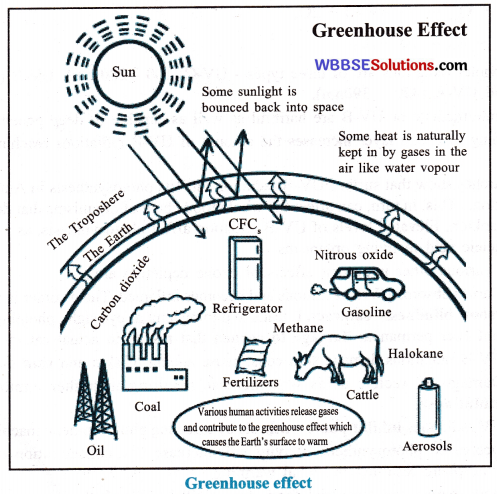
The atmospheric greenhouse gases forms a blanket like covering around the earth. It controls the escape of heat from the earth’s surface to outer space and keeps it warm and hostile. This phenomenon is known as greenhouse effect.
It is actually a warming effect found in greenhouse by allowing solar radiations to pass in but preventing long wave heat radiations to pass out due to glass panels, water vapours and carbon dioxide. Because of it greenhouses are used for growing tropical plants in temperate areas.
The capacity of atmosphere to keep the Earth warm depends on the amount of greenhouse gases the gases which are transparent to solar radiation but retain and partially reflect back long wave heat radiations.
Greenhouse gases radiate a part of this solar energy back to the earth. The phenomenon is called greenhouse flux. Because of greenhouse flux, the mean annual temperature of earth is 15° C.
Recently the concentration of greenhouse gases has started rising resulting in enhanced greenhouse effect that is resulting in increasing the mean global temperature. It is called global warming.
The various greenhouse gases are CO2 (warming effect 60% ), CH4 (effect 20%), chlorofluorocarbons or CFCs (14%) and nitrous oxide (N2 O 6%). Others of minor significance are water vapour and ozone.

WBBSE Class 10 Life Science Solutions Chapter 5B Environmental Pollution 5

Effects of green house gases
CO2 fertilization : Increase in CO2 concentration increases the rate of photosynthesis especially in C3 plants. Amount of stomatal conductance will decrease resulting in lower rate of transpiration. There will be greater root growth, more mycorrhizal development and increase in N2 fixation in root nodules. So that plants will grow more successfully in regions of water scarcity and nutrient poor soils. However, these beneficial effect will be nullified by negative effects of global warming.
Global warming : It is believed that increase in concentration of greenhouse gases has resulted in rise of atmospheric temperature. Rise in temperature will be slight in tropics, moderate in middle latitudes and maximum in polar regions (World Climate Programme, WCP, 1988).

Global warming has many fold effects as :
Effect on weather and climate: There is increase in average temperature by 1.4-5.8° centigrade by the year 2100 . Warming of atmosphere increases its moisture containing capacity. All these are responsible for change in precipitation pattern. This climatic change is harmful for human health.

Sea level change : The global warming is responsible for increase in sea level and melting of-glaciers and Greenland ice sheets.
Effects on range of species distribution : Due to increase in global warming, many species are expected to shift poleward or towards high elevation in mountain regions.

Food production : Increase in temperature causes extensive growth of weeds which ultimately decrease crop production.
Some strategies should be followed to deal with global warming:
Vegetation cover should be increased for photosynthetic utilization of carbon dioxide.
Chlorofluorocarbon should be replaced with some other substitute having little effect on global warming.
Reducing the use of nitrogen fertilizers to reduce nitrous oxide emission.
Minimizing the use of fossil fuel to reduce the greenhouse gas emission.

Question 8.
What do you mean by air pollution?
Answer:
Air Pollution

  1. Oxides of Carbon : Carbon monoxide, Carbon dioxide
  2. Oxides of Nitrogen : Nitrogen oxide and Nitrogen dioxide
  3. Oxides of Sulphur : Sulphur dioxide and Sulphur trioxide.
  4. Photochemical oxidants : Ozone, PAN (Peroxyacyl nitrate) aldehydes and other organic compounds produced by photochemical reactions between primary pollutants.
  5. Hydrocarbons : Products of incomplete combustion of automobile fuel.
  6. Particulate Matter : Fine solid and liquid particles, like flyash and soot from burning of coal; dust particles from industries.
  7. Chemical released in vapour form as fluorocarbons, chloro-fluoromethanes.

WBBSE Class 10 Life Science Solutions Chapter 5B Environmental Pollution

Sources :

  1. Effect-on plants : Like Chlorosis, necrosis, bleaching, premature fall of leaves, reducing photosynthetic capacity etc. leading to the damage of the crops.
  2. Effects on animals and man : Like dryness of skin, congestion of respiratory tract, reduction in oxygen transport, damage to nervous system; chromosomal aberrations and cancer.
  3. Climatic changes: Like Green House effect leading to global warming. Depletion of ozone layer and consequent increase in ultraviolet radiations which can cause mutations and cancer.
  4. Aesthetic loss: Like spoiling the beauty of nature.

WBBSE Class 10 Life Science Solutions Chapter 5B Environmental Pollution 6

Effects :

  1. Stationery combustion sources
  2. Mobile combustion sources
  3. Industrial processes and
  4. Other sources

Question 9.
What are the sources and effects of Water Pollution?
Answer:
WBBSE Class 10 Life Science Solutions Chapter 5B Environmental Pollution 7
Sources :

  1. Community waste water : as discharges from homes and commercial and industrial establishments connected to municipal sewage system.
  2. Industrial waste : as chemical wastes which are discharged into rivers or streams.
  3. Agricultural sources: addition of fertilisers to crops results in water pollution in water-bodies.
  4. Marine pollution : navigational discharges of oil grease and petroleum products, detergents, sewage and garbage including radioactive wastes.

Effects :
The main effects of water pollution are:

  1. Compounds of mercury, arsenic and lead are poisonous and they may affect the waste treatment plant.
  2. Organic sulphur compounds interfere with nitrification.
  3. Inorganic nitrates and phosphates stimulate excessive plant growth in lakes and reservoirs.
  4. The organochlorines from pesticides are highly persistent and pass through food chains. They mainly accumulate in the nervous tissue and affect the nervous system.
  5. The broad spectrum pesticides used currently cause mass destruction of aquatic life through their accidental release or excessive use.
  6. Due to the presence of very fine suspended matter, water becomes unclear, unfit for drinking and industrial use.
  7. Presence of free chlorine, phenol, hydrogen, ammonia, algae and microorganisms make it bad in taste and odour, and cause infection too.
  8. Formation of foam due to presence of soaps, detergents and alkalies.

WBBSE Class 10 Life Science Solutions Chapter 5B Environmental Pollution

Question 10.
What are the effects of radioactive pollution?
Answer:
Effects of radioactive pollution
The effect of radioactive pollutants depends on :
Strength of radiations
Rate of diffusion and deposition of the pollutants
The length of time for which the tissue is exposed to radiation
Half-life of pollutants. Environmental factors (wind, temperature, rainfall) also influence their effects.
Radioactive pollution affects all the organisms including humans. It causes cancer, mutations and even death in humans and animals.
On the basis of their action on cells, radiations are divided into two categories non-ionising radiations and ionising radiations.
Non ionising radiation refers to any type of electromagnetic radiation, that does not carry enough energy per quantum to ionize atoms or molecules.
Near ultra-violet, visible light, infrared, microwave, radio waves are all examples of non-ionising radiations.
Ionising radiation consists of electromagnetic waves that are energetic enough to detach electrons from atoms or molecules ionising them.
Ionising radiations include ultra-violet rays. X-rays, cosmic rays and atomic radiations which damage the living cells by ionisation (shifting the electrons from one to other bio-molecule). Ultra-violet rays (100-300 nm) are known to cause sunburn, snow blindness, inactivation of organic bio-molecules, formation of thymine-dimer in DNA and skin cancer.
Strontium-90 behaves like calcium in biogeochemical cycling of materials in ecosystem. It accumulates in the bones to cause bone cancer and tissue degeneration in a number of organs.
Iodine-131 damages WBCs, bone marrow, spleen, lymph nodes, skin cancer, sterility and defective eye sight.
Radioactive iodine may also cause cancer of thyroid glands.
Cesium-137 brings about nervous, muscular and genetic changes.
Uranium causes skin cancers and tumors in the miners.
Actively growing and dividing cells like those of stratum germinativum, intestinal lining, bone marrow; gonads and embryo (with all cells rapidly growing and dividing) are more susceptible to ionising radiations.
A foetus in the womb may be killed by radiation which has little effect on the mother. Cancer cells are destroyed by radiation as they are of actively growing type. It has been reported that the pine seedlings are destroyed by radiations whereas the trees flourish.
Less active and non-dividing cells like osteocytes of bones, muscles fibres and neurons are not easily damaged by radiation.

Multiple Choice Questions : 1 Mark

Question 1.
Pollution is an undesirable change in physical, chemical and biological properties of
(a) Air
(b) Soil
(c) Water
(d) All of these
Answer:
(d) All of these

Question 2.
An indicator of air pollution is
(a) Lichens
(b) Mosses
(c) Ferns
(d) Pines
Answer:
(a) Lichens

Question 3.
Which of the following is the chief source of air pollution?
(a) Automobiles
(b) Burning coal
(c) Industries
(d) All of these
Answer:
(d) All of these

Question 4.
Carbon dioxide, nitrates and phosphates are
(a) Producers
(b) Decomposers
(c) Biotic substances
(d) Abiotic substances
Answer:
(c) Biotic substances

Question 5.
The hazardous metal pollutant from automobiles which hampers haemoglobin formation is
(a) NO2
(b) SO2
(c) Lead
(d) Mercury
Answer:
(c) Lead

Question 6.
Which of the following is an important atmospheric pollutant?
(a) Carbon monoxide
(b) Carbon dioxide
(c) Sulphur dioxide
(d) Hydrocarbon
Answer:
(a) Carbon monoxide

WBBSE Class 10 Life Science Solutions Chapter 5B Environmental Pollution

Question 7.
Which of the following is the least harmful pollutant?
(a) CO
(b) SO2
(c) NO2
(d) CO2
Answer:
(d) CO2

Question 8.
The presence of ozone (O3) in the atmosphere of our earth
(a) Helps in checking the penetration of ultra-violet rays on the earth
(b) Is advantageous since it supplies O2 for people travelling in jets
(c) Hinders higher rate of photosynthesis
(d) Both (b) and (c)
Answer:
(a) Helps in checking the penetration of ultra-violet rays on the earth

Question 9.
If BOD of a river is high, it means the river
(a) Is not polluted
(b) Is very polluted
(c) Does not have green plants
(d) Gets least amount of light
Answer:
(b) Is very polluted

Question 10.
The disease which is not caused by polluted water is
(a) Dysentery
(b) Jaundice
(c) Tuberculosis
(d) Typhoid
Answer:
(d) Typhoid

Question 11.
Which of the following is the index of pollution in a polluted lake?
(a) Algae
(b) Daphnia
(c) Frog
(d) Aquatic weeds
Answer:
(b) Daphnia

Question 12.
A powerful eye irritant present in smog is
(a) Nitric acid
(b) Peroxyacetyl nitrate
(c) Sulphur dioxide
(d) Ozone
Answer:
(b) Peroxyacetyl nitrate

WBBSE Class 10 Life Science Solutions Chapter 5B Environmental Pollution

Question 13.
The atmosphere pollutant which is not produced by the exhaust of motor vehicle in Delhi is
(a) Carbon monoxide
(b) Sulphur dioxide
(c) Flyash
(d) Hydrocarbon gases
Answer:
(c) Flyash

Question 14.
In Bombay, the major air pollutant is
(a) Carbon monoxide
(b) Hydrocarbons
(c) Algal spores
(d) All of these
Answer:
(a) Carbon monoxide

Question 15.
The most polluted city in the world is
(a) Tokyo
(b) New York
(c) Calcutta
(d) Mexico
Answer:
(d) Mexico

Question 16.
Which one is the major source of pollution in metropolitan cities?
(a) Pesticides
(b) Automobiles
(c) Industries
(d) Radioactive substances
Answer:
(c) Industries

Question 17.
The pollutant which directly affects the nervous system is
(a) DDT
(b) Aldrin
(c) Lindane
(d) Organic phosphate
Answer:
(d) Organic phosphate

Question 18.
Some effect of SO2 and its transformation products on plants includes
(a) Plasmolysis
(b) Chlorophyll destruction
(c) Golgi body destruction
(d) All of these
Answer:
(b) Chlorophyll destruction

WBBSE Class 10 Life Science Solutions Chapter 5B Environmental Pollution

Question 19.
In the atmosphere, the accumulation of which gas does not lead to green house effect?
(a) N2
(b) NO2
(c) CO
(d) All of these
Answer:
(d) All of these

Question 20.
The environmental planning organisation is
(a) ICAR
(b) NEERI
(c) NCL
(d) NPO
Answer:
(b) NEERI

Question 21.
Contamination of radioactive materials are dangerous because it causes
(a) Biological magnification
(b) Gene mutation
(c) Photochemical smog
(d) Ozone destruction
Answer:
(b) Gene mutation

Question 22.
Which of the following is not an ionising radiation ?
(a) Alpha rays
(b) Beta rays
(c) UV rays
(d) Infrared
Answer:
(d) Infrared

Question 23.
The pollutant that is degradable but toxic to workers
(a) Melathion
(b) DDT
(c) Aldrin
(d) Lindane
Answer:
(a) Melathion

Question 24.
The Environment (Protection) Act to protect and improve the quality of environment (air, water and soil) was passed by the Government of India in the year
(a) 1971
(b) 1974
(c) 1981
(d) 1986
Answer:
(d) 1986

Question 25.
Which one of the following occurs in radioactive fallout and behaves like calcium in biogeochemical cycling of material in ecosystem?
(a) Strontium-30
(b) Cobalt-60
(c) Cesium-137
(d) None of these.
Answer:
(a) Strontium-30

WBBSE Class 10 Life Science Solutions Chapter 5B Environmental Pollution

Question 26.
Ozone prevents the entry of
(a) Infrared rays
(b) Visible rays
(c) UV rays
(d) X-rays
Answer:
(c) UV rays

Question 27.
Ozone layer of upper atmosphere is being destroyed by
(a) SO2
(b) Chlorofluorocarbons (CFCs)
(c) CO2
(d) Both (a) and (b)
Answer:
(b) Chlorofluorocarbons (CFCs)

Question 28.
Green muffler is used against which type of pollution?
(a) Air
(b) Soil
(c) Water
(d) Noise
Answer:
(d) Noise

Question 29.
Ozone hole refers to
(a) Reduction in the thickness of ozone layer in stratosphere
(b) Reduction in ozone layer in stratosphere
(c) Hole in the ozone layer
(d) Increased concentration of ozone
Answer:
(a) Reduction in the thickness of ozone layer in stratosphere

Question 30.
UV-B radiation from sun causes which of the following disorder of eyes?
(a) Cataract
(b) Glaucoma
(c) Dilation of pupil
(d) Some defect in retina
Answer:
(a) Cataract

Question 31.
Sound above is termed as noise
(a) 95 dB
(b) 80 dB
(c) 115 dB
(d) 140 dB
Answer:
(b) 80 dB

WBBSE Class 10 Life Science Solutions Chapter 5B Environmental Pollution

Question 32.
Flyash is a
(a) Mining waste
(b) Hospital waste
(c) Industrial waste
(d) Municipal waste
Answer:
(c) Industrial waste

Question 33.
Green house effect is warming due to
(a) Infrared rays reaching earth
(b) Moisture layer in atmosphere
(c) Increase in temperature due to increase in carbon dioxide concentration of atmosphere
(d) Ozone layer of atmosphere.
Answer:
(c) Increase in temperature due to increase in carbon dioxide concentration of atmosphere

Question 34.
ODS means
(a) Ozone developing substances
(b) Ozone depleting substances
(c) Ozone data source
(d) Office data secrecy
Answer:
(b) Ozone depleting substances

Question 35.
Montreal Protocol was signed in
(a) 1978
(b) 1987
(c) 1991
(d) 1993
Answer:
(b) 1987

Question 36.
Kyoto conference is connected with
(a) Limiting production of CO2
(b) Developing alternatives to ODS
(c) Both (a) and (b)
(d) Reduction in use of energy
Answer:
(c) Both (a) and (b)

WBBSE Class 10 Life Science Solutions Chapter 5B Environmental Pollution

Question 37.
CFCs split up in stratosphere to release chlorine by the action of
(a) UV-A
(b) UV-B
(c) UV-C
(d) All of these.
Answer:
(c) UV-C

Question 38.
Thermal pollution causes
(a) Increase in metabolic activities of aquatic organisms
(b) Decreases in DO contents of water
(c) Oxygenation in water
(d) Both (a) and (b)
Answer:
(d) Both (a) and (b)

Question 39.
Greenhouse gases are
(a) Absorbers of long-wave heat radiations from earth
(b) Transparent to both solar radiations and long-wave radiations from earth
(c) Absorbers of solar radiations for warming the atmosphere of earth
(d) Transparent to emissions from earth for passage into outer space.
Answer:
(a) Absorbers of long-wave heat radiations from earth

Question 40.
Climate of the world is threatened by
(a) Increasing concentration of atmospheric oxygen
(b) Decreasing amount of atmospheric oxygen
(c) Increasing amount of atmospheric carbon dioxide
(d) Decreasing amount of atmospheric carbon dioxide.
Answer:
(c) Increasing amount of atmospheric carbon dioxide

Question 41.
The first effect of noise is
(a) Constriction of blood vessels
(b) Anxiety and stress reactions
(c) Increased heart beat
(d) Digestive spasm
Answer:
(b) Anxiety and stress reactions

Question 42.
Ban of DOT and start of Ganga action plan occurred in the year
(a) 1982 and 1985
(b) 1985 and 1986
(c) both in 1982
(d) both in 1985
Answer:
(b) 1985 and 1986

Question 43.
World environment day is
(a) 5th June
(b) 14th November
(c) 2nd October
(d) 28th February
Answer:
(a) 5th June

Question 44.
The worst environmental hazards created accidents in nuclear power plant and MIC gas tragedy respectively in
(a) Russia in 1990 and Bhopal in 1996
(b) Ukrain in 1986 and Bhopal in 1984
(c) Bhopal in 1994 and Russia in 1999
(d) Ukrain in 1988 and USA in 1984
Answer:
(b) Ukrain in 1986 and Bhopal in 1984

WBBSE Class 10 Life Science Solutions Chapter 5B Environmental Pollution

Question 45.
The ‘Earth Summit’ was held at
(a) Geneva
(b) New Delhi
(c) Sydney
(d) Rio-de-janeiro
Answer:
(d) Rio-de-janeiro

Fill in the blanks with suitable words

1. The agents that pollute the environment are called _______
2. ______ percent of atmospheric pollution is caused due to activities of modern man.
3. ______ pollutants may be solid or liquid particles.
4. Pollutants are evaluated on the basis of the amount and their relative _______
5. Ozone and nitrous compounds are _______ pollutants.
6. Oxidation of sulphur in the fossil fuels produces harmful gases ______ and _____
7. Particulate pollutants are produced as result of incomplete combustion of hydrocarbons and are ______
8. _______ serve as pollution indicators.
9. ________ is an agent or factor that causes cancer.
10. ________ are the chemicals that are released in the air with a force in the form
of mist or vapour.
11. The process of polluting streams, rivers and lakes by excessive addition of organic fertilizers is known as ________
12. ______ pollution is caused by the discharge of hot water from cooling towers of power plants.
13. _______ is a physical phenomena in which energy travels through the space.
14. ______ is the lung disease caused due to inhalation of gritty dust.
15. Threshold is the _______ is a physical phenomena in which energy travels through the space. is the lung disease caused due to inhalation of gritty dust. intensity at which a sound becomes perceptible.
Answer:
1. pollutants
2. 0.05
3. particulate
4. toxicity
5. secondary
6. SO2, SO3
7. carcinogenic
8. Lichens
9. carcinogen
10. aerosols
11. eutrophication
12. thermal
13. radiation
14. silicosis
15. lowest

WBBSE Class 10 Life Science Solutions Chapter 5B Environmental Pollution

State whether the following statements are True or False. If False, then write the correct statement.

Question 1.
Atmospheric pollution is caused due to addition of harmful substances from uncontrollable non-human sources.
Answer:
True.

Question 2.
Pollutants resulting from human activities are mainly discharged in remote and isolated areas.
Answer:
False. Pollutants resulting from human activities are mainly discharged in cities and industrial centres.

Question 3.
Vapours of compounds whose boiling point is below 200° C are classified as gaseous pollutants.
Answer:
True.

Question 4.
Lung diseases are more common in rural areas because of more air pollution.
Answer:
False. Lung diseases are more common in urban areas because of more air pollution.

Question 5.
Vapours of compounds whose boiling point is below 200° C are known as particulate.
Answer:
False. They are known as gaseous.

Question 6.
Products of atmospheric reactions of hydrocarbons and nitrogen oxides in the presence of sunlight are called secondary pollutants.
Answer:
True.

Question 7.
Atmospheric diffusion of air is maximum at elevations of 3000m above the earth’s surface.
Answer:
False. It is minimum at this altitude.

WBBSE Class 10 Life Science Solutions Chapter 5B Environmental Pollution

Question 8.
Dust and mist consist of particles smaller than one micrometre.
Answer:
False. They consist of particles larger than one micrometer.

Question 9.
Lead is poisonous because it hampers haemoglobin formation.
Answer:
True.

Question 10.
Nitrogen oxide impairs the functioning of lungs by causing accumulation of water in the air spaces.
Answer:
True.

Question 11 .
Ethylene gas bleaches and damages plant-leaves.
Answer:
False. Ethylene causes premature failing of leaves.

WBBSE Class 10 Life Science Solutions Chapter 5B Environmental Pollution

Question 12.
Abundant growth of lichens indicates pollution free air.
Answer:
True.

WBBSE Class 10 Life Science Solutions Chapter 5A Nitrogen Cycle

Detailed explanations in West Bengal Board Class 10 Life Science Book Solutions Chapter 5A Nitrogen Cycle offer valuable context and analysis.

WBBSE Class 10 Life Science Chapter 5A Question Answer – Nitrogen Cycle

Short Answer Type Questions : 2 Marks

Question 1.
What is the most abundant form under which nitrogen is found in nature?
Answer:
The most abundant nitrogen-containing molecule found in nature is molecular nitrogen (N2). The air is 80% constituted of molecular nitrogen.

Question 2.
Under which form is nitrogen fixed by living beings?
Answer:
Most living beings cannot use molecular nitrogen to obtain nitrogen atoms: Producers fix nitrogen mainly from nitrate (N\(\mathbf{O}_3^{-}\)). Some plants also fix nitrogen from ammonia. Consumers and decomposers acquire nitrogen through digestion of mainly proteins and nucleic acids from the body of other living beings.

Question 3.
Why is leguminous crop rotation used in agriculture?
Answer:
Leguminous crop rotation and other types of crop rotation are used in agriculture because many bacteria important for the nitrogen cycle live in these plants. Leguminous crop rotation (or conjointly with the main crop) helps the soil to become rich in nitrates, which are then absorbed by the plants. Green manure, the covering of the soil with grass and leguminous plants, is also a way to improve the fixation of nitrogen and is an option for avoiding chemical fèrtilizers.

WBBSE Class 10 Life Science Solutions Chapter 5A Nitrogen Cycle

Question 4.
Define biological nitrogen fixation.
Answer:
The synthesis of organic nitrogenous compounds from atmospheric nitrogen by certain micro-organisms is called biological nitrogen fixation.

Question 5.
Why do plants need fixation of atmospheric nitrogen?
Answer:
Higher plants cannot directly utilize molecular nitrogen of the atmosphere. But certain micro-organisms can utilize atmospheric nitrogen. There are two types of nitrogen fixing micro-organisms: Asymbiotic and symbiotic.

Question 6.
What is the role of lichens in biological nitrogen fixation?
Answer:
Nostoc and Scytonema develop symbiotic association with fungi. This association is called lichens. The algal components fix the molecular nitrogen in the form of organic compounds.

Question 7.
What is the role of fungi in biological nitrogen fixation?
Answer:
Several species of Actinomycetes develop mycorrhizal association with the root of Casurina, Pinus and other plants. These mycorrhizae may be ectotropic and endotropic mycorrhizae. These fungi have ability to fix atmospheric nitrogen.

Question 8.
What is leghaemoglobin?
Answer:
The nodule is pink in colour. The pink colour is due to the presence of pigment leghaemoglobin. This pigment is synthesized by the host cells in response to bacterial infection. It is similar to haemoglobin of red blood cells of mammals.

WBBSE Class 10 Life Science Solutions Chapter 5A Nitrogen Cycle

Question 9.
Which intermediate compound is formed during biological nitrogen fixation?
Answer:
Diamide (NH=NH) and hydrazine (NH2-NH2) and NH3-NH3 are the intermediate compounds.

Question 10.
Define the following terms :
Answer:
Nitrogen fixation: The synthesis of organic nitrogenous compounds from atmospheric nitrogen by certain micro-organisms is called biological nitrogen fixation.
Asymbiotic organism : The free living nitrogen fixing organisms are called are asymbiotic organisms.
Leghaemoglobin : The nodule is pink in colour. The pink colour is due to the presence of pigment leghaemoglobin.

Long Answer Type Questions : 5 Marks

Question 1.
Describe nitrogen cycle briefly.
Answer:
The process by which limited amount of nitrogen is circulated and re-circulated throughout the world of living organisms is known as the nitrogen cycle. The chief reservoir of nitrogen is the atmosphere. Nitrogen makes up 78 per cent of the gases in atmosphere. Most living things cannot use atmospheric nitrogen. They cannot make amino acid and other nitrogen containing compounds from this nitrogen. They are dependent on nitrogen present in soil minerals. The shortage of nitrogen in the soil is the major limiting factor in plant growth. The living organism obtains nitrogen by two methods: Nitrogen fixation and decomposition.

(a) Nitrogen fixation : There are different methods to fix atmospheric nitrogen
i. Asymbiotic nitrogen fixation : The free living nitrogen fixing organisms are called asymbiotic organisms. There are following organisms which fix the atmospheric nitrogen: bacteria, anaerobic bacteria, blue green algae (cyanobacteria) and lichens. The example of anaerobic bacteria is Clostridium and the example of aerobic bacteria is Azotobacter. The example of blue green algae is anabaena.

WBBSE Class 10 Life Science Solutions Chapter 5A Nitrogen Cycle

ii. Symbiotic Nitrogen Fixation : It is the most important method of nitrogen fixation. These are of two types : Fungi (Actinomycetes) and Nodule forming Rhizobium species. Some fungi develop mycorrhizal association and fix atmospheric nitrogen. Similarly, some bacteria live in the nodule of the leguminous plants like bean, pea and gram. They fix atmospheric nitrogen.

iii. Nitrogen fixation by Electrification : The lightening of the thunder storm fixes the atmospheric nitrogen. Nitrogen and oxygen of the atmosphere combine with, each other during lightning. They form nitric oxide. It combines with more oxygen to form nitrogen peroxide. It is changed into nitric acid. Nitric acid reacts with alkalies of soil and form nitrates. These nitrates are used by the plants.

(b) Release of nitrogen by decomposition : Nitrogen is present in also present in dead plants and animals. Bacteria and fungi decompose these dead plants and animals and form nitrates and ammonia. These compounds are used up by plants. It has following steps:

i. Ammonification : The breakdown of nitrogenous compound like protein, amino acids into ammonia with the help of micro-organism like fungi and bacteria is called ammonification. Soil contains many organic materials in the form of complex organic compounds like protein, amino acids, nucleic acid and nucleotides. Most of the nitrogen formed in the soil by the decomposition of these organic compounds. Bacteria and fungi decompose these nitrogenous compounds into simple compounds. These microorganisms use the proteins and amino acids and release excess of ammonia (NH3) or ammonium ions (NH\(\mathbf{O}_4^{+}\)). This process is known as ammonification.

ii. Nitrification : Several bacteria in soil oxidize ammonia or ammonium ions into nitrates. This oxidation is known as nitrification.

iii. Assimilation : The absorption and utilization of ammonia or nitrates by the plant is called assimilation. The plants can utilize ammonium directly. But most of the nitrogen moves from the soil into the roots in the form of nitrate. The nitrates are reduced back to ammonium in plant. This assimilation process requires energy. These ammonium ions finally transferred to carbon containing compounds. These compounds produce amino acids and other nitrogenous organic compounds.

(c) Loss of nitrogen : There are two sources of loss of nitrogen.
i. Leaching : Nitrates is soluble in water. So it is leached out of the soil by rain water. It is driven into the ground water streams, lakes and into the oceans. Some of it is utilized by algae. But some nitrogen is lost into the deep sediments and become part of the rock.

ii. Denitrification : The soil contains many denitrifying bacteria like pseudomonas, which break the nitrates and release the gaseous nitrogen into atmosphere. This process is known as denitrification.

WBBSE Class 10 Life Science Solutions Chapter 5A Nitrogen Cycle 1

Question 2.
Draw the word diagram of N2 cycle.
Answer:
WBBSE Class 10 Life Science Solutions Chapter 5A Nitrogen Cycle 2

Question 3.
Distinguish the following terms :
Answer:
WBBSE Class 10 Life Science Solutions Chapter 5A Nitrogen Cycle 3

Multiple choice questions : 1 Mark

Question 1.
The conversion of nitrogen to ammonia or nitrogenous compounds is called as
(a) Nitrogen assimilation
(b) Nitrogen fixation
(c) Denitrification
(d) Nitrification
Answer:
(b) Nitrogen fixation

WBBSE Class 10 Life Science Solutions Chapter 5A Nitrogen Cycle

Question 2.
Plants absorbs N2 in the form of
(a) nitrites (N\(\mathbf{O}_2^{-}\))
(b) nitrates (N\(\mathbf{O}_3^{-}\))
(c) ammonium (N\(\mathbf{H}_4^{+}\))
(d) all of these
Answer:
(d) all of these

Question 3.
Plants cannot absorb molecular N2 in the atmosphere because
(a) N2 has double bonds making it highly stable
(b) Abundance in the atmosphere inhibits absorption
(c) N2 has triple bonds making it highly stable
(d) None of these
Answer:
(c) N2 has triple bonds making it highly stable

Question 4.
Symbiotic N2 fixing cyanobacteria are present in all except
(a) Anthoceros
(b) Azolla
(c) Cycas
(d) Gnetum
Answer:
(d) Gnetum

Question 5.
All the following are free living N2 fixers except
(a) Rhizobium
(b) Azotobacter
(c) Rhodospirillum
(d) Clostridium
Answer:
(a) Rhizobium

WBBSE Class 10 Life Science Solutions Chapter 5A Nitrogen Cycle

Question 6.
Which of the following N2 fixer is involved in symbiotic association with legumes forming root nodules?
(a) Rhizobium
(b) Azotobacter
(c) Rhodospirillum
(d) Clostridium
Answer:
(a) Rhizobium

Question 7.
Anabaena, a N2-fixer is present in the root pockets of
(a) Marselia
(b) Salvinia
(c) Pistia
(d) Azolla
Answer:
(d) Azolla

Question 8.
Splitting of dinitrogen molecule into free nitrogen atom in biological N2 fixation is carried out by
(a) hydrogenase
(b) nitrogenase
(c) dinitrogenase
(d) nitrate reductase
Answer:
(b) nitrogenase

Question 9.
The conversion of amino acids to ammonium by soil decomposers is called
(a) ammonification
(b) mineralization
(c) deamination
(d) Both a and b
Answer:
(d) Both a and b

Question 10.
Industrial fixation is accomplished by
(a) Helmonts process
(b) Haber process
(c) Friedel Crafts reaction
(d) Reimer Tiemann Reaction
Answer:
(b) Haber process

Question 11.
To fix one molecule of nitrogen
(a) 6 ATP molecules are required
(b) 12 ATP molecules are required
(c) 16 ATP molecules are required
(d) 20 ATP molecules are required
Answer:
(c) 16 ATP molecules are required

Question 12.
The root nodules of legumes contain a pink pigment which has high affinity for oxygen is
(a) nitric oxide (NO) haemoglobin
(b) leghaemoglobin
(c) haemoglobin
(d) bacterial haemoglobin
Answer:
(b) leghaemoglobin

Question 13.
Conversion of N\(\mathbf{O}_2^{-}\)to N\(\mathbf{O}_3^{-}\)is carried out by
(a) Nitrosomonas
(b) Nitrososcoccus
(c) Nitrobacter
(d) Clostridium
Answer:
(c) Nitrobacter

Question 14.
The process of conversion of soil \(\mathbf{O}_3^{-}\)to N2 is called
(a) nitrification
(b) denitrification
(c) ammonification
(d) nitrogen fixation
Answer:
(b) denitrification

Question 15.
Leghaemoglobin creates
(a) Anaerobic condition for optimum activity of nitrogenase
(b) Aerobic condition for optimum activity of nitrogenase
(c) Required oxygen concentration for optimum activity of nitrogenase
(d) Suitable environment for nodule formation
Answer:
(a) Anaerobic condition for optimum activity of nitrogenase

WBBSE Class 10 Life Science Solutions Chapter 5A Nitrogen Cycle

Question 16.
Which of the followings is an anaerobic bacterium?
(a) Azotobacter
(b) Nitrobacter
(c) Clostridium
(d) None of these
Answer:
(c) Clostridium

Question 17.
Which of the followings is non-aerobic bacterium?
(a) Azotobacter
(b) Nitrobacter
(c) Clostridium
(d) None of these
Answer:
(a) Azotobacter

Question 18.
Which of the followings fixed nitrogen in waterlogged soil?
(a) Nostoc
(b) Nitrobacter
(c) Clostridium
(d) None of these
Answer:
(a) Nostoc

Question 19.
Which of the followings is a group of biological nitrogen fixing fungi?
(a) Nostacles
(b) Actinomycetes
(c) Casurina
(d) None of these
Answer:
(b) Actinomycetes

WBBSE Class 10 Life Science Solutions Chapter 5A Nitrogen Cycle

Question 20.
The nodule forming bacteria are:
(a) Azotobacter
(b) Nitrobacter
(c) Clostridium
(d) Rhizobium
Answer:
(c) Clostridium

Very Short Answer Type Questions : 1 Mark

Question 1.
Name the acids form through Natural process in N2 cycle.
Answer:
Nitric acid, Nitrogen acid.

Question 2.
Name one bacterium which can fix N2 symbiotically.
Answer:
Rhizobium bacterium.

Question 3.
Name one aerobic bacteria which can fix N2.
Answer:
Azotobacter.

Question 4.
Name one anaerobic bacteria which can fix N2.
Answer:
Clostridium.

Question 5.
Name one ammonifying bacterium.
Answer:
Bacillus mycoides.

WBBSE Class 10 Life Science Solutions Chapter 5A Nitrogen Cycle

Question 6.
Write two effects of N2 cycle on human.
Answer:
(i) Nutrient cycle
(ii) Algal bloom in acquatic region.

Question 7.
_______ is the suspended liquid particle.
Answer:
Aerosol.

Fill in the blanks :

Question 8.
The free living nitrogen fixing organisms are called _ organisms.
Answer: asymbiotic

Question 9.
Several species of develop mycorrhizal association with the root of Casurina, Pinus and other plants.
Answer:
actinomycetes

WBBSE Class 10 Life Science Solutions Chapter 5A Nitrogen Cycle

Question 10.
Name the N2 fixing organisms which have intermediate compounds
(a) NH=NH,
(b) NH2-NH2
Answer:
(a) asymbiotic
(b) actinomycetes.

WBBSE Class 10 Life Science Solutions Chapter 4B Survival Strategies: Adaptation

Detailed explanations in West Bengal Board Class 10 Life Science Book Solutions Chapter 4B Survival Strategies: Adaptation offer valuable context and analysis.

WBBSE Class 10 Life Science Chapter 4B Question Answer – Survival Strategies: Adaptation

Short Answer Type Questions : 2 Marks

Question 1.
What is an adaptation?
Answer:
An adaptation is a way an animal’s body helps it survive, or live in its environment. Camels have learned to adapt (or change) so that they can survive. Animals depend on their physical features to help them obtain food, keep safe, build homes, withstand weather and attract mates. These physical features are called physical adaptations. They make it possible for the animal to live in a particular place and in a particular way. Each adaptation has been produced by evolution. This means that the adaptation have developed over many generations.

Question 2.
Write the examples of the basic adaptations that help creatures survive.
Answer:

  • Shape of a bird’s beak
  • The number of fingers
  • Colour of the fur
  • The thickness or thinness of the fur
  • The shape of the nose or ears

Question 3.
What is a habitat?
Answer:
The surroundings where plants and animals live, is called their habitat. A habitat provides suitable climatic conditions like food and shelter so that plants and animals can live there.

WBBSE Class 10 Life Science Solutions Chapter 4B Survival Strategies: Adaptation

Question 4.
Do all organisms live in same habitat?
Answer:
No, all organisms do not live in same habitat. Some may share the habitat e.g. lion and deer. For example camel can live in deserts only while frogs can survive in fresh/rain water.

Question 5.
Are all forests habitats of tigers or lions?
Answer:
No all forests are not habitats of tigers and lions. For example, tigers can live in forests, which have thick forests, water (ponds and streams) and rich supply of food (e.g. deer).

Question 6.
How is cactus adapted to survive in a desert?
Answer:
Cactus survives in deserts due to following adaptations-It has flat green stem to store water and prepare food by photosynthesis. The stem is also covered with a thick waxy layer, which helps to retain water. It’s roots that go very deep into the soil for absorbing water. Leaves are turned into spines to prevent loss of water.

Question 7.
Name two plants and two animals of mountain regions.
Answer:
Animals-yak, snow leopard, mountain goat. Plants-pines, spruce, fir, cedar.

Question 8.
Give an example of a non-living thing, which shows any two characteristics of living things.
Answer:
A bus or a car which shows movement and consume energy (petrol).

Question 9.
Which of the non-living things listed below, were once part of a living thing? Butter, leather, soil, wool, electric bulb, cooking oil, salt, apple, rubber.
Answer:
Following are the things which were once part of living beings :

  • Butter : Obtained from milk from dairy animals.
  • Leather : From animal skin of buffaloes, cows etc.
  • Wool : From hair of sheep and goat.
  • Cooking oil : seeds of plants (e.g. mustard) or by grinding whole plant (e.g. olive).
  • Apple : fruit from apple tree.
  • Rubber : Latex of rubber tree. Following things were never part of living beings-soil, electric bulb, salt.

Question 10.
List the common characteristics of the living things.
Answer:

  1. Movement : All organisms show movement of one kind or another. Animals can move from one place to another. While plants also show movement e.g. bend towards light.
  2. Respiration : All organisms breathe and respire. They intake oxygen and release carbon dioxide.
  3. Feeding: They consume food to stay fit and grow.
  4. Growth and Death: All living beings grow i.e. with age they become larger in size and eventually die.
  5. Excretion : They remove waste material from their bodies.
  6. Reproduction : Living beings bear children.
  7. Stimuli or Sensitivity : All living beings react to external changes around them.

WBBSE Class 10 Life Science Solutions Chapter 4B Survival Strategies: Adaptation

Question 11.
Give examples of animals which give birth to young ones.
Answer:
Humans, dogs, cats (mammals) give birth to young ones.

Question 12.
Give examples of terrestrial habitats.
Answer:
Deserts, forests, grasslands, coastal regions, mountain regions.

Question 13.
Give examples of aquatic habitats.
Answer:
Aquatic habitat includes rivers, ponds, lakes, ocean and swamps.

Question 14.
What is Acclimatization? How it is different from adaptation?
Answer:
The small adjustments by the body to overcome small changes in the surrounding atmosphere for a short period of time are called acclimatization. While in adaptation, it takes thousands of years for a living being to adapt to its habitat.

Question 15.
What are the two components of habitat?
Answer:
Biotic component, abiotic component.

WBBSE Class 10 Life Science Solutions Chapter 4B Survival Strategies: Adaptation

Question 16.
Why is adaptation necessary? What does happen to those animals who do not adapt to the environment?
Answer:
Over thousands of years the abiotic factors of a region change. To survive animals and plants must adapt these changes. Those animals which cannot adapt these changes, die out, and only the adapted ones survive.

Question 17.
Do animals have the same kind of adaptations? Explain with an example.
Answer:
Animals adapt to different abiotic factors in different ways. For example, to survive in deserts, camels have long legs and padded feet. While desert animals like snakes and rats do not have long legs, but they stay in burrows deep in the sand and come out during night, when it is cooler.

Question 18.
What are the main morphological features of birds?
Answer:
Birds are animals with aerodynamic bodies covered with feathers, anterior limbs transformed into wings, pneumatic bones and horny (corneous) beaks.

Question 19.
In which habitat do birds live?
Answer:
Birds are terrestrial animals but the majority of them also explore the aerial environment by flying.

Question 20.
What adaptations for flight are present in birds?
Answer:
The features of birds that allow them to fly are-wings attached to a welldeveloped pectoral musculature, pneumatic bones, less accumulation of feces in the bowels due to the absence of the colon, the absence of a bladder (no urine storage), an aerodynamic body and lungs with specialized air sacs.

Question 21.
What are pneumatic bones?
Answer:
Birds have lightweight bones with internal spaces filled with air. These bones are called pneumatic bones. This feature reduces the density of body of the animal, facilitating flight.

WBBSE Class 10 Life Science Solutions Chapter 4B Survival Strategies: Adaptation

Question 22.
How do camels adapt to their environment?
Answer:
Camels have many adaptations that allow them to live successfully in desert conditions. Deserts are hot and dry. Winds blow sand all around, so a camel has long eyelashes. It has nostrils that can open and close.

Question 23.
Why do camels have long eyelashes?
Answer:
The long eyelashes keep sand out of the camel’s eyes. Thick eyebrows shield the eyes from the desert sun.
WBBSE Class 10 Life Science Solutions Chapter 4B Survival Strategies Adaptation 1

Question 24.
Why does a camel have nostrils which can close?
Answer:
A camels nostrils can close so it doesn’t get sand up its nose.

Question 25.
What is swim bladder?
Answer:
The swim bladder, gas bladder, fish maw or air bladder is an internal gasfilled organ that contributes to the ability of a fish to control its buoyancy, and thus to stay at the current water depth without having to waste energy in swimming. The swim bladder is also of use as a stabilizing agent because in the upright position the centre of mass is below the centre of volume due to the dorsal position of the swim bladder. Another function of the swim bladder is the use as a resonating chamber to produce or receive sound.

Question 26.
What is Waggle dance?
Answer:
Waggle dance is a term used in beekeeping and ethology for a particular figure-eight dance of the honey bee. By performing this dance, successful foragers can share with other members of the colony, information about the direction and distance to patches of flowers yielding nectar and pollen to water sources or to new nest-site locations. A waggle dance with a very short waggle run used to be characterized as a distinct (round) recruitment dance.

Long Answer Type Questions : 5 Marks

Question 1.
Write the adaptive features of cactus plant.
Answer:
With desert conditions, conservation of water is extremely important to survive. Rainfall averages less than 10 inches per year. Consequently, plants have evolved ways to conserve or store water.
Among these adaptations are :

  • Water storage tissues in stems or leaves.
  • Leaves absent, reduced in size or short lived only when there is rain.
  • Deep root systems to reach water or very wide root systems that efficiently capture water after a rainfall.
  • Plants may produce a heavy thick cuticle of wax on leaves and stems to reduce water loss.
  • Anatomically those plants that retain their leaves may show anatomical changes such as, reduced number of stomatas, sunken stomatas or “hairy” stomatas (protective trichomes that reduce water evaporation).
  • Leaves may develop numerous trichomes (“hairs”) that shade the leaf and reduce water loss.

WBBSE Class 10 Life Science Solutions Chapter 4B Survival Strategies: Adaptation

Question 2.
What are the physiological adaptations of a Sundry plants?
Answer:
They have a tolerance for salt water. Like xerophytes, halophytes also possess

Succulent leaves and stem
Thick walled and heavily cutinized epidermis
Hairy covering and mucilage cells.

Adaptations

  • The leaves are reduced to small scaly structures (Casuarinas) or spines (Opuntia)
  • The leaves are shed when water is scarce
  • Water storage structures develop in the leaves
  • They have a thick cuticle and a multiple layered epidermis
  • They have sunken stomata
  • They have long roots, which go in search of water
  • The stem becomes green and takes over the function of photosynthesis where the leaves are absent/reduced/shed.

Question 3.
Write the name of air sacs of birds with their role.
Answer:
WBBSE Class 10 Life Science Solutions Chapter 4B Survival Strategies Adaptation 2
Most birds have 9 air sacs :

  • one interclavicular sac
  • two cervical sacs
  • two anterior thoracic sacs
  • two posterior thoracic sacs
  • two abdominal sacs

Functionally, these 9 air sacs can be divided into anterior sacs (interclavicular, cervicals, & anterior thoracics) & posterior sacs (posterior thoracics & abdominals). Air sacs have very thin walls with few blood vessels. So, they do not play a direct role in gas exchange. Rather, they act as a ‘bellows’ to ventilate the lungs. The air sacs permit a unidirectional flow of air through the lungs. Unidirectional flow means that air moving through bird lungs is largely ‘fresh’ air and has higher oxygen content. In contrast, air flow is ‘bidirectional’ in mammals, moving back and forth into and out of the lungs. As a result, air coming into a mammal’s lungs is mixed with ‘old’ air (air that has been in the lungs for a while) and this ‘mixed air’ has less oxygen. So, in bird lungs, more oxygen is available to diffuse into the blood .

Question 4.
Write the adaptive features of camel.
Answer:
i. A camel can go a week or more without water, and they can last for several months without food.
ii. They can drink up to 32 gallon (46 litre) of water at one drinking session.
iii. Camels store fat in the hump, not water. The fat can be metabolised for energy.

WBBSE Class 10 Life Science Solutions Chapter 4B Survival Strategies Adaptation 3

iv. Unlike most mammals, a healthy camel’s body temperature fluctuates (changes) throughout the day from 34°C to 41.7°C (93°F-107°F) This allows the camel to conserve water by not sweating as the environmental temperature rises.
v. Camels feet are wide so they can walk on sand more easily. Their huge feet help them to walk on sand without sinking into it.
vi. Camels have thick lips so they can eat the prickly desert plants without feeling pain.
vii. The colour of their bodies helps them to blend into their environment.
viii. Camel’s ears are covered with hair, even on the inside. The hair helps keep out sand or dust that might blow into the animal’s ears.

WBBSE Class 10 Life Science Solutions Chapter 4B Survival Strategies: Adaptation

Question 5.
Where the swim bladder is seen? Write the structure and role of swim bladder.
Answer:
Swim bladders are only found in ray-finned fish. In the embryonic stages some species have lost the swim bladder again, mostly bottom dwellers like the weather fish. Other fishes like the Opah and the Pomfret use their pectoral fins to swim and balance the weight of the head to keep a horizontal position. The normally bottom dwelling sea robin can use their pectoral fins to produce lift while swimming. The cartilaginous fish (e,g. sharks and rays) and lobe-finned fish do not have swim bladders. They can control their depth only by swimming (using dynamic lift); others store fats or oils for the purpose.

Structure and function : The swim bladder normally consists of two gas-filled sacs located in the dorsal portion of the fish, although in a few primitive species, there is only a single sac. It has flexible walls that contract or expand according to the ambient pressure. The walls of the bladder contain very few blood vessels and are lined with guanine crystals, which make them impermeable to gases. By adjusting the gas pressure using the gas gland or oval window the fish can obtain neutral buoyancy and ascend and descend to a large range of depths. Due to the dorsal position it gives the fish lateral stability.

In physostomous swim bladders a connection is retained between the swim bladder and the gut. The pneumatic duct allowing the fish to fill up the swim bladder by “gulping” air and filling the swim bladder. Excess gas can be removed in a similar manner. In more derived varieties of fish, the physoclisti connection to the gastric duct is lost. In early life stages, fishes have to rise to the surface to fill up their swim bladders. However, in later stages the connection disappears and the gas gland has to introduce gas (usually oxygen) to the bladder to increase its volume and thus increase buoyancy.

In order to introduce gas into the bladder, the gas gland excretes lactic acid and produces carbon dioxide. The resulting acidity causes the haemoglobin of the blood to lose its oxygen (Root effect) which then diffuses partly into the swim bladder. The blood flowing back to the body first enters a rete mirabile where virtually all the excess carbon dioxide and oxygen produced in the gas gland diffuses back to the arteries supplying the gas gland. Thus a very high gas pressure of oxygen can be obtained, which can even account for the presence of gas in the swim bladders of deep sea.

The combination of gases in the bladder varies. In shallow water fish the ratios closely approximate that of the atmosphere, while deep sea fish tends to have higher percentages of oxygen.

Physoclist swim bladders have one important disadvantage-they prohibit fast rising, as the bladder would burst. Physostomes can “burp” out gas, though this complicates the process of re-submergence. In some fish, mainly fresh water species (e.g. common carp, wels catfish), the swim bladder is connected to the labyrinth of the inner ear by the Weberian apparatus, a bony structure derived from the vertebrae, which provides a precise sense of water pressure (and thus depth), and improves hearing.

WBBSE Class 10 Life Science Solutions Chapter 4B Survival Strategies Adaptation 4

Question 6.
Write about behavioural adaptation of Chimpanzee.
Answer:
Chimpanzees live in large multi-male and multi-female social groups, which are called communities. Within a community, the position of an individual and the influence the individual has on others dictates a definite social hierarchy. Chimpanzees live in a leaner hierarchy wherein more than one individual may be dominant enough to dominate other members of lower rank. Typically, a dominant male is referred to as the alpha male. The alpha male is the highest-ranking male that controls the group and maintains order during disputes. In chimpanzee society, the ‘dominant male’ sometimes is not the largest or strongest male but rather the most manipulative and political male that can influence the goings on within a group.

Chimpanzees make tools and use them to acquire foods and for social displays; they have sophisticated hunting strategies requiring cooperation, influence and rank. They are status conscious, manipulative and capable of deception. They can learn to use symbols and understand aspects of human language including some relational syntax, concepts of number and numerical sequence and they are capable of spontaneous planning for a future state or event.

Chimpanzees also engage in targeted hunting of lower-order primates, such as the red colobus and bush babies and use the meat from these kills as a “social tool” within their community.

WBBSE Class 10 Life Science Solutions Chapter 4B Survival Strategies: Adaptation

Question 7.
Write about the language of bees and components of the dance language.
Answer:
When an experienced forager returns to the colony with a load of nectar or pollen that is sufficiently nutritious to warrant a return to the source, she performs a dance on the surface of the honeycomb to tell other foragers where the food is. The dancer “spells out” two items of information- distance and direction to the target food patch. Recruits then leave the hive to find the nectar or pollen. Distance and direction are presented in separate components of the dance.

Distance : When a food source is very close to the hive (less than 50 meters), a forager performs a round dance. She does so by running around in narrow circles, suddenly reversing direction to her original course. She may repeat the dance several times at the same location or move to another location on the comb to repeat it. After the round dance has ended, she often distributes food to the bees following her. A round dance, therefore, communicates distance (“close to the hive,” in this example), but not direction. Food sources that are at intermediate distances, between 50 and 150 meters from the hive, are described by the sickle dance. This dance is crescent-shaped and represents a transitional dance between the round dance and a waggle dance.

The waggle dance or wag-tail dance, is performed by bees foraging at food sources that are more than 150 meters from the hive. This dance, unlike the round dance, communicates both distance and direction. A bee that performs a waggle dance runs straight ahead for a short distance, returns in a semicircle to the starting point, runs again through the straight course, then makes a semicircle in the opposite direction to complete a full figure-eight circuit. While running the straightline course of the dance, the bee’s body, especially the abdomen, wags vigorously from side to side. This vibration of the body produces a tail-wagging motion. At the same time, the bee emits a buzzing . sound, produced by wing beats at a low audio frequency of 250 to 300 hertz or cycles per second. The buzzing occurs in pulse beats of about 20 milliseconds, delivered at a rate of about 30 per second.

WBBSE Class 10 Life Science Solutions Chapter 4B Survival Strategies Adaptation 5

Direction : The orientation of the dancing bee during the straight portion of her waggle dance indicates the location of the food source relative to the sun. The angle that the bee adopts, relative to vertical, represents the angle to the flowers relative to the direction of the sun outside the hive. In other words, the dancing bee transposes the solar angle into the gravitational angle. The figure gives three examples-a forager recruiting to a food source in the same direction as the sun will perform a dance with the waggle-run portion traveling directly upward on the honey comb. Conversely, if the food source is located directly away from the sun, the straight run will be performed vertically downward. If the food source is 60 degree to the left of the sun, the waggle run will be 60 degree to the left of vertical.

Because directional information is given relative to the sun’s position arid not to a compass direction, a forager’s dance for a particular resource will change during a day. This is because the sun’s position moves during the day.

Multiple Choice Questions : 1 Mark

Question 1.
Xerophytic plants are developed in
(a) Water
(b) Land
(c) Desert
(d) Ice
Answer:
(c) Desert

WBBSE Class 10 Life Science Solutions Chapter 4B Survival Strategies: Adaptation

Question 2.
Phylloclade is
(a) Modified leaf
(b) Modified stem
(c) Root
(d) Flower
Answer:
(b) Modified stem

Question 3.
In cactus, leaves are modified into
(a) Tendril
(b) New plant
(c) Apines
(d) Stipule
Answer:
(c) Apines

Question 4.
The swim bladder is present in
(a) Chondrichthyes
(b) Rayed finned bony fish
(c) Aquatic mammals
(d) Scoliodon
Answer:
(b) Rayed finned bony fish

Question 5.
Number of air sacs in Pigeon is
(a) 8
(b) 9
(c) 10
(d) 7
Answer:
(b) 9

Question 6.
Trophic movement in breathing root is
(a) Positively phototrophic movement
(b) Negatively geotrophic movement
(c) Positively geotrophic movement
(d) Tacticative movement
Answer:
(b) Negatively geotrophic movement

WBBSE Class 10 Life Science Solutions Chapter 4B Survival Strategies: Adaptation

Question 7.
In camel metabolic water comes from
(a) Protein
(b) Fat
(c) Carbohydrate
(d) Stored water in stomach
Answer:
(b) Fat

Question 8.
After parasitic attack, chimpanzee consumes
(a) Medicinal plant
(b) Medicines
(c) Water
(d) Protein
Answer:
(a) Medicinal plant

Question 9.
Waggling movement is seen in
(a) Chimpanzee
(b) Bees
(c) Human
(d) Cat
Answer:
(b) Bees

Question 10.
The hydrostatic organ is
(a) Air sac
(b) Swim bladder
(c) Spine
(d) Pneumatophore
Answer:
(b) Swim bladder

Very Short Answer Type Questions : 1 Mark

Question 1.
What is phylloclade?
Answer:
Modified stem.

Question 2.
In cactus, leaves are modified into which part?
Answer:
Leaves are modified into spine.

WBBSE Class 10 Life Science Solutions Chapter 4B Survival Strategies: Adaptation

Question 3.
Name the hydrostatic organ of rohu fish.
Answer:
Swim bladder.

Question 4.
How many air sacs are present in Pigeon?
Answer:
9 air sacs.

Question 5.
Name one animal where double respiration is seen.
Answer:
Pigeon.

Question 6.
Name the soil where halophytes are developed.
Answer:
Physiologically dry soil.

Question 7.
Name pores present on the breathing root.
Answer:
Pneumatophores.

Question 8.
Name one mammal where RBC is nucleated.
Answer:
Camel.

Question 9.
In camel metabolic water is coming from
Answer:
Fat.

Question 10.
Which tool is used by chimpanzee to break nuts?
Answer:
Hammer.

WBBSE Class 10 Life Science Solutions Chapter 4B Survival Strategies: Adaptation

Question 11.
Waggle dance by bees form which shape?
Answer:
‘8’ shape.

Question 12.
Dance is performed by which caste of bees?
Answer:
Worker.

WBBSE Class 10 Life Science Solutions Chapter 4A Evolution

Detailed explanations in West Bengal Board Class 10 Life Science Book Solutions Chapter 4A Evolution offer valuable context and analysis.

WBBSE Class 10 Life Science Chapter 4A Question Answer – Evolution

Short Answer Type Questions : 2 Marks

Question 1.
What is organic(biological) evolution ?
Answer:
A natural process of structural sequential transformation of species which is slow but progressive, is called organic(biological) evolution. OR, The structural and well-organised process of gradual changes in species is called organic(biological) evolution.

Question 2.
How old is the earth?
Answer:
It is believed that the earth is approximately 4.5 billion years old.

Question 3.
How old is the universe?
Answer:
From analysis of data collected by the Hubble telescope the age of the universe is estimated to be about 12 billion years.

WBBSE Class 10 Life Science Solutions Chapter 4A Evolution

Question 4.
When did life appear on earth?
Answer:
It is estimated that life on earth emerged about 3.5 billion years ago, thus 1 billion years after the formation of the planet.

Question 5.
What is the spontaneous generation hypothesis?
Answer:
The spontaneous generation hypothesis, or abiogenesis asserts that life on earth has come from nonliving material. For example, the fact that with time rats appeared around waste was considered in the past a confirmation of this hypothesis. Some supporters of spontaneous generation associated it with the existence of an active principle (the vital elan) that would be the source of life, a theory known as vitalism.

Question 6.
How did the experiments of Redi and Pasteur refute the hypothesis of spontaneous generation?
Answer:
To refute the spontaneous generation hypothesis many experiments were performed. Francisco Redi, in 1668, verified that maggots appeared on meat only when there was exposition to the environment; within closed environment, they did not appear. In 1862, Louis Pasteur working with swan-neck flasks refuted the abiogenesis hypothesis definitively.

In this experiment Pasteur demonstrated that boiled (to kill micro-organisms) nutritive soups put in swan-neck flasks (with a curved down mouth so that micro-organisms could not enter easily) did not contaminate with micro-organisms while the same soups within flasks with open upwards mouths were contaminated in a few days. The fact that both flasks were open refuted the argument of the vitalists that the vital elan could not enter the flasks. Pasteur broke the swannecks of the flasks to demonstrate that proliferation of micro-organism could happen if these beings were able to reach the broth.

Question 7.
What is panspermia?
Answer:
Panspermia is a hypothesis that describes life on earth as not originated from the planet. The idea is that the first living beings that colonized the earth came from outer space, from other planets or even from other galaxies by travelling in meteorites comets etc. According to this hypothesis even the type of life now existent on ear could have also been seeded intentionally by extraterrestrial beings in other stellar a planetary systems.

WBBSE Class 10 Life Science Solutions Chapter 4A Evolution

Question 8.
What is the autotrophic hypothesis on the origin of life?
Answer:
The autotrophic hypothesis on the origin of life asserts that the first living beings on earth were producers of their own food, just like plants and chemosynthetic micro-organisms.

Question 9.
What is the heterotrophic hypothesis on the origin of life?
Answer:
According to the heterotrophic hypothesis, the first living beings were very simple heterotrophic organisms, i.e. not producers of their own food, which emerged from the gradual association of organic molecules into small organized structures (the coacervates). The first organic molecules in their turn would have appeared from substances of the earth’s primitive atmosphere submitted to strong electrical discharges to solar radiation and to high temperatures.

Question 10
What is the most accepted hypothesis about the origin of life on earth? How does it compare to the other main hypothesis?
Answer:
The heterotrophic hypothesis is the strongest and most accepted hypothesis about the origin of life. The spontaneous generation hypothesis has been excluded by the experiments of Pasteur. The panspermia hypothesis is not yet completely refuted but it is not well-accepted since it would be necessary to explain how living beings could survive long space journeys under conditions of extreme temperatures as well as to clarify the manner by which they would resist the high temperatures faced when entering the earth’s atmosphere.

The autotrophic hypothesis is weakened if one takes into account that the production of organic material from inorganic substances is a highly complex process requiring diversified enzymatic systems and that the existence of complex metabolic reactions on the primitive earth were not probable.

Question 11.
What are the main constituents of the earth’s atmosphere in our time?
Answer:
The present atmosphere of the earth is constituted mainly of molecular nitrogen (N2) and molecular oxygen (O2). Nitrogen is the most abundant gas, approximately 80% of the total volume. Oxygen makes up about 20%. Other gases exist in the atmosphere in a low percentage. (Of great concern is the increase in the amount of carbon dioxide due to human activity, the cause of the threatening global warming.)

WBBSE Class 10 Life Science Solutions Chapter 4A Evolution

Question 12.
Was there molecular oxygen in the earth’s primitive atmosphere? How has that molecule become abundant?
Answer:
The presence of molecular oxygen in the primitive atmosphere was probably minimum and extremely rare. Oxygen became abundant with the emergence of photosynthetic beings, approximately 1.5 billion years after the appearance of life on the planet.

Question 13.
Which physical elements contributed to the great amount of available energy on the primitive earth at the time of the origin of life?
Answer:
3.5 billion years ago the water cycle was faster than today, resulting in hard storms with intense electrical discharges. There was also no chemical protection from he ozone layer against ultraviolet radiation. The temperatures in the atmosphere and n the planet surface were very high. Electricity, radiation and heat constituted large vilable energy sources.

Question 14.
What was the experiment of Stanley Miller (1953) on the origin of life?
Answer:
In 1953 Stanley Miller arranged an experimental apparaius that simulated the atmospheric conditions of the primitive earth. The experiment contained a mixture of methane, ammonia, hydrogen and circulating water that when heated, was transformed into vapour.

WBBSE Class 10 Life Science Solutions Chapter 4A Evolution 1

He submitted the mixture to continuous bombardment of electrical discharge and after days obtained a liquid residual within which he discovered organic molecules and among them surprisingly the amino acids glycine and alanine, the most abundant constituents of proteins. Other researchers reproduced the Miller experiment and noted also the formation of other organic molecules such as lipids, carbohydrates and nucleotides.

Question 15.
What are coacervates?
Answer:
Coacervates are small structures made of the aggregation of organic molecules under water solution. By electrical attraction the molecules join into bigger and more organized particles distinct from the fluid environment forming a membrane-like structure that separates an internal region of the coacervate from the exterior. The coacervates might divide themselves and also absorb and excrete substances. It is believed that these structures may have been the precursors of cells.

WBBSE Class 10 Life Science Solutions Chapter 4A Evolution

Question 16.
How can coacervates be formed of phospholipids or polypeptides?
Answer:
Phospholipids are amphipathic molecules, i.e. they present a polar portion and a nonpolar portion. In contact with water these molecules tend to spontaneously unite and organize themselves forming membranes that create a closed interior space separated from the exterior environment. Polypeptide chains in their turn can attract water (by electrical attraction) forming a surrounding water layer and also creating an organized structure with delimited interior space.

Question 17.
How could coacervates have facilitated the emergence of life on earth?
Answer:
Coacervates probably provided a nitid separation between an internal and external environment and thus the organic material within was not lost to the oc The enzymatic action inside that internal environment could develop in different manners increasing the speed of specific chemical reactions. Coacervates also allowed the molecular flux across its membrane to be selective. Since containing different molecules and differently organized from each other, coacervates could have promoted a competition for molecules from the environment setting out an evolutionary selection.

Question 18.
What is the evolutionary origin of the internal membranous organelles of the cell?
Answer:
It is accepted that the internal membranous organelles of the eukaryotic, like the golgi apparatus and the endoplasmic reticulum, appeared from invaginations of the external membrane of primitive cells.

Question 19.
How have prokaryotic cells given origin to aerobic eukaryotic cells and to photosynthetic aerobic eukaryotic cells?
Answer:
According to the most accepted hypothesis aerobic eukaryotic cells emerged from the association of aerobic prokaryotes engulfed by primitive anaerobic eukaryotic cells. This would have been the origin of mitochondria that thus would have primitively been aerobic bacteria engulfed by eukaryotic anaerobes. This hypothesis is called the endosymbiotic hypothesis on the origin of mitochondria. Chloroplasts would also have appeared by endosymbiosis from the entry of photosynthetic prokaryotes into aerobic eukaryotes, both establishing a mutualist ecological interaction.

Question 20.
What evidence strengthens the hypothesis that chloroplasts could have been photosynthetic prokaryotes and mitochondria could have been aerobic prokaryotes?
Answer:
The fact that chloroplasts are the organelles responsible for photosynthesis in plants leads to the supposition that before symbiosis they were autotrophic prokaryotes. For the reason that mitochondria are the centre of the aerobic cellular respiration, the powerhouse of the eukaryotic cell, it is supposed that they were once aerobic prokaryotes.

The endosymbiotic hypothesis to explain the emergence of aerobic and autotrophic eukaryotic beings is strengthened further by the following evidence: chloroplasts as well as mitochondria have their own DNA, similar to bacterial DNA; chloroplasts and mitochondria reproduce asexually by binary division, like bacteria do. Both organelles have ribosomes and synthesize proteins.

WBBSE Class 10 Life Science Solutions Chapter 4A Evolution

Question 21.
How did the first fermenting autotrophs appeared? What about the first aerobic beings?
Answer:
The heterotrophic hypothesis asserts that the first living beings were the fermenting heterotrophs. Fermentation released carbon dioxide (CO2) and then the atmosphere became enriched by this gas. By mutation and natural selection organisms capable of using carbon dioxide and light to synthesize organic material appeared. hese would have been the first photosynthetic beings (that were also fermenting ngs since there was no abundance of oxygen).
Since photosynthesis is a reaction that releases molecular oxygen, with the emergence menting autotrophs this gas became available. Some organisms then developed respiration using O2, a highly efficient method to produce energy.

Question 22.
Why is it more probable that the photosynthetic prokaryotes appeared before the aerobic eukaryotes?
Answer:
It is more probable that photosynthetic prokaryotes appeared before the aerobic eukaryotes because without photosynthesis the earth’s atmosphere would not be enriched with molecular oxygen, and without oxygen the existence of aerobic beings would not be possible.

Question 23.
What is an argument that shows that the emergence of photosynthetic beings was crucial for life to reach the marine surface and later the dry land?
Answer:
Ultraviolet radiation from the sun was not disallowed to reach the surface of the primitive earth. Therefore the development of life on dry land or even near the aquatic surface was impracticable. Probably the first living beings lived submerged in deep water to avoid destruction by solar radiation. Only after the appearance of photosynthetic beings and the later filling of the atmosphere with oxygen released by them. The formation of the atmospheric ozone layer that filters ultraviolet radiation was possible.

Question 24.
What are fossils?
Answer:
Fossils are petrified vestiges of beings that lived in the past conserved by chemical and geological processes and found within rocks and sedimentary strata of the terrestrial crust.

Question 25.
How does the study of fossils strengthen the theory of evolution?
Answer:
The study of fossils reveals ancient and extinct species having many similar structures to others of the present and of the past. Fossils still allow radioactive dating to estimate the periods during which species lived and to establish a chronological relationship between them. Those evidences strengthen the hypothesis of relationship and common origin among species and that their features have modified gradually until the formation of the current species.

Question 26.
What is meant by the law of use and disuse and by the law of the transmission of acquired characteristics?
Answer:
According to the law of use and disuse, the characteristics of a body vary as it is more or less used. This rule is valid for example for features like the muscular mass and the size of the bones.
The law of the transmission of acquired characteristics in its turn established that parents could transmit to their offspring characteristics acquired by the law of use and disuse.

WBBSE Class 10 Life Science Solutions Chapter 4A Evolution

Question 27.
What is Lamarckism?
Answer:
Lamarckism is the theory that unites the law of use and disuse with the law of the transmission of acquired characteristics, i.e., that asserted that acquired characteristics, for example, the muscular mass could be transmitted from a parent to its offspring. The theory was proposed by the French naturalist Lamarck in the beginning of the 19th century. At that time the idea was not so absurd since nobor knew how the transmission of hereditary characteristics occurred. (Lamarck had gn merit in introducing an evolutionary theory based in natural law at a time domin by fixism.)

WBBSE Class 10 Life Science Solutions Chapter 4A Evolution

Question 28.
Who was Charles Darwin?
Answer:
Charles Darwin was an English naturalist born in 1809 and considered the father of the theory of evolution. At the end of the year 1831, before turning 23 years of age, Darwin embarked as volunteer scientist on the ship, the Beagle for a five year expedition to the South American coast and the Pacific. During the voyage, whose most famous passage was the stop in the Galapagos Islands, Darwin collected data that he used to write his masterpiece “The Origin of Species” (1859). In this book the principles of the common ancestry of all living beings and of natural selection as the force that drives the diversity of species were described. Darwin died in 1882.
(The original name of the most famous book written by Darwin was “On the Origin of Species by Means of Natural Selection”.)

Question 29.
How did Darwin reach the principle of natural selection from the observation of differences among individuals of the same species?
Answer:
Darwin recognized that in a same species there were individuals with different characteristics. He also realized that those differences could lead to different survival and reproduction chances for each individual. Therefore he discovered the importance of the environment acting upon organisms and preserving those having more advantageous characteristics for survival and more able to generate offspring and so he described the basis of the principle of natural selection.

Question 30.
How did the industrial revolution in England offer an example of natural selection?
Answer:
One of the classic examples of natural selection is regarding the moths of industrial zones of England in the end of the 19th century and the beginning of the 20 th century. As the industrial revolution advanced the bark of the trees that moths landed on became darker due to the soot released from factories.

The population of light moths then decreased and was substituted by a population of dark moths since the mimicry of the dark moths in the new environment protected them from predators, i.e., they had an adaptive advantage in that new environment. Light moths in their turn suffered the negative effect of natural selection for becoming more visible to predators and were almost eliminated. In the open forest far from factories however it was experimentally verified that light moths maintained their adaptive advantage and the dark moths continued to be more easily found by predators.

WBBSE Class 10 Life Science Solutions Chapter 4A Evolution

Question 31.
What are the fundamental similarities and differences between lamarckism and darwinism?
Answer:
Both lamarckism and darwinism are evolutionary theories as opposed to fixism, both admit the existence of processes that caused changes in the characteristics of the living beings in the past. They have however different explanations for those changes. Lamarckism combines the law of use and disuse with the law of the transmission of acquired characteristics to explain the changes. Darwinism defends the action of the natural selection.

Question 32.
In the time of Darwin the results of Mendel’s research on biological inheritance had not been published. Genetics was not yet developed, neither DNA nor the concept of genetic mutation were known. What is the modern Darwinist theory that incorporates these bodies of knowledge?
Answer:
The modern Darwinist theory that incorporates knowledge from genetics and lecular biology is called neo-darwinism, or synthetic theory of evolution.

Question 33.
How does the synthetic theory of evolution incorporate knowledge from genetics and molecular biology into the Darwinism?
Answer:
Today it is known that variation of inherited characteristics is created by alterations in the genetic material of the individuals. More precisely by modifications or recombinations of DNA molecules. Small changes in the genetic material accumulate and new phenotypical characteristics emerge. The carriers of these characteristics then are submitted to natural selection. From modern Biology its recognized that natural selection generates in a given population an increase in the frequency of alleles and genes more favorable to survival and reproduction; less advantageous genes and alleles tend to be eliminated.

Question 34.
What is adaptive convergence?
Answer:
Adaptive convergence is the phenomenon by which living beings facing the same environmental pressure (problems) and undergoing genetic variability and natural selection incorporate similar (analogous) organs and structures (solutions) into their bodies during evolution. For example, the fins and the hydrodynamic body of fishes and dolphins, phylogenetically distant animals.

Question 35.
What is adaptive radiation?
Answer:
Adaptive radiation is the appearance of several other species from one common ancestral species that have spread to various regions or environments. The different characteristics among the species correspond to the adaptive necessities of the ecological niches each one occupies, i.e., to different environmental pressures.

WBBSE Class 10 Life Science Solutions Chapter 4A Evolution

Question 36.
What is the difference between analogous and homologous organs?
Answer:
Characteristics of different species are said to be analogous when having the same biological function, for example, the wings of bats and the wings of insects.
Characteristics of different species are said to be homologous when having the same biological origin, i.e., when they are products of differentiation of a same characteristic from a common ancestor, like cat paws and human feet. (Characteristics of different species may be analogous and homologous.)

Question 37.
Distinguish between acquired and inherited traits giving one example of each.
Answer:
Acquired traits
i. A trait (or characteristic) of an organism which is not inherited, but develops in response to the environment is called an acquired trait.
ii. The acquired traits of an organism cannot be passed on to its future generations, e.g. low weight of beetle, cut tail of a mouse.

Inherited traits
i. A trait (or characteristic) of an organism which is caused by a change in its genes (or DNA) is called an inherited trait.
ii. The inherited traits of an organism are passed on to its future generations, e.g. red colour of beetles, fur coat of guinea pigs.

Question 38.
How does the creation of variations in a species promote survival?
Answer:
Variations take place in response to the changes in the environment. Such variations enable a species to cope up with the new changes. Thus, variations help species in survival.

Question 39.
What are the different ways in which individuals with a particular trait may increase in a population?
Answer:
When a beneficial trait appears, it can increase in a population. The example of blue beetles in the chapter shows this. Since blue beetles could not be spotted by the crows, hence more blue beetles could survive. Sometimes, an accident can also lead to proliferation of a new trait in a population, as happened in the example of trampling of bushes by elephants. It can be said that sudden or gradual changes in the environment or some mutation in a species can lead to a particular trait being passed on through generations.

WBBSE Class 10 Life Science Solutions Chapter 4A Evolution

Question 40.
Why are traits acquired during the lifetime of an individual not inherited?
Answer:
Acquired traits do not bring any change in the genotype of an individual. Hence, acquired traits do not get inherited.

Question 41.
Why are the small number of surviving tigers a cause of worry from the point of view of genetics?
Answer:
Small number of surviving tigers means that a small gene pool of tigers is left. A smaller population reduces the chances of variations. A time may come when lack of useful variations may result in extinction of tigers. Hence, small number of surviving tigers is a cause of worry from the point of view of genetics.

Question 42.
Explain the importance of fossils in deciding evolutionary relationships.
Answer:
There are certain animals which became extinct millions of years ago. Fossils of many of such animals give important clues about missing links in the evolutionary relationship. The fossil of archaeopteryx is a good example of missing link. The fossil of archaeopteryx shows characters of birds and reptiles, which suggests that birds have evolved from reptiles. This example shows the importance of fossils in deciding evolutionary relationships.

Question 43.
Explain the term analogous and homologous organs with examples.
Answer:
Homologous Organs: Organs which have common design but serve different functions in different animals are called homologous organs. For example : the forelimbs of all tetrapods are composed of humerus, radio-ulna, tarsals and metatarsals. Yet, the forelimbs of frogs are adapted to a jumping movement, those of birds are used for flying and those of humans are used for handling tools. This shows that frogs, birds and humans have evolved from a common ancestor.

Analogous Organs: Organs which have different design but serve a common function in different animals are called analogous organs. Wings of birds and wings of bat are good examples of a pair of analogous organs. Wings of birds are composed of all the bones of forelimb and are covered with feathers. Wings of bats are mainly composed of the digital bones and a thin membrane covering the structure. Yet wings in both the organisms are used for flying.

Question 44.
How are the areas of study, evolution and classification interlinked?
Answer:
The modern system of classification is also called phylogenetic classification, which means it is based on evolutionary relationships. Hence, evolution and classification are closely related.

Question 45.
What evidence do we have for the origin of life from inanimate matter?
Answer:
The famous experiment by Miller and Urey could establish that life originated from inanimate matter. These scientists replicated the conditions which may have existed during the early years of origin of the earth. In that experiment, inorganic substances gave rise to amino acids. Amino acids, we know are the bases of various biomolecules.

WBBSE Class 10 Life Science Solutions Chapter 4A Evolution

Question 46.
What are homologous organs? How do they provide evidence in support of evolution?
Answer:
Homologous organs are those organs which have the same basic structure and developmental origin but have different functions and appearance.
Homologous organs support evolution:
i. The similarities of structure and origin of organs indicate that all vertebrates had common ancestors. For example, the forelimbs of human, whale and bat show structural similarities but functional dissimilarities. Forelimbs in human used for grasping or holding the things, in whale for swimming and in bat for flying.

ii. All the organs and systems of the vertebrates show fundamental similarities i.e. homology, which indicate towards common ancestry. Thus, homologous point that organic evolution has taken place.

Question 47.
How do embryological studies provide evidence for evolution?
Answer:
The similarities in embryonic development reinforce the idea of evolution from common ancestors. The sequence of embryonic development in different vertebrates shows striking similarities. Notochord and gill clefts appear in the embryos of all vertebrates.

Question 48.
Define evolution. Describe the contribution of Lamarck?
Answer:
Evolution is the sequence of gradual changes which takes place in the primitive organisms over million of years in which new species are produced.
Contribution of Lamarck:
i. Lamarck proposed a theory called “The Theory of inheritance of Acquired Characters” to explain the origin and evolution of species.
ii. The theory was explained in his book ‘Philosophie Zoologique’.

Question 49.
Name the two homologous structures in vertebrates. Why are they so called? How do such organs help in understanding an evolutionary relationship?
Answer:
Limbs of birds, reptiles and humans are all the examples of homologous structures in the vertebrates. They are called so as the basic structure of the limbs is similar. Though it has been modified to perform different functions in various vertebrates. These are organs which are inherited from a common ancestor. Such a homologous characteristic helps to identify an evolutionary relationship between apparently different species.

Question 50.
What are the different ways in which individuals with a particular trait may increase in a population?
Answer:
The different ways in which individuals with a particular trait may increase in a population are-genetic drift ; geographical isolation ; natural selection and artificial selection.

Question 51.
What is the evolutionary significance of the fossil archaeopteryx?
Answer:
Archaeopteryx serves as a connecting link between birds and reptiles. It is the fossil evidence to show that birds have evolved from reptiles.

Question 52 .
Give the evidence that – birds have been evolved from reptile?
Answer:
They both lay eggs, have scales on feet and soft anatomy such as musculature, brain, heart.

Question 53.
What are vestigial organs? Name any two vestigial organs in man and name organ which is vestigial in man but not in birds.
Answer:
Organs that are well developed and functional in many organisms and are very much reduced and functionless in other organisms is called vestigial organs. Nictitating membrane in the eye and vermiform appendix attached to the intestine are two such examples of vestigial organs in man. Nictitating membrane provides protection of eyes in birds, but in humans it remains as a small fold of skin.

WBBSE Class 10 Life Science Solutions Chapter 4A Evolution

Question 54.
Variation is useful for the survival of species overtime but the variants have unequal chances of survival. Explain the statement.
Answer:
If organisms are suited to a particular environment there is chances of survival but drastic changes in environment could wipe out that population.
i. If some variations are there, few individuals might survive.
ii. Depending on whether the variations are useful to the change in the environment, some variants survive whereas others do not.

Question 55.
Evolution is a process in which simple lifeforms change into complex lifeforms by gradual changes. But, there is a difference between chemical and organic evolution. Differentiate by giving three points.
Answer:
The formation of organic molecules from inorganic molecules is known as chemical evolution. Around four billion years ago, earth’s atmosphere consisted of chemicals such as water vapour, methane, ammonia, hydrogen, sunlight, heat from volcanoes and lightning caused these molecules to combine in the shallow seas and produce various organic molecules such as sugars. Slowly, these organic molecules combined to form big molecules which include proteins and simple RNA and DNA molecules.

The enzymes, proteins, RNA and DNA once formed constituted a self-replicating system enclosed in a selectively permeable, protective lipid sphere which further evolved into membrane bound proto cells and finally into living cells. This is known as organic evolution. It includes the changes from the simplest unicellular forms of life to the most complex multicellular forms.

Question 56.
There are a number of ways by which the genes enter a population. Explain briefly the three ways.
Answer:
Gene flow refers to the transfer of alleles from one population to another as a result of interbreeding between members of two populations.
Mutation: are the sudden changes that take place in the DNA sequence of an organism.
Migration : Migration will change gene frequencies by bringing in more copies of an allele already in the population or by bringing in a new allele that has arisen by mutation.

Question 57.
Why more complex organisms cannot give rise to new individuals through regeneration?
Answer:
Complex organisms have highly differentiated tissues and organs. In this case regeneration of complex individual organism is difficult from a small piece.

Question 58.
In evolutionary terms, can we say which among bacteria, spiders, fish and chimpanzees have a ‘better’ body design? Why or why not?
Answer:
Evolution cannot be considered as progress in better body designs. Evolution states that more and more complex body designs have emerged over time. It doesnot say that the older designs are inefficient. Many of the older and simpler designs still survive. In fact, one of the simplest life forms – bacteria – inhabit the most inhospitable habitats like hot springs, deep-sea thermal vents and the ice in Antarctica. Therefore, bacteria, spiders, fish, chimpanzees etc. are yet another species in the teeming spectrum of evolving life.

WBBSE Class 10 Life Science Solutions Chapter 4A Evolution

Question 59.
Define variation. How variations are classified based on origin?
Answer:
Variation may be defined as differences among individuals of a species. Variations are classified as follows based on the origin:
Somatogenic : They are somatic and non-inheritable. They are caused by the influence of the environment upon the somatic cells. For example, strong sunlight causes skin to darken in humans.
Blastogenic: There are changes that occur in the genes of the organism. These changes may be heritable. The changes may be due to assortment of genes during meiosis in sexual reproduction or due to some sudden change in the composition of genes or chromosome number. An example of change due to meiosis is the difference in height of a population.

Question 60.
What are petrifactions?
Answer:
The skeleton remains for sometimes and the sediments harden around it. The soft parts disintegrate and the gaps created in this manner are filled by mineral deposits such as silica, calcium carbonate etc. Such fossils are called the petrifactions. Finer details are also preserved in such fossils.

Question 61.
What are homologous and analogous organs?
Answer:
Organs that have common basic form but are present in different species are called the homologous organs. Thus the wings of bat are homologous to the limbs of man. Analogous structures are those that show no similarity in the internal structure or anatomy but appear similar in appearance and function on the outside. Bird and bat wings are analogous-that is, they have separate evolutionary origins, but are superficially similar because they evolved to serve the same function.

Question 62.
What are the evolutionary mechanisms that directly affect gene frequencies in a population? Describe any one of them.
Answer:
Micro-evolutionary changes that directly affect gene frequencies in a population can happen in a four basic ways – mutation, migration, genetic drift, and natural selection. Migration refers to some members of the population leaving and going away to different habitats. Conversely, it can refer to new members from the similar populations joining in.

Question 63.
What is common to micro-evolution and macro-evolution?
Answer:
While there is a large difference in terms of time scale and level of study, micro-evolution and macro-evolution, the mechanisms that cause evolution i.e. mutation, migration, genetic drift, and natural selection are common to both.

WBBSE Class 10 Life Science Solutions Chapter 4A Evolution

Question 64.
What is the importance of the duck-billed platypus to evolution?
Answer:
The animal is a living fossil that links warm blooded mammals to cold blooded reptiles. It appears to have features of both and does not exactly fit into any phylogenetic or group of organisms.

Question 65.
How does the creation of variations in a species promote survival?
Answer:
Variations occur due to sexual reproduction and also due to inaccurate copying of DNA. Depending on the nature of variations, different individuals would have different kinds of advantages. For example, bacteria variants which can withstand heat have better chances to survive in a heat wave, non-variant bacteria having no capacity to tolerate heat wave. Thus, variations in a population of a species help in survival of a species.

Question 66.
What are fossils? What do they tell us about the process of evolution?
Answer:
Fossils are the remains of organisms that once existed on earth.
They tell us about the development of the structures from simple structured to complex structured organisms. They tell us about the phases of evolutions through which they must have undergone in order to sustain themselves in the competitive environment.

Question 67.
Explain the importance of fossils in deciding evolutionary relationships.
Answer:
Fossil provides us evidence about-

  • The organisms that lived long ago such as the time period during which they lived, their structure etc.
  • Evolutionary development of species i.e. line of their development.
  • Connecting links between two groups, for example, feathers present in some dinosaurs means that birds are very closely related to reptiles.
  • Which organisms evolved earlier and which later.
  • Development of complex body designs from the simple body designs.

Question 68.
What evidence do we have for the origin of life from inanimate matter?
Answer:
The evidence for the origin of life from inanimate matter, was provided through an experiment, conducted in 1953, by Stanley L. Miller and Harold C. Urey. In experiment they assembled an atmosphere containing molecules like ammonia, methane and hydrogen sulphide, but no oxygen over water. This was similar to atmosphere that thought to exist on early earth. This was maintained at a temperature just below 100° C and sparks were passed through the mixture of gases to simulate lightning. At the end of a week, 15% of the carbon from methane had been converted to simple compounds of carbon including amino acids which make up protein molecules and support the life in basic form. Thus, amply suggesting that life arose afresh on earth.

WBBSE Class 10 Life Science Solutions Chapter 4A Evolution

Question 69.
Write a brief account on Lamarck’s theory. Who disproved this theory?
Answer:
Salient points of Lamarck’s theory:
1. The use and disuse of an organ leads to acquiring of change in the features of have organ.
2. These changes are inherited by the offsprings.
3. Favourable variations result in evolution of new species.
August Weismann disproved this theory.

Question 70.
How do embryological studies provide evidence for evolution?
Answer:
The similarities in embryonic development reinforce the idea of evolution from common ancestors. The sequence of embryonic development in different vertebrates shows striking similarities. Notochord and gill clefts appear in the embryos of all vertebrates.

Question 71
Define evolution. Describe the contribution of Lamarck?
Answer:
Evolution is the sequence of gradual changes which takes place in the primitive organisms over million of years in which new species are produced.
Contribution of Lamarck :
i. Lamarck proposed a theory called “The Theory of inheritance of Acquired Characters” to explain the origin and evolution of species.
ii. The theory was explained in his book ‘Philosophie Zoologique’.

Question 72.
What are homologous organs? How do they provide evidence in support of evolution?
Answer:
Homologous organs are those organs which have the same basic structure and developmental origin but have different functions and appearance.
Homologous organs support evolution:
i. The similarities of structure and origin of organs indicate that all vertebrates had common ancestors. For example, the forelimbs of human, whale and bat show structural similarities but functional dissimilarities. Forelimbs in human used for grasping or holding the things, in whale for swimming and in bat for flying.
ii. All the organs and systems of the vertebrates show fundamental similarities i.e. homology, which indicate towards common ancestry. Thus, homologous point that organic evolution has taken place.

Long Answer Type Questions : 5 Marks

Question 1.
Historically how has the origin of life on earth been explained?
Answer:
The most recurrent explanation for the phenomenon of life on earth is mythological. People from various parts of the world developed explanatory myths about the origin of animals and human beings. Some of those myths were incorporated into religions and almost all religions have metaphorical or transcendental explanations about the origin of life on the planet.

With the development of Science new explanatory attempts have emerged. Notable among them are the spontaneous generation hypothesis or abiogenesis, that asserted that living beings were created from non-living material, the cosmic panspermia hypothesis theory, that life on earth is a result of seeding from the outer space, the autotrophic hypothesis, according to which the first living beings were autotrophs, and the heterotrophic hypothesis, the most accepted nowadays that affirms that life emerged from heterotrophic cells.

At the end of the 1980 s decade a new hypothesis known as the RNA world hypothesis was presented. This hypothesis asserts that primitive life had only RNA as genetic material and as structural molecules that later turned into DNA and proteins. The RNA world hypothesis is strengthened by the fact that RNA can play a catalytic role like enzymes, and by the finding that some bacteria have ribosomes, made only of RNA without associated proteins.

WBBSE Class 10 Life Science Solutions Chapter 4A Evolution

Question 2 .
Using the concepts of variability, environmental pressure and natural selection how does the synthetic theory explain the Darwinian natural selection?
Answer:
Genetic variability occurs from recombination of chromosomes during sexual reproduction and from DNA mutations in germ cells and gametes. Such variability creates individuals who are carriers of some new phenotypical characteristics compared to their ancestors. These individuals are submitted to environmental pressure and can be more or less well-succeeded concerning survival or reproduction. Those better succeeded transmit their genetic patrimony to a larger number of descendants increasing the frequency of their genes in the population; those less well-succeeded tend to transmit their genes to a small number of descendants decreasing the frequency of their genes in the population or even becoming extinct. This process is called natural selection (preservation of organisms that present more adapted phenotypes for the environmental pressure they face).

Question 3.
In hospitals where many tuberculosis patients are treated, the population of the tuberculosis mycobacteria may be constituted of multi-resistant (to antibiotics) strains. How does the synthetic theory of evolution explain this fact?
Answer:
The appearance of multiresistant strains of pathogenic parasites in hospitals, for example, multi-resistant tuberculosis bacteria can be explained by the synthetic theory of evolution.

As in any environment, TB bacteria in hospitals undergo changes in their genetic material. In the hospital environment however they suffer continuous exposition to antibiotics. Many of them die by the antibiotic action, but carriers of mutations that provide resistance to those antibiotics proliferate freely. These resistant micro-organisms when submitted to other antibiotics, again undergo natural selection and those which became resistant to these other drugs are preserved and proliferate. Thus strains of multi-resistant (nontreatable) mutant bacteria emerge in hospitals.

The use of antibiotics is a factor that promotes natural selection and the emergence of multi-resistant bacteria. This is the reason why hospitals often have committees that control the use of antibiotics:

Question 4.
Why life was possible in the primitive earth?
Answer:
Life was possible in the Earth because of the following reasons:

  1. Presence of essential elements : The earth has essential elements like carbon, hydrogen, nitrogen and oxygen. These elements combine to form proteins-the building blocks of life.
  2. Presence of oxygen : Life cannot survive without oxygen. The Earth has a large amount of oxygen in the air.
  3. Presence of water: Water is also essential for life. The Earth has vast reserves of water. Water regulates body temperature and also helps in processes like digestion, excretion etc.
  4. Presence of atmosphere : The atmosphere has a protective layer of ozone gas which saves the Earth from harmful effects of ultraviolet radiation from the sun.
  5. Temperature of Earth : The Earth’s distance from the sun gives it the right temperature for the development of life-forms. If there were even a ten per cent increase or decrease in the distance from the sun, the Earth would have been a cold or hot desert.
  6. Right amount of mass and gravitational force: The Earth has the right amount of mass. This mass produces strong gravitational force. This force holds the atmosphere intact.

WBBSE Class 10 Life Science Solutions Chapter 4A Evolution

Question 5.
What are fossils? What do they tell us about the process of evolution?
Answer:
A fossil is evidence of an organism that lived long ago. These are remnants or impressions of the extinct organisms which existed on earth million of years ago. Fossils can be of following types:

  • Trace Fossils : These are indirect evidence of the dead organism. E.g. footprint, trail etc.
  • Casts : In rocks, the spaces are filled with dead organism making its replica or cast.
  • Molds : Organism buried in sediment and decayed leaving an impression.
  • Petrified Fossils : Minerals replacing the hard part of the organism.
  • Frozen Fossils : Organism trapped in ice or in tree sap which hardened later.

Fossils help us to understand the process of evolution in following ways:
i. These are the clues to the past, thus trace the path of evolution.
ii. Help in building evolutionary relationships among the present organisms. Eg. fossil evidence, like Archaeopteryx and some characteristics of present day birds like this Hoatzin suggest, that dinosaurs might have been the ancestors of today’s birds.
iii. Fossils help us in learning diversity of life and animal behaviour in past. This helped in understanding ancient environment and climate and categorizing geological time scale.

Question 6.
How are the areas of study, evolution and classification interlinked?
Answer:
Classification involves grouping of organism into a formal system based on similarities in internal and external structure or evolutionary history. Two species are more closely related if they have more characteristics in common and if two species are more closely related, then it means they have a more recent ancestor.

For example, in a family, a brother and sister are closely related and they have a recent common ancestor i.e. their parents. A brother and his cousin are also related but less than the sister and her brother. This is because the brother and his cousin have a common ancestor i.e. their grandparents in the second generation, whereas the parents were from the first generation. With subsequent generations, the variations make organisms more different than their ancestors. This discussion clearly proves that we classify organisms according to their resemblance which is similar to creating an evolutionary tree.

WBBSE Class 10 Life Science Solutions Chapter 4A Evolution

Question 7.
Explain paleontological evidence with special references of horse for the theory of evolution.
Answer:
The Evolution of Horses is one of the best-studied cases in the fossil record concerns the evolution of horses. Modernday members of the equidae including horses, zebras, donkeys and asses, all of which are large, long-legged, fast-running animals

adapted to living on open grasslands. These species, all classified in the genus Equus, are the last living descendants of a long lineage that has produced 34 genera since its origin 55 million years ago. Examination of these fossils has provided a particularly well documented case of how evolution has proceeded by adaptation to changing environments.
The possible pathway of evolution of modern horse is as follows :
Hyracotherium or Eohippus :

WBBSE Class 10 Life Science Solutions Chapter 4A Evolution 2

  • It is a genus of fossil herbivores which was quite widespread during eocene epoch in Europe and North America.
  • Eohippus originated about 60 million years ago.
  • The animal has a size of a fox or terrier, reaching a height of about 30cm. Legs were pad-footed.
  • Forelimbs had four functional (2,3,4,5) and one (first) reduced toes. Hindlimbs contained three functional (2,3,4) and two reduced (1,5) toes.

Mesohippus :

  • It evolved about 40 million years back. Mesohippus lived during oligocene.
  • The size was that of a goat. Height was about 60cm.
  • Legs had three digits, all of which were functional. They touched the ground though the middle was larger than the other two.

Parahippus

  • It occurred in American lower miocene.
  • All the three digits carried hoofs but the central or third digit was longer and stonger.
  • The lateral toes seem to touch the ground only on uneven surfaces to maintain balance.

Merychippus

  • It seems to be direct descendant of Parahippus which lived during later miocene about 25 million years ago.
  • Height was about 100 ~cm.
  • Only the third or central toe touched the ground. The lateral digits were reduced to short stumps. They, however, carried hoofs.
  • The animal could graze and chew grass. For this neck became longer. Pliohippus
  • The primitive horse had a height of 100-120cm. It lived about 10 million years back.
  • The lateral digits were lost. Their metapodials formed splint bones. Equus
  • The modern horse evolved about 0.5 million years ago most probably in North America.
  • From there it spread to various parts of the world but became extinct from America.The animal was reintroduced in America by Europeans.
  • Modern horse, Equus caballus is a grass grazing, swift moving animal which is specialised for running.
  • Third digit is well developed and covered by hoof. Splint bones are present.
  • Head and neck are long.
  • Height is about 165cm.

WBBSE Class 10 Life Science Solutions Chapter 4A Evolution

Question 8.
Explain evolution with the help of comparative structure of heart of different vertebrate animals.
Answer:
If a comparative account of the hearts of different vertebrates like a fish, a lizard, a bird and animal is considered, it will be found that the heart of aforesaid different animals are constructed on a similar basic plan. Variations are due to adoptation with different environment.
WBBSE Class 10 Life Science Solutions Chapter 4A Evolution 3

Comment :
The fish heart is linear, with a sequence of three chambers in series. Blood from the body first enters the heart through the sinus venosus, then passes into the atrium and then ventricle. A series of one-way values between the chambers prevents reverse blood flow. Blood leaving the heart travels to the gills.
WBBSE Class 10 Life Science Solutions Chapter 4A Evolution 4WBBSE Class 10 Life Science Solutions Chapter 4A Evolution 5

Comment :
Amphibian hearts are three chambered. The atrium is divided into left and right chamber, but the ventricle lacks an internal dividing wall. Although this allows mixing of oxygened and deoxygenated blood. The spongy nature of the ventricle reduces mixing. Amphibians are able to tolerate this because much of their oxygen uptake occurs across their moist skin and not through their lungs.

WBBSE Class 10 Life Science Solutions Chapter 4A Evolution 6

Comment :
Reptilian heart has three chambers-Left and Right auricle, one incompletely divided ventricle. The heart shows double circulation but oxygen rich blood and carbon dioxide rich blood are mixed in some cases eg. crocodiles etc. Ventricle is separated in a septum. They have only sinus venosus as an accessory chamber of heart and oxygenated blood remains separated.

WBBSE Class 10 Life Science Solutions Chapter 4A Evolution 7

Comment : In birds and mammals, the heart is fully partitioned into two halves resulting in four chambers. Blood circulated through two circuits with no mixing of the two. Oxygen rich blood from the lungs is kept separated from the carbon dioxide rich blood returning from the rest of the body. In these animals, basal metabolic rate is so high that the tissues of the body require more oxygen. The double circulation helps not to mix up the oxygen rich and carbon dioxide rich blood.

WBBSE Class 10 Life Science Solutions Chapter 4A Evolution 8

Question 9.
Write about Homology and homologous organs.
Answer:
Homology and homologous organs :
Homology is the similarity between organs of different animals based on common ancestry or common embryonic origin and built on the same fundamental pattern, but perform varied functions and have different appearance.

Some examples are given below :
The flipper of a seal, wing of a bat, forelimb of a mole, front leg of horse and the arm of a man look very different, perform different functions, but exhibit the same structural plan including same bones.
Legs in mole, cricket, grasshopper, honey-bee, mantids and water beetles are specialized for digging, jumping, collecting pollen, grasping prey and swimming respectively, but in all these cases the legs are formed of similar five podomeres.
In insects like cockroach, mosquito, housefly, honey bee and bedbug, the mouth parts are adapted for biting and chewing, sucking and absorbing and have different appearance, but all have evolved from the same prototype.
Thorns of Bougainvillea and tendrils of Passiflora are modified branches and are axillary in position.
Leaves of higher plants arise from nodes, possess axillary buds and produce a gap in the vascular supply of the stem.
In form, they may be sessile (eg. Zinnia) or petiolate (eg. Pipal), simple (eg. Mango) or compound (eg. Cassia), reduced to scales (eg. Asparagus) modified into spines (eg. Barberry) for protection and tendrils (eg. Latiyrus aphaca) for climbing.
The modifications indicated the evolution of the organ to suit different functions.
Presence of homologous organs in different groups confirm
Common ancestry and relationship between different groups and Differences in appearance are due to divergent evolution i.e. the ancestors migrated to different habitats and organs become modified in adaptations to new requirements.
When lineages split and evolve along separate adaptive pathways showing increased morphological differences in a given biospace, it is called adaptive divergence or divergent evolution.

WBBSE Class 10 Life Science Solutions Chapter 4A Evolution

Question 10.
Write about analogy and analogous structure.
Answer:
Analogy and analogous structures
The analogous organs have almost similar appearance and perform the same function but these develop in totally different groups and are totally different in their basic structure and developmental origin.

Examples are as follows:

  • The wing of a butterfly, bird, pterodactyl and bat serve the same purpose of uplifting the body in the air, but their basic structure is totally different.
  • The wing of an insect is formed of a thin flap of chitin and stiffened by a series of ‘veins’. It is operated by muscles attached to its base.
  • In pterodactyl, the wing is an enormous fold of skin supported by an enormously enlarged fourth finger of the forelimb.
  • In bird, the flight surface is formed by feathers attached to the bones of forelimb.
  • In bat, the wing is formed of a fold of integument (patagium), supported by the elongated and outspread phalanges of last four digits (2nd, 3rd, 4th, and 5th digits ).
  • The fins of fishes and the flippers of whale have similar appearance and function (swimming), but their structural details are totally different.
  • The phyllode of Ruscus or cladode of Asparagus are analogous to leaves of other plants. Both look alike and
  • perform the same function of photosynthesis but are different in origin.’
  • Study of analogous structures illustrates the occurrence of convergent evolution.
  • In convergent evolution separate lineages assume similar morphology under the influence of similar environmental factors.
  • For example, dolphins and whales (mammals) have fish-like appearance to lead a successful aquatic life.

When species of distinct lineages come to resemble each other closely in overall morphology they are termed homeomorphs.

WBBSE Class 10 Life Science Solutions Chapter 4A Evolution

Question 11
Write about vestigial organs with some examples.
Answer:
Vestigial organs or vestiges

The vestigial or rudimentary organs are the useless remnants of structures or organs which might have been large and functional in the ancestors.

Vestigial organs in man

  • Vermiform appendix in man
  • Auricular muscles of external ear
  • Third eyelid (Nictitating membrane)
  • Vestigial tail vertebra
  • Wisdom teeth
  • Canines
  • Mammary glands
  • Body hair

Vestigial organs in other animals

  • Both whales and pythons have vestiges of bones of hindlimbs and pelvic embedded in the flesh of abdomen.
  • This shows that both of them have evolved from ancestors which had functional hindlimbs. In snakes these have diappeared because of burrowing habit.
  • Flightless birds (Kiwi of New Zealand and Ostrich of Africa) possess vestiges of wings supported by tiny replicas of usual bones of a bird’s wing.
  • In horse leg, the splint bones represent the metacarpals of 2 nd and 4 th digits of its ancestor.

Vestigial organs in plants

  • Cutin-covered stomata on the stems of cacti plants.
  • Rudimentary stamens on some Asparagus plants.

The non-functional flagella on the cycad sperms that are passively transported to the egg cells.

Question 12.
Explain evolution taking evidences from embryology.
Answer:
Evidence from embryology :
The aspects of embryology which lend support to the doctrine of organic evolution are discussed as follows :

  • Homology in early embryonic development
  • Homology in the embryos
  • Recapitulation theory
  • Progressive metamorphosis
  • Retrogressive metamorphosis
  • Neoteny and Paedogenesis.

Homology in early development

  • All the multicellular organisms exhibit a common pattern of development.
  • Their development starts from an unicellular fertilized egg or zygote.
  • The fertilized egg after repeated cell divisions forms blastula, which finally develops into a two layered gastrula.
  • The outer layer of gastrula represents future ectoderm and inner one represents future endoderm.

Homology in the embryos

  • The similarities in the embryonic stages of different vertebrate groups are
  • Similar form and structures, like presence of gill clefts, notochord, tail and rudiments of eyes and ears.
  • Replacement of notochord by vertebral column.
  • Similarity in the development of limbs in the tetrapod embryos as limb buds.
  • Embryos of closely related vertebrates resemble more and for a longer period.

Recapitulation theory and Biogenetic law
Haeckel formulated the ‘Recapitulation Theory’ or ‘Biogenetic Law’. It says ‘Ontogeny recapitulates phylogeny’.
Ontogeny is the life history of the individual starting from ovum and phylogeny is the series of adult ancestors of the individual which must have incurred in the evolution of the group of this individual. It means that an individual during its development briefs its ancestral history.
Examples are as follows:
The early human embryo with a dorsal hollow nerve cord, a well developed noto chord and a series of gill-slits represents the fundamental chordate characters.
With the development of piscine heart, paired aortic arches, primitive pronephros and a tail, it resembles a fish embryo.
Later on, it resembles reptilian embryo, and finally develops mammalian characteristics.
During the seventh month of intrauterine development the human resembles a baby ape, completely covered with hair and having proportionately longer forelimbs.
Presence of fish-like characters like gills, gill-slits, tail, tailfin, lateral line sense organs in tadpole larva of frog.

The primitive gymnosperms (e.g. Cycas and Ginkgo) have flagellated sperms and need water for fertilization like the pteriodophytes. This indicates that the gymnosperms have descended from the pteridophyte-like ancestor.
Progressive metamorphosis
Ammocoete larva of lamprey resembles the adult form of Amphioxus or Branchiostoma in most of the details which are possible only if we presume that lamprey has evolved from Branchiostoma like animals.

Retrogressive metamorphosis
The ascidian tadpole is free-swimming and possesses all the three chordate characters.
On metamorphosis, it changes into sendentary degenerated adult.
During metamorphosis, it loses all the chordate features like notochord, nerve cord and myotomes.
This is called retrogressive metamorphosis. Larva has helped in determining its chordate nature.
Neoteny and Paedogenesis
Neoteny refers to the retention of a larval or embryonic trait in the adult body e.g. Retention of embryonic cartilaginous skeleton in adult in chondrichthyes and larval gills in some adult salamanders.
Paedogenesis or paedomorphosis refers to development of gonads and /or production of young ones by an otherwise immature, larval or preadult animal e.g. gall fly, fiver fiuke, salamanders.
Thus, whereas neoteny emphasizes the retention of embryonic or larval features in the adult body, paedogenesis stresses precocious development of gonads in larval body.

WBBSE Class 10 Life Science Solutions Chapter 4A Evolution 9

Question 13.
Describe about the Lamarck’s theory of inheritence of Acquired characteres.
Answer:
Lamarckism is the first theory of evolution, which was proposed by Jean Baptiste de Lamarck (1744-1829), a French biologist and was explained in his famous book Philosophie Zoologique (1809).

Factors or propositions of Lamarckism : It includes four main propositions :
Internal vital force
All the living things and their component parts are continually increased due to internal vital force.
Effect of environment and new needs
Variation in the environment of an organism creates a new need for adapting to the change.
New needs or desire produce new structures and change habits of the organism.
It is also known as doctrine of desires or appentency.
Use and disuse of organ.
This affects their form, structure and mode of functioning.
Continuous extensive use of the organs to cope with the environment keeps them active and makes them larger, stronger and more efficient while disuse results in their degeneration.
Inheritence of acquired characters
The characters acquired by an individual in its life time due to internal vital force, effect of environment, new needs and use and disuse of organs are inherited (transmitted) to the next generations.
This process continues and after several generations the variations are accumulated upto such an extent that they give rise to new species.
Examples explaining Lamarck’s theory
Following are the examples which explain Lamarck’s theory
Long neck and high forelimbs of giraffe developed due to their stretching for obtaining foliage from trees when ground vegetation became sparse, is the prime example of Lamarckism.
Development of webbed feet in aquatic birds like duck. They were considered to have arisen from the terrestrial ancestors.
Ancestors of snake were lizard like reptiles with two pairs of fully developed limbs. They acquired elongated limbless body for the sake of protection.
Bottom dwelling flat fish whose larvae have normal eyes while in adults, eyes migrate to one side of the head.
Evolution of flightless birds from their flying ancestors.
Claws of carnivorous mammals are well adapted for their carnivorous habits.
Development of speed in deer through continuous efforts of running in order to protect itself from enemies.
Criticism of theory
Lamarckism was not accepted fully and was discarded or criticised by Mendel’s Laws of Inheritence and Weismann’s Theory of Continuity of Germplasm (1892).
August Weismann, a German biologist, was the main opposer of the inheritence of acquired characters and put forward the theory of continuity germplasm in 1892 .
According to this theory, each animal consists of two types of cells :
The germ cells, which contain determinants for all the hereditary characters in their nuclei and,
The somatic cells, which harbour in their nuclei only the characters of a particular organ

WBBSE Class 10 Life Science Solutions Chapter 4A Evolution

Question 14.
What is Neo-Lamarckism? Write the differences between Lamarckism and Neo-Lamarckism.
Answer:
Neo-Lamarckism.

  • The evidence for the inheritence of acquired characters revived the otherwise Lamarckism. The revival of Lamarckism in a modified form is called NeoLamarckism.
  • It proposes that
  • Environment does influence an organism and change its heredity.
  • At least some of the variations acquired by an individual can be passed on to the offspring.
  • Internal vital force and appetency do not play any role in evolution.
  • Only those variations are passed on to the offspring which also affect germ cells or where somatic cells give rise to germ cells.

Differences between Lamarckism and Neo-Lamarckism

Lamarckism Neo-Lamarckism
i. It refers to the original theory of Lamarck. i. It refers to the modified version of Lamarck’s theory (Lamarck’s views + new facts).
ii. It has inner will and use and disues of organs as postulates. ii. It does not include these factors.
iii. It does not differentiate between somatic cells and germ cells. iii. It differentiates between somatic cells and germ cells.
iv. It holds that all acquired characters are inheritable. iv. It holds, that only the variations affecting germs cells are inheritable.

Question 15.
Explain Darwinism or Darwin’s theory of Natural Selection.
Answer:
Darwinism or Darwin’s Theory of Natural Selection :
Darwinism is the term coined for the explanation offered by Darwin for the origin of species by natural selection. Darwin travelled round the world on the ship H.M.S Beagle with a surveying expedition for 5 years and made extensive observations of animals and plants and noted a huge variety and remarkable similarity among organisms and their adaptation to environment. Darwin gave the biological world a master key that unlocked the previous intricacies about evolution.

The theory of natural selection was announced on June 30,1858 by the English naturalist Charles Darwin (1809-1882) and Alfred Russel Wallace (1823-1913). This theory is also known as Darwin- Wallace theory. Darwinism was published in 1859, in the book “The Origin of Species by Means of Natural Selection.” Darwinism or theory of natural selection is based on three observable ‘acts on nature from which deductions have been made in the form of a theory. The facts and deductions can be summarised as under:’

WBBSE Class 10 Life Science Solutions Chapter 4A Evolution 10

Factors of the theory

  • Over production (Rapid multiplication).
  • Limited environmental resources such as food and space.
  • Struggle for existence.
  • Variation.
  • Survival of the fittest or natural selection.
  • Inheritence of useful variations.
  • Formation of new species.

Rapid multiplication

All organisms possess enormous fertility and they muitiply in geometric ratio. Some examples are :
Insects, cod fish lay hundreds of eggs.
Plant produce thousands of seeds.
A female rabbit gives birth to six young ones in one litter and produce four litters in a year.
Each pair of mice produce dozens of young ones.
Elephant maturing at the age of 30 years and living for 90 years gives rise to six offspring, if all of them survive, a single pair would produce 1,90,00,000 elephants in 750 years.
Thus some organisms produce more offspring and others produce fewer offspring. This is called differential reproduction.

Limited food and space
Despite rapid multiplication of all type of species food and space and other resources remain limited. They are not liable to increase.

Struggle for existence

Darwin read an essay on ‘The Principles of Population’, by R. Mathus, who explained that the rate of reproduction was such that animal population increases many times more rapidly than the available food supply. The food supply increase in arithmetic ratio but population increase in geometric ratio.
This theory struck to Darwin that there is struggle for existence among plants and animals.
Struggle for existence is three-fold for every individual :
Intraspecific struggle
It is the struggle between the individuals of the same species because their requirements like food, shelter, breeding places etc. are similar.
Many human wars and cannibalism (eating the individuals of its own species) are examples of this.
Interspecific struggle
It is the struggle between the individuals of different species for food, shelter and breeding places. For e.g. a fox hunts out a rabbit while the fox is preyed upon by a tiger.
Environmental struggle
It is the struggle between the organisms and the environmental factors, such as drought, heavy rains, extreme heat or cold, earthquakes, famine, diseases, lack of light, presence of predators etc.
Variations
The everlasting competition has compelled organisms to change according to their needs, so that they can survive successfully.
Except the identical twins, no two individuals are similar and their requirements are also not exactly the same.
According to Darwin, the variations are continuous and those which are helpful in the adaptation of an organism would be passed on to the next generation, while the other disappear.
Survival of the fittest or Natural selection
The organisms which are provided with favourable variations would survive, because they are the fittest to face their surroundings, while the unfit are destroyed.
Originally, it was an idea of Herbert Spencer (1820-1903), who used the phrase “the survival of the fittest” first time while Darwin named it as natural selection.
Darwin and Wallace thus, recognised the environment as the principle cause of natural selection; the environment would gradually weed out organisms with unfavourable variations but preserve those with favourable variations.
Inheritance of useful variations
The organisms after getting fitted to the surroundings transmit their useful variations to the next generation while the non-useful variations are eliminated.
Darwin could not differentiate between continuous and discontinuous vacations, hence, upto some extent, he agreed with Lamarck’s views.
Formation of new species
In each generation useful variations are transmitted to the offspring and appear more prominently in succeeding generations.
After some generations these continuous and gradual variations in the possessor would be so distinct that they form a new species.
New species, thus, arise by gradual modification of the older ones.
Evidences in favour of natural selection
Rate of reproduction – Rate of reproduction is many times higher than the rate of survival in all organisms.
Limitation of resources – Food, space and other resources are limited.
Struggle for existence – Competition or struggle for existence is seen in all organisms.
Abundance of variations -Variations are so abundant in nature that no two individuals of a species are similar, not even the monozygotic twins (they possess some dissimilarities due to their environment).
Evidences against natural selection
The theory doesn’t explain certain factors of life. Darwin himself confessed.

The points not explained by the theory are :
Inheritance of small variations : According to natural selection theory only useful variations are transmitted to the next generation, but sometimes small variation which are not useful for the possessor, are also inherited. It is beyond understanding that if the appearance of small wings in birds could help them in flying.
Over-Specialization of some organs : Some organs like tusks of elephants of deer have develop too much that instead of providing usefulness to the possessor, they often give hindrance to them. This theory cannot explain these facts.
Vestigial organs: Why vestigial organs are present in some animals when the have no function? According to the natural selection theory, vestigial organs should not be present.

WBBSE Class 10 Life Science Solutions Chapter 4A Evolution

Question 16.
Write the difference between Darwinism and Neo-Darwinisim.
Answer:
Differences between Darwinism and Neo-Darwinism :

Darwinism Neo-Darwinism.
i. It is a original concept postulated by Darwin and Wallace to explain mode of speciation. i. It is a modification of Darwinism in the light of genetic research
ii. It does not explain causes variation. ii. It incorporates cause of variation.
iii. It considers all favourable variations inheritable and raw material for evolution. iii. It considers only genetic variations (mutations) inheritable for evolution.
iv. Unit of evolution is an individual in this theory. iv. Unit of evolution is a population in this concept.
v. Natural selection refers to survival of the fit and weeding out of unfit in this theory. v. Natural selection is referred to as differential reproduction, leading to change is gene frequency.
vi. It does not consider reproductive isolation a factor in speciation. vi. It considers reproductive isolation as an essential factor in speciation.

Multiple Choice Questions : 1 Mark

Question 1.
First life on earth was
(a) cyanobacteria
(b) autotrophs
(c) photoautotrophs
(d) chemoheterotrophs
Answer:
(d) chemoheterotrophs

Question 2.
One of the possible early sources of energy were/was
(a) green plants
(b) carbon dioxide
(c) chlorophyll
(d) UV rays and lightening
Answer:
(a) green plants

WBBSE Class 10 Life Science Solutions Chapter 4A Evolution

Question 3.
First experiment regarding evolution of life was performed by
(a) Watson and Crick
(b) Oparin and Haldane
(c) Urey and Miller
(d) Meselson and Stahl
Answer:
(c) Urey and Miller

Question 4.
Coacervates were formed by
(a) DNA
(b) radiations
(c) polymerisation
(d) polymerisation and aggregation
Answer:
(d) polymerisation and aggregation

Question 5.
Miller and Urey performed an experiment to prove origin of life. They look for gases NH and H along with
(a) N and HO
(b) HO and CH
(c) CO and N
(d) CH and N
Answer:
(b) HO and CH

Question 6.
According to Oparin, which one of the following was not present in the primitive atmosphere of the earth?
(a) methane
(b) hydrogen
(c) water vapour
(d) oxygen
Answer:
(d) oxygen

Question 7.
Swan neck flask experiment was performed by
(a) Oparin and Haldane
(b) Darwin
(c) Aristotle
(d) Louis Pasteur
Answer:
(d) Louis Pasteur

Question 8.
Coacervates were experimentally produced by
(a) Urey and Miller
(b) Jacob and Monad
(c) Oparin
(d) Fischer and Huxley
Answer:
(c) Oparin

WBBSE Class 10 Life Science Solutions Chapter 4A Evolution

Question 9.
Finding of Miller’s experiment on origin of life has provided evidence for the
(a) theory of special creation
(b) theory of biogenesis
(c) theory of abiogenesis
(d) theory of organic evolution
Answer:
(c) theory of abiogenesis

Question 10.
Theory of abiogenesis was put forward by
(a) Spallanzani
(b) F. Redi
(c) Van Helmont
(d) Pasteur
Answer:
(c) Van Helmont

Question 11.
Which of the following is a pair of homologous organs?
(a) pectoral fin of rohu and fore-limb of horse
(b) wings of grasshopper and wings of crow
(c) lungs of rabbit and gills of rohu
(d) wings of bat and wings of butterfly
Answer:
(a) pectoral fin of rohu and fore-limb of horse

Question 12.
Evolutionary convergence is characterized by
(a) development of dissimilar characteristics in closely related groups
(b) development of a common set of characteristics in groups of different ancestry
(c) development of characteristics by random mating
(d) replacement of common characteristics in different groups
Answer:
(b) development of a common set of characteristics in groups of different ancestry

Question 13.
The earliest fossil form, in the phylogeny of horse is
(a) Equus
(b) Mesohippus
(c) Eohippus
(d) Merychippus
Answer:
(c) Eohippus

WBBSE Class 10 Life Science Solutions Chapter 4A Evolution

Question 14.
Which of the following is the correct group of vestigial organs in man?
(a) nictitating membrane, ear muscles, eyelids and coccyx
(b) appendix, coccyx, ear muscles and elbow joint
(c) wisdom tooth, coccyx, body hair and ear muscles
(d) wisdom tooth, body hair, nictitating membrane and vermiform appendix
Answer:
(d) wisdom tooth, body hair, nictitating membrane and vermiform appendix

Question 15.
Convergent evolution is illustrated by
(a) rat and dog
(b) bacterium and protozoan
(c) starfish and cuttle fish
(d) dogfish and whale
Answer:
(d) dogfish and whale

Question 16.
Age of fossils in the past was generally determined by radio-carbon method and other methods involve radioactive elements found in the rocks. More precise methods, which were used recently and led to the revision of the evolutionary periods for different groups of organisms, includes
(a) study of carbohydrates/proteins in fossils
(b) study of the conditions of fossilization
(c) electron spin resonance (ESR) and fossil DNA
(d) study of carbohydrates/proteins in rocks
Answer:
(c) electron spin resonance (ESR) and fossil DNA

Question 17.
In which era reptiles were dominant ?
(a) coenozoic era
(b) mesozoic era
(c) palaeozoic era
(d) archaeozoic era
Answer:
(b) mesozoic era

Question 18.
When two species of different geneology come to resemble each other as a result of adaptation, the phenomenon is termed as
(a) microevolution
(b) coevolution
(c) convergent evolution
(d) divergent evolution
Answer:
(b) coevolution

WBBSE Class 10 Life Science Solutions Chapter 4A Evolution

Question 19.
Dominant flora, 2.5 billion years ago was
(a) ferns
(b) mosses
(c) blue green bacteria
(d) archaebacteria
Answer:
(c) blue green bacteria

Question 20.
Ancestral amphibians were tetrapods that evolved during
(a) jurassic period
(b) devonian period
(c) cretaceous period
(d) carboniferous period
Answer:
(b) devonian period

Question 21.
The preserved fossil remains of Archaeopteryx shows that
(a) it was a flying reptile in the triassic period
(b) reptiles gavie rise to birds during jurassic period
(c) it was flying reptile from the permian period
(d) reptiles gave rise to birds during permian period
Answer:
(b) reptiles gavie rise to birds during jurassic period

Question 22.
Fossils are studied for
(a) tracing evolutionary history of organisms
(b) studying extinct organisms
(c) providing jobs to scientist
(d) both (a) and (b)
Answer:
(d) both (a) and (b)

Question 23.
Sweet potato and potato are examples of
(a) analogous structures
(b) homologous structures
(c) vestigial structures
(d) both (a) and (c)
Answer:
(a) analogous structures

WBBSE Class 10 Life Science Solutions Chapter 4A Evolution

Question 24.
Peripatus is a connecting link between
(a) mollusca and echinodermata
(b) annelida and arthropoda
(c) coelenterata and porifera
(d) ctenophora and platyhelminthes
Answer:
(b) annelida and arthropoda

Question 25.
The type of fossils where hard parts like bone or trunks of trees are preserved are known as
(a) petrification
(b) moulds
(c) compression
(d) pseudofossil
Answer:
(a) petrification

Question 26.
Splint bone is a vestigial structure in
(a) man
(b) whale
(c) horse
(d) rhea
Answer:
(c) horse

Question 27.
A baby has been born with a small tail. It is a case exhibiting
(a) retrogressive evolution
(b) mutation
(c) atavism
(d) metamorphosis
Answer:
(c) atavism

Question 28.
The connecting link between annelida and mollusca is
(a) Nautieus
(b) Glochidium larva
(c) Neopilina
(d) Veliger larva
Answer:
(c) Neopilina

Question 29.
Which of the following statements is correct ?
(a) organs which are different in basic structure and origins but have similar functions are called analogous organs
(b) organs which are different in basic structure and origin but have dissimilar functions are called analogous organs
(c) organs which are similar in basic structure and origin but have different functions are called analogous organs
(d) none of the above
Answer:
(a) organs which are different in basic structure and origins but have similar functions are called analogous organs

WBBSE Class 10 Life Science Solutions Chapter 4A Evolution

Question 30.
Dinosaurs became extinct in
(a) permian age
(b) jurassic period
(c) triassic period
(d) cretaceous period
Answer:
(d) cretaceous period

Question 31.
The term ‘Survival of the Fittest’ was used by
(a) Charles Darwin
(b) Herbert Spencer
(c) Jean Baptiste
(d) Hugo de Vries
Answer:
(b) Herbert Spencer

Question 32.
“Continuity of germplasm” theory was given by
(a) De Vries
(b) Weismann
(c) Darwin
(d) Lamarck
Answer:
(b) Weismann

Question 33.
Theory of inheritance of acquired characters was given by
(a) Wallace
(b) Lamarck
(c) Darwin
(d) De Vries
Answer:
(a) Wallace

Question 34.
The book ‘Philosophie Zoologique’ was written by
(a) De Vries
(b) Lamarck
(a) Mendel
(d) Spencer
Answer:
(b) Lamarck

WBBSE Class 10 Life Science Solutions Chapter 4A Evolution

Question 35.
Which one of the following sequences was proposed by Darwin and Wallace for organic evolution?
(a) overproduction, variations, constancy of poputation size, natural selection
(b) variations, constancy of population size, overproduction, natural selection
(c) overproduction, constancy of population size, variations, natural selection
(d) variations, natural selection, overproduction, constancy of population size
Answer:
(c) overproduction, constancy of population size, variations, natural selection

Question 36.
Darwin in his “Natural Selection Theory” did not believe in any role of which one of the following?
(a) parasites and predators as natural enemies
(c) struggle for existence
(b) survival of the fittest
(d) discontinuous variations
Answer:
(d) discontinuous variations

Question 37.
Which of the following is not a part of Darwin’s theory of evolution?
(a) genetic draft
(b) natural selection
(c) Survival of the fittest
(d) struggle for existence
Answer:
(a) genetic draft

Question 38.
Which book was written by Charles Darwin?
(a) Origin of Species
(b) Species plantarum
(b) Origin of Life
(d) Scala naturae
Answer:
(a) Origin of Species

Question 39.
Which one provides correct sequence of events in origin of new species according to Darwinism?
(a) natural selection
(b) variations and their inheritance
(c) survival of the fittest
(d) struggle for existence
(a) ABCD
(b) BCAD
(c) CDAB
(d) DBCA
Answer:
(d) struggle for existence

Question 40.
The weakest point of Darwin’s natural selection theory was that he could not explain the
(a) inheritance of characters
(b) role of macro-variation
(c) overspecialization of characters
(d) occurrence of vestigial organs
Answer:
(a) inheritance of characters

WBBSE Class 10 Life Science Solutions Chapter 4A Evolution

Question 41.
Darwin was most influenced by
(a) Lamarck’s theory of acquired characters
(b) Weismann’s theory of germplasm
(c) Wallace’s theory of origin of species
(d) essay on population by Malthus
Answer:
(d) essay on population by Malthus

Question 42.
Darwin’s theory of pangenesis proposes
(a) some physical basis of inheritance
(b) development of useful organs and degeneration of useless organs
(c) increase in organ size with age
(d) development of organs due to will power
Answer:
(a) some physical basis of inheritance

Question 43.
“Human population grows in geometric ratio while food materials increase in arithmetic proportion.” It is a statement from
(a) Darwin
(b) Bateson
(c) Malthus
(d) Swaminathan
Answer:
(c) Malthus

Question 44.
Theory of natural selection of Darwin
(a) is completely changed
(c) has been failed in explaining variations
(b) does not explain fossils
(d) is the first theory of organic evolution
Answer:
(c) has been failed in explaining variations

Question 45.
Who stated that a population is a self-regulating system?
(a) Darwin
(b) Lamarck
(c) T.H. Malthus
(d) Wynne Edward
Answer:
(c) T.H. Malthus

Question 46.
Which is not explained by Lamarckism?
(a) elongation of neck of giraffe
(b) loss of tail in human being
(c) weak progeny of a nobel laureate
(d) none of these
Answer:
(c) weak progeny of a nobel laureate

WBBSE Class 10 Life Science Solutions Chapter 4A Evolution

Question 47.
Which evolutionary book is most accepted worldwide after Bible?
(a) Philosophie Zoologique, Lamarck
(b) Origin of life, Oparin
(c) Origin of Species, Darwin
(d) Mutation and Origin of Species, De Vries
Answer:
(c) Origin of Species, Darwin

Question 48
‘Use and disuse’ theory was proposed by
(a) Lamarck
(b) Darwin
(c) Hugo de Vries
(d) Malthus
Answer:
(a) Lamarck

Question 49.
The diversity in the type of beak of finches adapted to different feeding habits on the Galapagos islands, as observed by Darwin provides evidence for
(a) origin of species by natural selection
(b) intraspecific variation
(c) intraspecific competition
(d) interspecific competition
Answer:
(a) origin of species by natural selection

Question 50.
Which one of the following phenomenon supports Darwin’s concept of natural selection in organic evolution?
(a) development of transgenic animals
(b) production of ‘dolly’, the sheep by cloning
(c) prevalence of pesticide resistant insects
(d) development of organs from ‘stem cells’ for organ transplantation
Answer:
(c) prevalence of pesticide resistant insects

Question 51.
An example of homologous organ is
(a) our arm and a dog’s foreleg
(b) our teeth and an elephant’s tusks
(c) potato and runners of a grass
(d) all of these
Answer:
(d) all of these

WBBSE Class 10 Life Science Solutions Chapter 4A Evolution

Question 52.
In evolutionary terms, we have more in common with
(a) a Chinese boy
(b) a chimpanzee
(c) a spider
(d) a bacterium
Answer:
(a) a Chinese boy

Question 53.
The principle of inheritance of acquired characters was given by…
(a) Lamarck
(b) Weismann
(c) Darwin
(d) Hugo De Vries
Answer:
(a) Lamarck

Question 54.
gave Germplasm Theory.
(a) Lamarck
(b) Weismann
(c) Darwin
(d) Hugo De Vries
Answer:
(b) Weismann

Question 55.
Mutation theory was described by
(a) Lamarck
(b) Hugo De Vries
(c) Darwin
(d) Weismann
Answer:
(b) Hugo De Vries

Question 56.
Fossils of provide evidence of evolution as the connecting link between birds and reptiles.
(a) dinosaurs
(b) lizard
(c) archeopteryx
(d) ostrich
Answer:
(c) archeopteryx

Question 57.
gives detailed information of variation and evolution.
(a) Lamarckism
(b) Modern synthetic theory
(c) Recapitulation theory
(d) Darwinism
Answer:
(d) Darwinism

Question 58.
The process of inheritance of characters in living beings is called…
(a) heredity
(b) evolution
(c) variation
(d) migration
Answer:
(a) heredity

WBBSE Class 10 Life Science Solutions Chapter 4A Evolution

Question 59.
Individual variation means…
(a) heredity
(b) variation
(c) evolution
(d) similarities
Answer:
(a) heredity

Question 60.
The branch of Biology related with heredity and variation is called…
(a) genetics
(b) evolution
(c) taxonomy
(d) livinglogy
Answer:
(a) genetics

Question 61.
Boveri and Sutton proved that…
(a) factor is responsible for information of heredity
(b) variation is inherited generation to generation
(c) chromosomes are transported by gametes
(d) gene is a part of a chromosome
Answer:
(b) variation is inherited generation to generation

Question 62.
Which principle was given by Darwin ?
(a) inheritance of acquired characters
(c) mutation theory
(b) germplasm theory
(d) theory of natural selection
Answer:
(d) theory of natural selection

Question 63.
Which of the following sentences is true about the evolutionary process?
(a) there is no real ‘progress’ in the idea of evolution
(b) humans are unique, a totally new type of organism
(c) progress is nature’s religion
(d) evolution of life forms was rapid in the beginning ages
Answer:
(a) there is no real ‘progress’ in the idea of evolution

WBBSE Class 10 Life Science Solutions Chapter 4A Evolution

Question 64.
Microevolution takes place due to
(a) somatogenic variation
(b) blastogenic variation
(c) continuous variation
(d) successive variation
Answer:
(b) blastogenic variation

Question 65.
By studying analogous structures we look for
(a) similarities in appearance and function but different in structure
(b) similarities in appearance but differences in functions
(c) Similarities in organ structure
(d) Similarities in cell make up
Answer:
(a) similarities in appearance and function but different in structure

Question 66.
was a predecessor of Darwin’s and developed the theory of acquired characteristics.
(a) Weismann
(b) Mendel
(c) Malthus
(d) Lamarck
Answer:
(d) Lamarck

Question 67.
Which of these is not a living fossil?
(a) archaeopteryx
(b) duck-billed platypus
(c) lungfish
(d) frog
Answer:
(a) archaeopteryx

Question 68.
Which of the following are not examples of analogous structures?
(a) wings of bat and butterfly
(b) wings of bat and forelimb of cattle
(c) thorn and spine
(d) tendril of lathyrus and tendril of gloriosa
Answer:
(b) wings of bat and forelimb of cattle

Question 69.
The scientist who cut off the tails of mice of successive generations to prove Lamarck’s theory wrong was
(a) Weismann
(b) Haeckel
(c) Darwin
(d) Wallace
Answer:
(a) Weismann

Question 70.
Human being belongs to the species of
(a) Homo erectus
(b) Homo habillis
(c) Homo sapiens
(d) Hominidae
Answer:
(c) Homo sapiens

WBBSE Class 10 Life Science Solutions Chapter 4A Evolution

Question 71.
Evidences of evolutionary relationships is found in
(a) atmosphere
(b) fossils
(c) ocean beds
(d) rocks
Answer:
(b) fossils

Very Short Answer Type Questions : 1 Mark

Question 1.
Before the emergence of life what gases was the earth’s primitive atmosphere constituted?
Answer:
The earth’s primitive atmosphere was basically formed of methane, hydrogen, ammonia and water vapour.

Question 2.
What is the problem that the theory of evolution and its rival theories try to solve?
Answer:
The problem that the theory of evolution, or simply evolution, and its rival theories try to solve is to explain how the different living beings that live on earth have appeared.

Question 3.
What is the main theory opposed to evolution?
Answer:
The main theory that opposes the evolution theory on the explanation of how species emerged (phylogenesis) is fixism.

Question 4.
Historically what were the two main evolutionary theories?
Answer:
The two main evolutionary theories were Lamarckism and Darwinism.

WBBSE Class 10 Life Science Solutions Chapter 4A Evolution

Question 5.
What is the mechanism described by Darwin that eliminates species less adapted to environmental conditions?
Answer:
The mentioned mechanism is the natural selection.

Question 6.
What are the important sources which provide evidence for evolution?
Answer:
Sources that provide evidence for evolution are :

  1. Homologous organs
  2. Analogous organs
  3. Fossils

Question 7.
Which variation contributes to evolution – somatogenic or blastogenic? Why?
Answer:
Blastogenic variation contributes to evolution as it is inheritable and passed on from generation to generation.

Question 8.
Which are the various fields from which evidences for evolution can be used?
Answer:
The various fields from which evidences for evolution can be used are genetics, paleontology, molecular biology, ecology and ethology (study of behaviour).

Question 9.
‘The haemoglobin of chimpanzees differs from that of man in only 1 amino acid, of gorilla in 3 amino acids and of gibbon in 8 amino acids.’ What does this statement indicate?
Answer:
The statement means that there are only minor differences in the haemoglobin structure of the four primates. It is a reliable indicator pointing to the fact that these four groups are linked.

Question 10.
Who proposed the theory of inheritance of acquired characters?
Answer:
J.B. Lamarck.

Question 11.
State one of the evolutionary forces leading to the origin of a new species according to the synthetic theory of evolution.
Answer:
Origin of new species is based on natural selection acting on genetic va. tions that appear among the members of a population.

WBBSE Class 10 Life Science Solutions Chapter 4A Evolution

Question 12.
Give an example of a vestigial organ present in human body.
Answer:
Vermiform appendix.

Question 13.
What is the evolutionary significance of the fossil archaeopteryx?
Answer:
Archaeopteryx is the connecting link between reptiles and birds. It has both reptilian features and avian(bird-like) features.

Question 14.
Who proposed the theory of natural selection?
Answer:
Charles Darwin.

Question 15.
One of the examples of two analogous organs can be the wing of parrot and
(a) Flippers of whale
(c) foreleg of horse
(b) front leg of frog
(d) wing of housefly.
Answer:
Wing of housefly.

Question 16.
Define the following terms.
i. Vestigial organs,
ii. Analogous organs.
Answer:
i. Vestigial organs: Vestigial organs are those organs, which are rudimentary and functionless in the evolved forms but are well developed and functional in the ancestral forms. Eg: Vermiform appendix in human beings.
ii. Analogous organs : Analogous organs are those organs which have different basic structure and developmental origin but have similar appearance and perform similar functions. Eg: The wings of an insect and a bird have different structures, but they perform the same function of flying.

Question 17.
What are the two basic factors of evolution ?
Answer:
Variation and heredity are the two basic factors of evolution.

WBBSE Class 10 Life Science Solutions Chapter 4A Evolution

Question 18.
How is a new species evolved ?
Answer:
A new species is evolved during evolution process due to small changes in the heredity of one generation which gives rise to a new generation with different characters.

Question 19.
Mention the types of evidence that support the biological evolution.
Answer:
Evidences of comparative anatomy, comparative embryology, vestigial organs, fossils, connecting links, physiology and taxonomy support biological evolution.

Question 20.
Which theory of evolution did Darwin give ?
Answer:
Darwin gave the Theory of Natural Selection.

Question 21.
Mention the limitation of Darwinism.
Answer:
Darwinism explains evolution with the help of variation but it does not explain how variation occurs.

Question 22.
What are homologous organs ?
Answer:
The organs showing similarities in origin but performing different functions are called homologous organs.

Question 23.
What are analogous organs ?
Answer:
The organs with different origin but performing same functions are called analogous organs.

Question 24.
Who proposed recapitulation theory ?
Answer:
Emst Hackel proposed recapitulation theory.

WBBSE Class 10 Life Science Solutions Chapter 4A Evolution

Question 25.
What does recapitulation theory state?
Answer:
Recapitulation theory states that ‘Ontogeny recapitulates phylogeny’.

Question 26.
What are vestigial organs ?
Answer:
Those organs found in an organism which are not functional but which might ieen functional in ancestors are called vestigial organs.

WBBSE Class 10 Life Science Solutions Chapter 3B Some Common Genetic Diseases

Detailed explanations in West Bengal Board Class 10 Life Science Book Solutions Chapter 3B Some Common Genetic Diseases offer valuable context and analysis.

WBBSE Class 10 Life Science Chapter 3B Question Answer – Some Common Genetic Diseases

Short Answer Type Questions : 2 Marks

Question 1.
What is genetical disease?
Answer:
The disease which arises due to mutation of genes or chromosomes and is inherited, then the disease is known as genetical disease.

Question 2.
What do you mean by autosomal and sex linked inheritance.
Answer:
Autosomal inheritance : When the gene is transmitted through autosomes from one generation to the next, then the situation is known as autosomal inheritance.
Sex linked inheritance: When the gene is transmitted through sex chromosome from one generation to the next therr the situation is known as sex linked inheritance.

WBBSE Class 10 Life Science Solutions Chapter 3B Some Common Genetic Diseases

Question 3.
Give examples of autosomal and sex-chromosomal disease.
Answer:

  • Autosomal : Thalassemia
  • Sex-chromosomal : Haemophilia

Question 4.
What is the cause of Thalassemia?
Answer:
Mutational change in 16th and 11th autosome causes defective structure of haemoglobin.

Question 5.
Write two symptoms of thalassemia.
Answer:

  1. Digestive disorder and frequent fever.
  2. Enlargement of spleen.

Question 6.
What is causes of haemophilia?
Answer:
Recessive gene of ‘X’ chromosome does not produce anti-coagulant in the blood, causing not to clot in the body any time.

WBBSE Class 10 Life Science Solutions Chapter 3B Some Common Genetic Diseases

Question 7.
Write two symptoms of ‘haemophilia?
Answer:

  1. Blood does not coagulate.
  2. After birth body may be died due to excessive bleeding.

Question 8.
What do you mean by haemophilia A and B ?
Answer:
Haemophilia A : Due to the absence of anti-haemophilic gene globulin (AHG) or factor (VII) ; the blood does not clot, there is injury in the body. 80% of the patient is of this type.
Haemophilia B : Due to the absence of christmas factor, or factor IX, the blood can’t coagulate when there forms an injury in or outside the body.

Question 9.
What is colour blindness?
Answer:
Colour blind is a genetical disease caused by a sex linked recessive gene in human being. The normal gene is C+ and its mutant recessive form, which hampers the activity of C+. The male carries C in his ‘ X ‘ chromosome and becomes colour blind. He is unable to detect red and green light.

Question 10.
What is genetic counselling?
Answer:
Consultation about genetic inheritance and probability of occurring genetical disease like thalassemia is known as genetic counselling.

Long Answer Type Questions : 5 Marks

Question 1.
What do you mean by autosomal and X linked inheritance in Human.
Answer:
Autosomal: The gene responsible for the phenotype is located on one of the 22 pairs of autosomes (non-sex determining chromosomes). Dominant: conditions that are manifest in heterozygotes (individuals with just one copy of the mutant allele). Recessive: conditions are only manifest in individuals who have two copies of the mutant allele (are homozygous).
Autosomal Dominant Conditions:

  • Huntington Disease
  • Acondroplasia (short-limbed dwarfism)
  • Polycystic kidney disease

Affected individuals are indicated by solid black symbols and unaffected carriers are indicated by the half black symbols. Autosomal recessive diseases:

  • Cystic fibrosis
  • Tay-Sachs
  • Haemochromatosis
  • Phenylketonuria (PKU)

X linked: The gene that encodes for the trait is located on the X chromosome. X linked Recessive Disorders:

  • Duchenne muscular dystrophy
  • haemophilia A
  • X linked severe combined immune disorder (SCID)
  • some forms of congenital deafness

WBBSE Class 10 Life Science Solutions Chapter 3B Some Common Genetic Diseases

Question 2.
What is Thalassemia trait?
Answer:
Thalassemia Trait : Thalassemia is a genetic disease. This means that a person can only get thalassemia disease or trait by inheriting the genes for thalassemia from their parents. Genes determine what we look like, such as hair colour, and are also responsible for many diseases. Inheritance of thalassemia happens purely by chancethere is nothing that parents do, or do not do, that will cause their child to inherit thalassemia. Thalassemia is never ‘caught’ by another person in the way that a cold or flu is transmitted. People with thalassemia disease and trait are born with it.

WBBSE Class 10 Life Science Solutions Chapter 3B Some Common Genetic Diseases 1

Thalassemia trait is not and never will become thalassemia disease. There are two main types of thalassemia trait: Alpha Thalassemia trait and Beta Thalassemia trait. Most types of thalassemia trait cause the red blood cells to be smaller in size than usual, but there is no scientific evidence that thalassemia trait causes health problems. Individuals with thalassemia trait have some level of protection from malaria. Therefore, although thalassemia trait is found in all populations, it is most common in people from region where malaria occurs.

Question 3.
What do mean by the Inheritance of Thalassemia?
Answer:
The Inheritance of Thalassemia

WBBSE Class 10 Life Science Solutions Chapter 3B Some Common Genetic Diseases 2

Haemoglobin is made of heme, alpha globins, and beta globins. At least 9 different genes direct the production of heme. Changes in these genes may lead to disorders of heme production, a group of conditions separate from the thalassemias. Alpha thalassemia occurs when a mutation in the gene that codes for alpha globin results in reduced or absent production of alpha globins. Beta thalassemia occurs with a corresponding change in the beta globin gene. Therefore, the thalassemias are a result of quantitative mutations in the globin genes.

Below is a karyotype, a picture of all of an individual’s genetic information as seen through a microscope. There are 22 pairs of numbered chromosomes (autosomes) and one pair of sex determining chromosomes. A male carries both an X- and a Ychromosome, whereas a female has two X-chromosomes. Because a man can pass down either an X – or a Y-chromosome, he is the one who randomly determines the sex of the baby. The instructions for alpha globin production are present in duplicate, two genes on each chromosome 16 for a total of four. The instructions for beta globin production are on chromosome 11 , one gene on each chromosome for a total of two.

WBBSE Class 10 Life Science Solutions Chapter 3B Some Common Genetic Diseases 3

Half of a woman’s genetic information goes into each egg, including one chromosome 11 and one chromosome 16. The same is true in the formation of sperm. At conception, the total of 46 chromosomes is restored in which chromosome 11 or 16 is passed down is determined randomly. There is nothing that a mother or father does (or does not do) to direct which chromosome, and therefore which allele, is transmitted to his or her children.

Recessive Inheritance : In recessive conditions, a benign trait or carrier state can exist in which an individual has both a normal and a mutated copy of the gene. The term “normal” is a convention to simply describe the copy of the gene, called an allele, that is seen most often in the general population. The normal allele is able to compensate for the missing or altered function of the mutant allele. Therefore, the individual with trait does not have the symptoms seen in the disease. It is generally thought that each one of us carries 7-8 of these recessive traits, which would cause disease if present in a “double dose.”

It is not uncommon for a person with a recessive disease to be the first individual in his or her family to have the condition. Typically, this occurs when both parents are carriers of the trait. This is different from a dominantly inherited condition in which members of a family in several consecutive generations are affected. Some Recessive Conditions:

  • Attached earlobes
  • Sickle cell anemia
  • Cystic Fibrosis
  • Thalassemia

Some Dominant Conditions :

  • Tongue rolling
  • Huntington’s disease

WBBSE Class 10 Life Science Solutions Chapter 3B Some Common Genetic Diseases

Question 4.
Write about the inheritance of Haemophilia.
Answer:
The genes – or instructions – for blood clotting are found on the X chromosome, which means that haemophilia is described as an X-linked disorder. Since girls have two X chromosomes, they usually receive a healthy gene on the second X chromosome. The healthy gene will be dominant, meaning that girls who inherit the gene for haemophilia remain carriers, but do not usually show symptoms as their healthy gene can generally produce enough clotting factor for their blood to clot properly. However, this is not the case for boys who inherit the gene for haemophilia, because they only inherit one X chromosome. This means that they have no “back up” set of instructions for the clotting factor so are unable to produce very much, or in some cases none at all.

It can be quite complicated to visualise how haemophilia is inherited and what the chances are of someone having haemophilia or being a carrier, so it is worth looking at the diagram and reading the explanation. And remember, with the same parents, the likelihood of having a child with haemophilia is the same for each pregnancy.
Diagram of haemophilia inheritance (where is the gene for haemophilia A)

WBBSE Class 10 Life Science Solutions Chapter 3B Some Common Genetic Diseases 4

When a man with an affected gene on his X chromosome and a woman with two healthy genes have a child (see part (a) of the inheritance diagram), a daughter will receive one affected gene (from their father) and one healthy gene (from their mother), making them a ‘carrier’ of the condition, although they will not suffer from it. No son receives the affected gene as they must inherit the Y chromosome (not the X

chromosome) from their father. If the mother is a carrier and the father has healthy genes (see part (b) of the inheritance diagram), each son has a 50 per cent chance of receiving the affected gene from the mother. Any daughter has 50 per cent chance of receiving one affected gene and one healthy gene (therefore becoming a carrier) or of receiving two healthy genes. It is worth to note that in 30 per cent of newly diagnosed children their haemophilia is caused by a new mutation in the X chromosome, either in the mother or the child, where there is no previous family history of haemophilia. If the altered gene occurs in the mother it can also be passed to other children that she has, as detailed above. In addition, it may have arisen in her mother so her sisters, aunts and cousins may also be carriers.

WBBSE Class 10 Life Science Solutions Chapter 3B Some Common Genetic Diseases

Question 5.
Write about the inheritance pattern of Haemophilia.
Answer:
Inheritance Pattern of Haemophilia
The following diagrams show how the haemophilia gene can be inherited. It is important to note that in one-third of people with haemophilia, there is no family history of the disorder.
Mother is a carrier

  • 50% chance that each son will have haemophilia.
  • 0% chance that each daughter will be a carrier of the haemophilia gene.

Father has haemophilia

  • All daughters will carry the haemophilia gene.
  • No sons will have haemophilia.

WBBSE Class 10 Life Science Solutions Chapter 3B Some Common Genetic Diseases 5

WBBSE Class 10 Life Science Solutions Chapter 3B Some Common Genetic Diseases 6

Mother is a carrier and
Father has haemophilia

  • 50% chance that each son will have haemophilia.
  • 50% chance that each daughter will be a carrier of the haemophilia gene.
  • 50% chance that each daughter will have haemophilia.

WBBSE Class 10 Life Science Solutions Chapter 3B Some Common Genetic Diseases

Question 6.
What do you mean by Genetic Counselling? State its necessity, component and limitation in relation to Thalassemia.
Genetic Counselling
Genetic counselling is the communication process of providing information and support to individuals and families with a diagnosis and/or risk of occurrence of an inherited disorder. Culturally sensitive genetic counselling, with an emphasis on reproductive issues, is an integral and necessary component of comprehensive care for patients and parents affected by all forms of thalassemia disease and trait. Services should be provided by a licensed genetic counselor in states with licensed legislation and by an ABGC board-certified or board-eligible genetic counselor in all other states.
Genetic counselling is needed :

  • at diagnosis and during adolescence
  • prior to and after any genetic testing
  • prior to pregnancy and/or as early in pregnancy as possible
  • Annual follow-ups are needed to reinforce teaching.

Critical components of genetic counselling include :

obtaining a three-generation genetic family history (pedigree)
assessing risk for thalassemia in family members
identifying risk factors impacting medical management (e.g., family history of other haemoglobin traits or diseases, hereditary haemochromatosis, G6 PD deficiency, inherited thrombophilia, cardiovascular disease or its risk factors, cardiac conduction defects, diabetes, renal disease, ophthalmologic disorders, hearing loss, allergies, ethnicity, consanguinity)
incorporating psychosocial information impacting the family system and relationships (e.g., location of residence, disclosure/nondisclosure of diagnosis, reliable source of emotional/social support)
assisting patients in conveying information about genetic risk to other family members
providing informed consent, pre-and post-counselling for all genetic testing
alpha-globin genotyping: haemoglobin H-Constant Spring and other structural alpha-globin variants, possible modifying effects of alpha-globin deletions/triplications on beta-thalassemia
beta-globin genotyping: beta0/beta+, S, D, E, O, and other structural variants

The limitations of drawing genotype/phenotype correlations include:

  • developmentally appropriate consent/education for minors
  • reproductive genotype post-stem cell transplant or bone marrow transplant
  • the possibility of revealing undisclosed adoption or alternative paternity
  • discussing/facilitating appropriate screening and diagnostic tests for relatives

Genetic Testing

If HLA typing is performed when stem cell transplant or bone marrow transplant is an option, genetic counselling and education is vital due to ethical implications. A genetic counselor should provide initial and ongoing teaching regarding natural history and clinical manifestations; signs and symptoms of disease that warrant immediate medical attention; and available emotional and social support services. Genetic counselors should also provide available resources in collaboration with outreach coordinators and social workers (e.g. research studies, support groups, advocacy organizations, and patient-to-patient or parent-to-parent connections).

Multiple Choice Questions : 1 Mark

Question 1.
Both husband and wife have normal vision though their fathers were colour blind. The probability of their daughter becoming colour blind is
(a) 0%
(b) 25%
(c) 50%
(d) 75%
Answer:
(a) 0%

WBBSE Class 10 Life Science Solutions Chapter 3B Some Common Genetic Diseases

Question 2.
Which one is a hereditary disease?
(a) cataract
(b) leprosy
(c) blindness
(d) phenylketonuria.
Answer:
(d) phenylketonuria.

Question 3.
Haemophilia is more common in males because it is a
(a) recessive character carried by Y-chromosome
(b) dominant character carried by Y-chromosome
(c) dominant trait carried by X-chromosome
(d) recessive trait carried by X-chromosome.
Answer:
(d) recessive trait carried by X-chromosome.

Question 4.
A colour blind girl is rare because she will be born only when
(a) her mother and maternal grandfather were colour blind
(b) her father and maternal grandfather were colour blind
(c) her mother is colour blind and father has normal vision
(d) parents have normal vision but grandparents were colour blind.
Answer:
(b) her father and maternal grandfather were colour blind

Question 5.
A colour blind mother and normal father would have
(a) colour blind sons and normal/carrier daughters
(b) colour blind sons and daughters
(c) all colour blind
(d) all normal.
Answer:
(a) colour blind sons and normal/carrier daughters

Question 6.
The colour blindness is more likely to occur in males than in females because
(a) the Y-chromosome of males have the genes for distinguishing colours
(b) genes for characters are located on the sex-chromosomes
(c) the trait is dominant in males and recessive in females
(d) none of the above.
Answer:
(b) genes for characters are located on the sex-chromosomes

WBBSE Class 10 Life Science Solutions Chapter 3B Some Common Genetic Diseases

Question 7.
The genes, which remain confined to differential region of Y-chromosome, are
(a) autosomal genes
(b) holandric genes
(c) completely sex-linked genes
(d) mutant genes.
Answer:
(b) holandric genes

Question 8.
A genetically diseased father (male) marries with a normal female and gives birth to 3 carrier girls and 5 normal sons. It may be which type of genetic disease?
(a) sex-influenced disease
(b) blood group inheritance disease
(c) sex-linked disease
(d) sex-recessive disease.
Answer:
(c) sex-linked disease

Question 9.
A person whose father is colour blind marries a lady whose mother is a daughter of a colour blind man. Their children will be
(a) all sons colour blind
(b) some sons normal and some colour blind
(c) all colour blind
(d) all daughters normal.
Answer:
(d) all daughters normal.

Question 10.
A woman with two genes for haemophilia and one gene for colour blindness on one of the ‘X’ chromosomes marries a normal man. How will the progeny be?
(a) 50% haemophilic colour-blind sons and 50% normal sons
(b) 50% haemophilic daughters (carrier) and 50% colour blind daughters (carrier)
(c) all sons and daughters haemophilic and colour blind
(d) haemophilic and colour blind daughters.
Answer:
(b) 50% haemophilic daughters (carrier) and 50% colour blind daughters (carrier)

WBBSE Class 10 Life Science Solutions Chapter 3B Some Common Genetic Diseases

Question 11.
Haemophilic man marries a normal woman. Their offsprings will be
(a) all haemophilic
(b) all boys haemophilic
(c) all girls haemophilic
(d) all normal.
Answer:
(d) all normal.

Question 12.
A marriage between normal visioned man and colour blind woman will produce offspring
(a) colour blind sons and 50% carrier daughter
(b) 50% colour blind sons and 50% carrier daughter
(c) normal males and carrier daughters
(d) colour blind sons and carrier daughters.
Answer:
(d) colour blind sons and carrier daughters.

Question 13.
A diseased man marries a normal woman. They get three daughters and five sons. All the daughters were diseased and sons were normal. The gene of this disease is
(a) sex linked dominant
(b) sex linked recessive
(c) sex limited character
(d) autosomal dominant.
Answer:
(a) sex linked dominant

Question 14.
The recessive genes located on X-chromosome humans are always
(a) lethal
(a) sub-lethal
(c) expressed in males
(d) expressed in females.
Answer:
(c) expressed in males

Question 15.
A normal woman, whose father was colour blind is married to a normal man. The sons would be
(a) 75% colour blind
(b) 50% colour blind
(c) all normal
(d) all colour blind.
Answer:
(b) 50% colour blind

Question 16.
A woman with normal vision, but whose father was colour blind, marries a colour blind man. Suppose that the fourth child of this couple was a boy. This boy
(a) may be colour blind or may be of normal vision
(b) must be colour blind
(c) must have normal colour vision
(d) will be partially colour blind since he is heterozygous for the colour blind mutant allele.
Answer:
(a) may be colour blind or may be of normal vision

WBBSE Class 10 Life Science Solutions Chapter 3B Some Common Genetic Diseases

Question 17.
Which of the following is not a hereditary disease?
(a) cystic fibrosis
(b) thalassemia
(c) haemophilia
(d) cretinism.
Answer:
(d) cretinism.

Question 18.
Haemophilia is more commonly seen in human males than in human females because
(a) a greater proportion of girls die in infancy
(b) this disease is due to a Ylinked recessive mutation
(c) this disease is due to an X-linked recessive mutation
(d) this disease is due to an X-linked dominant mutation.
Answer:
(c) this disease is due to an X-linked recessive mutation

Question 19.
If a colour blind woman marries a normal visioned man, their sons will be
(a) all colour blind
(b) all normal visioned
(c) one-half colour blind and onehalf normal
(d) three-fourths colour blind and one-fourth normal
Answer:
(a) all colour blind

Very Short Answer Type Questions : 1 Mark

Question 1.
When the disease transmitted from one generation to next, the disease known as-
Answer:
Genetical disease.

Question 2.
Give example of one autosomal disease.
Answer:
Thalassemia.

Question 3.
Give two examples of sex linked disease.
Answer:
Haemophilia, Colour blindness.

Question 4.
Which chromosomes are involved in case of thalassemia?
Answer:
16th and 11th autosome.

WBBSE Class 10 Life Science Solutions Chapter 3B Some Common Genetic Diseases

Question 5.
Write the vision defect for colour blindness.
Answer:
Unable to detect red and green colour.

Question 6.
Which disease is also known as sea of blood?
Answer:
Thalassemia.

Question 7.
Name one disease for which genetic counselling is necessary.
Answer:
Thalassemia.

Question 8.
Excess iron causes diseases.
Answer:
Thalassemia.

Question 9.
Which factor is absent in haemophilia-A?
Answer:
Anti-haemophilia gene globulin (AHG) or factor VIII.

Question 10.
Which factor is absent in haemophilia-B?
Answer:
Christmas factor or factor IX.

WBBSE Class 10 Life Science Solutions Chapter 3B Some Common Genetic Diseases

Question 11.
Which disease is also known as haemoglobinopathy.
Answer:
Thalassemia.

Question 12.
What is the nature of gene for haemophilia?
Answer:
Recessive X chromosome linked.

WBBSE Class 10 Life Science Solutions Chapter 3A Heredity

Detailed explanations in West Bengal Board Class 10 Life Science Book Solutions Chapter 3A Heredity offer valuable context and analysis.

WBBSE Class 10 Life Science Chapter 3A Question Answer – Heredity

Short answer type questions : 2 Marks

Question 1.
Define heredity. Give some common instances of inherited traits in Humans.
Answer:
Heredity may be defined as the transmission of characteristics through generations. Common instances of inherited traits may include, colour of skin, colour of eyes, diseases like, diabetes and conditions like baldness.

Question 2.
Name the two laws of inheritance postulated by Mendel?
Answer:
1. The Law of Segregation
2. The law of Independent Assortment

Question 3.
How do Mendel’s experiments show that traits mav be dominant or recessive?
Answer:
Mendel took one tall pea (TT) plant and one short pea (tt) plant and produced progeny from them. The plants grown from F1 seeds represent first filial (F1) generation. All F1 plants were tall. Then Mendel self-pollinated F1 plants and found that all plants obtained in F2 progeny were not tall. Instead 75% were tall (dominant) while remaining 25% were dwarf (recessive traits). From the experiment, he concluded the F1 progeny is not a true breed but carries both traits. He concluded one trait is dominant over the other, that’s why plants appear tall. It is also called the law of Segregation.

WBBSE Class 10 Life Science Solutions Chapter 3A Heredity

Question 4.
How do Mendel’s experiments show that traits are inherited independentily?
Answer:
When a pea plant of round green (RRyy) seeds is crossed with a pea plant having wrinkled yellow seeds (rrYY), plants in F1 progeny have round and yellow seeds. However in F2 generation, all traits appear independently. In F2, he got the following result (called dihybrid ratio):
Round Yellow-9
Wrinkled Yellow – 3
Round Green – 3
Wrinkled Green – 1
He concluded alleles controlling different traits are not linked and are inherited independently. It is also known as Law of Independent Assortment.

Question 5.
A man with blood group A marries a woman with blood group O and their daughter has blood group O. Is this information enoagh to tell you which of the traits-blood group A or O – is dominant? Why or why not?
Answer:
No, the information is not sufficient. The blood group is determined by a pair of genes. It might happen the gene responsible for O group in the daughter might be inherited from mother or from father. For example, one possibility is father having AO pair and mother has O O pair of genes.

Question 6.
Define allelomorph.
Answer:
The contrasting pair of genes or alleles constitute an allelomorph. Examples : Tall and dwarf plants, wrinkled and smooth seed coat, white and violet coloured flower.

Question 7.
How is the sex of the child determined in human beings?
Answer:
Normal human somatic cells are diploid. They have 46 chromosomes made up of two sets of 23-one set from each parent. In human diploid cells, there are 22 homologous pairs of autosomes, each with a maternal and a paternal homolog. The 23rd pair, the sex chromosomes, determines whether the person is female (XX) or male (XY). Mother provides only X chromosomes. The sex of the child is determined by the type of chromosome (X or Y) received from male gamete.

WBBSE Class 10 Life Science Solutions Chapter 3A Heredity

Question 8.
Define Homozygous.
Answer:
An organism that has a pair of identical alleles for a character is said to be homozygous for the gene controlling that character. Homozygous plants “breed true” because all of their gametes contain the same allele-either TT or t t for example.

Question 9.
Define Heterozygous.
Answer:
An organism that has two different alleles for a gene is said to be heterozygous for that gene. Unlike homozygotes, heterozygotes are not true-breeding because they produce gametes with different alleles; for example T t.

Question 10.
A normal pea plant bearing coloured flowers suddenly start producing white flowers. What could be the possible cause?
Answer:
Because of change in genetic sequence (called mutation).

Question 11.
What is mutation?
Answer:
Organisms have evolved in number of ways to protect their DNA from changes. In spite of these mechanisms, however, changes in the DNA occasionally do occur. Any change in the DNA sequence is called a mutation. Mutations can be caused by errors in replication, transcription, cell division, or by external agents. e.g. nuclear radiation can lead to mutation.

Question 12.
Why are human beings who look so different from each other in terms of size, colour and looks, said to belong to the same species?
Answer:
Although human beings look so different from each other in terms of size, colour and looks, but all of them belong to same species (Homo sapiens) because of the following reasons:

  1. All human beings belong to same species and are able to interbreed.
  2. Fossil evidences prove that Archaic Homo sapiens arose in South Africa and moved across continents and developed into distinct races during the ice age.
  3. Fossil evidence shows that humans have not changed much anatomically over the last 200000 years.

WBBSE Class 10 Life Science Solutions Chapter 3A Heredity

Question 13.
If the sperm bearing Y-chromosome fertilizes the egg, the child born will not be entirely like his father. Why is it so?
Answer:
It is because the other sex chromosome i.e. X-chromosome also has its effect on the fertilized egg.

Question 14.
A normal girl baby receives her X chromosomes from which?
Answer:
Both from her mother and father (One X from father and another X from mother).

Question 15.
List the seven pairs of contrasting characters or traits selected by Mendel while doing experiment on garden sweet pea (Pisum sativum).
Answer:
seven pairs of contrasting characters or traits of garden sweet pea (Pisum sativum):

Traits α Characters Dominant Recessive
1. Form of Seed Round(R) Wrinkle(r)
2. Colour of Seed Coats Coloured(C) White(w)
3. Colour of Cotyledons Yellow(Y) Green(y)
4. Colour of pod Green(G) Yellow(g)
5. Form of Pod Inflated(I) Constricted(c)
6. Position of flower Axial(A) Terminal(a)
7. Height of Plant Tall(T) Dwarf(t)

Question 16.
Define gene. What are its important characteristics?
Answer:
Gene is the unit of inheritance.
1. Genes are found in chromosomes at fixed positions.
2. Each gene is responsible for a providing particular trait to an organism.
3. Chemically gene is a segment of a large polynucleotide molecule called DNA (deoxy-ribonucleic acid) and RNA (ribonucleic acid)

Question 17.
Who was Gregor Mendel and what was his contribution to science?
Answer:
Gregor Mendel was an Austrian monk who first started the study of inheritance in an organized manner. This was the beginning of genetics and therefore, he is called the Father of Genetics.

Question 18.
Which plant did Mendel select for his studies and why?
Answer:
Mendel selected the purebred garden pea plant for his studies. These plants showed many contrasting traits that were easy to track through the generations. These plants are naturally self-pollinated, allowed him to easily get pure lines for his studies.

WBBSE Class 10 Life Science Solutions Chapter 3A Heredity

Question 19.
What are hybrids? How does one distinguish a monohybrid from a dihybrid cross?
Answer:
The plants produced as a result of cross between two different plants are called hybrids. Monohybrid cross is the cross between two organisms in which the inheritance of only one trait is followed. The crosses that study two traits together are called the dihybrid crosses.

Question 20.
What are phenotype and genotype?
Answer:
Phenotype refers to the externally exhibited trait, whereas genotype refers to the traits developed by genes.

Question 21.
What is the physical basis of heredity? What are alleles?
Answer:
Genes are the physical basis of heredity. The different expressions of the same genes are called alleles.

Question 22.
What are homozygous and heterozygous plants?
Answer:
Homozygous plants are those with similar alleles for a trait. Heterozygous plants have different alleles for a trait.

Question 23.
What are the phenotypic and genotypic ratio in the F2 generation in monohybrid cross?
Answer:
The phenotypic ratio in the F2 generation in monohybrid cross is 3 : 1 and the genotypic ratio is 1 : 2 : 1.

Question 24.
Which are the allelic forms of the gene for height?
Answer:
The two allelic forms of the gene for height are T, the dominant gene for tallness and t, the recessive gene for dwarfness.

Question 25.
What is the law of unit characters?
Answer:
According to the law of unit characters, all the traits are separate entities or units by themselves whose inheritance is controlled by factors, now called genes.

Question 26.
Where are genes present and what are they made up of?
Answer:
Genes are present arranged in a linear manner on the chromosomes. They are made up of series of nucleotides in a particular sequence.

WBBSE Class 10 Life Science Solutions Chapter 3A Heredity

Question 27.
Which are the two types of chromosomes and what is the difference between them?
Answer:
The two types of chromosomes are : autosomes and sex chromosomes. While autosomes have homologous chromosomes as pairs, sex chromosomes are of two different types – X and Y.

Question 28.
How do Mendel’s experiments show that traits may be dominant or recessive?
Answer:
The trait which appears in all the members of F1 generation and also in 75% numbers of F2 generation obtained by self fertilization of F1 generation is dominant character.
The trait which does not appear in F1 generation but after self-fertilization of F1 generation, reappears in 25% of F2 generation is known as recessive.

Question 29.
How do Mendel’s experiments show that traits are inherited independently?
Answer:
Mendel crossed pure breeding tall plants having round seeds with pure breeding short plants having wrinkled seeds. The plants of F1 generation were all tall with round seeds indicating that the traits of tallness and round seeds were dominant. Self breeding of F1 yielded plants with characters of 9 tall round seeded, 3 tall wrinkled seeded , 3 short round seeded and 1 short wrinkled seeded. Tall wrinkled seeded and short round seeded plants are new combinations which can develop only when the traits are inherited independently.

Question 30.
A man with blood group A marries a woman with blood group O and their daughter has blood group O. Is this information enough to tell you which of the traits- blood group A or O – is dominant? Why or why not?
Answer:
No. This information is not sufficient to determine which of the traits – blood group A or O – is dominant. This is because we do not know about the blood group of all the progeny.
Blood group A can be genotypically AA or AO. Hence, the information is incomplete to draw any such conclusion.

WBBSE Class 10 Life Science Solutions Chapter 3A Heredity

Question 31.
A study found that children with light-coloured eyes are likely to have parents with light-coloured eyes. On this basis, can we say anything about whether the light eye colour trait is dominant or recessive? Why or why not?
Answer:
This information is not sufficient. For considering a trait as dominant or recessive, we need data of at least three generations. This data is about only two generations.

Question 32.
Outline a project which aims to find the dominant coat colour in dogs.
Answer:
Dogs have a variety of genes that govern coat colour. There are at least eleven identified gene series (A, B, C, D, E, F, G, M, P, S, T) that influence coat colour in dog.

A dog inherits one gene from each of its parents. The dominant gene gets expressed in the phenotype. For example, in the B series, a dog can be genetically black or brown.
Let us assume that one parent is homozygous black (BB), while the other parent is homozygous brown (bb).

WBBSE Class 10 Life Science Solutions Chapter 3A Heredity 1

In this case, all the offsprings will be heterozygous (Bb).
Since black (B) is dominant, all the offsprings will be black. However, they will have both B and b alleles.

If such heterozygous pups are crossed, they will produce 25% homozygous black (BB), 50% heterozygous black (Bb) and 25% homozygous brown (bb) offsprings.

WBBSE Class 10 Life Science Solutions Chapter 3A Heredity 2

Question 33.
How is the equal genetic contribution of male and female parents ensured in the progeny?
Answer:
In human beings, equal genetic contribution of male and female parents is ensured in the progeny through inheritance of equal number of chromosomes from both parents. There are 23 pairs of chromosomes. All human chromosomes are not paired. Out of these 23 pairs, the first 22 pairs are known as autosomes and the remaining one pair is known as sex chromosomes represented as X and Y. Females have a perfect pair of two X sex chromosomes and males have a mismatched pair of one X and one Y sex chromosome.

During the course of reproduction, as fertilization process takes place, the male gamete (haploid) fuses with the female gamete (haploid) resulting in formation of the diploid zygote. The zygote in the progeny receives an equal contribution of genetic material from the parents. Out of 23 pairs of chromosomes in progeny, male parent contributes 22 autosomes and one X or Y chromosome and female parent contributes 22 autosomes and one X chromosome.

WBBSE Class 10 Life Science Solutions Chapter 3A Heredity

Question 34.
Guineapig having black colour when crossed with guineapig having same colour produced 80 offsprings, out of which 60 were black and 20 were white. Now find out : (a) What is the possible genotype of the guineapigs? (b) Which trait is dominant and which trait is recessive? (c) What is this cross called as and what is its phenotypic ratio?
Answer:
(a) Bb × Bb
(b) Black is dominant and white is recessive.
(c) Monohybrid cross, phenotypic ratio = 3 : 1

Question 35.
Why did Mendel choose pea plant for his experiments?
Answer:
Mendel chose pea plant for his experiments because it is
(a) Easy to grow.
(b) Short lifespan.
(c) Easily distinguishable characters.
(d) Larger size of flower.
(e) Self-pollinated.

Question 36.
What do you mean by genotype?
Answer:
The complete set of genes in an organism’s genome is called genotype.

Question 37.
What do you mean by phenotype?
Answer:
The observable characters in an organism make the phenotype. Phenotype is a result of genotype’s interaction with the environment. Due to this reason, many phenotypes are not inheritable.

Question 38.
What are the possible reasons of pea plants used by Mendel?
Answer:
Pea can be termed as biennial plant, i.e. two generations of a pea plant can grow in a given year. This means that Mendel could get enough time to observe a larger number of generations.

  • Many easily identifiable and contrasting characters are present in pea plants.
  • Cross pollination can be easily induced in pea plants.

WBBSE Class 10 Life Science Solutions Chapter 3A Heredity

Question 39.
State the Law of Independent Assortment.
Answer:
Mendel’s Second Law : Law of Independent Assortment : Alleles of different characters separate independent from each other during gamete formation.

Question 40.
What do you mean by sex determination in human?
Answer:
Somatic cells in human beings contain 23 pairs of chromosomes. Out of them the 23 rd pair is composed of different types of chromosomes, which are named as X and Y chromosomes. The 23 rd pair contains one X and one Y chromosome in a male. On the other hand, the 23rd pair in a female contains X chromosomes. This means that all the eggs would have X chromosome as the 23 rd chromosome, while a sperm may have either X or Y chromosome as the 23 rd chromosome. When a sperm with X chromosome fertilizes the egg, the resulting zygote would develop into a female child. When a sperm with Y chromosome fertilizes the egg, the resulting zygote would develop into a male child.

WBBSE Class 10 Life Science Solutions Chapter 3A Heredity 3

Question 41.
What are the components of chromosome?
Answer:
Each chromosome is double or replicated and consists of two thread like structures called chromatids attached to each other at centromere. Each chromatid has a number of dense areas arranged linearly, which are known as chromomeres. They represent the areas of active genes. Internally each chromosome has two spirally coiled threads called chromonemata embedded in matrix. These are DNA molecules.

Question 42.
How is sex determined in human beings?
Answer:
Sex is determined at the time of fertilization and the two sexes are produced in approximately equal numbers. A human male has XY sex-chromosomes and produces two types of sperms (heterogametic). Either with X-chromosome or with Ychromosome.
A human female has XX sex-chromosomes and produces ova of one type (homogametic) all with X-chromosomes.

WBBSE Class 10 Life Science Solutions Chapter 3A Heredity 4

Long Answer Type Questions : 5 Marks

Question 1.
What do mean by heredity and variation?
Answer:
The offsprings of all the organisms (plants and animals) resemble their parents in several aspects. This is only due to the phenomenon of heredity. Hereditary literally means “tendency of like begets like” i.e. all living organisms tend to produce offsprings like themselves.

Hereditary may be defined as the transmission of characters from one generation to successive generations or from parents to their offsprings. Thus, heredity is the cause of similarities between the offsprings, so that the individuals of the same parents resemble each other in many aspects. Heredity involves the transfer of genetic characters from parents to the offsprings via the egg and sperm. These transferable characters are called “hereditary characters”.

Variation : Though offsprings receive all the characters from their parents, they are not exactly alike. Differences are found even between the offsprings of the same parents. It is difficult to find out the identical individuals. The progeny differs not only in itself but also with the parents. These differences are called variations. Thus, variations may be defined as the visible differences between the parents and the offsprings or between the offsprings of the same parents.

WBBSE Class 10 Life Science Solutions Chapter 3A Heredity

Question 2.
Describe different types of Variation.
Answer:
The variations may be classified into two types:
i. Hereditary variation : The variations which arise as a result of any change in the structure and function of the gene and are inherited from one generation to another are called hereditary variation.

ii. Environmental variations : Two individuals with the same genotype may become different in phenotype when they come in contact with different conditions of food, temperature, light, humidity and other external factors. Such differences among organisms of similar heredity are known as environmental variation. These are not heritable.

Based on the type of cells, variation is classified into two types.
i. Somatic variation : The variation which occurs in somatic cells is called somatic variation. It is generally insignificant, because it is not inherited from parents. It is acquired by the organisms during their own lifetime and is lost with death. Hence, it is also called acquired variation.

ii. Germinal variation : The variation which affects the germinal or reproductive cells is called germinal variation. It is heritable and genetically significant. It provides raw materials for evolution.

Based on the degree of differences, variation is classified into two types:
i. Continuous variation : Small and indistinct variations are called continuous variation.
(a) These are fluctuating with environmental conditions.
(b) These are non-heritable.
(c) They have no role in evolution.
(d) They are most common and occur in all organisms.

ii. Discontinuous variation : Large, distinct and sudden variations are called discontinuous variation.
(a) These are relatively unaffected by environmental conditions.
(b) These are heritable.
(c) They provide raw materials for evolution on which selection is based.
(d) They are not common and appear suddenly.

WBBSE Class 10 Life Science Solutions Chapter 3A Heredity

Question 3.
How is the sex of the child determined in human beings?
Answer:
WBBSE Class 10 Life Science Solutions Chapter 3A Heredity 5
In human beings, the females have two X chromosomes and the males have one X and one Y chromosome. Therefore, the females are XX and the males are XY.

The gametes, as we know, receive half of the chromosomes. The male gametes have 22 autosomes and either X or Y sex chromosome.
Type of male gametes : 22+X Or 22+Y.
However, since the females have XX sex chromosomes, their gametes can only have X sex chromosome.
Type of female gamete : 22+X
Thus, the mother provides only X chromosomes. The sex of the baby is determined by the type of male gamete (X or Y) that fuses with the X chromosome of the female.

Question 4.
Explain Mendel’s experiment of monohybrid cross on pea plant?
Answer:
Mendel selected for his experiment two types of bisexual sweet pea plants-one tall pure plant and one dwarf pure plant. Each tall and dwarf plants are made true breading by self pollination. These true breeding tall and dwarf plants are called parent plants and the generation is known as parental generation. First and second filial generations are arranged through cross pollination and fertilization among the hybrid plants.

T = gene for tallness of pea plant
t = gene for dwarfness of pea plant
T, t = genes are alleles for each other
T = gene is dominant over t gene

WBBSE Class 10 Life Science Solutions Chapter 3A Heredity 6

Cross pollination performed among all hybrid plants produced during first filial generation.

WBBSE Class 10 Life Science Solutions Chapter 3A Heredity 7

F2 generation is shown through checker board or Punnet square

WBBSE Class 10 Life Science Solutions Chapter 3A Heredity 8

Phenotype : Tall pea plant : Dwarf pea plant = 3 : 1
Genotype : TT : Tt : tt = 1 : 2 : 1
Explantion : In monohybrid cross, hybrid pea plant is produced at the first filial generation. There is no dwarf plant in this generation. But at the second filial generation, there is 25% dwarf plant. Dwarfness character is again developed at the second generation.

When in a homologous chromosome pair a pair of contrasting characters are present in a cross, the contrasting characters never get blended but they separate out during gamete formation in the next generation. This is known as Law of Segregation or First Law of Mendel.

WBBSE Class 10 Life Science Solutions Chapter 3A Heredity

Question 5.
Explain Mendel’s experiment on dihybrid cross with the help of two pairs of characters in pea plant.
Answer:
Mendel selected bisexual pea plant for dihybrid cross. He has separated one pea plant with pure, smooth, yellow seeded pea plant and one pea plant with pure, winkle, green needed pea plant.
R = gene for smooth seeded character.
r = gene for wrinkle seeded character.
Y = gene for yellow coloured seed.
y = gene for green coloured seed.
R, r are both alleles and R gene is dominant over r gene.
Y, y are both alleles and Y gene is dominant over y gene.

WBBSE Class 10 Life Science Solutions Chapter 3A Heredity 9

Phenotype : 100% pea plant with smooth, yellow coloured seed.
Genotype : Hybrid plant (Heterozygous)
Cross pollination is performed among all hybrid plants produced during first filial generation.

WBBSE Class 10 Life Science Solutions Chapter 3A Heredity 10

F2 generation is shown through checker board or Punnet square

WBBSE Class 10 Life Science Solutions Chapter 3A Heredity 11
WBBSE Class 10 Life Science Solutions Chapter 3A Heredity 12.1

Explanation : In the first filial generation, hybrid plants with smooth yellow seeds are developed. Four types of gamete are produced in this generation. Any gamete is fused with any other type of gametes to form sixteen types of plants.

When two or more pairs of contrasting characteristics present in a pair of homologous chromosomes are involved in a cross, segregation of one pair of characters is independent that of the others and one can fuse any of the others independently. This is known as Law of Independent Assortment or, Second Law of Mendel.

WBBSE Class 10 Life Science Solutions Chapter 3A Heredity

Question 6.
Explanation : Mendel’s monohybrid cross in guineapig.
Answer:
Pure black coloured hair and pure white coloured hair are selected, when monohybrid cross is experimented in case of guineapig. Gene for black colour hair (B) is dominant over gene for white colour hairs (b). Both B, b genes are both allele.

WBBSE Class 10 Life Science Solutions Chapter 3A Heredity 13

Phenotype : 100 % guineapig with black coloured hair.
Genotype : Hybrid guineapig (Heterozygous)
Sexual reproduction is performed among all hybrids produced during first filial generation.

WBBSE Class 10 Life Science Solutions Chapter 3A Heredity 14

F2 generation is shown through the checker board or punnet square

WBBSE Class 10 Life Science Solutions Chapter 3A Heredity 15

Phenotype : Black coloured hair : White coloured hair
= 3 : 1
Genotype : BB : Bb bb
= 1 : 2 : 1

Explanation : Recessive characters-white coloured hair of guineapig remain suppressed in the first filial generation. Dominant character is expressed. But in the second generation, the recessive character is segregated separately. This is the Law of Segregation.

WBBSE Class 10 Life Science Solutions Chapter 3A Heredity

Question 7.
Explain dihybrid cross with the help of two pairs of characters present in guinea pig.
Answer:
Two type of guinea pigs are selected for dihybrid cross guinea pig with rough (RR) and black coloured (BB) hair is crossed with smoth (rr), white coloured (bb) guinea pig.
B = gene for black coloured hair.
b = gene for white coloured hair.
B, b are both alleles; B gene is dominant over b gene.
R = gene for rough hair
r = gene for smooth hair.
R, r are both alleles; R gene is dominant over r gene.

WBBSE Class 10 Life Science Solutions Chapter 3A Heredity 16

Phenotype : 100% rough, black coloured guinea pig.
Genotype : Hybrid guinea pig (Heterozygous)
Sexual reproduction is performed among all hybrid guinea pigs produced in the first filial generation.

WBBSE Class 10 Life Science Solutions Chapter 3A Heredity 17

F2 generation is shown through checker board or Punnet square

WBBSE Class 10 Life Science Solutions Chapter 3A Heredity 18

Explanation : In the first filial generation, hybrid guineapigs with rough, black colour are producted. Gametes developed from the male and female hybrid guineapigs. Any gamete are fused with other type of other gametes to form sixteen types of guineapigs. This is the Law of Independent Assortment or Second Law of Mendel.

WBBSE Class 10 Life Science Solutions Chapter 3A Heredity

Question 8.
What is incomplete dominance? Explain it with an example.
Answer:
Incomplete dominance : It is the deviation of Mendel’s law of heredity. When pure homozygous dominant alleles are crossed with pure homozygous recessive allele, the heterozygous hybrids are produced during first generation, with a few phenotypic character. The phenotypic character is not the dominant but near to the dominant character. It is known as incomplete dominance, e.g. when homozygous dominants red flowered 4 o’ clock plant (Mirabilis jalapa) is crossed with homozygous recessive flower plant, the heterozygous plant with pink colour flowers are developed in the first filial generation. The homozygous recessive characters become reappeared in the next generation without blending each other.

WBBSE Class 10 Life Science Solutions Chapter 3A Heredity 19

F2 generation is shown through checker board or Punnet square. Cross pollination among the plants of F1 generation develops two type of gametes

WBBSE Class 10 Life Science Solutions Chapter 3A Heredity 20

Phenotype : Red flower : Pink flower : White Flower
= 1 : 2 : 1
Genotype : RR : Rr : rr = 1 : 2 : 1
Explanation : Dominant character i.e. red colour is not expressed in the F1 generation but new character, the pink coloured flower is developed. The dominant and recessive character with the new character are again expressed in the F1 generation. It is the deviation of Mendel’s law. The phenotype and genotypic ratios are not same as Mendel’s experiment.

Multiple Choice Questions : 1 Mark

Question 1.
Alternative form of gene are called ________.
(a) Loci
(b) Multiples
(c) Chromosomes
(d) Alleles
Answer:
(d) Alleles

Question 2.
Heredity or inheritance of specific traits became clearer due to
(a) Lamarck’s theory
(b) Mendel worked on garden peas
(c) Darwinism
(d) Neo-Darwinism
Answer:
(b) Mendel worked on garden peas

WBBSE Class 10 Life Science Solutions Chapter 3A Heredity

Question 3.
Which of these is homozygous recessive?
(a) Ss
(b) ss
(c) SS
(d) s
Answer:
(b) ss

Question 4.
What will be the genotypic ratio of the cross between Rr and rr ?
(a) 1 : 2 : 1
(b) 3 : 1
(c) 1 : 1
(d) 1 : 1 : 1
Answer:
(c) 1 : 1

Question 5.
What will be the genotypic ratio of the cross between Rr and Rr ?
(a) 1 : 1
(b) 3 : 1
(c) 1 : 2 : 1
(d) 1 : 1 : 1
Answer:
(c) 1 : 2 : 1

Question 6.
The offspring resulting from a cross between two pure homozygous recessives would be ________.
(a) 50% homozygous recessive and 50% homozygous dominant
(b) 75% homozygous recessive and 25% heterozygous dominant
(c) 75% homozygous recessive and 25% homozygous dominant
(d) 100% homozygous recessive
Answer:
(d) 100% homozygous recessive

Question 7.
On what cellular structures are genes in eukaryotes carried?
(a) Endoplasmic reticulum
(b) Nuclear membrane
(c) Chromosomes
(d) Mitochondria
Answer:
(c) Chromosomes

WBBSE Class 10 Life Science Solutions Chapter 3A Heredity

Question 8.
In man the chromosome number is 46. How many chromosomes are present in man’s muscle cells?
(a) 23
(b) 46
(c) 96
(d) variable
Answer:
(b) 46

Question 9.
The component of a chromosome that controls heredity is ________.
(a) proteins
(b) histones
(c) DNA
(d) RNA
Answer:
(c) DNA

Question 10.
Number of chromosomes in a human male is ________.
(a) 23
(b) 23 pairs
(c) 22 pairs +XY
(d) 22 pairs
Answer:
(c) 22 pairs +XY

Question 11.
In dogs the chromosome number is 78 . How many chromosomes are present in the dog sperm?
(a) 78
(b) 39
(c) cannot determine from this information
(d) variable
Answer:
(a) 78

Question 12.
Homologous chromosomes which are similar in both the sexes are called ________.
(a) sex chromosomes
(b) autosomes
(c) allosomes
(d) androsomes
Answer:
(b) autosomes

Question 13.
How many pairs of contrasting characters of pea were selected by Mendel for cross fertilization?
(a) six
(b) seven
(c) five
(d) twelve
Answer:
(b) seven

Question 14.
RrYy yield gamete of which type?
(a) four
(b) five
(c) two
(d) six
Answer:
(a) four

WBBSE Class 10 Life Science Solutions Chapter 3A Heredity

Question 15.
Genetic information is carried out by long chain of molecules made up of :
(a) phosphates
(b) MRNA
(c) nucleotides
(d) none of these
Answer:
(c) nucleotides

Question 16.
The character which predominates and clearly seen in F1 Generation is said to be :
(a) Dominant
(b) Recessive
(c) Inherited
(d) None of these
Answer:
(a) Dominant

Question 17.
The Genotypic Ratio of a mono hybrid cross in F2 Generation is :
(a) 3 : 1
(b) 2 : 1
(c) 1 : 2 : 1
(d) 1 : 3
Answer:
(c) 1 : 2 : 1

Question 18.
When two individuals are similar in external appearance but different in their genetic makeup they are called as?
(a) Allele
(b) Dominant
(c) Homozygous
(d) Heterozygous
Answer:
(d) Heterozygous

Question 19.
The phenotypic ratio of a di-hybrid cross in F2 Generation is :
(a) 1 : 4 : 6 : 1
(a) 1 : 2 : 1
(c) 9 : 3 : 3 : 1
(d) 2 : 1 : 4
Answer:
(c) 9 : 3 : 3 : 1

Question 20.
A couple with blood types A and B may have children with blood types
(a) A & B only
(b) AB
(c) A, B, AB & O
(d) A and O
Answer:
(a) A & B only

Question 21.
A gamete contains :
(a) only one allele of a gene
(b) two alleles
(c) three alleles
(c) none of these
Answer:
(a) only one allele of a gene

WBBSE Class 10 Life Science Solutions Chapter 3A Heredity

Question 22.
A character which is expressed in a hybrid is called
(a) Dominant
(b) Recessive
(c) Co-dominant
(d) Epistatic
Answer:
(a) Dominant

Question 23.
How many different kinds of gametes will be produced by a plant having the genotype AABbCC?
(a) Three
(b) Four
(c) Nine
(d) Two
Answer:
(d) Two

Question 24.
If a colour blind woman marries a normal visioned man, their sons will be
(a) Three-fourths colour blind and one-fourth normal
(b) One-half colour blind and one-half normal
(c) All normal visioned
(d) All colour blind
Answer:
(d) All colour blind

Question 25.
The term Genetics first coined by
(a) Mendel
(b) Darwin
(c) Purret
(d) Bateson
Answer:
(d) Bateson

Question 26.
Genes for cytoplasmic male sterility in plants are generally located in:
(a) Nuclear-genome
(b) Mitochondrial genome
(c) Chloroplast genome
(d) Cytosol
Answer:
(b) Mitochondrial genome

Question 27.
A polygenic trait is controlled by 3 genes A, B and C. In a cross A aBbCc × AaBbCc, the phenotypic ratio of the “offsprings was observed as 1 : 6 : x : 20 : x : 6 : 1. What is the possible value of x ?
(a) 3
(b) 9
(c) 15
(d) 25
Answer:
(c) 15

WBBSE Class 10 Life Science Solutions Chapter 3A Heredity

Question 28.
A common test to find the genotype of a hybrid is by:
(a) Crossing of one F1 progeny with male parent
(b) Crossing of one F2 progeny with male parent
(c) Crossing of one F2 progeny with female parent
(d) Studying the sexual behaviour of F1 progenies
Answer:
(a) Crossing of one F1 progeny with male parent

Question 29.
A man and a women, who do not show any apparent signs of a certain inherited disease, have seven children (2 daughter and 5 sons). Three of the sons suffer from the given disease but none of the daughters are affected. Which of the following mode of inheritance do you suggest for this disease?
(a) Sex-linked recessive
(b) Autosomal dominant
(c) Sex-limited recessive
(d) Sex-linked dominant
Answer:
(a) Sex-linked recessive

Question 30.
A person with unknown blood group under ABO system, has suffered much blood loss in an accident and needs immediate blood transfusion. His one friend who has a valid certificate of his own blood type, offers for blood donation without delay. What would have been the type of blood group of the donor friend?
(a) Type A
(b) Type B
(c) Type AB
(d) Type O
Answer:
(d) Type O

Question 31.
A self-fertilizing trihybrid plant forms :
(a) 8 different gametes and 32 different zygotes
(b) 8 different gametes and 16 different zygotes
(c) 8 different gametes and 64 different zygotes
(d) 4 different gametes and 16 different zygotes
Answer:
(c) 8 different gametes and 64 different zygotes

Question 32.
Assertion : An organism with lethal mutation may not even develop beyond the zygote stage.
Reason : All types of gene mutations are lethal.
(a) Both assertion and reason are true and the reason is the correct explanation of the assertion.
(b) Both assertion and reason are true but the reason is not the correct explanation of the assertion.
(c) Assertion is true statement but reason is false.
(d) Both assertion and reason are false.
Answer:
(c) Assertion is true statement but reason is false.

WBBSE Class 10 Life Science Solutions Chapter 3A Heredity

Question 33.
Excessive growth of hair on the pinna is a feature found only in males because
(a) The gene responsible for the character is recessive in females and dominant only in males
(b) The character is induced in males as males produce testosterone
(c) The female sex hormone estrogen suppresses the character in females
(d) The gene responsible for the character is present on the Y chromosome only
Answer:
(d) The gene responsible for the character is present on the Y chromosome only

Question 34.
Given below is a pedigree chart of a family with five children. It shows the inheritance of attached ear lobes as opposed to the free ones. The squares represent the male individuals and circles the female individuals. Which one of the following conclusions drawn is correct?
WBBSE Class 10 Life Science Solutions Chapter 3A Heredity 21
(a) The parents are homozygous recessive
(b) The trait is Y-linked
(c) The parents are homozygous dominant
(d) The parents are heterozygous
Answer:
(d) The parents are heterozygous

Question 35.
Grain colour in wheat is determined by three pairs of polygene. Following the cross AABBCC (dark colour) × aabbcc (light colour), in F2-generation what proportion of the progeny is likely to resemble either parent
(a) One fourth
(b) Less than 5 percent
(c) One third
(d) None of these
Answer:
(b) Less than 5 percent

Question 36.
Haemophilia is more commonly seen in human males than in human females because
(a) This disease is due to a Y-linked recessive mutation
(b) This disease is due to an X-linked recessive mutation
(c) This disease is due to an X-linked dominant
(d) A greater proportion of girls die in infancy
Answer:
(b) This disease is due to an X-linked recessive mutation

Question 37.
Gregor Mendel proposed which of the following concepts?
I. The law of independent assortment
III. The theory of evolution
II. The law of segregation
IV. Natural selection
(a) I, II and IV
(b) I and II
(c) I, II, III and IV
(d) II, III and IV
Answer:
(b) I and II

WBBSE Class 10 Life Science Solutions Chapter 3A Heredity

Question 38.
Hemophilia is a trait carried by the mother and passed to her sons. The allele for hemophilia, therefore,
(a) is carried on one of the ‘mother’s autosomal chromosomes.
(b) can be carried on the X or Y chromosome.
(c) is on the X chromosome and can only be inherited by the son if the mother is a carrier (heterozygous).
(d) is carried in the mitochondrial genome because sons inherit this allele from their mothers.
Answer:
(c) is on the X chromosome and can only be inherited by the son if the mother is a carrier (heterozygous).

Question 39.
Which of the following statements is/are true?
I. A human with two X chromosomes and a Y chromosome is male.
II. A human with one X chromosome is female.
III. All children of a colour blind woman and a man who is not colour blind will carry a colour blind allele.
(a) I and II
(b) II
(c) II and III
(d) I, II and III
Answer:
(a) I and II

Question 40.
True-breeding plants show what phenotype?
(a) They have no mutations
(b) They result from a monohybrid cross
(c) They produce the same offspring when crossed for many generations.
(a) They result from a dihybrid cross.
Answer:
(c) They produce the same offspring when crossed for many generations.

Very Short Answer Type Questions : 1 Mark

Question 1.
Name the plant on which Mendel performed his experiments?
Answer:
Garden Pea (Pisum sativum.)

Question 2.
Define a gene?
Answer:
Gene is a small segment of DNA on a chromosome occupying specific position in which is a hereditary determinant or unit of a biological function.

Question 3.
Write the expanded form of DNA?
Answer:
DNA – Deoxyribonucleic Acid.

WBBSE Class 10 Life Science Solutions Chapter 3A Heredity

Question 4.
Define : Heredity.
Answer:
Heredity is defined as ‘the transmission of characters from parents to the offsprings’.

Question 5.
Give the meaning of variation from biological point of view.
Answer:
From biological point of view, variation means some individual difference(diversity) in the organism of one generation from that of the parental generation.

Question 6.
What is Genetics?
Answer:
Genetics is the branch of biology which studies important aspects of heredity and variation.

Question 7.
What did Mendel propose ?
Answer:
Mendel proposed that for regulation of every character(in an organism) there is a pair of factors.

Question 8.
What happens when a cross is made between two pea plants ?
Answer:
When a cross is made between two pea plants showing different characters, only one character is seen in the offsprings but the successive generations show both characters.

Question 9.
Who showed that gene is a part of chromosome ?
Answer:
T. Boveri and W.S. Sutton showed that gene is a part of chromosome.

Question 10.
Where are genes located ?
Answer:
Genes are located on chromosomes.

WBBSE Class 10 Life Science Solutions Chapter 3A Heredity

Question 11.
Of what is a gene the segment ?
Answer:
A gene is a segment of DNA(deoxyribonucleic acid).

Question 12.
What is meant by homologous chromosomes?
Answer:
Homologous chromosomes are chromosomes occurring in pair and the members of a pair of chromosomes are exactly identical.

Question 13.
What is the difference between prokaryotic and eukaryotic chromosomes ?
Answer:
In prokaryotes only one chromosome occurs whereas in eukaryotes many chromosomes occur in pairs.

Question 14.
What is the difference in number of chromosomes of somatic cells and reproductive cells?
Answer:
The number of chromosomes in reproductive cells is half(haploid) of that in somatic cells(diploid).

Question 15.
When do chromosomes get separated from each other ?
Answer:
Chromosomes get separated from each other during metaphase of cell division.

WBBSE Class 10 Life Science Solutions Chapter 3A Heredity

Question 16.
What do you study in Genetics ?
Answer:
We study important aspects of heredity and variation in Genetics.

WBBSE Class 10 Life Science Solutions Chapter 2D Growth and Development

Detailed explanations in West Bengal Board Class 10 Life Science Book Solutions Chapter 2D Growth and Development offer valuable context and analysis.

WBBSE Class 10 Life Science Chapter 2D Question Answer – Growth and Development

Short Snswer Type Questions : 2 Marks

Question 1.
Define growth.
Answer:
Growth may be defined as an irreversible permanent increase in size, volume or mass of a cell or organ or whole organism accompanied by an increase in dry weight.

Question 2.
Differentiate between differentiation, dedifferentiation and redifferentiation of cells.
Answer:
Differentiation is a process during which cells undergoes structural changes in the cell wall and protoplasm. An undividable differentiated cell sometimes regains the power of division. This process is called dedifferentiation. The new cells produced by dedifferentiated cells again loose the power of division and become a part of permanent tissue. This process is called redifferentiation.

WBBSE Class 10 Life Science Solutions Chapter 2D Growth and Development

Question 3.
What is a sigmoid curve?
Answer:
It is an ‘S’ shaped curve obtained when growth is plotted against time. It is also called growth curve.

Question 4.
Name the phases of growth curve.
Answer:
The four phases of growth curve are lag phase, log phase, diminishing phase and steady phase.

Question 5.
What are phytohormones?
Answer:
Plant hormones are chemically diverse substances produced in minute quantity and they involve in most of the plant cell activities. They regulate the growth process both by promoting and inhibiting growth. They are produced in certain parts of the plant and transported to other tissues where their action is shown.

Question 6.
Name growth promoters and growth inhibitors. List their functions. Answer:
Answer:
WBBSE Class 10 Life Science Solutions Chapter 2D Growth and Development 1

Question 7.
What is photoperiodism?
Answer:
This flowering response in plants to the relative length of light and dark periods within a 24 hour cycle is called ‘Photoperiodism’.

WBBSE Class 10 Life Science Solutions Chapter 2D Growth and Development

Question 8.
Classify the plants based on their photoperiodic response.
Answer:
There are three types of plant based on their photoperiodic response. They are long day plants, short day plants and day neutral plants.

Question 9.
Define vernalization.
Answer:
Some biennials like carrot, cabbage and sugar beet need a cold/low temperature treatment before they flower. This is called ‘vernalization’.

Long Answer Type Questions : 5 Marks

Question 1.
Define growth. Explain types of growth in plants.
Answer:
Grow th may be defined as an irreversible permanent increase in size, volume or mass of a cell or organ or whole organism accompanied by an increase in dry weight.
Types of growth :
Primary and secondary growth: The mitotic division of meristematic cells present at the root and shoot apex increases the length of the plant body. This is called the primary growth. The secondary meristem increases the diameter of the plant body and it is called the secondary growth.
Life Sc. Comp. (x) : 8

Unlimited Growth: The root and the shoot system of plants grow continuously from germination stage to the death or throughout the life span of the plant. It is called ‘Unlimited’ or ‘indeterminate’ type of growth.
Limited growth: The leaves, fruits and flowers stop growing after attaining certain size. This is called ‘limited’ or ‘determinate’ type of growth.

WBBSE Class 10 Life Science Solutions Chapter 2D Growth and Development 2

Vegetative growth : The earlier growth of plant producing leaves, stem and branches without flowers is called Vegetative growth/ phase.
Reproductive growth : After the vegetative growth, plants produce flowers which is the reproductive part of the plant. This is called reproductive growth/phase.

WBBSE Class 10 Life Science Solutions Chapter 2D Growth and Development

Question 2.
What do you mean by growth curve? Explain with a graph.
Answer:
WBBSE Class 10 Life Science Solutions Chapter 2D Growth and Development 3
Growth curve : It is an ‘S’ shaped curve obtained when we plot growth against time. It is also called ‘sigmoid ‘curve. This curve mainly shows four phases of growth- (i) initial slow growth (Lag phase), (ii) the rapid period of growth (log phase/grand period of growth/ exponential phase) where maximum growth is seen in a short period and (iii) The diminishing phase where growth will be slow and (iv) Stationary / steady phase where finally growth stops.

Question 3.
What do you mean by differentiation, dedifferentiation and redifferentiation of cells ?
Answer:
The three phases of cell growth are cell division, cell enlargement and cell differentiation. The first two stages increase the size of the plant cell while the 3rd stage brings maturity to the cells. Differentiation, is a process during which cells undergoes structural changes in the cell wall and protoplasm (Fig). A differentiated cell cannot divide.

WBBSE Class 10 Life Science Solutions Chapter 2D Growth and Development 4

An undividable differentiated cell sometimes regains the power of division. This process is called dedifferentiation. Dedifferentiation is a common process in plants during secondary growth and in wound healing mechanisms. A dedifferentiated cell can divide and produce new cells. Thus produced new cells again loose the power of division and become a part of permanent tissue. This process is called “redifferentiation”. Tumour cells form good example for redifferentiated cells.

WBBSE Class 10 Life Science Solutions Chapter 2D Growth and Development

Question 4.
What is development? What are plant hormones regulating development.
Answer:
Development : Development is defined as sum total of growth and differentiation. Development is governed by both environmental and internal factors. One of the internal factors that regulate growth and development is ‘plant hormones’.
Plant hormones/ Phytohormones/ Growth regulators : Plant hormones are chemically diverse substances produced in minute quantity and they involve in most of the plant cell activities. They regulate the growth process both by promoting and inhibiting growth. They are produced in certain parts of the plant and transported to other tissues where their action is shown. Based on their promotory and inhibitory activity they have been classified into growth promoters and growth inhibitors.
e.g. Growth Promoters : Auxins
Growth inhibitors : Ethylene.

Question 5.
What do you mean by human development?
Answer:
Human development is a lifelong process of physical, behavioral, cognitive, and emotional growth and change. In the early stages of life-from babyhood to childhood, childhood to adolescence, and adolescence to adulthood-enormous changes take place. Throughout the process, each person develops attitudes and values that guide choices, relationships, and understanding.

Sexuality is also a lifelong process. Infants, children, teens, and adults are sexual beings. Just as it is important to enhance a child’s physical, emotional, and cognitive growth, so it is important to lay foundations for a child’s sexual growth. Adults have a responsibility to help young people understand and accept their envolving sexuality. Read on to learn more about human growth and development.

  • Infants & Toddlers-Ages 0 to 3
  • Preschoolers-Ages 4 to 5
  • Grade Schoolers -Ages 6 to 8
  • Preteens-Ages 9 to 12
  • Teens-Ages 13 to 17 young
  • Adults-Ages 18 and Over

WBBSE Class 10 Life Science Solutions Chapter 2D Growth and Development

Question 6.
Describe different stages of growth in human.
Answer:
Different stages of growth.

  • There are stages of growth that a person goes through.
  • Infancy
  • Early childhood
  • Childhood
  • Late childhood
  • Adolescence
  • Adulthood

Infancy :

    • Infancy : from birth to 18th months
  • Physical changes :
    • Bones are still soft and flexible
    • Learns to sit, to crawl, to stand and to sit.
  • Mental changes :
    • Gets what it needs by crying
    • Can recognize parents and siblings

Early childhood :

    • 18th month to 3 years
  • Physical changes :
    • Learns to walk and to talk
    • Arms and legs get longer
  • Mental changes :
    • Learns to use the toilet
  • Social changes :
    • Not ready to share or to play interactively with others

Childhood :

    • 3 to 6 years
  • Physical changes :
    • Begins to lose milk teeth
  • Mental changes :
    • Learns to behave while in a group
  • Social changes
    • Learns to play interactively and to make friends
    • Emotional changes
    • Physical contact becomes less frequent

Late childhood :

  • Physical changes :
    • Appetite increases
    • Process of sexual maturity begins
  • Mental changes :
    • Acquires high-level thinking skills
  • Emotional changes :
    • Self-centeredness lessens
    • Choose friends of the same sex

Adolescence :

    • The period of gradual change from childhood to adulthood the time of life between childhood and adulthood.
  • Physical changes :
    • Rapid physical growth
    • Body starts to look more like an adult
  • Mental changes :
    • Begins to question oneself
    • Starts to enjoy participating in adult conversation

Adulthood :

    • Period from the twenties onward
  • Physical changes :
    • A slow weakening of the five senses
    • A slow loss of calcium in the bones
    • Bones become brittle
    • Stiffening of the joints and weakening of the muscles
  • Emotional changes :
    • Feeling very quickly from being happy to being lonely
    • Sees people as having needs like his
    • Social changes
    • Friends’ views become more important

Multiple Choice Questions : 1 Mark

Question 1.
The phase of growth which is the first phase and represents lag phase of growth curve is
(a) Formative phase
(b) Cell enlargement phase
(c) Maturation phase
(d) Stationary phase
Answer:
(a) Formative phase

WBBSE Class 10 Life Science Solutions Chapter 2D Growth and Development

Question 2.
The lateral meristem in plant is responsible for
(a) Primary growth
(b) Secondary growth
(c) Exponential growth
(d) Growth in elongation
Answer:
(b) Secondary growth

Question 3.
Plant growth can be measured by
(a) Horizontal microscope
(b) Crescograph
(c) Auxanometer
(d) All of these
Answer:
(d) All of these

Question 4.
The rate of growth is called as
(a) Growing index
(b) Increasing index
(c) Effective index
(d) Efficiency index
Answer:
(d) Efficiency index

Question 5.
Which of the following shows secondary growth?
(a) Monocots
(b) Dicots
(c) Ferns
(d) Mosses
Answer:
(b) Dicots

Question 6.
Growth can be measured in terms of
(a) Fresh or fry weight increase
(b) Increase in girth of stem
(c) Increase is surface area of leaf
(d) All of these
Answer:
(d) All of these

WBBSE Class 10 Life Science Solutions Chapter 2D Growth and Development

Question 7.
Auxins were first isolated from the plants by
(a) Darwin
(b) F.W.Wend
(c) Boysen-Jensen
(d) Sachs
Answer:
(b) F.W.Wend

Question 8.
Apical dominance is due to
(a) Abcisic acid
(b) Gibberelic acid
(c) Auxin
(d) Cytokinin
Answer:
(c) Auxin

Question 9.
Hormone related with cell divisions is
(a) NAA
(b) IAA
(c) Cytokinin
(d) GAS
Answer:
(c) Cytokinin

Question 10.
Which of the following hormone is mainly concerned with root Initiation?
(a) Kinetin
(b) GAB
(c) IAA
(d) ABA
Answer:
(c) IAA

Question 11.
Primary precursor of IAA is
(a) Methionine
(b) Adenine
(c) Tryptophan
(d) Alanine
Answer:
(c) Tryptophan

WBBSE Class 10 Life Science Solutions Chapter 2D Growth and Development

Question 12.
Avena-Curvature biossay was conducted by
(a) Went
(b) Pal
(c) Darwin
(d) Boysen-Jenson
Answer:
(a) Went

Question 13.
Which one of the following groups comprises synthetic auxin?
(a) 2, 4-D; 2, 4, 5,-T and Zeatin
(b) Gibberellic acid, ABA, IAA
(c) 2, 4-D, 2, 4, 5-T and NAA
(d) Cytokinin, IAA, IBA
Answer:
(c) 2, 4-D, 2, 4, 5-T and NAA

Very short answer type questions : 1 Mark

Question 1.
Define growth, differentiation, development, dedifferentiation, redifferentiation, determinate growth, meristem and growth rate.
Answer:
Growth : A permanent and irreversible increase in size of an organ or its part or even of an individual cell is called growth.
Differentiation : The process which leads to maturation of cells is called differentiation. During differentiation, a few or major changes happen in protoplasm and cell walls of the cells.
Development : All the changes which an organism goes through during its life cycle become parts of development. In case of a flowering plant, right from seed germination to seed bearing, each stage is a part of the development process.
Dedifferentiation : A differentiated cell can regain its capacity for cell division under certain conditions. This phenomenon is called dedifferentiation. Formation of interfascicular cambium and cork cambium from fully differentiated parenchyma cells is an example of dedifferentiation.
Redifferentiation : A dedifferentiated plant cell once again loses its capacity to divide and becomes mature. This phenomenon is called redifferentiation.
Determinate Growth : When growth stops after a certain phase, this type of growth is called determinate growth.
Meristem : The plant tissue which has the ability to divide is called meristematic tissue. The region with such tissues is called meristem.
Growth Rate : The increased growth per unit time is called growth rate.

WBBSE Class 10 Life Science Solutions Chapter 2D Growth and Development

Question 2.
Why is not any one parameter good enough to demonstrate growth throughout the life of a flowering plant?
Answer:
Different parts of a plant grow in different ways. There could be one way of measuring growth for a stem, while there could be a different way of measuring growth in a leaf. Different plants can be of different sizes and measurement of growth should be done in different ways in them. Hence, there cannot be one parameter to measure growth in different plants or even at different stages of the life cycle of a flowering plant.

WBBSE Class 10 Life Science Solutions Chapter 2C Sexual Reproduction in Flowering Plants

Detailed explanations in West Bengal Board Class 10 Life Science Book Solutions Chapter 2C Sexual Reproduction in Flowering Plants offer valuable context and analysis.

WBBSE Class 10 Life Science Chapter 2C Question Answer – Sexual Reproduction in Flowering Plants

Short Answer Type Questions : 2 Marks

Question 1.
Define asexual and sexual reproduction.
Answer:
Asexual Reproduction : It is a type of multiplication in which a young one is formed from a specialized or unspecialized part of a parent without the formation and fusion of sex cells, gametes.
Sexual Reproduction : It is a type of reproduction which takes place by the formation and fusion of gametes. It involves two major processes;
(a) Meiosis (reductional division) by which diploid sporophytic cells give rise to haploid gametes and
(b) Fertilization, which reconstitutes the sporophytic diploid generation through gametic fusion.

Question 2.
What are the two kinds of pollination?
Answer:
Two Kinds of pollination-
i. Self pollination : It is the transfer of pollen from the anther to the stigma of the same flower or to the stigma of another flower of the same plant.
ii. Cross-pollination : It is the transfer of pollen from the anther of flowers of the one plant to the stigma of a flower of another plant.

WBBSE Class 10 Life Science Solutions Chapter 2C Sexual Reproduction in Flowering Plants

Question 3.
Define the term unisexual and bisexual giving one example of each.
Answer:
Unisexual Organism : Male and female sex organs are present in different individuals. Such organisms are called unisexual. Example- Human.
Bisexual organism : Single individual having both male and female sex organs. Examples: Most of the plants, Tapeworm, Earthworm.

Question 4.
Mention the reproductive parts of a flower.
Answer:
Reproductive parts of a flower :
Stamens : It consists of stalk and a flattened top called anther. Anthers produce pollen grains. The pollen grains produce two male gametes.
Carpels : It has a swollen ovary at the base and an elongated middle style and terminal stigma. The ovary contains, ovules. Each ovule has an egg or female gamete.

Question 5.
Differentiate ovule and ovary.
Answer:
Ovule : A structure in the ovary of a plant that develops into a seed after fertilization.
Ovary : The enlarged basal portion of a pistil that bears the ovules in angiosperms.

Question 6.
What are the ways in which pollination happens?
Answer:
Pollination may happen in any of the following ways :

  1. The pollen of the same flower may fall on its stigma by itself.
  2. The pollen of another flower of the same plant may fall on the stigma.
  3. The pollen of a flower of another plant of the same species may land on the stigma. This transference can occur through wind, insects or other agents.

WBBSE Class 10 Life Science Solutions Chapter 2C Sexual Reproduction in Flowering Plants

Question 7.
Where do the molds on bread come from?
Answer:
The spores of the molds are present in the air. The spores of the molds under suitable conditions settle on the bread and grow.

Long Answer Type Questions : 5 Marks

Question 1.
Draw the chart for the fertilization of flowering plant.
Answer:
WBBSE Class 10 Life Science Solutions Chapter 2C Sexual Reproduction in Flowering Plants 1

Question 2.
What do mean by Pollination?
Answer:
Pollination is the process of transfer of pollen grains from the anther to the stigma of a flower, it is of two types :
(i) Self-pollination : If the pollen grains from the anther of a flower are transferred to the stigma of the same flower, it is termed as self-pollination or autogamy (auto : self; gamy: marriage), e.g. pea and china rose.

(ii) Cross-pollination : If the pollen grains from anther of one plant reach the stigma of a flower on another plant of the same species, then this is called as cross-pollination or allogamy (alias: other; gamy: marriage). Cross-pollination has the advantage of increasing the chances of variations.

WBBSE Class 10 Life Science Solutions Chapter 2C Sexual Reproduction in Flowering Plants

Question 3.
Write a short note on asexual and sexual reproduction in plant.
Answer:
ASEXUAL : DNA is identical to the parent (clones). Plants use this method naturally, they have developed special structures for asexual “propagation.” Bulbs, rhizomes, tubers, corns, runners are all structures that can form new plants identical to the parent.

SEXUAL : DNA from male (sperm) and female (egg) is recombined to produce offspring genetically different than the parents. Flowers develops as the sexual structures in flowering plants. Egg and sperm come together (egg is fertilized) to produce seeds.

Question 4.
Mention different parts of flower with their role.
Answer:
Parts of a flower :
Stamen : Male part, Anther : produces pollen (sperm), Filament : positions anther,
Pistil : Female part, Stigma : traps pollen (sperm), Style : positions stigma, Ovary : produces egg cells, develops into fruit, Egg cells : get fertilized by sperm develops into seeds.

Question 5.
How pollination occurs in flowering plants?
Answer:
Pollination: “Pollen landing on the stigma of a pistil”- The first step in the development of seed.
Reasons for Pollination methods :

  1. Sperm must travel to the egg (Pistil) of a flower
  2. Plants’ movement is limited
  3. Must use other methods to move pollen

Methods : Animal Wind

WBBSE Class 10 Life Science Solutions Chapter 2C Sexual Reproduction in Flowering Plants

Question 6.
What are the adaptations required for animal and wind pollination?
Answer:
Adaptation for Animal Pollination :
i. Size and Colour of petals :
Red colour attracts some birds, like Humming birds. White colour flowers open at night and moths are attracted.
Pattern of petals sometimes reflects UV light and helps the insects where to land.
ii. Fragrance of flowers :
Sweet : some animals are attracted like bees.
Rotten : Some animals like flies are attracted.
iii. Nectar : contains sugar water which helps in pollination.
Adaptations for Wind Pollination :

  1. Lack of petals : Energy is not spent on producing petals
  2. Lack of Fragrance : Energy is not spent on producing these chemicals
  3. Lack of Nectar : Energy is not spent on producing sugars
  4. Lots of pollen : Only by chance that pollen lands on the stigma, produces lots of pollen to increase lots of success
  5. Modification of stigma : Large, Feathery, Sticky- all to increase chance of catching pollen.

Question 7.
Write the various steps involved in the formation of a plant seed, starting from pollination.
Answer:
The transfer of pollen grains from anther to stigma is called pollination. The stamens in flower have anthers which produce pollen grains. Gynaecium or pistil bears three parts ovary, style and stigma. After pollination pollen grains form pollen tubes. Inside the pollen tube the nucleus divides into vegetative nucleus and generative nucleus. This generative nucleus gives rise to two male gametes inside the pollen tube. Pollen tube after piercing through the style reaches the ovary. One of which fuses with egg to form zygote. The second male gamete fuses with two polar nuclei to form triploid endosperm nucleus which finally gives rise to endosperm. So, the higher plants (angiosperms) show the process of double fertilization.

Soon after fertilization the petals, stamens, stigma and style fall off. The sepals wither and hold on to the ovule. The zygote, divides in a fixed fashion to form embryo. It may bear one or two cotyledons. An embryo axis made up of plumule and radicle. Radicle gives rise to root and plumule to shoot after germination of seed. Cotyledons contain food reserve.

WBBSE Class 10 Life Science Solutions Chapter 2C Sexual Reproduction in Flowering Plants

Question 8.
Explain the different parts of the flower with the help of a labelled diagram.
Answer:
A complete flower contains sepals, petals, androecium or stamen and gynoecium or carpel or pistils. Sepals are green in colour and protect the flower in bad condition. Petals are large and variously coloured to attract insects for pollination. Stamen is the male reproductive part. It consists of two parts-a long narrow stalk like filament and anther. The anther lobes consist of pollen sacs that contain millions of pollen grains. The male gametes are produced inside the pollen grains.

A pistil is the female reproductive part and consists of a swollen stigma at the top, a slender tube like style and a swollen ovary at the bottom. Inside the ovary, ovules are present which contain embryo sac. The unripe seed or eggs are present inside this sac.

WBBSE Class 10 Life Science Solutions Chapter 2C Sexual Reproduction in Flowering Plants 2

Question 9.
Describe the various post fertilization changes in flowers.
Answer:
Various post fertilization changes in flowers are :
(a) Bright colour of flower is lost.
(b) Except ovary, all the parts of flower fall off.
(c) Ovules in the ovary supplies food to the zygote which becomes embryo.
(d) Meanwhile, the walls of ovules become hard.
(e) Thus, the ovule transforms itself into seed.
(f) As the seeds form, the ovary increases in size and becomes fruit.
(g) The ovary wall becomes fruit wall.

Question 10.
Discuss the three different methods of vegetative propagation. Give suitable examples to support your answer.
Answer:
When new plants are produced from parts of the parent plant such as the root, stem or leaves, without the help of any reproductive organs, the process is known as vegetative propagation. Three types of vegetative propagation are:
(a) Vegetative propagation by stem : Aerial weak stems like runners and stolons, when they touch the ground, give off adventitious roots. When the connection with the parent plant is broken, the portion with the newly struck roots develops into an independent plant. Example-Some species of grass and strawberry. Underground stems can also produce several new plants from their buds. Example : Tuber of potato, bulb of onion.

(b) Vegetative propagation by root : Roots also help in vegetative propagation. For example, dahlia and sweet potato have roots that help in vegetative propagation. Root tuber of sweet potato grow into a new plant when sown in well prepared soil. Weeds like dandelion are capable of regenerating into a new plant, if some parts of its root are left behind in the soil.

(c) Vegetative propagation by leaves : It can be seen in very few plants like bryophyllum and begonia which are produced from leaves. They have buds on the notches in their margins. These buds, after falling on the ground or coming in contact with the soil, grow into new plants.

Multiple Choice Questions : 1 Mark

Question 1.
Flowers with both Androecium and the Gynoecium are called
(a) Anthers
(b) Stamens
(c) Bisexual flowers
(d) Unisexual flowers
Answer:
(c) Bisexual flowers

WBBSE Class 10 Life Science Solutions Chapter 2C Sexual Reproduction in Flowering Plants

Question 2.
Flowers with either the Androecium or the Gynoecium are called
(a) unisexual flowers
(b) Stigma
(c) Anther
(d) Bisexual flowers
Answer:
(a) unisexual flowers

Question 3.
Which of the following have unisexual flowers?
(a) Papaya
(b) Coconut
(c) Palm
(d) All of these
Answer:
(d) All of these

Question 4.
The Anthers of the stamens when ripe produce fine dust like particles called
(i) Sperms
(b) Egg Cells
(c) Stigma
(d) Pollen grains
Answer:
(d) Pollen grains

Question 5.
The transfer of pollen grains from the anther to the stigma of a flower is known as
(a) Fertilization
(b) Pollination
(c) Diffusion
(d) Adoption
Answer:
(b) Pollination

Question 6.
The pollen grains of a flower are transferred to the stigma of the same flower in
(a) Diffusion
(b) Cross Pollination
(c) Self pollination
(d) Fertilization
Answer:
(c) Self pollination

WBBSE Class 10 Life Science Solutions Chapter 2C Sexual Reproduction in Flowering Plants

Question 7.
Self pollination occurs in plants like
(a) Wheat
(b) Tobacco
(c) Peas
(d) All of these
Answer:
(d) All of these

Question 8.
Cross pollination takes place in
(a) Tomato
(b) Hibiscus and Lady Finger
(c) Brinjal
(d)All of these
Answer:
(d)All of these

Question 9.
Which of the following helps in cross pollination in unisexual flowers?
(it) Wind
(b) Bees
(c) Butterflies
(d) All of these
Answer:
(d) All of these

Question 10.
Pollination by wind takes place in Maize, Paddy and grass
(a) Maize
(b) Paddy
(c) Grass
(d) All of these
Answer:
(d) All of these

Question 11.
In Vallisneria, Hydrilla pollination takes place by
(a). Wind
(b) Water
(c) Insects
(d) All of these
Answer:
(d) All of these

WBBSE Class 10 Life Science Solutions Chapter 2C Sexual Reproduction in Flowering Plants

Question 12.
Flowers like night queen, Jasmine emit a sweet scent to attract insects like
(a) Honey bees
(b) Butterflies
(c) Beetles and moths
(d) All the above
Answer:
(d) All the above

Question 13.
The fusion of the male reproductive nucleus and the female reproductive nucleus is called
(a) Fertilization
(b) Adoption
(c) Regeneration
(d) Excretion
Answer:
(d) Excretion

Question 14.
At the end of pollen tube there are two nuclei called
(a) Sperm and Ovum
(b) Tube nucleus and generatvie nucleus
(c) Tube nucleus and Sperm
(d) Generative nucleus and Stigma
Answer:
(b) Tube nucleus and generatvie nucleus

Question 15.
Which of the following are the two nuclei inside the embryo sac
(a) Egg cell and Secondary nucleus
(b) Micropyle and Egg cell
(c) Stamen and Stigma
(d) Anther and style
Answer:
(a) Egg cell and Secondary nucleus

Question 16.
The tip of the pollen tube breaks when the pollen tube passes into the ovule through
(a) Micropyle
(b) Embryo
(c) Calyx
(d) Corolla
Answer:
(a) Micropyle

WBBSE Class 10 Life Science Solutions Chapter 2C Sexual Reproduction in Flowering Plants

Question 17.
The zygote develops into
(a) Pedicel
(b) Embryo
(c) Stigma
(d) Style
Answer:
(b) Embryo

Question 18.
One of the male nuclei fuses with the egg cell and forms
(a) Stigma
(b) Pedicel
(c) Corolla
(d) Zygote
Answer:
(d) Zygote

Question 19.
One of the nucleus of the pollen tube fuses with the secondary nucleus of the ovum and grows into
(a) Stamen
(b) Stigma
(c) Anther
(d) Endosperm
Answer:
(d) Endosperm

Question 20.
Generative nucleus divides forming
(a) Three female nuclei
(b) Two male nuclei
(c) Three male nuclei
(d) Two female nuclei
Answer:
(b) Two male nuclei

Question 21.
The number of outer layers present in each ovule are
(a) 2
(b) 3
(c) 4
(d) 5
Answer:
(a) 2

Question 22.
At the upper end of the outer layer there is an opening known as
(a) Stigma
(b) Style
(c) Micropyle
(d) Anther
Answer:
(c) Micropyle

WBBSE Class 10 Life Science Solutions Chapter 2C Sexual Reproduction in Flowering Plants

Question 23.
Embryo sac is present inside the
(a) Ovule
(b) Stigma
(c) Micropyle
(d) Style
Answer:
(a) Ovule

Question 24.
The number of nuclei present inside the embryo sac are
(a) 4
(b) 2
(c) 5
(d) 3
Answer:
(b) 2

Question 25.
Pollen from one flower is carried to the stigma of another flower of the same plant or a different plant of same species in
(a) Self pollination
(b) Cross pollination
(c) Fertilization
(d) Diffusion
Answer:
(b) Cross pollination

Very Short Answer Type Questions : 1 Mark

Question 1.
Name the reporductive whorls of flowering plants.
Answer:
Male sex organ : Stamens
Female sex organ : Carpels.

Question 2.
Name the elements of egg apparatus.
Answer:
Egg nucleus, definitive nucleus, synergids, antipodal cells.

Question 3.
Give example for self and cross pollination
Answer:
Self pollination : Vinca
Cross pollination : Cucurbita

WBBSE Class 10 Life Science Solutions Chapter 2C Sexual Reproduction in Flowering Plants

Question 4.
Give examples of the following : Anemophilous, Hydrophilous. Entomophilous, Ornithophilous Plant
Answer:

  • Anemophilous : Paddy flower
  • Hydrophilous : Ceratophyllum
  • Entomophilous : Mangifera indica
  • Ornithophilous : Erythrina

Question 5.
What are synergids ?
Answer:
There are three nuclei adjacent to micropyle. Out of these three nuclei, the central one is egg and other two nuclei are known as synergids.

WBBSE Class 10 Life Science Solutions Chapter 2B Reproduction

Detailed explanations in West Bengal Board Class 10 Life Science Book Solutions Chapter 2B Reproduction offer valuable context and analysis.

WBBSE Class 10 Life Science Chapter 2B Question Answer – Reproduction

Long Answer Type Questions : 5 Marks

Question 1.
Describe different types of asexual reproduction in plants.
Answer:
(a) Fission : Fission is of two types: Binary fission and multiple fission.
Binary fission : In binary fission, two individuals are formed from a single parent. This type of reproduction is found in organisms like bacteria, yeast and Amoeba (Fig. Binary fission in Amoeba).

WBBSE Class 10 Life Science Solutions Chapter 2B Reproduction 1

Multiple fission : In multiple fission, many individuals are formed from a single parent. This type of reproduction by multiple fission occurs during unfavourable conditions.

WBBSE Class 10 Life Science Solutions Chapter 2B Reproduction 2

In this type of reproduction, the unicellular organism develops a protective covering called cyst over the cell. The nucleus of the cell divides repeatedly producing many nuclei. Many daughter cells are produced within the cyst. The cyst breaks and small offsprings are liberated. This type of reproduction is seen in many algae and in some protozoans, such as the malarial parasite (Plasmodium) (Fig. Binary fission in Plasmodium).

(b) Budding : In this type of reproduction, a bulb-like projection or outgrowth arises from the parent body known as bud, which detaches and forms a new organism.
For example, Hydra reproduces by budding (Fig. multiple fission in Plasmodium). A small protuberance arises from one side of its body, which grows, develops tentacles and gets detached to lead an independent life.

WBBSE Class 10 Life Science Solutions Chapter 2B Reproduction 3

(c) Regeneration or Fragmentation : In this type of reproduction, the body of an individual breaks up into two or more parts and each part develops into a complete individual. Example : Spirogyra, and Planaria.

(d) Spore formation : In lower forms of life like the alga, Chlamydomonas, the protoplast of the cell divides to form 4-8 spores. These being motile are termed as zoospores. When spores are released in the surrounding medium they develop into new plants.

WBBSE Class 10 Life Science Solutions Chapter 2B Reproduction

(e) Vegetative propagation or vegetative reproduction in plants : Vegetative reproduction (or vegetative propagation) is a form of asexual reproduction in plants in which a bud grows and develops into a new plant. In this type of reproduction, any vegetative part of the plant body like leaf, stem or root develops into a complete new plant. Vegetative reproduction can take place by two methods-natural and artificial.

I) Vegetative reproduction by natural methods : This type of vegetative reproduction can involve roots, stem or leaves. Some common modes of vegetative reproduction are given below:
i. By roots : The roots of sweet potato and mint bear adventitious buds. When these roots are planted in the soil, new plants are produced.
ii. By stem : In many plants the stem develops buds on it. The part of the stem that bears buds serves as an organ for vegetative multiplication, e.g. the modified parts of stem, such as runners of grass, suckers of mint and Chrysanthemum, bulbs of onion and tulip, rhizomes of ginger, corns of gladiolus and Colocasia, and tubers of potato etc.

WBBSE Class 10 Life Science Solutions Chapter 2B Reproduction 4

iii. By leaves : In some plants, e.g. in Bryophyllum and Bigonia, adventitious buds are developed in the margins of their leaves. When the leaf falls on moist soil, these buds develop into small plantlets, which can be separated and grown into independent plants.

WBBSE Class 10 Life Science Solutions Chapter 2B Reproduction

(b) Vegetative propagation by artificial methods : Some plants can be propagated artificially. The methods of artificial propagation include grafting, layering, cutting and tissue culture.

i. Grafting : It is the method of obtaining a superior quality plant from two different plants, taking the root system of one plant and the shoot system of another plant. The plant whose root system is taken is called stock. The plant whose shoot system is taken is called scion.

The ends to be grafted, of the stock and the scion, are cut obliquely and placed face to face and are bound firmly with tape. The stock supplies all the desired nutrients to the scion. This technique has been used in raising superior quality plants of mango, apples, roses, rubber and citrus.

WBBSE Class 10 Life Science Solutions Chapter 2B Reproduction 5

ii. Cutting : In some plants like rose, sugarcane, Bougainvillaea etc. this method is used quite frequently. Stem cuttings with nodes and internodes are placed in moist soil which give rise to adventitious roots, and grow into new plants.

iii. Layering : Layering is the development of roots on a stem while it is still attached to the parent plant. The stem or the branch that develops adventitious roots while still attached to the parent plant is called a layer. It is a means of reproduction in black raspberries, jasmine (Jasminum), Magnolia etc.

iv. Micropropa galion Tissue culture : This is a modern technique of vegetative propagation. In this technique, a small piece of tissue is cut from a plant and is transferred to a container with nutrient medium under aseptic conditions. The tissue utilizes nutrients from the medium, divides and re-divides, and forms a callus. Small portions of this callus are transferred to another medium which induces differentiation and plantlets are produced. These plantlets are transplanted in soil to form an adult plant. Orchids, Chrysanthemum, Asparagus and many other plants are now being grown by using plant tissue culture technique.

Multiple Choice Questions : 1 Mark

Question 1.
______ is (are) the basis for asexual reproduction.
(a) Mitosis
(b) Meiosis
(c) Sex hormones
(d) All A, B and C
Answer:
(a) Mitosis

Question 2.
What is the advantage of asexual reproduction?
(a) Organisms increases rapidly
(b) Organisms are morphologically alike
(c) Organisms are genetically alike
(d) All A, B and C
Answer:
(d) All A, B and C

WBBSE Class 10 Life Science Solutions Chapter 2B Reproduction

Question 3.
What is the advantage of sexual reproduction?
(a) Genetically varied individuals are born
(b) Chances of survival increases
(c) Chances of evolution increases
(d) All A, B and C
Answer:
(d) All A, B and C

Question 4.
Natural method(s) of asexual reproduction in plants is (are)
(a) Spores
(b) Vegetative propagation
(c) Apomixis
(d) All A, B and C
Answer:
(d) All A, B and C

Question 5.
Artificial method(s) of asexual reproduction in plants is (are)
(a) Cuttings
(b) Tissue culture
(c) Both A and B
(d) Alternation of generation
Answer:
(c) Both A and B

Question 6.
In apomixis, an embryo is created from a diploid cell in the
(a) Pollen tube
(b) Leaf
(c) Ovule
(d) All of the choices are correct
Answer:
(c) Ovule

Question 7.
Asexual reproduction differs from sexual reproduction, in that it does not require
(a) 1 parent
(b) 2 parents
(c) Spores
(d) Vegetative parts
Answer:
(b) 2 parents

WBBSE Class 10 Life Science Solutions Chapter 2B Reproduction

Question 8.
Asexual reproduction does not introduce
(a) Variation
(b) Similarity between parents & offsprings
(c) Same chromosomal number in offsprings
(d) All of the choices are incorrect
Answer:
(a) Variation

Question 9.
Which of the following statements is true of clones?
(a) Clones show variation
(b) Clones have DNA identical to parent
(c) Clones are formed by meiotic division
(d) All the choices are incorrect
Answer:
(b) Clones have DNA identical to parent

Question 10.
Vegetative propagation does not involve
(a) Root parts
(b) Stem parts
(c) Leaf parts
(d) Flower parts
Answer:
(d) Flower parts

Question 11.
At the cut end of shoot a mass of dividing undifferentiated cell is called
(a) Callus
(b) Periblem
(c) Dermatogen
(d) Pericycle
Answer:
(a) Callus

Question 12.
One of the following is NOT a method of asexual reproduction.
(a) Sporulation
(b) Gametogenesis
(c) Apomixis
(d) Parthenogenesis
Answer:
(b) Gametogenesis

Question 13.
Tissue culture is a technique used to produce a large number of ______ plants quickly.
(a) Variable
(b) Unicellular
(c) Identical
(d) All A, B and C
Answer:
(c) Identical

Question 14.
A flagellated motile sperm fertilizing a non-motile egg, this syngamy is called
(a) Isogamy
(b) Anisogamy
(c) Oogamy
(d) All of the choices are correct
Answer:
(c) Oogamy

Question 15.
A type of syngamy in which both fusing gametes are flagellated but different in size are known as
(a) Isogamy
(b) Anisogamy
(c) Oogamy
(d) All of the choices are correct
Answer:
(b) Anisogamy

WBBSE Class 10 Life Science Solutions Chapter 2B Reproduction

Question 16.
A type of syngamy in which both fusing gametes are flagellated and same in size are known as
(a) Isogamy
(b) Anisogamy
(c) Oogamy
(d) All of the choices are correct
Answer:
(a) Isogamy

Question 17.
If someone gives you a plant and tells you that it is an angiosperm, you know that during its life cycle it will produce
(a) Swimming sperm
(b) A prothallus
(c) Flowers
(d) Cones
Answer:
(c) Flowers

Question 18.
The transfer of pollen grains to the female part of the plant is called
(a) Germination
(b) Reproduction
(c) Pollination
(d) Fertiliztion
Answer:
(c) Pollination

Question 19.
The production of new plants from underground stems is an example of ______ reproduction.
(a) Two parents
(b) Asexual
(c) Zygote
(d) Sexual
Answer:
(b) Asexual

Question 20.
Which one of the following is the male reproductive part of a flower?
(a) Stamen
(b) Sepal
(c) Petal
(d) Pistils
Answer:
(a) Stamen

Question 21.
In seed plants, sperm travels down a(an) _______ to reach the egg.
(a) Stigma tube
(b) Ovule tube
(c) Pollen tube
(d) Stamen tube
Answer:
(c) Pollen tube

Question 22.
A carpel is a leaf which has been modified to produce
(a) Microsporania
(b) 2 male gametes
(c) Pollen grains
(d) Ovules
Answer:
(d) Ovules

WBBSE Class 10 Life Science Solutions Chapter 2B Reproduction

Question 23.
The stamens are leaves modified for the production of
(a) Microspores
(b) Megaspores
(c) Ovules
(d) Seed
Answer:
(a) Microspores

Question 24.
The sepals and petals are
(a) Reproductive parts of flower
(b) Non-reproductive parts of flower
(c) Parts of Gametophyte
(d) Both A and C
Answer:
(b) Non-reproductive parts of flower

Question 25.
The ovule contains
(a) Microsporangium
(b) Male gametophyte
(c) Embryo sac
(d) All A, B and C
Answer:
(c) Embryo sac

Question 26.
The unisexual flowers are called
(a) Staminate
(b) Carpellate
(c) A and B
(d) Monoecious
Answer:
(c) A and B

Question 27.
If staminate and carpellate flowers are present on same plant it is termed as
(a) Monoecious
(b) Dioecious
(c) Unisexual
(d) Neuter
Answer:
(a) Monoecious

Question 28.
Angiosperms, double fertilization produces two distinct portions of the seed. The endosperm portion’s role is to
(a) Develop into the embryo
(b) Nourish the embryo
(c) Develop into the mature sperm
(d) Serve as a reservoir for extra DNA
Answer:
(b) Nourish the embryo

Question 29.
Each of the following is a part of a seed except the
(a) Embryo
(b) Endosperm
(c) Seed-coat
(d) Gametophyte
Answer:
(d) Gametophyte

WBBSE Class 10 Life Science Solutions Chapter 2B Reproduction

Question 30.
The _______ ultimately matures into a fruit
(a) Integument
(b) Ovary
(c) Archegonium
(d) Ovule
Answer:
(b) Ovary

Question 31
Which of the following is a part of the third whorl?
(a) Calyx
(b) Corolla
(c) Petal
(d) Stamen
Answer:
(d) Stamen

Question 32.
Which of the following is formed in the double fertilization and becomes an endosperm?
(a) Synergid cells
(b) Antipodal cells
(c) Primary endosperm nucleus
(d) Triploid (3n) nucleus
Answer:
(d) Triploid (3n) nucleus

Question 33
A pollen grain is a
(a) Immature male gametophyte
(b) Spore
(c) Fruiting body
(d) Mature male gametophyte
Answer:
(a) Immature male gametophyte

Question 34.
In plants, spores are formed by $I$, whereas gametes are formed by 2
(a) I-meiosis, 2-mitosis
(b) I -fission, 2-fusion
(c) I-meiosis, 2-meiosis
(d) I-mitosis, 2-mitosis
Answer:
(a) I-meiosis, 2-mitosis

Question 35.
From life cycle point of view the most important part of a plant is
(a) Flower
(b) Leaf
(c) Stem
(d) Root
Answer:
(a) Flower

WBBSE Class 10 Life Science Solutions Chapter 2B Reproduction

Question 36.
The main embryo develops from the structure formed as result of fusion of
(a) 2 polar nuclei of embryo sac
(b) Definitive nucleus and male gamete
(c) Egg cell and male gamete
(d) Male gamete and synergids
Answer:
(c) Egg cell and male gamete

Question 37.
The fertilization occurs in
(a) Ovary
(b) Ovule
(c) Embryo sac
(d) Nucleus
Answer:
(c) Embryo sac

Question 38.
The process in which fruit develops without fertilization is called
(a) Parthenogenesis
(b) Parthenocarpy
(c) Viviparous germination
(d) Apomixis
Answer:
(a) Parthenogenesis

Question 39.
The first organ to emerge from the germinating seed is
(a) Radicle
(b) Plumule
(c) Cotyledon
(d) Epicotyl
Answer:
(a) Radicle

Question 40.
A form of asexual reproduction in which new individual grows out as small outgrowth and eventually separates from parent body is called
(a) Forming a spore
(b) Budding
(c) Regeneration
(d) Fission
Answer:
(b) Budding

Question 41.
Reproduction of egg without fertilization by sperm is termed as
(a) Parthenogenesis
(b) Parthenocarpy
(c) Regeneration
(d) Budding
Answer:
(a) Parthenogenesis

WBBSE Class 10 Life Science Solutions Chapter 2B Reproduction

Question 42.
The technique of producing a genetically identical copy of an organism by replacing the nucleus of an unfertilized ovum with the nucleus of a body cell from the organism is
(a) Budding
(b) Cloning
(c) Parthenocarpy
(d) Fission
Answer:
(b) Cloning

Question 43.
Reproduction is important to avoid
(a) Variation
(b) Chances of survival
(c) Genetic monotony
(d) All A, B and C
Answer:
(c) Genetic monotony

Question 44.
Which of the following cell type is haploid?
(a) Primary spermatocyte
(b) Spermatogonium
(c) Sertoli cell
(d) Secondary spermatocyte
Answer:
(d) Secondary spermatocyte

Question 45.
The animals which lay eggs are called
(a) Oviparous
(b) Viviparous
(c) Dioecious
(d) Neuter
Answer:
(a) Oviparous

Question 46.
In terrestrial conditions which type of fertilization is more common
(a) External
(b) Internal
(c) Self
(d) None of these
Answer:
(b) Internal

Question 47.
Which of the following is not a unicellular organism ?
(a) Amoeba
(b) Paramecium
(c) Hydra
(d) Yeast
Answer:
(c) Hydra

Question 48.
Which of the following shows budding ?
(a) Yeast
(b) Amoeba
(c) Paramecium
(d) Plasmodium
Answer:
(a) Yeast

WBBSE Class 10 Life Science Solutions Chapter 2B Reproduction

Question 49.
Which of the following shows multiple fission ?
(a) Hydra
(b) Yeast
(c) Spirogyra
(d) Plasmodium
Answer:
(d) Plasmodium

Question 50.
Which is the most common method of reproduction in majority of fungi and bacteria?
(a) Binary fission
(b) Multiple fission
(c) Budding
(d) Spore formation
Answer:
(d) Spore formation

Question 51.
Which of the following shows spore formation?
(a) Amoeba
(b) Mucor
(c) Plasmodium
(d) Paramecium
Answer:
(b) Mucor

Question 52.
Regeneration is observed in ______.
(a) Amoeba
(b) Planaria
(c) Spirogyra
(d) Yeast
Answer:
(b) Planaria

Question 53.
Which of the following does not show regeneration?
(a) Mucor
(b) Planaria
(c) Sponge
(d) Starfish
Answer:
(a) Mucor

Question 54.
Which of the following is not an artificial method of vegetative propagation?
(a) Cutting
(b) Layering
(c) Grafting
(d) Hybridization
Answer:
(d) Hybridization

Question 55.
Testes produce _______ hormone.
(a) Estrogen
(b) Testosterone
(c) Progesterone
(d) Both estrogen and testosterone
Answer:
(b) Testosterone

Question 56.
Which of the following is not produced in the ovary ?
(a) Ovum
(b) Estrogen
(c) Progesterone
(d) Testosterone
Answer:
(d) Testosterone

WBBSE Class 10 Life Science Solutions Chapter 2B Reproduction

Question 57.
The main reproductive organ of human male is ______.
(a) a pair of testes
(b) vas deferens
(c) urethra
(d) penis
Answer:
(a) a pair of testes

Question 58.
The main female reproductive organ is _______.
(a) Fallopian tubes
(b) uterus
(c) vagina
(d) a pair of ovaries
Answer:
(d) a pair of ovaries

Question 59.
Which of the following shows budding ?
(a) Hydra
(b) Amoeba
(c) Paramecium
(d) Spirogyra
Answer:
(a) Hydra

Question 60.
Several new individuals are produced
(a) Binary fission
(b) Multiple fission
(c) Both binary fission and multiple fission
(d) Fertilization
Answer:
(b) Multiple fission

Question 61.
In grafting the plant rooted in the soil is called _______.
(a) stock
(b) sucker
(c) scion
(d) rhizome
Answer:
(a) stock

Question 62.
Which of the following plants shows vegetative propagation ?
(a) Wheat
(b) Radish
(c) Sunflower
(d) Bryophyllum
Answer:
(d) Bryophyllum

WBBSE Class 10 Life Science Solutions Chapter 2B Reproduction

Question 63.
In the process of sexual reproduction ______
(a) only males are needed
(b) both male and female are needed
(c) only females are needed
(d) only mitosis is involved
Answer:
(b) both male and female are needed

Question 64.
The unicellular fungus which shows bud formation is
(a) mucor
(b) yeast
(c) amoeba
(d) none of these
Answer:
(a) mucor

Question 65.
The animal which shows regeneration is ______.
(a) amoeba
(b) paramecium
(c) hydra
(d) rhizopus
Answer:
(b) paramecium

Question 66.
The method by which desired characters of two plants can be combined is ______.
(a) cutting
(b) layering
(c) budding
(d) grafting
Answer:
(c) budding

WBBSE Class 10 Life Science Solutions Chapter 2B Reproduction

Question 67.
Yeast reproduces by _____.
(a) budding
(b) fission
(c) regeneration
(d) spore formation
Answer:
(d) spore formation

Question 68.
A chain of buds is formed in _____.
(a) hydra
(b) yeast
(c) mucor
(d) plasmodium
Answer:
(b) yeast

Question 69.
Vegetative propagation is observed in _____.
(a) yeast
(b) hydra
(c) mucor
(d) bryophyllum
Answer:
(d) bryophyllum

Question 70.
_____ is useful where seeds have long dormancy period and poor germination capacity _____.
(a) Cutting
(b) Layering
(c) Grafting
(d) Regeneration
Answer:
(c) Grafting

Question 71.
_____ is a very useful method for developing garden.
(a) Cutting
(b) Layering
(c) Grafting
(d) Budding
Answer:
(a) Cutting

Very Short Answer Type Questions : 1 Mark

Question 1.
Name any two types of asexual reproduction.
Answer:
Budding, Fragmentation.

Question 2.
Name the process by which ovam gives rise to plant without fertilization.
Answer:
Parthenogenesis.

WBBSE Class 10 Life Science Solutions Chapter 2B Reproduction

Question 3.
Adventitious root is seen in which plant?
Answer:
Ipomea sp.(sweet potato).

Question 4.
In which plant leaf buds are seen?
Answer:
Bryophyllum.

Question 5.
Name two process for artificial vegetative reproduction.
Answer:
Cutting, Grafting.

Question 6.
What is callus?
Answer:
In case cell culture, from callus organ (eg. root, stem), tiny plant is developed.

Question 7.
Name the phases of alternation of generation.
Answer:
It consists of two phases-gametophyte and sporophyte.

Question 8.
Name the different types of floral leaves.
Answer:
Floral leaves are of four types: Calyx, Corolla, androecium and gynoecium.

Question 9.
Name the rooted plant and cutting branch in case of grafting.
Answer:
Rooted plant is known as stalk and cutting branch is known as scion.

Question 10.
Give example of plants which show reproduction through spore formation and fragmentation.
Answer:
Spore formation : moss, fern,
Fragmentation : Spirogyra.

WBBSE Class 10 Life Science Solutions Chapter 2B Reproduction

Question 11.
What is reproduction?
Answer:
Reproduction: It is the ability of an organism to produce the young ones of its own kind.

Question 12.
What is the role of reproduction?
Answer:
i. Propagation of species
ii. Evolution of species.

Question 13.
Name the two major kinds of reproduction.
Answer:
i. Asexual reproduction and
ii. Sexual reproduction.

Question 14.
Name the various methods of vegetative propagation in plants.
Answer:

  1. Cutting
  2. Layering
  3. Grafting.

Question 15.
Name common method for vegetative propagation of Rose and Sugarcane.
Answer:
Cutting.

Question 16.
How do Spirogyra and Mucor reproduce asexually?
Answer:
Spirogyra-Fragmentation and Regeneration; Mucor – Spore formation.

Question 17.
Name the mode of vegetative propagation in (i) Begonia (ii) Mint.
Answer:
(i) Begonia – Leaf buds (ii) Mint – Runners.

Question 18.
How do yeast, sponges and hydra reproduce asexually?
Answer:
All the three reproduce by budding.

Question 19.
Which part of Bryophyllum can be used for vegetative propagation?
Answer:
Leaf of Bryophyllum.

WBBSE Class 10 Life Science Solutions Chapter 2B Reproduction

Question 20.
Give one example of each : Vegetative propagation by (i) root (ii) stem.
Answer:
i. Vegetative propagation by roots, e.g.-Sweet potato.
ii. Vegetative propagation by stem, e.g.-Potato.

Question 21.
List two advantages of vegetative propagation.
Answer:
Advantages of vegetative propagation-
i. It is usually a means of propagating such plants which do not produce viable seeds.
ii. It is rapid method of producing young ones.

Question 22.
What is pollination?
Answer:
Pollination: It is the transference of pollen grains from the anther of a flower to the stigma of a flower.

Question 23.
What term is used if the pollen is transferred to the stigma of same flower?
Answer:
Self-pollination.

Question 24.
Where are pollens and ovules present in flower?
Answer:
i. Pollens – Anther lobes
ii. Ovules – Ovary.

Question 25.
Which floral part is very attractive and coloured?
Answer:
Petal.

WBBSE Class 10 Life Science Solutions Chapter 2B Reproduction

Question 26.
What is fruit?
Answer:
A ripened ovary.

Question 27.
What is reproduction ?
Answer:
The process by which the organisms produce new organisms similar to them is known as reproduction.

Question 28.
Why is reproduction essential ?
Answer:
Reproduction is essential for the perpetuation of species and thereby life. 29. Mention the types of reproduction.
Answer: Asexual reproduction and sexual reproduction are the two types of reproduction.

Question 30.
What is asexual reproduction ?
Answer:
Asexual reproduction is the method of reproduction involving only a single individual (organism),i.e. only one organism is needed for reproduction.

Question 31.
Mention different types of asexual reproduction.
Answer:

  1. Fission
  2. Budding
  3. Spore Formation
  4. Regeneration
  5. Vegetative propagation etc. are the types of asexual reproduction.

Question 32.
Mention two types of reproduction by fission.
Answer:
Binary fission and multiple fission are the two types of fission.

Question 33.
What is binary fission?
Answer:
When two independent adult organisms are formed after the division of the nucleus and the cytoplasm of one (mother) cell into two (daughter) cells, the process of reproduction is called binary fission.

Question 34.
Give examples of organisms showing binary fission.
Answer:
Amoeba and Paramecium show binary fission.

WBBSE Class 10 Life Science Solutions Chapter 2B Reproduction

Question 35.
What is multiple fission ?
Answer:
When the nucleus of one (mother) cell divides several times into many (daughter) nuclei, each forming an individual organism, the process is called multiple fission.

Question 36.
Give examples of organism showing multiple fission.
Answer:
Plasmodium and Amoeba show multiple fission.

Question 37.
What is budding ?
Answer:
Budding is a process of reproduction in which a small protuberance (bud) appearing on an adult cell gradually grows bigger and then behaves as an independent organism after being detached from the (mother) cell.

Question 38.
Give examples of organism showing budding.
Answer:
Yeast and Hydra show budding.

Question 39.
What is the similarity between Hydra and Yeast ?
Answer:
Both Hydra and Yeast exhibit budding as the method of reproduction.

Question 40.
Mention some organisms showing spore formation.
Answer:
Mucor, Rhizopus and Penicillium show spore formation.

Question 41.
What is sporangium ?
Answer:
Sporangium is a structure developing from fungal hypha and it contains a nucleus (spore) which divides several times forming a large number of spores which develop into new hyphae after falling on the ground.

Question 42.
What is regeneration?
Answer:
The ability of an organism to replace the lost parts of its body is called regeneration.

Question 43.
What is fragmentation ?
Answer:
When an organism breaks into two or more pieces after being mature and then each piece grows as an individual organism, the process is known and fragmentation.

Question 44.
Give examples of organism showing fragmentation.
Answer:
Oscillatoria and spirogyra show fragmentation.

WBBSE Class 10 Life Science Solutions Chapter 2B Reproduction

Question 45.
What is vegetative propagation ?
Answer:
Vegetative propagation is a method of reproduction in which a new plant developes from a part of a root, stem or leaf.

Question 46.
Give examples of plant showing vegetative propagation.
Answer:
Potato, sweet potato, Bryophyllum etc. show vegetative propagation.

Question 47.
Mention the name of artificial methods of vegetative propagation.
Answer:
Cutting, layering, grafting etc. are artificial methods of vegetative propagation.

Question 48.
Give examples of some plants in which cutting is used as a method of vegetative propagation.
Answer:
Cutting is used as a method of vegetative propagation for sugarcane, grapes, rose, phalsa etc.

Question 49.
Give examples of some plants in which layering is used as a method of vegetative propagation.
Answer:
layering is used as a method of vegetative propagation for lemon, guava, Hibiscus, jasmine, bougainvillaea, eie.

Question 50.
What is grafting ?
Answer:
Grafting is a method of vegetative propagation in which two parts of two different plants are joined together in a specific manner so that they unite to grow as one plant.

Question 51.
What is ‘scion’?
Answer:
The portion of the plant which is grafted on other plant is called scion.

Question 52.
What is ‘stock’?
Answer:
The plant on which grafting is performed is called stock.

WBBSE Class 10 Life Science Solutions Chapter 2B Reproduction

Question 53.
In what circumstances is grafting a better method ?
Answer:
Grafting is a better method for plants where seeds are having long dormancy period and poor germination capacity.

WBBSE Class 10 Life Science Solutions Chapter 2A Cell Division and Cell Cycle

Detailed explanations in West Bengal Board Class 10 Life Science Book Solutions Chapter 2A Cell Division and Cell Cycle offer valuable context and analysis.

WBBSE Class 10 Life Science Chapter 2A Question Answer – Cell Division and Cell Cycle

Short Answer Type Questions : 2 Marks

Question 1.
What is prokaryotic cell? Mention two differences between Prokaryotic and Eukaryotic cell.
Answer:
Prokaryotic cell : The most primitive type of cell are small, lacking membrane around the nucleus and the nuclear contents as protein and nuclic acid is termed as prokaryotic cell (Pro-primitive, karyon-nucleus)

Prokaryotic cell Eukaryotic cell
i. Cell wall composed of amino sugar and muramic acid. i. Plant cell wall composed of cellulose.
ii. Cytoplasmic organellesendoplasmic reticulum, mitochondria, golgi bodies etc. are absent. ii. Cytoplasmic organelles endoplasmic reitculum, mitochondria, golgi bodies etc. are present.

Question 2.
What is amitosis? Give example What is cell cycle?
Answer:
Amitosis : The process of cell division in which the nucleus first constricts in the middle to divide into two nuclei and then the cell body undergoes changes without spindle formation and ultimately divides into two daughter cells are known as amitosis.
e.g. Chara, Amoeba etc. show amitosis.
Cell Cycle : The cycle through which a cell passes involving different phases of changes, when it undergoes division is called cell cycle.

WBBSE Class 10 Life Science Solutions Chapter 2A Cell Division and Cell Cycle

Question 3.
Compare ‘cleavage’ and ‘cell plate formation’ during cell division. Mention the importance features of G1 of cell cycle.
Dissimilarities :
Answer:

Cleavage Cell plate formation
i. Occurs in animal cell i. Occurs in plant cell.
ii. Formed by furrowing. ii. Formed by aggression of golgi vesicles.

Similarity : Both helps in cytokinesis either in animal or in plant cell.
Importance of G1 phase : Cell grows in size, RNA and protein synthesis occurs, DNA content remains unchanged.

Question 4.
Write two differences between plant and animal mitosis.
Answer:

Plant mitosis Animal mitosis
i. Spindle is formed by microtubules of nucleoplasm. i. Spindle is formed from astral rays of the centrosome.
ii. Absence of centromere. ii. During division centromere is separated out and centrioles move towards opposite poles.

Question 5.
Write two major differences between plant cell cytokinesis and animal cell cytokinesis.
Answer:

Plant cytokinesis Animal Cytokinesis
i. Cytokinesis takes place by cell plate formation. i. Cytokinesis takes place by furrowing cleavage.
ii. In plant cell cytokinesis begins from telophase. ii. Cytokinesis begins from anaphase.

WBBSE Class 10 Life Science Solutions Chapter 2A Cell Division and Cell Cycle

Question 6.
What are Phragmoplasts?
Answer:
Phragmoplast is the aggregation of vesicles from golgi body which helps in plant cytokinesis.

Question 7.
Why mitosis is called equational division and meiosis is called reductional division? When meiosis cell division occurs?
Answer:
Equational division is the division in which chromosome number of parent cell and daughter cell is equal. In Mitosis, two daughter cells are produced (diploid or 2n) remain indentical to the diploid (2n) parent cell.
Reductional division is the division in chromosome. Number of daughter cell becomes half of that of mother cell. In meiosis, the daughter cells which are produced are haploid cells (n) while that of parent is a diploid cell (2n).

Question 8.
What is mitosis? What is the importance of mitosis?
Answer:
Mitosis is the process in which one eukaryotic cell divides into two cells identical to the parent cell (generally identical, since alterations in genetic material can occur, more or less organelles may be distributed between the daughter cells, etc.)
Mitosis is fundamental for asexual reproduction of eukaryotes, for the embryonic development and for tissue renewal.

Question 9.
Why in some cases is mitosis a synonym of reproduction?
Answer:
In some living beings asexual reproduction occurs by many means: binary division, schizogony, budding, grafting, etc. In asexual reproduction of eukaryotes mitosis is the mechanism by which the constituent cells of the new beings are made.
The term mitosis does not apply to prokaryotes since it involves nuclear division and eukaryotic structures.

WBBSE Class 10 Life Science Solutions Chapter 2A Cell Division and Cell Cycle

Question 10.
What is the importance of mitosis for the embryonic development?
Answer:
Every embryo grows from a single cell that suffers mitosis and generates other cells that also divide themselves by mitosis forming tissues and complete organs. The perfect regulation and control of each of those cell divisions are fundamental for the creation of a normal individual. Without mitosis the embryonic development would be impossible.

Question 11.
What are some examples of organ and tissue where mitosis is more frequent, less frequent or practically absent?
Answer:
Generally in vertebrates mitosis is more frequent in tissues that require intense renewing due to their functions, like epithelial tissues and the bone marrow. In plants the meristem tissue has numerous cells undergoing mitosis. Mitosis takes place with low frequency in tissues of slow renovation, like the bones in adults and the connective tissues. In some adult tissues mitosis is almost absent, like the nervous tissue and the striated muscle tissue (skeletal and cardiac). The nervous tissue develops from stimulus by development of new electrical networks between cells and the striated muscle tissue grows by cellular hypertrophy.

Question 12.
How does mitosis participate in the growth of pluricellular organisms?
Answer:
All pluricellular beings grow with the increase in quantity of their cells. This increase is produced by mitosis (although some types of growth occur by cellular hypertrophy or by deposition of substances in interstitial spaces).

Question 13.
What is the uncontrolled mitotic process that occurs as disease in pluricellular beings called?
Answer:
Uncontrolled mitotic cell division is called neoplasia. Neoplasia (the formation of new strange tissues) occurs when a cell suffers mutation in its genetic material, loses the ability to control its own division and the failure is transmitted to its descendants. Cancers are malignant neoplasias. The term malignant means that neoplastic cells can disseminate to distant sites invading other organs and tissues. Neoplasias whose cells cannot disseminate to distant sites are called benign neoplasias.

WBBSE Class 10 Life Science Solutions Chapter 2A Cell Division and Cell Cycle

Question 14.
What is cellular regeneration? How is mitosis related to this process?
Answer:
Some tissues are able to regenerate when injured. The liver, for example, regenerates when small pieces of hepatic tissue are removed, bones make new tissues in fracture regions, etc. Some animals, like planarias, are capable of regenerating their bodies when sectioned. In tissue regeneration cellular proliferation happens by mitosis.

Question 15.
What is cell cycle?
Answer:
Cell cycle, or mitotic cycle, is the time period that begins when the cell is created and finishes when it is divided by mitosis creating two daughter cells. The cell cycle is divided into interphase and the mitotic phase.

Question 16.
Is cell division happening during the entire cell cycle? What is interphase?
Answer:
Cell division properly occurs during the mitotic phase of the cell cycle. During interphase processes that are a preparation to cell division take place, like the duplication of DNA and centrioles. Interphase is the preceding phase and the mitotic is the following phase.

Question 17.
What are the three periods into which interphase is divided?
Answer:
Interphase is the preceding phase to the mitotic division. It is divided into three periods, G1, S and G2 (the letter G comes from “gap”, meaning interval or breach, and the letter S comes from “synthesis”, indicating the period in which DNA replicates).
In fact, “gap” is not totally appropriate for the periods immediately before and after the DNA synthesis. The idea of “growth” would be more adequate since in those periods (G1 and G2) the cell is growing to divide later in mitosis.

WBBSE Class 10 Life Science Solutions Chapter 2A Cell Division and Cell Cycle

Question 18.
What are the events that mark the beginning and the end of the second interphase period? What happens in the cell in this period?
Answer:
The second interphase period is the S. It starts with the beginning of DNA replication and finishes with the end of that process. The main event in this period is the synthesis of new polynucleotide chains, each bound to each DNA chain that served as a template, i.e., the duplication of the original set of DNA molecules.

Question 19.
What are the events that mark the beginning and the end of the third interphase period? What happens in the cell in this period?
Answer:
The third interphase period is the G2. It begins with the end of DNA replication and ends with the beginning of the first period of the mitotic phase. On G2 the cell is growing too and the duplication of centrioles occurs (only in cells that have these structures).

Question 20.
What are centrioles? In which type of cell are they present?
Answer:
Centrioles are tiny cylindrical structures made of nine microtubule triplets. They appear in pairs in the cell. Centrioles participate in the making of cytoskeleton and of cilia and flagella. In cell division they play a role in the formation of the aster fibers. Centrioles are structures present in animal cells, in most protists and in some primitive fungi. There are no centrioles in cells of superior plants and in general it is considered that plant cells do not have centrioles (although this is not entirely correct since some plants have centriole-containing cells).
The region where the centrioles are located is called the centrosome of the cell.

WBBSE Class 10 Life Science Solutions Chapter 2A Cell Division and Cell Cycle

Question 21.
What are the main events of the first mitotic period?
Answer:
The first mitotic period is prophase. During prophase the following events occur : migration of each centriole pair (centrioles were duplicated in interphase) to opposite cell poles; aster formation around the centriole pairs; formation of the spindle fibres between the two centriole pairs; end of chromosome condensation; disintegration of the nucleolus; breaking of the karyotheca; dispersion of condensed chromosomes in the cytoplasm; binding of chromosomes to the spindle fibres.

Question 22.
What is the mitotic apparatus?
Answer:
Mitotic apparatus is the set of aster fibres, radial structures around each centriole pair, plus the spindle fibres, fibres that extend across the cell between the two centriole pairs located in opposite cell poles. The mitotic apparatus appears in prophase and has important role in the orientation and gripping of chromosomes and other cellular elements causing them to separate and migrate to opposite cell poles.

Substances that disallow the formation of the mitotic apparatus, like colchicine, a molecule that binds to tubulin molecules and prevents the synthesis of microtubules, interrupt cell division. Colchicine is used to study chromosomes since it paralyzes mitosis when chromosomes are condensed and so are more easily viewed under the microscope.

Question 23.
What are the main events of the second mitotic period?
Answer:
The second mitotic period is metaphase. In metaphase the following events occur : condensed chromosomes bind (in their centromere region) to the spindle fibres and get concentrated in the middle of the cell; the formation of the mitotic apparatus is completed. Metaphase ends with the breaking of the binding of identical chromatids and then anaphase begins.

WBBSE Class 10 Life Science Solutions Chapter 2A Cell Division and Cell Cycle

Question 24.
What are the main events of the third mitotic period?
Answer:
The third mitotic period is anaphase. In anaphase the following events occur: duplication and breaking of centromeres with separation of identical chromatids; traction (by the spindle fibres) of identical chromatids each to opposite cell poles; beginning of chromosome decondensation.

Question 25.
During mitotic anaphase is there separation of homologous chromosomes or separation of identical chromatids?
Answer:
In the anaphase of mitosis the identical chromatids separate and complete pairs of homologous chromosomes continue to exist in each daughter cell. The separation of the homologous chromosomes occurs in the anaphase of the cell division by meiosis.

Question 26.
What are the main events of the final mitotic period?
Answer:
The final mitotic phase is telophase. In telophase the following events occur: decondensation of chromosomes, each set located in opposite cell poles; karyotehca formation around each set of chromosomes forming two nuclei; destruction of the mitotic apparatus; reappearing of the nucleoli; beginning of cytokinesis (the division of cytoplasm to ultimately separate the new cells).

Question 27.
How does the quantity of genetic material vary within the cell during the sequential phases of the cell cycle?
Answer:
The first period of the first phase (interphase) of the cell cycle is the G1, followed by S and G2 and then by the mitotic phase.
In G1 the ploidy (the quantity of DNA molecules in the cell) can be represented by the formula 2n ( n is the number of DNA molecules in a gamete cell of a given species). In S DNA duplicates and the quantity of genetic material increases from 2n to 4n. In G2 that quantity is constant: 4n. After the mitotic phase the quantity of genetic material decreases to 2n in each daughter cell.

Question 28.
Concerning their final products (daughter cells and their ploidies) what are the differences between mitosis and meiosis?
Answer:
In mitosis one cell, for example, with 2n chromosomes, duplicates its chromosomal set and divides generating two other cells, each with 2n chromosomes too. In meiosis, one diploid cell (2n) duplicates its chromosomes too, but four cells with n chromosomes are generated.

WBBSE Class 10 Life Science Solutions Chapter 2A Cell Division and Cell Cycle

Question 29.
Why is meiosis important for the maintenance of the normal quantity of chromosomes of a species with sexual reproduction?
Answer:
A reduction to a half of the maximum normal quantity of chromosomes is mandatory in some phase of the life cycle of a species that reproduces sexually. If that could not happen in each generation, whenever a zygote is formed by fusion of gametes there would be duplication in the quantity of chromosomes in a geometric progression.

Question 30.
What are the two divisions of meiosis? What are the main events that occur in those divisions?
Answer:
Meiosis is divided into first meiotic division, or meiosis I, and second meiotic division, or meiosis II. During meiosis I the separation of homologous chromosomes occurs, with formation of two haploid cells. In meiosis II there is separation of identical chromatids of each of the two haploid cells created in meiosis I, giving birth to four haploid cells.
Meiosis II is a process identical to mitosis.

Question 31.
In which meiotic division does the separation of the homologous occur? What are the ploidies of the generated cells after the end of that process?
Answer:
The separation of the homologous chromosomes occurs in the first division of meiosis, or meiosis I. After the end of this cell division two haploid cells are made, each having different chromosomes (with no set of homologous). Note that in the cells generated after meiosis I each chromosome is still duplicated since the homologous chromosomes and not the identical chromatids were separated.

Question 32.
In which meiotic division does the separation of identical chromatids occur? After the end of this process what are the ploidies of the new cells?
Answer:
The separation of identical chromatids occurs in the second meiotic division, or meiosis II. After this cell division (similar to mitosis and that does not alter ploidy) the cells are still haploid (they have become haploid after meiosis I).

Question 33.
In which period of meiosis does the pairing of homologous chromosomes occur?
Answer:
The pairing of homologous chromosomes is a vital step for meiosis because the rightness of the homologous separation depends on the process. This event occurs in prophase I of the cell division.

WBBSE Class 10 Life Science Solutions Chapter 2A Cell Division and Cell Cycle

Question 34.
What is crossing over? In which period of meiosis does this event occur?
Answer:
Crossing over is the eventual.exchange of chromosomal fragments between homologous chromosomes. The phenomenon occurs in prophase I when homologous chromosomes are paired. Crossing over is of great importance for evolution and biodiversity since it provides recombination of alleles (of different genes) linked in the same chromosome during cell divison by meiosis.

Question 35.
What are the ‘chiasms’ of homologous chromosomes seen in prophase I?
Answer:
Chiasms are intersections of two tracts in the form of ‘x’.
The chiasms seen in prophase I are chromosome arms crossing over same arms of their homologous. In fact when chiasms are seen under the microscope chromatids exchange chromosomal segments with other chromatids of its homologous.

Question 36.
What are the respective functions of the separation of homologous chromosomes and of the separation of identical chromatids in meiosis?
Answer:
The separation of homologous chromosomes in meiosis I has two main functions: to reduce to half the total number of chromosomes, generating haploid daughter cells at the end of the process, and to make possible genetic recombination since the separation is aleatory, i.e., each pair of daughter cells can be different from the other pair relating chromosomal combination from paternal and maternal origins.
The separation of identical chromatids in meiosis II has the same function it has in mitosis: to separate the chromosomes already duplicated to the daughter cells.

Long Answer Type Questions : 5 Marks

Question 1.
State two significance of each of mitotic and amitotic cell division. What is gene?
Answer:
Significance of mitotic cell division :
i. Helps in growth and development of organs and body of organism.
ii. Helps in maintaining proper size.

Significance of amitetic cell division :
i. Helps in multiplication of cells in foetal membranes.
ii. Easy process.

Gene : Gene is the heriditary unit consisting of a particular sequence of basis and amino acids in DNA and specifying the production of distinct enzymatic protein in the cell.

WBBSE Class 10 Life Science Solutions Chapter 2A Cell Division and Cell Cycle

Question 2.
Describe anaphase stage of mitosis. Write differences between Mitosis and Meiosis.
Answer:
Anaphase stage of mitosis :

  1. The centromeres of the chromosomes divide and the two chromatids of each pair separate. They are called-daughter chromosomes.
  2. The daughter chromosomes migrate towards poles due to shortening of spindle fibres attached to the centromeres.
  3. Pulling causes the chromosomes to assume their characteristic V-shape of L-shape etc.
Mitosis Meiosis
i. Occurs in somatic cell i. Occurs in germ mother cell or spare mother cell.
ii. No crossing over takes place. ii. Crossing over takes place.
iii. Two diploid cells are formed from a diploid cell. iii. Four haploid cells are formed from a diploid cell.
iv. Cell divides only once. iv. Cell divides twice.

Question 3.
Discuss characteristics of prophase of mitotic cell division in an animal cell.
Answer:

  1. Chromosomes are condensed, thicken and become stainable.
  2. Chromatids coil around each other and are held together at centromere.
  3. The chromosomes are evenly distributed in the neucleoplasm.
  4. Nucleoli gradually deminishes in size and disappear.
  5. Centrioles duplicate and move towards opposite poles.
  6. The movement of centrioles are due to they are being pushed by the growth of spindle fibres.
  7.  Asters are formed from cytoplasm.

Question 4.
When does DNA synthesis occur during interphase? Discuss process of cytokinesis in plant cell and in animal cell.
Answer:
S-phase : DNA synthesis occurs.
Cytokinesis for plant cell : Cytokinesis in plant cell involves the formation of a cell wall in between the daughter nuclei. This begins as a cell plate or phragmoplast formed by aggregation of vesicles from Golgi bodies. These vesicles fuse with each other to form cell membranes and cell walls, there by the cell divides into two parts. The spindle which is also involved in the cell plate formation, then disintegrates and cell division is completed.

Cytokinesis in animal cell : A cleavage furrow appears at the outer edges of the cell and midway between the poles at the beginning. This furrow of constriction becomes progressively deeper as the spindle breaks down. Finally the ingrowing constriction joins and cleves the cell into two parts.

WBBSE Class 10 Life Science Solutions Chapter 2A Cell Division and Cell Cycle

Question 5.
What is the name of the cytoplum divioion in the end of mitosis? What are the differences in this process ‘bétween animal and plant cells?
Answer:
Cytoplasm division occurs after telophase and it is called cytokinesis. In animal cells an invagination of the plasma membrane toward the cell centre appears in the equator of the parent cell and then the cell is strangulated in that region and divided into two daughter cells. This type of division is called centripetal cytokinesis (from outside).

In plant cells the cytokinesis is not centripetal since the division happens from the inside. Membranous sacs full of pectin concentrate in the internal central region of the cell and propagate to the periphery toward the plasma membrane. The pectin-containing sacs fuse themselves and form a central structure called phragmoplast. On the phragmoplast cellulose deposition occurs and a true cell wall is created to separate the daughter cells. Plant cells thus present centrifugal cytokinesis.
The phragmoplast has ‘failures’ or pores to permit cytoplasmic communications between the daughter cells. These openings are called plasmodesma.

Question 6.
Why is it important for chromosomes to be condensed during mitosis and decondensed during interphase?
Answer:
During mitosis the main problem to be solved is the correct separation of chromosome sets between daughter cells. If chromosomes were decondensed long, tiny fibres of DNA would be dispersed in cytoplasm after the karyotheca breaking and chromosomes could not be easily organized and pulled by the spindle fibres.

During interphase the function of chromosomes, i.e, of DNA molecules, is the synthesis of RNA and thus of proteins. For this task it is necessary for functional molecular regions to be decondensed (these regions form the euchromatin). During interphase in addition DNA replication occurs as a preparatory step for cell division. In this process it is fundamental for the exposition of DNA molecules to serve as templates to new DNA chains under production.

WBBSE Class 10 Life Science Solutions Chapter 2A Cell Division and Cell Cycle

Question 7.
Concerning their biological function what is the difference between mitosis and meiosis?
Answer:
The main biological function of mitosis is cellular multiplication, a fundamental process for the growth and development of multicellular organisms, tissue renewing, asexual reproduction etc. The biological function of meiosis is gamete formation (in gametic meiosis) or spore formation (in sporic meiosis), i.e., the production of cells qualified for sexual reproduction with half the quantity of chromosomes compared to the original cell.

There is a special type of meiosis that happens in zygotes of some algae, protozoans and fungi. This meiosis, called zygotic meiosis, has the function of reducing half the number of chromosomes of adult individuals that will be formed from the zygote. In species with zygotic meiosis the adult individuals are haploid and they form gametes by mitosis. These gametes fuse in pairs with others and generate a diploid zygote. Then, undergoes meiosis to restitute the normal ploidy of adult individuals.

Question 8.
For the biological diversity is mitosis or meiosis the more important process?
Answer:
Meiosis is the cell division process that allows the formation of gametes to sexual reproduction, with aleatory separation of each chromosome of the individual homologous pairs. These gametes can fecundate gametes from other individuals promoting combination of homologous chromosomes from different individuals. In that manner the chromosomal recombination provided by meiosis and sexual reproduction creates individuals with dissimilar genetic patrimony from their fathers and thus promotes biological diversity.

Some fungi species and plants, for example-present sporic meiosis, i.e., a structure where half of the chromosomes of the species is generated from meiosis. This structure, by mitosis, forms gametes. Even in this case diversity comes from meiosis. Meiosis then is the cell division process that in conjunction with genetic mutations is responsible for the biological diversity. Even in species having zygotic meiosis the aleatory separation of homologous chromosomes in meiosis creates biological diversity.

Question 9.
During which meiosis division does ploidy reduction occur? Does ploidy reduction occur in mitosis?
Answer:
In the cell division by meiosis ploidy reduction occurs in meiosis II. Initially, taking as example a 2n somatic cell, ploidy increases to 4n (duplication of DNA) during interphase. During meiosis I, since homologous chromosomes are separated, ploidy falls to 2n (the original number) and then during meiosis II ploidy finally falls to n in the resulting daughter cells.

Ploidy reduction does not occur in mitosis. This fact shows that, although in meiosis ploidy is decreased from its original number, in meiosis II, a process similar to mitosis, the cause of that reduction is what happens in meiosis I, i.e., the separation of the homologous chromosomes.

WBBSE Class 10 Life Science Solutions Chapter 2A Cell Division and Cell Cycle

Question 10.
In order for organisms to grow they must produce new cells and each cell rnus maintain the same genetic identity as the original cell. This will insure that the new cells will function properly and survive.
(a) Starting with interphase, explain how the events of the cycle insure that each new cell will be genetically identical to the original?
(b) What features of the prokaryotic genetic material eliminates the need for mitosis to insure identical daughter celis?
Answer:
(a) Replication during S phase results in two identical chromatids. They remain attached which insures proper sorting later. Chromosomes coil and condense which insures easier maneuvering of the chromosomes during mitosis. Nuclear membrane dissolves to allow greater area for movement of chromosomes. Kinetochore proteins on each chromatid allows for attachment to spindle fibers which will pull chromatids apart. Centromeres do not divide until they are in alignment to insure one chromatid moves to each new cell.

(b) The prokaryotic genome consists of only one circular chromosome. Upon replication there are only two chromosomes to sort. Each chromosome attaches to a specific site on the membrane and growth of the cell separates them. There is no need for the mitotic process to sort the chromosomes.

Question 11.
Write a short note on Cell cycle.
Answer:
Howard and Pelc (1953) first time described it. A series of changes or sequential events which occur regularly in a dividing cell is called cell cycle. The cell cycle includes the period from the beginning of one cell division to the beginning of the next cell division.
The time interval between two successive divisions is called generation time.
The cell cycle consists of two main phases i.e.
(i) Interphase or I – phase includes G1, S, G2 stages.
(ii) Mitosis or M – phase represents only a small part of life cycle of a cell i.e. about an hour in most cells.
i. Interphase or I-phase :
Resting phase.
Preparatory and synthetic phase of cell division. During this phase, the cell is metabolically active. An active phase for replication of DNA and synthesis of histone

proteins. This phase also involves synthesis of energy-rich compounds to supply energy. The interphase is further divided into three sub-phases : (a) G1 phase (b) S phase (c) G2 phase

G1 phase : First phase. Also called the post-mitotic gap phase. The cell grows in size due to synthesis of RNA, nucleotides, amino acids and proteins. In some cases, cell may not divide and it enters a quiescent stage called GG0 phase. It is also called as restriction point.

S phase : It is synthetic phase. It occurs between G1 phase and G2 phase. Replication of DNA takes place during this stage. DNA content doubles and a duplicate set of chromosomes is formed.

G2 phase: Second phase. Also called the pre-mitotic gap phase. Synthesis of spindle proteins and RNA. The cell prepares to enter mitotic phase. Duplication of cell organelles also takes place.

ii. Mitosis or M-phase : Shortest phase in the cell cycle. A cell divides to form two daughter cells, identical to each other and also to the mother cell. The division of nucleus and cytoplasm occurs only once.

During mitosis, the number of chromosomes remains the same. Mitosis can take place in both haploid and diploid cells.

WBBSE Class 10 Life Science Solutions Chapter 2A Cell Division and Cell Cycle 1

Also Called :
Somatic cell division : Cell division results in the formation of somatic body cells.

Equational division: Mitosis maintains chromosome number in daughter cells equal to that of the mother cell.

Question 12.
Describe about mitosis with proper diagram.
Answer:
The term ‘Mitosis’ was coined by Walther Flemming, a German biologist who for the first time observed dividing cell in 1878. Mitosis takes place in two stages: Karyokinesis and Cytokinesis.
(i) Karyokinesis (Nuclear division) : Nucleus undergoes a series of changes to form two daughter nuclei. Various stages of Karyokinesis are prophase, metaphase, anaphase and telophase.

a. Prophase (pro = first; phase = stage) :
Longest phase of mitosis. During early prophase, chromosomes become short and thick due to condensation and coiling. It appears as single-stranded (monad chromosome), but by the end of prophase, it appears double-stranded (dyad chromosome). It consists of two identical chromatids joined by a centromere. In late prophase, the nuclear membrane and nucleolus begin to disappear. The centrioles (in animal cells) start moving in opposite direction, till they occupy polar position.

b. Metaphase (meta = middle; phase = stage) :
Nuclear membrane and nucleolus completely disappear. The short and thick chromosomes get organized along the equatorial plane of the cell. Formation of spindle fibres takes place. Spindle fibres are fine thread-like structures formed by the proteins called tubulin. Tubulin is organized into protein units called microtubules. Spindle fibres are made up of microtubules. The spindle fibres are of two types.
Continuous fibres or non-chromosomal fibres : Fibres extend from pole to pole. Discontinuous or chromosomal fibres: Fibres extend from pole to centromere. Metaphase is the best stage to count the number of chromosomes during mitosis.
c. Anaphase (ana = up; phase = stage) :
It is the shortest phase of karyokinesis in which the centromere divides into two, resulting in the separation of chromatids.

Each separated chromatid is now called the daughter chromosome. The sister chromatids repel each other.

The chromosomal spindle fibres undergo contraction and pull the daughter chromosomes to the respective poles to form two groups of chromosomes.
d. Telophase ( telo = end; phase = stage ) :
The separated daughter chromosomes undergo uncoiling to form long thin chromosomes which become indistinct to form chromatin network.

The nuclear membrane begins to reappear around each group of chromosomes to form a daughter nucleus.

WBBSE Class 10 Life Science Solutions Chapter 2A Cell Division and Cell Cycle 2

The spindle fibres disappear while nucleolus reappears in each newly formed nucleus.
Cytokinesis :
Cytokinesis: Division of cytoplasm of the mother cell. Cytokinesis starts at the end of telophase.

In animal cells : Cytokinesis occurs by furrowing of plasma membrane (cleavage). In animal cell, cytokinesis takes place by cleavage constriction of cell cytoplasm. It begins peripherally and centripetally.

In plant cells : Cytokinesis takes place by formation of cell plate. Cell plate is first laid down in centre and then proceeds towards periphery. Vesicles provided by Golgi apparatus join to form phragmoplasts, which further join to form cell plate.
Cytokinesis results in formation of two daughter cells.
Significance of Mitosis :
Growth and development of multicellular organisms take place by forming new somatic cells.

  • It maintains surfaces volume ratio of the cell.
  • It maintains chromosome number of parent cell in the daughter cells.
  • It plays a significant role in the reproduction of unicellular organisms.
  • It plays an important role in healing and repairs by producing new cells.
  • Mitosis distributes and carries hereditary materials or genes to the next generation.

WBBSE Class 10 Life Science Solutions Chapter 2A Cell Division and Cell Cycle

Question 13.
Write a short note on Amitosis?
Answer:
Discovered by Remark. No synthesis of spindle fibres. No condensation of chromatin fibres. No disappearing of nuclear membrane.
Occurrence : In prokaryotes, in yeast cells, in eukaryotes Amoeba, meganucleus of Paramecium, endosperm cells, foetal membrane cells etc.
Mechanism : Two steps; Karyokinesis (karyon = nucleus; kinesis = movement): Nucleus divides into two.
Cytokinesis (kytos = cell; kinesis = movement): Cytoplasm divides and two cells are formed. Unequal distribution of chromatin in the daughter cells, leads to structural and functional irregularities.

Multiple Choice Questions : 1 Mark

Question 1.
The phase of mitosis cell division in which two sister chromatids are separated is _______.
(a) Prophase
(b) Metaphase
(c) Anaphase
(d) Telophase
Answer:
(c) Anaphase

Question 2.
In a DNA molecule complementary base pair of guanine is _______.
(a) Adenine
(b) Cytosine
(c) Thymine
(d) Uracil
Answer:
(b) Cytosine

WBBSE Class 10 Life Science Solutions Chapter 2A Cell Division and Cell Cycle

Question 3.
Number of chromosome present in germ cell of man is _______.
(a) 46
(b) 47
(c) 23
(d) 22
Answer:
(c) 23

Question 4.
In RNA molecule the complementary base of adenine is _______.
(a) Guanine
(b) Thymine
(c) Uracil
(d) Cytosine
Answer:
(c) Uracil

Question 5.
The phase of mitosis cell division in which two sister chromatids are separated is
(a) Prophase
(b) Metaphase
(c) Anaphase
(d) Telophase
Answer:
(c) Anaphase

Question 6.
Who discovered Meiosis?
(a) Flemming
(b) Weldeyar
(c) Farmar
(d) Pavlov
Answer:
(c) Farmar

Question 7.
The number of chromosomes of pollen mother cell is 10 . The number of chromosomes of the flower of some plant will be
(a) 10
(b) 20
(c) 5
(d) 30
Answer:
(b) 20

Question 8.
Who named the chromatins as chromosomes?
(a) Flemming
(b) Waldeyar
(c) Farmar
(d) Pavlov
Answer:
(b) Waldeyar

WBBSE Class 10 Life Science Solutions Chapter 2A Cell Division and Cell Cycle

Question 9.
In which of the stages of mitotic cell division does the nuclear membrane reappear?
(a) Prophase
(b) Metaphase
(c) Telophase
(d) Anaphase
Answer:
(d) Anaphase

Question 10.
In the specific part of DNA chain, if there be adenine and guanine in one chain then which N2 bases will be present in another chain as a complementary base respectively?
(a) Thymine and cytosine
(b) Thymine and adenine
(c) Guanine and cytosine
(d) Adenine and thymine
Answer:
(a) Thymine and cytosine

Question 11.
Chromosomes move towards the polar region of spindle during
(a) Prophase
(b) Metaphase
(c) Telophase
(d) Anaphase
Answer:
(b) Metaphase

Question 12.
Chromosome number of human gamet is _______.
(a) 32 pairs
(b) 23 pairs
(c) 32
(d) 23
Answer:
(d) 23

Question 13.
Chromosomes can be best at the stage of
(a) Late anaphase
(b) Telophase
(c) Metaphase
(d) Late prophase
Answer:
(c) Metaphase

Question 14.
In mitosis chromosome duplication occurs during
(a) Interphase
(b) Prophase
(c) Late prophase
(d) Late telophase
Answer:
(a) Interphase

WBBSE Class 10 Life Science Solutions Chapter 2A Cell Division and Cell Cycle

Question 15.
In mitosis the number of chromosome sets in daughter cells
(a) half the number in the parent cell
(b) twice the number
(c) one fourth the number
(d) same as in parent cell
Answer:
(d) same as in parent cell

Question 16.
A complete set of chromosome inherited as a unit from one parent is known as
(a) genotype
(b) karyotype
(c) genepool
(d) genome
Answer:
(d) genome

Question 17
Separation of sister chromatids takes place in
(a) anaphase of mitosis
(b) anaphase I of meiosis
(c) anaphase II of meiosis
(d) anaphase of mitosis and anaphase II of meiosis
Answer:
(d) anaphase of mitosis and anaphase II of meiosis

Question 18.
Homologous chromosomes are separated during
(a) anaphase of mitosis
(b) metaphase of meiosis
(c) anaphase I of meiosis
(d) anaphase I of meiosis and anaphase of mitosis
Answer:
(d) anaphase I of meiosis and anaphase of mitosis

Question 19.
Longest phase in cell cycle
(a) G1
(b) S
(c) G2
(d) M
Answer:
(a) G1

Question 20.
Which is the longest phase in Meiosis I?
(a) Prophase I
(b) Metaphase I
(c) Anaphase I
(d) Telophase I
Answer:
(a) Prophase I

WBBSE Class 10 Life Science Solutions Chapter 2A Cell Division and Cell Cycle

Question 21
Synapsis is characteristic of?
(a) Leptotene
(b) Zygotene
(c) Pachytene
(d) Diplotene
Answer:
(b) Zygotene

Question 22.
Which is the longest stage of Prophase I of Meiosis 1 ?
(a) Leptotene
(b) Zygotene
(c) Pachytene
(d) Diplotene
Answer:
(c) Pachytene

Question 23.
Synaptonemal complex completed düring
(a) Leptotene
(b) Zygotene
(c) Pachytene
(d) Diplotene
Answer:
(c) Pachytene

Question 24.
Terminalisation of chiasma occurs at
(a) Diakinensis
(b) Pachytene
(c) Zygotene
(d) Diplotene
Answer:
(a) Diakinensis

Question 25.
Chiasmata in cell division is seen in
(a) Leptotene
(b) Zygotene
(c) Pachytene
(d) Diplotene
Answer:
(d) Diplotene

Question 26.
Synapsis is the pairing of
(a) Homologous chromosomes
(b) Non homologous chromosomes
(c) Analogous chromosomes
(d) Paralogous chromosomes
Answer:
(a) Homologous chromosomes

WBBSE Class 10 Life Science Solutions Chapter 2A Cell Division and Cell Cycle

Question 27
The chromosomes appear as long thin threads in
(a) Leptotene
(b) Zygotene
(c) Pachytene
(d) Diplotene
Answer:
(a) Leptotene

Question 28.
A cell in G1 of interphase has 12 chromosomes how many chromatids will be found during metaphase two of meiosis?
(a) 6
(b) 12
(c) 18
(d) 24
Answer:
(b) 12

Question 29.
How many gametes would be formed from a genotype AaBBccDdEe?
(a) 8
(b) 16
(c) 32
(d) 64
Answer:
(a) 8

Question 30
Amitosis is _______.
(a) cleavage of nucleus without recognizable chromosomes
(b) a division in which chromosomes are unequally distributed
(c) a division in which chromosome bridge are formed
(d) a division in which spindles are formed
Answer:
(a) cleavage of nucleus without recognizable chromosomes

Question 31.
Homologous chromosome includes
(a) one smaller and one bigger chromosome
(b) one chromosome from each parent
(c) one complete and one incomplete chromosome
(d) none of these
Answer:
(b) one chromosome from each parent

Question 32.
How many mitotic division must occur in a cell of the root tip to form \mathbf{1 2 8 cells?
(a) 7
(b) 8
(c) 64
(d) 128
Answer:
(a) 7

WBBSE Class 10 Life Science Solutions Chapter 2A Cell Division and Cell Cycle

Question 33.
The minimum number of meiotic division to obtain 100 pollen grains of wheat
(a) 25
(b) 50
(c) 75
(d) 100
Answer:
(a) 25

Question 34.
The minimum number of chiasmata in a bivalent is
(a) 1
(b) 2
(c) 3
(d) 4
Answer:
(a) 1

Question 35.
Chromosome exhibits minimum coiling during
(a) Prophase
(b) Metaphase
(c) Anaphase
(d) Telophase
Answer:
(a) Prophase

Question 36.
Interkinesis is a period between
(a) Prophase I and metaphase I
(b) Metaphase I and anaphase I
(c) Anaphase I and telophase I
(d) Meiosis I and meiosis II
Answer:
(d) Meiosis I and meiosis II

Question 37.
Down syndrome is caused due to nondisjunction of chromosomes at
(a) Anaphase of mitosis
(b) Metaphase I of meiosis
(c) Anaphase I of meiosis
(d) Telophase I of meiosis
Answer:
(c) Anaphase I of meiosis

Question 38.
Cell cycle progression from one phase to another is primarily controlled by
(a) phosphorylation of CDKs
(b) proteolysis of cyclin
(d) dephosphorylation of cyclin
(e) proteolysis of CDKs
Answer:
(a) phosphorylation of CDKs

WBBSE Class 10 Life Science Solutions Chapter 2A Cell Division and Cell Cycle

Question 39.
CDK associated with S phase
(a) CDK 2
(b) CDK 1
(c) CDK 3
(d) CDK 4
Answer:
(a) CDK 2

Question 40.
DNA sequence is responsible for chromatid separation
(a) centromere
(b) telomere
(c) kinetochore
(d) satellite
Answer:
(a) centromere

Question 41.
During cell cycle sister chromatids are pulled apart during
(a) Metaphase
(b) Anaphase
(c) Prophase
(d) Interphase
Answer:
(b) Anaphase

Question 42.
Among the following the most variable stage of cell cycle is
(a) G1
(b) S
(c) G2
(d) M
Answer:
(a) G1

Question 43.
The Mendelian law of independent assortment is due to the arrangement of chromosome during
(a) anaphase I
(b) anaphase II
(c) S phase
(d) cytokinesis
Answer:
(a) anaphase I

WBBSE Class 10 Life Science Solutions Chapter 2A Cell Division and Cell Cycle

Question 44.
If cell has 46 chromosomes at the beginning of mitosis, then at anaphase there would be a total of
(a) 23 chromatids
(b) 46 chromatids
(c) 46 chromosomes
(d) 92 chromosomes
Answer:
(d) 92 chromosomes

Question 45.
If a cell has 46 chromosomes at the beginning of meiosis, then at anaphase I there would be a total of
(a) 23 chromatids
(b) 46 chromatids
(c) 46 chromosomes
(d) 92 chromosomes
Answer:
(b) 46 chromatids

Question 46.
Approximately how many cells are present in the body of an adult person ?
(a) 1014
(b) 1015
(c) 1018
(d) 1021
Answer:
(d) 1021

Question 47.
The period between two successive cell divisions is called
(a) Duplication
(b) Growth phase
(c) Cell cycle
(d) Interphase
Answer:
(d) Interphase

Question 48.
Which is fundamental property of all living organisms ?
(a) Respiration
(b) Germination
(c) Growth
(d) Photosynthesis
Answer:
(a) Respiration

WBBSE Class 10 Life Science Solutions Chapter 2A Cell Division and Cell Cycle

Question 49.
Which factors are required for growth ?
(a) An increase in group of cells, a duplication of genetic material
(b) An increase in group of cells, production of daughter cells by mitosis
(c) A dupliction of genetic material and a division assuring that daughter cells receive an equal complement of genetic material.
(d) An increase in cell mass, a duplication of genetic material, a division assuring that each daughter cell receives an equal complement of the genetic material
Answer:
(d) An increase in cell mass, a duplication of genetic material, a division assuring that each daughter cell receives an equal complement of the genetic material

Question 50.
With how many cell, reproduction starts ?
(a) Two cells
(b) Single cell
(c) Many cells
(d) Somatic cell
Answer:
(b) Single cell

Question 51.
Which of the following is present in maximum number in an adult person ?
(a) Somatic cell
(b) Gamete
(c) Reproductive cell
(d) Zygote
Answer:
(a) Somatic cell

Question 52.
At the end of which stage does cell enter mitosis ?
(a) G1 – phase
(b) S – phase
(c) M – phase
(d) G2– phase
Answer:
(d) G2– phase

Question 53.
What is synthesized during G2 – phase ?
(a) Protein
(b) Micro tubules
(c) RNA
(d) (a)and(b)
Answer:
(b) Micro tubules

Question 54.
The sequence in the cell cycle is _______.
(a) S, G1 G2 M
(b) G1, S G, M
(c) S, MG1, G2, M
(d) G2, S, M, G1
Answer:
(b) G1, S G, M

WBBSE Class 10 Life Science Solutions Chapter 2A Cell Division and Cell Cycle

Question 55.
Synthesis of RNA and protein takes place in which phase of the cell cycle?
(a) S-phase
(b) M-phase
(c) G1-phase ,
(d) Metaphase
Answer:
(a) S-phase

Question 56.
During mitosis, ER and nucleolus begin to disappear at
(a) Late prophase
(b) Early prophase
(c) Late metaphase
(d) Early metaphase
Answer:
(b) Early prophase

Question 57.
Mitosis is similar to
(a) Meiosis I
(b) Meiosis II
(c) Both a and b
(d) None of these
Answer:
(b) Meiosis II

Question 58.
Which of the following represents the best stage to view the shape, size and number of chromosomes?
(a) Interphase
(b) Prophase
(c) Metaphase
(d) Telophase
Answer:
(c) Metaphase

Question 59.
During metaphase mitosis chromosomes
(a) undergo coiling
(b) line up at the equator
(c) break and disintegrate
(d) none of these
Answer:
(b) line up at the equator

Question 60.
Number of chromatids at metaphase is
(a) Two each in mitosis and meiosis
(b) Two in mitosis and one in meiosis
(c) Two in mitosis and four in meiosis
(d) One in mitosis and two in meiosis
Answer:
(a) Two each in mitosis and meiosis

WBBSE Class 10 Life Science Solutions Chapter 2A Cell Division and Cell Cycle

Question 61.
During cell division in apical meristem, the nuclear membrane appears in
(a) Metaphase
(b) Telophase
(c) Anaphase
(d) Cytokinesis
Answer:
(b) Telophase

Question 62.
Mitotic anaphase differs from metaphase in possessing
(a) Same number of chromosomes and same number of chromatids
(b) Half number of chromosomes and half number of chromatids
(c) Half number of chromosomes and same number of chromatids
(d) Same number of chromosomes and half number of chromatids
Answer:
(d) Same number of chromosomes and half number of chromatids

Question 63.
How many mitotic divisions are needed for a single cell to make 128 cells?
(a) 7
(b) 14
(c) 28
(d) 32
Answer:
(a) 7

Question 64.
Which aspect of mitosis is affected by colchicine in inducing polyploidy?
(a) DNA replication.
(b) Spindle formation
(c) Formation of cell plate
(d) Chromosome doubling
Answer:
(b) Spindle formation

Question 65.
If you are provided with root tips of onion in your class and are asked to count the chromosomes, which of the following stages can you most conveniently look into?
(a) Prophase
(b) Metaphase
(c) Anaphase
(d) Telophase
Answer:
(b) Metaphase

WBBSE Class 10 Life Science Solutions Chapter 2A Cell Division and Cell Cycle

Question 66.
Meiosis takes place
(a) Only in haploid individuals
(b) Only in diploid individuals
(c) Both in haploid and diploid individuals
(d) None of these
Answer:
(b) Only in diploid individuals

Question 67.
In one of the following stages of cell division, the DNA content is doubled. It is
(a) G1 phase
(b) G2 phase
(c) Metaphase
(d) S phase
Answer:
(d) S phase

Question 68.
Amitosis is the usual process of cell division in
(a) Meristematic cells
(b) Prokaryotic cells
(c) Eukaryotic cells
d) Spore mother cells
Answer:
(b) Prokaryotic cells

Question 69.
During synapsis the number of thread (Chromonemata) in each chromosome is
(a) 2
(b) 4
(c) 8
(d) Many
Answer:
(a) 2

Question 70.
Homologous chromosomes are
(a) Morphologically and genetically similar
(b) Morphologically similar
(c) Those which pair during synapsis
(d) None of these
Answer:
(c) Those which pair during synapsis

Question 71.
Cell division of mitosis is a normal process in a living cell but sudden and abnormal mitosis in an organ will sometime result in
(a) Cancer
(b) New organ
(c) Zygote
(d) Gastrula
Answer:
(a) Cancer

WBBSE Class 10 Life Science Solutions Chapter 2A Cell Division and Cell Cycle

Question 72.
Synapsis is characteristic of
(a) Leptotene
(b) Diplotene
(c) Zygotene
(d) Pachytene
Answer:
(c) Zygotene

Question 73.
The mechanism ensuring genetic continuity in mitosis is
(a) Having of chromosome number between the two new cells
(b) Formation of cells with 8 chromosomes
(c) Formation of two daughter cells
(d) Formation of two cells with identical kind of DNA
Answer:
(d) Formation of two cells with identical kind of DNA

Question 74.
During meiosis, crossing over occurs at
(a) Diplotene
(b) leptotene
(c) Pachytene
(d) Diakinesis
Answer:
(a) Diplotene

Question 75.
How many generations of mitotic division must occur in a cell of root tip to form 256 cells?
(a) 8
(b) 32
(c) 64
(d) 128
Answer:
(a) 8

Question 76.
Which of the following is not true concerning mitosis?
(a) Animal cells have centrioles while plant cells do not.
(b) Both plant and animal cells undergo cytokinesis.
(c) Mitosis allows growth and increases in size in both plants and animals.
(d) Animal cells form a cell plate during cytokinesis while plant cells do not
Answer:
(d) Animal cells form a cell plate during cytokinesis while plant cells do not

WBBSE Class 10 Life Science Solutions Chapter 2A Cell Division and Cell Cycle

Question 77.
The term that refers to division of the cytoplasm is
(a) cytokinesis
(b) anaphase
(c) apoptosis
(d) karyokinesis
Answer:
(a) cytokinesis

Question 78.
Cancer cells require lot of nutrients, which are supplied by blood vessels. The growth of new blood vessels to cancerous tissue is called
(a) angiogenesis
(b) metastasis
(c) carcinogenesis
(d) apoptosis
Answer:
(a) angiogenesis

Question 79.
Which is not true about bacterial chromosomes?
(a) There is generally only one chromosome in each bacterial cell.
(b) A bacterial chromosome is present in a single copy per cell.
(c) A bacterial chromosome is attached to the plasma membrane.
(d) A bacterial chromosome contains both DNA and associated histones.
Answer:
(d) A bacterial chromosome contains both DNA and associated histones.

Question 80.
The structure that contains the genetic information in a bacterial cell is called the
(a) nucleus
(b) nuçleoid
(c) nucleolus
(d) nucleosome
Answer:
(b) nuçleoid

Question 81.
The term “nucleoid” is built from the Latin and Greek root word meaning
(a) “center” and “outside.”
(b) “kernel-like.”
(c) “true-center.”
(d) “master control.”
Answer:
(b) “kernel-like.”

Question 82.
Virtually all specialized cells of multicellular organisms
(a) develop through mutation from less specialized cells of the organism.
(b) contain more genetic material than less specialized cells of the same organism.
(c) contain less genetic material than less specialized cells of the same organism.
(d) have the same amount of DNA and the same number of chromosomes as all other cells of the organism.
Answer:
(d) have the same amount of DNA and the same number of chromosomes as all other cells of the organism.

WBBSE Class 10 Life Science Solutions Chapter 2A Cell Division and Cell Cycle

Question 83.
The term used for DNA in a nucleus before it becomes condensed in preparation for mitosis is
(a) eukaryote
(b) chromosome
(c) chromatin.
(d) cytokinesis
Answer:
(c) chromatin.

Question 84.
Generally, animals build an organism using the diploid number of chromosomes. However, insects in the order of ants, wasps and bees can use a haploid-diploid system where adults of one sex are formed with a haploid number of chromosomes. This would mean that
(a) a single set of chromosomes is sufficient to code for a functional individual.
(b) a female could determine the sex of the offspring by fertilizing or not fertilizing an egg.
(c) the males and females are not equally “related” to their mothers considering the proportion of genes held in common.
(d) not all animals must be diploid in order to be viable organisms.
Answer:
(d) not all animals must be diploid in order to be viable organisms.

Question 85.
Which is not true about the chromosomes of a multicellular organism?
(a) They are made up of DNA and protein
(b) Each chromosome is replicated into two chromatids during the S phase of interphase
(c) Each chromosome separates into two daughter chromosomes by binary fission
(d) All cells contain chromosomes that carry the same genetic information.
Answer:
(c) Each chromosome separates into two daughter chromosomes by binary fission

Question 86.
In prokaryotes the chromosome is held in a region called the
(a) nucleoid
(b) centriole
(c) centrosome
(d) kinetochore
Answer:
(a) nucleoid

Question 87.
Generally, complex organisms do require more genes to control their synthesis and organization than do primitive organisms. However, the numbers of chromosomes vary from ants with 2 , molds with 8-14, humans with 46, potatoes with 100 and the crayfish with 200 . Given this, then
(a) there must be no relationship between amount of genetic information and complexity of the organism
(b) the number of genes per chromosome may vary among organisms, preventing a simple relationship between chromosome number and complexity.
(c) mitosis must differ from organism to organism.
(d) simpler organisms have more DNA than more complex organisms.
Answer:
(b) the number of genes per chromosome may vary among organisms, preventing a simple relationship between chromosome number and complexity.

Question 88.
Which statement is not true about eukaryotic chromosomes?
(a) There is only one chromosome of each type in each body cell.
(b) Chromosomes contain both DNA and associated histones.
(c) Chromosomes condense from chromatin at the start of mitosis.
(d) Chromosomes disperse back into chromatin at the end of mitosis.
Answer:
(a) There is only one chromosome of each type in each body cell.

Question 89.
The diploid (2n) number of chromosomes for humans is
(a) 23
(b) 24
(c) 44
(d) 46
Answer:
(d) 46

WBBSE Class 10 Life Science Solutions Chapter 2A Cell Division and Cell Cycle

Question 90.
The haploid (n) number of chromosomes for humans is
(a) 23
(b) 24
(c) 44
(d) 46
Answer:
(a) 23

Question 91.
Which statement is NOT true about mitosis?
(a) Mitosis is a process that duplicates and divides the nuclear contents only.
(b) Mitosis produces two daughter cells that contain the same number of chromosomes as the parent cell.
(c) Mitosis produces two daughter cells that contain the same kinds of chromosomes as the parent cell.
(d) Mitosis uses a 2n parent cell to form daughter cells containing n chromosomes
Answer:
(d) Mitosis uses a 2n parent cell to form daughter cells containing n chromosomes

Question 92.
Which represents the correct sequence of stages in the cell cycle?
(a) G1, G2, S, M
(b) G1, G2, M, S
(c) G1, M, G2, S
(d) G1, S, G2, M
Answer:
(d) G1, S, G2, M

Question 93.
Below the skin are “stem cells” that divide with some cells continuing the stem cell line and others being pushed toward the surface to flatten and sloughed off. In the bone marrow are other stem cells producing cells such as the erythrocytes that lose their nucleus and function for a few months in the bloodstream before they too die. Such “dead end” cells that reproduce no further
(a) leave the cell cycle in a GG0 phase, which immediately follows telophase.
(b) leave the cell cycle in G3 phase, which immediately follows G2
(c) halt in the midst of the S phase
(d) continually cycle but simply fail to go through cytokinesis
Answer:
(a) leave the cell cycle in a G0 phase, which immediately follows telophase.

Question 94.
At the completion of mitosis which of the following is not true?
(a) The cell has not yet undergone the G2 phase
(b) Each replicated chromosome has been separated into single chromatids.
(c) The daughter cell nuclei have acquired the same number and kinds of chromosomes as the parent cell nucleus.
(d) The cell may not have yet undergone cytokinesis
Answer:
(a) The cell has not yet undergone the G2 phase

Question 95.
The critical checkpoints that control the cell cycle are at the
(a) G1 to S stage and G2 to M stage
(b) S to G2 stage and G2 to M stage
(c) M to G1 stage and G2 to M stage.
(d) M to G1 stage and S to G2 stage.
Answer:
(a) G1 to S stage and G2 to M stage

Question 96.
During which stage of the cell cycle is cell growth and replication of organelles most significant?
(a) M phase
(b) G1 phase
(c) G2 phase
(d) S phase
Answer:
(d) S phase

WBBSE Class 10 Life Science Solutions Chapter 2A Cell Division and Cell Cycle

Question 97.
Which stage is most associated with a cell that is unable to divide again, such as a muscle or nerve cell?
(a) M phase
(b) G1 phase
(c) G2 phase
(d) G0 phase
Answer:
(d) G0 phase

Question 98.
Which sequence of stages in mitosis is correct?
(a) prophase, anaphase, prometaphase, metaphase, telophase
(b) prophase, telophase, anaphase, prometaphase, metaphase
(c) prophase, prometaphase, metaphase, anaphase, telophase
(d) telophase, anaphase, prophase, prometaphase, metaphase
Answer:
(c) prophase, prometaphase, metaphase, anaphase, telophase

Question 99.
Which occurs in metaphase?
(a) Centrioles move to opposite poles.
(b) Chromosomes line up along the equator of the dividing cell
(c) Chromosomes move to opposite poles.
(d) The nuclear envelope disappears.
Answer:
(b) Chromosomes line up along the equator of the dividing cell

Question 100.
Which occurs in anaphase?
(a) Centrioles move to opposite poles.
(b) Chromosomes line up along the equator of the dividing cell
(c) Chromosomes move to opposite poles
(d) The nuclear envelope disappears.
Answer:
(c) Chromosomes move to opposite poles

Question 101.
Plant cells differ from animal cells in mitosis in all except which of these ways?
(a) Plants lack centrioles, but animals have them
(b) Plants lack microtubules and spindles, but animals have them
(c) Plants lack cell furrows, but animals have them
(d) Plants form a cell plate, but animals do not
Answer:
(b) Plants lack microtubules and spindles, but animals have them

Question 102.
Which does not occur in telophase?
(a) Cytokinesis usually gets under way
(b) The nuclear envelope is being constructed
(c) The centromeres split apart
(d) Chromosomes decondense into chromatin
Answer:
(c) The centromeres split apart

WBBSE Class 10 Life Science Solutions Chapter 2A Cell Division and Cell Cycle

Question 103.
Cytokinesis in plant cells differs from animal cells in the following way
(a) The plant endoplasmic reticulum forms a cell plate.
(b) Microtubules are constructed into a cell plate pattern
(c) The Golgi apparatus produces vesicles that migrate along microtubules and fuse to become a cell plate
(d) The inner plasma membrane divides by cytokinesis as in animal cells and then secretes a cellulose cell wall.
Answer:
(c) The Golgi apparatus produces vesicles that migrate along microtubules and fuse to become a cell plate

Question 104.
Binary fission by bactería differs from mitosis because
(a) the chromosome copies attach to the plasma membrane and are pulled apart by cell growth
(b) the chromosome is a simple DNA ‘strand without complex proteins and no spindle forms
(c) there is no nuclear membrane to break down and rebuild
(d) All of the choices are correct.
Answer:
(d) All of the choices are correct.

Question 105.
In multicellular organisms, mitosis is
(a) the means of tissue growth and repair
(b) a way of generating new kinds of mutant or recombinant organisms
(c) the means of sexual reproduction
(d) not useful in stem cell lines that constantly replace skin etc.
Answer:
(a) the means of tissue growth and repair

Question 106.
Which of the following is not true about cancer cells?
(a) They never fully differentiate.
(b) They exhibit contact inhibition.
(c) They exhibit uncontrolled growth
(d) They exhibit disorganized growth.
Answer:
(b) They exhibit contact inhibition.

Question 107.
Which is not correctly associated with cancer?
(a) Angiogenesis forms new blood vessels and brings nutrients and oxygen to the tumor
(b) The disorganized mass of cells is encapsulated and does not invade adjacent tissue
(c) Metastasis establishes new tumors distant from the site of the primary tumor
(d) Cells have receptors to adhere to basement membranes, then secrete proteinase enzymes to invade underlying tissues
Answer:
(b) The disorganized mass of cells is encapsulated and does not invade adjacent tissue

Question 108.
Development of a tumor from a benign form to a malignant form is dependent upon
(a) growth of blood vessels into the tumor
(b) growth of the tumor
(c) Movement of tumor cells from the original location to another part of the body
(d) Lack of function of the cells in the tumor
Answer:
(c) Movement of tumor cells from the original location to another part of the body

Question 109.
Although cancer may originate in many regions of the body, many patients die from cancerous growth in the lungs, lymph glands, or liver. This is most readily explained as
(a) spreading of cancer by angiogenesis
(b) metastasis occurring more commonly in organs that have a filter effect
(c) proteinase enzymes making cancer particularly damaging to these tissues
(d) growth anywhere but in these organs is called benign
Answer:
(b) metastasis occurring more commonly in organs that have a filter effect

WBBSE Class 10 Life Science Solutions Chapter 2A Cell Division and Cell Cycle

Question 110.
Apoptosis refers to cell death and
(a) is always biologically detrimental to an organism
(b) is merely the accumulation of genetic errors
(c) can be programmed and is essential to normal development
(d) is a failure in the translation or transcription mechanism
Answer:
(c) can be programmed and is essential to normal development

Question 111.
Stages of the cell cycle include
(a) G1 stage
(b) mitotic stage
(c) cytokinesis
(d) All of the choices are correct.
Answer:
(d) All of the choices are correct.

Question 112.
Most of the cell cycle is spent in
(a) prophase
(b) cytokinesis
(c) interphase
(d) anaphase
Answer:
(c) interphase

Question 113.
Apoptosis
(a) is programmed cell death
(b) is a process that acts to decrease the number of somatic cells
(c) works to oppose the effects of mitosis
(d) All of the choices are correct.
Answer:
(d) All of the choices are correct.

Question 114.
Eukaryotic chromosomes
(a) consist of both DNA and protein.
(b) may occur as chromatin
(c) contain histones responsible for packaging DNA to fit into a small space
(d) All of the choices are correct.
Answer:
(d) All of the choices are correct.

Question 115.
The overall process of mitosis functions to ensure
(a) growth and tissue repair
(b) that each new cell receives a complete set of genetic information
(c) asexual reproduction in some species
(d) All of the choices are correct
Answer:
(d) All of the choices are correct

WBBSE Class 10 Life Science Solutions Chapter 2A Cell Division and Cell Cycle

Question 116.
The event that signals the start of anaphase is
(a) division of the centromeres to separate sister chromatids
(b) migration of the centrioles to opposite poles of the nuclear space
(c) a cleavage furrow starts to form
(d) asters disappear
WBBSE Class 10 Life Science Solutions Chapter 2A Cell Division and Cell Cycle 3
Answer:
(a) division of the centromeres to separate sister chromatids

Question 117.
Chrcimosomes typically appear like the above diagram in which stage of the : cell cycle?
(a) G1
(b) G2
(c) S
(d) Late prophase and metaphase
Answer:
(d) Late prophase and metaphase

Question 118.
What is the term for the structure labelled D ?
(a) centromere
(b) chromosome
(c) kinetochore
(d) chromatid
Answer:
(d) chromatid

Question 119.
Which structure is responsible for attaching to a spindle fibre?
(a) structure “A”
(b) structure ” B ”
(c) structure “C”
(d) structure “D”
Answer:
(c) structure “C”

WBBSE Class 10 Life Science Solutions Chapter 2A Cell Division and Cell Cycle

Question 120.
Which of the statements is not true of the above chromosome?
(a) The chromosome is only highly coiled like this during mitosis
(b) Each half of the chromosome is genetically different from the other
(c) Each half will split from the other during anaphase.
(d) Each half of the above chromosome will again be called a chromosome after they split from each other
Answer:
(b) Each half of the chromosome is genetically different from the other

Very Short Answer Type Questions : 1 Mark

Question 1.
What is chromosome?
Answer:
Chromosome : Intranuclear gene bearing fixed numbered, rod shaped structures which become clearly visible during metaphase and anaphase to cell division.

Question 2.
Where does meiosis occur?
Answer:
Germ mother cell.

Question 3.
Mention different stages of cell cycle.
Answer:
(i) G1 phase (ii) S Phase (iii) G2 phase
(iv) Mitotic phase [Prophase, Metaphase, Anaphase, Telophase, Cytokinesis, GG0]

Question 4.
Name the cytoplasmic organelle that helps in the formation of cell plate.
Answer:
Golgi vesicles.

Question 5.
Where is centromere situated?
Answer:
Within primary constriction.

Question 6.
Name the N2 base which is only present in RNA but not in tpNA.
Answer:
Uracil

Question 7.
In which phase of mitotic cell division nucleus reappears?
Answer:
Telophase.

WBBSE Class 10 Life Science Solutions Chapter 2A Cell Division and Cell Cycle

Question 8.
In which type of cell division the nuclear membrane does not disappè ar? State the importance of S-phase and G2– phase.
Answer:
Amitosis.
Importance of S-phase : New DNA is synthesized
Importance of G2 phase : Synthesis of RNA and protein continues and DNA content is doubled but paired dipoid condition exists.

Question 9.
Mention the number of autosomes present in human ovum.
Answer:
22

Question 10.
In which phase of cell division does a centromere divide.
Answer:
Anaphase.

Question 11.
What is autosome?
Answer:
The chromosomes in the cells which are responsible for the determination of the body (somatic) structure and functions are called autosomes.

Question 12.
Write the nitrogen bases of an RNA molecule.
Answer:
Adenine, guanine, cytosine, uracil.

Question 13.
In which type of cell division do the nucleus and cytoplasm divide directly?
Answer:
Amitosis.

Question 14.
What type of sex-chromosomes are found in the cells of human body?
Answer:
x and y.

Question 15.
In which type of cell division spindle fibre is not formed?
Answer:
Amitosis.

Question 16.
How many daughter cells are produced during one mitosis cell division?
Answer:
Two.

WBBSE Class 10 Life Science Solutions Chapter 2A Cell Division and Cell Cycle

Question 17.
By which method cytokinesis occurs in animal cell?
Answer:
Cleavage or by furrowing.

Question 18.
What will happen to a cell if karyokinesis is not followed by cytokinesis? From where do the spindle fibres develop during the cell divison of a plant cell and an animal cell?
Answer:
Spindle fibres are formed from microtubules of nucleoplasm in plant cell. Spindle fibres are formed from astral rays in animal cell.

Question 19.
By which part an Eukaryotic chromosome remains attached with spindle fibre?
Answer:
Centromere.

Question 20.
Mention two differences between DNA and RNA :
Answer:

DNA RNA
i. Sugar is deoxyribose sugar. i. Sugar is ribose sugar.
ii. N2 base is thymine. ii. N2 base is uracil.

Question 21.
What is the function of centromeres telomere?
Answer:
Centromere : Helps in attachment of spindle fibre during cell division. Telomere : Prevents the ends of chromosomes from sticking together.

Question 22.
In the chromosome number in pea plant is 2n = 18, what will be the chromosome number in leaf, pollen grain endosperm nucleus and egg of the plant?
Answer:
Chromosome number in leaf = 18(2n)
Chromorsome number in pollen grain = 9(n)
Chromosome number in endosperm nucleus = 27(3n)

Question 23.
What is cytokinesis?
Answer:
The process of cleavage and separation of the cytoplasm and the final stage of mitosis is known as cytokinesis.

Question 24.
What is mitotic apparatus?
Answer:
The aster, the centrioles and the spindle together make up the structure called mitotic apparatus.

WBBSE Class 10 Life Science Solutions Chapter 2A Cell Division and Cell Cycle

Question 25.
What is the chromosome number in human female gamet?
Answer:
Chromosome number present in human female gamet is 23.

Question 26.
Write two significance of meiosis cell division.
Answer:
i. Meiosis maintains a definite and constant number of chromosome in the cell of a particular species.
ii. In animals meiosis leads to the formation of sexual gamets, the egg ovum and the sperm with haploid number of chromosome.

Question 27.
Which allosomes are present in human male?
Answer:
y

Question 28.
Where is haploid chromosome seen?
Answer:
Germ mother cell.

WBBSE Class 10 Life Science Solutions Chapter 2A Cell Division and Cell Cycle

Question 29.
When is chromosome distinctly visible?
Answer:
Metaphase.